EPISODE 12
Cyclops Part Two
THE TOOTLE ON THE FLUTE (U.12.997-98)
ļ‚„ https://www.youtube.com/watch?v=MTFMkD8nI-Y
ļ‚„ From the song ā€œPhil the Fluter’s Ball,ā€ by Percy French. Chorus:
ā€œWith a tootle of the flute/ And a twiddle of the fiddle –oh/ Dancin’
up the middle like a herrin’ on the griddle - / up! Down! Hands
around! Crossin’ to the wall,/ oh, hadn’t we the gaiety at Phil the
Fluter’s ball.ā€
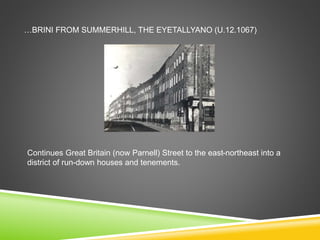
…BRINI FROM SUMMERHILL, THE EYETALLYANO (U.12.1067)
Continues Great Britain (now Parnell) Street to the east-northeast into a
district of run-down houses and tenements.
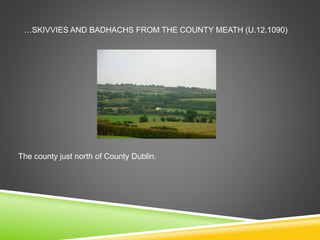
…SKIVVIES AND BADHACHS FROM THE COUNTY MEATH (U.12.1090)
The county just north of County Dublin.
OLD MOTHER HUBBARD WENT TO THE CUPBOARD (U.12.1231)
ļ‚„ https://www.youtube.com/watch?v=JJ5r0t76ETo
ļ‚„ The first line of ā€œOld Mother Hubbard,ā€ a fourteen-stanza nursery
rhyme recorded or composed (c. 1804) by Sarah Catherine Martin
(1768-1826); the first stanza continues: ā€œWent to the cupboard, /
To fetch her poor dog a bone; / But when she came there/ The
cupboard was bare / And so the poor dog had none.ā€
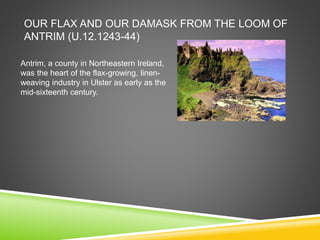
OUR FLAX AND OUR DAMASK FROM THE LOOM OF
ANTRIM (U.12.1243-44)
Antrim, a county in Northeastern Ireland,
was the heart of the flax-growing, linen-
weaving industry in Ulster as early as the
mid-sixteenth century.
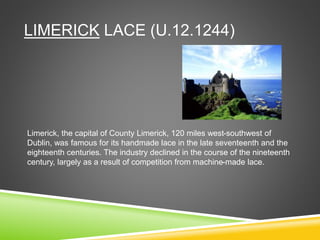
LIMERICK LACE (U.12.1244)
Limerick, the capital of County Limerick, 120 miles west-southwest of
Dublin, was famous for its handmade lace in the late seventeenth and the
eighteenth centuries. The industry declined in the course of the nineteenth
century, largely as a result of competition from machine-made lace.
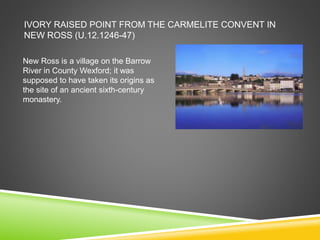
IVORY RAISED POINT FROM THE CARMELITE CONVENT IN
NEW ROSS (U.12.1246-47)
New Ross is a village on the Barrow
River in County Wexford; it was
supposed to have taken its origins as
the site of an ancient sixth-century
monastery.
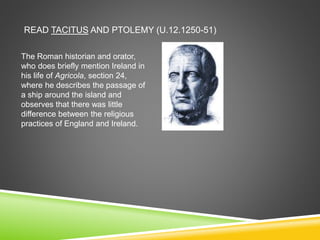
READ TACITUS AND PTOLEMY (U.12.1250-51)
The Roman historian and orator,
who does briefly mention Ireland in
his life of Agricola, section 24,
where he describes the passage of
a ship around the island and
observes that there was little
difference between the religious
practices of England and Ireland.
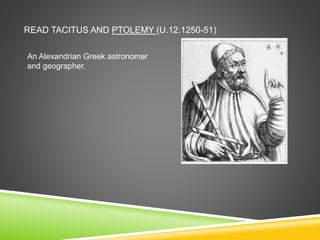
READ TACITUS AND PTOLEMY (U.12.1250-51)
An Alexandrian Greek astronomer
and geographer.
THE FAIR HILLS OF EIRE, O (U.12.1264)
ļ‚„ https://www.youtube.com/watch?v=MwkMol5U9z8
ļ‚„ From a song, ā€œThe Fair Hills of Eire, O,ā€ translated by James
Clarence Mangan from the Irish of Donogh Mac Con-Mara (1738-
1814). The poem begins, ā€œTake a blessing from my heart to the
land of my birth, / And the fair hills of Eire, O!
WOODMAN, SPARE THAT TREE (U.12.1290)
ļ‚„ https://www.youtube.com/watch?v=nwcYPCpIIkY
ļ‚„ An American popular song by George P. Morris and Henry
Russell. The first of its four verses, ā€œWoodman, spare that tree!/
Touch not a single bough/ In youth it shelter’d me/ And I’ll protect
it now/ Twas my forefather’s hand/ That placed it near his cot;/
There, woodman, let it stand/ Thy axe shall harm it not.
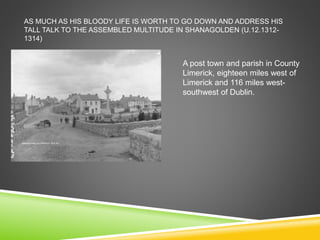
AS MUCH AS HIS BLOODY LIFE IS WORTH TO GO DOWN AND ADDRESS HIS
TALL TALK TO THE ASSEMBLED MULTITUDE IN SHANAGOLDEN (U.12.1312-
1314)
A post town and parish in County
Limerick, eighteen miles west of
Limerick and 116 miles west-
southwest of Dublin.
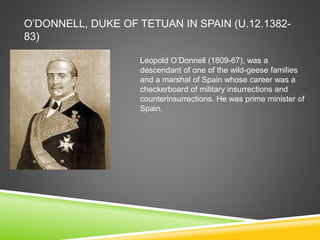
O’DONNELL, DUKE OF TETUAN IN SPAIN (U.12.1382-
83)
Leopold O’Donnell (1809-67), was a
descendant of one of the wild-geese families
and a marshal of Spain whose career was a
checkerboard of military insurrections and
counterinsurrections. He was prime minister of
Spain.
COME WHERE THE BOOSE IS CHEAPER (U.12.1397-98)
ļ‚„ https://www.youtube.com/watch?v=m4q4Mjcs2sc
ļ‚„ A parody, by George Dance of Stephen Foster’s song ā€œCome
Where My Love Lies Dreaming.ā€ Dance’s parody begins: ā€œCome
where the booze is cheaper; / Come where the pots hold more, /
Come where the boss is a deuce of a joss, / Come to the pub next
door.ā€
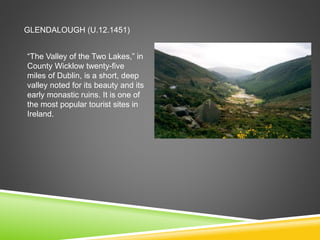
GLENDALOUGH (U.12.1451)
ā€œThe Valley of the Two Lakes,ā€ in
County Wicklow twenty-five
miles of Dublin, is a short, deep
valley noted for its beauty and its
early monastic ruins. It is one of
the most popular tourist sites in
Ireland.
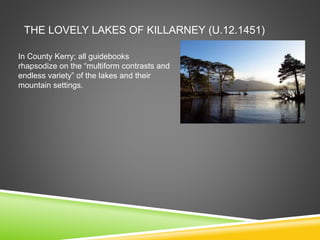
THE LOVELY LAKES OF KILLARNEY (U.12.1451)
In County Kerry; all guidebooks
rhapsodize on the ā€œmultiform contrasts and
endless varietyā€ of the lakes and their
mountain settings.
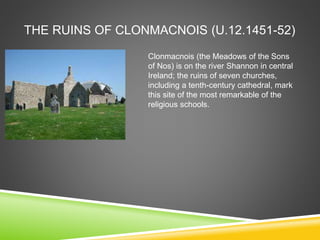
THE RUINS OF CLONMACNOIS (U.12.1451-52)
Clonmacnois (the Meadows of the Sons
of Nos) is on the river Shannon in central
Ireland; the ruins of seven churches,
including a tenth-century cathedral, mark
this site of the most remarkable of the
religious schools.
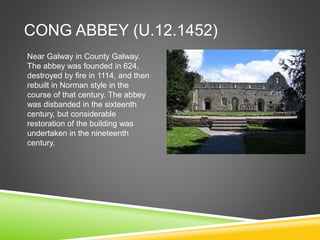
CONG ABBEY (U.12.1452)
Near Galway in County Galway.
The abbey was founded in 624,
destroyed by fire in 1114, and then
rebuilt in Norman style in the
course of that century. The abbey
was disbanded in the sixteenth
century, but considerable
restoration of the building was
undertaken in the nineteenth
century.
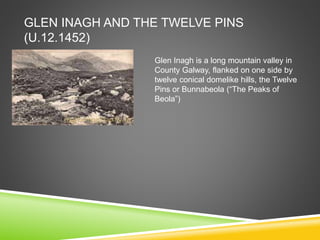
GLEN INAGH AND THE TWELVE PINS
(U.12.1452)
Glen Inagh is a long mountain valley in
County Galway, flanked on one side by
twelve conical domelike hills, the Twelve
Pins or Bunnabeola (ā€œThe Peaks of
Beolaā€)
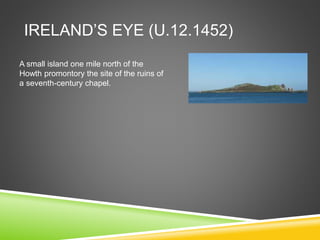
IRELAND’S EYE (U.12.1452)
A small island one mile north of the
Howth promontory the site of the ruins of
a seventh-century chapel.
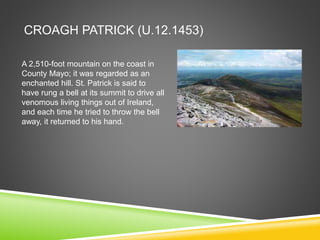
CROAGH PATRICK (U.12.1453)
A 2,510-foot mountain on the coast in
County Mayo; it was regarded as an
enchanted hill. St. Patrick is said to
have rung a bell at its summit to drive all
venomous living things out of Ireland,
and each time he tried to throw the bell
away, it returned to his hand.
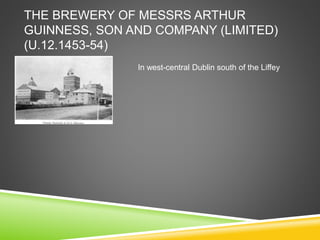
THE BREWERY OF MESSRS ARTHUR
GUINNESS, SON AND COMPANY (LIMITED)
(U.12.1453-54)
In west-central Dublin south of the Liffey
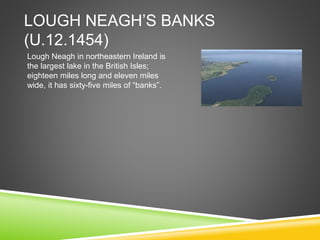
LOUGH NEAGH’S BANKS
(U.12.1454)
Lough Neagh in northeastern Ireland is
the largest lake in the British Isles;
eighteen miles long and eleven miles
wide, it has sixty-five miles of ā€œbanksā€.
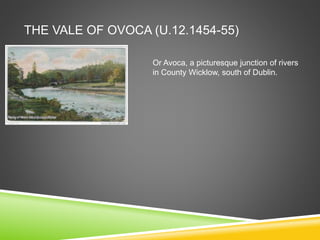
THE VALE OF OVOCA (U.12.1454-55)
Or Avoca, a picturesque junction of rivers
in County Wicklow, south of Dublin.
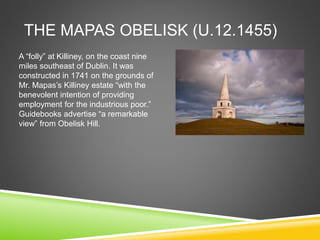
THE MAPAS OBELISK (U.12.1455)
A ā€œfollyā€ at Killiney, on the coast nine
miles southeast of Dublin. It was
constructed in 1741 on the grounds of
Mr. Mapas’s Killiney estate ā€œwith the
benevolent intention of providing
employment for the industrious poor.ā€
Guidebooks advertise ā€œa remarkable
viewā€ from Obelisk Hill.
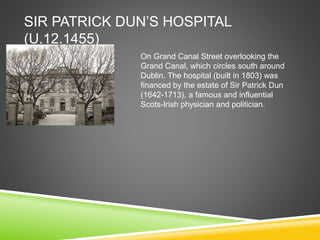
SIR PATRICK DUN’S HOSPITAL
(U.12.1455)
On Grand Canal Street overlooking the
Grand Canal, which circles south around
Dublin. The hospital (built in 1803) was
financed by the estate of Sir Patrick Dun
(1642-1713), a famous and influential
Scots-Irish physician and politician.
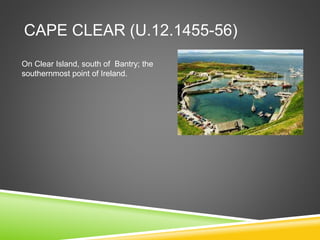
CAPE CLEAR (U.12.1455-56)
On Clear Island, south of Bantry; the
southernmost point of Ireland.
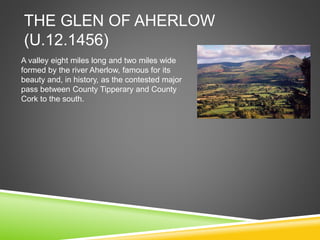
THE GLEN OF AHERLOW
(U.12.1456)
A valley eight miles long and two miles wide
formed by the river Aherlow, famous for its
beauty and, in history, as the contested major
pass between County Tipperary and County
Cork to the south.
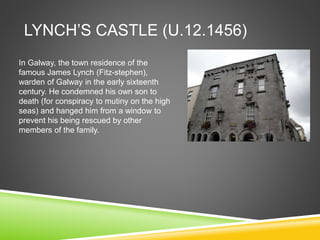
LYNCH’S CASTLE (U.12.1456)
In Galway, the town residence of the
famous James Lynch (Fitz-stephen),
warden of Galway in the early sixteenth
century. He condemned his own son to
death (for conspiracy to mutiny on the high
seas) and hanged him from a window to
prevent his being rescued by other
members of the family.
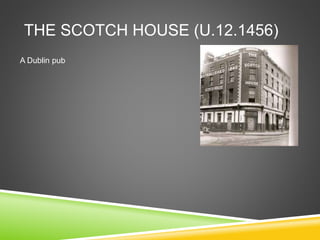
THE SCOTCH HOUSE (U.12.1456)
A Dublin pub
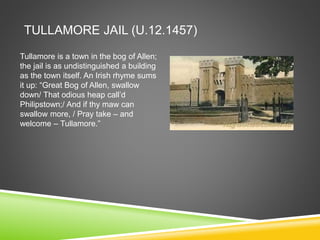
TULLAMORE JAIL (U.12.1457)
Tullamore is a town in the bog of Allen;
the jail is as undistinguished a building
as the town itself. An Irish rhyme sums
it up: ā€œGreat Bog of Allen, swallow
down/ That odious heap call’d
Philipstown;/ And if thy maw can
swallow more, / Pray take – and
welcome – Tullamore.ā€
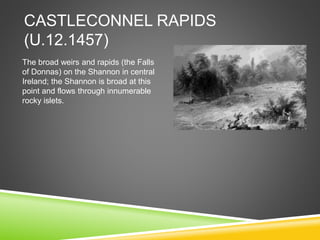
CASTLECONNEL RAPIDS
(U.12.1457)
The broad weirs and rapids (the Falls
of Donnas) on the Shannon in central
Ireland; the Shannon is broad at this
point and flows through innumerable
rocky islets.
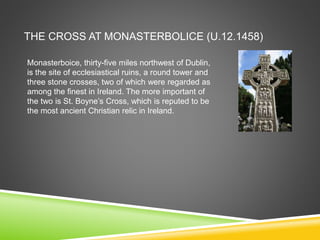
THE CROSS AT MONASTERBOLICE (U.12.1458)
Monasterboice, thirty-five miles northwest of Dublin,
is the site of ecclesiastical ruins, a round tower and
three stone crosses, two of which were regarded as
among the finest in Ireland. The more important of
the two is St. Boyne’s Cross, which is reputed to be
the most ancient Christian relic in Ireland.
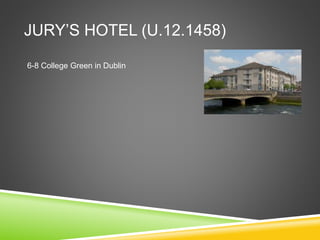
JURY’S HOTEL (U.12.1458)
6-8 College Green in Dublin
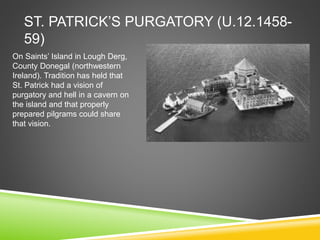
ST. PATRICK’S PURGATORY (U.12.1458-
59)
On Saints’ Island in Lough Derg,
County Donegal (northwestern
Ireland). Tradition has held that
St. Patrick had a vision of
purgatory and hell in a cavern on
the island and that properly
prepared pilgrams could share
that vision.
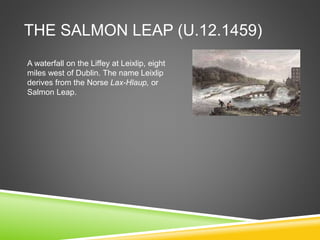
THE SALMON LEAP (U.12.1459)
A waterfall on the Liffey at Leixlip, eight
miles west of Dublin. The name Leixlip
derives from the Norse Lax-Hlaup, or
Salmon Leap.
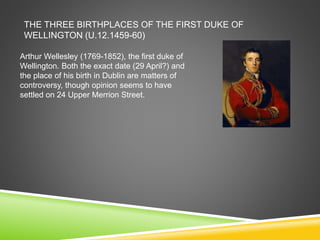
THE THREE BIRTHPLACES OF THE FIRST DUKE OF
WELLINGTON (U.12.1459-60)
Arthur Wellesley (1769-1852), the first duke of
Wellington. Both the exact date (29 April?) and
the place of his birth in Dublin are matters of
controversy, though opinion seems to have
settled on 24 Upper Merrion Street.
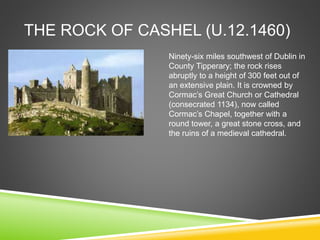
THE ROCK OF CASHEL (U.12.1460)
Ninety-six miles southwest of Dublin in
County Tipperary; the rock rises
abruptly to a height of 300 feet out of
an extensive plain. It is crowned by
Cormac’s Great Church or Cathedral
(consecrated 1134), now called
Cormac’s Chapel, together with a
round tower, a great stone cross, and
the ruins of a medieval cathedral.
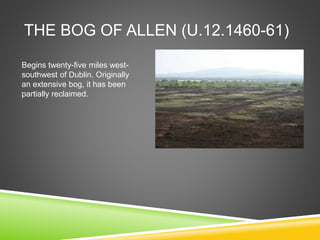
THE BOG OF ALLEN (U.12.1460-61)
Begins twenty-five miles west-
southwest of Dublin. Originally
an extensive bog, it has been
partially reclaimed.
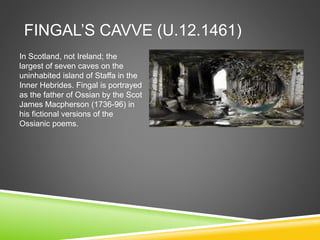
FINGAL’S CAVVE (U.12.1461)
In Scotland, not Ireland; the
largest of seven caves on the
uninhabited island of Staffa in the
Inner Hebrides. Fingal is portrayed
as the father of Ossian by the Scot
James Macpherson (1736-96) in
his fictional versions of the
Ossianic poems.
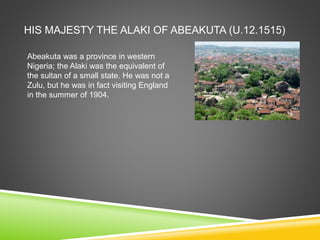
HIS MAJESTY THE ALAKI OF ABEAKUTA (U.12.1515)
Abeakuta was a province in western
Nigeria; the Alaki was the equivalent of
the sultan of a small state. He was not a
Zulu, but he was in fact visiting England
in the summer of 1904.
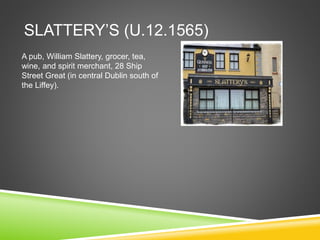
SLATTERY’S (U.12.1565)
A pub, William Slattery, grocer, tea,
wine, and spirit merchant, 28 Ship
Street Great (in central Dublin south of
the Liffey).
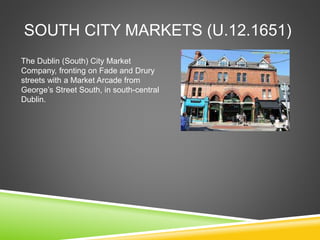
SOUTH CITY MARKETS (U.12.1651)
The Dublin (South) City Market
Company, fronting on Fade and Drury
streets with a Market Arcade from
George’s Street South, in south-central
Dublin.
IF THE MAN IN THE MOON WAS A JEW, JEW, JEW (U.12.1801)
ļ‚„ https://www.youtube.com/watch?v=neEnhgBDVlM
ļ‚„ After the American popular song ā€œIf the Man in the Moon were a
Coonā€ (1905), by Fred Fisher. Chorus: ā€œIf the man in the moon
were a coon, coon, coon/ What would you do?/ He would fade
with his shade the silv’ry moon, moon, moon/ Away from you./ No
roaming ā€˜round the park in the bright moonlight, / If the man in the
moon were a coon, coon, coon
COME BACK TO ERIN (U.12.1828)
ļ‚„ https://www.youtube.com/watch?v=gThS3qOaHnU
ļ‚„ A song by the English ballad composer ā€œClaribel,ā€ Mrs. Charlotte
Allington Barnard (1830-69). ā€œCome back to Erin, Mavourneen,
Mavourneen,/ Come back, Aroon, to the land of thy birth: / Come
with the shamrocks and springtime, Mavourneen, / And its
Killarney shall ring with our mirth. / Sure when we lent you to
beautiful England, / Little we thought of the long winter days, /
Little we thought of the hush of the starshine, / Over the
mountains, the hills, and the braes.ā€
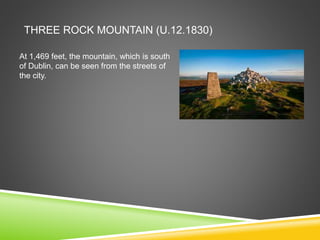
THREE ROCK MOUNTAIN (U.12.1830)
At 1,469 feet, the mountain, which is south
of Dublin, can be seen from the streets of
the city.
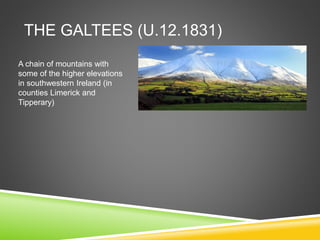
THE GALTEES (U.12.1831)
A chain of mountains with
some of the higher elevations
in southwestern Ireland (in
counties Limerick and
Tipperary)
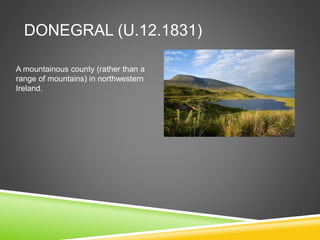
DONEGRAL (U.12.1831)
A mountainous county (rather than a
range of mountains) in northwestern
Ireland.
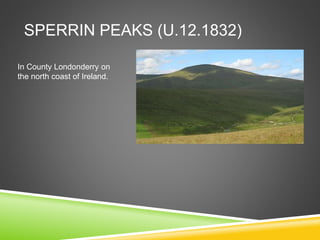
SPERRIN PEAKS (U.12.1832)
In County Londonderry on
the north coast of Ireland.
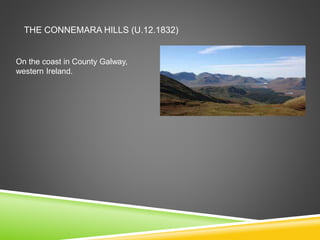
THE CONNEMARA HILLS (U.12.1832)
On the coast in County Galway,
western Ireland.
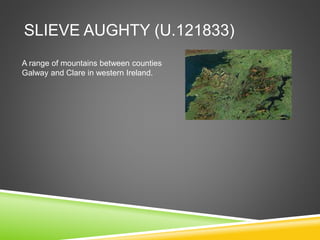
SLIEVE AUGHTY (U.121833)
A range of mountains between counties
Galway and Clare in western Ireland.
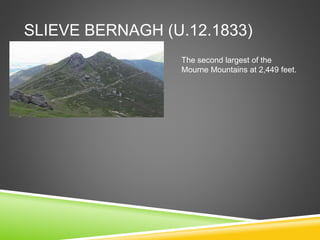
SLIEVE BERNAGH (U.12.1833)
The second largest of the
Mourne Mountains at 2,449 feet.
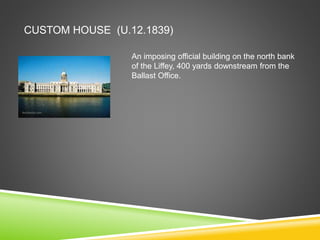
CUSTOM HOUSE (U.12.1839)
An imposing official building on the north bank
of the Liffey, 400 yards downstream from the
Ballast Office.
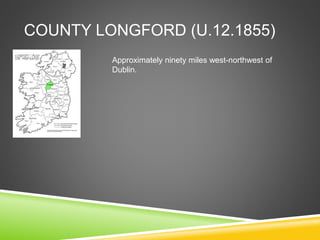
COUNTY LONGFORD (U.12.1855)
Approximately ninety miles west-northwest of
Dublin.
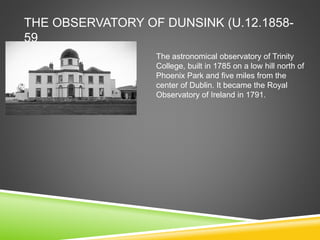
THE OBSERVATORY OF DUNSINK (U.12.1858-
59
The astronomical observatory of Trinity
College, built in 1785 on a low hill north of
Phoenix Park and five miles from the
center of Dublin. It became the Royal
Observatory of Ireland in 1791.
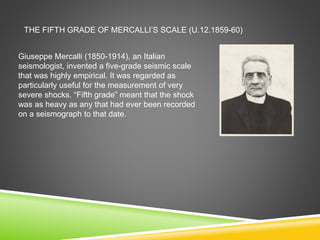
THE FIFTH GRADE OF MERCALLI’S SCALE (U.12.1859-60)
Giuseppe Mercalli (1850-1914), an Italian
seismologist, invented a five-grade seismic scale
that was highly empirical. It was regarded as
particularly useful for the measurement of very
severe shocks. ā€œFifth gradeā€ meant that the shock
was as heavy as any that had ever been recorded
on a seismograph to that date.
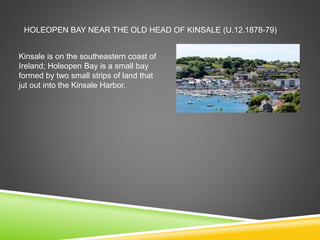
HOLEOPEN BAY NEAR THE OLD HEAD OF KINSALE (U.12.1878-79)
Kinsale is on the southeastern coast of
Ireland; Holeopen Bay is a small bay
formed by two small strips of land that
jut out into the Kinsale Harbor.

Cyclops Part 2

  • 1.
  • 2.
    THE TOOTLE ONTHE FLUTE (U.12.997-98) ļ‚„ https://www.youtube.com/watch?v=MTFMkD8nI-Y ļ‚„ From the song ā€œPhil the Fluter’s Ball,ā€ by Percy French. Chorus: ā€œWith a tootle of the flute/ And a twiddle of the fiddle –oh/ Dancin’ up the middle like a herrin’ on the griddle - / up! Down! Hands around! Crossin’ to the wall,/ oh, hadn’t we the gaiety at Phil the Fluter’s ball.ā€
  • 3.
    …BRINI FROM SUMMERHILL,THE EYETALLYANO (U.12.1067) Continues Great Britain (now Parnell) Street to the east-northeast into a district of run-down houses and tenements.
  • 4.
    …SKIVVIES AND BADHACHSFROM THE COUNTY MEATH (U.12.1090) The county just north of County Dublin.
  • 5.
    OLD MOTHER HUBBARDWENT TO THE CUPBOARD (U.12.1231) ļ‚„ https://www.youtube.com/watch?v=JJ5r0t76ETo ļ‚„ The first line of ā€œOld Mother Hubbard,ā€ a fourteen-stanza nursery rhyme recorded or composed (c. 1804) by Sarah Catherine Martin (1768-1826); the first stanza continues: ā€œWent to the cupboard, / To fetch her poor dog a bone; / But when she came there/ The cupboard was bare / And so the poor dog had none.ā€
  • 6.
    OUR FLAX ANDOUR DAMASK FROM THE LOOM OF ANTRIM (U.12.1243-44) Antrim, a county in Northeastern Ireland, was the heart of the flax-growing, linen- weaving industry in Ulster as early as the mid-sixteenth century.
  • 7.
    LIMERICK LACE (U.12.1244) Limerick,the capital of County Limerick, 120 miles west-southwest of Dublin, was famous for its handmade lace in the late seventeenth and the eighteenth centuries. The industry declined in the course of the nineteenth century, largely as a result of competition from machine-made lace.
  • 8.
    IVORY RAISED POINTFROM THE CARMELITE CONVENT IN NEW ROSS (U.12.1246-47) New Ross is a village on the Barrow River in County Wexford; it was supposed to have taken its origins as the site of an ancient sixth-century monastery.
  • 9.
    READ TACITUS ANDPTOLEMY (U.12.1250-51) The Roman historian and orator, who does briefly mention Ireland in his life of Agricola, section 24, where he describes the passage of a ship around the island and observes that there was little difference between the religious practices of England and Ireland.
  • 11.
    READ TACITUS ANDPTOLEMY (U.12.1250-51) An Alexandrian Greek astronomer and geographer.
  • 12.
    THE FAIR HILLSOF EIRE, O (U.12.1264) ļ‚„ https://www.youtube.com/watch?v=MwkMol5U9z8 ļ‚„ From a song, ā€œThe Fair Hills of Eire, O,ā€ translated by James Clarence Mangan from the Irish of Donogh Mac Con-Mara (1738- 1814). The poem begins, ā€œTake a blessing from my heart to the land of my birth, / And the fair hills of Eire, O!
  • 13.
    WOODMAN, SPARE THATTREE (U.12.1290) ļ‚„ https://www.youtube.com/watch?v=nwcYPCpIIkY ļ‚„ An American popular song by George P. Morris and Henry Russell. The first of its four verses, ā€œWoodman, spare that tree!/ Touch not a single bough/ In youth it shelter’d me/ And I’ll protect it now/ Twas my forefather’s hand/ That placed it near his cot;/ There, woodman, let it stand/ Thy axe shall harm it not.
  • 14.
    AS MUCH ASHIS BLOODY LIFE IS WORTH TO GO DOWN AND ADDRESS HIS TALL TALK TO THE ASSEMBLED MULTITUDE IN SHANAGOLDEN (U.12.1312- 1314) A post town and parish in County Limerick, eighteen miles west of Limerick and 116 miles west- southwest of Dublin.
  • 15.
    O’DONNELL, DUKE OFTETUAN IN SPAIN (U.12.1382- 83) Leopold O’Donnell (1809-67), was a descendant of one of the wild-geese families and a marshal of Spain whose career was a checkerboard of military insurrections and counterinsurrections. He was prime minister of Spain.
  • 16.
    COME WHERE THEBOOSE IS CHEAPER (U.12.1397-98) ļ‚„ https://www.youtube.com/watch?v=m4q4Mjcs2sc ļ‚„ A parody, by George Dance of Stephen Foster’s song ā€œCome Where My Love Lies Dreaming.ā€ Dance’s parody begins: ā€œCome where the booze is cheaper; / Come where the pots hold more, / Come where the boss is a deuce of a joss, / Come to the pub next door.ā€
  • 17.
    GLENDALOUGH (U.12.1451) ā€œThe Valleyof the Two Lakes,ā€ in County Wicklow twenty-five miles of Dublin, is a short, deep valley noted for its beauty and its early monastic ruins. It is one of the most popular tourist sites in Ireland.
  • 18.
    THE LOVELY LAKESOF KILLARNEY (U.12.1451) In County Kerry; all guidebooks rhapsodize on the ā€œmultiform contrasts and endless varietyā€ of the lakes and their mountain settings.
  • 19.
    THE RUINS OFCLONMACNOIS (U.12.1451-52) Clonmacnois (the Meadows of the Sons of Nos) is on the river Shannon in central Ireland; the ruins of seven churches, including a tenth-century cathedral, mark this site of the most remarkable of the religious schools.
  • 20.
    CONG ABBEY (U.12.1452) NearGalway in County Galway. The abbey was founded in 624, destroyed by fire in 1114, and then rebuilt in Norman style in the course of that century. The abbey was disbanded in the sixteenth century, but considerable restoration of the building was undertaken in the nineteenth century.
  • 21.
    GLEN INAGH ANDTHE TWELVE PINS (U.12.1452) Glen Inagh is a long mountain valley in County Galway, flanked on one side by twelve conical domelike hills, the Twelve Pins or Bunnabeola (ā€œThe Peaks of Beolaā€)
  • 22.
    IRELAND’S EYE (U.12.1452) Asmall island one mile north of the Howth promontory the site of the ruins of a seventh-century chapel.
  • 23.
    CROAGH PATRICK (U.12.1453) A2,510-foot mountain on the coast in County Mayo; it was regarded as an enchanted hill. St. Patrick is said to have rung a bell at its summit to drive all venomous living things out of Ireland, and each time he tried to throw the bell away, it returned to his hand.
  • 24.
    THE BREWERY OFMESSRS ARTHUR GUINNESS, SON AND COMPANY (LIMITED) (U.12.1453-54) In west-central Dublin south of the Liffey
  • 25.
    LOUGH NEAGH’S BANKS (U.12.1454) LoughNeagh in northeastern Ireland is the largest lake in the British Isles; eighteen miles long and eleven miles wide, it has sixty-five miles of ā€œbanksā€.
  • 26.
    THE VALE OFOVOCA (U.12.1454-55) Or Avoca, a picturesque junction of rivers in County Wicklow, south of Dublin.
  • 27.
    THE MAPAS OBELISK(U.12.1455) A ā€œfollyā€ at Killiney, on the coast nine miles southeast of Dublin. It was constructed in 1741 on the grounds of Mr. Mapas’s Killiney estate ā€œwith the benevolent intention of providing employment for the industrious poor.ā€ Guidebooks advertise ā€œa remarkable viewā€ from Obelisk Hill.
  • 28.
    SIR PATRICK DUN’SHOSPITAL (U.12.1455) On Grand Canal Street overlooking the Grand Canal, which circles south around Dublin. The hospital (built in 1803) was financed by the estate of Sir Patrick Dun (1642-1713), a famous and influential Scots-Irish physician and politician.
  • 29.
    CAPE CLEAR (U.12.1455-56) OnClear Island, south of Bantry; the southernmost point of Ireland.
  • 30.
    THE GLEN OFAHERLOW (U.12.1456) A valley eight miles long and two miles wide formed by the river Aherlow, famous for its beauty and, in history, as the contested major pass between County Tipperary and County Cork to the south.
  • 31.
    LYNCH’S CASTLE (U.12.1456) InGalway, the town residence of the famous James Lynch (Fitz-stephen), warden of Galway in the early sixteenth century. He condemned his own son to death (for conspiracy to mutiny on the high seas) and hanged him from a window to prevent his being rescued by other members of the family.
  • 32.
    THE SCOTCH HOUSE(U.12.1456) A Dublin pub
  • 33.
    TULLAMORE JAIL (U.12.1457) Tullamoreis a town in the bog of Allen; the jail is as undistinguished a building as the town itself. An Irish rhyme sums it up: ā€œGreat Bog of Allen, swallow down/ That odious heap call’d Philipstown;/ And if thy maw can swallow more, / Pray take – and welcome – Tullamore.ā€
  • 34.
    CASTLECONNEL RAPIDS (U.12.1457) The broadweirs and rapids (the Falls of Donnas) on the Shannon in central Ireland; the Shannon is broad at this point and flows through innumerable rocky islets.
  • 35.
    THE CROSS ATMONASTERBOLICE (U.12.1458) Monasterboice, thirty-five miles northwest of Dublin, is the site of ecclesiastical ruins, a round tower and three stone crosses, two of which were regarded as among the finest in Ireland. The more important of the two is St. Boyne’s Cross, which is reputed to be the most ancient Christian relic in Ireland.
  • 36.
    JURY’S HOTEL (U.12.1458) 6-8College Green in Dublin
  • 37.
    ST. PATRICK’S PURGATORY(U.12.1458- 59) On Saints’ Island in Lough Derg, County Donegal (northwestern Ireland). Tradition has held that St. Patrick had a vision of purgatory and hell in a cavern on the island and that properly prepared pilgrams could share that vision.
  • 38.
    THE SALMON LEAP(U.12.1459) A waterfall on the Liffey at Leixlip, eight miles west of Dublin. The name Leixlip derives from the Norse Lax-Hlaup, or Salmon Leap.
  • 39.
    THE THREE BIRTHPLACESOF THE FIRST DUKE OF WELLINGTON (U.12.1459-60) Arthur Wellesley (1769-1852), the first duke of Wellington. Both the exact date (29 April?) and the place of his birth in Dublin are matters of controversy, though opinion seems to have settled on 24 Upper Merrion Street.
  • 40.
    THE ROCK OFCASHEL (U.12.1460) Ninety-six miles southwest of Dublin in County Tipperary; the rock rises abruptly to a height of 300 feet out of an extensive plain. It is crowned by Cormac’s Great Church or Cathedral (consecrated 1134), now called Cormac’s Chapel, together with a round tower, a great stone cross, and the ruins of a medieval cathedral.
  • 41.
    THE BOG OFALLEN (U.12.1460-61) Begins twenty-five miles west- southwest of Dublin. Originally an extensive bog, it has been partially reclaimed.
  • 42.
    FINGAL’S CAVVE (U.12.1461) InScotland, not Ireland; the largest of seven caves on the uninhabited island of Staffa in the Inner Hebrides. Fingal is portrayed as the father of Ossian by the Scot James Macpherson (1736-96) in his fictional versions of the Ossianic poems.
  • 43.
    HIS MAJESTY THEALAKI OF ABEAKUTA (U.12.1515) Abeakuta was a province in western Nigeria; the Alaki was the equivalent of the sultan of a small state. He was not a Zulu, but he was in fact visiting England in the summer of 1904.
  • 44.
    SLATTERY’S (U.12.1565) A pub,William Slattery, grocer, tea, wine, and spirit merchant, 28 Ship Street Great (in central Dublin south of the Liffey).
  • 45.
    SOUTH CITY MARKETS(U.12.1651) The Dublin (South) City Market Company, fronting on Fade and Drury streets with a Market Arcade from George’s Street South, in south-central Dublin.
  • 46.
    IF THE MANIN THE MOON WAS A JEW, JEW, JEW (U.12.1801) ļ‚„ https://www.youtube.com/watch?v=neEnhgBDVlM ļ‚„ After the American popular song ā€œIf the Man in the Moon were a Coonā€ (1905), by Fred Fisher. Chorus: ā€œIf the man in the moon were a coon, coon, coon/ What would you do?/ He would fade with his shade the silv’ry moon, moon, moon/ Away from you./ No roaming ā€˜round the park in the bright moonlight, / If the man in the moon were a coon, coon, coon
  • 47.
    COME BACK TOERIN (U.12.1828) ļ‚„ https://www.youtube.com/watch?v=gThS3qOaHnU ļ‚„ A song by the English ballad composer ā€œClaribel,ā€ Mrs. Charlotte Allington Barnard (1830-69). ā€œCome back to Erin, Mavourneen, Mavourneen,/ Come back, Aroon, to the land of thy birth: / Come with the shamrocks and springtime, Mavourneen, / And its Killarney shall ring with our mirth. / Sure when we lent you to beautiful England, / Little we thought of the long winter days, / Little we thought of the hush of the starshine, / Over the mountains, the hills, and the braes.ā€
  • 48.
    THREE ROCK MOUNTAIN(U.12.1830) At 1,469 feet, the mountain, which is south of Dublin, can be seen from the streets of the city.
  • 49.
    THE GALTEES (U.12.1831) Achain of mountains with some of the higher elevations in southwestern Ireland (in counties Limerick and Tipperary)
  • 50.
    DONEGRAL (U.12.1831) A mountainouscounty (rather than a range of mountains) in northwestern Ireland.
  • 51.
    SPERRIN PEAKS (U.12.1832) InCounty Londonderry on the north coast of Ireland.
  • 52.
    THE CONNEMARA HILLS(U.12.1832) On the coast in County Galway, western Ireland.
  • 53.
    SLIEVE AUGHTY (U.121833) Arange of mountains between counties Galway and Clare in western Ireland.
  • 54.
    SLIEVE BERNAGH (U.12.1833) Thesecond largest of the Mourne Mountains at 2,449 feet.
  • 55.
    CUSTOM HOUSE (U.12.1839) Animposing official building on the north bank of the Liffey, 400 yards downstream from the Ballast Office.
  • 56.
    COUNTY LONGFORD (U.12.1855) Approximatelyninety miles west-northwest of Dublin.
  • 57.
    THE OBSERVATORY OFDUNSINK (U.12.1858- 59 The astronomical observatory of Trinity College, built in 1785 on a low hill north of Phoenix Park and five miles from the center of Dublin. It became the Royal Observatory of Ireland in 1791.
  • 58.
    THE FIFTH GRADEOF MERCALLI’S SCALE (U.12.1859-60) Giuseppe Mercalli (1850-1914), an Italian seismologist, invented a five-grade seismic scale that was highly empirical. It was regarded as particularly useful for the measurement of very severe shocks. ā€œFifth gradeā€ meant that the shock was as heavy as any that had ever been recorded on a seismograph to that date.
  • 59.
    HOLEOPEN BAY NEARTHE OLD HEAD OF KINSALE (U.12.1878-79) Kinsale is on the southeastern coast of Ireland; Holeopen Bay is a small bay formed by two small strips of land that jut out into the Kinsale Harbor.