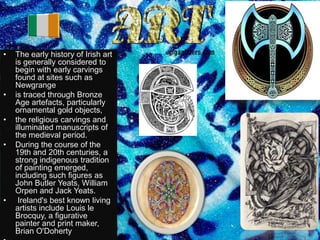
•   The early history of Irish art
    is generally considered to
    begin with early carvings
    found at sites such as
    Newgrange
•   is traced through Bronze
    Age artefacts, particularly
    ornamental gold objects,
•   the religious carvings and
    illuminated manuscripts of
    the medieval period.
•   During the course of the
    19th and 20th centuries, a
    strong indigenous tradition
    of painting emerged,
    including such figures as
    John Butler Yeats, William
    Orpen and Jack Yeats.
•    Ireland's best known living
    artists include Louis le
    Brocquy, a figurative
    painter and print maker,
    Brian O'Doherty
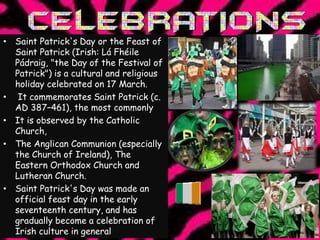
• Saint Patrick's Day or the Feast of
  Saint Patrick (Irish: Lá Fhéile
  Pádraig, "the Day of the Festival of
  Patrick") is a cultural and religious
  holiday celebrated on 17 March.
• It commemorates Saint Patrick (c.
  AD 387–461), the most commonly
• It is observed by the Catholic
  Church,
• The Anglican Communion (especially
  the Church of Ireland), The
  Eastern Orthodox Church and
  Lutheran Church.
• Saint Patrick's Day was made an
  official feast day in the early
  seventeenth century, and has
  gradually become a celebration of
  Irish culture in general
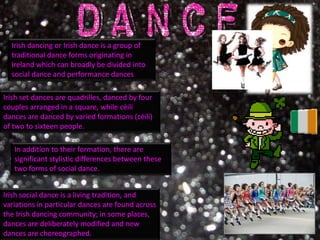
Irish dancing or Irish dance is a group of
  traditional dance forms originating in
  Ireland which can broadly be divided into
  social dance and performance dances

Irish set dances are quadrilles, danced by four
couples arranged in a square, while céilí
dances are danced by varied formations (céilí)
of two to sixteen people.

   In addition to their formation, there are
   significant stylistic differences between these
   two forms of social dance.


Irish social dance is a living tradition, and
variations in particular dances are found across
the Irish dancing community; in some places,
dances are deliberately modified and new
dances are choreographed.
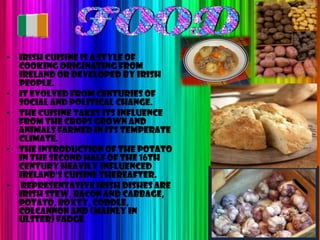
• Irish cuisine is a style of
  cooking originating from
  Ireland or developed by Irish
  people.
• It evolved from centuries of
  social and political change.
• The cuisine takes its influence
  from the crops grown and
  animals farmed in its temperate
  climate.
• The introduction of the potato
  in the second half of the 16th
  century heavily influenced
  Ireland's cuisine thereafter.
• Representative Irish dishes are
  Irish stew, bacon and cabbage,
  potato, boxty, coddle,
  colcannon and (mainly in
  Ulster) fadge.
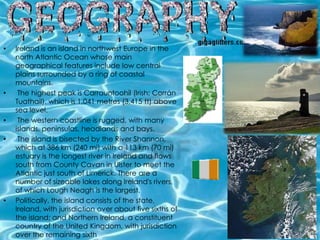
•   Ireland is an island in northwest Europe in the
    north Atlantic Ocean whose main
    geographical features include low central
    plains surrounded by a ring of coastal
    mountains.
•    The highest peak is Carrauntoohil (Irish: Corrán
    Tuathail), which is 1,041 metres (3,415 ft) above
    sea level.
•    The western coastline is rugged, with many
    islands, peninsulas, headlands and bays.
•    The island is bisected by the River Shannon,
    which at 386 km (240 mi) with a 113 km (70 mi)
    estuary is the longest river in Ireland and flows
    south from County Cavan in Ulster to meet the
    Atlantic just south of Limerick. There are a
    number of sizeable lakes along Ireland's rivers,
    of which Lough Neagh is the largest.
•   Politically, the island consists of the state,
    Ireland, with jurisdiction over about five sixths of
    the island; and Northern Ireland, a constituent
    country of the United Kingdom, with jurisdiction
    over the remaining sixth
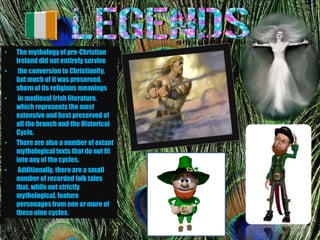
•   The mythology of pre-Christian
    Ireland did not entirely survive
•    the conversion to Christianity,
    but much of it was preserved,
    shorn of its religious meanings
•    in medieval Irish literature,
    which represents the most
    extensive and best preserved of
    all the branch and the Historical
    Cycle.
•   There are also a number of extant
    mythological texts that do not fit
    into any of the cycles.
•    Additionally, there are a small
    number of recorded folk tales
    that, while not strictly
    mythological, feature
    personages from one or more of
    these nine cycles.
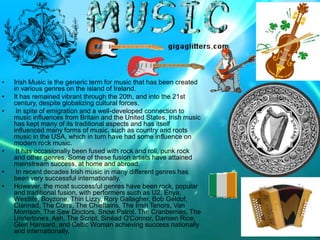
•   Irish Music is the generic term for music that has been created
    in various genres on the island of Ireland.
•   It has remained vibrant through the 20th, and into the 21st
    century, despite globalizing cultural forces.
•    In spite of emigration and a well-developed connection to
    music influences from Britain and the United States, Irish music
    has kept many of its traditional aspects and has itself
    influenced many forms of music, such as country and roots
    music in the USA, which in turn have had some influence on
    modern rock music.
•    It has occasionally been fused with rock and roll, punk rock
    and other genres. Some of these fusion artists have attained
    mainstream success, at home and abroad.
•    In recent decades Irish music in many different genres has
    been very successful internationally.
•   However, the most successful genres have been rock, popular
    and traditional fusion, with performers such as U2, Enya,
    Westlife, Boyzone, Thin Lizzy, Rory Gallagher, Bob Geldof,
    Clannad, The Corrs, The Chieftains, The Irish Tenors, Van
    Morrison, The Saw Doctors, Snow Patrol, The Cranberries, The
    Undertones, Ash, The Script, Sinéad O'Connor, Damien Rice,
    Glen Hansard, and Celtic Woman achieving success nationally
    and internationally.
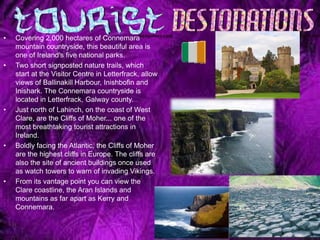
•   Covering 2,000 hectares of Connemara
    mountain countryside, this beautiful area is
    one of Ireland's five national parks.
•   Two short signposted nature trails, which
    start at the Visitor Centre in Letterfrack, allow
    views of Ballinakill Harbour, Inishbofin and
    Inishark. The Connemara countryside is
    located in Letterfrack, Galway county.
•   Just north of Lahinch, on the coast of West
    Clare, are the Cliffs of Moher... one of the
    most breathtaking tourist attractions in
    Ireland.
•   Boldly facing the Atlantic, the Cliffs of Moher
    are the highest cliffs in Europe. The cliffs are
    also the site of ancient buildings once used
    as watch towers to warn of invading Vikings.
•   From its vantage point you can view the
    Clare coastline, the Aran Islands and
    mountains as far apart as Kerry and
    Connemara.

Culture

  • 2.
    The early history of Irish art is generally considered to begin with early carvings found at sites such as Newgrange • is traced through Bronze Age artefacts, particularly ornamental gold objects, • the religious carvings and illuminated manuscripts of the medieval period. • During the course of the 19th and 20th centuries, a strong indigenous tradition of painting emerged, including such figures as John Butler Yeats, William Orpen and Jack Yeats. • Ireland's best known living artists include Louis le Brocquy, a figurative painter and print maker, Brian O'Doherty
  • 3.
    • Saint Patrick'sDay or the Feast of Saint Patrick (Irish: Lá Fhéile Pádraig, "the Day of the Festival of Patrick") is a cultural and religious holiday celebrated on 17 March. • It commemorates Saint Patrick (c. AD 387–461), the most commonly • It is observed by the Catholic Church, • The Anglican Communion (especially the Church of Ireland), The Eastern Orthodox Church and Lutheran Church. • Saint Patrick's Day was made an official feast day in the early seventeenth century, and has gradually become a celebration of Irish culture in general
  • 4.
    Irish dancing orIrish dance is a group of traditional dance forms originating in Ireland which can broadly be divided into social dance and performance dances Irish set dances are quadrilles, danced by four couples arranged in a square, while céilí dances are danced by varied formations (céilí) of two to sixteen people. In addition to their formation, there are significant stylistic differences between these two forms of social dance. Irish social dance is a living tradition, and variations in particular dances are found across the Irish dancing community; in some places, dances are deliberately modified and new dances are choreographed.
  • 5.
    • Irish cuisineis a style of cooking originating from Ireland or developed by Irish people. • It evolved from centuries of social and political change. • The cuisine takes its influence from the crops grown and animals farmed in its temperate climate. • The introduction of the potato in the second half of the 16th century heavily influenced Ireland's cuisine thereafter. • Representative Irish dishes are Irish stew, bacon and cabbage, potato, boxty, coddle, colcannon and (mainly in Ulster) fadge.
  • 6.
    Ireland is an island in northwest Europe in the north Atlantic Ocean whose main geographical features include low central plains surrounded by a ring of coastal mountains. • The highest peak is Carrauntoohil (Irish: Corrán Tuathail), which is 1,041 metres (3,415 ft) above sea level. • The western coastline is rugged, with many islands, peninsulas, headlands and bays. • The island is bisected by the River Shannon, which at 386 km (240 mi) with a 113 km (70 mi) estuary is the longest river in Ireland and flows south from County Cavan in Ulster to meet the Atlantic just south of Limerick. There are a number of sizeable lakes along Ireland's rivers, of which Lough Neagh is the largest. • Politically, the island consists of the state, Ireland, with jurisdiction over about five sixths of the island; and Northern Ireland, a constituent country of the United Kingdom, with jurisdiction over the remaining sixth
  • 7.
    The mythology of pre-Christian Ireland did not entirely survive • the conversion to Christianity, but much of it was preserved, shorn of its religious meanings • in medieval Irish literature, which represents the most extensive and best preserved of all the branch and the Historical Cycle. • There are also a number of extant mythological texts that do not fit into any of the cycles. • Additionally, there are a small number of recorded folk tales that, while not strictly mythological, feature personages from one or more of these nine cycles.
  • 8.
    Irish Music is the generic term for music that has been created in various genres on the island of Ireland. • It has remained vibrant through the 20th, and into the 21st century, despite globalizing cultural forces. • In spite of emigration and a well-developed connection to music influences from Britain and the United States, Irish music has kept many of its traditional aspects and has itself influenced many forms of music, such as country and roots music in the USA, which in turn have had some influence on modern rock music. • It has occasionally been fused with rock and roll, punk rock and other genres. Some of these fusion artists have attained mainstream success, at home and abroad. • In recent decades Irish music in many different genres has been very successful internationally. • However, the most successful genres have been rock, popular and traditional fusion, with performers such as U2, Enya, Westlife, Boyzone, Thin Lizzy, Rory Gallagher, Bob Geldof, Clannad, The Corrs, The Chieftains, The Irish Tenors, Van Morrison, The Saw Doctors, Snow Patrol, The Cranberries, The Undertones, Ash, The Script, Sinéad O'Connor, Damien Rice, Glen Hansard, and Celtic Woman achieving success nationally and internationally.
  • 9.
    Covering 2,000 hectares of Connemara mountain countryside, this beautiful area is one of Ireland's five national parks. • Two short signposted nature trails, which start at the Visitor Centre in Letterfrack, allow views of Ballinakill Harbour, Inishbofin and Inishark. The Connemara countryside is located in Letterfrack, Galway county. • Just north of Lahinch, on the coast of West Clare, are the Cliffs of Moher... one of the most breathtaking tourist attractions in Ireland. • Boldly facing the Atlantic, the Cliffs of Moher are the highest cliffs in Europe. The cliffs are also the site of ancient buildings once used as watch towers to warn of invading Vikings. • From its vantage point you can view the Clare coastline, the Aran Islands and mountains as far apart as Kerry and Connemara.