Our Locality

Tubberclare / Glasson
Index
•
•
•
•
•
•
•
•
•

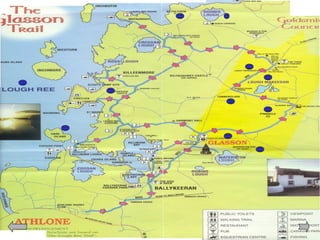
Map
Early Occupation
Early Christianity
The Normans
Waterstown House
Waterstown Ruins
Pigeon House
Glasson
The Old School House

•
•
•
•
•
•
•
•
•

Bethlehem
Goldsmith
Lissoy
The Pinnacle
Killinure
Tubberclair
Modern Glasson
Lough Ree
Bibliography
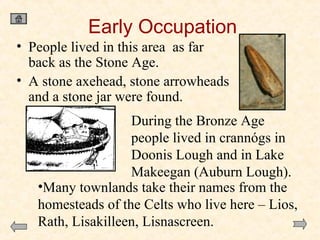
Early Occupation
• People lived in this area as far
back as the Stone Age.
• A stone axehead, stone arrowheads
and a stone jar were found.
During the Bronze Age
people lived in crannógs in
Doonis Lough and in Lake
Makeegan (Auburn Lough).
•Many townlands take their names from the
homesteads of the Celts who live here – Lios,
Rath, Lisakilleen, Lisnascreen.
Early Christianity
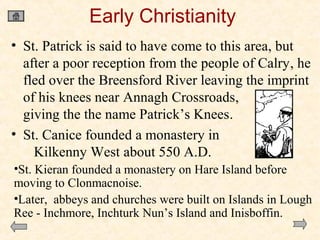
• St. Patrick is said to have come to this area, but
after a poor reception from the people of Calry, he
fled over the Breensford River leaving the imprint
of his knees near Annagh Crossroads,
giving the the name Patrick’s Knees.
• St. Canice founded a monastery in
Kilkenny West about 550 A.D.
•St. Kieran founded a monastery on Hare Island before
moving to Clonmacnoise.
•Later, abbeys and churches were built on Islands in Lough
Ree - Inchmore, Inchturk Nun’s Island and Inisboffin.
The Normans
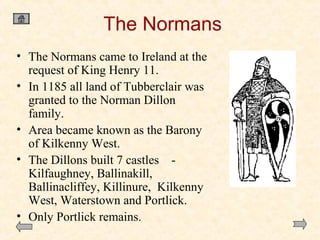
• The Normans came to Ireland at the
request of King Henry 11.
• In 1185 all land of Tubberclair was
granted to the Norman Dillon
family.
• Area became known as the Barony
of Kilkenny West.
• The Dillons built 7 castles Kilfaughney, Ballinakill,
Ballinacliffey, Killinure, Kilkenny
West, Waterstown and Portlick.
• Only Portlick remains.
Waterstown
House
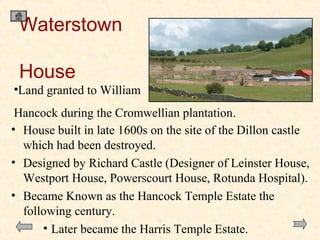
•Land granted to William
Hancock during the Cromwellian plantation.
• House built in late 1600s on the site of the Dillon castle
which had been destroyed.
• Designed by Richard Castle (Designer of Leinster House,
Westport House, Powerscourt House, Rotunda Hospital).
• Became Known as the Hancock Temple Estate the
following century.
• Later became the Harris Temple Estate.
Waterstown Ruins
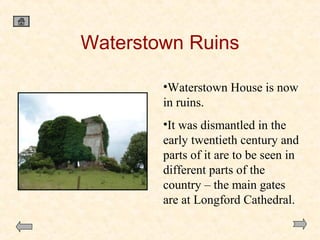
•Waterstown House is now
in ruins.
•It was dismantled in the
early twentieth century and
parts of it are to be seen in
different parts of the
country – the main gates
are at Longford Cathedral.
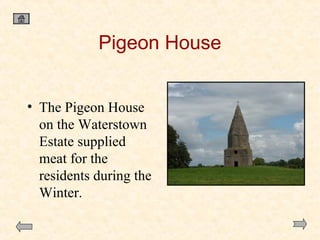
Pigeon House
• The Pigeon House
on the Waterstown
Estate supplied
meat for the
residents during the
Winter.
Glasson
• Glasson takes its name from
the Irish word “Glasan”
which means a streamlet.
• The village was built by the
owners of Waterstown for
its workers,
• An underground tunnel ran
from the village to the
estate.
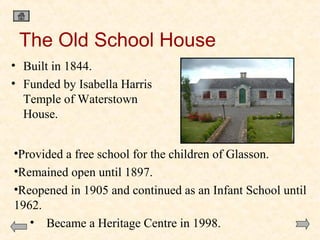
The Old School House
• Built in 1844.
• Funded by Isabella Harris
Temple of Waterstown
House.
•Provided a free school for the children of Glasson.
•Remained open until 1897.
•Reopened in 1905 and continued as an Infant School until
1962.
• Became a Heritage Centre in 1998.
Bethlehem
• Poor Clare Nuns fled from Dublin after their convent
was suppressed in 1630.
• Nuns given protection by their relatives the Dillons.
• Convent built on the shore of Lough Ree in 1631and
called Bethlehem.
• Mother Cecily Dillon was the first Abbess.
• In 1642 the convent was destroyed by English soldiers.
• Nuns fled to Nun’s Island in Lough Ree.
• The soldiers were all murdered at Ballinacliffy Castle.
• The nuns went to Galway city where they founded a
monastery at Nun’s Island.
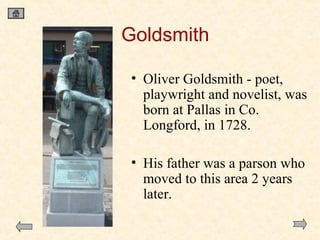
Goldsmith
• Oliver Goldsmith - poet,
playwright and novelist, was
born at Pallas in Co.
Longford, in 1728.
• His father was a parson who
moved to this area 2 years
later.
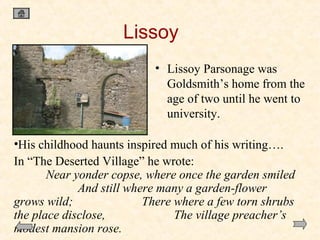
Lissoy
• Lissoy Parsonage was
Goldsmith’s home from the
age of two until he went to
university.
•His childhood haunts inspired much of his writing….
In “The Deserted Village” he wrote:
Near yonder copse, where once the garden smiled
And still where many a garden-flower
grows wild;
There where a few torn shrubs
the place disclose,
The village preacher’s
modest mansion rose.
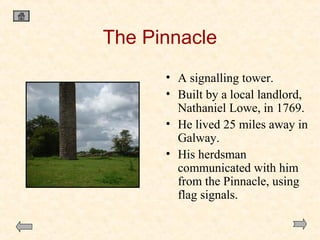
The Pinnacle
• A signalling tower.
• Built by a local landlord,
Nathaniel Lowe, in 1769.
• He lived 25 miles away in
Galway.
• His herdsman
communicated with him
from the Pinnacle, using
flag signals.
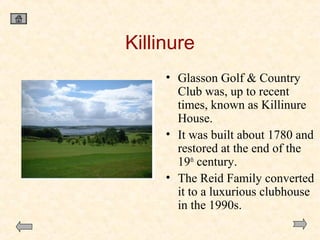
Killinure
• Glasson Golf & Country
Club was, up to recent
times, known as Killinure
House.
• It was built about 1780 and
restored at the end of the
19th century.
• The Reid Family converted
it to a luxurious clubhouse
in the 1990s.
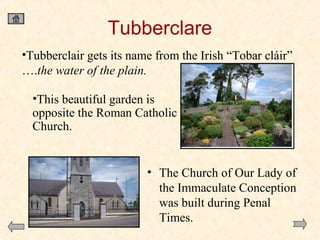
Tubberclare
•Tubberclair gets its name from the Irish “Tobar cláir”
….the water of the plain.
•This beautiful garden is
opposite the Roman Catholic
Church.

• The Church of Our Lady of
the Immaculate Conception
was built during Penal
Times.
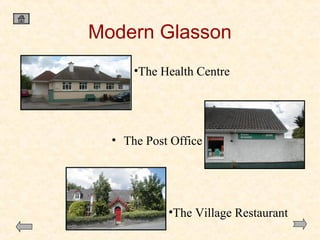
Modern Glasson
•The Health Centre

• The Post Office

•The Village Restaurant
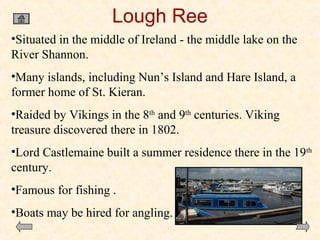
Lough Ree
•Situated in the middle of Ireland - the middle lake on the
River Shannon.
•Many islands, including Nun’s Island and Hare Island, a
former home of St. Kieran.
•Raided by Vikings in the 8th and 9th centuries. Viking
treasure discovered there in 1802.
•Lord Castlemaine built a summer residence there in the 19th
century.
•Famous for fishing .
•Boats may be hired for angling.
Bibliography
• The Glasson Trail - Westmeath Tourism
• The Spring Wells - Fr. Seamus Mulvany

Our locality

  • 1.
  • 3.
    Index • • • • • • • • • Map Early Occupation Early Christianity TheNormans Waterstown House Waterstown Ruins Pigeon House Glasson The Old School House • • • • • • • • • Bethlehem Goldsmith Lissoy The Pinnacle Killinure Tubberclair Modern Glasson Lough Ree Bibliography
  • 4.
    Early Occupation • Peoplelived in this area as far back as the Stone Age. • A stone axehead, stone arrowheads and a stone jar were found. During the Bronze Age people lived in crannógs in Doonis Lough and in Lake Makeegan (Auburn Lough). •Many townlands take their names from the homesteads of the Celts who live here – Lios, Rath, Lisakilleen, Lisnascreen.
  • 5.
    Early Christianity • St.Patrick is said to have come to this area, but after a poor reception from the people of Calry, he fled over the Breensford River leaving the imprint of his knees near Annagh Crossroads, giving the the name Patrick’s Knees. • St. Canice founded a monastery in Kilkenny West about 550 A.D. •St. Kieran founded a monastery on Hare Island before moving to Clonmacnoise. •Later, abbeys and churches were built on Islands in Lough Ree - Inchmore, Inchturk Nun’s Island and Inisboffin.
  • 6.
    The Normans • TheNormans came to Ireland at the request of King Henry 11. • In 1185 all land of Tubberclair was granted to the Norman Dillon family. • Area became known as the Barony of Kilkenny West. • The Dillons built 7 castles Kilfaughney, Ballinakill, Ballinacliffey, Killinure, Kilkenny West, Waterstown and Portlick. • Only Portlick remains.
  • 7.
    Waterstown House •Land granted toWilliam Hancock during the Cromwellian plantation. • House built in late 1600s on the site of the Dillon castle which had been destroyed. • Designed by Richard Castle (Designer of Leinster House, Westport House, Powerscourt House, Rotunda Hospital). • Became Known as the Hancock Temple Estate the following century. • Later became the Harris Temple Estate.
  • 8.
    Waterstown Ruins •Waterstown Houseis now in ruins. •It was dismantled in the early twentieth century and parts of it are to be seen in different parts of the country – the main gates are at Longford Cathedral.
  • 9.
    Pigeon House • ThePigeon House on the Waterstown Estate supplied meat for the residents during the Winter.
  • 10.
    Glasson • Glasson takesits name from the Irish word “Glasan” which means a streamlet. • The village was built by the owners of Waterstown for its workers, • An underground tunnel ran from the village to the estate.
  • 11.
    The Old SchoolHouse • Built in 1844. • Funded by Isabella Harris Temple of Waterstown House. •Provided a free school for the children of Glasson. •Remained open until 1897. •Reopened in 1905 and continued as an Infant School until 1962. • Became a Heritage Centre in 1998.
  • 12.
    Bethlehem • Poor ClareNuns fled from Dublin after their convent was suppressed in 1630. • Nuns given protection by their relatives the Dillons. • Convent built on the shore of Lough Ree in 1631and called Bethlehem. • Mother Cecily Dillon was the first Abbess. • In 1642 the convent was destroyed by English soldiers. • Nuns fled to Nun’s Island in Lough Ree. • The soldiers were all murdered at Ballinacliffy Castle. • The nuns went to Galway city where they founded a monastery at Nun’s Island.
  • 13.
    Goldsmith • Oliver Goldsmith- poet, playwright and novelist, was born at Pallas in Co. Longford, in 1728. • His father was a parson who moved to this area 2 years later.
  • 14.
    Lissoy • Lissoy Parsonagewas Goldsmith’s home from the age of two until he went to university. •His childhood haunts inspired much of his writing…. In “The Deserted Village” he wrote: Near yonder copse, where once the garden smiled And still where many a garden-flower grows wild; There where a few torn shrubs the place disclose, The village preacher’s modest mansion rose.
  • 15.
    The Pinnacle • Asignalling tower. • Built by a local landlord, Nathaniel Lowe, in 1769. • He lived 25 miles away in Galway. • His herdsman communicated with him from the Pinnacle, using flag signals.
  • 16.
    Killinure • Glasson Golf& Country Club was, up to recent times, known as Killinure House. • It was built about 1780 and restored at the end of the 19th century. • The Reid Family converted it to a luxurious clubhouse in the 1990s.
  • 17.
    Tubberclare •Tubberclair gets itsname from the Irish “Tobar cláir” ….the water of the plain. •This beautiful garden is opposite the Roman Catholic Church. • The Church of Our Lady of the Immaculate Conception was built during Penal Times.
  • 18.
    Modern Glasson •The HealthCentre • The Post Office •The Village Restaurant
  • 19.
    Lough Ree •Situated inthe middle of Ireland - the middle lake on the River Shannon. •Many islands, including Nun’s Island and Hare Island, a former home of St. Kieran. •Raided by Vikings in the 8th and 9th centuries. Viking treasure discovered there in 1802. •Lord Castlemaine built a summer residence there in the 19th century. •Famous for fishing . •Boats may be hired for angling.
  • 20.
    Bibliography • The GlassonTrail - Westmeath Tourism • The Spring Wells - Fr. Seamus Mulvany