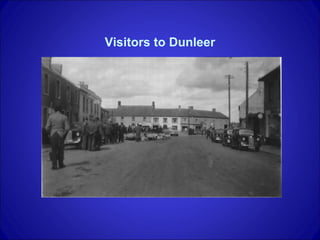
Visitors to Dunleer
William Forster

1784 - 1854

Toured Ireland as a
Quaker Minister in
1813-14.

Member of the British
& Foreign Anti-Slavery
Society.
William Forster

“We came yesterday afternoon to Dunleer where we
appointed a meeting for the evening. It is a small town with
very few Protestants and it was known that a meeting had
been held there before by any Friend. We had a good-sized
room for the purpose. I think I never saw so many persons
assembled with so little appearance of seriousness. They
were principally the poor native Irish. A man was among
them who had been drinking in the house…. After I had
been speaking for a while, this man got up… threatening to
fetch the priest. All was confusion in a moment; the poor
people fled in every direction, both out of the door and the
windows.” Memoirs of William Forster (Quaker) 1865 p.152
Vere Foster

April 25th, 1819 – December 21st, 1900

Diplomat in the British Foreign Office until his
return to Ireland in 1847

Founder of the Belfast School of Art & patron of many
  schools and the Royal Victoria Hospital.

Assisted 25,000 people to start new lives in the
  Americas and spent £100,000 on other charitable
  endeavors while living on £100 per year.
Vere Foster

“It is my intention to stop at Dunleer for a few
   weeks to receive applications. I shall be there all
   day on Sundays, Thursdays and holidays. I intend
   to send about 140 girls and a few boys. Those
   persons will be preferred who are in farm service,
   who have the smallest wages and the best
   recommendations and are the members of the
   largest families, one only out of each family.”

Vere Foster c-1857 (Golden Bridge: Young
  Immigrants to Canada, 1833-1939)
Methodist Review

“We passed through Dunleer, a small
 town in which a fair was being held. The
   spectacle was curious enough.
The goods, vegetables, live-stock &
what-not were disposed around in an
open space, mostly upon the ground.
   Here was a pile of potatoes, and there was a woman with a
   basket of trinkets; in one place, some calves tied together and
   in another a number of pigs in the same condition. A Paddy
   who had bought one of the ‘nice craturs’ was driving him
   home, having a hay-rope tied to his leg, while he walked along
   as orderly as a trained ox. But the scene cannot be described.
   Such a medley of matters & things, discordant and in strange
   juxtaposition, we never looked upon before.” Methodist
   Review 1847 p.625
Henry Grattan

3 July 1746 – 6 June 1820

• Member of pre-1800 Irish House
of Commons.
• Led the movement seeking Irish
legislative independence; ‘Grattan’s
Parliament’ lasted from 1782 to
1800.
• Spent his last 15 years in the British House of
   Commons, fighting for Catholic Emancipation.
Henry Grattan

“I am at Foster’s, at Dunleer. His son and I are at
   College; the family are agreeable, the
   neighborhood social and the country pretty.”

Memoirs of Henry Grattan (p48, 1839)
Reference to Anthony Kearns of Dunleer, aged 25.
Eliakim Littell

2 January 1797 – 17 May 1870

• American editor and founder of the
long-lived periodical Littell’s Living Age (1844-1941)

“I cannot forget our terror on that winter journey to
   Dublin, as we approached Dunleer, whereabouts
   the exploits of a robber named Collier were well-
   known.” The Living Age (1844, p.539)
Sir Walter Scott

15th Aug 1771 – 21st Sep 1832
* Scottish historical novelist, poet
and playwright.

* Famous titles include Ivanhoe,
Rob Roy, The Lady of the Lake,
Waverly, The Heart of Midlothian and The Bride of
   Lammermoor.
Sir Walter Scott

“ An old man at Dunleer having got some pence
  from Anne while the carriage stopt, an older
  woman came forward to sell gooseberries, and
  we, declining these, she added that we might as
  well give her an alms too then, for she was an old
  struggler. Anne thought she said smuggler and
  dreamt of potheen but she meant that she had
  done her best to resist the ‘sea of trouble’,
  whereas her neighbor, the professed mendicant,
  had yielded to the stream too easily.”

(Memoirs of the life of Sir Walter Scott, 1837)
The United Irishmen – Nancy J. Curtin

By the summer of 1792 Defenderism had
become particularly rampant in North
Leinster. In Louth, in December 1792 Defenders
  raided the houses of nearly forty Protestants in a
  quest for arms. Faulkner’s Dublin Journal
  reported that the rebels, ‘infested the road from
  Drogheda to Dunleer stopping passengers for
  arms.’ When seven hundred Defenders paraded
  with arms near Dunleer, Freeman’s Journal
  claimed that they ‘consisted of the lowest
  peasantry of the country.’
Thomas Reid

• 1791 – 1825
• Prison Reformer.
• Surgeon superintendent on convict ships bound
  for Sydney and Hobart.
Thomas Reid

“Having last night taken a place to Drogheda in a coach
   that starts from Dundalk every morning at four, I rose
   early today and at the usual hour the coach set off. The
   first stage to Castlebellingham we got on very well but
   the horses we took from that place could not be kept on
   the road. Several times the coach was near being
   overturned. The driver flogged the poor animals most
   unmercifully. One of them fell down in the street of
   Dunleer, and in a few minutes expired… The peasantry
   of the county of Louth are uncommonly strong, robust
   and healthy, and rather more respectable in their general
   appearance than many of the others I have seen. Their
   clothing is of domestic manufacture chiefly.”
Travels in Ireland in the year 1822, p233. (Thomas Reid)
Sir Richard Hoare, 2nd Baronet

9 Dec 1758 – 19 May 1838

English antiquarian , artist and
archeologist.

Author of Recollections Abroad,
A Classical Tour Through Italy &
Sicily as well as Tour in Ireland.
Sir Richard Hoare, 2nd Baronet

  “Mud cottages as well as the long grey coats
  reappear. The Inn at Dunleer (an old Mansion-
  house) is tolerable.”

Journal of a Tour in Ireland (1806, p.237)
Adam Clarke

1762 – 1832

• British Methodist theoligian and Biblical scholar.
• Author of ‘Commentary on the Bible’ (1831)
Adam Clarke

“Our next stage was Dundalk, ten Irish miles from
  Dunleer. On the way we saw a poor decent woman
  with a child, endeavoring to induce a shark of a carr-
  man to carry her and her child into Dundalk which he
  refused to do under ten penny pieces and a glass of
  whiskey.”

An Account of the Infancy, Religious & Literary Life of
  Adam Clarke. (Volume 2, 1833)
Thomas Kitson Cromwell

1792 – 1870
• English dissenting minister & antiquary.
• Fellow of the Society of Antiquaries of London.
• Author of:
 - Excursions Through Ireland
 - Walks Through Islington
 - The Soul and The Future Life
Thomas Kitson Cromwell

“Dunleer, much decayed from its former consequence, is
  situated on a streamlet flowing into the River Dee… Most of
  the inhabitants of this village and its vicinity speak English
  but they prefer the Irish for domestic intercourse. The
  children almost universally in this neighbourhood
  understand English and are always able to explain and
  interpret to strangers when their parents are unaquainted
  with it. In their style of dress, the peasantry of this part of
  the country, the females more particularly, have much
  improved within these few years, shoes and stockings, it
  may be observed, are universal with both sexes.”

Excursions through Ireland. (Thomas Cromwell, 1820)
Arthur Young


• English writer on agriculture, economics and
  social statistics.
• Pioneer in the use of sample surveys on national
  income statistics.
• Advocate of peasant proprietorship – “The magic
  of property turns sand to gold.”
Arthur Young
Arthur Young toured Ireland 1776-1779. He visited Baron Foster,
   who had been born in Dunleer, at Collon. He expressed surprise
   to the Baron at the severity of Popery Laws. The Baron stated
   that they were severe in the letter, but never executed. He
   instanced the severe penalties about reading Mass, but made
   the point that there was a mass house in his village. The
   Baron’s account of the laws against Catholics reminded Young,
   however, of Edmund Burke’s statement in the House of
   Commons, “Connivance is the relaxation of slavery, not the
   definition of liberty.” By law, school-mastering by Catholics, the
   maintenance of a tutor by Catholic families or sending Catholics
   overseas was prohibited. In practice, better-off Catholics
   managed to have their children educated abroad. At home,
   schoolmasters were numerous.
Richard Twiss in his Tour of Ireland in
      1776 states in relation to his visit to
                    Dunleer:
•   I observed about a dozen bare-legged boys sitting by the side of
    the road scrawling on scraps of paper placed on their knees;
    these lads, it appears, found the smoke in their school or cabin
    insufferable.
•   I then proceeded to Dunleer; the country produces potatoes,
    wheat, flax and oats, the enclosures are mostly of loose stones
    piled on each other; over the door or chimney, the same
    opening serving for both, of many of the cabins, I observed a
    board with the words ‘good dry lodgings’; however as I was sure
    that hogs could not read, I avoided mistaking them for styes.
    The brass coins of the Isle of Man are current all along the
    coast. The beggars here are not exorbitant in their demands,
    most of them offering a bad halfpenny, what they call a ‘rap’ and
    soliciting a good one in exchange.
...contd
• He then goes on to describe the boys who were at
  school, already mentioned and continues, ‘the
  bridles, stirrups and cruppers, which compose the
  horse furniture of the peasants are only wisps of
  stray; however I procured a horse with
  extraordinary accoutrements, as they were of
  leather and rode to Monasterboice, which is about
  three miles from Dunleer, to see the round tower –
  110’ in height.’
Richard Twiss was hostile to
     Ireland and to its people:
• “It might be better that the lowest class of
  people throughout Europe were neither
  taught to read nor write, excepting those
  few who discover evident marks of genius;
  those acquisitions only creating new wants
  and exciting new desires, which they will
  seldom be able to gratify and consequently
  rendering them less happy than otherwise
  they might be.”
Philip Luckombe was a printer and writer
    of 19th century Irish travel literature
• We proceeded to Dunleer, six miles further north, on
  the road to which place the inclosures are chiefly made
  of loose stones, piled on each other, without mortar or
  even clay and the roads sprinkled with wretched cabins
  more like hog-sties than the dwellings of human beings
  who, too frequently intrude upon the view and solicit
  charity. Dunleer is a post town and it stands on a small
  river that empties itself into the Irish Sea. From Dunleer,
  we visited Atherdee and Lowth, when we again
  returned eastward and, after seven miles riding along
  the seashore, arrived at Dundalk, where Lord
  Clanbrassil has a house and fine gardens.

Slides

  • 1.
  • 2.
    William Forster 1784 -1854 Toured Ireland as a Quaker Minister in 1813-14. Member of the British & Foreign Anti-Slavery Society.
  • 3.
    William Forster “We cameyesterday afternoon to Dunleer where we appointed a meeting for the evening. It is a small town with very few Protestants and it was known that a meeting had been held there before by any Friend. We had a good-sized room for the purpose. I think I never saw so many persons assembled with so little appearance of seriousness. They were principally the poor native Irish. A man was among them who had been drinking in the house…. After I had been speaking for a while, this man got up… threatening to fetch the priest. All was confusion in a moment; the poor people fled in every direction, both out of the door and the windows.” Memoirs of William Forster (Quaker) 1865 p.152
  • 4.
    Vere Foster April 25th,1819 – December 21st, 1900 Diplomat in the British Foreign Office until his return to Ireland in 1847 Founder of the Belfast School of Art & patron of many schools and the Royal Victoria Hospital. Assisted 25,000 people to start new lives in the Americas and spent £100,000 on other charitable endeavors while living on £100 per year.
  • 5.
    Vere Foster “It ismy intention to stop at Dunleer for a few weeks to receive applications. I shall be there all day on Sundays, Thursdays and holidays. I intend to send about 140 girls and a few boys. Those persons will be preferred who are in farm service, who have the smallest wages and the best recommendations and are the members of the largest families, one only out of each family.” Vere Foster c-1857 (Golden Bridge: Young Immigrants to Canada, 1833-1939)
  • 6.
    Methodist Review “We passedthrough Dunleer, a small town in which a fair was being held. The spectacle was curious enough. The goods, vegetables, live-stock & what-not were disposed around in an open space, mostly upon the ground. Here was a pile of potatoes, and there was a woman with a basket of trinkets; in one place, some calves tied together and in another a number of pigs in the same condition. A Paddy who had bought one of the ‘nice craturs’ was driving him home, having a hay-rope tied to his leg, while he walked along as orderly as a trained ox. But the scene cannot be described. Such a medley of matters & things, discordant and in strange juxtaposition, we never looked upon before.” Methodist Review 1847 p.625
  • 7.
    Henry Grattan 3 July1746 – 6 June 1820 • Member of pre-1800 Irish House of Commons. • Led the movement seeking Irish legislative independence; ‘Grattan’s Parliament’ lasted from 1782 to 1800. • Spent his last 15 years in the British House of Commons, fighting for Catholic Emancipation.
  • 8.
    Henry Grattan “I amat Foster’s, at Dunleer. His son and I are at College; the family are agreeable, the neighborhood social and the country pretty.” Memoirs of Henry Grattan (p48, 1839) Reference to Anthony Kearns of Dunleer, aged 25.
  • 9.
    Eliakim Littell 2 January1797 – 17 May 1870 • American editor and founder of the long-lived periodical Littell’s Living Age (1844-1941) “I cannot forget our terror on that winter journey to Dublin, as we approached Dunleer, whereabouts the exploits of a robber named Collier were well- known.” The Living Age (1844, p.539)
  • 10.
    Sir Walter Scott 15thAug 1771 – 21st Sep 1832 * Scottish historical novelist, poet and playwright. * Famous titles include Ivanhoe, Rob Roy, The Lady of the Lake, Waverly, The Heart of Midlothian and The Bride of Lammermoor.
  • 11.
    Sir Walter Scott “An old man at Dunleer having got some pence from Anne while the carriage stopt, an older woman came forward to sell gooseberries, and we, declining these, she added that we might as well give her an alms too then, for she was an old struggler. Anne thought she said smuggler and dreamt of potheen but she meant that she had done her best to resist the ‘sea of trouble’, whereas her neighbor, the professed mendicant, had yielded to the stream too easily.” (Memoirs of the life of Sir Walter Scott, 1837)
  • 12.
    The United Irishmen– Nancy J. Curtin By the summer of 1792 Defenderism had become particularly rampant in North Leinster. In Louth, in December 1792 Defenders raided the houses of nearly forty Protestants in a quest for arms. Faulkner’s Dublin Journal reported that the rebels, ‘infested the road from Drogheda to Dunleer stopping passengers for arms.’ When seven hundred Defenders paraded with arms near Dunleer, Freeman’s Journal claimed that they ‘consisted of the lowest peasantry of the country.’
  • 13.
    Thomas Reid • 1791– 1825 • Prison Reformer. • Surgeon superintendent on convict ships bound for Sydney and Hobart.
  • 14.
    Thomas Reid “Having lastnight taken a place to Drogheda in a coach that starts from Dundalk every morning at four, I rose early today and at the usual hour the coach set off. The first stage to Castlebellingham we got on very well but the horses we took from that place could not be kept on the road. Several times the coach was near being overturned. The driver flogged the poor animals most unmercifully. One of them fell down in the street of Dunleer, and in a few minutes expired… The peasantry of the county of Louth are uncommonly strong, robust and healthy, and rather more respectable in their general appearance than many of the others I have seen. Their clothing is of domestic manufacture chiefly.” Travels in Ireland in the year 1822, p233. (Thomas Reid)
  • 15.
    Sir Richard Hoare,2nd Baronet 9 Dec 1758 – 19 May 1838 English antiquarian , artist and archeologist. Author of Recollections Abroad, A Classical Tour Through Italy & Sicily as well as Tour in Ireland.
  • 16.
    Sir Richard Hoare,2nd Baronet “Mud cottages as well as the long grey coats reappear. The Inn at Dunleer (an old Mansion- house) is tolerable.” Journal of a Tour in Ireland (1806, p.237)
  • 17.
    Adam Clarke 1762 –1832 • British Methodist theoligian and Biblical scholar. • Author of ‘Commentary on the Bible’ (1831)
  • 18.
    Adam Clarke “Our nextstage was Dundalk, ten Irish miles from Dunleer. On the way we saw a poor decent woman with a child, endeavoring to induce a shark of a carr- man to carry her and her child into Dundalk which he refused to do under ten penny pieces and a glass of whiskey.” An Account of the Infancy, Religious & Literary Life of Adam Clarke. (Volume 2, 1833)
  • 19.
    Thomas Kitson Cromwell 1792– 1870 • English dissenting minister & antiquary. • Fellow of the Society of Antiquaries of London. • Author of: - Excursions Through Ireland - Walks Through Islington - The Soul and The Future Life
  • 20.
    Thomas Kitson Cromwell “Dunleer,much decayed from its former consequence, is situated on a streamlet flowing into the River Dee… Most of the inhabitants of this village and its vicinity speak English but they prefer the Irish for domestic intercourse. The children almost universally in this neighbourhood understand English and are always able to explain and interpret to strangers when their parents are unaquainted with it. In their style of dress, the peasantry of this part of the country, the females more particularly, have much improved within these few years, shoes and stockings, it may be observed, are universal with both sexes.” Excursions through Ireland. (Thomas Cromwell, 1820)
  • 21.
    Arthur Young • Englishwriter on agriculture, economics and social statistics. • Pioneer in the use of sample surveys on national income statistics. • Advocate of peasant proprietorship – “The magic of property turns sand to gold.”
  • 22.
    Arthur Young Arthur Youngtoured Ireland 1776-1779. He visited Baron Foster, who had been born in Dunleer, at Collon. He expressed surprise to the Baron at the severity of Popery Laws. The Baron stated that they were severe in the letter, but never executed. He instanced the severe penalties about reading Mass, but made the point that there was a mass house in his village. The Baron’s account of the laws against Catholics reminded Young, however, of Edmund Burke’s statement in the House of Commons, “Connivance is the relaxation of slavery, not the definition of liberty.” By law, school-mastering by Catholics, the maintenance of a tutor by Catholic families or sending Catholics overseas was prohibited. In practice, better-off Catholics managed to have their children educated abroad. At home, schoolmasters were numerous.
  • 23.
    Richard Twiss inhis Tour of Ireland in 1776 states in relation to his visit to Dunleer: • I observed about a dozen bare-legged boys sitting by the side of the road scrawling on scraps of paper placed on their knees; these lads, it appears, found the smoke in their school or cabin insufferable. • I then proceeded to Dunleer; the country produces potatoes, wheat, flax and oats, the enclosures are mostly of loose stones piled on each other; over the door or chimney, the same opening serving for both, of many of the cabins, I observed a board with the words ‘good dry lodgings’; however as I was sure that hogs could not read, I avoided mistaking them for styes. The brass coins of the Isle of Man are current all along the coast. The beggars here are not exorbitant in their demands, most of them offering a bad halfpenny, what they call a ‘rap’ and soliciting a good one in exchange.
  • 24.
    ...contd • He thengoes on to describe the boys who were at school, already mentioned and continues, ‘the bridles, stirrups and cruppers, which compose the horse furniture of the peasants are only wisps of stray; however I procured a horse with extraordinary accoutrements, as they were of leather and rode to Monasterboice, which is about three miles from Dunleer, to see the round tower – 110’ in height.’
  • 25.
    Richard Twiss washostile to Ireland and to its people: • “It might be better that the lowest class of people throughout Europe were neither taught to read nor write, excepting those few who discover evident marks of genius; those acquisitions only creating new wants and exciting new desires, which they will seldom be able to gratify and consequently rendering them less happy than otherwise they might be.”
  • 26.
    Philip Luckombe wasa printer and writer of 19th century Irish travel literature • We proceeded to Dunleer, six miles further north, on the road to which place the inclosures are chiefly made of loose stones, piled on each other, without mortar or even clay and the roads sprinkled with wretched cabins more like hog-sties than the dwellings of human beings who, too frequently intrude upon the view and solicit charity. Dunleer is a post town and it stands on a small river that empties itself into the Irish Sea. From Dunleer, we visited Atherdee and Lowth, when we again returned eastward and, after seven miles riding along the seashore, arrived at Dundalk, where Lord Clanbrassil has a house and fine gardens.