Christian Lewis
Krystyna Williams
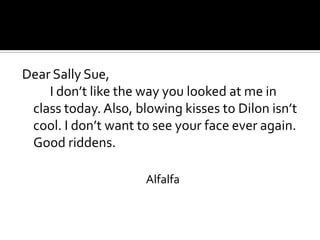
Dear Sally Sue,
    I don’t like the way you looked at me in
 class today. Also, blowing kisses to Dilon isn’t
 cool. I don’t want to see your face ever again.
 Good riddens.

                      Alfalfa
   Definition:
     “involves the use of information and
     communication technologies to support
     deliberate, repeated, and hostile behavior by an
     individual or group, that is intended to harm
     others.”
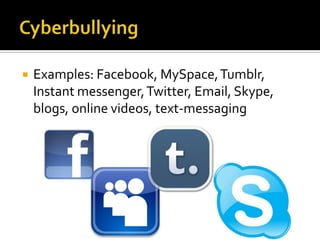
   Examples: Facebook, MySpace, Tumblr,
    Instant messenger, Twitter, Email, Skype,
    blogs, online videos, text-messaging
   Became prevalent in the late 1990s and early
    2000s as there was widespread access to the
    internet.
   Schools focus on internet safety from
    predators and pornography.
     Does not address internal problems, such as
     cyberbullying
   Promotes internet safety
   Teaches adolescents how to recognize
    cyberbullying
   Reduces teen health problems
   Promotes good interactions between peers
   Restrictions on 1st Amendment Rights
     Freedom of speech
   Violation of the 14th Amendment
     Illegal search and seizure
     If regulated, the government would have access
     to private matters.
   Lower self-esteem
   Be unwilling to attend school
   Receive poor grades
   Have more health problems
     Depression
     Anxieties
     Anorexia/Bulimia
     Suicide
   Research has found, young people who have
    been victimized are more likely to:
     Use alcohol and drugs
     Skip school
     Experience in-person bullying or victimization
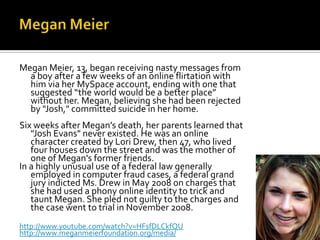
Megan Meier, 13, began receiving nasty messages from
  a boy after a few weeks of an online flirtation with
  him via her MySpace account, ending with one that
  suggested “the world would be a better place”
  without her. Megan, believing she had been rejected
  by "Josh," committed suicide in her home.
Six weeks after Megan’s death, her parents learned that
   "Josh Evans" never existed. He was an online
   character created by Lori Drew, then 47, who lived
   four houses down the street and was the mother of
   one of Megan's former friends.
In a highly unusual use of a federal law generally
   employed in computer fraud cases, a federal grand
   jury indicted Ms. Drew in May 2008 on charges that
   she had used a phony online identity to trick and
   taunt Megan. She pled not guilty to the charges and
   the case went to trial in November 2008.
http://www.youtube.com/watch?v=HFsfDLCkfQU
http://www.meganmeierfoundation.org/media/
   http://video.foxnews.com/v/1208401298001/
    cyber-bullying-victims-fight-back/
     National Crime Prevention Council website,
      www.ncpc.org:
     http://www.wiredsafety.org/ Wired Safety
     http://www.stopcyberbullying.org/
     http://www.stopbullying.gov/
   Talk about risks and benefits
   Share examples of incidents
   Learn about teen online behavior
   Visit websites
   Tell teen never give out personal info
   No face-to-face contact
   Enforce online rules
   Place computer in highly trafficked area
   Teach youth about cyberbullying
     Negative consequences
     Can be traced
   Speak to teen on how to react
   http://en.wikipedia.org/wiki/Cyberbullying
   http://www.ncpc.org/resources/files/pdf/bullying/cyberbull
    ying.pdf
   http://www.stopbullying.gov/topics/cyberbullying/
   Levy, P. (2011). Confronting
    cyberbullying.T.H.E.Journal, 38(5), 25-27.
   Patchin, J. W., & Hinduja, S. (2010). Cyberbullying and self-
    esteem. Journal of School Health, 80(12), 614-621.
   Siegle, D. (2010). Cyberbullying and sexting: Technology
    abuses of the 21st century. Gifted Child Today, 33(2), 14-16.
   Snakenborg, J., Van Acker, R., & Gable, R. A. (2011).
    Cyberbullying: Prevention and intervention to protect our
    children and youth. Preventing School Failure, 55(2), 88-95.

Cyberbullying

  • 1.
  • 5.
    Dear Sally Sue, I don’t like the way you looked at me in class today. Also, blowing kisses to Dilon isn’t cool. I don’t want to see your face ever again. Good riddens. Alfalfa
  • 8.
    Definition:  “involves the use of information and communication technologies to support deliberate, repeated, and hostile behavior by an individual or group, that is intended to harm others.”
  • 9.
    Examples: Facebook, MySpace, Tumblr, Instant messenger, Twitter, Email, Skype, blogs, online videos, text-messaging
  • 10.
    Became prevalent in the late 1990s and early 2000s as there was widespread access to the internet.  Schools focus on internet safety from predators and pornography.  Does not address internal problems, such as cyberbullying
  • 12.
    Promotes internet safety  Teaches adolescents how to recognize cyberbullying  Reduces teen health problems  Promotes good interactions between peers
  • 13.
    Restrictions on 1st Amendment Rights  Freedom of speech  Violation of the 14th Amendment  Illegal search and seizure  If regulated, the government would have access to private matters.
  • 14.
    Lower self-esteem  Be unwilling to attend school  Receive poor grades  Have more health problems  Depression  Anxieties  Anorexia/Bulimia  Suicide
  • 15.
    Research has found, young people who have been victimized are more likely to:  Use alcohol and drugs  Skip school  Experience in-person bullying or victimization
  • 16.
    Megan Meier, 13,began receiving nasty messages from a boy after a few weeks of an online flirtation with him via her MySpace account, ending with one that suggested “the world would be a better place” without her. Megan, believing she had been rejected by "Josh," committed suicide in her home. Six weeks after Megan’s death, her parents learned that "Josh Evans" never existed. He was an online character created by Lori Drew, then 47, who lived four houses down the street and was the mother of one of Megan's former friends. In a highly unusual use of a federal law generally employed in computer fraud cases, a federal grand jury indicted Ms. Drew in May 2008 on charges that she had used a phony online identity to trick and taunt Megan. She pled not guilty to the charges and the case went to trial in November 2008. http://www.youtube.com/watch?v=HFsfDLCkfQU http://www.meganmeierfoundation.org/media/
  • 17.
    http://video.foxnews.com/v/1208401298001/ cyber-bullying-victims-fight-back/  National Crime Prevention Council website, www.ncpc.org:  http://www.wiredsafety.org/ Wired Safety  http://www.stopcyberbullying.org/  http://www.stopbullying.gov/
  • 18.
    Talk about risks and benefits  Share examples of incidents  Learn about teen online behavior  Visit websites  Tell teen never give out personal info  No face-to-face contact
  • 19.
    Enforce online rules  Place computer in highly trafficked area  Teach youth about cyberbullying  Negative consequences  Can be traced  Speak to teen on how to react
  • 20.
    http://en.wikipedia.org/wiki/Cyberbullying  http://www.ncpc.org/resources/files/pdf/bullying/cyberbull ying.pdf  http://www.stopbullying.gov/topics/cyberbullying/  Levy, P. (2011). Confronting cyberbullying.T.H.E.Journal, 38(5), 25-27.  Patchin, J. W., & Hinduja, S. (2010). Cyberbullying and self- esteem. Journal of School Health, 80(12), 614-621.  Siegle, D. (2010). Cyberbullying and sexting: Technology abuses of the 21st century. Gifted Child Today, 33(2), 14-16.  Snakenborg, J., Van Acker, R., & Gable, R. A. (2011). Cyberbullying: Prevention and intervention to protect our children and youth. Preventing School Failure, 55(2), 88-95.

Editor's Notes

  • #3 Poll: How do you prevent Cyberbullying?Press F5 or use the tool bar to enter presentation mode in order to see the poll.\r\nIn an emergency during your presentation, if the poll isn't showing, navigate to this link in your web browser:http://www.polleverywhere.com/free_text_polls/LTcwNTI2ODQwNwIf you like, you can use this slide as a template for your own voting slides. You might use a slide like this if you feel your audience would benefit from the picture showing a text message on a phone.
  • #4 Poll: What are venues for Cyberbullying?Press F5 or use the tool bar to enter presentation mode in order to see the poll.\r\nIn an emergency during your presentation, if the poll isn't showing, navigate to this link in your web browser:http://www.polleverywhere.com/free_text_polls/LTIwNTM1MTE0NjUIf you like, you can use this slide as a template for your own voting slides. You might use a slide like this if you feel your audience would benefit from the picture showing a text message on a phone.
  • #5 Poll: What is Cyberbullying?Press F5 or use the tool bar to enter presentation mode in order to see the poll.\r\nIn an emergency during your presentation, if the poll isn't showing, navigate to this link in your web browser:http://www.polleverywhere.com/free_text_polls/LTEwMDg4NTM0NDQIf you like, you can use this slide as a template for your own voting slides. You might use a slide like this if you feel your audience would benefit from the picture showing a text message on a phone.
  • #7 Poll: Is this Cyberbullying?Press F5 or use the tool bar to enter presentation mode in order to see the poll.\r\nIn an emergency during your presentation, if the poll isn't showing, navigate to this link in your web browser:http://www.polleverywhere.com/multiple_choice_polls/LTExNTYyMzY2MDIIf you like, you can use this slide as a template for your own voting slides. You might use a slide like this if you feel your audience would benefit from the picture showing a text message on a phone.
  • #8 Poll: Should schools intervene?Press F5 or use the tool bar to enter presentation mode in order to see the poll.\r\nIn an emergency during your presentation, if the poll isn't showing, navigate to this link in your web browser:http://www.polleverywhere.com/multiple_choice_polls/MTg5MjM4NDc1NwIf you like, you can use this slide as a template for your own voting slides. You might use a slide like this if you feel your audience would benefit from the picture showing a text message on a phone.