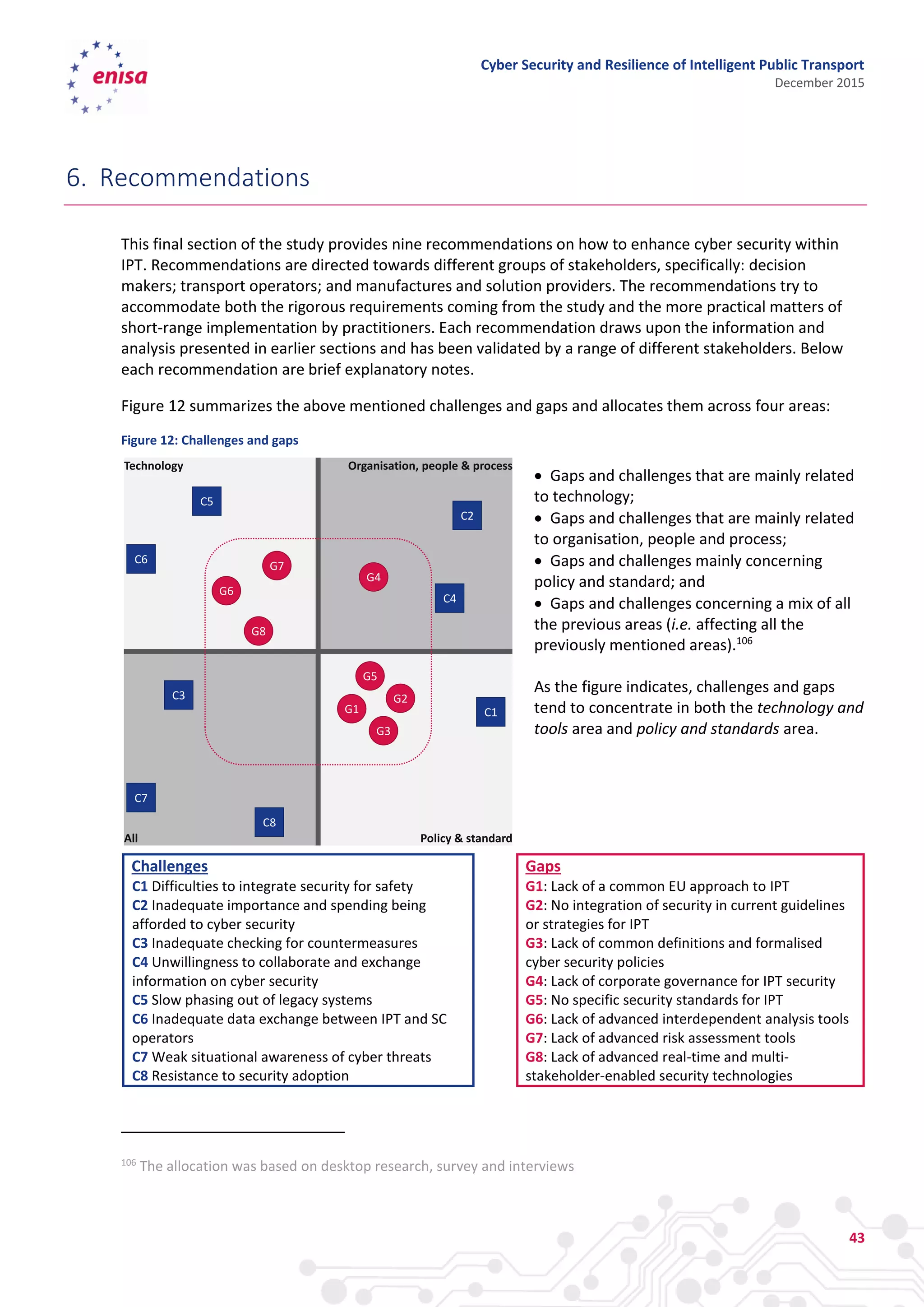
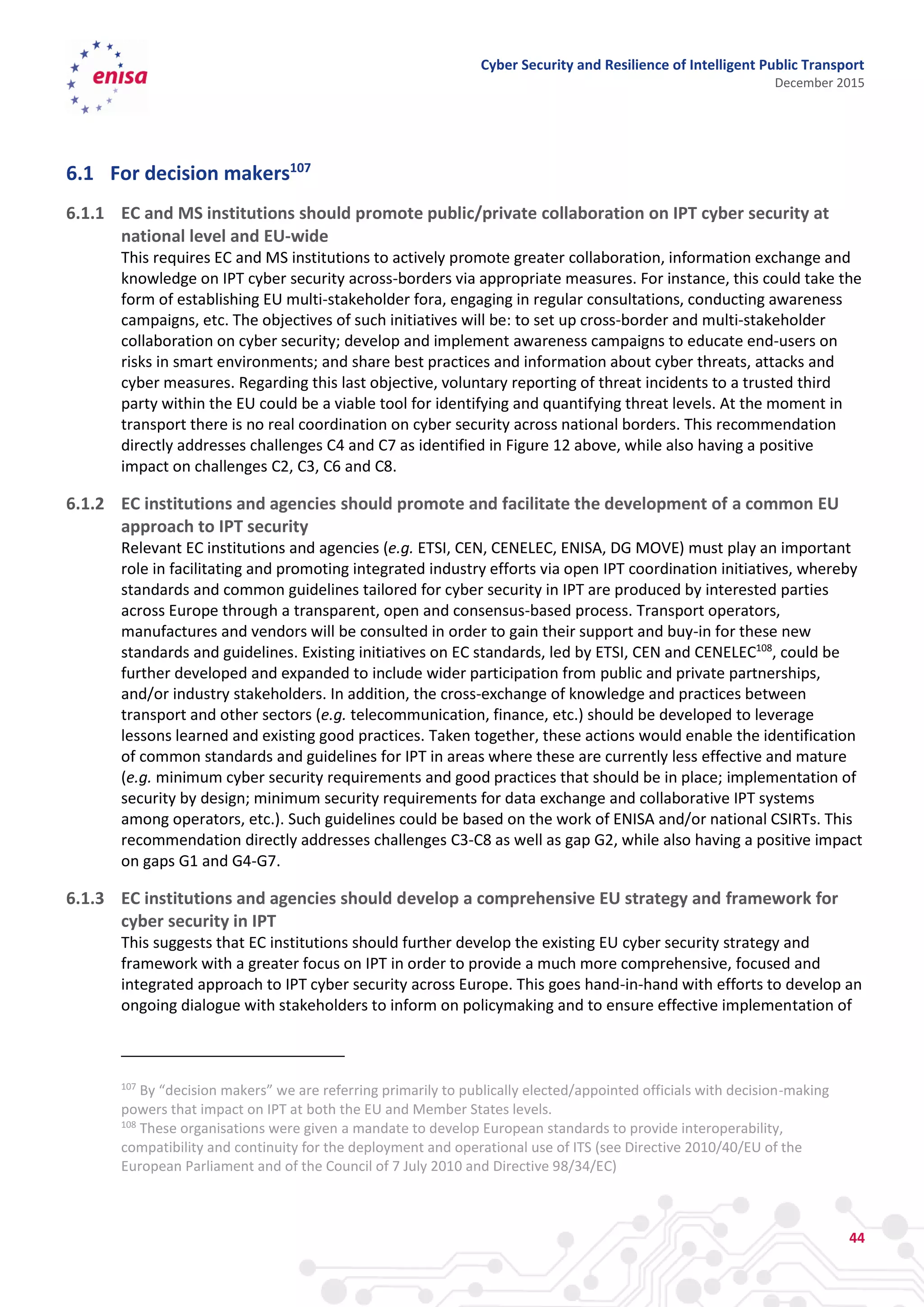
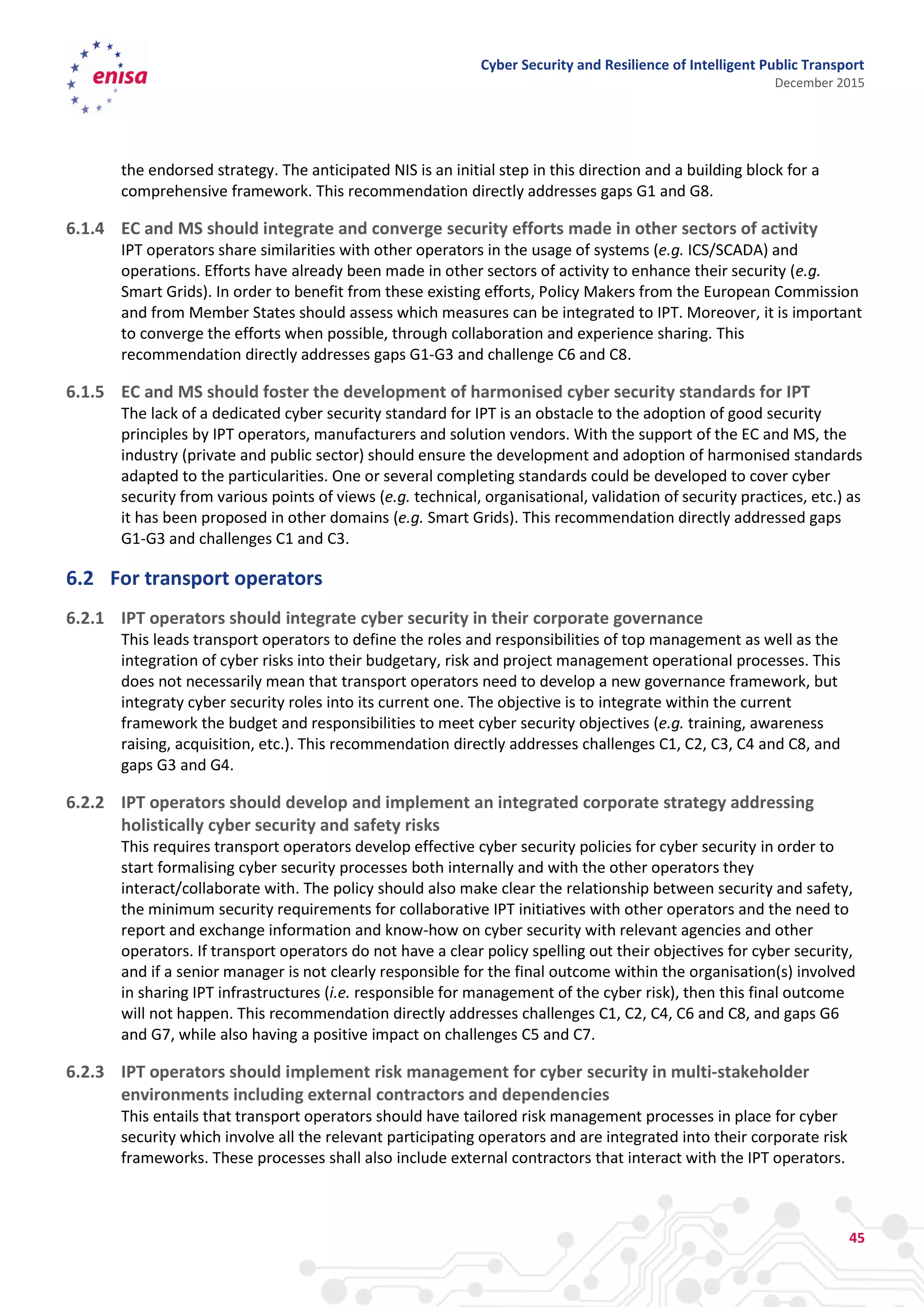
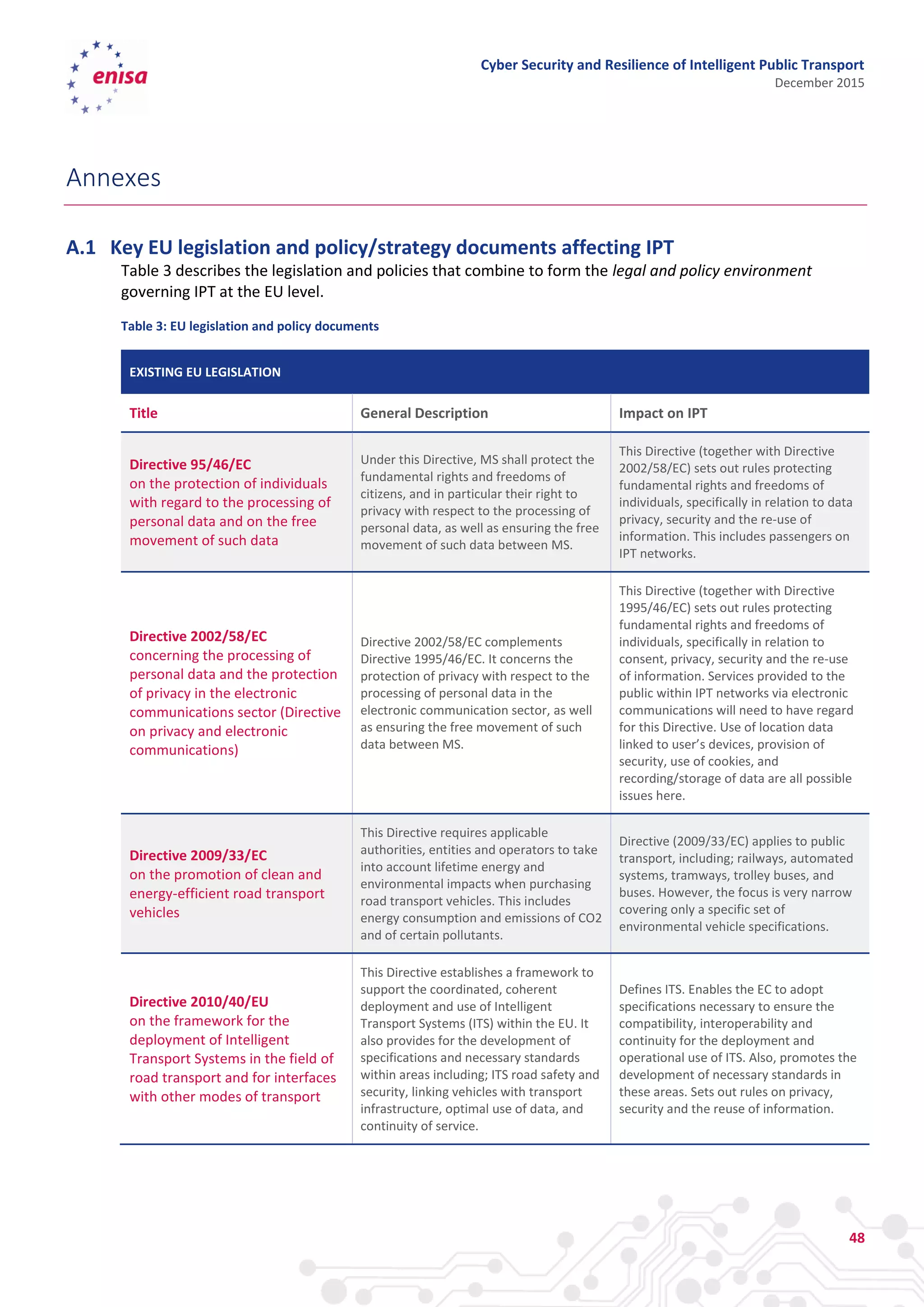
www.enisa.europa.eu European Union Agency For Network And Information Security
Cyber Security and Resilience of
Intelligent Public Transport
Good practices and recommendations
DECEMBER 2015
Cyber Security and Resilience of Intelligent Public Transport
December 2015
02
About ENISA
The European Union Agency for Network and Information Security (ENISA) is a centre of network and
information security expertise for the EU, its Member States (MS), the private sector and Europe’s citizens.
ENISA works with these groups to develop advice and recommendations on good practice in information
security. It assists EU MS in implementing relevant EU legislation and works to improve the resilience of
Europe’s critical information infrastructure and networks. ENISA seeks to enhance existing expertise in EU
MS by supporting the development of cross-border communities committed to improving network and
information security throughout the EU. More information about ENISA and its work can be found at
www.enisa.europa.eu.
Authors
Dr. Cédric LÉVY-BENCHETON, Ms. Eleni DARRA (ENISA)
Contact
For contacting the authors please use resilience@enisa.europa.eu.
For media enquires about this paper, please use press@enisa.europa.eu.
Acknowledgements
Dr. Timothy MITCHENER-NISSEN (Trilateral Research)
Dr. Monica LAGAZIO (Trilateral Research)
Dr. Daniel BACHLECHNER (Fraunhofer ISI)
Dr. Michael FRIEDEWALD (Fraunhofer ISI)
Mr. Antonio KUNG (Trialog)
ENISA would like to acknowledge all participants to the study. In particular, ENISA would like to thank the
following experts for their contribution (in alphabetical order):
Mrs. Lindsey BARR MANCINI (UITP)
Ms. Luana BIDASCA (European Transport Safety Council)
Mr. Carl-Johan BOSTORP (Stockholm Public Transport)
Mr. Leon BRAIN (DG MOVE)
Mr. Daniele CATTEDDU (Cloud Security Alliance)
Mr. Patrick CHAMBET (Métropole Nice Côte d’Azur)
Mr. Gino CORMONS (Regione Autonoma Friuli Venezia Giulia)
Mr. Christopher J. COX (Metroselskabet I/S)
Dr. Alexander DIX (German Data Protection Agency)
Mr. Ignasi FONTANAL (Opticits)
Mr. Sergey GORDEYCHIK (Securing Smart Cities / Kaspersky Lab)
Ms. Michele HANSON (Transport for London – TfL)
Eng. Francois HAUSMAN (UNIFE)
Ms. Alena HAVLOVÁ (CER)
Mr. Thomas KRITZER (Wiener Linien)
Mr. Mariano LAMARCA LORENTE (Barcelona City Council – BCN.cat)
Mr. Joe PICHLMAYR (Cyber Security Austria)
Mr. José PIRES (International Union of Railways – UIC)
Cyber Security and Resilience of Intelligent Public Transport
December 2015
03
Mr. David PRIOR (Xuvasi Ltd.)
Ms. Stefanie PROOST (De Lijn)
Mr. Maxime RAPAILLE (STIB - MIVB Brussels public transportation)
Mr. Luis RODA (Empresa Municipal de Transportes de Valencia – EMT)
Mr. Bernardo RODRIGUES (London’s European Office)
Mr. Jean-Luc SALLABERRY (FNCCR)
Mr. Stephen SMITH (ECSA)
ir. Andre SMULDERS, CISSP (Senior Business Consultant Security, TNO)
Ms. Andrea SOEHNCHEN (UITP)
Mr. Frank VAN STEENWINKEL (Fidecity)
Cyber Security and Resilience of Intelligent Public Transport
December 2015
04
Legal notice
Notice must be taken that this publication represents the views and interpretations of the authors and
editors, unless stated otherwise. This publication should not be construed to be a legal action of ENISA or
the ENISA bodies unless adopted pursuant to the Regulation (EU) No 526/2013. This publication does not
necessarily represent state-of the-art and ENISA may update it from time to time.
Third-party sources are quoted as appropriate. ENISA is not responsible for the content of the external
sources including external websites referenced in this publication.
This publication is intended for information purposes only. It must be accessible free of charge. Neither
ENISA nor any person acting on its behalf is responsible for the use that might be made of the
information contained in this publication.
Copyright Notice
© European Union Agency for Network and Information Security (ENISA), 2015
Reproduction is authorised provided the source is acknowledged.
ISBN: 978-92-9204-146-5 | doi:10.2824/778225
Cyber Security and Resilience of Intelligent Public Transport
December 2015
05
Table of Contents
Executive Summary 7
1. Introduction 9
1.1 Scope of the study 10
1.2 Target audience 11
1.3 Methodology 11
1.4 Outline 12
2. The intelligent public transport environment 13
2.1 Definitions 13
2.2 EU policy context 14
2.3 Critical business and societal functions and assets for intelligent public transport 16
2.3.1 Asset groups 16
2.3.2 Main critical assets for intelligent public transport 17
2.3.3 Three key insights on the nature of intelligent public transport assets 19
2.3.4 Three key insights on security for intelligent public transport assets 19
2.4 Intelligent public transport environment and elements 20
3. A need to secure intelligent public transport 21
3.1 Threats 21
3.1.1 Threat model 21
3.1.2 List of threats to public transport 22
3.1.3 IPT assets exposure to cyber threats 23
3.2 Vulnerabilities 26
3.2.1 General vulnerabilities 26
3.2.2 Specific vulnerabilities 27
3.3 Risks 29
3.3.1 Business risks 29
3.3.2 Societal risks 30
3.4 Challenges 31
3.4.1 Challenge 1: Difficulties to integrate security for safety 31
3.4.2 Challenge 2: Inadequate importance and spending being afforded to cyber security 31
3.4.3 Challenge 3: Inadequate checking for countermeasures 31
3.4.4 Challenge 4: Unwillingness to collaborate and exchange information on cyber security 32
3.4.5 Challenge 5: Slow phasing out of legacy systems 33
3.4.6 Challenge 6: Inadequate data exchange between IPT and Smart Cities operators 33
3.4.7 Challenge 7: Weak situational awareness of cyber threats 33
3.4.8 Challenge 8: Resistance to security adoption 33
4. Good practices for securing intelligent public transport 34
4.1 Technical good practices 34
4.2 Policies and standards 36
4.3 Organisational, people and processes 38
5. Gap analysis 40
5.1 Gap 1: Lack of a common EU approach to Intelligent Public Transport Security 40
Cyber Security and Resilience of Intelligent Public Transport
December 2015
06
5.2 Gap 2: No integration of security in current EU guidelines for IPT 40
5.3 Gap 3: Lack of common definitions and formalised cyber security policies 40
5.4 Gap 4: Lack of corporate governance for IPT security 41
5.5 Gap 5: No specific security standards for IPT 41
5.6 Gap 6: Lack of advanced interdependent analysis tools 41
5.7 Gap 7: Lack of advanced risk assessment tools 42
5.8 Gap 8: Lack of advanced real-time and multi-stakeholder-enabled security technologies 42
6. Recommendations 43
6.1 For decision makers 44
6.1.1 EC and MS institutions should promote public/private collaboration on IPT cyber security at
national level and EU-wide 44
6.1.2 EC institutions and agencies should promote and facilitate the development of a common EU
approach to IPT security 44
6.1.3 EC institutions and agencies should develop a comprehensive EU strategy and framework for
cyber security in IPT 44
6.1.4 EC and MS should integrate and converge security efforts made in other sectors of activity 45
6.1.5 EC and MS should foster the development of harmonised cyber security standards for IPT 45
6.2 For transport operators 45
6.2.1 IPT operators should integrate cyber security in their corporate governance 45
6.2.2 IPT operators should develop and implement an integrated corporate strategy addressing
holistically cyber security and safety risks 45
6.2.3 IPT operators should implement risk management for cyber security in multi-stakeholder
environments including external contractors and dependencies 45
6.2.4 IPT operators should clearly and routinely specify their cyber security requirements 46
6.2.5 IPT operators should annually review organisational cyber security processes, practices and
infrastructures 46
6.3 For manufacturers and solution providers 46
6.3.1 Manufacturers and solution providers should create products/solutions that match the cyber
security requirements of IPT end-users 46
6.3.2 Manufacturers and solution providers should collaborate in the development of IPT-specific
standards and apply them to IPT solutions 47
6.3.3 Manufacturers and solution providers should develop a trusted information sharing platform on
risks and vulnerabilities 47
6.3.4 Manufacturers and solution providers should provide security guidance for your systems,
products and solutions 47
Annexes 48
A.1 Key EU legislation and policy/strategy documents affecting IPT 48
A.2 Top critical functions, assets, and threats identified for Intelligent Public Transport 51
A.3 Threats to individual assets 52
A.4 Reference guide for applying good practices to Intelligent Public Transport 55
A.5 Survey questions 62
Cyber Security and Resilience of Intelligent Public Transport
December 2015
07
Executive Summary
The concept of “Smart Cities” revolves around the interconnection of different operators from domains of activity
such as public transport, energy… These operators rely on Information and Communication Technology (ICT) systems
to retrieve, process, and exchange data in order to improve their services and the quality of life of citizens.
In this context, public transport operators have an important role to enable this smartness. They contribute to the
life of the city, to the economy and ensure the resilience of the Smart City. The integration of several ICT systems
enables “Intelligent Public Transport” (IPT), where cyber-physical devices, communication networks and central
servers optimise the transport service up to a certain degree of automation.
While this fusion of cyber technology, physical infrastructures and mass transport vehicles creates new
opportunities for improving services and functionality, it also has the effect of introducing cyber security risks into
transport networks that have not historically been susceptible to such risks. Moreover, IPT becomes a natural
target for emerging cyber threats that will have an impact not only on the operations of the transport service but
also on the whole economy and potentially on the health and safety of citizens.
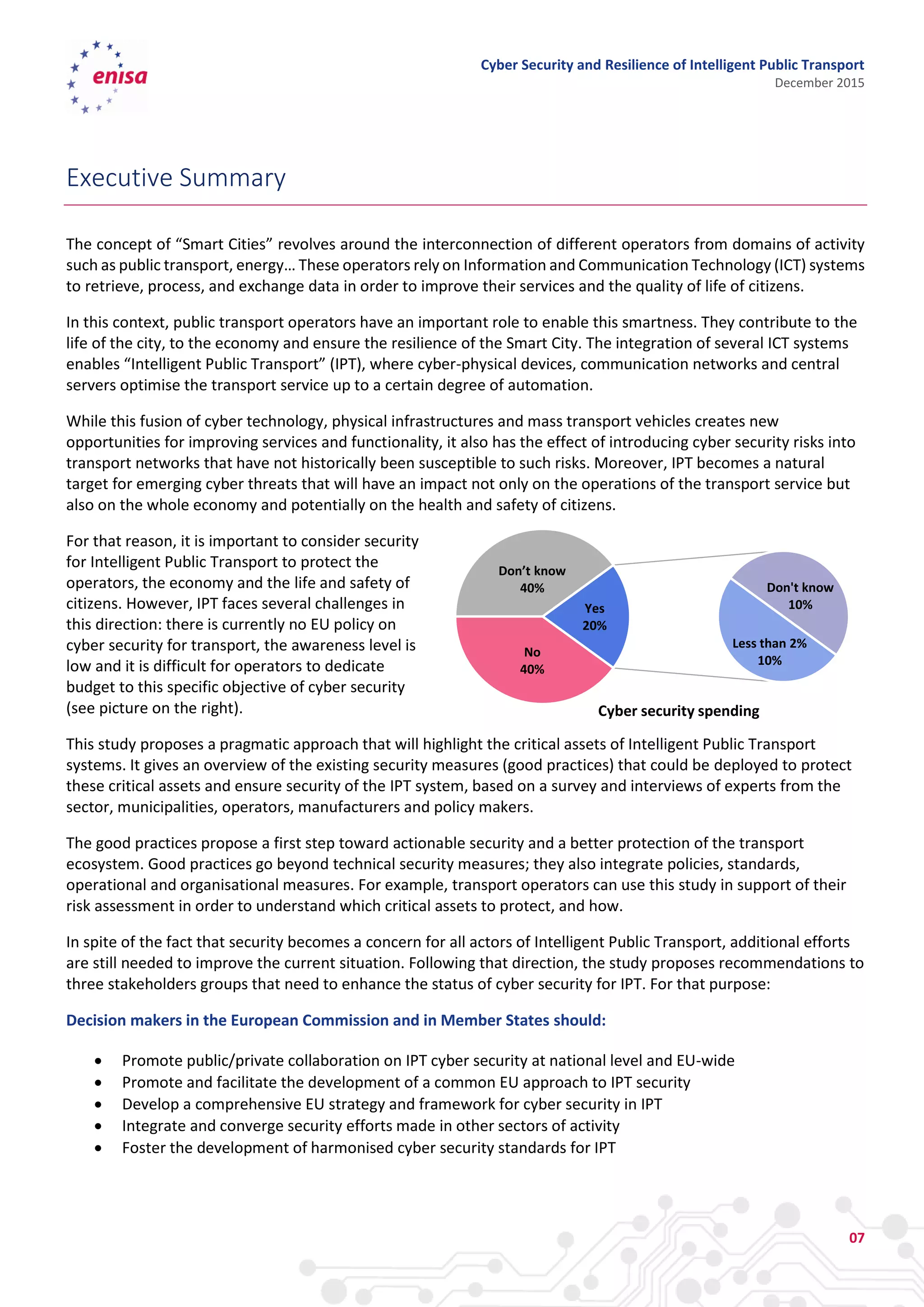
For that reason, it is important to consider security
for Intelligent Public Transport to protect the
operators, the economy and the life and safety of
citizens. However, IPT faces several challenges in
this direction: there is currently no EU policy on
cyber security for transport, the awareness level is
low and it is difficult for operators to dedicate
budget to this specific objective of cyber security
(see picture on the right).
This study proposes a pragmatic approach that will highlight the critical assets of Intelligent Public Transport
systems. It gives an overview of the existing security measures (good practices) that could be deployed to protect
these critical assets and ensure security of the IPT system, based on a survey and interviews of experts from the
sector, municipalities, operators, manufacturers and policy makers.
The good practices propose a first step toward actionable security and a better protection of the transport
ecosystem. Good practices go beyond technical security measures; they also integrate policies, standards,
operational and organisational measures. For example, transport operators can use this study in support of their
risk assessment in order to understand which critical assets to protect, and how.
In spite of the fact that security becomes a concern for all actors of Intelligent Public Transport, additional efforts
are still needed to improve the current situation. Following that direction, the study proposes recommendations to
three stakeholders groups that need to enhance the status of cyber security for IPT. For that purpose:
Decision makers in the European Commission and in Member States should:
 Promote public/private collaboration on IPT cyber security at national level and EU-wide
 Promote and facilitate the development of a common EU approach to IPT security
 Develop a comprehensive EU strategy and framework for cyber security in IPT
 Integrate and converge security efforts made in other sectors of activity
 Foster the development of harmonised cyber security standards for IPT
No
40%
Don’t know
40%
Less than 2%
10%
Don't know
10%Yes
20%
Cyber security spending
Cyber Security and Resilience of Intelligent Public Transport
December 2015
08
Intelligent Public Transport operators should:
 Integrate cyber security in their corporate governance
 Develop and implement an integrated corporate strategy addressing holistically cyber security and safety
risks
 Implement risk management for cyber security in multi-stakeholder environments including external
contractors and dependencies
 Clearly and routinely specify their cyber security requirements
 Annually review organisational cyber security processes, practices and infrastructures
Manufacturers of IPT systems and solutions should:
 Create products/solutions that match the cyber security requirements of IPT end-users
 Collaborate in the development of IPT-specific standards and apply them to IPT solutions
 Develop a trusted information sharing platforms on risks and vulnerabilities
 Provide security guidance for your systems, products and solutions
Cyber Security and Resilience of Intelligent Public Transport
December 2015
09
1. Introduction
Transport networks are designated as critical infrastructure within the European Union (EU) and are
essential for maintaining the health, safety, security, and social and economic well-being of citizens within
EU Member States (MS).1
Yet the effective operation of these transport networks is vulnerable to the
increasing levels of traffic, which also contribute to rising energy consumption and environmental and
social problems.2
These negative symptoms are strongly felt in European cities which draw together large
concentrations of citizens within relatively small geographic areas.
To help manage and mitigate increases in traffic congestion, cities rely upon effective public transport
networks as efficient mobility solutions. However, when seeking to expand and improve these public
transport networks it is not enough to count solely upon the traditional measure of simply increasing the
physical road and rail infrastructure. Rather technological innovation has a major role to play here in the
creation of appropriate solutions, and the realisation of this fact is directly connected with the rise of
Intelligent Transport Systems (ITS) integrated into Smart Cities.3
ITS integrates information and communication technology (ICT) with transport engineering so as to plan,
design, operate, maintain and manage transport systems, which in turn significantly contribute to
improving the efficiency and operation of such networks.2
The application of these technologies to public
transport systems produces Intelligent Public Transport (IPT).
However, this process of increasing the incorporation of ICT into public transport through both the
introduction of networked devices and the expansion of remote access and control capabilities, coupled
with the linking together of different operators within a single Smart City network (creating a system-of-
systems), all acts to increase the cyber threat exposure of traditional transport networks. While current
transport operators and engineers possess a wealth of knowledge and experience in ensuring their
networks and products are designed with safety in mind, they have less experience in ensuring the cyber
security of their networks and products.
This increase in the cyber security risks for IPT produces new objectives that need to be met. These include
the identification of critical IPT assets and the associated threats that target them, as well as the
identification of good practices in cyber security that can address these threats and increase the cyber
resilience of IPT operators. Such outcomes need to be coupled with a coherent strategic and policy
approach that encompasses all of the stakeholders linked to IPT within the Smart City environment.
1
See Council Directive 2008/11/EC on the identification and designation of European critical infrastructures and the
assessment of the need to improve their protection, specifically Art.2 and Annex I
2
See Directive 2010/40/EU of the European Parliament and of the Council on the framework for the deployment of
Intelligent Transport Systems in the field of road transport and for interfaces with other modes of transport.
3
Smart Cities are cities that integrate ICT to meet public needs and foster development in a multi-stakeholder
environment. It is anticipated this integration of cyber-physical technologies and infrastructures creates
environmental and economic efficiencies while improving resident’s quality of life (see US Dept. of Homeland
Security, “The Future of Smart Cities: Cyber-Physical Infrastructure Risk”, August 2015).
Cyber Security and Resilience of Intelligent Public Transport
December 2015
10
1.1 Scope of the study
This study focuses on the protection of the assets critical to Intelligent Public Transports in the context of
Smart Cities. These assets are considered critical as they contribute to the normal operation of local public
transport networks, including metro, buses, light rail and other modes of mass public transport found in
Smart Cities.
For that purpose, this study identifies these critical assets from a business and societal point of view. It
highlights good security practices against cyber threats. The objective is to enhance the resilience of IPT.
From the point of view of Smart Cities, these assets can be considered “internal” to IPT operators.
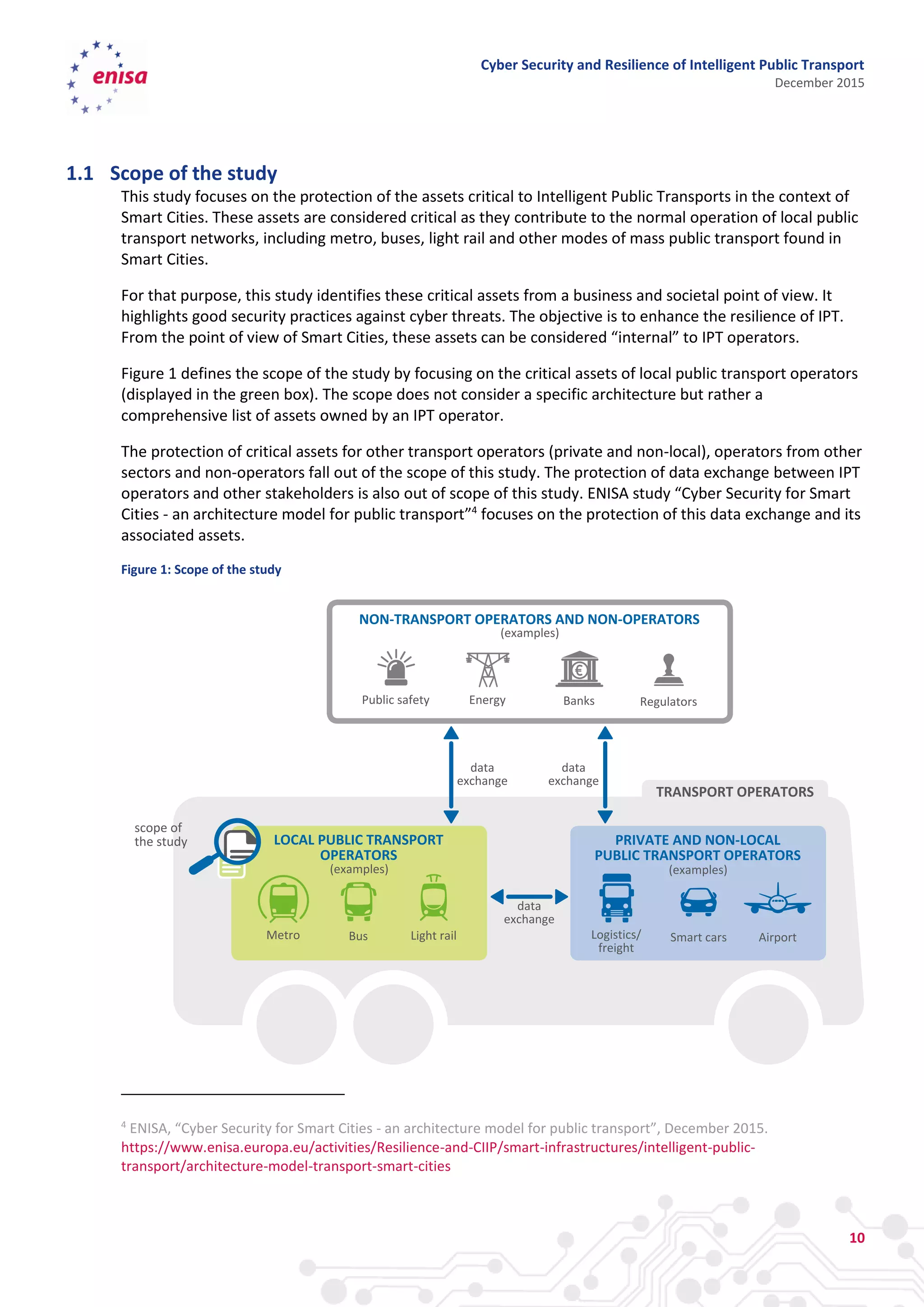
Figure 1 defines the scope of the study by focusing on the critical assets of local public transport operators
(displayed in the green box). The scope does not consider a specific architecture but rather a
comprehensive list of assets owned by an IPT operator.
The protection of critical assets for other transport operators (private and non-local), operators from other
sectors and non-operators fall out of the scope of this study. The protection of data exchange between IPT
operators and other stakeholders is also out of scope of this study. ENISA study “Cyber Security for Smart
Cities - an architecture model for public transport”4
focuses on the protection of this data exchange and its
associated assets.
Figure 1: Scope of the study
4
ENISA, “Cyber Security for Smart Cities - an architecture model for public transport”, December 2015.
https://www.enisa.europa.eu/activities/Resilience-and-CIIP/smart-infrastructures/intelligent-public-
transport/architecture-model-transport-smart-cities
NON-TRANSPORT OPERATORS AND NON-OPERATORS
(examples)
PublicSsafety Energy Banks Regulators
data
exchange
data
exchange
TRANSPORT OPERATORS
LOCAL PUBLIC TRANSPORT
OPERATORS
PRIVATE AND NON-LOCAL
PUBLIC TRANSPORT OPERATORS
(examples) (examples)
Metro Bus LightSrail Logistics/
freight
SmartScars Airport
data
exchange
scopeSofS
theSstudy
Cyber Security and Resilience of Intelligent Public Transport
December 2015
11
1.2 Target audience
The interconnected network of actors facilitates the operation of IPT within a Smart City environment.
Hence, the task of developing secure and resilient IPT systems falls on multiple actors, requiring the
cooperation of both public and private stakeholders working together to enhance cyber security. Given
this fact, the target audiences of this study are drawn from a number of sectors (see Figure 2):
Figure 2: Target audience groups
 Operators: they cover a wide range of actors; both those directly
involved in operating different public transport modes (metro,
bus, tram/trolley-bus, light rail, ferry) and an interconnected
network of operators within the Smart City (energy,
infrastructure, public & private clouds, communications, banks
and payment systems, etc.).
 Manufacturers: Covering the full spectrum of manufacturers
including physical transport infrastructure, providers, vehicle
manufacturers, developers of ICT networks, hardware and
software engineers, etc.
 Service Providers: Including risk managers, cloud providers, ICT
network providers, security providers, etc.
 Policy Makers: Different levels of government (local, national,
EU), regulators and law enforcement agencies involved in IPT.
1.3 Methodology
This study is based on a combination of desktop research as well as empirical research (i.e. survey and
interviews) with the results validated through a stakeholder workshop. Initial data gathering scoped the
development of the study, including the current key policies and legislation. Critical societal and business
assets for IPT were identified by integrating the desktop and empirical findings, and a comparative
approach was employed (i.e. between threats, risks, vulnerabilities, good practices, and challenges and
gaps) focussing on enhancing cyber security within IPT.
Results of the desktop research were further developed, and good practices identified, through an online
survey5
and series of interviews involving a total of 22 respondents drawn from different stakeholder
groups.6
While this is sample size is limited it nevertheless represents a good starting point for conducting
research into IPT. These respondents were based in the following EU MS:
 Belgium
 Denmark
 Estonia
 France
 Germany
 Latvia
 Luxembourg
 Netherlands
 Republic of Ireland
 Spain
 Sweden
 United Kingdom
5
See Annex 5 for the survey questions.
6
See Section 1.3 of ENISA, “Cyber Security for Smart Cities - an architecture model for public transport”, December
2015, for a distribution of respondents based on sector.
Service
providers
Policy
makers
ManufacturersOperators
IPT Critical
assets
Cyber Security and Resilience of Intelligent Public Transport
December 2015
12
The findings and recommendations of this study were validated through a final workshop of IPT operators,
Smart City municipalities and policy makers.
1.4 Outline
This study is structured as follows:
 Section 1 – Introduction: introduces the topic and provides an outline of the study, the target
audiences and the methodologies employed.
 Section 2 – The Intelligent Public Transport environment: provides the contextual environment
for IPT, including the key legislative environment, critical business and societal functions for IPT,
and key assets.
 Section 3 – A need to secure IPT: identifies and organises the key cyber threats affecting the
critical assets of IPT operators. The cyber threat vulnerabilities inherent to IPT are identified and
discussed, and an initial analysis of risks is conducted.
 Section 4 – Good practices for securing Intelligent Public Transport: good practices for securing
IPT networks from cyber threats are presented here, as identified through both desktop research
and the interviews/surveying of IPT operators.
 Section 5 – Gap analysis: The identification and analysis of existing gaps in securing IPT (arising
from existing policies, legislation, operational practices and employed technologies) identified
throughout this research via a comparative analysis of previous findings.
 Section 6 – Recommendations: Sets out nine key recommendations for policy makers, IPT
operators, manufacturers and solution providers on enhancing the security and resilience of IPT.
Cyber Security and Resilience of Intelligent Public Transport
December 2015
13
2. The intelligent public transport environment
This section provides an overview of the IPT environment. It defines terms commonly used within this
sector, outlines the current legal and policy environment within which IPT operates, places IPT within the
wider smart environment, sets out the critical functions and assets for IPT operators, and finally it explains
why cyber security is so fundamentally critical in the physical-digital fusion that is IPT.
2.1 Definitions
Many of the common concepts within intelligent transport are the subject of multiple definitions provided
by different stakeholders, each with differing perspectives and agendas. These have been distilled here to
produce a single set of definitions describing how these concepts are approached within this study. Table 1
defines the terms employed throughout this study.
Table 1: Key definitions employed within this study
TERM DEFINITION
Intelligent Transport
The application of information and communication technologies to transport so as to
improve levels of service and efficiency.
Intelligent Public Transport7 (IPT)
The application of information and communication technologies to public transport
networks so as to improve levels of service and efficiency.
Intelligent Transport Systems (ITS)
The application of information and communication technologies to the real-time
management of vehicles and networks involving the movement of people and
goods.8 9 10
Smart City
A city that uses ICT to meet public needs and foster development in a multi-stakeholder
environment.
Business critical
(as applied to IPT)
Any elements which can directly impact the execution and sustainability of a business
in the long-term, including business revenue, service provision, business operations,
and/or the brand and image of an organisation.
Societal critical
(as applied to IPT)
Any elements affecting the quality of life of the citizens and their daily experience of
transport, which includes the environment, their safety and security and their privacy.
Critical Infrastructure
(as applied to the EU)
An asset, system or part thereof located in MS which is essential for the maintenance of
vital societal functions, health, safety, security, economic or social well-being of people,
and the disruption or destruction of which would have a significant impact in a MS as a
result of the failure to maintain those functions.11
7
Intelligent Public Transport is not a term widely used or adopted, rather it is a term coined for this study.
8
EC,16.12.2008 COM(2008) 886 final, “Action Plan for the Deployment of Intelligent Transport Systems in Europe”.
9
EC, 20.3.2009 COM(2008) 886 final/2, “Corrigendum to Action Plan for the Deployment of Intelligent Transport
Systems in Europe”.
10
Federal Ministry for Economic Cooperation and Development (Germany), “Intelligent Transport Systems”, p.2.
11
As defined within Article 2a of Directive 2008/114/EC. For more details on critical infrastructure see ENISA,
“Methodologies for the identification of Critical Information Infrastructure assets and services”, February 2015.
Cyber Security and Resilience of Intelligent Public Transport
December 2015
14
TERM DEFINITION
Cyber security
Cyber security is the collection of tools, policies, security concepts, security safeguards,
guidelines, risk management approaches, actions, training, best practices, assurance
and technologies that can be used to protect the cyber environment and organization
and user’s assets.
IPT Cyber security
For IPT, cyber security is the protection of data, systems, infrastructure and end-users
vital to the transport network, its operation and stability.
2.2 EU policy context
At the EU regulatory level, Regulations and Directives have yet to be specifically drafted to govern the form
and operation of IPT. Instead, what currently exists are a number of Directives whose broader remits are,
to differing degrees, applicable to IPT. These existing Directives cover the protection of personal data,12
the
processing of personal data in the electronic communications sector,13
the promotion of clean and energy-
efficient road transport vehicles,14
creating interoperability of national rail systems across the European
Community,15
and the deployment of intelligent transport systems in the field of road transport.16
Individual analyses of these Directives is provided in Annex 1.
Collectively these Directives demonstrate that while there is currently no piece of EU legislation focussing
specifically on the operation of IPT at the EU level, there are elements of IPT operations that are still
subject to a level of regulation. Despite this fact, when it comes to either cyber security protections,
requirements and/or guidance specific to IPT, these Directives have very little to say beyond a cursory
mention of general security and the need to protect in-vehicle communications in Directive 2010/40/EU,17
and the need to protect the data privacy rights of citizens in Directives 1995/46/EC and 2002/58/EC.18
There is the proposed Network Information Security (NIS) Directive19
which, if enacted, will place a duty on
https://www.enisa.europa.eu/activities/Resilience-and-CIIP/critical-infrastructure-and-services/Methodologies-for-
identification-of-ciis
12
Directive 95/46/EC of the European Parliament and of the Council of 24 October 1995 on the protection of
individuals with regard to the processing of personal data and on the free movement of such data. http://eur-
lex.europa.eu/legal-content/EN/TXT/?uri=URISERV:l14012
13
Directive 2002/58/EC of the European Parliament and of the Council of 12 July 2002 concerning the processing of
personal data and the protection of privacy in the electronic communications sector (Directive on privacy and
electronic communications). http://eur-lex.europa.eu/legal-
content/EN/TXT/?qid=1440673681836&uri=CELEX:32002L0058
14
Directive 2009/33/EC of the European Parliament and of the Council of 23 April 2009 on the promotion of clean
and energy-efficient road transport vehicles. http://eur-lex.europa.eu/legal-
content/EN/TXT/?qid=1440673932348&uri=CELEX:32009L0033
15
Directive 2008/57/EC of the European Parliament and of the Council of 17 June 2008 on the interoperability of the
rail system within the Community. http://eur-lex.europa.eu/legal-content/EN/TXT/?uri=celex:32008L0057
16
Directive 2010/40/EU of the European Parliament and of the Council of 7 July 2010 on the framework for the
deployment of Intelligent Transport Systems in the field of road transport and for interfaces with other modes of
transport. http://eur-lex.europa.eu/legal-content/EN/TXT/?qid=1440674103143&uri=CELEX:32010L0040
17
Art.2(1), Directive 2010/40/EU
18
Art.10, Directive 2010/40/EU
19
Proposal for a DIRECTIVE OF THE EUROPEAN PARLIAMENT AND OF THE COUNCIL concerning measures to ensure a
high common level of network and information security across the Union (COM/2013/048 final - 2013/0027 (COD)).
http://eur-lex.europa.eu/legal-content/EN/TXT/?uri=celex:52013PC0048
Cyber Security and Resilience of Intelligent Public Transport
December 2015
15
operators of critical infrastructures (including transport) to manage the risks posed to the security of the
networks and information systems which they control and use in their operations.20
While this Directive will
apply to IPT operators, the level of impact is uncertain as again it is not primarily focussed on the operation
of IPT.21
At the national level, while Member States need to ensure these Directives are incorporated into their
respective legal systems, they are free to go beyond existing EU legislation by establishing additional
national measures to promote IPT and cyber security.22
Running parallel with these Directives are a number of important EU policy documents acting to drive the
future development of IPT. These have appeared with regularity since the late 2000’s focussing on
Intelligent Transport and its integration within Smart Cities, and they indicate the importance being
assigned to these topics at the EU level. These policy documents include the following:23
 Action Plan for the Deployment of Intelligent Transport Systems in Europe: This Action Plan aims
to accelerate and coordinate the deployment of Intelligent Transport Systems (ITS) in road
transport, including interfaces with other transport modes.16
 Internet of Things - An action plan for Europe: Sets out 14 “Lines of Action” regarding the future
design of objects/systems falling under the Internet of Things (IoT).24
 A Digital Single Market Strategy Europe: Sets out the Commission’s strategy for creating a Digital
Single Market whereby the free movement principles of goods, services, people and capital are
translated and implemented into EU cyber space.25
 European Innovation Partnership on Smart Cities and Communities: Strategic Implementation
Plan: Presents the Strategic Implementation Plan for creating Smart Cities produced by the High
Level Group of the European Innovation Partnership for Smart Cities and Communities.26
 Roadmap to a Single European Transport Area – Towards a competitive and resource efficient
transport system: Focus is on how to remove barriers and bottlenecks so as to complete the
internal market for transport by creating a competitive and sustainable transport market within
the EU.27
20
Art.14(1), Proposed NIS Directive
21
When multiple operators (including IPT operators) are integrated into the architecture of a Smart City it is
uncertain to what extent they control any shared network and information systems. Additionally the scope assigned
to transport as critical infrastructure within the proposed Directive as currently drafted in Annex II of the draft NIS
Directive does not clearly apply to road-based IPT operators (i.e. busses).
22
For example, it was noted during the final validation workshop that the French Agence nationale de la sécurité des
systèmes d’information (ANSSI) is working with Vital Importance Operators such as public transport and railways to
establish laws related to cyber security.
23
See Annex 1: Key EU legislation and policy/strategy documents affecting IPT, for more details on these documents.
24
Internet of Things - An action plan for Europe - COM(2009) 278 final. http://eur-
lex.europa.eu/LexUriServ/LexUriServ.do?uri=COM:2009:0278:FIN:EN:PDF
25
A Digital Single Market Strategy for Europe - COM(2015)192 final. http://ec.europa.eu/priorities/digital-single-
market/docs/dsm-communication_en.pdf
26
European Innovation Partnership on Smart Cities and Communities: Strategic Implementation Plan.
http://ec.europa.eu/eip/smartcities/files/sip_final_en.pdf
27
Roadmap to a Single European Transport Area – Towards a competitive and resource efficient transport system -
COM(2011) 144 final. http://eur-lex.europa.eu/legal-content/EN/TXT/?uri=uriserv:tr0054
Cyber Security and Resilience of Intelligent Public Transport
December 2015
16
 Rolling plan for ICT Standardisation: This Rolling Plan provides a multi-annual overview of the
needs for preliminary or complementary ICT standardisation activities to undertake in support of
EU policy activities.28
 Smart Cities and Communities – European Innovation Partnership: These are partnerships across
the areas of energy, transport and information and communication with the objective to catalyse
progress in areas where energy use, mobility and transport, and ICT are intimately linked.29
What is most telling is that many of the EU policy and strategy documents within IPT have moved beyond
simply seeking to educate the reader about IPT and/or justifying the development of this capability, and on
to promoting concrete actions and outcomes through the use of action plans and/or the setting of specific
objectives. This represents the level of acceptance IPT has achieved within the EU.
However, an EU policy specific to the development and security of IPT as a whole is still lacking. Instead the
focus of these documents is primarily to promote the uptake and development of ITS, IoT, ICT, Smart
Cities. Yet, there is no related policy on the cyber security requirements for the operators of such systems.
2.3 Critical business and societal functions and assets for intelligent public transport
2.3.1 Asset groups
In order to identify the key IPT assets, based on the field work we have extrapolated key functions and
their relevant specific assets from a business and societal prospective. Successfully managing an IPT
business requires identifying and protecting those functions that are critical to the effective, continued
operation of that business: i.e. business critical functions. Given the role and importance of IPT networks to
citizens and societies, there are also functions that are critical from a societal perspective; i.e. societal
critical functions. Within each of these business and societal functions are individual assets related to the
provision of that function. Through the survey, interviews as well as desktop research covering key
documents, the following five business and five societal functions were identified.
Business functions:
 Traffic and vehicle management defines IPT through the use of ICT, and underlies its goals of
increasing efficiencies and productivity through the linking of systems and employing data. As a
result this function contains a long list of related assets covering the full digital-physical spectrum.
This mirrors the societal function “sustainable urban mobility”.
 Transportation safety and security focuses on ensuring the effective cyber/physical security and
safety of IPT infrastructures (including both physical and digital entities) attached to the business
operations of the IPT operator. As such the assets range from cyber protection measures (i.e.
ensuring the confidentiality, integrity and availability of data and communications) to access
controls to both physical and digital assets.
 Sales, fees and charges are essential to the continuing financial viability of an IPT operator,
whether privately or publically owned. Protecting the payment system assets is therefore of
fundamental importance.
28
Rolling plan for ICT Standardisation. https://ec.europa.eu/digital-agenda/en/news/rolling-plan-ict-standardisation-
0
29
Smart Cities and Communities – European Innovation Partnership - COM(2012) 4701 final.
http://ec.europa.eu/eip/smartcities/files/ec_communication_scc.pdf
Cyber Security and Resilience of Intelligent Public Transport
December 2015
17
 Resilient management structure allows an IPT operator to respond effectively to, and overcome,
the range of threats IPT networks are subject to, including: acts of nature, cyber attacks, physical
attacks, energy supply problems, etc. Staff and business reputation are important assets here.
 Energy and environment concerns have a direct impact on the operation of IPT networks.
Operators need to ensure the sufficient and continuous supply of energy to meet their network’s
needs. While at the same time they must manage energy usage to control costs and mitigate any
negative environmental impacts arising from their transport network. This function also mirrors the
societal function “sustainable environment”.
Societal functions:
 Sustainable urban mobility networks are fundamental to the efficient operation of a city, providing
a wealth of social and economic benefits. Incorporating ICT into the operation of traditional
mobility networks to create IPT acts to maximise the efficiency, operation and sustainability of
these mobility networks. This is fundamental in differentiating IPT from the traditional silo-based
model of an urban public transport system. This infusion of ICT into the physical infrastructure and
assets of different operators enables the integration of wider systems and processes. The critical
assets to this function now include the digital infrastructure and integrated systems as well as
physical infrastructures.
 Passenger safety and security focuses on ensuring the effective cyber/physical security and safety
of passengers using urban public transport networks. Achieving acceptable levels of safety and
security are fundamental prerequisites for passengers to trust and willingly choose to use such
networks. Providing the safety and (cyber) security of passengers on IPT networks requires a range
of assets, from technological safety systems and surveillance (CCTV) capabilities, through to trained
staff and the real-time ability to communicate with passengers.
 Data protection and privacy are digital rights valued by societies, as well as representing EU legal
requirements which apply to the operation of IPT networks (see Section 2.2). Mature IPT operators
recognise that the data/information they hold constitutes one of their most valuable assets.
 Sustainable environment recognises the impact of traffic networks on the wider city environment
through vectors including; air quality, noise pollutions, traffic flow, user safety, sustainable energy
grids, and the economic impact for both end-users and local businesses.30
Because of the different nature and focus of these two viewpoints (i.e. business and societal), business
assets tend to focus more on individual components of IPT, while societal assets tend to be concerned
more with integrated and broader elements of IPT systems cutting across several operators.
2.3.2 Main critical assets for intelligent public transport
Figure 3 below set out the business and societal functions grouped together with associated assets as
identified through the survey, interviews and desktop research of related documents.31
These were also
evaluated to identify those that are critical. The resulting five critical functions and 21 critical assets are
30
Scottish Government, “Smart Cities Maturity Model and Self-Assessment Tool”, January 2015
31
Key documents here included: EC, COM(2011)144 final, “Roadmap to a Single European Transport Area”, March
2011. EC, COM(2012) 4701 final, “Smart Cities and Communities. European Innovation Partnership”, July 2012.
European Innovation Partnership on Smart Cities and Communities, Strategic Implementation, October 2013. EC,
COM(2009) 278 final, “Internet of Things. An Action Plan for Europe”, June 2009. EC, COM(2010) 245 final, “A Digital
Agenda for Europe”, May 2010. Ericsson, “Smart communication + Accurate information = Intelligent Transport
users”, 2014.
Cyber Security and Resilience of Intelligent Public Transport
December 2015
18
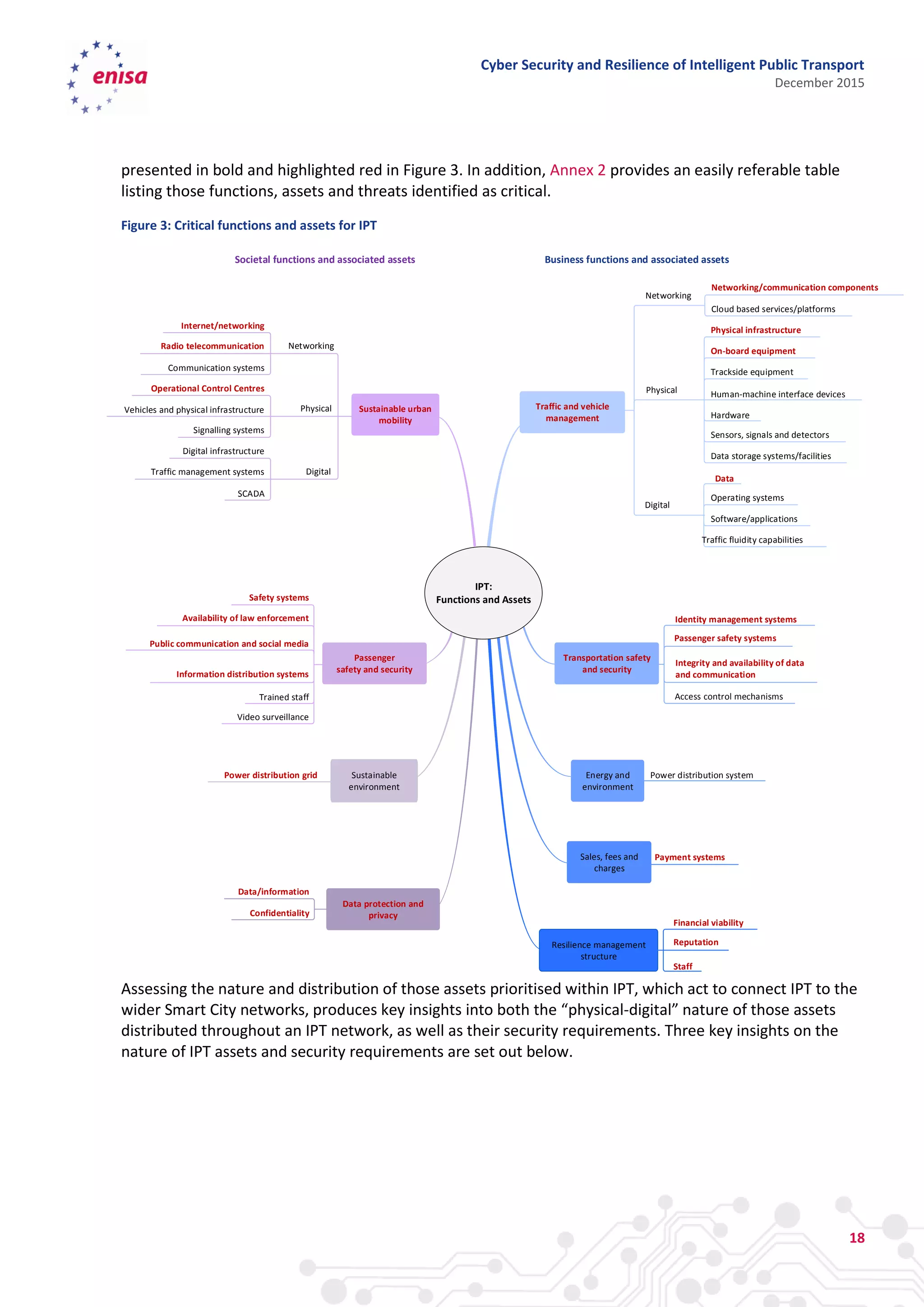
presented in bold and highlighted red in Figure 3. In addition, Annex 2 provides an easily referable table
listing those functions, assets and threats identified as critical.
Figure 3: Critical functions and assets for IPT
Assessing the nature and distribution of those assets prioritised within IPT, which act to connect IPT to the
wider Smart City networks, produces key insights into both the “physical-digital” nature of those assets
distributed throughout an IPT network, as well as their security requirements. Three key insights on the
nature of IPT assets and security requirements are set out below.
Transportation safety
and security
Identity management systems
Integrity and availability of data
and communication
Access control mechanisms
Data storage systems/facilities
Sensors, signals and detectors
Hardware
Human-machine interface devices
Trackside equipment
On-board equipment
Physical infrastructure
Networking/communication components
Cloud based services/platforms
Physical
Networking
Digital
Passenger safety systems
Traffic and vehicle
management
Sustainable urban
mobility
SCADA
Traffic management systems
Digital infrastructure
Signalling systems
Vehicles and physical infrastructure
Operational Control Centres
Physical
Networking
Communication systems
Radio telecommunication
Internet/networking
Digital
Video surveillance
Information distribution systems
Public communication and social media
Safety systems
Availability of law enforcement
Trained staff
Passenger
safety and security
IPT:
Functions and Assets
Societal functions and associated assets Business functions and associated assets
Data
Traffic fluidity capabilities
Software/applications
Operating systems
Power distribution systemEnergy and
environment
Power distribution grid
Payment systemsSales, fees and
charges
Staff
Reputation
Financial viability
Resilience management
structure
Data protection and
privacy
Data/information
Confidentiality
Sustainable
environment
Cyber Security and Resilience of Intelligent Public Transport
December 2015
19
2.3.3 Three key insights on the nature of intelligent public transport assets
 Individual IPT assets combine multiple components: IPT assets are more complex than similar
assets in traditional silo-based transport systems, as they combine multiple assets into one. For
example, a bus is no longer just a public transport vehicle – it is also a data collection and recording
system, an information dissemination asset, mobile Wi-Fi hub, and a source of real-time intelligence
for optimising the transport network. This is especially true for those assets linked to societal
functions.
 The cyber/physical divide disappears within IPT assets: IPT assets fuse together both physical and
digital components. The resulting assets are now cyber-physical hybrids.
 IPT assets are linked together to form individual systems and systems-of-systems shared amongst
multiple stakeholders: Through the use of ICT, the individual assets of a traditional silo-based
transport network are linked together to form a transport operators IPT system. A Smart City links
these assets further by integrating the systems of multiple operators and/or other stakeholders and
providers, forming a system-of-systems.
2.3.4 Three key insights on security for intelligent public transport assets
 IPT assets are subject to a greater range of security threats: When assets become cyber-physical
hybrids, they become susceptible to both physical attacks and cyberattacks.
 Cyber security and physical safety can no longer be treated as separate concerns: When attackers
can affect the physical operation of ICT-enabled vehicles or other physical assets,32
network cyber
security and physical safety become interdependent.
 Determining where an IPT operator’s (security) responsibilities end is no longer clear: By
integrating IPT into the wider Smart City through the sharing of assets, data and ICT networks with
3rd
parties, the boundary of the transport operator’s network is no longer clear. If an organisation
cannot accurately map the network they control, this has important implications for how they
conduct their network risk assessments.
32
Chris Valasek and Charle Miller, Adventures in Automotive Networks and Control Units, 2014.
http://www.ioactive.com/pdfs/IOActive_Adventures_in_Automotive_Networks_and_Control_Units.pdf
Cyber Security and Resilience of Intelligent Public Transport
December 2015
20
2.4 Intelligent public transport environment and elements
In order to discuss IPT it makes sense to place it in the urban context that both justifies the need for
developing IPT systems, as well as provides the necessary cyber-physical infrastructure that enables public
transport to become intelligent. This environment is the Smart City. Producing IPT systems (as opposed to
traditional public transport systems) within this Smart City environment requires the successful integration
of cyber-physical technologies and urban infrastructure. This entails the linking and integration of
(physical) infrastructures and (digital) processes which are not always well connected.27, 33
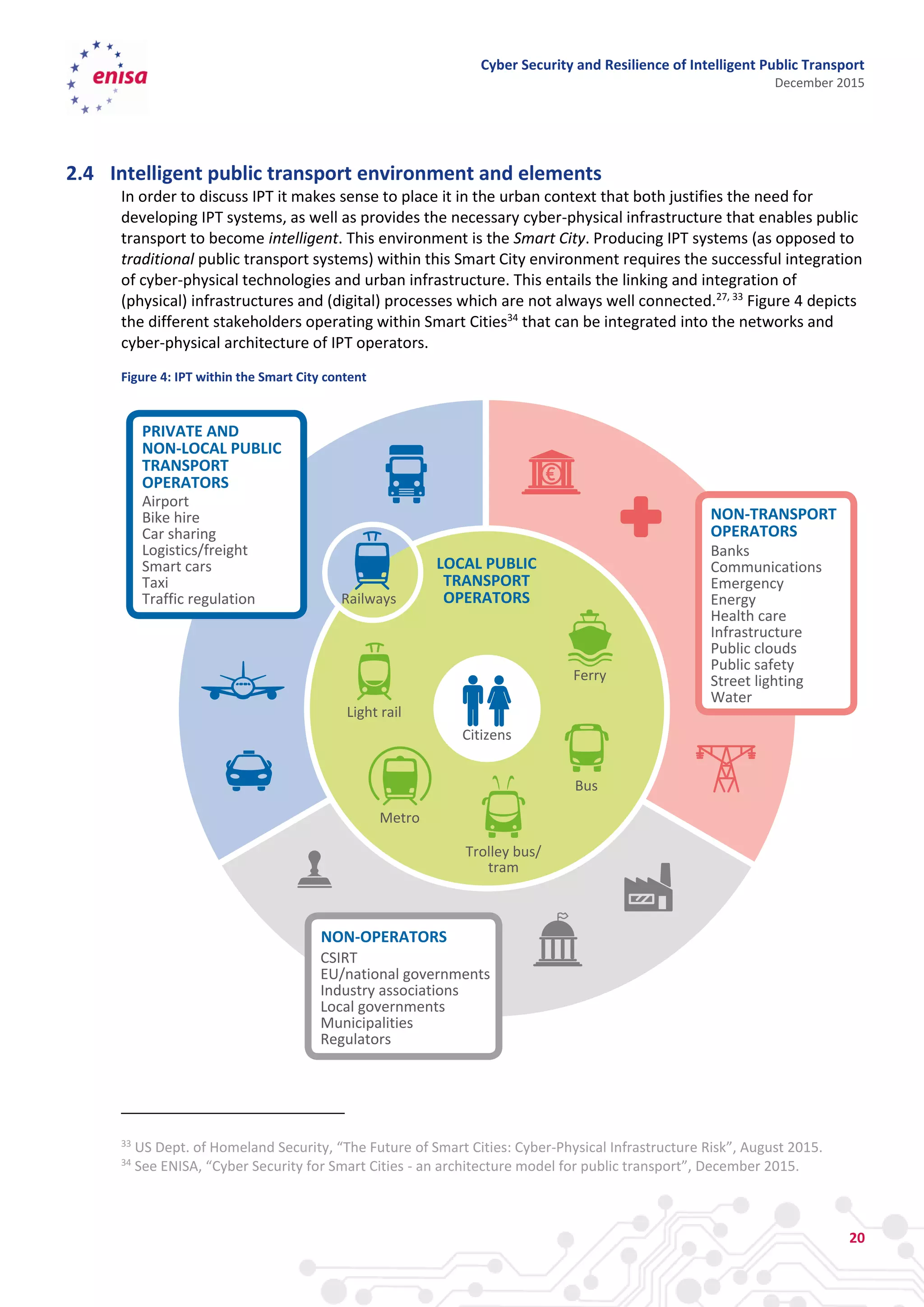
Figure 4 depicts
the different stakeholders operating within Smart Cities34
that can be integrated into the networks and
cyber-physical architecture of IPT operators.
Figure 4: IPT within the Smart City content
33
US Dept. of Homeland Security, “The Future of Smart Cities: Cyber-Physical Infrastructure Risk”, August 2015.
34
See ENISA, “Cyber Security for Smart Cities - an architecture model for public transport”, December 2015.
Banks
Communications
Emergency
Energy
Health/care
Infrastructure
Public/clouds
Public/safety
Street/lighting
Water
Airport
Bike/hire
Car/sharing
Logistics/freight
Smart/cars
Taxi
Traffic/regulation
CSIRT
EU/national/governments
Industry/associations
Local/governments
Municipalities
Regulators
Railways
Light/rail
Metro
Trolley/bus/
tram
Bus
Ferry
Citizens
PRIVATE AND
NON-LOCAL PUBLIC
TRANSPORT
OPERATORS
NON-TRANSPORT
OPERATORS
NON-OPERATORS
LOCAL PUBLIC
TRANSPORT
OPERATORS
Cyber Security and Resilience of Intelligent Public Transport
December 2015
21
3. A need to secure intelligent public transport
This section focuses on the threats, vulnerabilities and risks that are faced by IPT networks and operators
and their impact on both businesses and society. To this end we employ the following definitions35
when
discussing these terms.
 Threat: is the potential cause of an incident that may result in harm to an IPT system or IPT
organisation.
 Vulnerability: is a weakness within an IPT asset that can be exploited by the threats.
 Risk: is the potential that a given threat will successfully exploit vulnerabilities within an IPT asset
and thereby result in harm to the businesses and/or society as a whole.
 Challenges: are current limitations faced by stakeholders on the security status of IPT (as
expressed during the survey and the interviews).
3.1 Threats
3.1.1 Threat model
For the purpose of this study, a practical IPT based threat-taxonomy has been developed. The threats
included in the suggested threat model are all applicable to the IPT assets presented in the previous
section. The presented threat taxonomy covers mainly cyber-security threats; that is, threats applying to
information and communication technology assets. Additional non-IT threats have also been included in
order to cover threats to physical assets that are necessary for the operation of the considered ICT-assets.
Threats appear to be multifaceted and can be directed against specific assets, ranging from IPT systems to
data, through to broad organisational structures and entire IPT infrastructures. Furthermore, due to IPT
assets blurring the lines between digital and physical layers (see Section 3.2), IPT operators lean more
towards multifaceted threats affecting complex assets having both physical and digital characteristics.
This threat taxonomy draws upon the key findings from the survey, interviews and desktop research.
Previous ENISA studies have also been employed as a basis for the taxonomy (e.g. ENISA Threat Landscape
and Good Practice Guide for Internet Infrastructure 2015,36
ENISA Threat Landscape 201337
and the Smart
Grid Threat Landscape and Good Practice Guide).38
In order to keep a practical focus we propose a threat
model that regroups threats into seven threat categories. These groups define the origin of the threat with
each category having its own implications over the security of IPT. However, it must be noted that these
seven threat categories represent a generalised model. The threats each IPT operator must address will
vary depending on multiple factors, including the size of the operator and the contextual nature of their
35
These are contextually modified definitions of those from ETSI TS 102 165-1 V4.2.3 “Telecommunications and
Internet converged Services and Protocols for Advanced Networking (TISPAN); Methods and protocols; Part 1:
Method and preforms for Threat, Risk, Vulnerability Analysis”, March 2011.
http://www.etsi.org/deliver/etsi_ts/102100_102199/10216501/04.02.03_60/ts_10216501v040203p.pdf
36
ENISA, “Threat Landscape and Good Practice Guide for Internet Infrastructure”.
https://www.enisa.europa.eu/activities/risk-management/evolving-threat-environment/enisa-thematic-
landscapes/threat-landscape-of-the-internet-infrastructure
37
ENISA, “ENISA Threat Landscape 2013: Overview of current and emerging cyber threats”.
http://www.enisa.europa.eu/activities/risk-management/evolving-threat-environment/enisa-threat-landscape-2013-
overview-of-current-and-emerging-cyber-threats
38
ENISA, “Smart Grid Threat Landscape and Good Practice Guide”. http://www.enisa.europa.eu/activities/risk-
management/evolving-threat-environment/sgtl/smart-grid-threat-landscape-and-good-practice-guide
Cyber Security and Resilience of Intelligent Public Transport
December 2015
22
operating environment. As such it is essential IPT operators conduct individualised risk assessments to
identify the specific threats that they need to address.
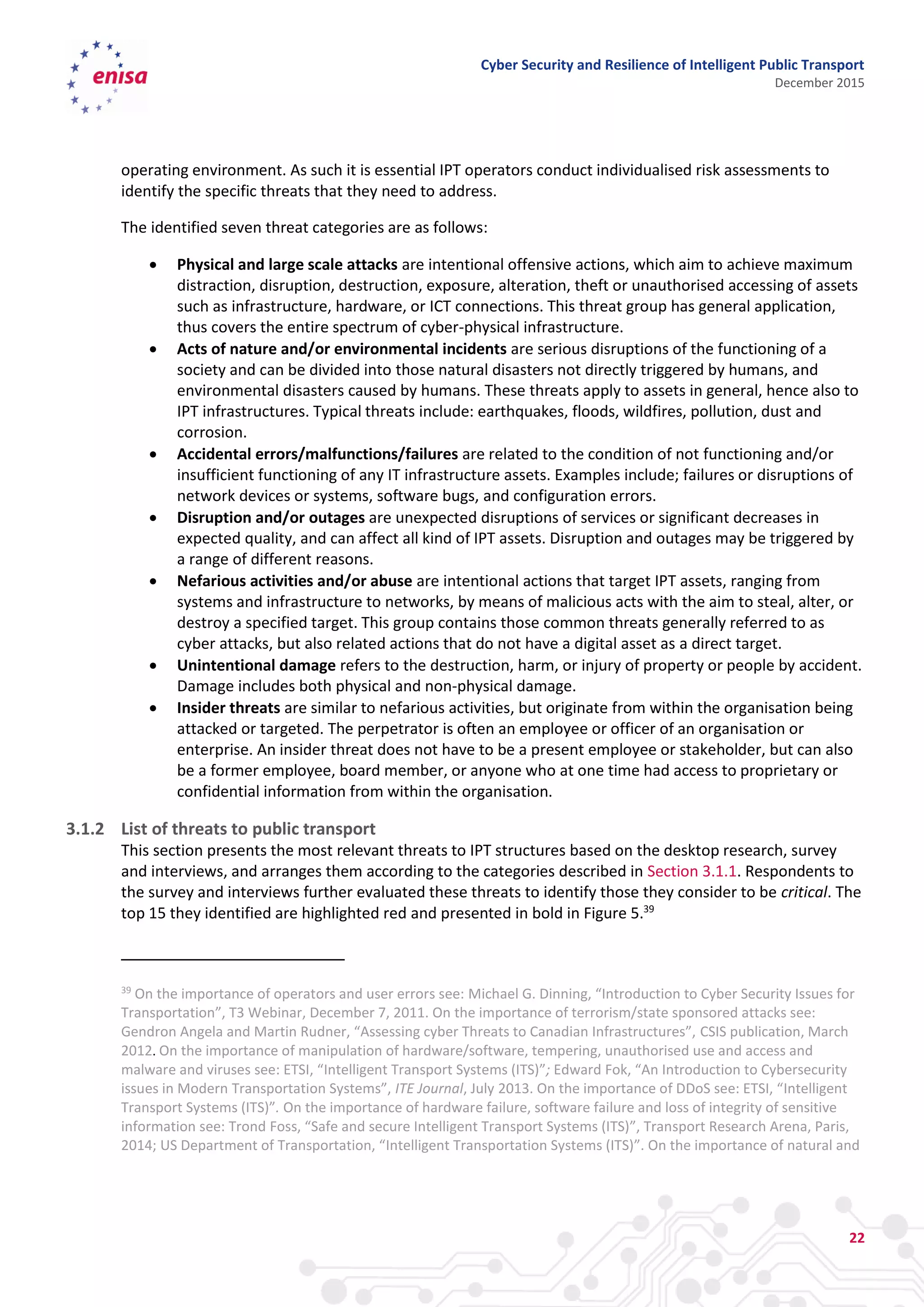
The identified seven threat categories are as follows:
 Physical and large scale attacks are intentional offensive actions, which aim to achieve maximum
distraction, disruption, destruction, exposure, alteration, theft or unauthorised accessing of assets
such as infrastructure, hardware, or ICT connections. This threat group has general application,
thus covers the entire spectrum of cyber-physical infrastructure.
 Acts of nature and/or environmental incidents are serious disruptions of the functioning of a
society and can be divided into those natural disasters not directly triggered by humans, and
environmental disasters caused by humans. These threats apply to assets in general, hence also to
IPT infrastructures. Typical threats include: earthquakes, floods, wildfires, pollution, dust and
corrosion.
 Accidental errors/malfunctions/failures are related to the condition of not functioning and/or
insufficient functioning of any IT infrastructure assets. Examples include; failures or disruptions of
network devices or systems, software bugs, and configuration errors.
 Disruption and/or outages are unexpected disruptions of services or significant decreases in
expected quality, and can affect all kind of IPT assets. Disruption and outages may be triggered by
a range of different reasons.
 Nefarious activities and/or abuse are intentional actions that target IPT assets, ranging from
systems and infrastructure to networks, by means of malicious acts with the aim to steal, alter, or
destroy a specified target. This group contains those common threats generally referred to as
cyber attacks, but also related actions that do not have a digital asset as a direct target.
 Unintentional damage refers to the destruction, harm, or injury of property or people by accident.
Damage includes both physical and non-physical damage.
 Insider threats are similar to nefarious activities, but originate from within the organisation being
attacked or targeted. The perpetrator is often an employee or officer of an organisation or
enterprise. An insider threat does not have to be a present employee or stakeholder, but can also
be a former employee, board member, or anyone who at one time had access to proprietary or
confidential information from within the organisation.
3.1.2 List of threats to public transport
This section presents the most relevant threats to IPT structures based on the desktop research, survey
and interviews, and arranges them according to the categories described in Section 3.1.1. Respondents to
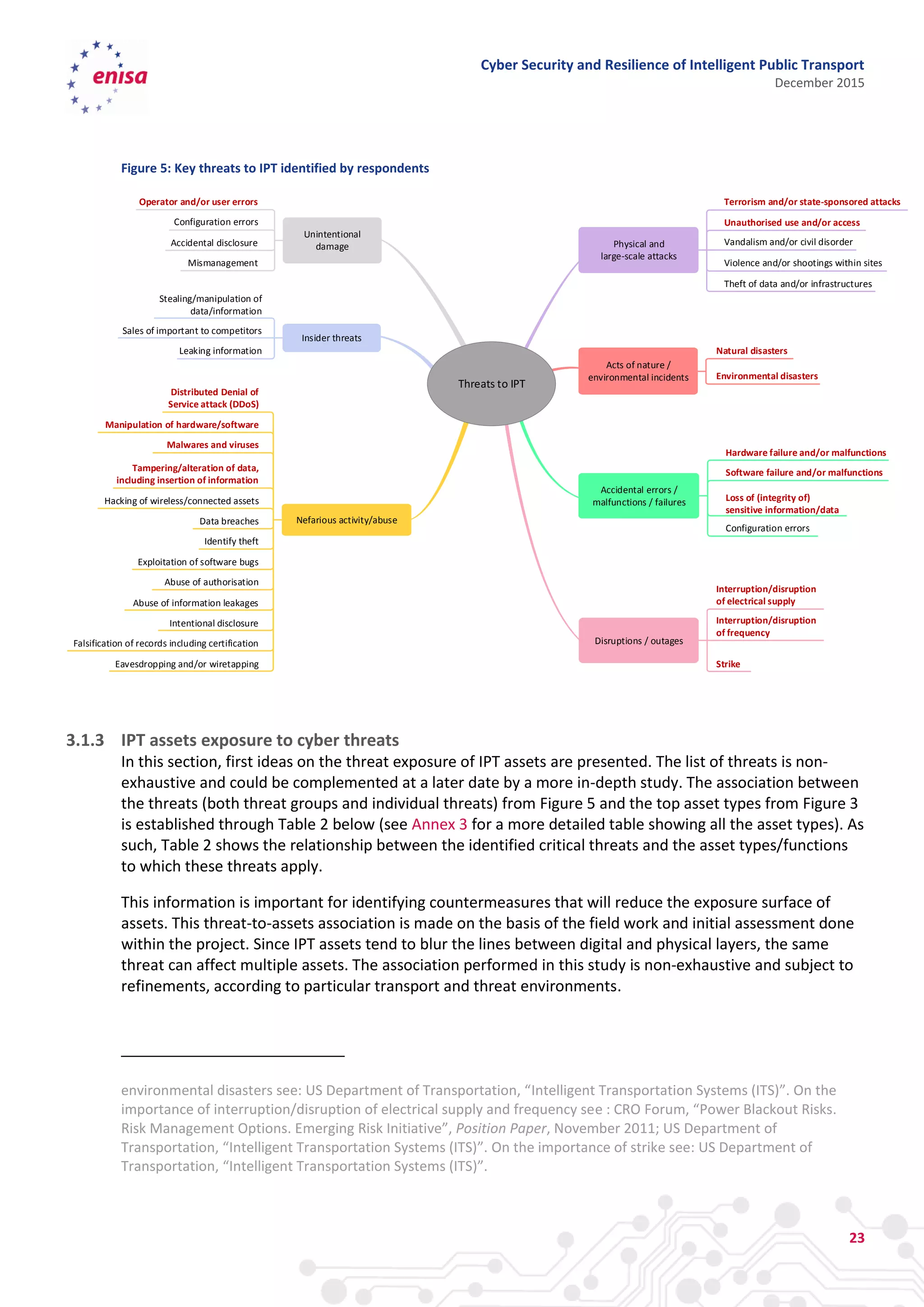
the survey and interviews further evaluated these threats to identify those they consider to be critical. The
top 15 they identified are highlighted red and presented in bold in Figure 5.39
39
On the importance of operators and user errors see: Michael G. Dinning, “Introduction to Cyber Security Issues for
Transportation”, T3 Webinar, December 7, 2011. On the importance of terrorism/state sponsored attacks see:
Gendron Angela and Martin Rudner, “Assessing cyber Threats to Canadian Infrastructures”, CSIS publication, March
2012. On the importance of manipulation of hardware/software, tempering, unauthorised use and access and
malware and viruses see: ETSI, “Intelligent Transport Systems (ITS)”; Edward Fok, “An Introduction to Cybersecurity
issues in Modern Transportation Systems”, ITE Journal, July 2013. On the importance of DDoS see: ETSI, “Intelligent
Transport Systems (ITS)”. On the importance of hardware failure, software failure and loss of integrity of sensitive
information see: Trond Foss, “Safe and secure Intelligent Transport Systems (ITS)”, Transport Research Arena, Paris,
2014; US Department of Transportation, “Intelligent Transportation Systems (ITS)”. On the importance of natural and
Cyber Security and Resilience of Intelligent Public Transport
December 2015
23
Figure 5: Key threats to IPT identified by respondents
3.1.3 IPT assets exposure to cyber threats
In this section, first ideas on the threat exposure of IPT assets are presented. The list of threats is non-
exhaustive and could be complemented at a later date by a more in-depth study. The association between
the threats (both threat groups and individual threats) from Figure 5 and the top asset types from Figure 3
is established through Table 2 below (see Annex 3 for a more detailed table showing all the asset types). As
such, Table 2 shows the relationship between the identified critical threats and the asset types/functions
to which these threats apply.
This information is important for identifying countermeasures that will reduce the exposure surface of
assets. This threat-to-assets association is made on the basis of the field work and initial assessment done
within the project. Since IPT assets tend to blur the lines between digital and physical layers, the same
threat can affect multiple assets. The association performed in this study is non-exhaustive and subject to
refinements, according to particular transport and threat environments.
environmental disasters see: US Department of Transportation, “Intelligent Transportation Systems (ITS)”. On the
importance of interruption/disruption of electrical supply and frequency see : CRO Forum, “Power Blackout Risks.
Risk Management Options. Emerging Risk Initiative”, Position Paper, November 2011; US Department of
Transportation, “Intelligent Transportation Systems (ITS)”. On the importance of strike see: US Department of
Transportation, “Intelligent Transportation Systems (ITS)”.
Threats to IPT
Insider threats
Stealing/manipulation of
data/information
Sales of important to competitors
Leaking information
Physical and
large-scale attacks
Terrorism and/or state-sponsored attacks
Unauthorised use and/or access
Vandalism and/or civil disorder
Violence and/or shootings within sites
Theft of data and/or infrastructures
Unintentional
damage
Operator and/or user errors
Configuration errors
Accidental disclosure
Mismanagement
Nefarious activity/abuse
Distributed Denial of
Service attack (DDoS)
Manipulation of hardware/software
Tampering/alteration of data,
including insertion of information
Malwares and viruses
Hacking of wireless/connected assets
Data breaches
Identify theft
Exploitation of software bugs
Abuse of authorisation
Abuse of information leakages
Intentional disclosure
Falsification of records including certification
Eavesdropping and/or wiretapping
Acts of nature /
environmental incidents
Natural disasters
Environmental disasters
Accidental errors /
malfunctions / failures
Hardware failure and/or malfunctions
Software failure and/or malfunctions
Loss of (integrity of)
sensitive information/data
Configuration errors
Disruptions / outages
Interruption/disruption
of electrical supply
Interruption/disruption
of frequency
Strike
Cyber Security and Resilience of Intelligent Public Transport
December 2015
24
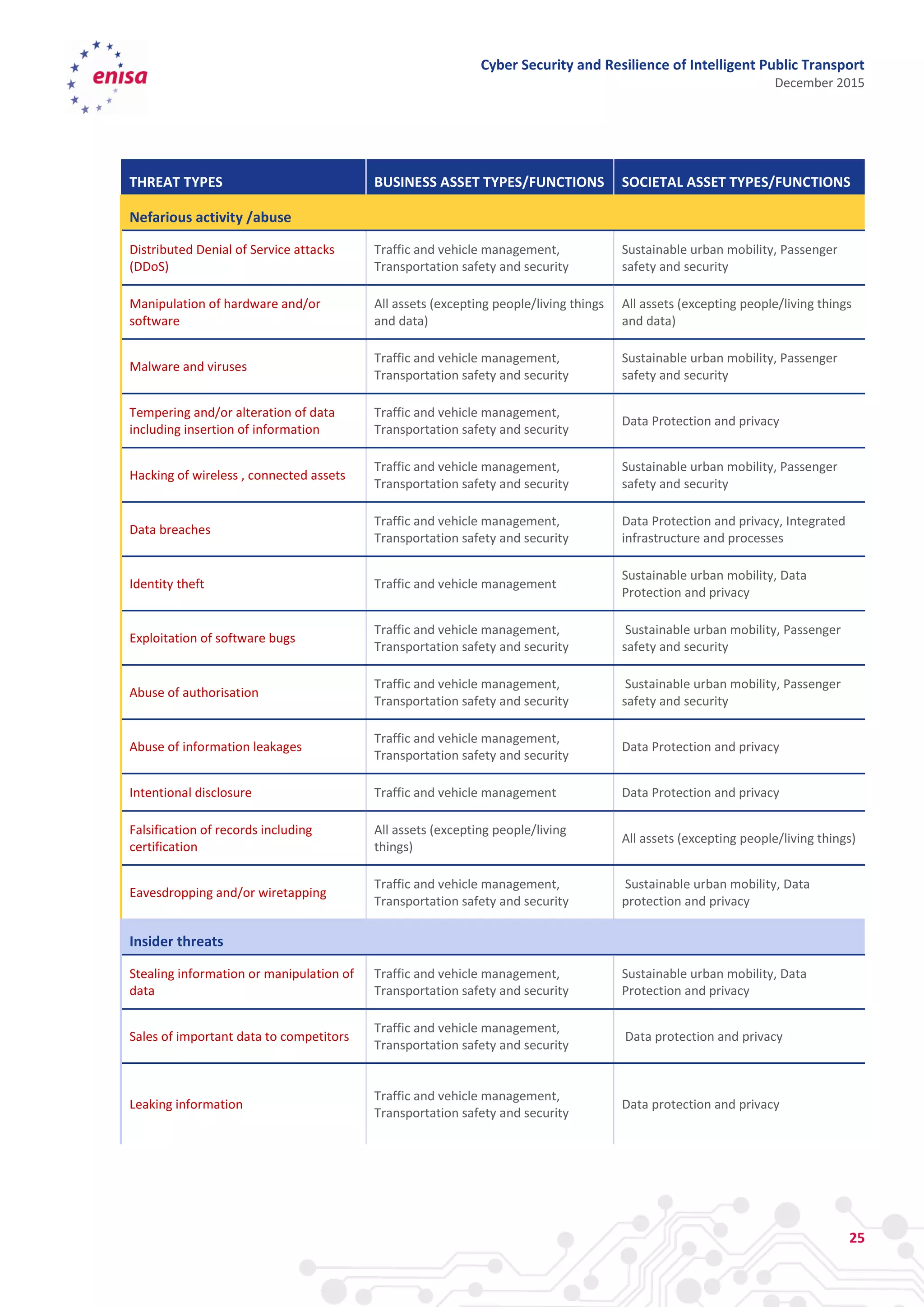
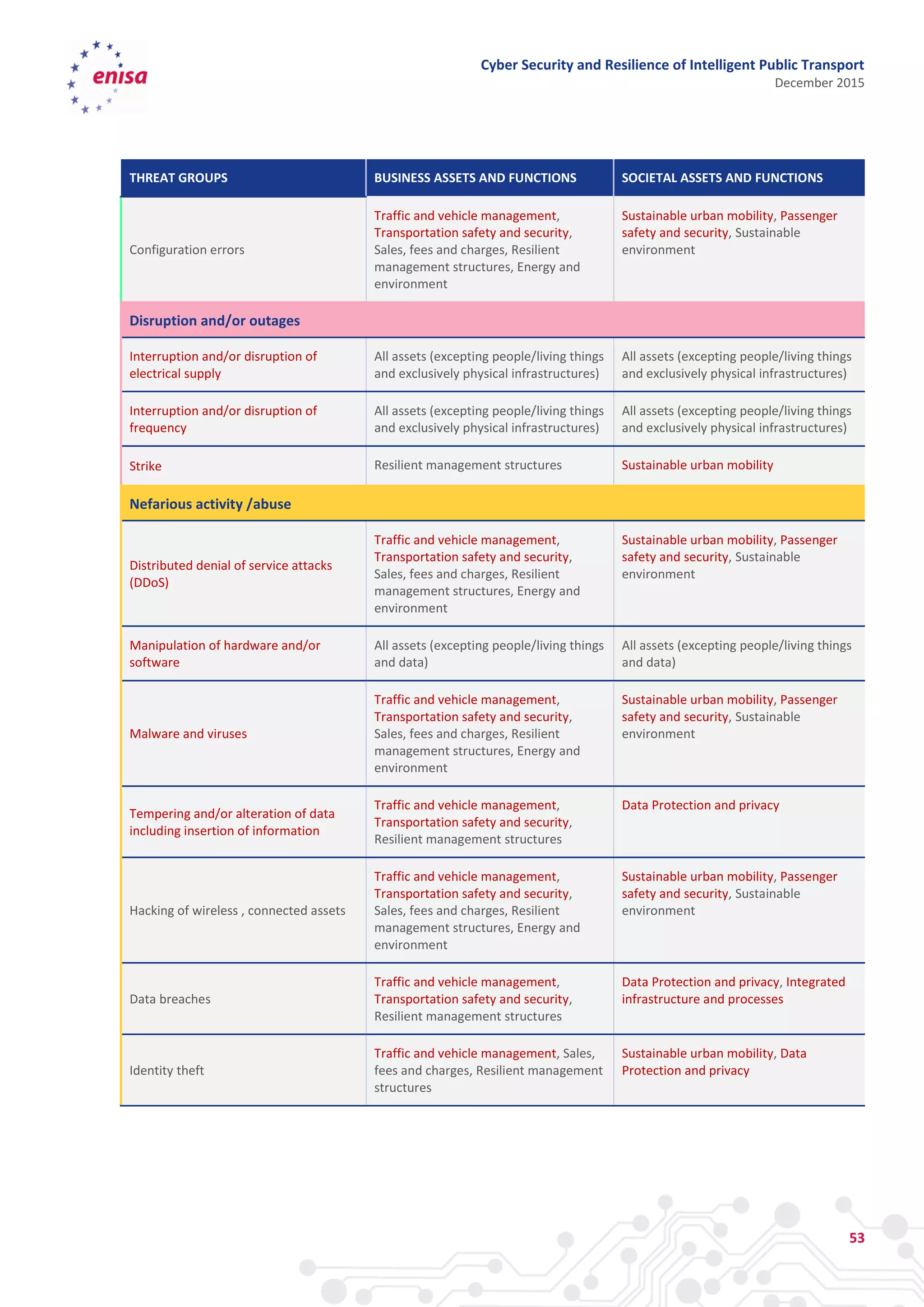
Table 2: Association between IPT threats and assets
THREAT TYPES BUSINESS ASSET TYPES/FUNCTIONS SOCIETAL ASSET TYPES/FUNCTIONS
Physical and large scale attacks
Terrorism and/ or state sponsored
attacks
All All
Unauthorised use and/or access
Traffic and vehicle management,
Transportation safety and security
Sustainable urban mobility, Passenger
safety and security, Data protection and
privacy
Vandalism and/or civil disorder
Traffic and vehicle management,
Transportation safety and security
Sustainable urban mobility, Passenger
safety and security
Violence and/or shooting within sites Traffic and vehicle management Passenger safety and security
Theft of data and/or infrastructures
Traffic and vehicle management,
Transportation safety and security
Sustainable urban mobility, Passenger
safety and security, Data protection and
privacy
Acts of nature / environmental incidents
Natural disasters All All
Environmental disasters All All
Accidental errors/malfunctions/failures
Hardware failure and /or malfunctions
Traffic and vehicle management,
Transportation safety and security
Sustainable urban mobility, Passenger
safety and security
Software failure and/or malfunctions
Traffic and vehicle management,
Transportation safety and security
Sustainable urban mobility, Passenger
safety and security
Loss of (integrity of) sensitive
information/data
Traffic and vehicle management,
Transportation safety and security
Data protection and privacy, Sustainable
urban mobility
Configuration errors
Traffic and vehicle management,
Transportation safety and security
Sustainable urban mobility, Passenger
safety and security
Disruption and/or outages
Interruption and/or disruption of
electrical supply
All assets (excepting people/living things
and exclusively physical infrastructures)
All assets (excepting people/living things
and exclusively physical infrastructures)
Interruption and/or disruption of
frequency
All assets (excepting people/living things
and exclusively physical infrastructures)
All assets (excepting people/living things
and exclusively physical infrastructures)
Strike N/A to the top 15 assets Sustainable urban mobility
Cyber Security and Resilience of Intelligent Public Transport
December 2015
25
THREAT TYPES BUSINESS ASSET TYPES/FUNCTIONS SOCIETAL ASSET TYPES/FUNCTIONS
Nefarious activity /abuse
Distributed Denial of Service attacks
(DDoS)
Traffic and vehicle management,
Transportation safety and security
Sustainable urban mobility, Passenger
safety and security
Manipulation of hardware and/or
software
All assets (excepting people/living things
and data)
All assets (excepting people/living things
and data)
Malware and viruses
Traffic and vehicle management,
Transportation safety and security
Sustainable urban mobility, Passenger
safety and security
Tempering and/or alteration of data
including insertion of information
Traffic and vehicle management,
Transportation safety and security
Data Protection and privacy
Hacking of wireless , connected assets
Traffic and vehicle management,
Transportation safety and security
Sustainable urban mobility, Passenger
safety and security
Data breaches
Traffic and vehicle management,
Transportation safety and security
Data Protection and privacy, Integrated
infrastructure and processes
Identity theft Traffic and vehicle management
Sustainable urban mobility, Data
Protection and privacy
Exploitation of software bugs
Traffic and vehicle management,
Transportation safety and security
Sustainable urban mobility, Passenger
safety and security
Abuse of authorisation
Traffic and vehicle management,
Transportation safety and security
Sustainable urban mobility, Passenger
safety and security
Abuse of information leakages
Traffic and vehicle management,
Transportation safety and security
Data Protection and privacy
Intentional disclosure Traffic and vehicle management Data Protection and privacy
Falsification of records including
certification
All assets (excepting people/living
things)
All assets (excepting people/living things)
Eavesdropping and/or wiretapping
Traffic and vehicle management,
Transportation safety and security
Sustainable urban mobility, Data
protection and privacy
Insider threats
Stealing information or manipulation of
data
Traffic and vehicle management,
Transportation safety and security
Sustainable urban mobility, Data
Protection and privacy
Sales of important data to competitors
Traffic and vehicle management,
Transportation safety and security
Data protection and privacy
Leaking information
Traffic and vehicle management,
Transportation safety and security
Data protection and privacy
Cyber Security and Resilience of Intelligent Public Transport
December 2015
26
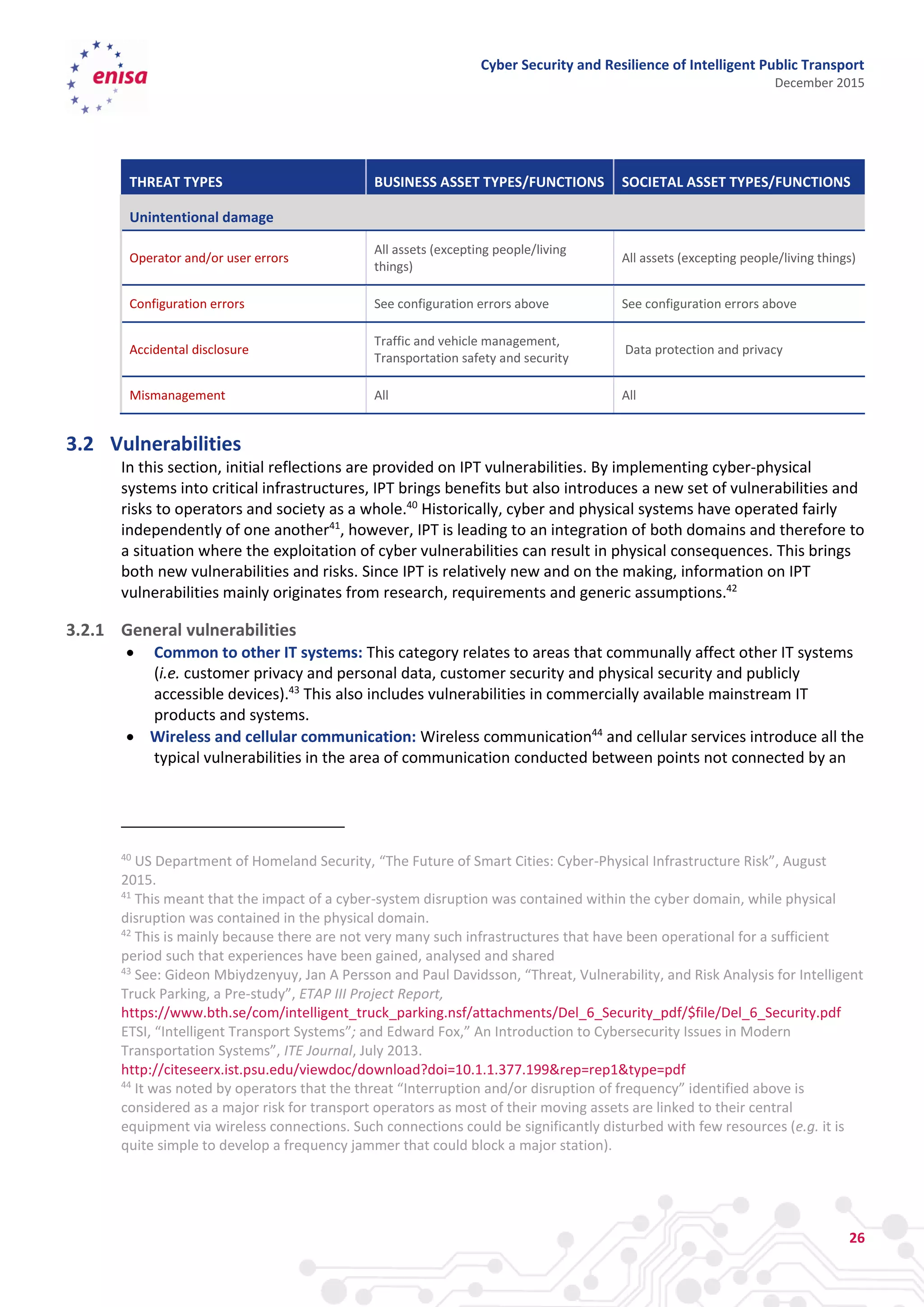
THREAT TYPES BUSINESS ASSET TYPES/FUNCTIONS SOCIETAL ASSET TYPES/FUNCTIONS
Unintentional damage
Operator and/or user errors
All assets (excepting people/living
things)
All assets (excepting people/living things)
Configuration errors See configuration errors above See configuration errors above
Accidental disclosure
Traffic and vehicle management,
Transportation safety and security
Data protection and privacy
Mismanagement All All
3.2 Vulnerabilities
In this section, initial reflections are provided on IPT vulnerabilities. By implementing cyber-physical
systems into critical infrastructures, IPT brings benefits but also introduces a new set of vulnerabilities and
risks to operators and society as a whole.40
Historically, cyber and physical systems have operated fairly
independently of one another41
, however, IPT is leading to an integration of both domains and therefore to
a situation where the exploitation of cyber vulnerabilities can result in physical consequences. This brings
both new vulnerabilities and risks. Since IPT is relatively new and on the making, information on IPT
vulnerabilities mainly originates from research, requirements and generic assumptions.42
3.2.1 General vulnerabilities
 Common to other IT systems: This category relates to areas that communally affect other IT systems
(i.e. customer privacy and personal data, customer security and physical security and publicly
accessible devices).43
This also includes vulnerabilities in commercially available mainstream IT
products and systems.
 Wireless and cellular communication: Wireless communication44
and cellular services introduce all the
typical vulnerabilities in the area of communication conducted between points not connected by an
40
US Department of Homeland Security, “The Future of Smart Cities: Cyber-Physical Infrastructure Risk”, August
2015.
41
This meant that the impact of a cyber-system disruption was contained within the cyber domain, while physical
disruption was contained in the physical domain.
42
This is mainly because there are not very many such infrastructures that have been operational for a sufficient
period such that experiences have been gained, analysed and shared
43
See: Gideon Mbiydzenyuy, Jan A Persson and Paul Davidsson, “Threat, Vulnerability, and Risk Analysis for Intelligent
Truck Parking, a Pre-study”, ETAP III Project Report,
https://www.bth.se/com/intelligent_truck_parking.nsf/attachments/Del_6_Security_pdf/$file/Del_6_Security.pdf
ETSI, “Intelligent Transport Systems”; and Edward Fox,” An Introduction to Cybersecurity Issues in Modern
Transportation Systems”, ITE Journal, July 2013.
http://citeseerx.ist.psu.edu/viewdoc/download?doi=10.1.1.377.199&rep=rep1&type=pdf
44
It was noted by operators that the threat “Interruption and/or disruption of frequency” identified above is
considered as a major risk for transport operators as most of their moving assets are linked to their central
equipment via wireless connections. Such connections could be significantly disturbed with few resources (e.g. it is
quite simple to develop a frequency jammer that could block a major station).
Cyber Security and Resilience of Intelligent Public Transport
December 2015
27
electrical conductor. For example, inadequate security protocols, inadequate authentication
mechanisms, energy constrain, poor security and unreliable communication.45
 Integration of physical and virtual layers: The physical and virtual layers are becoming increasingly
permeable as cyber and physical systems become networked and remotely accessible. “Increased
connectivity, faster speeds, and multi-directional data flows diversify access points into critical
infrastructure, changing and stretching the borders that must be secured.”46
 Cohabitation between legacy and new systems: IPT evolves at different rates among operators
because of several factors including; resource availability, user preferences, and scale and
accessibility. Inconsistency of IPT technologies introduces new vulnerabilities. Blind-spots may emerge
in areas where legacy equipment and infrastructures are still used.46
 Increased automation: While the process of removing or limiting human interaction for IPT systems
through increased automation improves safety by removing the possibility of human error, it also
introduces new potential vulnerabilities. These include, but are not limited to: an increased number of
system access points and, therefore, potential attack vectors; skill atrophy; cascading failures; and
changes in emergency response plans.46
3.2.2 Specific vulnerabilities
 Scale and complexity of transportation networks: This refers to the difficulty of mapping the entire
IPT system (i.e. due to the loss of visibility for all parts of a system) and the difficulty of securing the
connectivity of mobile devices within transportation networks. Other issues include; the need to trust
components and participants within the network, working with teams with different skills and
competences, and the effective involvement of multiple stakeholders.47
 Applying networked technology across large transport systems: This leads to a large number of
system access points stemming from the presence of networked technology across these large
systems, which in turn increase both the difficulty and cost of properly securing each system device.48
 Multiple interdependent systems: This refers to the burden of ensuring the smooth interfacing,
communication, and security among interdependent systems. These diverse systems include; sensors,
computers, payment systems, financial systems, emergency systems, ventilation systems, automated
devices, power relays, etc.46
 Access to real-time data: IPT requires nonstop access to real-time data which in turn leads to higher
costs associated with maintenance and service downtime and therefore increased vulnerability. 46
 Higher volumes of passengers and freight: This refers to logistical and security hurdles of physically
accommodating enormous volumes of passengers and freight, along with the reality that security
breaches could result in public safety risks.46
45
C.K. Marigowda and Manjunath Shingadi, “Security Vulnerability issues in Wireless Sensor Network: A short
Survey”, International Journal of Advanced Research in Computer and Communication Engineering Vol. 2, Issue 7, July
2013
46
US Department of Homeland Security, “The Future of Smart Cities”.
47
Bertrand Berche, Christian von Ferber, Taras Holovatch and Yurij Holovatch, “Public Transport Networks under
Random Failure and Directed Attack”, Workshop NET 2009, Rome, May 28th-30th, 2009; US Department of
Homeland Security, “The Future of Smart Cities”.
48
Mulligan, Catherine, “ICT and the Future of Transport”, Ericsson, 2014.
http://www.ericsson.com/res/docs/2014/ict-and-the-future-of-transport.pdf; and US Department of Homeland
Security, “The Future of Smart Cities”.
Cyber Security and Resilience of Intelligent Public Transport
December 2015
28
 Online passenger services: The online provision of passenger services (such as timetabling, passenger
information and ticket booking) that historically have only been available offline, means these
functions and now susceptible to all the associated cyber risks.
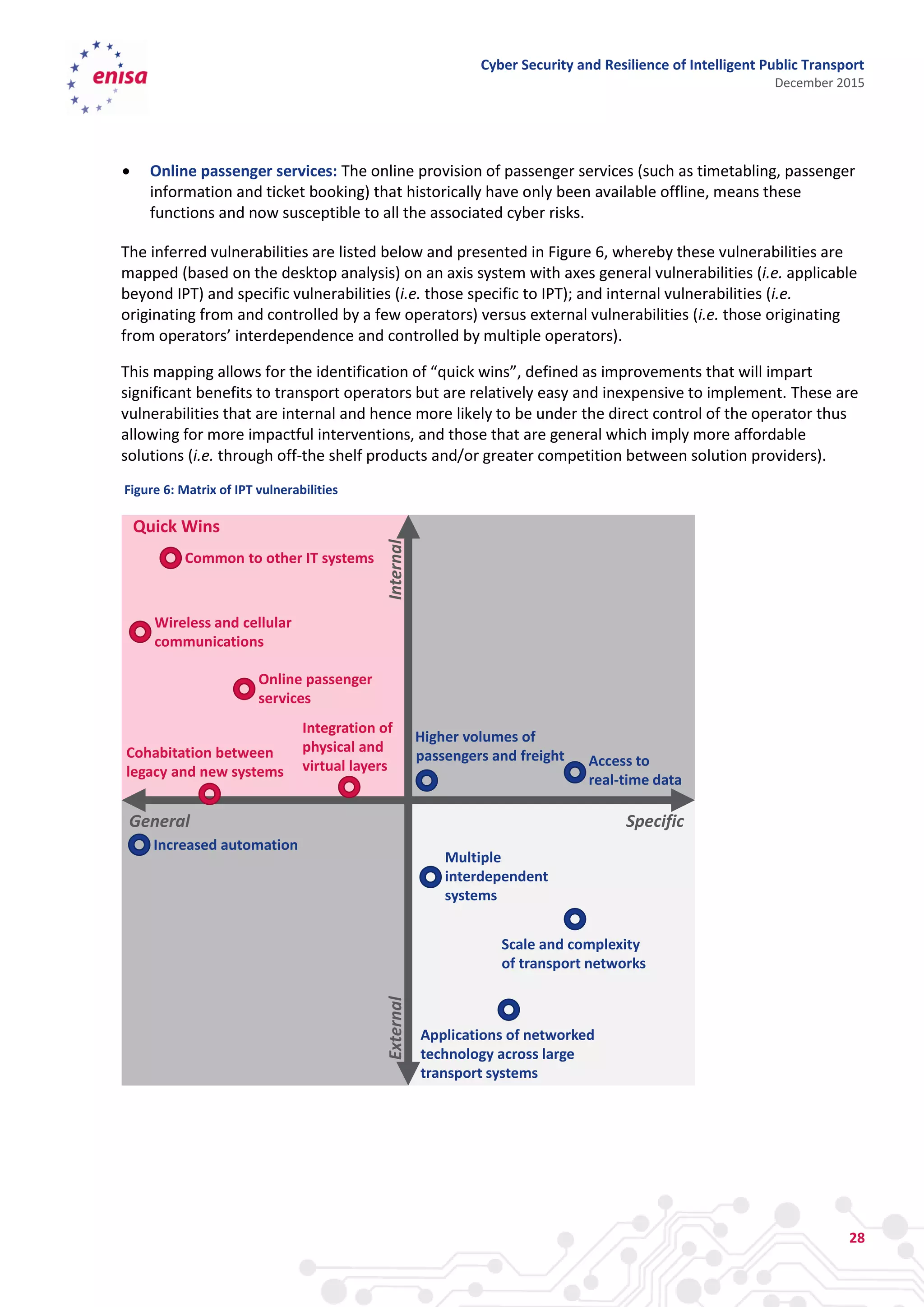
The inferred vulnerabilities are listed below and presented in Figure 6, whereby these vulnerabilities are
mapped (based on the desktop analysis) on an axis system with axes general vulnerabilities (i.e. applicable
beyond IPT) and specific vulnerabilities (i.e. those specific to IPT); and internal vulnerabilities (i.e.
originating from and controlled by a few operators) versus external vulnerabilities (i.e. those originating
from operators’ interdependence and controlled by multiple operators).
This mapping allows for the identification of “quick wins”, defined as improvements that will impart
significant benefits to transport operators but are relatively easy and inexpensive to implement. These are
vulnerabilities that are internal and hence more likely to be under the direct control of the operator thus
allowing for more impactful interventions, and those that are general which imply more affordable
solutions (i.e. through off-the shelf products and/or greater competition between solution providers).
Figure 6: Matrix of IPT vulnerabilities
Quick Wins
Common to other IT systems
Wireless and cellular
communications
Higher volumes of
passengers and freight
Applications of networked
technology across large
transport systems
Scale and complexity
of transport networks
Increased automation
Multiple
interdependent
systems
Access to
real-time data
Online passenger
services
Cohabitation between
legacy and new systems
Integration of
physical and
virtual layers
SpecificGeneral
ExternalInternal
Cyber Security and Resilience of Intelligent Public Transport
December 2015
29
3.3 Risks
As defined earlier, risk is the potential that a given threat will successfully exploit vulnerabilities within an
IPT asset and thereby produce a negative impact on businesses and/or society as a whole.49
Risks exploit several vulnerabilities within an IPT company, but above all those found in the area of: “wireless
and cellular communication”, “cohabitation between legacy and new system” and “integration of physical
and virtual layer”.50
The risks are divided in two categories:
 Business risks, which can be at the source of economic loss and impact normal operations;
 Societal risks, which may lead to safety issues and limit service unavailability.
3.3.1 Business risks
Business risks usually affect different and multiple components due to dependencies between the affected
IPT assets.
 Impact on operations: When operations are impacted, service usually follows a degraded mode.
Specific actions are needed to recover operations, usually in a limited timeframe.
 Loss of revenue: In the case of an incident, operations can become limited or suspended, which
leads to a loss revenues. Moreover, responsibilities in case of an incident can also lead to loss of
revenue (fines…).
 Impact on reputation / loss of trust: In the case of major service disruptions, risks can also cover
reputational damage and the loss of revenue which can directly impact a company’s bottom line.51
 Non-compliance with the regulation on data protection: The disclosure of personal data,
voluntarily or not, is covered by regulation. This risk is usually associated with loss of revenue (due
to fines and mitigation action) and loss of trust (from passengers, clients and municipalities).
 Risks on hardware and software: Risks related to the manipulation or destruction of IPT
components, hardware and software (see Section 3.1 Threats) impact the stability and availability
of the IPT systems. This can lead to the disruption of services, inferior passenger and freight
experience, loss of sensitive data and fraud.52
 Reliance on invalid information: The area of multiple interdependent systems is also becoming a
more relevant source of concern as traffic operators become more interconnected with each other
and with other smart operators. Using invalid information is a risk as it may limit the quality of the
service.
49
In risk management methodologies risk is interpreted as “the risk factor”, which is calculated based upon the
likelihood of a particular threat being successful and the impact that a successful threats would have on the system.
In this study we do not use risk as a risk factor but instead in more general term as the negative impact produced by a
successful threats.
50
Ahmed Abdel Rahim and Ybette Ochoa “A Framework to Analyze the Survivability and Vulnerability of Intelligent
Transportation System Networks”, Journal of Intelligent Transportation and Urban Planning, Jan 2014, Vol. 2 Issue 1,
pp. 22-29
51
Transport for London , “Strategic Risk Management and Assurance Annual Report 2013/14”, July 2013
52
US Department of Homeland Security , “The Future of Smart Cities”.
Cyber Security and Resilience of Intelligent Public Transport
December 2015
30
 Lack of security of dependencies: The more IPT is moving towards “a system of systems”, the
more important is to understand the dependencies among involved components.53
Hence, the
output of individual vulnerability and risk assessments will depend on the particular mix of
components, processes and infrastructure involved in a particular scenario. For example, with the
increasing proliferation of mobile devices in traffic systems mobile security becomes another
important component of the complex traffic infrastructure.
 Unavailability of a dependency: The IPT service depends on several internal and external
dependencies (e.g. power supply, mobile telecommunications…). Hence, the IPT service may suffer
from the unavailability of a dependency and become unavailable.
3.3.2 Societal risks
Similarly to business risk, societal risks are mainly triggered by the manipulation and destruction of IPT
components (see Section 3.1 Threats).54
Effective transportation systems are essential to European society: not only do they enable the mobility of
citizens and goods, they also have significant impacts on economic growth, social development and the
environment.55
Although the expectation is that IPT will cut costs, improve environmental quality and
enhance traditional safety (i.e. by reducing road accidents), it could also amplify old and open up new
societal risks.55
 Unavailability of the IPT service: Given the nature of societal assets,56
these components tend to
be integrated systems which are shared among multiple stakeholders. This amplifies the
interdependency effect and consequently increases the risk that such events will lead not only to
interrupted and disrupted transport services for a single IPT operator but also to the unavailability
of transport systems (i.e. network gridlock) with consequent secondary effects for other sectors,
and increases in traffic accidents.57
 Disruption to the society: The IPT service is used by citizens to carry out their daily lives. Incident
on the transport system will bring disruption to the society with several impacts on the economy
and the life of the citizens. In case of severe network gridlocks, societal financial losses and slower
economic growth could also occur.
 Passengers’ health and safety: Passengers safety in IPT is the priority of all actors. Yet, specific
incidents may impact the transport system and bring a risk to health and safety (e.g. derailing
train…). Furthermore, the international context has changed in recent years: the sustained threat
from terrorism is real and needs to be accounted for when protecting IPT infrastructures.58
53
Steven H. Bayless, Sean Murphy and Anthony Shaw, “Connected Vehicle Assessment. Cybersecurity and
Dependable Transportation”, Connected Vehicle Technology Scan Series, 2012-2014.
54
US Department of Homeland Security , “The Future of Smart Cities”.
55
EC, “ Information Society and Transport: Linking European Policy”, DG Information Society and Media publication,
2006.
56
See Section 2.3
57
CGI, “Could Your Security Vulnerabilities Cause Network Gridlock?”, A Discussion Paper for Transportation
Information Technology Leaders and Executives, http://www.cgi.com/sites/default/files/white-
papers/transportation-information-technology_security-vulnerabilities-causing-network-gridlock.pdf
58
Transport for London , “Strategic Risk Management and Assurance Annual Report 2013/14”, July 2013.
Cyber Security and Resilience of Intelligent Public Transport
December 2015
31
 Environmental impact: The reliance on ICT assets to control energy assets (e.g. fuel, gas,
electricity) may lead to increased energy consumption with an environmental impact. For example,
vehicles may emit higher pollutants than their expected levels. 59
 Confidentiality and privacy: The increased use of sensing, tracking, real-time behavior evaluation
and automated decisions within IPT raises new risks against the confidentiality and privacy of
citizens. 60
3.4 Challenges
This section summarises eight identified key challenges facing cyber security within IPT. Challenges are
identified based on criticisms and/or shortcomings of the existing status quo that were collected during
the survey and the interviews with stakeholders.
While they are numbered 1 to 8 below, these challenges have not been ranked according to any measure
of importance.
3.4.1 Challenge 1: Difficulties to integrate security for safety
While there is a tendency in other contexts to combine safety and security into a single category, within
transport these two concepts are traditionally very separate. Manufacturers and IPT operators usually
prioritise the need for safety requirements, due to the fact that IPT operators experience difficulties in
understanding the concept of (cyber) security, acquiring the necessary skills and developing the necessary
measures to integrate security for safety in their systems.
3.4.2 Challenge 2: Inadequate importance and spending being afforded to cyber security
A key finding from the survey and interviews (see Figure 7) indicates that transport organisations still do
not grant the necessary importance to cyber security within their company. Spending on cyber security
also appears to be inadequate in response to the range of multifaceted cyber threats affecting IPT.
Figure 7: Cyber security spending
3.4.3 Challenge 3: Inadequate checking for countermeasures
The majority of transport organisations do not measure the effectiveness of their countermeasures (see
Figure 8 below presenting findings from the survey and interviews).61
This in turn produces a lack of
59
Even though not directly applied to IPT, the Volkswagen emission scandal shows that emission levels of vehicles can
be modified by software https://en.wikipedia.org/wiki/Volkswagen_emissions_scandal
60
Steinfeld, Aaron, “Ethics and Policy Implications for Inclusive Intelligent Transportation Systems”, Second
International Symposium on Quality of Life Technology, 2010.
61
Please note that the respondents could select multiple relevant answers.
No
40%
Don’t know
40%
Less than 2%
10%
Don't know
10%Yes
20%
Cyber Security and Resilience of Intelligent Public Transport
December 2015
32
awareness and knowledge in relation to what “works” and what “does not work” in cyber security for IPT.
The question of measuring the value of security in a transport organisation is also important when security
teams ask the business to invest in security. The inability to answer this question can often explain why the
business is reluctant to invest.62
Figure 8: Measuring Effectiveness in Cyber security Measures
3.4.4 Challenge 4: Unwillingness to collaborate and exchange information on cyber security
Overall, transport organisations are less than willing to collaborate on and exchange information about
cyber security with other industry players, most likely because of the reputational costs, competitive
pressures and other indirect losses related to cyber crime. Additionally, they may not have implemented
the necessary systems/measures to collect the necessary information to be shared (see Figure 9 below
presenting finding from the survey and interviews). Furthermore, they also have low awareness of any
collaboration and information-sharing activities pertaining to cyber security being carried out within the
sector. However, operators are open to collaborate and exchange information with national Computer
Security Incident Response Team (CSIRT) and Law Enforcement Agencies (LEA).
62
Ashford Warwick, “How can businesses measure the effectiveness of their IT security teams to ensure they are
getting value?”, http://www.computerweekly.com/feature/Security-Think-Tank-How-can-businesses-measure-the-
effectiveness-of-their-IT-security-teams
0%
5%
10%
15%
20%
25%
30%
35%
40%
45%
Cyber Security and Resilience of Intelligent Public Transport
December 2015
33
Figure 9: Cyber security Information Exchange
3.4.5 Challenge 5: Slow phasing out of legacy systems
The existence and use of legacy systems can weaken cyber security. Legacy systems have security controls
typically focused on the simple necessity of reducing the risk of physical product tampering or theft.
However, the security and threat environment within IPT is beginning to shift towards connected
transportation systems as they become increasingly interconnected to the wider world.63
3.4.6 Challenge 6: Inadequate data exchange between IPT and Smart Cities operators
Data exchanges between IPT and different Smart Cities operators (i.e. railways, LEA, local government,
etc.) tend to be restricted, uncoordinated and ad-hoc. These interactions also vary depending on the
context and/or business model adopted by the operators.64
The potential implications of this uneven data
exchange include weaker security as threats are not being communicated and there is uncertainty over
who is responsible for the security of individual components within systems that integrate multiple
stakeholders.
3.4.7 Challenge 7: Weak situational awareness of cyber threats
Due to the fast moving and interconnect nature of IPT, transport organisations are struggling to achieve a
full awareness of the range of cyber threats and boundaries for securing the IPT landscape.65
3.4.8 Challenge 8: Resistance to security adoption
One finding from the field work indicates that some countermeasures are widely adopted even though
they are not considered effective (e.g. monitoring ICT systems for hardware and software faults), while
others that are considered effective are frequently not deployed (e.g. privacy-by-design, building-in
redundancy and shut down procedures). This underlines a resistance to adapt within the IPT sector and a
culture where things are done because operators are told to do them and/or have always done them
rather than because they work.
63
Steven H. Bayless, Sean Murphy and Anthony Shaw, “Connected Vehicle Assessment. Cybersecurity and
Dependable Transportation”, Connected Vehicle Technology Scan Series, 2012-2014.
64
For example electrified transport systems report good integration with energy suppliers. Some data exchanges are
happening between infrastructure providers, law enforcement and emergency services (and to a less extent with
local government, transport industry associations, e.g. UITP, and government/regulatory bodies) in relation to
criminal incidents and emergency events yet other stakeholders/elements such as banks and social media are often
not well integrated.
65
US Department of Homeland Security, “The Future of Smart Cities”.
Mandatory
10%
Voluntary
20%
Plan to do
20%
No
30%
Don't know
20%
Cyber Security and Resilience of Intelligent Public Transport
December 2015
34
4. Good practices for securing intelligent public transport
This section sets out existing good practices for securing IPT networks as identified through both an
analysis of existing good practice documentation complemented by interviews with a range of
stakeholders, including; transport operators, Smart City municipalities, risk managers and cyber security
experts. By good practices we are referring to effective security measures that should be implemented if
they address weaknesses identified during a risk assessment of your business operation. The inclusion of
these good practices reflects our intention that this study should operate as a practical guide for IPT
operators, one that will assist in supporting their internal processes.
One point that must be remembered when considering the good practices discussed here is that this
section only deals with existing good practices as identified during the desktop research and the survey
and interviews. Gaps in the current suite of existing good practices are not addressed here, but are
identified and discussed in Section 5.
This section provides a brief description of each individual good practice identified to secure IPT. They are
presented and arranged into three categories according to their inherent nature:
 Technical good practices;
 Policies and standards;
 Organisational, people and processes.
These good practices are effective to counter threats before, during and/or after an attack. For more
information, Annex 4 details these good practices by presenting them as a checklist to assist stakeholders
in their assessment and implementation.
4.1 Technical good practices
Conduct security-focused risk assessments: Each operator should conduct regular risk assessments
covering physical, cyber and information security that entail mapping the scope of their business
operations, identifying the critical business functions, and then identifying the assets critical to these
functions. Regular risk assessments are required to identify changes in the threat landscape and thereby
ensure that the correct threats to the business are identified and efficiently addressed.66
Employ appropriate physical security, access controls and protection measures: Physical security is
required to protect both the physical and digital assets of an IPT network by preventing unauthorised
physical access to sensitive locations, whether deliberate and unintentional. The nature of the physical
security employed should be commensurate to the assets being protected67
(i.e. from simple locks for
areas designated low risk/value to layered security, such as multi-factor authentication systems potentially
combined with guards/CCTV, for high risk/value areas).68
66
See Cristin Goodwin and Paul Nicholas, “Developing a City Strategy for Cybersecurity: A seven-step guide for local
governments”, October 2014. http://download.microsoft.com/download/1/B/3/1B3C6BE3-8FA4-40BD-9BD6-
640FD2F1F648/City%20Strategy%20for%20Cybersecurity.pdf
67
A Risk Assessment will be required to differentiate between areas of high risk/value and low risk/value.
68
Ross Anderson, “Security Engineering (2nd
Edition)”, 2008.
Cyber Security and Resilience of Intelligent Public Transport
December 2015
35
Employ secure digital access controls to networks and data: To complement physical security measures,
IPT operators must ensure they employ robust digital access controls to their networks and stored data
(whether in local servers or cloud-based) so as to prevent attackers accessing these via ICT due to the
prevalent of these attacks on both large and small businesses.69 70
Common measures include: firewalls;
password controls; multi-factor authentication; use of firewall based VPNs.71 72
Employ alarms/surveillance for protecting physical and digital assets: Closely linked to the monitoring
and recording of activity is the need to install alarms and surveillance systems across the cyber/physical
network of an IPT operator to secure that network. Alarms and surveillance systems designed to focus the
attention of operators on specific locales or events are necessary requirements. This is because the size
and complexity of an IPT network distributed across a city demands the implementation of systems
enabling a limited security team to effectively monitor the entire network.
Encryption: Operators need to ensure the confidentiality of sensitive data (e.g. customer/employee
financial details, intellectual property, etc.) that they both hold (either internally or on external
servers/clouds) and communicate across networks, due to the prevalence of cyber attacks.68
In effect, IPT
operators should work on the assumption their digital systems will be successfully accessed by attackers.
To this end they should employ industry-recognised encryption standards,73
use VPNs,74
and if available
make use of national cyber security agencies to guide on encryption methods.
Develop secure and private communication networks: Operators need to ensure the security of their
communication networks and the privacy of the data traveling across these networks as they represent a
target for attacker. As IPT communication networks include both physical and digital elements, a
combination of protection methods are required, including; tamper-resistant devices, access controls,
firewalled VPNs, encryption, message integrity provisions, network intrusion detection systems, etc.75
Employ intrusion detection systems (IDSs): IDSs aid in monitoring a network to inform on internal and
external attacks, malicious network communications and usage of computer systems. Common methods
include anomaly detection and misuse (signature) detection.76
IDSs are needed to supplement firewalls
69
HM Government, “2015 Information Security Breaches Survey”, June 2015.
http://www.pwc.co.uk/assets/pdf/2015-isbs-technical-report-blue-03.pdf
70
Mariana Carroll and Paula Kotzé, “Secure Cloud Computing: Benefits, Risks and Controls”, Information Security
South Africa, 2011. http://researchspace.csir.co.za/dspace/bitstream/10204/5184/1/Kotze4_2011.pdf
71
HM Government, “Cyber Essentials Scheme: Requirements for basic technical protection from cyber attacks”, June
2014.
https://www.gov.uk/government/uploads/system/uploads/attachment_data/file/317481/Cyber_Essentials_Require
ments.pdf
72
Government of the HKSAR, “VPN Security”, February 2008.
http://www.infosec.gov.hk/english/technical/files/vpn.pdf
73
See for example: ENISA, “Algorithms, key size and parameters report – 2014”, November 2014; ANSSI,
“Mécanismes cryptographiques, V2.03” 2014; BSI “Kryptographische Verfahren: Empfehlungen und Schlussellangen:
BSI TR-02102-1”, February 2015.
74
Ye Yan, Yi Qian, Hamid Sharif and David Tipper, “A survey on Cyber Security for Smart Grid Communications”,
Communication Surveys & Tutorials, IEEE, Vol.14(4), 2012, pp.998-1010.
75
Hung-Jen Liao, Chun-Hung Richard Lin, Ying-Chih Lin and Kuang-Yuan Tung, “Intrusion detection system: A
comprehensive review”, Journal of Network and Computer Applications, Vol.36, 2013, pp.16-24.
76
Chih-Fong Tsai, Yu-Feng Hsu, Chia-Ying Lin, and Wei-Yang Lin, “Intrusion detection by machine learning: A review”,
Expert Systems with Applications, Vol.36, 2009, pp.11994-12000.
Cyber Security and Resilience of Intelligent Public Transport
December 2015
36
and virus scanners as there is no network security measure that will ensure perfect cyber security. Hence
IPT operators should employ multiple protection measures through a defence-in-depth approach.
Employ identity management and authentication systems: To secure IPT requires restricting access to
both physical spaces and digital networks, such that only authorised individuals can access these spaces.
This requires the implementation of measures, such as multifactor (i.e. two and three-factor)
authentication systems, for confirming that the person seeking access is who they claim to be. Additionally
there is the need to link activity within a network to the identity of the actor to prevent repudiation:
measures such as digital signatures, access controls, and audit trails should be employed here.77
Integrate shut-down procedures/remote deactivation of capabilities, for assets: Malfunctioning,
compromised or stolen assets may be in geographically remote locales on a transport network. To enable
prompt reactions by IPT operators, the ability to either remotely shut-down or deactivate certain
capabilities/functionalities of these assets can minimise damage/loss. Operators can use SCADA systems to
issue such supervisory commands to field devices/assets.78
Operate in degraded mode of operation: In case of a failure, the system might still operate at with a
reduced level of service. In these conditions, the IPT system manages to ensure certain critical functions at
a minimum level. For that purpose, IPT operators have to determine which key performance indicators can
be relaxed until the normal service is recovered.
4.2 Policies and standards
Employ security by design: Physical/cyber infrastructure should incorporate security requirements
upstream during the engineering process to minimise the potential and impact of breaches. As per these
requirement, employing security by design improves the security capabilities of products and helps
mitigate the likelihood of the costly retrofitting of security protections.79
Establish disaster recovery processes and maintain back-ups: It is imperative to develop and establish a
disaster recovery processes, and to maintain back-ups of business data preferably in a remote secure
location to minimising the likelihood of collateral damage. These actions acknowledge the reality that
despite an operator’s best security efforts, it is inevitable that incidents will occur,80
whether through
deliberate attacks, user errors, accidents and/or environmental incidents.
Define degraded modes of operation: The definition of degraded modes of operation contributes to
enhancing the resilience of the IPT system by ensuring a minimum level of service. One of several
degraded modes can be defined in function of the systems impacted and the dependencies identified. For
example, degraded modes of operation are applied in air traffic management in order to ensure safety.81
77
Thomas Calabrese, “Information Security Intelligence: Cryptographic Principles and Applications”, 2004.
78
Bonnie Zhu, Anthony Joseph and Shankar Sastry, “A Taxonomy of Cyber Attacks on SCADA Systems”, Internet of
Things (iThings/CPSCom), 2011 International Conference on and 4th International Conference on Cyber, Physical and
Social Computing, pp.380-388, October 2011.
79
Ann Cavoukian and Marc Chanliau, “Privacy and Security by Design: A Convergence of Paradigms”, January 2013.
https://www.ipc.on.ca/images/resources/pbd-convergenceofparadigms.pdf
80
A. Bartoli et al., “Security and Privacy in your Smart City”, EU project ICT-258512 EXALTED, December 2011.
81
Chris Johnsona, Barry Kirwanb and Tony Licuc , “The interaction between safety culture and degraded modes: A
survey of national infrastructures for air traffic management”, October 2009. http://www.palgrave-
journals.com/rm/journal/v11/n3/pdf/rm200910a.pdf
Cyber Security and Resilience of Intelligent Public Transport
December 2015
37
Implement an information security policy: An organisation’s information security policy sets their course
for information security. It emphasises the need for information security to all staff members, and reflects
the commitment of the organisation to operate in a controlled, secure manner and achieve information
security.82
Failure to develop and implement an information security policy undermines the operator’s
ability to focus their information security activities consistently across their organisation.
Forecasting, early warning systems and risk analysis: IPT operators possess finite security resources,
hence it is essential they can direct these resources appropriately so as to maximise their impact. Knowing
of, or predicting the risk of, threats in advance of their emergence enables the stakeholder to efficiently
allocate their resources and to take pre-emptive steps to mitigate damages.
Separate critical systems from non-critical systems: Critical systems (i.e. those controlling steering,
braking, etc.) should not be accessible though other non-critical systems installed within the same vehicle
(e.g. information displays, entertainment systems, etc.). Successful attacks on critical systems in smart
vehicles where access was gained through non-critical systems demonstrates the safety and security
imperatives of keeping these systems separate.83 84
Similarly, networks linking critical systems and/or those
essential to the provision of critical services should be separated (either physically or virtually) from
networks linking non-critical systems/services.85
Enhance physical security protecting critical physical infrastructure: Risk assessments should be used to
identify which infrastructure is critical to the IPT operator and, enhanced physical protection measures
should be implemented as a result.86
Each operator will have their own unique assets requiring protection,
and this two-step process ensures resources are allocated on an evidence basis.
Implement a security control centre with real-time monitoring: A centralised control centre for directing
and coordinating security resources to respond to threats as they are identified enables the efficient
allocation of resources, and provides a recognisable point of contact for liaising with LEA, CSIRTs and other
Smart City stakeholders.
Ensure redundancy for critical systems: Building redundancy into critical systems reduces the likelihood
that the failure of a single or small number of components, or an isolated incident within the network, will
result in the failure of the entire network. While this good practice is applicable to all critical systems, two
specific instances were highlighted by respondents as being particularly critical for IPT, these being;
communication systems and power systems.
Create resilient communication systems: Communication systems are essential components of IPT
systems with the integration of ICT into public transport defining IPT. At its extreme, the failure of the
communication system will halt an IPT network, and these communication systems are susceptible to a
multitude of physical and cyber attacks, acts of nature and environmental incidents. Hence it is essential to
82
Karin Hone and J.H.P Eloff, “What Makes an Effective Information Security Policy?”, Network Security, Vol.6(1),
2002, pp.14-16.
83
BBC News, “Fiat Chrysler recalls 1.4 million cars after Jeep hack”, 24 July 2015.
http://www.bbc.co.uk/news/technology-33650491
84
BBC News, “Car hack uses digital-radio broadcasts to seize control”, 22 July 2015.
http://www.bbc.co.uk/news/technology-33622298
85
See Eric D. Knapp and Joel Langill, “Industrial Network Security: Securing Critical Infrastructure Networks for Smart
Grid, SCADA, and Other Industrial Control Systems (2nd
edition)”, 2015.
86
This is not to say that non-critical infrastructure should be unprotected; merely that critical infrastructure should be
assessed for additional protections.
Cyber Security and Resilience of Intelligent Public Transport
December 2015
38
build redundancy into IPT communication systems so no single failure will break the network. When public
telecommunication networks are used, this resilience can be contractual if specified in the Service Level
Agreement established with communication providers.
Create resilient power systems: IPT infrastructure (including some vehicles) require electricity to operate.
Nevertheless, these power systems are susceptible to a multitude of physical and cyber attacks, strikes,
acts of nature and environmental incidents which can lead to disruptions and outages. Hence it is essential
to build redundancy into IPT power networks so that no single point of failure exists. This resilience can be
contractual if specified in the Service Level Agreement established with power suppliers.
4.3 Organisational, people and processes
Monitor and record activity: Operators need to implement technologies to monitor and record both
physical activity at high value locations (e.g. CCTV, authentication logging, etc.) and digital activity (e.g.
activity logs) on their networks as part of a cohesive Security Management System.87
These measures are
required for multiple purposes including: ensuring safety, providing security, the gathering of forensic
evidence, system recovery processes, training purposes, identifying insider threats, data for risk analyses,
maintaining system stability, etc.88
Define security requirements during procurement processes: During the procurement process “security”
needs to be afforded the same importance as “functionality”. This enhancing of the status of security at
this early stage is to decrease business risks posed by cyber and physical threats, and acts to mitigate the
likelihood of the costly retrofitting of security protections.89
Coordinate with LEAs and CSIRTs: IPT operators should coordinate with LEAs/CSIRTS. The level of
coordination can include sharing threat/good practice information, developing and running online training
programmes, and conducting live drills.90
This level of coordination is necessary as LEA/CSIRTs occupy
privileged positions to see emerging and/or applicable threats from other stakeholders outside of IPT.
Raise awareness on cyber threats to all levels of staff including management: Cyber threats keep evolving
at fast pace. It is important to raise awareness among staff by informing them periodically about current
and top threats targeting IT systems and assets of the organisation. Highlighting security good practices to
protect against these threats is also important. In order to improve the awareness level efficiently, all staff
including non-technical staff and in particular management shall be informed. In particular, informing
management on existing governance models is likely to help integrating cyber security in the organisation.
Engage in staff training: IPT staff are valuable assets for protecting the network against both physical and
digital threats. They are also a potential source of threats to the network through accidently introducing
viruses and malware, as spearfishing victims, etc. To maximise benefits and minimise risks, pre-emptive
training programmes complemented by post-event training (to incorporate “lessons learnt”) are essential.
87
Giovanni Bocchetti, Francesco Flammini, Concetta Pragliola and Alfio Pappalardo, “Dependable integrated
surveillance systems for the physical security of metro railways”, Third ACM/IEEE International Conference on
Distributed Smart Cameras, 2009.
88
Preeti Tuli and Priyanka Sahu, “System Monitoring and Security Using Keylogger”, International Journal of
Computer Science and Mobile Computing, Vol.2 (3), March 2013, pp.106-111.
89
Robert Newby, “Security Think Tank: Procurement and security are uneasy bedfellows”, ComputerWeekly.com,
November 2013.
90
See Cristin Goodwin and Paul Nicholas, “Developing a City Strategy for Cybersecurity: A seven-step guide for local
governments”, October 2014.
Cyber Security and Resilience of Intelligent Public Transport
December 2015
39
Develop organisational and operational procedures and guidelines: The development and
implementation of operational guidelines and procedures should be integrated into the culture of an IPT
via staff training. Without this process, good practices, lessons learnt from prior incidents and corporate
knowledge cannot be retained and applied throughout an organisation in a systematic fashion.
Cyber Security and Resilience of Intelligent Public Transport
December 2015
40
5. Gap analysis
This section provides an analysis of the main gaps in relation to cyber security in IPT as identified during
the field work. Gaps were elicited from the comparison between the identified threats, vulnerabilities and
risk, and good practices.
Gaps to be addressed are widespread and focused not just on technology but also on other areas, such as:
organisational gaps, policy and standardisation issues, and the need to develop more comprehensive and
integrated tools. This section summaries eight identified key cyber security gaps in IPT. While they are
numbered 1 to 8 below, these gaps have not been ranked according to any measure of importance.
5.1 Gap 1: Lack of a common EU approach to Intelligent Public Transport Security
There is currently no common EU approach specific to either intelligent or standard public transport, or
related framework that specifically address IPT cyber security needs (see Section 2.2 for an analysis on EU
legislation).91
Potentially the proposed NIS Directive might have an impact on addressing elements of this
gap, above all in relation to cyber threat reporting, but may need to be expanded to encompass
requirements for IPT cyber security within both urban transport networks and national/international rail
networks.
5.2 Gap 2: No integration of security in current EU guidelines for IPT
Although there are EU guidelines on cyber security, very little is specifically designed for intelligent
transport.92
A gap here exists for EU common guidelines that deal more closely with intelligent transport
above all in relation to enhancing the cyber security of IPT systems and the implementation of appropriate
processes with a suitable cyber security focus.93
Furthermore, although some initial developments in
relation to an EU-wide strategy for intelligent transport have been put in place in recent years, via the
action plan for the Deployment of Intelligent Transport Systems in Europe94
and the Directive
2010/40/EU95
requiring MS to develop their own strategy for implementing transport, these attempts do
not focus on cyber security.96
Therefore there is still a gap in relation to comprehensive and integrated
guidelines or strategies tailored to secure IPT from cyber threats. Such guidelines could define the action
of different stakeholders involved on IPT cyber security (e.g. coordination, responsibilities…).
5.3 Gap 3: Lack of common definitions and formalised cyber security policies
The field work indicates that definitions for IPT are not widely used or adopted (see Figure 10) within
transport organisations. Furthermore, the majority of transport organisations do not have a formalised
91
While Directive 2008/57/EC is a partial exception here covering the interoperability of EU railways, this Directive
also has nothing to say on cyber security needs.
92
See: ENISA, “Good Practice Guide for Incident Management”, 2010; and ENISA, “Technical Guidelines on Security
Measures”, October 2014.
93
More mature IPT implies the coordination and cooperation among different operators and users in different
countries , hence the EU focus is a paramount.
94
EC, “Action Plan for the Deployment of Intelligent Transport Systems in Europe - COM(2008) 886 final/2 –
CORRIGENDUM”, 2008.
95
EC, “Directive 2010/40/EU on the framework for the deployment of Intelligent Transport Systems in the field of
road transport and for interfaces with other modes of transport”, 2010.
96
In addition they only address road vehicles, therefore other major modes of transportation of IPT are not covered.
Cyber Security and Resilience of Intelligent Public Transport
December 2015
41
cyber security policy in place and/or list of critical assets that need to be protected by cyber threats (see
Figure 11). There is need for common definitions and the adoption of more formalised security
strategies.97
This will lead to greater security and collaboration within and among transport organisations.
Figure 10: Use of definition of Intelligent Transport Figure 11: Cyber security policy and definitions for critical assets
5.4 Gap 4: Lack of corporate governance for IPT security98
An effective governance framework for IPT security within organisations, setting out clear responsibilities
and objectives is still missing.99
By allocating clear cyber security responsibilities with an organisation, this
governance framework (covering common training programmes, the identification and advance warning of
threats, support and advice, etc.) would also greatly facilitate cyber security collaboration between IPT and
smart city operators on the one hand, and governments, LEA and national CSIRTs on the other.
5.5 Gap 5: No specific security standards for IPT
There is a lack of specific security standards for IPT that can address the specific context and security
threats faced by IPT assets. Generic standards, such as the ISO27000 series, are not sufficiently useful for
the complex reality of IPT and are poorly related to the security environment within which transport
organisations interact and operate today. It is important that standards are able to accommodate new IPT
functionalities and concepts as they become relevant, while being able to remain dynamic, extensible and
flexible.100
5.6 Gap 6: Lack of advanced interdependent analysis tools
Given the highly interconnected and complex nature of transportation networks, there is the need for
more sophisticated analysis tools that can capture asset interdependence and cascade-effects among all
97
ISO, “Smart Cities. Preliminary Report 2014”, ISO/IEC publication, 2015.
http://www.iso.org/iso/smart_cities_report-jtc1.pdf
98
While we have avoided ranking either the identified gaps or challenges, during the validation workshop for this
research, practitioners were of the consensus that the lack of corporate governance currently represents the most
important gap/challenge facing IPT.
99
ESADEgeo and Zurich, “Global cyber governance: preparing for new business risks”, Risk Nexus, April 2015.
100
The recent work on IPT standards from ETSI and the US Department of Transportation aim at filling this gap at the
European and US level. See: http://www.etsi.org/technologies-clusters/technologies/intelligent-transport and
http://www.its.dot.gov/standards_strategic_plan/#ID; US Department of Transportation, “Intelligent Transportation
Systems (ITS) Standards Program Strategic Plan for 2011–2014 “, Final report, April 2011.
Yes
20%
No
70%
Don't know
10% Yes
20%
No
60%
Don’t know
20%
Yes
30%
No
60%
Don’t know
10%
Documented cyber
security policy for
IPT
Definition of
"critical assets"
Cyber Security and Resilience of Intelligent Public Transport
December 2015
42
the involved assets and different stakeholders. These tools will help capture how interdependencies
operate and will heighten impacts in order to develop procedures and policies to improve recovery.101
5.7 Gap 7: Lack of advanced risk assessment tools
Risk assessment methodologies that can deal with multiple networked stakeholders working in
collaboration need to be developed. This requires a different mind-set for existing risk management
approaches, which often begin by scoping a system (i.e. defining its borders) prior to a risk assessment
based on the individual elements. However, in interconnected systems this clear border does not exist. To
address this gap we need to redesign risk management systems/approaches so that they operate from a
stakeholder perspective rather than border perspective.102 103
5.8 Gap 8: Lack of advanced real-time and multi-stakeholder-enabled security
technologies
Due to the number of networked technologies applied across the transportation systems, often belonging
to different operators and displaying multiple interdependence,104 105
there is a need for more advanced
security IT infrastructures that allow for multi-stakeholder penetration testing, and provide real-time
authentication among both trusted and un-trusted users in a multi-stakeholder environment.105
101
Rae Zimmerman and Carlos E. Restrepo, “Analyzing Cascading Effects within Infrastructure Sectors for
Consequence Reduction”, Proceedings of the 2009 IEEE International Conference on Technologies for Homeland
Security, HST 2009, Waltham, MA.
102
E. Bekiaris, A. Parkes, A. Stevens and M. Wiethoff, “A Structured Methodology and Preliminary Results of ADAS
Risk Assessment, including Technical, Behavioural, Liability and Organisational Risks”, 8th WORLD CONGRESS ON ITS,
Sydney, Australia, 2001.
103
See also Riek Joosten and André Smulders, “Networked Risk Management: How to successfully manage risks in
hyperconnected value networks”, July 2014, TNO. http://publications.tno.nl/publication/34612233/jfvm8m/joosten-
2014-networked.pdf
104
Catherine Mulligan, “ICT and the Future of Transport”, Ericsson, 2014.
http://www.ericsson.com/res/docs/2014/ict-and-the-future-of-transport.pdf
105
US Department of Homeland Security , “The Future of Smart Cities”.
Cyber Security and Resilience of Intelligent Public Transport
December 2015
43
6. Recommendations
This final section of the study provides nine recommendations on how to enhance cyber security within
IPT. Recommendations are directed towards different groups of stakeholders, specifically: decision
makers; transport operators; and manufactures and solution providers. The recommendations try to
accommodate both the rigorous requirements coming from the study and the more practical matters of
short-range implementation by practitioners. Each recommendation draws upon the information and
analysis presented in earlier sections and has been validated by a range of different stakeholders. Below
each recommendation are brief explanatory notes.
Figure 12 summarizes the above mentioned challenges and gaps and allocates them across four areas:
Figure 12: Challenges and gaps
 Gaps and challenges that are mainly related
to technology;
 Gaps and challenges that are mainly related
to organisation, people and process;
 Gaps and challenges mainly concerning
policy and standard; and
 Gaps and challenges concerning a mix of all
the previous areas (i.e. affecting all the
previously mentioned areas).106
As the figure indicates, challenges and gaps
tend to concentrate in both the technology and
tools area and policy and standards area.
Challenges
C1 Difficulties to integrate security for safety
C2 Inadequate importance and spending being
afforded to cyber security
C3 Inadequate checking for countermeasures
C4 Unwillingness to collaborate and exchange
information on cyber security
C5 Slow phasing out of legacy systems
C6 Inadequate data exchange between IPT and SC
operators
C7 Weak situational awareness of cyber threats
C8 Resistance to security adoption
Gaps
G1: Lack of a common EU approach to IPT
G2: No integration of security in current guidelines
or strategies for IPT
G3: Lack of common definitions and formalised
cyber security policies
G4: Lack of corporate governance for IPT security
G5: No specific security standards for IPT
G6: Lack of advanced interdependent analysis tools
G7: Lack of advanced risk assessment tools
G8: Lack of advanced real-time and multi-
stakeholder-enabled security technologies
106
The allocation was based on desktop research, survey and interviews
Technology Organisation, people & process
All Policy & standard
C1
C2
C3
C6
C5
C4
C8
C7
G1
G2
G3
G6
G5
G4
G8
G7
Cyber Security and Resilience of Intelligent Public Transport
December 2015
44
6.1 For decision makers107
6.1.1 EC and MS institutions should promote public/private collaboration on IPT cyber security at
national level and EU-wide
This requires EC and MS institutions to actively promote greater collaboration, information exchange and
knowledge on IPT cyber security across-borders via appropriate measures. For instance, this could take the
form of establishing EU multi-stakeholder fora, engaging in regular consultations, conducting awareness
campaigns, etc. The objectives of such initiatives will be: to set up cross-border and multi-stakeholder
collaboration on cyber security; develop and implement awareness campaigns to educate end-users on
risks in smart environments; and share best practices and information about cyber threats, attacks and
cyber measures. Regarding this last objective, voluntary reporting of threat incidents to a trusted third
party within the EU could be a viable tool for identifying and quantifying threat levels. At the moment in
transport there is no real coordination on cyber security across national borders. This recommendation
directly addresses challenges C4 and C7 as identified in Figure 12 above, while also having a positive
impact on challenges C2, C3, C6 and C8.
6.1.2 EC institutions and agencies should promote and facilitate the development of a common EU
approach to IPT security
Relevant EC institutions and agencies (e.g. ETSI, CEN, CENELEC, ENISA, DG MOVE) must play an important
role in facilitating and promoting integrated industry efforts via open IPT coordination initiatives, whereby
standards and common guidelines tailored for cyber security in IPT are produced by interested parties
across Europe through a transparent, open and consensus-based process. Transport operators,
manufactures and vendors will be consulted in order to gain their support and buy-in for these new
standards and guidelines. Existing initiatives on EC standards, led by ETSI, CEN and CENELEC108
, could be
further developed and expanded to include wider participation from public and private partnerships,
and/or industry stakeholders. In addition, the cross-exchange of knowledge and practices between
transport and other sectors (e.g. telecommunication, finance, etc.) should be developed to leverage
lessons learned and existing good practices. Taken together, these actions would enable the identification
of common standards and guidelines for IPT in areas where these are currently less effective and mature
(e.g. minimum cyber security requirements and good practices that should be in place; implementation of
security by design; minimum security requirements for data exchange and collaborative IPT systems
among operators, etc.). Such guidelines could be based on the work of ENISA and/or national CSIRTs. This
recommendation directly addresses challenges C3-C8 as well as gap G2, while also having a positive impact
on gaps G1 and G4-G7.
6.1.3 EC institutions and agencies should develop a comprehensive EU strategy and framework for
cyber security in IPT
This suggests that EC institutions should further develop the existing EU cyber security strategy and
framework with a greater focus on IPT in order to provide a much more comprehensive, focused and
integrated approach to IPT cyber security across Europe. This goes hand-in-hand with efforts to develop an
ongoing dialogue with stakeholders to inform on policymaking and to ensure effective implementation of
107
By “decision makers” we are referring primarily to publically elected/appointed officials with decision-making
powers that impact on IPT at both the EU and Member States levels.
108
These organisations were given a mandate to develop European standards to provide interoperability,
compatibility and continuity for the deployment and operational use of ITS (see Directive 2010/40/EU of the
European Parliament and of the Council of 7 July 2010 and Directive 98/34/EC)
Cyber Security and Resilience of Intelligent Public Transport
December 2015
45
the endorsed strategy. The anticipated NIS is an initial step in this direction and a building block for a
comprehensive framework. This recommendation directly addresses gaps G1 and G8.
6.1.4 EC and MS should integrate and converge security efforts made in other sectors of activity
IPT operators share similarities with other operators in the usage of systems (e.g. ICS/SCADA) and
operations. Efforts have already been made in other sectors of activity to enhance their security (e.g.
Smart Grids). In order to benefit from these existing efforts, Policy Makers from the European Commission
and from Member States should assess which measures can be integrated to IPT. Moreover, it is important
to converge the efforts when possible, through collaboration and experience sharing. This
recommendation directly addresses gaps G1-G3 and challenge C6 and C8.
6.1.5 EC and MS should foster the development of harmonised cyber security standards for IPT
The lack of a dedicated cyber security standard for IPT is an obstacle to the adoption of good security
principles by IPT operators, manufacturers and solution vendors. With the support of the EC and MS, the
industry (private and public sector) should ensure the development and adoption of harmonised standards
adapted to the particularities. One or several completing standards could be developed to cover cyber
security from various points of views (e.g. technical, organisational, validation of security practices, etc.) as
it has been proposed in other domains (e.g. Smart Grids). This recommendation directly addressed gaps
G1-G3 and challenges C1 and C3.
6.2 For transport operators
6.2.1 IPT operators should integrate cyber security in their corporate governance
This leads transport operators to define the roles and responsibilities of top management as well as the
integration of cyber risks into their budgetary, risk and project management operational processes. This
does not necessarily mean that transport operators need to develop a new governance framework, but
integraty cyber security roles into its current one. The objective is to integrate within the current
framework the budget and responsibilities to meet cyber security objectives (e.g. training, awareness
raising, acquisition, etc.). This recommendation directly addresses challenges C1, C2, C3, C4 and C8, and
gaps G3 and G4.
6.2.2 IPT operators should develop and implement an integrated corporate strategy addressing
holistically cyber security and safety risks
This requires transport operators develop effective cyber security policies for cyber security in order to
start formalising cyber security processes both internally and with the other operators they
interact/collaborate with. The policy should also make clear the relationship between security and safety,
the minimum security requirements for collaborative IPT initiatives with other operators and the need to
report and exchange information and know-how on cyber security with relevant agencies and other
operators. If transport operators do not have a clear policy spelling out their objectives for cyber security,
and if a senior manager is not clearly responsible for the final outcome within the organisation(s) involved
in sharing IPT infrastructures (i.e. responsible for management of the cyber risk), then this final outcome
will not happen. This recommendation directly addresses challenges C1, C2, C4, C6 and C8, and gaps G6
and G7, while also having a positive impact on challenges C5 and C7.
6.2.3 IPT operators should implement risk management for cyber security in multi-stakeholder
environments including external contractors and dependencies
This entails that transport operators should have tailored risk management processes in place for cyber
security which involve all the relevant participating operators and are integrated into their corporate risk
frameworks. These processes shall also include external contractors that interact with the IPT operators.
Cyber Security and Resilience of Intelligent Public Transport
December 2015
46
This will improve standardisation and consistency on how to manage cyber security risks within all the
participant organisations, while supporting managers with cyber security responsibilities in doing their
jobs. Transport operators should also think of involving other external stakeholders, such as end-users and
civil society, as part of their approach to managing cyber risk. These external stakeholders could bring
valuable, external insights and a customer or citizen point of view, which are necessary for the effective
management of cyber risks. This recommendation directly addresses challenge C7 and gaps G3 and G4,
while also having a positive impact on challenge C4.
6.2.4 IPT operators should clearly and routinely specify their cyber security requirements
This suggests that transport operators should routinely and clearly specify their cyber security
requirements for all their transports initiatives and projects as part of their risk management processes.
Such activities should not be “one-off events”, rather they should be a part of regular cyber security
reviews. These cyber security requirements can then be incorporated into the beginning of project-cycles
through the use of security by design. They also provide a guide for enhancing the cyber security of future
infrastructure developments when planning the phasing-out of legacy systems. This recommendation
directly addresses challenges C5 and C8.
6.2.5 IPT operators should annually review organisational cyber security processes, practices and
infrastructures
This suggests that transport operators should check and review their internal processes, practices and
infrastructures for cyber security every year as part of the organisation’s corporate review and
performance management procedures. It also feed into the goal of creating/strengthening a cyber security
practice knowledge base among IPT stakeholders. This annual review should be done in parallel with the
review of overall risk management procedures. Senior managers discuss and assess how well the
organisation has performed in relation to its cyber security objectives, and assess whether the
implemented cyber security processes, practices, training, infrastructures and tools have been adequate.
This review provides a systematic and periodic process for assessing the organisation’s cyber security
performance in relation to certain pre-established criteria and organisational objectives, while identifying
needs for further enhancement and next steps. This recommendation directly addresses challenges C3,
while also having a positive impact on challenges C5 and C8, and gaps G3-G5.
6.3 For manufacturers and solution providers
6.3.1 Manufacturers and solution providers should create products/solutions that match the cyber
security requirements of IPT end-users
Manufacturers and providers should increase their collaboration with end-users in relation to R&D, while
aligning their solutions much more closely to the cyber security requirements, needs and affordability
concerns of end-users. Solutions should be specifically tailored to address both existing gaps and the needs
of end-users that the end-users themselves have identified via their own risk analyses (examples here may
include; the development of advanced interdependent analysis tools, improving real-time capabilities,
developing advanced risk assessment tools that can operate in multi-stakeholder environments, and
technologies that enable security). Products should also be developed by employing security by design
principles including; defence in depth, separation of privilege, securing the weakest link, promoting
privacy, etc. At the moment solutions tend to be too general and do not reflect the contextual reality of IPT
offerings. This recommendation directly addresses gaps G3-G5.
Cyber Security and Resilience of Intelligent Public Transport
December 2015
47
6.3.2 Manufacturers and solution providers should collaborate in the development of IPT-specific
standards and apply them to IPT solutions
This recommends that manufacturers and providers should collaborate in the development of security
standards tailored for IPT by participating in open IPT coordination initiatives (see recommendation in
Section 6.1.2), while also meeting all applicable EU and international standards in the development of their
products and solutions (e.g. ETSI, Intelligent Transport Systems (ITS); Security; Security header and
certificate formats, 2015 and US government, Federal Information Security Management Act - FISMA,
2002). This recommendation directly addresses gap G2.
6.3.3 Manufacturers and solution providers should develop a trusted information sharing platform on
risks and vulnerabilities
A trusted information sharing platform offers the possibility to its participants to exchange knowledge on
risks and vulnerabilities. The trust aspect of such platform is necessary to ensure good participation, as it
constitutes an incentive to share about incidents and solutions. For Intelligent Public Transports, it is
recommended that manufacturers and solution providers participate to the development of such a trusted
information sharing platform. The objective is to understand existing vulnerabilities in IPT systems, the
risks associated to IPT as well as to promote possible solutions in order to improve the readiness level of
the participants. This recommendation directly addresses challenges C4 and C7 as well as gap G3.
6.3.4 Manufacturers and solution providers should provide security guidance for your systems,
products and solutions
IPT operators who integrate new systems needs guidance to do it securely. Manufacturers and service
providers should provide security guidance to describe proper procedures and parameters for secure
configuration, operation and maintenance. Such guidance should lead IPT operators to improve their
awareness and clarify liabilities. For instance, one possible guidance regarding patch management could
explain the consequences on patching systems in relation to compatibility and availability. This
recommendation directly addresses challenges C6 and C7 as well as gaps G6 and G7.
Cyber Security and Resilience of Intelligent Public Transport
December 2015
48
Annexes
A.1 Key EU legislation and policy/strategy documents affecting IPT
Table 3 describes the legislation and policies that combine to form the legal and policy environment
governing IPT at the EU level.
Table 3: EU legislation and policy documents
EXISTING EU LEGISLATION
Title General Description Impact on IPT
Directive 95/46/EC
on the protection of individuals
with regard to the processing of
personal data and on the free
movement of such data
Under this Directive, MS shall protect the
fundamental rights and freedoms of
citizens, and in particular their right to
privacy with respect to the processing of
personal data, as well as ensuring the free
movement of such data between MS.
This Directive (together with Directive
2002/58/EC) sets out rules protecting
fundamental rights and freedoms of
individuals, specifically in relation to data
privacy, security and the re-use of
information. This includes passengers on
IPT networks.
Directive 2002/58/EC
concerning the processing of
personal data and the protection
of privacy in the electronic
communications sector (Directive
on privacy and electronic
communications)
Directive 2002/58/EC complements
Directive 1995/46/EC. It concerns the
protection of privacy with respect to the
processing of personal data in the
electronic communication sector, as well
as ensuring the free movement of such
data between MS.
This Directive (together with Directive
1995/46/EC) sets out rules protecting
fundamental rights and freedoms of
individuals, specifically in relation to
consent, privacy, security and the re-use
of information. Services provided to the
public within IPT networks via electronic
communications will need to have regard
for this Directive. Use of location data
linked to user’s devices, provision of
security, use of cookies, and
recording/storage of data are all possible
issues here.
Directive 2009/33/EC
on the promotion of clean and
energy-efficient road transport
vehicles
This Directive requires applicable
authorities, entities and operators to take
into account lifetime energy and
environmental impacts when purchasing
road transport vehicles. This includes
energy consumption and emissions of CO2
and of certain pollutants.
Directive (2009/33/EC) applies to public
transport, including; railways, automated
systems, tramways, trolley buses, and
buses. However, the focus is very narrow
covering only a specific set of
environmental vehicle specifications.
Directive 2010/40/EU
on the framework for the
deployment of Intelligent
Transport Systems in the field of
road transport and for interfaces
with other modes of transport
This Directive establishes a framework to
support the coordinated, coherent
deployment and use of Intelligent
Transport Systems (ITS) within the EU. It
also provides for the development of
specifications and necessary standards
within areas including; ITS road safety and
security, linking vehicles with transport
infrastructure, optimal use of data, and
continuity of service.
Defines ITS. Enables the EC to adopt
specifications necessary to ensure the
compatibility, interoperability and
continuity for the deployment and
operational use of ITS. Also, promotes the
development of necessary standards in
these areas. Sets out rules on privacy,
security and the reuse of information.
Cyber Security and Resilience of Intelligent Public Transport
December 2015
49
Directive 2008/57/EC
on the interoperability of the rail
system within the Community
This Directive concerns the provisions
relating to the interoperability
constituents, the interfaces and
procedures, as well as the conditions of
overall compatibility of the rail systems
across the EU, that are required to
achieve its interoperability.
This Directive establishes Technical
Specifications for Interoperability (TSIs)
for the subsystems that comprise the
trans-European rail system. No specific
mention of ITS, however, the
development of interoperability across
national rail networks provides a
convenient common platform for
developers of ITS to utilise and link into.
FUTURE EU LEGISLATION
Title General Description Impact on IPT
Proposed NIS Directive109
concerning measures to ensure a
high common level of network
and information security across
the Union
The aim of the proposed Directive is to
ensure a high common level of network
and information security (NIS). This means
improving the security of the Internet and
the private networks and information
systems underpinning the functioning of
EU societies and economies.
Operators of critical infrastructures,
including transport, will be required to
manage cyber security risks and report
serious incidents to their national
competent authorities.
PRINCIPLE EU POLICY & STRATEGY DOCUMENTS
Title General Description Impact on IPT
Action Plan for the Deployment
of Intelligent Transport Systems
in Europe - COM(2008) 886
final/2 – CORRIGENDUM
This Action Plan aims to accelerate and
coordinate the deployment of Intelligent
Transport Systems (ITS) in road transport,
including interfaces with other transport
modes.
While the overall focus of this Action Plan
is wider than just security and resilience
of ITS, specific actions identified within
this plan are applicable. These include: the
optimal use of traffic/travel data; road
safety and security; integration of the
vehicle into the transport infrastructure;
data security and protection and liability
issues; and European ITS cooperation and
coordination.
Internet of Things - An action
plan for Europe - COM(2009) 278
final
This action plan sets out 14 “Lines of
Action” regarding the future design of
objects/systems falling under the Internet
of Things (IoT) umbrella. Specifically this
introduces questions of privacy, the
monitoring of individuals, and the storage
of personal data. Also issues of design
standardisation are raised.
The IoT will become integrated into the
ICT networks of Smart Cities and IPT
systems. This action plan is useful in that
it raises a number of issues yet to be
addressed. As the IoT develops and
becomes integrated elements of this
action plan will take on increased
significance.
109
EC, “EU Cybersecurity plan to protect open internet and online freedom and opportunity - Cyber Security strategy
and Proposal for a Directive”. http://ec.europa.eu/digital-agenda/en/news/eu-cybersecurity-plan-protect-open-
internet-and-online-freedom-and-opportunity-cyber-security
Cyber Security and Resilience of Intelligent Public Transport
December 2015
50
Title General Description Impact on IPT
A Digital Single Market Strategy
for Europe - COM(2015) 192 final
The overall aim is to develop a Digital
Single Market across EU cyber space
whereby the principle of free movement
of people, goods, services and capital is
translated and applied online.
This Strategy has the potential to impact
the technical operation of ICT networks,
create a more joined-up approach to the
development of online network security
solutions, and boost the development of
standards for interoperability in the
transport sector.
European Innovation Partnership
on Smart Cities and
Communities: Strategic
Implementation Plan
Presents the Strategic Implementation
Plan for creating Smart Cities produced by
the High Level Group of the European
Innovation Partnership for Smart Cities
and Communities.
This plan places strong emphasis on urban
mobility (i.e. map public transport) and
the integration of infrastructure assets
and processes across energy, ICT and
transport to improve the efficiency and
sustainability of cities (i.e. creating IPT).
Roadmap to a Single European
Transport Area – Towards a
competitive and resource
efficient transport system -
COM(2011) 144 final
Focus is on how to remove barriers and
bottlenecks so as to complete the internal
market for transport by creating a
competitive and sustainable transport
market within the EU.
While the focus is limited the Roadmap
does specifically mention the
development of smart mobility systems
such as intelligent transport systems, and
the need for regulatory frameworks to
protect privacy and personal data in
parallel with the wider use of information
technology tools. Highlights
standardisation and interoperability as
keys to avoiding the technological
fragmentation of the European transport
market.
Rolling plan for ICT
Standardisation
This Rolling Plan provides a multi-annual
overview of the needs for preliminary or
complementary ICT standardisation
activities to undertake in support of EU
policy activities.
Within Intelligent Transport Systems, this
document sets out the standards
developments that have occurred and the
legislation and policy documents at the
European and (to a lesser extent) at the
MS level.
Smart Cities and Communities –
European Innovation Partnership
- COM(2012) 4701 final
Covering Smart Cities and Communities
European Innovation Partnerships; these
are partnerships across the areas of
energy, transport and information and
communication with the objective to
catalyse progress in areas where energy
use, mobility and transport, and ICT are
intimately linked.
Strong focus on energy efficiency and
environmental concerns, this
communication does emphasise the need
for interoperability of smart technologies.
Highlights the lack of standards and the
immaturity of the market in truly
integrated energy, transport and ICT
solutions as market impediments.
Cyber Security and Resilience of Intelligent Public Transport
December 2015
51
A.2 Top critical functions, assets, and threats identified for Intelligent Public Transport
Table 4 below lists the critical societal/business functions, assets and threats identified for IPT during the
survey and the interviews. While all of these functions, assets and threats are to be treated as critical they
have also been ranked by the end-users who have participated in the stocktaking and may be subjective.
Table 4: Top critical functions, assets and threats
TOP 5 CRITICAL
SOCIETAL/BUSINESS FUNCTIONS
TOP 21 CRITICAL ASSETS TOP 15 CRITICAL THREATS
1 Passenger safety and security
= Transportation safety and
security
3 Data protection and privacy
= Traffic and vehicle
management
5 Sustainable urban mobility
1 Payment systems
= Financial viability
3 Internet & networking
= Networking &communication
components
= Radio telecommunication
= On-board equipment
7 Operational control centres
= Physical infrastructure
= Data
= Power distribution grid
11 Identity management systems
12 Safety systems
= Passenger safety systems
14 Integrity and availability of data and
communications
= Staff
16 Reputation
= Confidentiality
= Data protection and privacy
19 Availability of law enforcement
20 Public communication and social
media
= Information distribution systems
1 Distributed denial of service
attack (DDoS)
2 Terrorism and/or state
sponsored attacks
3 Manipulation of hardware
and/or software
4 Interruption and/or
disruption of electrical supply
= Interruption and/or
disruption of frequency
= Software failure and/or errors
7 Natural disasters
= Environmental disasters
9 Malware and viruses
= Hardware failure and/or
malfunctions
11 Unauthorised use and/or
access
= Loss of (integrity of) sensitive
information/data
= Tampering and/or alteration
of data including insertion of
information
14 Operator and/or user errors
15 Strike
LEGEND FUNCTIONS AND ASSETS
Societal critical
Business critical
THREATS
Unintentional damages
Insider threats
Nefarious activities/abuses
Physical and large-scale attacks
Acts of nature/environmental incidents
Accidental errors / malfunctions / failures
Disruptions/outages
Cyber Security and Resilience of Intelligent Public Transport
December 2015
52
A.3 Threats to individual assets
Table 5 below associates the threat groups and individual threats to all assets functions.
Table 5: Complete list of threats
THREAT GROUPS BUSINESS ASSETS AND FUNCTIONS SOCIETAL ASSETS AND FUNCTIONS
Physical and large scale attacks
Terrorism and/ or state sponsored
attacks
All All
Unauthorised use and/or access
Traffic and vehicle management,
Transportation safety and security,
Sales, fees and charges, Resilient
management structure, Energy and
environment
Sustainable urban mobility, Passenger
safety and security, Sustainable
environment, Data protection and
privacy
Vandalism and/or civil disorder
Traffic and vehicle management,
Transportation safety and security,
Sales, fees and charges, Energy and
environment
Sustainable urban mobility, Passenger
safety and security, Sustainable
environment
Violence and/or shooting within sites
Traffic and vehicle management,
Resilient management structures
Passenger safety and security
Theft of data and/or infrastructures
Traffic and vehicle management,
Transportation safety and security,
Resilient management structures,
Energy and environment
Sustainable urban mobility, Passenger
safety and security, Sustainable
environment, Data protection and
privacy
Acts of nature / environmental incidents
Natural disasters All All
Environmental disasters All All
Accidental errors/malfunctions/failures
Hardware failure and /or malfunctions
Traffic and vehicle management,
Transportation safety and security,
Sales, fees and charges, Resilient
management structures, Energy and
environment
Sustainable urban mobility, Passenger
safety and security, Sustainable
environment
Software failure and/or malfunctions
Traffic and vehicle management,
Transportation safety and security,
Sales, fees and charges, Resilient
management structures, Energy and
environment
Sustainable urban mobility, Passenger
safety and security, Sustainable
environment
Loss of (integrity of) sensitive
information/data
Traffic and vehicle management,
Transportation safety and security,
Resilient management structures
Data protection and privacy, Sustainable
urban mobility
Cyber Security and Resilience of Intelligent Public Transport
December 2015
53
THREAT GROUPS BUSINESS ASSETS AND FUNCTIONS SOCIETAL ASSETS AND FUNCTIONS
Configuration errors
Traffic and vehicle management,
Transportation safety and security,
Sales, fees and charges, Resilient
management structures, Energy and
environment
Sustainable urban mobility, Passenger
safety and security, Sustainable
environment
Disruption and/or outages
Interruption and/or disruption of
electrical supply
All assets (excepting people/living things
and exclusively physical infrastructures)
All assets (excepting people/living things
and exclusively physical infrastructures)
Interruption and/or disruption of
frequency
All assets (excepting people/living things
and exclusively physical infrastructures)
All assets (excepting people/living things
and exclusively physical infrastructures)
Strike Resilient management structures Sustainable urban mobility
Nefarious activity /abuse
Distributed denial of service attacks
(DDoS)
Traffic and vehicle management,
Transportation safety and security,
Sales, fees and charges, Resilient
management structures, Energy and
environment
Sustainable urban mobility, Passenger
safety and security, Sustainable
environment
Manipulation of hardware and/or
software
All assets (excepting people/living things
and data)
All assets (excepting people/living things
and data)
Malware and viruses
Traffic and vehicle management,
Transportation safety and security,
Sales, fees and charges, Resilient
management structures, Energy and
environment
Sustainable urban mobility, Passenger
safety and security, Sustainable
environment
Tempering and/or alteration of data
including insertion of information
Traffic and vehicle management,
Transportation safety and security,
Resilient management structures
Data Protection and privacy
Hacking of wireless , connected assets
Traffic and vehicle management,
Transportation safety and security,
Sales, fees and charges, Resilient
management structures, Energy and
environment
Sustainable urban mobility, Passenger
safety and security, Sustainable
environment
Data breaches
Traffic and vehicle management,
Transportation safety and security,
Resilient management structures
Data Protection and privacy, Integrated
infrastructure and processes
Identity theft
Traffic and vehicle management, Sales,
fees and charges, Resilient management
structures
Sustainable urban mobility, Data
Protection and privacy
Cyber Security and Resilience of Intelligent Public Transport
December 2015
54
THREAT GROUPS BUSINESS ASSETS AND FUNCTIONS SOCIETAL ASSETS AND FUNCTIONS
Exploitation of software bugs
Traffic and vehicle management,
Transportation safety and security,
Sales, fees and charges, Resilient
management structures, Energy and
environment
Sustainable urban mobility, Passenger
safety and security, Sustainable
environment
Abuse of authorisation
Traffic and vehicle management,
Transportation safety and security,
Sales, fees and charges, Resilient
management structures
Sustainable urban mobility, Passenger
safety and security, Sustainable
environment
Abuse of information leakages
Traffic and vehicle management,
Transportation safety and security,
Resilient management structures
Data Protection and privacy
Intentional disclosure
Traffic and vehicle management,
Resilient management structures
Data Protection and privacy
Falsification of records including
certification
All assets (excepting people/living
things)
All assets (excepting people/living things)
Eavesdropping and/or wiretapping
Traffic and vehicle management,
Transportation safety and security,
Resilient management structures
Sustainable urban mobility, Data
protection and privacy
Insider threats
Stealing information or manipulation of
data
Traffic and vehicle management,
Transportation safety and security,
Resilient management structures
Sustainable urban mobility, Data
Protection and privacy
Sales of important data to competitors
Traffic and vehicle management,
Transportation safety and security,
Resilient management structures
Data protection and privacy
Leaking information Ditto Ditto
Unintentional damage
Operator and/or user errors
All assets (excepting people/living
things)
All assets (excepting people/living things)
Configuration errors See configuration errors above See configuration errors above
Accidental disclosure
Traffic and vehicle management,
Transportation safety and security,
Resilient management structures
Data protection and privacy
Mismanagement All All
Cyber Security and Resilience of Intelligent Public Transport
December 2015
55
A.4 Reference guide for applying good practices to Intelligent Public Transport
Table 3 provides a reference guide of the current good practices identified for IPT whereby the practices are described according to both the
business/societal functions identified in Section 2.3, and the different threat groups identified in Section 3.1.1. In addition these good
practices are assessed according to when they should be applied using the following three categories:110
 Pre-attack good practices: Focus is on identifying threats to, and weaknesses within, an IPT network and increasing the preparedness
and resilience of that network prior to attacks such that threats can be reduced or even negated.
 During attack good practices: Focuses on both measures that will enable the operator to identify that an attack is occurring, as well
as measures to be implemented once an ongoing attack is detected so as to halt and/or mitigate the consequences of that attack.
 Post-attack good practices: Focuses on system monitoring practices that will enable the operator to identify that an attack has
occurred, returning the network to its pre-attack state, gathering evidence on the nature and perpetrators of the attacks, and
identifying lessons-learnt for improving the security of the network to resist future similar attacks.
Table 6: Good practice security measures for protecting IPT
GOOD PRACTICE BUSINESS / SOCIETAL FUNCTIONS THREAT GROUPS ADDRESSED
WHEN TO APPLY
GOOD PRACTICE
Technical good practices
Conduct security-focused
risk assessments
 Traffic & vehicle management / Sustainable urban mobility
 Transportation safety and security / Passenger safety and security
 Energy and environment / Sustainable environment
 Sales, fees & charge / Data protection & privacy/ Resilient
management structure
 Unintentional damage
 Physical & large-scale threats
 Acts of nature/environmental incidents
 Accidental errors/malfunctions/ failures
 Disruptions/outages
 Nefarious activities/abuse
 Insider threats
110
This Refers to when the good practice should be engaged so as to address the different threat groups. It does not refer to when the good practice should
be developed and implemented by the IPT operator – which will always be “before the threat has manifested itself”.
Pre-attack Post-attack
Cyber Security and Resilience of Intelligent Public Transport
December 2015
56
GOOD PRACTICE BUSINESS / SOCIETAL FUNCTIONS THREAT GROUPS ADDRESSED
WHEN TO APPLY
GOOD PRACTICE
Employ physical security,
access controls and
protection measures
 Traffic & vehicle management / Sustainable urban mobility
 Transportation safety and security / Passenger safety and security
 Unintentional damage
 Physical & large-scale threats
 Accidental errors/malfunctions/ failures
 Nefarious activities/abuse
 Insider threats
Employ secure digital
access controls to
networks and data
 Traffic & vehicle management / Sustainable urban mobility
 Transportation safety and security / Passenger safety and security
 Sales, fees & charge / Data protection & privacy/ Resilient
management structure
 Unintentional damage
 Physical & large-scale threats
 Accidental errors/malfunctions/ failures
 Nefarious activities/abuse
 Insider threats
Employ
alarms/surveillance for
protecting physical and
digital assets
 Traffic & vehicle management / Sustainable urban mobility
 Transportation safety and security / Passenger safety and security
 Energy and environment / Sustainable environment
 Sales, fees & charge / Data protection & privacy/Resilient
management structure
 Unintentional damage
 Physical & large-scale threats
 Accidental errors/malfunctions/ failures
 Nefarious activities/abuse
 Insider threats
Encryption
 Traffic & vehicle management / Sustainable urban mobility
 Transportation safety and security / Passenger safety and security
 Sales, fees & charge / Data protection & privacy / Resilient
management structure
 Unintentional damage
 Physical & large-scale threats
 Accidental errors/malfunctions/ failures
 Nefarious activities/abuse
 Insider threats
Develop secure and
private communication
networks
 Traffic & vehicle management / Sustainable urban mobility
 Transportation safety and security / Passenger safety and security
 Sales, fees & charge / Data protection & privacy / Resilient
management structure
 Physical & large-scale threats
 Nefarious activities/abuse
Pre-attack
Pre-attack
Pre-attack
During attack
Pre-attack
During attack
Cyber Security and Resilience of Intelligent Public Transport
December 2015
57
GOOD PRACTICE BUSINESS / SOCIETAL FUNCTIONS THREAT GROUPS ADDRESSED
WHEN TO APPLY
GOOD PRACTICE
Employ intrusion detection
systems (IDSs)
 Traffic & vehicle management / Sustainable urban mobility
 Transportation safety and security / Passenger safety and security
 Energy and environment /Sustainable environment
 Sales, fees & charge / Data protection & privacy / Resilient
management structure
 Unintentional damage
 Physical & large-scale threats
 Accidental errors/malfunctions/ failures
 Nefarious activities/abuse
Employ identity
management and
authentication systems
 Traffic & vehicle management / Sustainable urban mobility
 Transportation safety and security / Passenger safety and security
 Sales, fees & charge / Data protection & privacy / Resilient
management structure
 Unintentional damage
 Physical & large-scale threats
 Accidental errors/malfunctions/ failures
 Nefarious activities/abuse
 Insider threats
Integrate shut-down
procedures/remote
deactivation of capabilities
 Traffic & vehicle management / Sustainable urban mobility
 Transportation safety and security / Passenger safety and security
 Energy and environment / Sustainable environment
 Unintentional damage
 Physical & large-scale threats
 Accidental errors/malfunctions/ failures
 Nefarious activities/abuse
Operate in degraded mode
of operation
 Traffic & vehicle management / Sustainable urban mobility
 Transportation safety and security / Passenger safety and security
 Sales, fees & charge / Data protection & privacy / Resilient
management structure
 Unintentional damage
 Physical & large-scale threats
 Acts of nature/environmental incidents
 Accidental errors/malfunctions/ failures
 Nefarious activities/abuse
Policies and standards
Employ security by design
 Traffic & vehicle management / Sustainable urban mobility
 Transportation safety and security / Passenger safety and security
 Energy and environment / Sustainable environment
 Sales, fees & charge / Data protection & privacy / Resilient
management structure
 Unintentional damage
 Physical & large-scale threats
 Accidental errors/malfunctions/ failures
 Disruptions/outages
 Nefarious activities/abuse
 Insider threats
Pre-attack
During attack
Pre-attack
During attack
During attack
Pre-attack
Cyber Security and Resilience of Intelligent Public Transport
December 2015
58
GOOD PRACTICE BUSINESS / SOCIETAL FUNCTIONS THREAT GROUPS ADDRESSED
WHEN TO APPLY
GOOD PRACTICE
Establish disaster recovery
processes and maintain
back-ups
 Traffic & vehicle management / sustainable urban mobility
 Transportation safety and security / Passenger safety and security
 Energy and environment / Sustainable environment
 Sales, fees & charge / Data protection & privacy / Resilient
management structure
 Unintentional damage
 Physical & large-scale threats
 Acts of nature/environmental incidents
 Accidental errors/malfunctions/ failures
 Disruptions/outages
 Nefarious activities/abuse
 Insider threats
Define degraded modes of
operation
 Traffic & vehicle management / Sustainable urban mobility
 Transportation safety and security / Passenger safety and security
 Sales, fees & charge / Data protection & privacy / Resilient
management structure
 Unintentional damage
 Physical & large-scale threats
 Acts of nature/environmental incidents
 Accidental errors/malfunctions/ failures
 Nefarious activities/abuse
Implement an information
security policy
 Transportation safety and security / Passenger safety and security
 Sales, fees & charge / Data protection & privacy / Resilient
management structure
 Unintentional damage
 Physical & large-scale threats
 Accidental errors/malfunctions/ failures
 Nefarious activities/abuse
 Insider threats
Forecasting, early warning
systems and risk analysis
 Traffic & vehicle management / Sustainable urban mobility
 Transportation safety and security / Passenger safety and security
 Energy and environment / Sustainable environment
 Sales, fees & charge / Data protection & privacy / Resilient
management structure
 Unintentional damage
 Physical & large-scale threats
 Acts of nature/environmental incidents
 Accidental errors/malfunctions/ failures
 Disruptions/outages
 Nefarious activities/abuse
 Insider threats
Separate critical systems
from non-critical systems
 Traffic & vehicle management / Sustainable urban mobility
 Transportation safety and security / Passenger safety and security
 Unintentional damage
 Physical & large-scale threats
 Accidental errors/malfunctions/ failures
 Nefarious activities/abuse
 Insider threats
Post-attack
Pre-attack
During attack
Pre-attack
Pre-attack
Pre-attack
Cyber Security and Resilience of Intelligent Public Transport
December 2015
59
GOOD PRACTICE BUSINESS / SOCIETAL FUNCTIONS THREAT GROUPS ADDRESSED
WHEN TO APPLY
GOOD PRACTICE
Enhance physical security
protecting critical physical
infrastructure
 Traffic & vehicle management / Sustainable urban mobility
 Transportation safety and security / Passenger safety and security
 Energy and environment / Sustainable environment
 Unintentional damage
 Physical & large-scale threats
 Accidental errors/malfunctions/ failures
 Nefarious activities/abuse
 Insider threats
Implement a security
control centre with real-
time monitoring
 Traffic & vehicle management / Sustainable urban mobility
 Transportation safety and security / Passenger safety and security
 Energy and environment / Sustainable environment
 Unintentional damage
 Physical & large-scale threats
 Acts of nature/environmental incidents
 Accidental errors/malfunctions/ failures
 Disruptions/outages
 Nefarious activities/abuse
 Insider threats
Ensure redundancy for
critical systems
 Traffic & vehicle management / Sustainable urban mobility
 Transportation safety and security / Passenger safety and security
 Energy and environment / Sustainable environment
 Sales, fees & charge / Data protection & privacy/Resilient
management structure
 Unintentional damage
 Physical & large-scale threats
 Acts of nature/environmental incidents
 Accidental errors/malfunctions/ failures
 Disruptions/outages
 Nefarious activities/abuse
 Insider threats
Create resilient
communication systems
 Traffic & vehicle management / Sustainable urban mobility
 Transportation safety and security / Passenger safety and security
 Unintentional damage
 Physical & large-scale threats
 Acts of nature/environmental incidents
 Accidental errors/malfunctions/ failures
 Disruptions/outages
Create resilient power
systems
 Traffic & vehicle management / Sustainable urban mobility
 Energy and environment /Sustainable environment
 Unintentional damage
 Physical & large-scale threats
 Acts of nature/environmental incidents
 Accidental errors/malfunctions/ failures
 Disruptions/outages
Pre-attack
During attack
Pre-attack
During attack
During attack
Cyber Security and Resilience of Intelligent Public Transport
December 2015
60
GOOD PRACTICE BUSINESS / SOCIETAL FUNCTIONS THREAT GROUPS ADDRESSED
WHEN TO APPLY
GOOD PRACTICE
Organisational, people and processes
Monitor and record
activity
 Traffic & vehicle management / Sustainable urban mobility
 Transportation safety and security/ Passenger safety and security
 Sales, fees & charge /Data protection & privacy / Resilient
management structure
 Unintentional damage
 Physical & large-scale threats
 Acts of nature/environmental incidents
 Accidental errors/malfunctions/ failures
 Disruptions/outages
 Nefarious activities/abuse
 Insider threats
Define security
requirements during
procurement processes
 Traffic & vehicle management / Sustainable urban mobility
 Transportation safety and security / Passenger safety and security
 Unintentional damage
 Physical & large-scale threats
 Accidental errors/malfunctions/ failures
 Nefarious activities/abuse
 Insider threats
Coordinate with LEAs and
CSIRTs
 Traffic & vehicle management / Sustainable urban mobility
 Transportation safety and security / Passenger safety and security
 Energy and environment / Sustainable environment
 Sales, fees & charge / Data protection & privacy / Resilient
management structure
 Unintentional damage
 Physical & large-scale threats
 Acts of nature/environmental incidents
 Accidental errors/malfunctions/ failures
 Disruptions/outages
 Nefarious activities/abuse
 Insider threats
Raise awareness on cyber
threats to all levels of staff
including management
 Traffic & vehicle management / Sustainable urban mobility
 Transportation safety and security / Passenger safety and security
 Energy and environment / Sustainable environment
Sales, fees & charge / Data protection & privacy / Resilient
management structure
 Unintentional damage
 Physical & large-scale threats
 Accidental errors/malfunctions/ failures
 Disruptions/outages
 Nefarious activities/abuse
 Insider threats
During attack
Post-attack
Pre-attack
Pre-attack
During attack
Post-attack
Pre-attack
During attack
Post-attack
Cyber Security and Resilience of Intelligent Public Transport
December 2015
61
GOOD PRACTICE BUSINESS / SOCIETAL FUNCTIONS THREAT GROUPS ADDRESSED
WHEN TO APPLY
GOOD PRACTICE
Engage in staff training
 Traffic & vehicle management / Sustainable urban mobility
 Transportation safety and security / Passenger safety and security
 Sales, fees & charge / Data protection & privacy / Resilient
management structure
 Unintentional damage
 Physical & large-scale threats
 Acts of nature/environmental incidents
 Accidental errors/malfunctions/ failures
 Disruptions/outages
 Nefarious activities/abuse
 Insider threats
Develop organisational
and operational
procedures and guidelines
 Traffic & vehicle management / Sustainable urban mobility
 Transportation safety and security / Passenger safety and security
 Energy and environment / Sustainable environment
 Sales, fees & charge / Data protection & privacy / Resilient
management structure
 Unintentional damage
 Physical & large-scale threats
 Acts of nature/environmental incidents
 Accidental errors/malfunctions/ failures
 Disruptions/outages
 Nefarious activities/abuse
 Insider threats
Pre-attack Post-attack
Pre-attack
During attack
Post-attack
Cyber Security and Resilience of Intelligent Public Transport
December 2015
62
A.5 Survey questions
The following are the survey questions used for the initial elicitation of information on cyber security
within both IPT and Smart Cities.
Organisational description
1. What organisation are you affiliated with?
2. What is your role within this organisation?
3. Which of the following sectors does your organisation belong to? (select one option and include any
additional details if requested)
 Professional organisation (please specify)
 Public transport operator (which mode(s) of public transport: metro, bus, light-rail, tram, other?)
 Vendor (please specify primary area)
 Service provider (please specify service area)
 Manufacturer (what products do you manufacture?)
 EU level organisation/representative (please specify: e.g. policy maker, regulator, elected
representative, administrative authority, etc.)
 Member State level organisation/representative (please specify: e.g. policy maker, regulator,
elected representative, administrative authority, etc.)
 Local government (please specify area of control: e.g. single-city municipality, district, region, etc.)
 Academia/research (please specify: e.g. university, research centre, think-tank, etc.)
 Civil society (please specify)
 Other (please specify)
4. Please state which country your organisation is based in, or if multi-national/EU-wide, please describe
this here:
5. Please state the Smart City your organisation operates in/has responsibility over, also indicating the
size of that city using the following scale ≤500k = small, 500k<1,000k = medium, 1,000k+ = large. If you
operate in multiple Smart Cities, choose up to 5 for inclusion here.
6. What is the size of your organisation?
 1-9 employees/members
 10-49 employees/members
 50-249 employees/members
 250+ employees/members
General attitudes to Smart Cities and Intelligent Public Transport
7. In your experience how important are each of the following components for making a city “smart”?
(please rate all of the following components as either: not-important / low-importance / medium-
importance / high-importance / crucial)
 “In-the-field” and physical infrastructures
 Data collection and processing
 Connectivity and digital networking
 Data exchange/collaboration
 Smart applications
 Analytics and new knowledge extraction
Cyber Security and Resilience of Intelligent Public Transport
December 2015
63
 Mobile and virtual technology
 Multichannel platforms
 Cyber/network security
 Human infrastructure
 Social capital
 Integrated services
 Smart services
 Personalised services
 Business-citizen collaboration
 eGovernance activities
 Government smart city policies
 Smart city legislation
 Clear vision/objectives for the future
 Other (please specify the component)
8. Does your organisation engage in and/or enable Smart City collaboration in the following forms
(yes/no/don’t know):
 Across sectors? (please name the sectors)
 Between multiple Smart Cities? (please name the cities)
 Across national borders (please name the countries)
9. Does your organisation have or use a definition for “intelligent transport”?
 Yes (please provide this definition)
 No
 Don’t know
Data flow via Information Technologies in Smart Cities
10. Based on your experience, in order for Intelligent Public Transport to operate effectively within a
Smart City which of the following aspects of Smart Cities should be linked with Intelligent Public
Transport? (please indicate as many as you consider relevant)
 Financial/banking components
 Energy
 Health systems
 Public safety components
 Logistics
 Retail
 Water/wastewater
 Telecoms
 Traffic lights and other traffic-flow systems
 Other (please specify aspect)
 Don’t know
11. Does your organisation either exchange data with other operators, or recommend the exchange of
data between operators, to support Smart Cities?
 Yes - If “yes” what data does your organisation exchange/recommend to be exchanged and with
whom? Please specify the nature of this data (e.g. traffic data, ticketing data, financial transaction
data, etc.) and recipient of this data (e.g. public transport operators, governments, service
providers, etc.)
Cyber Security and Resilience of Intelligent Public Transport
December 2015
64
 No - If “no” what are the key reasons/inhibitors that are preventing your organization from
exchanging/recommending the exchange of this data? (for example are they - technological
constraints (please specify), financial costs (please specify), legal reasons (please specify), security
concerns (please specify), trust concerns (please specify), organisational constraints (please
specify), resource constraints (please specify), other (please specify))
 Don’t know
12. In relation to the exchanging of data within Smart Cities:
 Are there specific technology(s) you use or recommend be used to facilitate the exchange of
data within Smart Cities? (please specify what these technologies are)
 Are there specific process(es) you use or recommend be used to facilitate the exchange of data
within Smart Cities? (please specify what these processes are)
 Are there specific standard(s) you use or recommend be used to facilitate the exchange of data
within Smart Cities? (please specify what these standards are)
13. From the list provided, which of the following components of a Smart City’s architecture would your
organisation be most likely to either integrate with, or recommend that they be integrated? (please
select as many options as are relevant)
 Data and data storage layer
 Software/applications
 Business processes/service delivery
 System networking
 Sensors and other monitoring devices
 Physical infrastructure
 Operating system
 None - we do not integrate
 Don’t know
13.1 Please provide details about the specific nature of any component integration you selected from
the list in Q.13 above
14. From the list provided, which of the following components of Intelligent Public Transport would your
organisation be most likely to either integrate with, or recommend that they be integrated? (please
select as many options as are relevant)
 Data and data storage layer
 Software/applications
 Business processes/service delivery
 System networking
 Sensors and other monitoring devices
 Physical infrastructure
 Operating system
 None - we do not integrate
 Don’t know
14.1. Please provide details about the specific nature of any component integration you selected from
the list above
Legislation
Cyber Security and Resilience of Intelligent Public Transport
December 2015
65
15. Are you aware of any specific pieces of legislation that apply to Intelligent Public Transport?
 Yes (please list this legislation)
 No
 Don’t know
16. Does your organisation either have a documented cyber security policy in place for Intelligent Public
Transport, or recommend to others that they should implement one?
 Yes
 No
 Don’t know
17. Within the context of Intelligent Public Transport, does your organisation have or use a definition for
“critical assets” (either business critical or societal critical)?
 Yes (what is this definition?)
 No
 Don’t know
18. Specifically in relation to Intelligent Public Transport, which of the following are critical assets that
your organisation either includes in its own cyber security policy/procedures, or recommends others to
include in their cyber security policy/procedures? (select as many as are relevant from the list provided)
 Data
 Data storage systems/facilities
 Hardware
 Software/applications
 Operating systems
 Sensors and detectors
 Physical infrastructure
 Networking and communication components
 Human-machine interface devices
 Traffic management applications
 Trackside equipment
 On-board equipment
 Payment systems
 Identity management and authentication systems
 Cloud-based services and platforms
 Others (please specify what these “other” critical assets are)
 Don’t know
19. From a societal perspective, what are the critical assets that need to be protected? (please specify up
to 10 assets)
20. What are the key threats to cyber security within Intelligent Public Transport your organisation has
experienced and/or identified? (Please indicate as many options as are relevant from the list provided)
 Distributed denial of service attacks (DDoS)
 Manipulation of hardware and software
 Manipulation/insertion of information
 Eavesdropping
 Traffic analysis
 Malware and viruses
Cyber Security and Resilience of Intelligent Public Transport
December 2015
66
 Data breaches
 Insider attacks
 Exploitation of software bugs
 Abuse of authorisations
 Generation and use of rogue certificates
 Abuse of information leakages
 Identity theft
 Natural disasters
 Accidental disclosure
 Configuration errors
 Hardware/software failure
 Distribution/disruption problems for electrical supply
 Vandalism/civil disorder
 Other (please specify)
Security measures
21. Does your organisation either allocate, or advise others to allocate, some of their IT budget to cyber
security for Intelligent Public Transport
 Yes (What percentage of your organisation’s IT budget is spent/recommended for cyber security?
Less than 2%; 2-10%; 11-25%; Greater than 25%; Don’t know)
 No
 Don’t know
22. What would you regard as the main motivators driving cyber security expenditure in the Intelligent
Public Transport context? (Please indicate as many options from the list provided as required to answer
this question)
 Protecting non-physical assets (Please specify these assets)
 Improving efficiencies/reducing-costs
 Enabling business opportunities
 Protecting intellectual property
 Business continuity in a disaster situation
 Protecting customer information
 Preventing downtime and service outage
 Compliance with regulation/legal requirements
 Protecting an organisation’s reputation
 Maintaining data integrity
 Protecting privacy/maintaining confidentiality
 Protecting physical infrastructure
 Other (Please specify)
 Don’t know
23. List the key measures either your organisation has implemented, or recommends that others
implement, in order to protect Intelligent Public Transport from cyberattacks. This can include technical
measures, processes and policies implements, organisational structures and roles, standards, and any other
measures. For each measure listed please rate how effective you believe these measures to be (please list
Cyber Security and Resilience of Intelligent Public Transport
December 2015
67
your measures and for each rate their effectiveness using the following scale: ineffective; low-effectiveness;
high-effectiveness). List as many as appropriate.
24. Does your organisation engage in or regulate the exchange of information related to cyber security?
 Yes, through mandatory reporting regulation (Specify the legislation – or state if not known)
 Yes, on a voluntary basis
 No, but we plan on doing so
 No
 Don’t know
25. How does your organisation go about measuring or benchmarking the effectiveness of cyber security
measures? (Please select as many responses as are relevant from the list provided)
 By measuring trends in security incident costs
 By benchmarking against other organisations
 By conducting a return-on-investment calculation
 By measuring staff awareness
 By relying on certification
 By conducting risk analyses
 By monitoring levels of regulatory compliance
 Through feedback from management
 Through other formalised processes (Please specify)
 Through the mandatory or voluntary collection of incident data
 By relying on the advice of third-parties such as law enforcement agencies, CSIRTs, etc.
 Through stakeholder feedback
 We don’t formally evaluate/benchmark the effectiveness of our cyber security measures
 We do not employ any cyber security measures
 Don’t know
26. How has your organisation responded to, or recommended how others should respond to, previous
cyberattacks on Intelligent Public Transport (please select as many responses as are relevant from the list
provided)
 Through additional staff training
 Through additional vetting of staff/contractors
 By changing the nature of business carried out
 By making changes to policies and procedures
 Through the deployment of new technologies
 By taking disciplinary actions
 By undertaking a formalised incident review
ENISA
European Union Agency for Network
and Information Security
Science and Technology Park of Crete (ITE)
Vassilika Vouton, 700 13, Heraklion, Greece
Athens Office
1 Vass. Sofias & Meg. Alexandrou
Marousi 151 24, Athens, Greec
TP-02-15-956-EN-N
PO Box 1309, 710 01 Heraklion, Greece
Tel: +30 28 14 40 9710
info@enisa.europa.eu
www.enisa.europa.eu
ISBN: 978-92-9204-146-5
doi:10.2824/778225

Cyber security and resilience of intelligent public transport

  • 1.
    www.enisa.europa.eu European UnionAgency For Network And Information Security Cyber Security and Resilience of Intelligent Public Transport Good practices and recommendations DECEMBER 2015
  • 2.
    Cyber Security andResilience of Intelligent Public Transport December 2015 02 About ENISA The European Union Agency for Network and Information Security (ENISA) is a centre of network and information security expertise for the EU, its Member States (MS), the private sector and Europe’s citizens. ENISA works with these groups to develop advice and recommendations on good practice in information security. It assists EU MS in implementing relevant EU legislation and works to improve the resilience of Europe’s critical information infrastructure and networks. ENISA seeks to enhance existing expertise in EU MS by supporting the development of cross-border communities committed to improving network and information security throughout the EU. More information about ENISA and its work can be found at www.enisa.europa.eu. Authors Dr. Cédric LÉVY-BENCHETON, Ms. Eleni DARRA (ENISA) Contact For contacting the authors please use resilience@enisa.europa.eu. For media enquires about this paper, please use press@enisa.europa.eu. Acknowledgements Dr. Timothy MITCHENER-NISSEN (Trilateral Research) Dr. Monica LAGAZIO (Trilateral Research) Dr. Daniel BACHLECHNER (Fraunhofer ISI) Dr. Michael FRIEDEWALD (Fraunhofer ISI) Mr. Antonio KUNG (Trialog) ENISA would like to acknowledge all participants to the study. In particular, ENISA would like to thank the following experts for their contribution (in alphabetical order): Mrs. Lindsey BARR MANCINI (UITP) Ms. Luana BIDASCA (European Transport Safety Council) Mr. Carl-Johan BOSTORP (Stockholm Public Transport) Mr. Leon BRAIN (DG MOVE) Mr. Daniele CATTEDDU (Cloud Security Alliance) Mr. Patrick CHAMBET (Métropole Nice Côte d’Azur) Mr. Gino CORMONS (Regione Autonoma Friuli Venezia Giulia) Mr. Christopher J. COX (Metroselskabet I/S) Dr. Alexander DIX (German Data Protection Agency) Mr. Ignasi FONTANAL (Opticits) Mr. Sergey GORDEYCHIK (Securing Smart Cities / Kaspersky Lab) Ms. Michele HANSON (Transport for London – TfL) Eng. Francois HAUSMAN (UNIFE) Ms. Alena HAVLOVÁ (CER) Mr. Thomas KRITZER (Wiener Linien) Mr. Mariano LAMARCA LORENTE (Barcelona City Council – BCN.cat) Mr. Joe PICHLMAYR (Cyber Security Austria) Mr. José PIRES (International Union of Railways – UIC)
  • 3.
    Cyber Security andResilience of Intelligent Public Transport December 2015 03 Mr. David PRIOR (Xuvasi Ltd.) Ms. Stefanie PROOST (De Lijn) Mr. Maxime RAPAILLE (STIB - MIVB Brussels public transportation) Mr. Luis RODA (Empresa Municipal de Transportes de Valencia – EMT) Mr. Bernardo RODRIGUES (London’s European Office) Mr. Jean-Luc SALLABERRY (FNCCR) Mr. Stephen SMITH (ECSA) ir. Andre SMULDERS, CISSP (Senior Business Consultant Security, TNO) Ms. Andrea SOEHNCHEN (UITP) Mr. Frank VAN STEENWINKEL (Fidecity)
  • 4.
    Cyber Security andResilience of Intelligent Public Transport December 2015 04 Legal notice Notice must be taken that this publication represents the views and interpretations of the authors and editors, unless stated otherwise. This publication should not be construed to be a legal action of ENISA or the ENISA bodies unless adopted pursuant to the Regulation (EU) No 526/2013. This publication does not necessarily represent state-of the-art and ENISA may update it from time to time. Third-party sources are quoted as appropriate. ENISA is not responsible for the content of the external sources including external websites referenced in this publication. This publication is intended for information purposes only. It must be accessible free of charge. Neither ENISA nor any person acting on its behalf is responsible for the use that might be made of the information contained in this publication. Copyright Notice © European Union Agency for Network and Information Security (ENISA), 2015 Reproduction is authorised provided the source is acknowledged. ISBN: 978-92-9204-146-5 | doi:10.2824/778225
  • 5.
    Cyber Security andResilience of Intelligent Public Transport December 2015 05 Table of Contents Executive Summary 7 1. Introduction 9 1.1 Scope of the study 10 1.2 Target audience 11 1.3 Methodology 11 1.4 Outline 12 2. The intelligent public transport environment 13 2.1 Definitions 13 2.2 EU policy context 14 2.3 Critical business and societal functions and assets for intelligent public transport 16 2.3.1 Asset groups 16 2.3.2 Main critical assets for intelligent public transport 17 2.3.3 Three key insights on the nature of intelligent public transport assets 19 2.3.4 Three key insights on security for intelligent public transport assets 19 2.4 Intelligent public transport environment and elements 20 3. A need to secure intelligent public transport 21 3.1 Threats 21 3.1.1 Threat model 21 3.1.2 List of threats to public transport 22 3.1.3 IPT assets exposure to cyber threats 23 3.2 Vulnerabilities 26 3.2.1 General vulnerabilities 26 3.2.2 Specific vulnerabilities 27 3.3 Risks 29 3.3.1 Business risks 29 3.3.2 Societal risks 30 3.4 Challenges 31 3.4.1 Challenge 1: Difficulties to integrate security for safety 31 3.4.2 Challenge 2: Inadequate importance and spending being afforded to cyber security 31 3.4.3 Challenge 3: Inadequate checking for countermeasures 31 3.4.4 Challenge 4: Unwillingness to collaborate and exchange information on cyber security 32 3.4.5 Challenge 5: Slow phasing out of legacy systems 33 3.4.6 Challenge 6: Inadequate data exchange between IPT and Smart Cities operators 33 3.4.7 Challenge 7: Weak situational awareness of cyber threats 33 3.4.8 Challenge 8: Resistance to security adoption 33 4. Good practices for securing intelligent public transport 34 4.1 Technical good practices 34 4.2 Policies and standards 36 4.3 Organisational, people and processes 38 5. Gap analysis 40 5.1 Gap 1: Lack of a common EU approach to Intelligent Public Transport Security 40
  • 6.
    Cyber Security andResilience of Intelligent Public Transport December 2015 06 5.2 Gap 2: No integration of security in current EU guidelines for IPT 40 5.3 Gap 3: Lack of common definitions and formalised cyber security policies 40 5.4 Gap 4: Lack of corporate governance for IPT security 41 5.5 Gap 5: No specific security standards for IPT 41 5.6 Gap 6: Lack of advanced interdependent analysis tools 41 5.7 Gap 7: Lack of advanced risk assessment tools 42 5.8 Gap 8: Lack of advanced real-time and multi-stakeholder-enabled security technologies 42 6. Recommendations 43 6.1 For decision makers 44 6.1.1 EC and MS institutions should promote public/private collaboration on IPT cyber security at national level and EU-wide 44 6.1.2 EC institutions and agencies should promote and facilitate the development of a common EU approach to IPT security 44 6.1.3 EC institutions and agencies should develop a comprehensive EU strategy and framework for cyber security in IPT 44 6.1.4 EC and MS should integrate and converge security efforts made in other sectors of activity 45 6.1.5 EC and MS should foster the development of harmonised cyber security standards for IPT 45 6.2 For transport operators 45 6.2.1 IPT operators should integrate cyber security in their corporate governance 45 6.2.2 IPT operators should develop and implement an integrated corporate strategy addressing holistically cyber security and safety risks 45 6.2.3 IPT operators should implement risk management for cyber security in multi-stakeholder environments including external contractors and dependencies 45 6.2.4 IPT operators should clearly and routinely specify their cyber security requirements 46 6.2.5 IPT operators should annually review organisational cyber security processes, practices and infrastructures 46 6.3 For manufacturers and solution providers 46 6.3.1 Manufacturers and solution providers should create products/solutions that match the cyber security requirements of IPT end-users 46 6.3.2 Manufacturers and solution providers should collaborate in the development of IPT-specific standards and apply them to IPT solutions 47 6.3.3 Manufacturers and solution providers should develop a trusted information sharing platform on risks and vulnerabilities 47 6.3.4 Manufacturers and solution providers should provide security guidance for your systems, products and solutions 47 Annexes 48 A.1 Key EU legislation and policy/strategy documents affecting IPT 48 A.2 Top critical functions, assets, and threats identified for Intelligent Public Transport 51 A.3 Threats to individual assets 52 A.4 Reference guide for applying good practices to Intelligent Public Transport 55 A.5 Survey questions 62
  • 7.
    Cyber Security andResilience of Intelligent Public Transport December 2015 07 Executive Summary The concept of “Smart Cities” revolves around the interconnection of different operators from domains of activity such as public transport, energy… These operators rely on Information and Communication Technology (ICT) systems to retrieve, process, and exchange data in order to improve their services and the quality of life of citizens. In this context, public transport operators have an important role to enable this smartness. They contribute to the life of the city, to the economy and ensure the resilience of the Smart City. The integration of several ICT systems enables “Intelligent Public Transport” (IPT), where cyber-physical devices, communication networks and central servers optimise the transport service up to a certain degree of automation. While this fusion of cyber technology, physical infrastructures and mass transport vehicles creates new opportunities for improving services and functionality, it also has the effect of introducing cyber security risks into transport networks that have not historically been susceptible to such risks. Moreover, IPT becomes a natural target for emerging cyber threats that will have an impact not only on the operations of the transport service but also on the whole economy and potentially on the health and safety of citizens. For that reason, it is important to consider security for Intelligent Public Transport to protect the operators, the economy and the life and safety of citizens. However, IPT faces several challenges in this direction: there is currently no EU policy on cyber security for transport, the awareness level is low and it is difficult for operators to dedicate budget to this specific objective of cyber security (see picture on the right). This study proposes a pragmatic approach that will highlight the critical assets of Intelligent Public Transport systems. It gives an overview of the existing security measures (good practices) that could be deployed to protect these critical assets and ensure security of the IPT system, based on a survey and interviews of experts from the sector, municipalities, operators, manufacturers and policy makers. The good practices propose a first step toward actionable security and a better protection of the transport ecosystem. Good practices go beyond technical security measures; they also integrate policies, standards, operational and organisational measures. For example, transport operators can use this study in support of their risk assessment in order to understand which critical assets to protect, and how. In spite of the fact that security becomes a concern for all actors of Intelligent Public Transport, additional efforts are still needed to improve the current situation. Following that direction, the study proposes recommendations to three stakeholders groups that need to enhance the status of cyber security for IPT. For that purpose: Decision makers in the European Commission and in Member States should:  Promote public/private collaboration on IPT cyber security at national level and EU-wide  Promote and facilitate the development of a common EU approach to IPT security  Develop a comprehensive EU strategy and framework for cyber security in IPT  Integrate and converge security efforts made in other sectors of activity  Foster the development of harmonised cyber security standards for IPT No 40% Don’t know 40% Less than 2% 10% Don't know 10%Yes 20% Cyber security spending
  • 8.
    Cyber Security andResilience of Intelligent Public Transport December 2015 08 Intelligent Public Transport operators should:  Integrate cyber security in their corporate governance  Develop and implement an integrated corporate strategy addressing holistically cyber security and safety risks  Implement risk management for cyber security in multi-stakeholder environments including external contractors and dependencies  Clearly and routinely specify their cyber security requirements  Annually review organisational cyber security processes, practices and infrastructures Manufacturers of IPT systems and solutions should:  Create products/solutions that match the cyber security requirements of IPT end-users  Collaborate in the development of IPT-specific standards and apply them to IPT solutions  Develop a trusted information sharing platforms on risks and vulnerabilities  Provide security guidance for your systems, products and solutions
  • 9.
    Cyber Security andResilience of Intelligent Public Transport December 2015 09 1. Introduction Transport networks are designated as critical infrastructure within the European Union (EU) and are essential for maintaining the health, safety, security, and social and economic well-being of citizens within EU Member States (MS).1 Yet the effective operation of these transport networks is vulnerable to the increasing levels of traffic, which also contribute to rising energy consumption and environmental and social problems.2 These negative symptoms are strongly felt in European cities which draw together large concentrations of citizens within relatively small geographic areas. To help manage and mitigate increases in traffic congestion, cities rely upon effective public transport networks as efficient mobility solutions. However, when seeking to expand and improve these public transport networks it is not enough to count solely upon the traditional measure of simply increasing the physical road and rail infrastructure. Rather technological innovation has a major role to play here in the creation of appropriate solutions, and the realisation of this fact is directly connected with the rise of Intelligent Transport Systems (ITS) integrated into Smart Cities.3 ITS integrates information and communication technology (ICT) with transport engineering so as to plan, design, operate, maintain and manage transport systems, which in turn significantly contribute to improving the efficiency and operation of such networks.2 The application of these technologies to public transport systems produces Intelligent Public Transport (IPT). However, this process of increasing the incorporation of ICT into public transport through both the introduction of networked devices and the expansion of remote access and control capabilities, coupled with the linking together of different operators within a single Smart City network (creating a system-of- systems), all acts to increase the cyber threat exposure of traditional transport networks. While current transport operators and engineers possess a wealth of knowledge and experience in ensuring their networks and products are designed with safety in mind, they have less experience in ensuring the cyber security of their networks and products. This increase in the cyber security risks for IPT produces new objectives that need to be met. These include the identification of critical IPT assets and the associated threats that target them, as well as the identification of good practices in cyber security that can address these threats and increase the cyber resilience of IPT operators. Such outcomes need to be coupled with a coherent strategic and policy approach that encompasses all of the stakeholders linked to IPT within the Smart City environment. 1 See Council Directive 2008/11/EC on the identification and designation of European critical infrastructures and the assessment of the need to improve their protection, specifically Art.2 and Annex I 2 See Directive 2010/40/EU of the European Parliament and of the Council on the framework for the deployment of Intelligent Transport Systems in the field of road transport and for interfaces with other modes of transport. 3 Smart Cities are cities that integrate ICT to meet public needs and foster development in a multi-stakeholder environment. It is anticipated this integration of cyber-physical technologies and infrastructures creates environmental and economic efficiencies while improving resident’s quality of life (see US Dept. of Homeland Security, “The Future of Smart Cities: Cyber-Physical Infrastructure Risk”, August 2015).
  • 10.
    Cyber Security andResilience of Intelligent Public Transport December 2015 10 1.1 Scope of the study This study focuses on the protection of the assets critical to Intelligent Public Transports in the context of Smart Cities. These assets are considered critical as they contribute to the normal operation of local public transport networks, including metro, buses, light rail and other modes of mass public transport found in Smart Cities. For that purpose, this study identifies these critical assets from a business and societal point of view. It highlights good security practices against cyber threats. The objective is to enhance the resilience of IPT. From the point of view of Smart Cities, these assets can be considered “internal” to IPT operators. Figure 1 defines the scope of the study by focusing on the critical assets of local public transport operators (displayed in the green box). The scope does not consider a specific architecture but rather a comprehensive list of assets owned by an IPT operator. The protection of critical assets for other transport operators (private and non-local), operators from other sectors and non-operators fall out of the scope of this study. The protection of data exchange between IPT operators and other stakeholders is also out of scope of this study. ENISA study “Cyber Security for Smart Cities - an architecture model for public transport”4 focuses on the protection of this data exchange and its associated assets. Figure 1: Scope of the study 4 ENISA, “Cyber Security for Smart Cities - an architecture model for public transport”, December 2015. https://www.enisa.europa.eu/activities/Resilience-and-CIIP/smart-infrastructures/intelligent-public- transport/architecture-model-transport-smart-cities NON-TRANSPORT OPERATORS AND NON-OPERATORS (examples) PublicSsafety Energy Banks Regulators data exchange data exchange TRANSPORT OPERATORS LOCAL PUBLIC TRANSPORT OPERATORS PRIVATE AND NON-LOCAL PUBLIC TRANSPORT OPERATORS (examples) (examples) Metro Bus LightSrail Logistics/ freight SmartScars Airport data exchange scopeSofS theSstudy
  • 11.
    Cyber Security andResilience of Intelligent Public Transport December 2015 11 1.2 Target audience The interconnected network of actors facilitates the operation of IPT within a Smart City environment. Hence, the task of developing secure and resilient IPT systems falls on multiple actors, requiring the cooperation of both public and private stakeholders working together to enhance cyber security. Given this fact, the target audiences of this study are drawn from a number of sectors (see Figure 2): Figure 2: Target audience groups  Operators: they cover a wide range of actors; both those directly involved in operating different public transport modes (metro, bus, tram/trolley-bus, light rail, ferry) and an interconnected network of operators within the Smart City (energy, infrastructure, public & private clouds, communications, banks and payment systems, etc.).  Manufacturers: Covering the full spectrum of manufacturers including physical transport infrastructure, providers, vehicle manufacturers, developers of ICT networks, hardware and software engineers, etc.  Service Providers: Including risk managers, cloud providers, ICT network providers, security providers, etc.  Policy Makers: Different levels of government (local, national, EU), regulators and law enforcement agencies involved in IPT. 1.3 Methodology This study is based on a combination of desktop research as well as empirical research (i.e. survey and interviews) with the results validated through a stakeholder workshop. Initial data gathering scoped the development of the study, including the current key policies and legislation. Critical societal and business assets for IPT were identified by integrating the desktop and empirical findings, and a comparative approach was employed (i.e. between threats, risks, vulnerabilities, good practices, and challenges and gaps) focussing on enhancing cyber security within IPT. Results of the desktop research were further developed, and good practices identified, through an online survey5 and series of interviews involving a total of 22 respondents drawn from different stakeholder groups.6 While this is sample size is limited it nevertheless represents a good starting point for conducting research into IPT. These respondents were based in the following EU MS:  Belgium  Denmark  Estonia  France  Germany  Latvia  Luxembourg  Netherlands  Republic of Ireland  Spain  Sweden  United Kingdom 5 See Annex 5 for the survey questions. 6 See Section 1.3 of ENISA, “Cyber Security for Smart Cities - an architecture model for public transport”, December 2015, for a distribution of respondents based on sector. Service providers Policy makers ManufacturersOperators IPT Critical assets
  • 12.
    Cyber Security andResilience of Intelligent Public Transport December 2015 12 The findings and recommendations of this study were validated through a final workshop of IPT operators, Smart City municipalities and policy makers. 1.4 Outline This study is structured as follows:  Section 1 – Introduction: introduces the topic and provides an outline of the study, the target audiences and the methodologies employed.  Section 2 – The Intelligent Public Transport environment: provides the contextual environment for IPT, including the key legislative environment, critical business and societal functions for IPT, and key assets.  Section 3 – A need to secure IPT: identifies and organises the key cyber threats affecting the critical assets of IPT operators. The cyber threat vulnerabilities inherent to IPT are identified and discussed, and an initial analysis of risks is conducted.  Section 4 – Good practices for securing Intelligent Public Transport: good practices for securing IPT networks from cyber threats are presented here, as identified through both desktop research and the interviews/surveying of IPT operators.  Section 5 – Gap analysis: The identification and analysis of existing gaps in securing IPT (arising from existing policies, legislation, operational practices and employed technologies) identified throughout this research via a comparative analysis of previous findings.  Section 6 – Recommendations: Sets out nine key recommendations for policy makers, IPT operators, manufacturers and solution providers on enhancing the security and resilience of IPT.
  • 13.
    Cyber Security andResilience of Intelligent Public Transport December 2015 13 2. The intelligent public transport environment This section provides an overview of the IPT environment. It defines terms commonly used within this sector, outlines the current legal and policy environment within which IPT operates, places IPT within the wider smart environment, sets out the critical functions and assets for IPT operators, and finally it explains why cyber security is so fundamentally critical in the physical-digital fusion that is IPT. 2.1 Definitions Many of the common concepts within intelligent transport are the subject of multiple definitions provided by different stakeholders, each with differing perspectives and agendas. These have been distilled here to produce a single set of definitions describing how these concepts are approached within this study. Table 1 defines the terms employed throughout this study. Table 1: Key definitions employed within this study TERM DEFINITION Intelligent Transport The application of information and communication technologies to transport so as to improve levels of service and efficiency. Intelligent Public Transport7 (IPT) The application of information and communication technologies to public transport networks so as to improve levels of service and efficiency. Intelligent Transport Systems (ITS) The application of information and communication technologies to the real-time management of vehicles and networks involving the movement of people and goods.8 9 10 Smart City A city that uses ICT to meet public needs and foster development in a multi-stakeholder environment. Business critical (as applied to IPT) Any elements which can directly impact the execution and sustainability of a business in the long-term, including business revenue, service provision, business operations, and/or the brand and image of an organisation. Societal critical (as applied to IPT) Any elements affecting the quality of life of the citizens and their daily experience of transport, which includes the environment, their safety and security and their privacy. Critical Infrastructure (as applied to the EU) An asset, system or part thereof located in MS which is essential for the maintenance of vital societal functions, health, safety, security, economic or social well-being of people, and the disruption or destruction of which would have a significant impact in a MS as a result of the failure to maintain those functions.11 7 Intelligent Public Transport is not a term widely used or adopted, rather it is a term coined for this study. 8 EC,16.12.2008 COM(2008) 886 final, “Action Plan for the Deployment of Intelligent Transport Systems in Europe”. 9 EC, 20.3.2009 COM(2008) 886 final/2, “Corrigendum to Action Plan for the Deployment of Intelligent Transport Systems in Europe”. 10 Federal Ministry for Economic Cooperation and Development (Germany), “Intelligent Transport Systems”, p.2. 11 As defined within Article 2a of Directive 2008/114/EC. For more details on critical infrastructure see ENISA, “Methodologies for the identification of Critical Information Infrastructure assets and services”, February 2015.
  • 14.
    Cyber Security andResilience of Intelligent Public Transport December 2015 14 TERM DEFINITION Cyber security Cyber security is the collection of tools, policies, security concepts, security safeguards, guidelines, risk management approaches, actions, training, best practices, assurance and technologies that can be used to protect the cyber environment and organization and user’s assets. IPT Cyber security For IPT, cyber security is the protection of data, systems, infrastructure and end-users vital to the transport network, its operation and stability. 2.2 EU policy context At the EU regulatory level, Regulations and Directives have yet to be specifically drafted to govern the form and operation of IPT. Instead, what currently exists are a number of Directives whose broader remits are, to differing degrees, applicable to IPT. These existing Directives cover the protection of personal data,12 the processing of personal data in the electronic communications sector,13 the promotion of clean and energy- efficient road transport vehicles,14 creating interoperability of national rail systems across the European Community,15 and the deployment of intelligent transport systems in the field of road transport.16 Individual analyses of these Directives is provided in Annex 1. Collectively these Directives demonstrate that while there is currently no piece of EU legislation focussing specifically on the operation of IPT at the EU level, there are elements of IPT operations that are still subject to a level of regulation. Despite this fact, when it comes to either cyber security protections, requirements and/or guidance specific to IPT, these Directives have very little to say beyond a cursory mention of general security and the need to protect in-vehicle communications in Directive 2010/40/EU,17 and the need to protect the data privacy rights of citizens in Directives 1995/46/EC and 2002/58/EC.18 There is the proposed Network Information Security (NIS) Directive19 which, if enacted, will place a duty on https://www.enisa.europa.eu/activities/Resilience-and-CIIP/critical-infrastructure-and-services/Methodologies-for- identification-of-ciis 12 Directive 95/46/EC of the European Parliament and of the Council of 24 October 1995 on the protection of individuals with regard to the processing of personal data and on the free movement of such data. http://eur- lex.europa.eu/legal-content/EN/TXT/?uri=URISERV:l14012 13 Directive 2002/58/EC of the European Parliament and of the Council of 12 July 2002 concerning the processing of personal data and the protection of privacy in the electronic communications sector (Directive on privacy and electronic communications). http://eur-lex.europa.eu/legal- content/EN/TXT/?qid=1440673681836&uri=CELEX:32002L0058 14 Directive 2009/33/EC of the European Parliament and of the Council of 23 April 2009 on the promotion of clean and energy-efficient road transport vehicles. http://eur-lex.europa.eu/legal- content/EN/TXT/?qid=1440673932348&uri=CELEX:32009L0033 15 Directive 2008/57/EC of the European Parliament and of the Council of 17 June 2008 on the interoperability of the rail system within the Community. http://eur-lex.europa.eu/legal-content/EN/TXT/?uri=celex:32008L0057 16 Directive 2010/40/EU of the European Parliament and of the Council of 7 July 2010 on the framework for the deployment of Intelligent Transport Systems in the field of road transport and for interfaces with other modes of transport. http://eur-lex.europa.eu/legal-content/EN/TXT/?qid=1440674103143&uri=CELEX:32010L0040 17 Art.2(1), Directive 2010/40/EU 18 Art.10, Directive 2010/40/EU 19 Proposal for a DIRECTIVE OF THE EUROPEAN PARLIAMENT AND OF THE COUNCIL concerning measures to ensure a high common level of network and information security across the Union (COM/2013/048 final - 2013/0027 (COD)). http://eur-lex.europa.eu/legal-content/EN/TXT/?uri=celex:52013PC0048
  • 15.
    Cyber Security andResilience of Intelligent Public Transport December 2015 15 operators of critical infrastructures (including transport) to manage the risks posed to the security of the networks and information systems which they control and use in their operations.20 While this Directive will apply to IPT operators, the level of impact is uncertain as again it is not primarily focussed on the operation of IPT.21 At the national level, while Member States need to ensure these Directives are incorporated into their respective legal systems, they are free to go beyond existing EU legislation by establishing additional national measures to promote IPT and cyber security.22 Running parallel with these Directives are a number of important EU policy documents acting to drive the future development of IPT. These have appeared with regularity since the late 2000’s focussing on Intelligent Transport and its integration within Smart Cities, and they indicate the importance being assigned to these topics at the EU level. These policy documents include the following:23  Action Plan for the Deployment of Intelligent Transport Systems in Europe: This Action Plan aims to accelerate and coordinate the deployment of Intelligent Transport Systems (ITS) in road transport, including interfaces with other transport modes.16  Internet of Things - An action plan for Europe: Sets out 14 “Lines of Action” regarding the future design of objects/systems falling under the Internet of Things (IoT).24  A Digital Single Market Strategy Europe: Sets out the Commission’s strategy for creating a Digital Single Market whereby the free movement principles of goods, services, people and capital are translated and implemented into EU cyber space.25  European Innovation Partnership on Smart Cities and Communities: Strategic Implementation Plan: Presents the Strategic Implementation Plan for creating Smart Cities produced by the High Level Group of the European Innovation Partnership for Smart Cities and Communities.26  Roadmap to a Single European Transport Area – Towards a competitive and resource efficient transport system: Focus is on how to remove barriers and bottlenecks so as to complete the internal market for transport by creating a competitive and sustainable transport market within the EU.27 20 Art.14(1), Proposed NIS Directive 21 When multiple operators (including IPT operators) are integrated into the architecture of a Smart City it is uncertain to what extent they control any shared network and information systems. Additionally the scope assigned to transport as critical infrastructure within the proposed Directive as currently drafted in Annex II of the draft NIS Directive does not clearly apply to road-based IPT operators (i.e. busses). 22 For example, it was noted during the final validation workshop that the French Agence nationale de la sécurité des systèmes d’information (ANSSI) is working with Vital Importance Operators such as public transport and railways to establish laws related to cyber security. 23 See Annex 1: Key EU legislation and policy/strategy documents affecting IPT, for more details on these documents. 24 Internet of Things - An action plan for Europe - COM(2009) 278 final. http://eur- lex.europa.eu/LexUriServ/LexUriServ.do?uri=COM:2009:0278:FIN:EN:PDF 25 A Digital Single Market Strategy for Europe - COM(2015)192 final. http://ec.europa.eu/priorities/digital-single- market/docs/dsm-communication_en.pdf 26 European Innovation Partnership on Smart Cities and Communities: Strategic Implementation Plan. http://ec.europa.eu/eip/smartcities/files/sip_final_en.pdf 27 Roadmap to a Single European Transport Area – Towards a competitive and resource efficient transport system - COM(2011) 144 final. http://eur-lex.europa.eu/legal-content/EN/TXT/?uri=uriserv:tr0054
  • 16.
    Cyber Security andResilience of Intelligent Public Transport December 2015 16  Rolling plan for ICT Standardisation: This Rolling Plan provides a multi-annual overview of the needs for preliminary or complementary ICT standardisation activities to undertake in support of EU policy activities.28  Smart Cities and Communities – European Innovation Partnership: These are partnerships across the areas of energy, transport and information and communication with the objective to catalyse progress in areas where energy use, mobility and transport, and ICT are intimately linked.29 What is most telling is that many of the EU policy and strategy documents within IPT have moved beyond simply seeking to educate the reader about IPT and/or justifying the development of this capability, and on to promoting concrete actions and outcomes through the use of action plans and/or the setting of specific objectives. This represents the level of acceptance IPT has achieved within the EU. However, an EU policy specific to the development and security of IPT as a whole is still lacking. Instead the focus of these documents is primarily to promote the uptake and development of ITS, IoT, ICT, Smart Cities. Yet, there is no related policy on the cyber security requirements for the operators of such systems. 2.3 Critical business and societal functions and assets for intelligent public transport 2.3.1 Asset groups In order to identify the key IPT assets, based on the field work we have extrapolated key functions and their relevant specific assets from a business and societal prospective. Successfully managing an IPT business requires identifying and protecting those functions that are critical to the effective, continued operation of that business: i.e. business critical functions. Given the role and importance of IPT networks to citizens and societies, there are also functions that are critical from a societal perspective; i.e. societal critical functions. Within each of these business and societal functions are individual assets related to the provision of that function. Through the survey, interviews as well as desktop research covering key documents, the following five business and five societal functions were identified. Business functions:  Traffic and vehicle management defines IPT through the use of ICT, and underlies its goals of increasing efficiencies and productivity through the linking of systems and employing data. As a result this function contains a long list of related assets covering the full digital-physical spectrum. This mirrors the societal function “sustainable urban mobility”.  Transportation safety and security focuses on ensuring the effective cyber/physical security and safety of IPT infrastructures (including both physical and digital entities) attached to the business operations of the IPT operator. As such the assets range from cyber protection measures (i.e. ensuring the confidentiality, integrity and availability of data and communications) to access controls to both physical and digital assets.  Sales, fees and charges are essential to the continuing financial viability of an IPT operator, whether privately or publically owned. Protecting the payment system assets is therefore of fundamental importance. 28 Rolling plan for ICT Standardisation. https://ec.europa.eu/digital-agenda/en/news/rolling-plan-ict-standardisation- 0 29 Smart Cities and Communities – European Innovation Partnership - COM(2012) 4701 final. http://ec.europa.eu/eip/smartcities/files/ec_communication_scc.pdf
  • 17.
    Cyber Security andResilience of Intelligent Public Transport December 2015 17  Resilient management structure allows an IPT operator to respond effectively to, and overcome, the range of threats IPT networks are subject to, including: acts of nature, cyber attacks, physical attacks, energy supply problems, etc. Staff and business reputation are important assets here.  Energy and environment concerns have a direct impact on the operation of IPT networks. Operators need to ensure the sufficient and continuous supply of energy to meet their network’s needs. While at the same time they must manage energy usage to control costs and mitigate any negative environmental impacts arising from their transport network. This function also mirrors the societal function “sustainable environment”. Societal functions:  Sustainable urban mobility networks are fundamental to the efficient operation of a city, providing a wealth of social and economic benefits. Incorporating ICT into the operation of traditional mobility networks to create IPT acts to maximise the efficiency, operation and sustainability of these mobility networks. This is fundamental in differentiating IPT from the traditional silo-based model of an urban public transport system. This infusion of ICT into the physical infrastructure and assets of different operators enables the integration of wider systems and processes. The critical assets to this function now include the digital infrastructure and integrated systems as well as physical infrastructures.  Passenger safety and security focuses on ensuring the effective cyber/physical security and safety of passengers using urban public transport networks. Achieving acceptable levels of safety and security are fundamental prerequisites for passengers to trust and willingly choose to use such networks. Providing the safety and (cyber) security of passengers on IPT networks requires a range of assets, from technological safety systems and surveillance (CCTV) capabilities, through to trained staff and the real-time ability to communicate with passengers.  Data protection and privacy are digital rights valued by societies, as well as representing EU legal requirements which apply to the operation of IPT networks (see Section 2.2). Mature IPT operators recognise that the data/information they hold constitutes one of their most valuable assets.  Sustainable environment recognises the impact of traffic networks on the wider city environment through vectors including; air quality, noise pollutions, traffic flow, user safety, sustainable energy grids, and the economic impact for both end-users and local businesses.30 Because of the different nature and focus of these two viewpoints (i.e. business and societal), business assets tend to focus more on individual components of IPT, while societal assets tend to be concerned more with integrated and broader elements of IPT systems cutting across several operators. 2.3.2 Main critical assets for intelligent public transport Figure 3 below set out the business and societal functions grouped together with associated assets as identified through the survey, interviews and desktop research of related documents.31 These were also evaluated to identify those that are critical. The resulting five critical functions and 21 critical assets are 30 Scottish Government, “Smart Cities Maturity Model and Self-Assessment Tool”, January 2015 31 Key documents here included: EC, COM(2011)144 final, “Roadmap to a Single European Transport Area”, March 2011. EC, COM(2012) 4701 final, “Smart Cities and Communities. European Innovation Partnership”, July 2012. European Innovation Partnership on Smart Cities and Communities, Strategic Implementation, October 2013. EC, COM(2009) 278 final, “Internet of Things. An Action Plan for Europe”, June 2009. EC, COM(2010) 245 final, “A Digital Agenda for Europe”, May 2010. Ericsson, “Smart communication + Accurate information = Intelligent Transport users”, 2014.
  • 18.
    Cyber Security andResilience of Intelligent Public Transport December 2015 18 presented in bold and highlighted red in Figure 3. In addition, Annex 2 provides an easily referable table listing those functions, assets and threats identified as critical. Figure 3: Critical functions and assets for IPT Assessing the nature and distribution of those assets prioritised within IPT, which act to connect IPT to the wider Smart City networks, produces key insights into both the “physical-digital” nature of those assets distributed throughout an IPT network, as well as their security requirements. Three key insights on the nature of IPT assets and security requirements are set out below. Transportation safety and security Identity management systems Integrity and availability of data and communication Access control mechanisms Data storage systems/facilities Sensors, signals and detectors Hardware Human-machine interface devices Trackside equipment On-board equipment Physical infrastructure Networking/communication components Cloud based services/platforms Physical Networking Digital Passenger safety systems Traffic and vehicle management Sustainable urban mobility SCADA Traffic management systems Digital infrastructure Signalling systems Vehicles and physical infrastructure Operational Control Centres Physical Networking Communication systems Radio telecommunication Internet/networking Digital Video surveillance Information distribution systems Public communication and social media Safety systems Availability of law enforcement Trained staff Passenger safety and security IPT: Functions and Assets Societal functions and associated assets Business functions and associated assets Data Traffic fluidity capabilities Software/applications Operating systems Power distribution systemEnergy and environment Power distribution grid Payment systemsSales, fees and charges Staff Reputation Financial viability Resilience management structure Data protection and privacy Data/information Confidentiality Sustainable environment
  • 19.
    Cyber Security andResilience of Intelligent Public Transport December 2015 19 2.3.3 Three key insights on the nature of intelligent public transport assets  Individual IPT assets combine multiple components: IPT assets are more complex than similar assets in traditional silo-based transport systems, as they combine multiple assets into one. For example, a bus is no longer just a public transport vehicle – it is also a data collection and recording system, an information dissemination asset, mobile Wi-Fi hub, and a source of real-time intelligence for optimising the transport network. This is especially true for those assets linked to societal functions.  The cyber/physical divide disappears within IPT assets: IPT assets fuse together both physical and digital components. The resulting assets are now cyber-physical hybrids.  IPT assets are linked together to form individual systems and systems-of-systems shared amongst multiple stakeholders: Through the use of ICT, the individual assets of a traditional silo-based transport network are linked together to form a transport operators IPT system. A Smart City links these assets further by integrating the systems of multiple operators and/or other stakeholders and providers, forming a system-of-systems. 2.3.4 Three key insights on security for intelligent public transport assets  IPT assets are subject to a greater range of security threats: When assets become cyber-physical hybrids, they become susceptible to both physical attacks and cyberattacks.  Cyber security and physical safety can no longer be treated as separate concerns: When attackers can affect the physical operation of ICT-enabled vehicles or other physical assets,32 network cyber security and physical safety become interdependent.  Determining where an IPT operator’s (security) responsibilities end is no longer clear: By integrating IPT into the wider Smart City through the sharing of assets, data and ICT networks with 3rd parties, the boundary of the transport operator’s network is no longer clear. If an organisation cannot accurately map the network they control, this has important implications for how they conduct their network risk assessments. 32 Chris Valasek and Charle Miller, Adventures in Automotive Networks and Control Units, 2014. http://www.ioactive.com/pdfs/IOActive_Adventures_in_Automotive_Networks_and_Control_Units.pdf
  • 20.
    Cyber Security andResilience of Intelligent Public Transport December 2015 20 2.4 Intelligent public transport environment and elements In order to discuss IPT it makes sense to place it in the urban context that both justifies the need for developing IPT systems, as well as provides the necessary cyber-physical infrastructure that enables public transport to become intelligent. This environment is the Smart City. Producing IPT systems (as opposed to traditional public transport systems) within this Smart City environment requires the successful integration of cyber-physical technologies and urban infrastructure. This entails the linking and integration of (physical) infrastructures and (digital) processes which are not always well connected.27, 33 Figure 4 depicts the different stakeholders operating within Smart Cities34 that can be integrated into the networks and cyber-physical architecture of IPT operators. Figure 4: IPT within the Smart City content 33 US Dept. of Homeland Security, “The Future of Smart Cities: Cyber-Physical Infrastructure Risk”, August 2015. 34 See ENISA, “Cyber Security for Smart Cities - an architecture model for public transport”, December 2015. Banks Communications Emergency Energy Health/care Infrastructure Public/clouds Public/safety Street/lighting Water Airport Bike/hire Car/sharing Logistics/freight Smart/cars Taxi Traffic/regulation CSIRT EU/national/governments Industry/associations Local/governments Municipalities Regulators Railways Light/rail Metro Trolley/bus/ tram Bus Ferry Citizens PRIVATE AND NON-LOCAL PUBLIC TRANSPORT OPERATORS NON-TRANSPORT OPERATORS NON-OPERATORS LOCAL PUBLIC TRANSPORT OPERATORS
  • 21.
    Cyber Security andResilience of Intelligent Public Transport December 2015 21 3. A need to secure intelligent public transport This section focuses on the threats, vulnerabilities and risks that are faced by IPT networks and operators and their impact on both businesses and society. To this end we employ the following definitions35 when discussing these terms.  Threat: is the potential cause of an incident that may result in harm to an IPT system or IPT organisation.  Vulnerability: is a weakness within an IPT asset that can be exploited by the threats.  Risk: is the potential that a given threat will successfully exploit vulnerabilities within an IPT asset and thereby result in harm to the businesses and/or society as a whole.  Challenges: are current limitations faced by stakeholders on the security status of IPT (as expressed during the survey and the interviews). 3.1 Threats 3.1.1 Threat model For the purpose of this study, a practical IPT based threat-taxonomy has been developed. The threats included in the suggested threat model are all applicable to the IPT assets presented in the previous section. The presented threat taxonomy covers mainly cyber-security threats; that is, threats applying to information and communication technology assets. Additional non-IT threats have also been included in order to cover threats to physical assets that are necessary for the operation of the considered ICT-assets. Threats appear to be multifaceted and can be directed against specific assets, ranging from IPT systems to data, through to broad organisational structures and entire IPT infrastructures. Furthermore, due to IPT assets blurring the lines between digital and physical layers (see Section 3.2), IPT operators lean more towards multifaceted threats affecting complex assets having both physical and digital characteristics. This threat taxonomy draws upon the key findings from the survey, interviews and desktop research. Previous ENISA studies have also been employed as a basis for the taxonomy (e.g. ENISA Threat Landscape and Good Practice Guide for Internet Infrastructure 2015,36 ENISA Threat Landscape 201337 and the Smart Grid Threat Landscape and Good Practice Guide).38 In order to keep a practical focus we propose a threat model that regroups threats into seven threat categories. These groups define the origin of the threat with each category having its own implications over the security of IPT. However, it must be noted that these seven threat categories represent a generalised model. The threats each IPT operator must address will vary depending on multiple factors, including the size of the operator and the contextual nature of their 35 These are contextually modified definitions of those from ETSI TS 102 165-1 V4.2.3 “Telecommunications and Internet converged Services and Protocols for Advanced Networking (TISPAN); Methods and protocols; Part 1: Method and preforms for Threat, Risk, Vulnerability Analysis”, March 2011. http://www.etsi.org/deliver/etsi_ts/102100_102199/10216501/04.02.03_60/ts_10216501v040203p.pdf 36 ENISA, “Threat Landscape and Good Practice Guide for Internet Infrastructure”. https://www.enisa.europa.eu/activities/risk-management/evolving-threat-environment/enisa-thematic- landscapes/threat-landscape-of-the-internet-infrastructure 37 ENISA, “ENISA Threat Landscape 2013: Overview of current and emerging cyber threats”. http://www.enisa.europa.eu/activities/risk-management/evolving-threat-environment/enisa-threat-landscape-2013- overview-of-current-and-emerging-cyber-threats 38 ENISA, “Smart Grid Threat Landscape and Good Practice Guide”. http://www.enisa.europa.eu/activities/risk- management/evolving-threat-environment/sgtl/smart-grid-threat-landscape-and-good-practice-guide
  • 22.
    Cyber Security andResilience of Intelligent Public Transport December 2015 22 operating environment. As such it is essential IPT operators conduct individualised risk assessments to identify the specific threats that they need to address. The identified seven threat categories are as follows:  Physical and large scale attacks are intentional offensive actions, which aim to achieve maximum distraction, disruption, destruction, exposure, alteration, theft or unauthorised accessing of assets such as infrastructure, hardware, or ICT connections. This threat group has general application, thus covers the entire spectrum of cyber-physical infrastructure.  Acts of nature and/or environmental incidents are serious disruptions of the functioning of a society and can be divided into those natural disasters not directly triggered by humans, and environmental disasters caused by humans. These threats apply to assets in general, hence also to IPT infrastructures. Typical threats include: earthquakes, floods, wildfires, pollution, dust and corrosion.  Accidental errors/malfunctions/failures are related to the condition of not functioning and/or insufficient functioning of any IT infrastructure assets. Examples include; failures or disruptions of network devices or systems, software bugs, and configuration errors.  Disruption and/or outages are unexpected disruptions of services or significant decreases in expected quality, and can affect all kind of IPT assets. Disruption and outages may be triggered by a range of different reasons.  Nefarious activities and/or abuse are intentional actions that target IPT assets, ranging from systems and infrastructure to networks, by means of malicious acts with the aim to steal, alter, or destroy a specified target. This group contains those common threats generally referred to as cyber attacks, but also related actions that do not have a digital asset as a direct target.  Unintentional damage refers to the destruction, harm, or injury of property or people by accident. Damage includes both physical and non-physical damage.  Insider threats are similar to nefarious activities, but originate from within the organisation being attacked or targeted. The perpetrator is often an employee or officer of an organisation or enterprise. An insider threat does not have to be a present employee or stakeholder, but can also be a former employee, board member, or anyone who at one time had access to proprietary or confidential information from within the organisation. 3.1.2 List of threats to public transport This section presents the most relevant threats to IPT structures based on the desktop research, survey and interviews, and arranges them according to the categories described in Section 3.1.1. Respondents to the survey and interviews further evaluated these threats to identify those they consider to be critical. The top 15 they identified are highlighted red and presented in bold in Figure 5.39 39 On the importance of operators and user errors see: Michael G. Dinning, “Introduction to Cyber Security Issues for Transportation”, T3 Webinar, December 7, 2011. On the importance of terrorism/state sponsored attacks see: Gendron Angela and Martin Rudner, “Assessing cyber Threats to Canadian Infrastructures”, CSIS publication, March 2012. On the importance of manipulation of hardware/software, tempering, unauthorised use and access and malware and viruses see: ETSI, “Intelligent Transport Systems (ITS)”; Edward Fok, “An Introduction to Cybersecurity issues in Modern Transportation Systems”, ITE Journal, July 2013. On the importance of DDoS see: ETSI, “Intelligent Transport Systems (ITS)”. On the importance of hardware failure, software failure and loss of integrity of sensitive information see: Trond Foss, “Safe and secure Intelligent Transport Systems (ITS)”, Transport Research Arena, Paris, 2014; US Department of Transportation, “Intelligent Transportation Systems (ITS)”. On the importance of natural and
  • 23.
    Cyber Security andResilience of Intelligent Public Transport December 2015 23 Figure 5: Key threats to IPT identified by respondents 3.1.3 IPT assets exposure to cyber threats In this section, first ideas on the threat exposure of IPT assets are presented. The list of threats is non- exhaustive and could be complemented at a later date by a more in-depth study. The association between the threats (both threat groups and individual threats) from Figure 5 and the top asset types from Figure 3 is established through Table 2 below (see Annex 3 for a more detailed table showing all the asset types). As such, Table 2 shows the relationship between the identified critical threats and the asset types/functions to which these threats apply. This information is important for identifying countermeasures that will reduce the exposure surface of assets. This threat-to-assets association is made on the basis of the field work and initial assessment done within the project. Since IPT assets tend to blur the lines between digital and physical layers, the same threat can affect multiple assets. The association performed in this study is non-exhaustive and subject to refinements, according to particular transport and threat environments. environmental disasters see: US Department of Transportation, “Intelligent Transportation Systems (ITS)”. On the importance of interruption/disruption of electrical supply and frequency see : CRO Forum, “Power Blackout Risks. Risk Management Options. Emerging Risk Initiative”, Position Paper, November 2011; US Department of Transportation, “Intelligent Transportation Systems (ITS)”. On the importance of strike see: US Department of Transportation, “Intelligent Transportation Systems (ITS)”. Threats to IPT Insider threats Stealing/manipulation of data/information Sales of important to competitors Leaking information Physical and large-scale attacks Terrorism and/or state-sponsored attacks Unauthorised use and/or access Vandalism and/or civil disorder Violence and/or shootings within sites Theft of data and/or infrastructures Unintentional damage Operator and/or user errors Configuration errors Accidental disclosure Mismanagement Nefarious activity/abuse Distributed Denial of Service attack (DDoS) Manipulation of hardware/software Tampering/alteration of data, including insertion of information Malwares and viruses Hacking of wireless/connected assets Data breaches Identify theft Exploitation of software bugs Abuse of authorisation Abuse of information leakages Intentional disclosure Falsification of records including certification Eavesdropping and/or wiretapping Acts of nature / environmental incidents Natural disasters Environmental disasters Accidental errors / malfunctions / failures Hardware failure and/or malfunctions Software failure and/or malfunctions Loss of (integrity of) sensitive information/data Configuration errors Disruptions / outages Interruption/disruption of electrical supply Interruption/disruption of frequency Strike
  • 24.
    Cyber Security andResilience of Intelligent Public Transport December 2015 24 Table 2: Association between IPT threats and assets THREAT TYPES BUSINESS ASSET TYPES/FUNCTIONS SOCIETAL ASSET TYPES/FUNCTIONS Physical and large scale attacks Terrorism and/ or state sponsored attacks All All Unauthorised use and/or access Traffic and vehicle management, Transportation safety and security Sustainable urban mobility, Passenger safety and security, Data protection and privacy Vandalism and/or civil disorder Traffic and vehicle management, Transportation safety and security Sustainable urban mobility, Passenger safety and security Violence and/or shooting within sites Traffic and vehicle management Passenger safety and security Theft of data and/or infrastructures Traffic and vehicle management, Transportation safety and security Sustainable urban mobility, Passenger safety and security, Data protection and privacy Acts of nature / environmental incidents Natural disasters All All Environmental disasters All All Accidental errors/malfunctions/failures Hardware failure and /or malfunctions Traffic and vehicle management, Transportation safety and security Sustainable urban mobility, Passenger safety and security Software failure and/or malfunctions Traffic and vehicle management, Transportation safety and security Sustainable urban mobility, Passenger safety and security Loss of (integrity of) sensitive information/data Traffic and vehicle management, Transportation safety and security Data protection and privacy, Sustainable urban mobility Configuration errors Traffic and vehicle management, Transportation safety and security Sustainable urban mobility, Passenger safety and security Disruption and/or outages Interruption and/or disruption of electrical supply All assets (excepting people/living things and exclusively physical infrastructures) All assets (excepting people/living things and exclusively physical infrastructures) Interruption and/or disruption of frequency All assets (excepting people/living things and exclusively physical infrastructures) All assets (excepting people/living things and exclusively physical infrastructures) Strike N/A to the top 15 assets Sustainable urban mobility
  • 25.
    Cyber Security andResilience of Intelligent Public Transport December 2015 25 THREAT TYPES BUSINESS ASSET TYPES/FUNCTIONS SOCIETAL ASSET TYPES/FUNCTIONS Nefarious activity /abuse Distributed Denial of Service attacks (DDoS) Traffic and vehicle management, Transportation safety and security Sustainable urban mobility, Passenger safety and security Manipulation of hardware and/or software All assets (excepting people/living things and data) All assets (excepting people/living things and data) Malware and viruses Traffic and vehicle management, Transportation safety and security Sustainable urban mobility, Passenger safety and security Tempering and/or alteration of data including insertion of information Traffic and vehicle management, Transportation safety and security Data Protection and privacy Hacking of wireless , connected assets Traffic and vehicle management, Transportation safety and security Sustainable urban mobility, Passenger safety and security Data breaches Traffic and vehicle management, Transportation safety and security Data Protection and privacy, Integrated infrastructure and processes Identity theft Traffic and vehicle management Sustainable urban mobility, Data Protection and privacy Exploitation of software bugs Traffic and vehicle management, Transportation safety and security Sustainable urban mobility, Passenger safety and security Abuse of authorisation Traffic and vehicle management, Transportation safety and security Sustainable urban mobility, Passenger safety and security Abuse of information leakages Traffic and vehicle management, Transportation safety and security Data Protection and privacy Intentional disclosure Traffic and vehicle management Data Protection and privacy Falsification of records including certification All assets (excepting people/living things) All assets (excepting people/living things) Eavesdropping and/or wiretapping Traffic and vehicle management, Transportation safety and security Sustainable urban mobility, Data protection and privacy Insider threats Stealing information or manipulation of data Traffic and vehicle management, Transportation safety and security Sustainable urban mobility, Data Protection and privacy Sales of important data to competitors Traffic and vehicle management, Transportation safety and security Data protection and privacy Leaking information Traffic and vehicle management, Transportation safety and security Data protection and privacy
  • 26.
    Cyber Security andResilience of Intelligent Public Transport December 2015 26 THREAT TYPES BUSINESS ASSET TYPES/FUNCTIONS SOCIETAL ASSET TYPES/FUNCTIONS Unintentional damage Operator and/or user errors All assets (excepting people/living things) All assets (excepting people/living things) Configuration errors See configuration errors above See configuration errors above Accidental disclosure Traffic and vehicle management, Transportation safety and security Data protection and privacy Mismanagement All All 3.2 Vulnerabilities In this section, initial reflections are provided on IPT vulnerabilities. By implementing cyber-physical systems into critical infrastructures, IPT brings benefits but also introduces a new set of vulnerabilities and risks to operators and society as a whole.40 Historically, cyber and physical systems have operated fairly independently of one another41 , however, IPT is leading to an integration of both domains and therefore to a situation where the exploitation of cyber vulnerabilities can result in physical consequences. This brings both new vulnerabilities and risks. Since IPT is relatively new and on the making, information on IPT vulnerabilities mainly originates from research, requirements and generic assumptions.42 3.2.1 General vulnerabilities  Common to other IT systems: This category relates to areas that communally affect other IT systems (i.e. customer privacy and personal data, customer security and physical security and publicly accessible devices).43 This also includes vulnerabilities in commercially available mainstream IT products and systems.  Wireless and cellular communication: Wireless communication44 and cellular services introduce all the typical vulnerabilities in the area of communication conducted between points not connected by an 40 US Department of Homeland Security, “The Future of Smart Cities: Cyber-Physical Infrastructure Risk”, August 2015. 41 This meant that the impact of a cyber-system disruption was contained within the cyber domain, while physical disruption was contained in the physical domain. 42 This is mainly because there are not very many such infrastructures that have been operational for a sufficient period such that experiences have been gained, analysed and shared 43 See: Gideon Mbiydzenyuy, Jan A Persson and Paul Davidsson, “Threat, Vulnerability, and Risk Analysis for Intelligent Truck Parking, a Pre-study”, ETAP III Project Report, https://www.bth.se/com/intelligent_truck_parking.nsf/attachments/Del_6_Security_pdf/$file/Del_6_Security.pdf ETSI, “Intelligent Transport Systems”; and Edward Fox,” An Introduction to Cybersecurity Issues in Modern Transportation Systems”, ITE Journal, July 2013. http://citeseerx.ist.psu.edu/viewdoc/download?doi=10.1.1.377.199&rep=rep1&type=pdf 44 It was noted by operators that the threat “Interruption and/or disruption of frequency” identified above is considered as a major risk for transport operators as most of their moving assets are linked to their central equipment via wireless connections. Such connections could be significantly disturbed with few resources (e.g. it is quite simple to develop a frequency jammer that could block a major station).
  • 27.
    Cyber Security andResilience of Intelligent Public Transport December 2015 27 electrical conductor. For example, inadequate security protocols, inadequate authentication mechanisms, energy constrain, poor security and unreliable communication.45  Integration of physical and virtual layers: The physical and virtual layers are becoming increasingly permeable as cyber and physical systems become networked and remotely accessible. “Increased connectivity, faster speeds, and multi-directional data flows diversify access points into critical infrastructure, changing and stretching the borders that must be secured.”46  Cohabitation between legacy and new systems: IPT evolves at different rates among operators because of several factors including; resource availability, user preferences, and scale and accessibility. Inconsistency of IPT technologies introduces new vulnerabilities. Blind-spots may emerge in areas where legacy equipment and infrastructures are still used.46  Increased automation: While the process of removing or limiting human interaction for IPT systems through increased automation improves safety by removing the possibility of human error, it also introduces new potential vulnerabilities. These include, but are not limited to: an increased number of system access points and, therefore, potential attack vectors; skill atrophy; cascading failures; and changes in emergency response plans.46 3.2.2 Specific vulnerabilities  Scale and complexity of transportation networks: This refers to the difficulty of mapping the entire IPT system (i.e. due to the loss of visibility for all parts of a system) and the difficulty of securing the connectivity of mobile devices within transportation networks. Other issues include; the need to trust components and participants within the network, working with teams with different skills and competences, and the effective involvement of multiple stakeholders.47  Applying networked technology across large transport systems: This leads to a large number of system access points stemming from the presence of networked technology across these large systems, which in turn increase both the difficulty and cost of properly securing each system device.48  Multiple interdependent systems: This refers to the burden of ensuring the smooth interfacing, communication, and security among interdependent systems. These diverse systems include; sensors, computers, payment systems, financial systems, emergency systems, ventilation systems, automated devices, power relays, etc.46  Access to real-time data: IPT requires nonstop access to real-time data which in turn leads to higher costs associated with maintenance and service downtime and therefore increased vulnerability. 46  Higher volumes of passengers and freight: This refers to logistical and security hurdles of physically accommodating enormous volumes of passengers and freight, along with the reality that security breaches could result in public safety risks.46 45 C.K. Marigowda and Manjunath Shingadi, “Security Vulnerability issues in Wireless Sensor Network: A short Survey”, International Journal of Advanced Research in Computer and Communication Engineering Vol. 2, Issue 7, July 2013 46 US Department of Homeland Security, “The Future of Smart Cities”. 47 Bertrand Berche, Christian von Ferber, Taras Holovatch and Yurij Holovatch, “Public Transport Networks under Random Failure and Directed Attack”, Workshop NET 2009, Rome, May 28th-30th, 2009; US Department of Homeland Security, “The Future of Smart Cities”. 48 Mulligan, Catherine, “ICT and the Future of Transport”, Ericsson, 2014. http://www.ericsson.com/res/docs/2014/ict-and-the-future-of-transport.pdf; and US Department of Homeland Security, “The Future of Smart Cities”.
  • 28.
    Cyber Security andResilience of Intelligent Public Transport December 2015 28  Online passenger services: The online provision of passenger services (such as timetabling, passenger information and ticket booking) that historically have only been available offline, means these functions and now susceptible to all the associated cyber risks. The inferred vulnerabilities are listed below and presented in Figure 6, whereby these vulnerabilities are mapped (based on the desktop analysis) on an axis system with axes general vulnerabilities (i.e. applicable beyond IPT) and specific vulnerabilities (i.e. those specific to IPT); and internal vulnerabilities (i.e. originating from and controlled by a few operators) versus external vulnerabilities (i.e. those originating from operators’ interdependence and controlled by multiple operators). This mapping allows for the identification of “quick wins”, defined as improvements that will impart significant benefits to transport operators but are relatively easy and inexpensive to implement. These are vulnerabilities that are internal and hence more likely to be under the direct control of the operator thus allowing for more impactful interventions, and those that are general which imply more affordable solutions (i.e. through off-the shelf products and/or greater competition between solution providers). Figure 6: Matrix of IPT vulnerabilities Quick Wins Common to other IT systems Wireless and cellular communications Higher volumes of passengers and freight Applications of networked technology across large transport systems Scale and complexity of transport networks Increased automation Multiple interdependent systems Access to real-time data Online passenger services Cohabitation between legacy and new systems Integration of physical and virtual layers SpecificGeneral ExternalInternal
  • 29.
    Cyber Security andResilience of Intelligent Public Transport December 2015 29 3.3 Risks As defined earlier, risk is the potential that a given threat will successfully exploit vulnerabilities within an IPT asset and thereby produce a negative impact on businesses and/or society as a whole.49 Risks exploit several vulnerabilities within an IPT company, but above all those found in the area of: “wireless and cellular communication”, “cohabitation between legacy and new system” and “integration of physical and virtual layer”.50 The risks are divided in two categories:  Business risks, which can be at the source of economic loss and impact normal operations;  Societal risks, which may lead to safety issues and limit service unavailability. 3.3.1 Business risks Business risks usually affect different and multiple components due to dependencies between the affected IPT assets.  Impact on operations: When operations are impacted, service usually follows a degraded mode. Specific actions are needed to recover operations, usually in a limited timeframe.  Loss of revenue: In the case of an incident, operations can become limited or suspended, which leads to a loss revenues. Moreover, responsibilities in case of an incident can also lead to loss of revenue (fines…).  Impact on reputation / loss of trust: In the case of major service disruptions, risks can also cover reputational damage and the loss of revenue which can directly impact a company’s bottom line.51  Non-compliance with the regulation on data protection: The disclosure of personal data, voluntarily or not, is covered by regulation. This risk is usually associated with loss of revenue (due to fines and mitigation action) and loss of trust (from passengers, clients and municipalities).  Risks on hardware and software: Risks related to the manipulation or destruction of IPT components, hardware and software (see Section 3.1 Threats) impact the stability and availability of the IPT systems. This can lead to the disruption of services, inferior passenger and freight experience, loss of sensitive data and fraud.52  Reliance on invalid information: The area of multiple interdependent systems is also becoming a more relevant source of concern as traffic operators become more interconnected with each other and with other smart operators. Using invalid information is a risk as it may limit the quality of the service. 49 In risk management methodologies risk is interpreted as “the risk factor”, which is calculated based upon the likelihood of a particular threat being successful and the impact that a successful threats would have on the system. In this study we do not use risk as a risk factor but instead in more general term as the negative impact produced by a successful threats. 50 Ahmed Abdel Rahim and Ybette Ochoa “A Framework to Analyze the Survivability and Vulnerability of Intelligent Transportation System Networks”, Journal of Intelligent Transportation and Urban Planning, Jan 2014, Vol. 2 Issue 1, pp. 22-29 51 Transport for London , “Strategic Risk Management and Assurance Annual Report 2013/14”, July 2013 52 US Department of Homeland Security , “The Future of Smart Cities”.
  • 30.
    Cyber Security andResilience of Intelligent Public Transport December 2015 30  Lack of security of dependencies: The more IPT is moving towards “a system of systems”, the more important is to understand the dependencies among involved components.53 Hence, the output of individual vulnerability and risk assessments will depend on the particular mix of components, processes and infrastructure involved in a particular scenario. For example, with the increasing proliferation of mobile devices in traffic systems mobile security becomes another important component of the complex traffic infrastructure.  Unavailability of a dependency: The IPT service depends on several internal and external dependencies (e.g. power supply, mobile telecommunications…). Hence, the IPT service may suffer from the unavailability of a dependency and become unavailable. 3.3.2 Societal risks Similarly to business risk, societal risks are mainly triggered by the manipulation and destruction of IPT components (see Section 3.1 Threats).54 Effective transportation systems are essential to European society: not only do they enable the mobility of citizens and goods, they also have significant impacts on economic growth, social development and the environment.55 Although the expectation is that IPT will cut costs, improve environmental quality and enhance traditional safety (i.e. by reducing road accidents), it could also amplify old and open up new societal risks.55  Unavailability of the IPT service: Given the nature of societal assets,56 these components tend to be integrated systems which are shared among multiple stakeholders. This amplifies the interdependency effect and consequently increases the risk that such events will lead not only to interrupted and disrupted transport services for a single IPT operator but also to the unavailability of transport systems (i.e. network gridlock) with consequent secondary effects for other sectors, and increases in traffic accidents.57  Disruption to the society: The IPT service is used by citizens to carry out their daily lives. Incident on the transport system will bring disruption to the society with several impacts on the economy and the life of the citizens. In case of severe network gridlocks, societal financial losses and slower economic growth could also occur.  Passengers’ health and safety: Passengers safety in IPT is the priority of all actors. Yet, specific incidents may impact the transport system and bring a risk to health and safety (e.g. derailing train…). Furthermore, the international context has changed in recent years: the sustained threat from terrorism is real and needs to be accounted for when protecting IPT infrastructures.58 53 Steven H. Bayless, Sean Murphy and Anthony Shaw, “Connected Vehicle Assessment. Cybersecurity and Dependable Transportation”, Connected Vehicle Technology Scan Series, 2012-2014. 54 US Department of Homeland Security , “The Future of Smart Cities”. 55 EC, “ Information Society and Transport: Linking European Policy”, DG Information Society and Media publication, 2006. 56 See Section 2.3 57 CGI, “Could Your Security Vulnerabilities Cause Network Gridlock?”, A Discussion Paper for Transportation Information Technology Leaders and Executives, http://www.cgi.com/sites/default/files/white- papers/transportation-information-technology_security-vulnerabilities-causing-network-gridlock.pdf 58 Transport for London , “Strategic Risk Management and Assurance Annual Report 2013/14”, July 2013.
  • 31.
    Cyber Security andResilience of Intelligent Public Transport December 2015 31  Environmental impact: The reliance on ICT assets to control energy assets (e.g. fuel, gas, electricity) may lead to increased energy consumption with an environmental impact. For example, vehicles may emit higher pollutants than their expected levels. 59  Confidentiality and privacy: The increased use of sensing, tracking, real-time behavior evaluation and automated decisions within IPT raises new risks against the confidentiality and privacy of citizens. 60 3.4 Challenges This section summarises eight identified key challenges facing cyber security within IPT. Challenges are identified based on criticisms and/or shortcomings of the existing status quo that were collected during the survey and the interviews with stakeholders. While they are numbered 1 to 8 below, these challenges have not been ranked according to any measure of importance. 3.4.1 Challenge 1: Difficulties to integrate security for safety While there is a tendency in other contexts to combine safety and security into a single category, within transport these two concepts are traditionally very separate. Manufacturers and IPT operators usually prioritise the need for safety requirements, due to the fact that IPT operators experience difficulties in understanding the concept of (cyber) security, acquiring the necessary skills and developing the necessary measures to integrate security for safety in their systems. 3.4.2 Challenge 2: Inadequate importance and spending being afforded to cyber security A key finding from the survey and interviews (see Figure 7) indicates that transport organisations still do not grant the necessary importance to cyber security within their company. Spending on cyber security also appears to be inadequate in response to the range of multifaceted cyber threats affecting IPT. Figure 7: Cyber security spending 3.4.3 Challenge 3: Inadequate checking for countermeasures The majority of transport organisations do not measure the effectiveness of their countermeasures (see Figure 8 below presenting findings from the survey and interviews).61 This in turn produces a lack of 59 Even though not directly applied to IPT, the Volkswagen emission scandal shows that emission levels of vehicles can be modified by software https://en.wikipedia.org/wiki/Volkswagen_emissions_scandal 60 Steinfeld, Aaron, “Ethics and Policy Implications for Inclusive Intelligent Transportation Systems”, Second International Symposium on Quality of Life Technology, 2010. 61 Please note that the respondents could select multiple relevant answers. No 40% Don’t know 40% Less than 2% 10% Don't know 10%Yes 20%
  • 32.
    Cyber Security andResilience of Intelligent Public Transport December 2015 32 awareness and knowledge in relation to what “works” and what “does not work” in cyber security for IPT. The question of measuring the value of security in a transport organisation is also important when security teams ask the business to invest in security. The inability to answer this question can often explain why the business is reluctant to invest.62 Figure 8: Measuring Effectiveness in Cyber security Measures 3.4.4 Challenge 4: Unwillingness to collaborate and exchange information on cyber security Overall, transport organisations are less than willing to collaborate on and exchange information about cyber security with other industry players, most likely because of the reputational costs, competitive pressures and other indirect losses related to cyber crime. Additionally, they may not have implemented the necessary systems/measures to collect the necessary information to be shared (see Figure 9 below presenting finding from the survey and interviews). Furthermore, they also have low awareness of any collaboration and information-sharing activities pertaining to cyber security being carried out within the sector. However, operators are open to collaborate and exchange information with national Computer Security Incident Response Team (CSIRT) and Law Enforcement Agencies (LEA). 62 Ashford Warwick, “How can businesses measure the effectiveness of their IT security teams to ensure they are getting value?”, http://www.computerweekly.com/feature/Security-Think-Tank-How-can-businesses-measure-the- effectiveness-of-their-IT-security-teams 0% 5% 10% 15% 20% 25% 30% 35% 40% 45%
  • 33.
    Cyber Security andResilience of Intelligent Public Transport December 2015 33 Figure 9: Cyber security Information Exchange 3.4.5 Challenge 5: Slow phasing out of legacy systems The existence and use of legacy systems can weaken cyber security. Legacy systems have security controls typically focused on the simple necessity of reducing the risk of physical product tampering or theft. However, the security and threat environment within IPT is beginning to shift towards connected transportation systems as they become increasingly interconnected to the wider world.63 3.4.6 Challenge 6: Inadequate data exchange between IPT and Smart Cities operators Data exchanges between IPT and different Smart Cities operators (i.e. railways, LEA, local government, etc.) tend to be restricted, uncoordinated and ad-hoc. These interactions also vary depending on the context and/or business model adopted by the operators.64 The potential implications of this uneven data exchange include weaker security as threats are not being communicated and there is uncertainty over who is responsible for the security of individual components within systems that integrate multiple stakeholders. 3.4.7 Challenge 7: Weak situational awareness of cyber threats Due to the fast moving and interconnect nature of IPT, transport organisations are struggling to achieve a full awareness of the range of cyber threats and boundaries for securing the IPT landscape.65 3.4.8 Challenge 8: Resistance to security adoption One finding from the field work indicates that some countermeasures are widely adopted even though they are not considered effective (e.g. monitoring ICT systems for hardware and software faults), while others that are considered effective are frequently not deployed (e.g. privacy-by-design, building-in redundancy and shut down procedures). This underlines a resistance to adapt within the IPT sector and a culture where things are done because operators are told to do them and/or have always done them rather than because they work. 63 Steven H. Bayless, Sean Murphy and Anthony Shaw, “Connected Vehicle Assessment. Cybersecurity and Dependable Transportation”, Connected Vehicle Technology Scan Series, 2012-2014. 64 For example electrified transport systems report good integration with energy suppliers. Some data exchanges are happening between infrastructure providers, law enforcement and emergency services (and to a less extent with local government, transport industry associations, e.g. UITP, and government/regulatory bodies) in relation to criminal incidents and emergency events yet other stakeholders/elements such as banks and social media are often not well integrated. 65 US Department of Homeland Security, “The Future of Smart Cities”. Mandatory 10% Voluntary 20% Plan to do 20% No 30% Don't know 20%
  • 34.
    Cyber Security andResilience of Intelligent Public Transport December 2015 34 4. Good practices for securing intelligent public transport This section sets out existing good practices for securing IPT networks as identified through both an analysis of existing good practice documentation complemented by interviews with a range of stakeholders, including; transport operators, Smart City municipalities, risk managers and cyber security experts. By good practices we are referring to effective security measures that should be implemented if they address weaknesses identified during a risk assessment of your business operation. The inclusion of these good practices reflects our intention that this study should operate as a practical guide for IPT operators, one that will assist in supporting their internal processes. One point that must be remembered when considering the good practices discussed here is that this section only deals with existing good practices as identified during the desktop research and the survey and interviews. Gaps in the current suite of existing good practices are not addressed here, but are identified and discussed in Section 5. This section provides a brief description of each individual good practice identified to secure IPT. They are presented and arranged into three categories according to their inherent nature:  Technical good practices;  Policies and standards;  Organisational, people and processes. These good practices are effective to counter threats before, during and/or after an attack. For more information, Annex 4 details these good practices by presenting them as a checklist to assist stakeholders in their assessment and implementation. 4.1 Technical good practices Conduct security-focused risk assessments: Each operator should conduct regular risk assessments covering physical, cyber and information security that entail mapping the scope of their business operations, identifying the critical business functions, and then identifying the assets critical to these functions. Regular risk assessments are required to identify changes in the threat landscape and thereby ensure that the correct threats to the business are identified and efficiently addressed.66 Employ appropriate physical security, access controls and protection measures: Physical security is required to protect both the physical and digital assets of an IPT network by preventing unauthorised physical access to sensitive locations, whether deliberate and unintentional. The nature of the physical security employed should be commensurate to the assets being protected67 (i.e. from simple locks for areas designated low risk/value to layered security, such as multi-factor authentication systems potentially combined with guards/CCTV, for high risk/value areas).68 66 See Cristin Goodwin and Paul Nicholas, “Developing a City Strategy for Cybersecurity: A seven-step guide for local governments”, October 2014. http://download.microsoft.com/download/1/B/3/1B3C6BE3-8FA4-40BD-9BD6- 640FD2F1F648/City%20Strategy%20for%20Cybersecurity.pdf 67 A Risk Assessment will be required to differentiate between areas of high risk/value and low risk/value. 68 Ross Anderson, “Security Engineering (2nd Edition)”, 2008.
  • 35.
    Cyber Security andResilience of Intelligent Public Transport December 2015 35 Employ secure digital access controls to networks and data: To complement physical security measures, IPT operators must ensure they employ robust digital access controls to their networks and stored data (whether in local servers or cloud-based) so as to prevent attackers accessing these via ICT due to the prevalent of these attacks on both large and small businesses.69 70 Common measures include: firewalls; password controls; multi-factor authentication; use of firewall based VPNs.71 72 Employ alarms/surveillance for protecting physical and digital assets: Closely linked to the monitoring and recording of activity is the need to install alarms and surveillance systems across the cyber/physical network of an IPT operator to secure that network. Alarms and surveillance systems designed to focus the attention of operators on specific locales or events are necessary requirements. This is because the size and complexity of an IPT network distributed across a city demands the implementation of systems enabling a limited security team to effectively monitor the entire network. Encryption: Operators need to ensure the confidentiality of sensitive data (e.g. customer/employee financial details, intellectual property, etc.) that they both hold (either internally or on external servers/clouds) and communicate across networks, due to the prevalence of cyber attacks.68 In effect, IPT operators should work on the assumption their digital systems will be successfully accessed by attackers. To this end they should employ industry-recognised encryption standards,73 use VPNs,74 and if available make use of national cyber security agencies to guide on encryption methods. Develop secure and private communication networks: Operators need to ensure the security of their communication networks and the privacy of the data traveling across these networks as they represent a target for attacker. As IPT communication networks include both physical and digital elements, a combination of protection methods are required, including; tamper-resistant devices, access controls, firewalled VPNs, encryption, message integrity provisions, network intrusion detection systems, etc.75 Employ intrusion detection systems (IDSs): IDSs aid in monitoring a network to inform on internal and external attacks, malicious network communications and usage of computer systems. Common methods include anomaly detection and misuse (signature) detection.76 IDSs are needed to supplement firewalls 69 HM Government, “2015 Information Security Breaches Survey”, June 2015. http://www.pwc.co.uk/assets/pdf/2015-isbs-technical-report-blue-03.pdf 70 Mariana Carroll and Paula Kotzé, “Secure Cloud Computing: Benefits, Risks and Controls”, Information Security South Africa, 2011. http://researchspace.csir.co.za/dspace/bitstream/10204/5184/1/Kotze4_2011.pdf 71 HM Government, “Cyber Essentials Scheme: Requirements for basic technical protection from cyber attacks”, June 2014. https://www.gov.uk/government/uploads/system/uploads/attachment_data/file/317481/Cyber_Essentials_Require ments.pdf 72 Government of the HKSAR, “VPN Security”, February 2008. http://www.infosec.gov.hk/english/technical/files/vpn.pdf 73 See for example: ENISA, “Algorithms, key size and parameters report – 2014”, November 2014; ANSSI, “Mécanismes cryptographiques, V2.03” 2014; BSI “Kryptographische Verfahren: Empfehlungen und Schlussellangen: BSI TR-02102-1”, February 2015. 74 Ye Yan, Yi Qian, Hamid Sharif and David Tipper, “A survey on Cyber Security for Smart Grid Communications”, Communication Surveys & Tutorials, IEEE, Vol.14(4), 2012, pp.998-1010. 75 Hung-Jen Liao, Chun-Hung Richard Lin, Ying-Chih Lin and Kuang-Yuan Tung, “Intrusion detection system: A comprehensive review”, Journal of Network and Computer Applications, Vol.36, 2013, pp.16-24. 76 Chih-Fong Tsai, Yu-Feng Hsu, Chia-Ying Lin, and Wei-Yang Lin, “Intrusion detection by machine learning: A review”, Expert Systems with Applications, Vol.36, 2009, pp.11994-12000.
  • 36.
    Cyber Security andResilience of Intelligent Public Transport December 2015 36 and virus scanners as there is no network security measure that will ensure perfect cyber security. Hence IPT operators should employ multiple protection measures through a defence-in-depth approach. Employ identity management and authentication systems: To secure IPT requires restricting access to both physical spaces and digital networks, such that only authorised individuals can access these spaces. This requires the implementation of measures, such as multifactor (i.e. two and three-factor) authentication systems, for confirming that the person seeking access is who they claim to be. Additionally there is the need to link activity within a network to the identity of the actor to prevent repudiation: measures such as digital signatures, access controls, and audit trails should be employed here.77 Integrate shut-down procedures/remote deactivation of capabilities, for assets: Malfunctioning, compromised or stolen assets may be in geographically remote locales on a transport network. To enable prompt reactions by IPT operators, the ability to either remotely shut-down or deactivate certain capabilities/functionalities of these assets can minimise damage/loss. Operators can use SCADA systems to issue such supervisory commands to field devices/assets.78 Operate in degraded mode of operation: In case of a failure, the system might still operate at with a reduced level of service. In these conditions, the IPT system manages to ensure certain critical functions at a minimum level. For that purpose, IPT operators have to determine which key performance indicators can be relaxed until the normal service is recovered. 4.2 Policies and standards Employ security by design: Physical/cyber infrastructure should incorporate security requirements upstream during the engineering process to minimise the potential and impact of breaches. As per these requirement, employing security by design improves the security capabilities of products and helps mitigate the likelihood of the costly retrofitting of security protections.79 Establish disaster recovery processes and maintain back-ups: It is imperative to develop and establish a disaster recovery processes, and to maintain back-ups of business data preferably in a remote secure location to minimising the likelihood of collateral damage. These actions acknowledge the reality that despite an operator’s best security efforts, it is inevitable that incidents will occur,80 whether through deliberate attacks, user errors, accidents and/or environmental incidents. Define degraded modes of operation: The definition of degraded modes of operation contributes to enhancing the resilience of the IPT system by ensuring a minimum level of service. One of several degraded modes can be defined in function of the systems impacted and the dependencies identified. For example, degraded modes of operation are applied in air traffic management in order to ensure safety.81 77 Thomas Calabrese, “Information Security Intelligence: Cryptographic Principles and Applications”, 2004. 78 Bonnie Zhu, Anthony Joseph and Shankar Sastry, “A Taxonomy of Cyber Attacks on SCADA Systems”, Internet of Things (iThings/CPSCom), 2011 International Conference on and 4th International Conference on Cyber, Physical and Social Computing, pp.380-388, October 2011. 79 Ann Cavoukian and Marc Chanliau, “Privacy and Security by Design: A Convergence of Paradigms”, January 2013. https://www.ipc.on.ca/images/resources/pbd-convergenceofparadigms.pdf 80 A. Bartoli et al., “Security and Privacy in your Smart City”, EU project ICT-258512 EXALTED, December 2011. 81 Chris Johnsona, Barry Kirwanb and Tony Licuc , “The interaction between safety culture and degraded modes: A survey of national infrastructures for air traffic management”, October 2009. http://www.palgrave- journals.com/rm/journal/v11/n3/pdf/rm200910a.pdf
  • 37.
    Cyber Security andResilience of Intelligent Public Transport December 2015 37 Implement an information security policy: An organisation’s information security policy sets their course for information security. It emphasises the need for information security to all staff members, and reflects the commitment of the organisation to operate in a controlled, secure manner and achieve information security.82 Failure to develop and implement an information security policy undermines the operator’s ability to focus their information security activities consistently across their organisation. Forecasting, early warning systems and risk analysis: IPT operators possess finite security resources, hence it is essential they can direct these resources appropriately so as to maximise their impact. Knowing of, or predicting the risk of, threats in advance of their emergence enables the stakeholder to efficiently allocate their resources and to take pre-emptive steps to mitigate damages. Separate critical systems from non-critical systems: Critical systems (i.e. those controlling steering, braking, etc.) should not be accessible though other non-critical systems installed within the same vehicle (e.g. information displays, entertainment systems, etc.). Successful attacks on critical systems in smart vehicles where access was gained through non-critical systems demonstrates the safety and security imperatives of keeping these systems separate.83 84 Similarly, networks linking critical systems and/or those essential to the provision of critical services should be separated (either physically or virtually) from networks linking non-critical systems/services.85 Enhance physical security protecting critical physical infrastructure: Risk assessments should be used to identify which infrastructure is critical to the IPT operator and, enhanced physical protection measures should be implemented as a result.86 Each operator will have their own unique assets requiring protection, and this two-step process ensures resources are allocated on an evidence basis. Implement a security control centre with real-time monitoring: A centralised control centre for directing and coordinating security resources to respond to threats as they are identified enables the efficient allocation of resources, and provides a recognisable point of contact for liaising with LEA, CSIRTs and other Smart City stakeholders. Ensure redundancy for critical systems: Building redundancy into critical systems reduces the likelihood that the failure of a single or small number of components, or an isolated incident within the network, will result in the failure of the entire network. While this good practice is applicable to all critical systems, two specific instances were highlighted by respondents as being particularly critical for IPT, these being; communication systems and power systems. Create resilient communication systems: Communication systems are essential components of IPT systems with the integration of ICT into public transport defining IPT. At its extreme, the failure of the communication system will halt an IPT network, and these communication systems are susceptible to a multitude of physical and cyber attacks, acts of nature and environmental incidents. Hence it is essential to 82 Karin Hone and J.H.P Eloff, “What Makes an Effective Information Security Policy?”, Network Security, Vol.6(1), 2002, pp.14-16. 83 BBC News, “Fiat Chrysler recalls 1.4 million cars after Jeep hack”, 24 July 2015. http://www.bbc.co.uk/news/technology-33650491 84 BBC News, “Car hack uses digital-radio broadcasts to seize control”, 22 July 2015. http://www.bbc.co.uk/news/technology-33622298 85 See Eric D. Knapp and Joel Langill, “Industrial Network Security: Securing Critical Infrastructure Networks for Smart Grid, SCADA, and Other Industrial Control Systems (2nd edition)”, 2015. 86 This is not to say that non-critical infrastructure should be unprotected; merely that critical infrastructure should be assessed for additional protections.
  • 38.
    Cyber Security andResilience of Intelligent Public Transport December 2015 38 build redundancy into IPT communication systems so no single failure will break the network. When public telecommunication networks are used, this resilience can be contractual if specified in the Service Level Agreement established with communication providers. Create resilient power systems: IPT infrastructure (including some vehicles) require electricity to operate. Nevertheless, these power systems are susceptible to a multitude of physical and cyber attacks, strikes, acts of nature and environmental incidents which can lead to disruptions and outages. Hence it is essential to build redundancy into IPT power networks so that no single point of failure exists. This resilience can be contractual if specified in the Service Level Agreement established with power suppliers. 4.3 Organisational, people and processes Monitor and record activity: Operators need to implement technologies to monitor and record both physical activity at high value locations (e.g. CCTV, authentication logging, etc.) and digital activity (e.g. activity logs) on their networks as part of a cohesive Security Management System.87 These measures are required for multiple purposes including: ensuring safety, providing security, the gathering of forensic evidence, system recovery processes, training purposes, identifying insider threats, data for risk analyses, maintaining system stability, etc.88 Define security requirements during procurement processes: During the procurement process “security” needs to be afforded the same importance as “functionality”. This enhancing of the status of security at this early stage is to decrease business risks posed by cyber and physical threats, and acts to mitigate the likelihood of the costly retrofitting of security protections.89 Coordinate with LEAs and CSIRTs: IPT operators should coordinate with LEAs/CSIRTS. The level of coordination can include sharing threat/good practice information, developing and running online training programmes, and conducting live drills.90 This level of coordination is necessary as LEA/CSIRTs occupy privileged positions to see emerging and/or applicable threats from other stakeholders outside of IPT. Raise awareness on cyber threats to all levels of staff including management: Cyber threats keep evolving at fast pace. It is important to raise awareness among staff by informing them periodically about current and top threats targeting IT systems and assets of the organisation. Highlighting security good practices to protect against these threats is also important. In order to improve the awareness level efficiently, all staff including non-technical staff and in particular management shall be informed. In particular, informing management on existing governance models is likely to help integrating cyber security in the organisation. Engage in staff training: IPT staff are valuable assets for protecting the network against both physical and digital threats. They are also a potential source of threats to the network through accidently introducing viruses and malware, as spearfishing victims, etc. To maximise benefits and minimise risks, pre-emptive training programmes complemented by post-event training (to incorporate “lessons learnt”) are essential. 87 Giovanni Bocchetti, Francesco Flammini, Concetta Pragliola and Alfio Pappalardo, “Dependable integrated surveillance systems for the physical security of metro railways”, Third ACM/IEEE International Conference on Distributed Smart Cameras, 2009. 88 Preeti Tuli and Priyanka Sahu, “System Monitoring and Security Using Keylogger”, International Journal of Computer Science and Mobile Computing, Vol.2 (3), March 2013, pp.106-111. 89 Robert Newby, “Security Think Tank: Procurement and security are uneasy bedfellows”, ComputerWeekly.com, November 2013. 90 See Cristin Goodwin and Paul Nicholas, “Developing a City Strategy for Cybersecurity: A seven-step guide for local governments”, October 2014.
  • 39.
    Cyber Security andResilience of Intelligent Public Transport December 2015 39 Develop organisational and operational procedures and guidelines: The development and implementation of operational guidelines and procedures should be integrated into the culture of an IPT via staff training. Without this process, good practices, lessons learnt from prior incidents and corporate knowledge cannot be retained and applied throughout an organisation in a systematic fashion.
  • 40.
    Cyber Security andResilience of Intelligent Public Transport December 2015 40 5. Gap analysis This section provides an analysis of the main gaps in relation to cyber security in IPT as identified during the field work. Gaps were elicited from the comparison between the identified threats, vulnerabilities and risk, and good practices. Gaps to be addressed are widespread and focused not just on technology but also on other areas, such as: organisational gaps, policy and standardisation issues, and the need to develop more comprehensive and integrated tools. This section summaries eight identified key cyber security gaps in IPT. While they are numbered 1 to 8 below, these gaps have not been ranked according to any measure of importance. 5.1 Gap 1: Lack of a common EU approach to Intelligent Public Transport Security There is currently no common EU approach specific to either intelligent or standard public transport, or related framework that specifically address IPT cyber security needs (see Section 2.2 for an analysis on EU legislation).91 Potentially the proposed NIS Directive might have an impact on addressing elements of this gap, above all in relation to cyber threat reporting, but may need to be expanded to encompass requirements for IPT cyber security within both urban transport networks and national/international rail networks. 5.2 Gap 2: No integration of security in current EU guidelines for IPT Although there are EU guidelines on cyber security, very little is specifically designed for intelligent transport.92 A gap here exists for EU common guidelines that deal more closely with intelligent transport above all in relation to enhancing the cyber security of IPT systems and the implementation of appropriate processes with a suitable cyber security focus.93 Furthermore, although some initial developments in relation to an EU-wide strategy for intelligent transport have been put in place in recent years, via the action plan for the Deployment of Intelligent Transport Systems in Europe94 and the Directive 2010/40/EU95 requiring MS to develop their own strategy for implementing transport, these attempts do not focus on cyber security.96 Therefore there is still a gap in relation to comprehensive and integrated guidelines or strategies tailored to secure IPT from cyber threats. Such guidelines could define the action of different stakeholders involved on IPT cyber security (e.g. coordination, responsibilities…). 5.3 Gap 3: Lack of common definitions and formalised cyber security policies The field work indicates that definitions for IPT are not widely used or adopted (see Figure 10) within transport organisations. Furthermore, the majority of transport organisations do not have a formalised 91 While Directive 2008/57/EC is a partial exception here covering the interoperability of EU railways, this Directive also has nothing to say on cyber security needs. 92 See: ENISA, “Good Practice Guide for Incident Management”, 2010; and ENISA, “Technical Guidelines on Security Measures”, October 2014. 93 More mature IPT implies the coordination and cooperation among different operators and users in different countries , hence the EU focus is a paramount. 94 EC, “Action Plan for the Deployment of Intelligent Transport Systems in Europe - COM(2008) 886 final/2 – CORRIGENDUM”, 2008. 95 EC, “Directive 2010/40/EU on the framework for the deployment of Intelligent Transport Systems in the field of road transport and for interfaces with other modes of transport”, 2010. 96 In addition they only address road vehicles, therefore other major modes of transportation of IPT are not covered.
  • 41.
    Cyber Security andResilience of Intelligent Public Transport December 2015 41 cyber security policy in place and/or list of critical assets that need to be protected by cyber threats (see Figure 11). There is need for common definitions and the adoption of more formalised security strategies.97 This will lead to greater security and collaboration within and among transport organisations. Figure 10: Use of definition of Intelligent Transport Figure 11: Cyber security policy and definitions for critical assets 5.4 Gap 4: Lack of corporate governance for IPT security98 An effective governance framework for IPT security within organisations, setting out clear responsibilities and objectives is still missing.99 By allocating clear cyber security responsibilities with an organisation, this governance framework (covering common training programmes, the identification and advance warning of threats, support and advice, etc.) would also greatly facilitate cyber security collaboration between IPT and smart city operators on the one hand, and governments, LEA and national CSIRTs on the other. 5.5 Gap 5: No specific security standards for IPT There is a lack of specific security standards for IPT that can address the specific context and security threats faced by IPT assets. Generic standards, such as the ISO27000 series, are not sufficiently useful for the complex reality of IPT and are poorly related to the security environment within which transport organisations interact and operate today. It is important that standards are able to accommodate new IPT functionalities and concepts as they become relevant, while being able to remain dynamic, extensible and flexible.100 5.6 Gap 6: Lack of advanced interdependent analysis tools Given the highly interconnected and complex nature of transportation networks, there is the need for more sophisticated analysis tools that can capture asset interdependence and cascade-effects among all 97 ISO, “Smart Cities. Preliminary Report 2014”, ISO/IEC publication, 2015. http://www.iso.org/iso/smart_cities_report-jtc1.pdf 98 While we have avoided ranking either the identified gaps or challenges, during the validation workshop for this research, practitioners were of the consensus that the lack of corporate governance currently represents the most important gap/challenge facing IPT. 99 ESADEgeo and Zurich, “Global cyber governance: preparing for new business risks”, Risk Nexus, April 2015. 100 The recent work on IPT standards from ETSI and the US Department of Transportation aim at filling this gap at the European and US level. See: http://www.etsi.org/technologies-clusters/technologies/intelligent-transport and http://www.its.dot.gov/standards_strategic_plan/#ID; US Department of Transportation, “Intelligent Transportation Systems (ITS) Standards Program Strategic Plan for 2011–2014 “, Final report, April 2011. Yes 20% No 70% Don't know 10% Yes 20% No 60% Don’t know 20% Yes 30% No 60% Don’t know 10% Documented cyber security policy for IPT Definition of "critical assets"
  • 42.
    Cyber Security andResilience of Intelligent Public Transport December 2015 42 the involved assets and different stakeholders. These tools will help capture how interdependencies operate and will heighten impacts in order to develop procedures and policies to improve recovery.101 5.7 Gap 7: Lack of advanced risk assessment tools Risk assessment methodologies that can deal with multiple networked stakeholders working in collaboration need to be developed. This requires a different mind-set for existing risk management approaches, which often begin by scoping a system (i.e. defining its borders) prior to a risk assessment based on the individual elements. However, in interconnected systems this clear border does not exist. To address this gap we need to redesign risk management systems/approaches so that they operate from a stakeholder perspective rather than border perspective.102 103 5.8 Gap 8: Lack of advanced real-time and multi-stakeholder-enabled security technologies Due to the number of networked technologies applied across the transportation systems, often belonging to different operators and displaying multiple interdependence,104 105 there is a need for more advanced security IT infrastructures that allow for multi-stakeholder penetration testing, and provide real-time authentication among both trusted and un-trusted users in a multi-stakeholder environment.105 101 Rae Zimmerman and Carlos E. Restrepo, “Analyzing Cascading Effects within Infrastructure Sectors for Consequence Reduction”, Proceedings of the 2009 IEEE International Conference on Technologies for Homeland Security, HST 2009, Waltham, MA. 102 E. Bekiaris, A. Parkes, A. Stevens and M. Wiethoff, “A Structured Methodology and Preliminary Results of ADAS Risk Assessment, including Technical, Behavioural, Liability and Organisational Risks”, 8th WORLD CONGRESS ON ITS, Sydney, Australia, 2001. 103 See also Riek Joosten and André Smulders, “Networked Risk Management: How to successfully manage risks in hyperconnected value networks”, July 2014, TNO. http://publications.tno.nl/publication/34612233/jfvm8m/joosten- 2014-networked.pdf 104 Catherine Mulligan, “ICT and the Future of Transport”, Ericsson, 2014. http://www.ericsson.com/res/docs/2014/ict-and-the-future-of-transport.pdf 105 US Department of Homeland Security , “The Future of Smart Cities”.
  • 43.
    Cyber Security andResilience of Intelligent Public Transport December 2015 43 6. Recommendations This final section of the study provides nine recommendations on how to enhance cyber security within IPT. Recommendations are directed towards different groups of stakeholders, specifically: decision makers; transport operators; and manufactures and solution providers. The recommendations try to accommodate both the rigorous requirements coming from the study and the more practical matters of short-range implementation by practitioners. Each recommendation draws upon the information and analysis presented in earlier sections and has been validated by a range of different stakeholders. Below each recommendation are brief explanatory notes. Figure 12 summarizes the above mentioned challenges and gaps and allocates them across four areas: Figure 12: Challenges and gaps  Gaps and challenges that are mainly related to technology;  Gaps and challenges that are mainly related to organisation, people and process;  Gaps and challenges mainly concerning policy and standard; and  Gaps and challenges concerning a mix of all the previous areas (i.e. affecting all the previously mentioned areas).106 As the figure indicates, challenges and gaps tend to concentrate in both the technology and tools area and policy and standards area. Challenges C1 Difficulties to integrate security for safety C2 Inadequate importance and spending being afforded to cyber security C3 Inadequate checking for countermeasures C4 Unwillingness to collaborate and exchange information on cyber security C5 Slow phasing out of legacy systems C6 Inadequate data exchange between IPT and SC operators C7 Weak situational awareness of cyber threats C8 Resistance to security adoption Gaps G1: Lack of a common EU approach to IPT G2: No integration of security in current guidelines or strategies for IPT G3: Lack of common definitions and formalised cyber security policies G4: Lack of corporate governance for IPT security G5: No specific security standards for IPT G6: Lack of advanced interdependent analysis tools G7: Lack of advanced risk assessment tools G8: Lack of advanced real-time and multi- stakeholder-enabled security technologies 106 The allocation was based on desktop research, survey and interviews Technology Organisation, people & process All Policy & standard C1 C2 C3 C6 C5 C4 C8 C7 G1 G2 G3 G6 G5 G4 G8 G7
  • 44.
    Cyber Security andResilience of Intelligent Public Transport December 2015 44 6.1 For decision makers107 6.1.1 EC and MS institutions should promote public/private collaboration on IPT cyber security at national level and EU-wide This requires EC and MS institutions to actively promote greater collaboration, information exchange and knowledge on IPT cyber security across-borders via appropriate measures. For instance, this could take the form of establishing EU multi-stakeholder fora, engaging in regular consultations, conducting awareness campaigns, etc. The objectives of such initiatives will be: to set up cross-border and multi-stakeholder collaboration on cyber security; develop and implement awareness campaigns to educate end-users on risks in smart environments; and share best practices and information about cyber threats, attacks and cyber measures. Regarding this last objective, voluntary reporting of threat incidents to a trusted third party within the EU could be a viable tool for identifying and quantifying threat levels. At the moment in transport there is no real coordination on cyber security across national borders. This recommendation directly addresses challenges C4 and C7 as identified in Figure 12 above, while also having a positive impact on challenges C2, C3, C6 and C8. 6.1.2 EC institutions and agencies should promote and facilitate the development of a common EU approach to IPT security Relevant EC institutions and agencies (e.g. ETSI, CEN, CENELEC, ENISA, DG MOVE) must play an important role in facilitating and promoting integrated industry efforts via open IPT coordination initiatives, whereby standards and common guidelines tailored for cyber security in IPT are produced by interested parties across Europe through a transparent, open and consensus-based process. Transport operators, manufactures and vendors will be consulted in order to gain their support and buy-in for these new standards and guidelines. Existing initiatives on EC standards, led by ETSI, CEN and CENELEC108 , could be further developed and expanded to include wider participation from public and private partnerships, and/or industry stakeholders. In addition, the cross-exchange of knowledge and practices between transport and other sectors (e.g. telecommunication, finance, etc.) should be developed to leverage lessons learned and existing good practices. Taken together, these actions would enable the identification of common standards and guidelines for IPT in areas where these are currently less effective and mature (e.g. minimum cyber security requirements and good practices that should be in place; implementation of security by design; minimum security requirements for data exchange and collaborative IPT systems among operators, etc.). Such guidelines could be based on the work of ENISA and/or national CSIRTs. This recommendation directly addresses challenges C3-C8 as well as gap G2, while also having a positive impact on gaps G1 and G4-G7. 6.1.3 EC institutions and agencies should develop a comprehensive EU strategy and framework for cyber security in IPT This suggests that EC institutions should further develop the existing EU cyber security strategy and framework with a greater focus on IPT in order to provide a much more comprehensive, focused and integrated approach to IPT cyber security across Europe. This goes hand-in-hand with efforts to develop an ongoing dialogue with stakeholders to inform on policymaking and to ensure effective implementation of 107 By “decision makers” we are referring primarily to publically elected/appointed officials with decision-making powers that impact on IPT at both the EU and Member States levels. 108 These organisations were given a mandate to develop European standards to provide interoperability, compatibility and continuity for the deployment and operational use of ITS (see Directive 2010/40/EU of the European Parliament and of the Council of 7 July 2010 and Directive 98/34/EC)
  • 45.
    Cyber Security andResilience of Intelligent Public Transport December 2015 45 the endorsed strategy. The anticipated NIS is an initial step in this direction and a building block for a comprehensive framework. This recommendation directly addresses gaps G1 and G8. 6.1.4 EC and MS should integrate and converge security efforts made in other sectors of activity IPT operators share similarities with other operators in the usage of systems (e.g. ICS/SCADA) and operations. Efforts have already been made in other sectors of activity to enhance their security (e.g. Smart Grids). In order to benefit from these existing efforts, Policy Makers from the European Commission and from Member States should assess which measures can be integrated to IPT. Moreover, it is important to converge the efforts when possible, through collaboration and experience sharing. This recommendation directly addresses gaps G1-G3 and challenge C6 and C8. 6.1.5 EC and MS should foster the development of harmonised cyber security standards for IPT The lack of a dedicated cyber security standard for IPT is an obstacle to the adoption of good security principles by IPT operators, manufacturers and solution vendors. With the support of the EC and MS, the industry (private and public sector) should ensure the development and adoption of harmonised standards adapted to the particularities. One or several completing standards could be developed to cover cyber security from various points of views (e.g. technical, organisational, validation of security practices, etc.) as it has been proposed in other domains (e.g. Smart Grids). This recommendation directly addressed gaps G1-G3 and challenges C1 and C3. 6.2 For transport operators 6.2.1 IPT operators should integrate cyber security in their corporate governance This leads transport operators to define the roles and responsibilities of top management as well as the integration of cyber risks into their budgetary, risk and project management operational processes. This does not necessarily mean that transport operators need to develop a new governance framework, but integraty cyber security roles into its current one. The objective is to integrate within the current framework the budget and responsibilities to meet cyber security objectives (e.g. training, awareness raising, acquisition, etc.). This recommendation directly addresses challenges C1, C2, C3, C4 and C8, and gaps G3 and G4. 6.2.2 IPT operators should develop and implement an integrated corporate strategy addressing holistically cyber security and safety risks This requires transport operators develop effective cyber security policies for cyber security in order to start formalising cyber security processes both internally and with the other operators they interact/collaborate with. The policy should also make clear the relationship between security and safety, the minimum security requirements for collaborative IPT initiatives with other operators and the need to report and exchange information and know-how on cyber security with relevant agencies and other operators. If transport operators do not have a clear policy spelling out their objectives for cyber security, and if a senior manager is not clearly responsible for the final outcome within the organisation(s) involved in sharing IPT infrastructures (i.e. responsible for management of the cyber risk), then this final outcome will not happen. This recommendation directly addresses challenges C1, C2, C4, C6 and C8, and gaps G6 and G7, while also having a positive impact on challenges C5 and C7. 6.2.3 IPT operators should implement risk management for cyber security in multi-stakeholder environments including external contractors and dependencies This entails that transport operators should have tailored risk management processes in place for cyber security which involve all the relevant participating operators and are integrated into their corporate risk frameworks. These processes shall also include external contractors that interact with the IPT operators.
  • 46.
    Cyber Security andResilience of Intelligent Public Transport December 2015 46 This will improve standardisation and consistency on how to manage cyber security risks within all the participant organisations, while supporting managers with cyber security responsibilities in doing their jobs. Transport operators should also think of involving other external stakeholders, such as end-users and civil society, as part of their approach to managing cyber risk. These external stakeholders could bring valuable, external insights and a customer or citizen point of view, which are necessary for the effective management of cyber risks. This recommendation directly addresses challenge C7 and gaps G3 and G4, while also having a positive impact on challenge C4. 6.2.4 IPT operators should clearly and routinely specify their cyber security requirements This suggests that transport operators should routinely and clearly specify their cyber security requirements for all their transports initiatives and projects as part of their risk management processes. Such activities should not be “one-off events”, rather they should be a part of regular cyber security reviews. These cyber security requirements can then be incorporated into the beginning of project-cycles through the use of security by design. They also provide a guide for enhancing the cyber security of future infrastructure developments when planning the phasing-out of legacy systems. This recommendation directly addresses challenges C5 and C8. 6.2.5 IPT operators should annually review organisational cyber security processes, practices and infrastructures This suggests that transport operators should check and review their internal processes, practices and infrastructures for cyber security every year as part of the organisation’s corporate review and performance management procedures. It also feed into the goal of creating/strengthening a cyber security practice knowledge base among IPT stakeholders. This annual review should be done in parallel with the review of overall risk management procedures. Senior managers discuss and assess how well the organisation has performed in relation to its cyber security objectives, and assess whether the implemented cyber security processes, practices, training, infrastructures and tools have been adequate. This review provides a systematic and periodic process for assessing the organisation’s cyber security performance in relation to certain pre-established criteria and organisational objectives, while identifying needs for further enhancement and next steps. This recommendation directly addresses challenges C3, while also having a positive impact on challenges C5 and C8, and gaps G3-G5. 6.3 For manufacturers and solution providers 6.3.1 Manufacturers and solution providers should create products/solutions that match the cyber security requirements of IPT end-users Manufacturers and providers should increase their collaboration with end-users in relation to R&D, while aligning their solutions much more closely to the cyber security requirements, needs and affordability concerns of end-users. Solutions should be specifically tailored to address both existing gaps and the needs of end-users that the end-users themselves have identified via their own risk analyses (examples here may include; the development of advanced interdependent analysis tools, improving real-time capabilities, developing advanced risk assessment tools that can operate in multi-stakeholder environments, and technologies that enable security). Products should also be developed by employing security by design principles including; defence in depth, separation of privilege, securing the weakest link, promoting privacy, etc. At the moment solutions tend to be too general and do not reflect the contextual reality of IPT offerings. This recommendation directly addresses gaps G3-G5.
  • 47.
    Cyber Security andResilience of Intelligent Public Transport December 2015 47 6.3.2 Manufacturers and solution providers should collaborate in the development of IPT-specific standards and apply them to IPT solutions This recommends that manufacturers and providers should collaborate in the development of security standards tailored for IPT by participating in open IPT coordination initiatives (see recommendation in Section 6.1.2), while also meeting all applicable EU and international standards in the development of their products and solutions (e.g. ETSI, Intelligent Transport Systems (ITS); Security; Security header and certificate formats, 2015 and US government, Federal Information Security Management Act - FISMA, 2002). This recommendation directly addresses gap G2. 6.3.3 Manufacturers and solution providers should develop a trusted information sharing platform on risks and vulnerabilities A trusted information sharing platform offers the possibility to its participants to exchange knowledge on risks and vulnerabilities. The trust aspect of such platform is necessary to ensure good participation, as it constitutes an incentive to share about incidents and solutions. For Intelligent Public Transports, it is recommended that manufacturers and solution providers participate to the development of such a trusted information sharing platform. The objective is to understand existing vulnerabilities in IPT systems, the risks associated to IPT as well as to promote possible solutions in order to improve the readiness level of the participants. This recommendation directly addresses challenges C4 and C7 as well as gap G3. 6.3.4 Manufacturers and solution providers should provide security guidance for your systems, products and solutions IPT operators who integrate new systems needs guidance to do it securely. Manufacturers and service providers should provide security guidance to describe proper procedures and parameters for secure configuration, operation and maintenance. Such guidance should lead IPT operators to improve their awareness and clarify liabilities. For instance, one possible guidance regarding patch management could explain the consequences on patching systems in relation to compatibility and availability. This recommendation directly addresses challenges C6 and C7 as well as gaps G6 and G7.
  • 48.
    Cyber Security andResilience of Intelligent Public Transport December 2015 48 Annexes A.1 Key EU legislation and policy/strategy documents affecting IPT Table 3 describes the legislation and policies that combine to form the legal and policy environment governing IPT at the EU level. Table 3: EU legislation and policy documents EXISTING EU LEGISLATION Title General Description Impact on IPT Directive 95/46/EC on the protection of individuals with regard to the processing of personal data and on the free movement of such data Under this Directive, MS shall protect the fundamental rights and freedoms of citizens, and in particular their right to privacy with respect to the processing of personal data, as well as ensuring the free movement of such data between MS. This Directive (together with Directive 2002/58/EC) sets out rules protecting fundamental rights and freedoms of individuals, specifically in relation to data privacy, security and the re-use of information. This includes passengers on IPT networks. Directive 2002/58/EC concerning the processing of personal data and the protection of privacy in the electronic communications sector (Directive on privacy and electronic communications) Directive 2002/58/EC complements Directive 1995/46/EC. It concerns the protection of privacy with respect to the processing of personal data in the electronic communication sector, as well as ensuring the free movement of such data between MS. This Directive (together with Directive 1995/46/EC) sets out rules protecting fundamental rights and freedoms of individuals, specifically in relation to consent, privacy, security and the re-use of information. Services provided to the public within IPT networks via electronic communications will need to have regard for this Directive. Use of location data linked to user’s devices, provision of security, use of cookies, and recording/storage of data are all possible issues here. Directive 2009/33/EC on the promotion of clean and energy-efficient road transport vehicles This Directive requires applicable authorities, entities and operators to take into account lifetime energy and environmental impacts when purchasing road transport vehicles. This includes energy consumption and emissions of CO2 and of certain pollutants. Directive (2009/33/EC) applies to public transport, including; railways, automated systems, tramways, trolley buses, and buses. However, the focus is very narrow covering only a specific set of environmental vehicle specifications. Directive 2010/40/EU on the framework for the deployment of Intelligent Transport Systems in the field of road transport and for interfaces with other modes of transport This Directive establishes a framework to support the coordinated, coherent deployment and use of Intelligent Transport Systems (ITS) within the EU. It also provides for the development of specifications and necessary standards within areas including; ITS road safety and security, linking vehicles with transport infrastructure, optimal use of data, and continuity of service. Defines ITS. Enables the EC to adopt specifications necessary to ensure the compatibility, interoperability and continuity for the deployment and operational use of ITS. Also, promotes the development of necessary standards in these areas. Sets out rules on privacy, security and the reuse of information.
  • 49.
    Cyber Security andResilience of Intelligent Public Transport December 2015 49 Directive 2008/57/EC on the interoperability of the rail system within the Community This Directive concerns the provisions relating to the interoperability constituents, the interfaces and procedures, as well as the conditions of overall compatibility of the rail systems across the EU, that are required to achieve its interoperability. This Directive establishes Technical Specifications for Interoperability (TSIs) for the subsystems that comprise the trans-European rail system. No specific mention of ITS, however, the development of interoperability across national rail networks provides a convenient common platform for developers of ITS to utilise and link into. FUTURE EU LEGISLATION Title General Description Impact on IPT Proposed NIS Directive109 concerning measures to ensure a high common level of network and information security across the Union The aim of the proposed Directive is to ensure a high common level of network and information security (NIS). This means improving the security of the Internet and the private networks and information systems underpinning the functioning of EU societies and economies. Operators of critical infrastructures, including transport, will be required to manage cyber security risks and report serious incidents to their national competent authorities. PRINCIPLE EU POLICY & STRATEGY DOCUMENTS Title General Description Impact on IPT Action Plan for the Deployment of Intelligent Transport Systems in Europe - COM(2008) 886 final/2 – CORRIGENDUM This Action Plan aims to accelerate and coordinate the deployment of Intelligent Transport Systems (ITS) in road transport, including interfaces with other transport modes. While the overall focus of this Action Plan is wider than just security and resilience of ITS, specific actions identified within this plan are applicable. These include: the optimal use of traffic/travel data; road safety and security; integration of the vehicle into the transport infrastructure; data security and protection and liability issues; and European ITS cooperation and coordination. Internet of Things - An action plan for Europe - COM(2009) 278 final This action plan sets out 14 “Lines of Action” regarding the future design of objects/systems falling under the Internet of Things (IoT) umbrella. Specifically this introduces questions of privacy, the monitoring of individuals, and the storage of personal data. Also issues of design standardisation are raised. The IoT will become integrated into the ICT networks of Smart Cities and IPT systems. This action plan is useful in that it raises a number of issues yet to be addressed. As the IoT develops and becomes integrated elements of this action plan will take on increased significance. 109 EC, “EU Cybersecurity plan to protect open internet and online freedom and opportunity - Cyber Security strategy and Proposal for a Directive”. http://ec.europa.eu/digital-agenda/en/news/eu-cybersecurity-plan-protect-open- internet-and-online-freedom-and-opportunity-cyber-security
  • 50.
    Cyber Security andResilience of Intelligent Public Transport December 2015 50 Title General Description Impact on IPT A Digital Single Market Strategy for Europe - COM(2015) 192 final The overall aim is to develop a Digital Single Market across EU cyber space whereby the principle of free movement of people, goods, services and capital is translated and applied online. This Strategy has the potential to impact the technical operation of ICT networks, create a more joined-up approach to the development of online network security solutions, and boost the development of standards for interoperability in the transport sector. European Innovation Partnership on Smart Cities and Communities: Strategic Implementation Plan Presents the Strategic Implementation Plan for creating Smart Cities produced by the High Level Group of the European Innovation Partnership for Smart Cities and Communities. This plan places strong emphasis on urban mobility (i.e. map public transport) and the integration of infrastructure assets and processes across energy, ICT and transport to improve the efficiency and sustainability of cities (i.e. creating IPT). Roadmap to a Single European Transport Area – Towards a competitive and resource efficient transport system - COM(2011) 144 final Focus is on how to remove barriers and bottlenecks so as to complete the internal market for transport by creating a competitive and sustainable transport market within the EU. While the focus is limited the Roadmap does specifically mention the development of smart mobility systems such as intelligent transport systems, and the need for regulatory frameworks to protect privacy and personal data in parallel with the wider use of information technology tools. Highlights standardisation and interoperability as keys to avoiding the technological fragmentation of the European transport market. Rolling plan for ICT Standardisation This Rolling Plan provides a multi-annual overview of the needs for preliminary or complementary ICT standardisation activities to undertake in support of EU policy activities. Within Intelligent Transport Systems, this document sets out the standards developments that have occurred and the legislation and policy documents at the European and (to a lesser extent) at the MS level. Smart Cities and Communities – European Innovation Partnership - COM(2012) 4701 final Covering Smart Cities and Communities European Innovation Partnerships; these are partnerships across the areas of energy, transport and information and communication with the objective to catalyse progress in areas where energy use, mobility and transport, and ICT are intimately linked. Strong focus on energy efficiency and environmental concerns, this communication does emphasise the need for interoperability of smart technologies. Highlights the lack of standards and the immaturity of the market in truly integrated energy, transport and ICT solutions as market impediments.
  • 51.
    Cyber Security andResilience of Intelligent Public Transport December 2015 51 A.2 Top critical functions, assets, and threats identified for Intelligent Public Transport Table 4 below lists the critical societal/business functions, assets and threats identified for IPT during the survey and the interviews. While all of these functions, assets and threats are to be treated as critical they have also been ranked by the end-users who have participated in the stocktaking and may be subjective. Table 4: Top critical functions, assets and threats TOP 5 CRITICAL SOCIETAL/BUSINESS FUNCTIONS TOP 21 CRITICAL ASSETS TOP 15 CRITICAL THREATS 1 Passenger safety and security = Transportation safety and security 3 Data protection and privacy = Traffic and vehicle management 5 Sustainable urban mobility 1 Payment systems = Financial viability 3 Internet & networking = Networking &communication components = Radio telecommunication = On-board equipment 7 Operational control centres = Physical infrastructure = Data = Power distribution grid 11 Identity management systems 12 Safety systems = Passenger safety systems 14 Integrity and availability of data and communications = Staff 16 Reputation = Confidentiality = Data protection and privacy 19 Availability of law enforcement 20 Public communication and social media = Information distribution systems 1 Distributed denial of service attack (DDoS) 2 Terrorism and/or state sponsored attacks 3 Manipulation of hardware and/or software 4 Interruption and/or disruption of electrical supply = Interruption and/or disruption of frequency = Software failure and/or errors 7 Natural disasters = Environmental disasters 9 Malware and viruses = Hardware failure and/or malfunctions 11 Unauthorised use and/or access = Loss of (integrity of) sensitive information/data = Tampering and/or alteration of data including insertion of information 14 Operator and/or user errors 15 Strike LEGEND FUNCTIONS AND ASSETS Societal critical Business critical THREATS Unintentional damages Insider threats Nefarious activities/abuses Physical and large-scale attacks Acts of nature/environmental incidents Accidental errors / malfunctions / failures Disruptions/outages
  • 52.
    Cyber Security andResilience of Intelligent Public Transport December 2015 52 A.3 Threats to individual assets Table 5 below associates the threat groups and individual threats to all assets functions. Table 5: Complete list of threats THREAT GROUPS BUSINESS ASSETS AND FUNCTIONS SOCIETAL ASSETS AND FUNCTIONS Physical and large scale attacks Terrorism and/ or state sponsored attacks All All Unauthorised use and/or access Traffic and vehicle management, Transportation safety and security, Sales, fees and charges, Resilient management structure, Energy and environment Sustainable urban mobility, Passenger safety and security, Sustainable environment, Data protection and privacy Vandalism and/or civil disorder Traffic and vehicle management, Transportation safety and security, Sales, fees and charges, Energy and environment Sustainable urban mobility, Passenger safety and security, Sustainable environment Violence and/or shooting within sites Traffic and vehicle management, Resilient management structures Passenger safety and security Theft of data and/or infrastructures Traffic and vehicle management, Transportation safety and security, Resilient management structures, Energy and environment Sustainable urban mobility, Passenger safety and security, Sustainable environment, Data protection and privacy Acts of nature / environmental incidents Natural disasters All All Environmental disasters All All Accidental errors/malfunctions/failures Hardware failure and /or malfunctions Traffic and vehicle management, Transportation safety and security, Sales, fees and charges, Resilient management structures, Energy and environment Sustainable urban mobility, Passenger safety and security, Sustainable environment Software failure and/or malfunctions Traffic and vehicle management, Transportation safety and security, Sales, fees and charges, Resilient management structures, Energy and environment Sustainable urban mobility, Passenger safety and security, Sustainable environment Loss of (integrity of) sensitive information/data Traffic and vehicle management, Transportation safety and security, Resilient management structures Data protection and privacy, Sustainable urban mobility
  • 53.
    Cyber Security andResilience of Intelligent Public Transport December 2015 53 THREAT GROUPS BUSINESS ASSETS AND FUNCTIONS SOCIETAL ASSETS AND FUNCTIONS Configuration errors Traffic and vehicle management, Transportation safety and security, Sales, fees and charges, Resilient management structures, Energy and environment Sustainable urban mobility, Passenger safety and security, Sustainable environment Disruption and/or outages Interruption and/or disruption of electrical supply All assets (excepting people/living things and exclusively physical infrastructures) All assets (excepting people/living things and exclusively physical infrastructures) Interruption and/or disruption of frequency All assets (excepting people/living things and exclusively physical infrastructures) All assets (excepting people/living things and exclusively physical infrastructures) Strike Resilient management structures Sustainable urban mobility Nefarious activity /abuse Distributed denial of service attacks (DDoS) Traffic and vehicle management, Transportation safety and security, Sales, fees and charges, Resilient management structures, Energy and environment Sustainable urban mobility, Passenger safety and security, Sustainable environment Manipulation of hardware and/or software All assets (excepting people/living things and data) All assets (excepting people/living things and data) Malware and viruses Traffic and vehicle management, Transportation safety and security, Sales, fees and charges, Resilient management structures, Energy and environment Sustainable urban mobility, Passenger safety and security, Sustainable environment Tempering and/or alteration of data including insertion of information Traffic and vehicle management, Transportation safety and security, Resilient management structures Data Protection and privacy Hacking of wireless , connected assets Traffic and vehicle management, Transportation safety and security, Sales, fees and charges, Resilient management structures, Energy and environment Sustainable urban mobility, Passenger safety and security, Sustainable environment Data breaches Traffic and vehicle management, Transportation safety and security, Resilient management structures Data Protection and privacy, Integrated infrastructure and processes Identity theft Traffic and vehicle management, Sales, fees and charges, Resilient management structures Sustainable urban mobility, Data Protection and privacy
  • 54.
    Cyber Security andResilience of Intelligent Public Transport December 2015 54 THREAT GROUPS BUSINESS ASSETS AND FUNCTIONS SOCIETAL ASSETS AND FUNCTIONS Exploitation of software bugs Traffic and vehicle management, Transportation safety and security, Sales, fees and charges, Resilient management structures, Energy and environment Sustainable urban mobility, Passenger safety and security, Sustainable environment Abuse of authorisation Traffic and vehicle management, Transportation safety and security, Sales, fees and charges, Resilient management structures Sustainable urban mobility, Passenger safety and security, Sustainable environment Abuse of information leakages Traffic and vehicle management, Transportation safety and security, Resilient management structures Data Protection and privacy Intentional disclosure Traffic and vehicle management, Resilient management structures Data Protection and privacy Falsification of records including certification All assets (excepting people/living things) All assets (excepting people/living things) Eavesdropping and/or wiretapping Traffic and vehicle management, Transportation safety and security, Resilient management structures Sustainable urban mobility, Data protection and privacy Insider threats Stealing information or manipulation of data Traffic and vehicle management, Transportation safety and security, Resilient management structures Sustainable urban mobility, Data Protection and privacy Sales of important data to competitors Traffic and vehicle management, Transportation safety and security, Resilient management structures Data protection and privacy Leaking information Ditto Ditto Unintentional damage Operator and/or user errors All assets (excepting people/living things) All assets (excepting people/living things) Configuration errors See configuration errors above See configuration errors above Accidental disclosure Traffic and vehicle management, Transportation safety and security, Resilient management structures Data protection and privacy Mismanagement All All
  • 55.
    Cyber Security andResilience of Intelligent Public Transport December 2015 55 A.4 Reference guide for applying good practices to Intelligent Public Transport Table 3 provides a reference guide of the current good practices identified for IPT whereby the practices are described according to both the business/societal functions identified in Section 2.3, and the different threat groups identified in Section 3.1.1. In addition these good practices are assessed according to when they should be applied using the following three categories:110  Pre-attack good practices: Focus is on identifying threats to, and weaknesses within, an IPT network and increasing the preparedness and resilience of that network prior to attacks such that threats can be reduced or even negated.  During attack good practices: Focuses on both measures that will enable the operator to identify that an attack is occurring, as well as measures to be implemented once an ongoing attack is detected so as to halt and/or mitigate the consequences of that attack.  Post-attack good practices: Focuses on system monitoring practices that will enable the operator to identify that an attack has occurred, returning the network to its pre-attack state, gathering evidence on the nature and perpetrators of the attacks, and identifying lessons-learnt for improving the security of the network to resist future similar attacks. Table 6: Good practice security measures for protecting IPT GOOD PRACTICE BUSINESS / SOCIETAL FUNCTIONS THREAT GROUPS ADDRESSED WHEN TO APPLY GOOD PRACTICE Technical good practices Conduct security-focused risk assessments  Traffic & vehicle management / Sustainable urban mobility  Transportation safety and security / Passenger safety and security  Energy and environment / Sustainable environment  Sales, fees & charge / Data protection & privacy/ Resilient management structure  Unintentional damage  Physical & large-scale threats  Acts of nature/environmental incidents  Accidental errors/malfunctions/ failures  Disruptions/outages  Nefarious activities/abuse  Insider threats 110 This Refers to when the good practice should be engaged so as to address the different threat groups. It does not refer to when the good practice should be developed and implemented by the IPT operator – which will always be “before the threat has manifested itself”. Pre-attack Post-attack
  • 56.
    Cyber Security andResilience of Intelligent Public Transport December 2015 56 GOOD PRACTICE BUSINESS / SOCIETAL FUNCTIONS THREAT GROUPS ADDRESSED WHEN TO APPLY GOOD PRACTICE Employ physical security, access controls and protection measures  Traffic & vehicle management / Sustainable urban mobility  Transportation safety and security / Passenger safety and security  Unintentional damage  Physical & large-scale threats  Accidental errors/malfunctions/ failures  Nefarious activities/abuse  Insider threats Employ secure digital access controls to networks and data  Traffic & vehicle management / Sustainable urban mobility  Transportation safety and security / Passenger safety and security  Sales, fees & charge / Data protection & privacy/ Resilient management structure  Unintentional damage  Physical & large-scale threats  Accidental errors/malfunctions/ failures  Nefarious activities/abuse  Insider threats Employ alarms/surveillance for protecting physical and digital assets  Traffic & vehicle management / Sustainable urban mobility  Transportation safety and security / Passenger safety and security  Energy and environment / Sustainable environment  Sales, fees & charge / Data protection & privacy/Resilient management structure  Unintentional damage  Physical & large-scale threats  Accidental errors/malfunctions/ failures  Nefarious activities/abuse  Insider threats Encryption  Traffic & vehicle management / Sustainable urban mobility  Transportation safety and security / Passenger safety and security  Sales, fees & charge / Data protection & privacy / Resilient management structure  Unintentional damage  Physical & large-scale threats  Accidental errors/malfunctions/ failures  Nefarious activities/abuse  Insider threats Develop secure and private communication networks  Traffic & vehicle management / Sustainable urban mobility  Transportation safety and security / Passenger safety and security  Sales, fees & charge / Data protection & privacy / Resilient management structure  Physical & large-scale threats  Nefarious activities/abuse Pre-attack Pre-attack Pre-attack During attack Pre-attack During attack
  • 57.
    Cyber Security andResilience of Intelligent Public Transport December 2015 57 GOOD PRACTICE BUSINESS / SOCIETAL FUNCTIONS THREAT GROUPS ADDRESSED WHEN TO APPLY GOOD PRACTICE Employ intrusion detection systems (IDSs)  Traffic & vehicle management / Sustainable urban mobility  Transportation safety and security / Passenger safety and security  Energy and environment /Sustainable environment  Sales, fees & charge / Data protection & privacy / Resilient management structure  Unintentional damage  Physical & large-scale threats  Accidental errors/malfunctions/ failures  Nefarious activities/abuse Employ identity management and authentication systems  Traffic & vehicle management / Sustainable urban mobility  Transportation safety and security / Passenger safety and security  Sales, fees & charge / Data protection & privacy / Resilient management structure  Unintentional damage  Physical & large-scale threats  Accidental errors/malfunctions/ failures  Nefarious activities/abuse  Insider threats Integrate shut-down procedures/remote deactivation of capabilities  Traffic & vehicle management / Sustainable urban mobility  Transportation safety and security / Passenger safety and security  Energy and environment / Sustainable environment  Unintentional damage  Physical & large-scale threats  Accidental errors/malfunctions/ failures  Nefarious activities/abuse Operate in degraded mode of operation  Traffic & vehicle management / Sustainable urban mobility  Transportation safety and security / Passenger safety and security  Sales, fees & charge / Data protection & privacy / Resilient management structure  Unintentional damage  Physical & large-scale threats  Acts of nature/environmental incidents  Accidental errors/malfunctions/ failures  Nefarious activities/abuse Policies and standards Employ security by design  Traffic & vehicle management / Sustainable urban mobility  Transportation safety and security / Passenger safety and security  Energy and environment / Sustainable environment  Sales, fees & charge / Data protection & privacy / Resilient management structure  Unintentional damage  Physical & large-scale threats  Accidental errors/malfunctions/ failures  Disruptions/outages  Nefarious activities/abuse  Insider threats Pre-attack During attack Pre-attack During attack During attack Pre-attack
  • 58.
    Cyber Security andResilience of Intelligent Public Transport December 2015 58 GOOD PRACTICE BUSINESS / SOCIETAL FUNCTIONS THREAT GROUPS ADDRESSED WHEN TO APPLY GOOD PRACTICE Establish disaster recovery processes and maintain back-ups  Traffic & vehicle management / sustainable urban mobility  Transportation safety and security / Passenger safety and security  Energy and environment / Sustainable environment  Sales, fees & charge / Data protection & privacy / Resilient management structure  Unintentional damage  Physical & large-scale threats  Acts of nature/environmental incidents  Accidental errors/malfunctions/ failures  Disruptions/outages  Nefarious activities/abuse  Insider threats Define degraded modes of operation  Traffic & vehicle management / Sustainable urban mobility  Transportation safety and security / Passenger safety and security  Sales, fees & charge / Data protection & privacy / Resilient management structure  Unintentional damage  Physical & large-scale threats  Acts of nature/environmental incidents  Accidental errors/malfunctions/ failures  Nefarious activities/abuse Implement an information security policy  Transportation safety and security / Passenger safety and security  Sales, fees & charge / Data protection & privacy / Resilient management structure  Unintentional damage  Physical & large-scale threats  Accidental errors/malfunctions/ failures  Nefarious activities/abuse  Insider threats Forecasting, early warning systems and risk analysis  Traffic & vehicle management / Sustainable urban mobility  Transportation safety and security / Passenger safety and security  Energy and environment / Sustainable environment  Sales, fees & charge / Data protection & privacy / Resilient management structure  Unintentional damage  Physical & large-scale threats  Acts of nature/environmental incidents  Accidental errors/malfunctions/ failures  Disruptions/outages  Nefarious activities/abuse  Insider threats Separate critical systems from non-critical systems  Traffic & vehicle management / Sustainable urban mobility  Transportation safety and security / Passenger safety and security  Unintentional damage  Physical & large-scale threats  Accidental errors/malfunctions/ failures  Nefarious activities/abuse  Insider threats Post-attack Pre-attack During attack Pre-attack Pre-attack Pre-attack
  • 59.
    Cyber Security andResilience of Intelligent Public Transport December 2015 59 GOOD PRACTICE BUSINESS / SOCIETAL FUNCTIONS THREAT GROUPS ADDRESSED WHEN TO APPLY GOOD PRACTICE Enhance physical security protecting critical physical infrastructure  Traffic & vehicle management / Sustainable urban mobility  Transportation safety and security / Passenger safety and security  Energy and environment / Sustainable environment  Unintentional damage  Physical & large-scale threats  Accidental errors/malfunctions/ failures  Nefarious activities/abuse  Insider threats Implement a security control centre with real- time monitoring  Traffic & vehicle management / Sustainable urban mobility  Transportation safety and security / Passenger safety and security  Energy and environment / Sustainable environment  Unintentional damage  Physical & large-scale threats  Acts of nature/environmental incidents  Accidental errors/malfunctions/ failures  Disruptions/outages  Nefarious activities/abuse  Insider threats Ensure redundancy for critical systems  Traffic & vehicle management / Sustainable urban mobility  Transportation safety and security / Passenger safety and security  Energy and environment / Sustainable environment  Sales, fees & charge / Data protection & privacy/Resilient management structure  Unintentional damage  Physical & large-scale threats  Acts of nature/environmental incidents  Accidental errors/malfunctions/ failures  Disruptions/outages  Nefarious activities/abuse  Insider threats Create resilient communication systems  Traffic & vehicle management / Sustainable urban mobility  Transportation safety and security / Passenger safety and security  Unintentional damage  Physical & large-scale threats  Acts of nature/environmental incidents  Accidental errors/malfunctions/ failures  Disruptions/outages Create resilient power systems  Traffic & vehicle management / Sustainable urban mobility  Energy and environment /Sustainable environment  Unintentional damage  Physical & large-scale threats  Acts of nature/environmental incidents  Accidental errors/malfunctions/ failures  Disruptions/outages Pre-attack During attack Pre-attack During attack During attack
  • 60.
    Cyber Security andResilience of Intelligent Public Transport December 2015 60 GOOD PRACTICE BUSINESS / SOCIETAL FUNCTIONS THREAT GROUPS ADDRESSED WHEN TO APPLY GOOD PRACTICE Organisational, people and processes Monitor and record activity  Traffic & vehicle management / Sustainable urban mobility  Transportation safety and security/ Passenger safety and security  Sales, fees & charge /Data protection & privacy / Resilient management structure  Unintentional damage  Physical & large-scale threats  Acts of nature/environmental incidents  Accidental errors/malfunctions/ failures  Disruptions/outages  Nefarious activities/abuse  Insider threats Define security requirements during procurement processes  Traffic & vehicle management / Sustainable urban mobility  Transportation safety and security / Passenger safety and security  Unintentional damage  Physical & large-scale threats  Accidental errors/malfunctions/ failures  Nefarious activities/abuse  Insider threats Coordinate with LEAs and CSIRTs  Traffic & vehicle management / Sustainable urban mobility  Transportation safety and security / Passenger safety and security  Energy and environment / Sustainable environment  Sales, fees & charge / Data protection & privacy / Resilient management structure  Unintentional damage  Physical & large-scale threats  Acts of nature/environmental incidents  Accidental errors/malfunctions/ failures  Disruptions/outages  Nefarious activities/abuse  Insider threats Raise awareness on cyber threats to all levels of staff including management  Traffic & vehicle management / Sustainable urban mobility  Transportation safety and security / Passenger safety and security  Energy and environment / Sustainable environment Sales, fees & charge / Data protection & privacy / Resilient management structure  Unintentional damage  Physical & large-scale threats  Accidental errors/malfunctions/ failures  Disruptions/outages  Nefarious activities/abuse  Insider threats During attack Post-attack Pre-attack Pre-attack During attack Post-attack Pre-attack During attack Post-attack
  • 61.
    Cyber Security andResilience of Intelligent Public Transport December 2015 61 GOOD PRACTICE BUSINESS / SOCIETAL FUNCTIONS THREAT GROUPS ADDRESSED WHEN TO APPLY GOOD PRACTICE Engage in staff training  Traffic & vehicle management / Sustainable urban mobility  Transportation safety and security / Passenger safety and security  Sales, fees & charge / Data protection & privacy / Resilient management structure  Unintentional damage  Physical & large-scale threats  Acts of nature/environmental incidents  Accidental errors/malfunctions/ failures  Disruptions/outages  Nefarious activities/abuse  Insider threats Develop organisational and operational procedures and guidelines  Traffic & vehicle management / Sustainable urban mobility  Transportation safety and security / Passenger safety and security  Energy and environment / Sustainable environment  Sales, fees & charge / Data protection & privacy / Resilient management structure  Unintentional damage  Physical & large-scale threats  Acts of nature/environmental incidents  Accidental errors/malfunctions/ failures  Disruptions/outages  Nefarious activities/abuse  Insider threats Pre-attack Post-attack Pre-attack During attack Post-attack
  • 62.
    Cyber Security andResilience of Intelligent Public Transport December 2015 62 A.5 Survey questions The following are the survey questions used for the initial elicitation of information on cyber security within both IPT and Smart Cities. Organisational description 1. What organisation are you affiliated with? 2. What is your role within this organisation? 3. Which of the following sectors does your organisation belong to? (select one option and include any additional details if requested)  Professional organisation (please specify)  Public transport operator (which mode(s) of public transport: metro, bus, light-rail, tram, other?)  Vendor (please specify primary area)  Service provider (please specify service area)  Manufacturer (what products do you manufacture?)  EU level organisation/representative (please specify: e.g. policy maker, regulator, elected representative, administrative authority, etc.)  Member State level organisation/representative (please specify: e.g. policy maker, regulator, elected representative, administrative authority, etc.)  Local government (please specify area of control: e.g. single-city municipality, district, region, etc.)  Academia/research (please specify: e.g. university, research centre, think-tank, etc.)  Civil society (please specify)  Other (please specify) 4. Please state which country your organisation is based in, or if multi-national/EU-wide, please describe this here: 5. Please state the Smart City your organisation operates in/has responsibility over, also indicating the size of that city using the following scale ≤500k = small, 500k<1,000k = medium, 1,000k+ = large. If you operate in multiple Smart Cities, choose up to 5 for inclusion here. 6. What is the size of your organisation?  1-9 employees/members  10-49 employees/members  50-249 employees/members  250+ employees/members General attitudes to Smart Cities and Intelligent Public Transport 7. In your experience how important are each of the following components for making a city “smart”? (please rate all of the following components as either: not-important / low-importance / medium- importance / high-importance / crucial)  “In-the-field” and physical infrastructures  Data collection and processing  Connectivity and digital networking  Data exchange/collaboration  Smart applications  Analytics and new knowledge extraction
  • 63.
    Cyber Security andResilience of Intelligent Public Transport December 2015 63  Mobile and virtual technology  Multichannel platforms  Cyber/network security  Human infrastructure  Social capital  Integrated services  Smart services  Personalised services  Business-citizen collaboration  eGovernance activities  Government smart city policies  Smart city legislation  Clear vision/objectives for the future  Other (please specify the component) 8. Does your organisation engage in and/or enable Smart City collaboration in the following forms (yes/no/don’t know):  Across sectors? (please name the sectors)  Between multiple Smart Cities? (please name the cities)  Across national borders (please name the countries) 9. Does your organisation have or use a definition for “intelligent transport”?  Yes (please provide this definition)  No  Don’t know Data flow via Information Technologies in Smart Cities 10. Based on your experience, in order for Intelligent Public Transport to operate effectively within a Smart City which of the following aspects of Smart Cities should be linked with Intelligent Public Transport? (please indicate as many as you consider relevant)  Financial/banking components  Energy  Health systems  Public safety components  Logistics  Retail  Water/wastewater  Telecoms  Traffic lights and other traffic-flow systems  Other (please specify aspect)  Don’t know 11. Does your organisation either exchange data with other operators, or recommend the exchange of data between operators, to support Smart Cities?  Yes - If “yes” what data does your organisation exchange/recommend to be exchanged and with whom? Please specify the nature of this data (e.g. traffic data, ticketing data, financial transaction data, etc.) and recipient of this data (e.g. public transport operators, governments, service providers, etc.)
  • 64.
    Cyber Security andResilience of Intelligent Public Transport December 2015 64  No - If “no” what are the key reasons/inhibitors that are preventing your organization from exchanging/recommending the exchange of this data? (for example are they - technological constraints (please specify), financial costs (please specify), legal reasons (please specify), security concerns (please specify), trust concerns (please specify), organisational constraints (please specify), resource constraints (please specify), other (please specify))  Don’t know 12. In relation to the exchanging of data within Smart Cities:  Are there specific technology(s) you use or recommend be used to facilitate the exchange of data within Smart Cities? (please specify what these technologies are)  Are there specific process(es) you use or recommend be used to facilitate the exchange of data within Smart Cities? (please specify what these processes are)  Are there specific standard(s) you use or recommend be used to facilitate the exchange of data within Smart Cities? (please specify what these standards are) 13. From the list provided, which of the following components of a Smart City’s architecture would your organisation be most likely to either integrate with, or recommend that they be integrated? (please select as many options as are relevant)  Data and data storage layer  Software/applications  Business processes/service delivery  System networking  Sensors and other monitoring devices  Physical infrastructure  Operating system  None - we do not integrate  Don’t know 13.1 Please provide details about the specific nature of any component integration you selected from the list in Q.13 above 14. From the list provided, which of the following components of Intelligent Public Transport would your organisation be most likely to either integrate with, or recommend that they be integrated? (please select as many options as are relevant)  Data and data storage layer  Software/applications  Business processes/service delivery  System networking  Sensors and other monitoring devices  Physical infrastructure  Operating system  None - we do not integrate  Don’t know 14.1. Please provide details about the specific nature of any component integration you selected from the list above Legislation
  • 65.
    Cyber Security andResilience of Intelligent Public Transport December 2015 65 15. Are you aware of any specific pieces of legislation that apply to Intelligent Public Transport?  Yes (please list this legislation)  No  Don’t know 16. Does your organisation either have a documented cyber security policy in place for Intelligent Public Transport, or recommend to others that they should implement one?  Yes  No  Don’t know 17. Within the context of Intelligent Public Transport, does your organisation have or use a definition for “critical assets” (either business critical or societal critical)?  Yes (what is this definition?)  No  Don’t know 18. Specifically in relation to Intelligent Public Transport, which of the following are critical assets that your organisation either includes in its own cyber security policy/procedures, or recommends others to include in their cyber security policy/procedures? (select as many as are relevant from the list provided)  Data  Data storage systems/facilities  Hardware  Software/applications  Operating systems  Sensors and detectors  Physical infrastructure  Networking and communication components  Human-machine interface devices  Traffic management applications  Trackside equipment  On-board equipment  Payment systems  Identity management and authentication systems  Cloud-based services and platforms  Others (please specify what these “other” critical assets are)  Don’t know 19. From a societal perspective, what are the critical assets that need to be protected? (please specify up to 10 assets) 20. What are the key threats to cyber security within Intelligent Public Transport your organisation has experienced and/or identified? (Please indicate as many options as are relevant from the list provided)  Distributed denial of service attacks (DDoS)  Manipulation of hardware and software  Manipulation/insertion of information  Eavesdropping  Traffic analysis  Malware and viruses
  • 66.
    Cyber Security andResilience of Intelligent Public Transport December 2015 66  Data breaches  Insider attacks  Exploitation of software bugs  Abuse of authorisations  Generation and use of rogue certificates  Abuse of information leakages  Identity theft  Natural disasters  Accidental disclosure  Configuration errors  Hardware/software failure  Distribution/disruption problems for electrical supply  Vandalism/civil disorder  Other (please specify) Security measures 21. Does your organisation either allocate, or advise others to allocate, some of their IT budget to cyber security for Intelligent Public Transport  Yes (What percentage of your organisation’s IT budget is spent/recommended for cyber security? Less than 2%; 2-10%; 11-25%; Greater than 25%; Don’t know)  No  Don’t know 22. What would you regard as the main motivators driving cyber security expenditure in the Intelligent Public Transport context? (Please indicate as many options from the list provided as required to answer this question)  Protecting non-physical assets (Please specify these assets)  Improving efficiencies/reducing-costs  Enabling business opportunities  Protecting intellectual property  Business continuity in a disaster situation  Protecting customer information  Preventing downtime and service outage  Compliance with regulation/legal requirements  Protecting an organisation’s reputation  Maintaining data integrity  Protecting privacy/maintaining confidentiality  Protecting physical infrastructure  Other (Please specify)  Don’t know 23. List the key measures either your organisation has implemented, or recommends that others implement, in order to protect Intelligent Public Transport from cyberattacks. This can include technical measures, processes and policies implements, organisational structures and roles, standards, and any other measures. For each measure listed please rate how effective you believe these measures to be (please list
  • 67.
    Cyber Security andResilience of Intelligent Public Transport December 2015 67 your measures and for each rate their effectiveness using the following scale: ineffective; low-effectiveness; high-effectiveness). List as many as appropriate. 24. Does your organisation engage in or regulate the exchange of information related to cyber security?  Yes, through mandatory reporting regulation (Specify the legislation – or state if not known)  Yes, on a voluntary basis  No, but we plan on doing so  No  Don’t know 25. How does your organisation go about measuring or benchmarking the effectiveness of cyber security measures? (Please select as many responses as are relevant from the list provided)  By measuring trends in security incident costs  By benchmarking against other organisations  By conducting a return-on-investment calculation  By measuring staff awareness  By relying on certification  By conducting risk analyses  By monitoring levels of regulatory compliance  Through feedback from management  Through other formalised processes (Please specify)  Through the mandatory or voluntary collection of incident data  By relying on the advice of third-parties such as law enforcement agencies, CSIRTs, etc.  Through stakeholder feedback  We don’t formally evaluate/benchmark the effectiveness of our cyber security measures  We do not employ any cyber security measures  Don’t know 26. How has your organisation responded to, or recommended how others should respond to, previous cyberattacks on Intelligent Public Transport (please select as many responses as are relevant from the list provided)  Through additional staff training  Through additional vetting of staff/contractors  By changing the nature of business carried out  By making changes to policies and procedures  Through the deployment of new technologies  By taking disciplinary actions  By undertaking a formalised incident review
  • 68.
    ENISA European Union Agencyfor Network and Information Security Science and Technology Park of Crete (ITE) Vassilika Vouton, 700 13, Heraklion, Greece Athens Office 1 Vass. Sofias & Meg. Alexandrou Marousi 151 24, Athens, Greec TP-02-15-956-EN-N PO Box 1309, 710 01 Heraklion, Greece Tel: +30 28 14 40 9710 info@enisa.europa.eu www.enisa.europa.eu ISBN: 978-92-9204-146-5 doi:10.2824/778225