No. 31 March– 4 April 2008 Optimizing Outcome with
Family Medicine
ตรวจลง อยางไรก็ตาม แพทยผูดูแลควรมีความรู และทราบถึงขอจํากัดของการตรวจ HPV DNA
(ความจําเพาะที่ต่ํา โดยเฉพาะอยางยิ่ง การนํามาใชตรวจในสตรีที่มีอายุนอย เนื่องจากสตรีกลุมนี้มีอุบัติการณ
การติดเชื้อ HPV สูงอยูแลว แตโอกาสเกิดความผิดปกติของปากมดลูกที่เปนรอยโรคขั้นสูง และมะเร็งปาก
มดลูกมีนอยมาก) และสามารถใหคําแนะนําแกสตรีที่มาขอรับการตรวจคัดกรองโรคมะเร็งปากมดลูก
ตลอดจนเลือกใชในกลุมประชากรที่เหมาะสม เนื่องจาก การใชการตรวจ HPV DNA อยางพร่ําเพรื่อ
นอกจากจะสรางความกังวลใจแกสตรีที่ไดรับการตรวจแลว ยังทําใหเกิดการสงตรวจอื่นๆ ที่ไมจําเปน
รวมถึงการรักษาที่มากเกินไปดวย ซึ่งสงผลใหเกิดความสิ้นเปลือง และอาจเกิดขอแทรกซอนจากการตรวจ
และการรักษาที่ไมจําเปนดวย
Reference
1. Ferlay J, Bray F, Pisani P, Parkin DM: Cancer incidence, mortality and prevalence worldwide. In:
GLOBOCAN 2002, Version 2.0. IARC Cancer Base No. 5. Lyon: IARC Press; 2004,
http://www.dep.iarc.fr/globocan/globocan.htm.
2. Nieminen P, Kallio M, Hakama M. The effect of mass screening on incidence and mortality of
squamous and adenocarcinoma of cervix uteri. Obstet Gynecol 1995;85:1017-1021.
3. Fink DJ. Change in American Cancer Society Checkup Guidelines for detection of cervical
cancer. CA Cancer J Clin 1988;38:127-8.
4. Fahey MT, Irwig L, Macaskill P. Meta-analysis of Pap-test accuracy. Am J Epidemiol
1995;141:680-9.
5. Agency for Health Care Policy and Research. Evaluation of cervical cytology: evidence
report/technology assessment (no. 5) Rockville, MD: AHCPR, January 1999. Online monograph:
http://www.ahcpr.gov/clinic/epcsums/cervsumm.htm.
6. Bernstein SJ, Sanchez-Ramos L, Ndubisi B. Liquid-based cervical cytologic smear study and
conventional Papanicolaou smears: a meta-analysis of prospective studies comparing cytologic
sample diagnosis, sample adequacy. Am J Obstet Gynecol 2001;185:308-17.
7. Guidos BJ, Selvaggi SM. Use of the ThinPrep test in clinical practice. Diagn Cytopathol
1999;20:70-3.
8. Scottish Cervical Screening Programme. Steering group report on the feasibility of introducing
liquid-based cytology (monograph online) Edinburgh: Scottish Cervical Screening Programme,
2002. Available online at http://www.omni.ac.uk/browse/mesh/detail/C0010818L0010818.html.
8.
No. 31 March– 4 April 2008 Optimizing Outcome with
Family Medicine
9. National Institute for Clinical Excellence. Final appraisal consultation document: guidance on the
use of liquid-based cytology for cervical screening (review of existing guidance Number 5)
(monograph online). London: NICE, 2003. Available online at
http://www.nice.org.uk/Docref.asp?d=82877.
10. Saslow D, Runowicz CD, Solomon D, Moscicki A, Smith RA, Eyre HJ, et al. American Cancer
Society guideline for the early detection of cervical neoplasia and cancer. CA Cancer J Clin
2002;52:342-62.
11. Davey E, Barratt A, Irwig L, Chan SF, Macaskill P, Mannes P, et al. Effect of study design and
quality on unsatisfactory rates, cytology classifications, and accuracy in liquid-based versus
conventional cervical cytology: a systematic review. Lancet 2006;367:122-32.
12. Walboomers JM, Jacobs MV, Manos MM, Bosch FX, Kummer JA, Shah KV, et al. Human
papillomavirusisa necessary cause ofinvasive cervicalcancerworldwide. JPathol1999;189:12-9.
13. Bosch FX, Lorincz A, Munoz N, Meijer CJ, Shah KV. The causal relation between human
papillomavirus and cervical cancer. J Clin Pathol 2002;55:244-65.
14. de Villiers EM, Fauquet C, Broker TR, Bernard HU, zur Hausen H. Classification of
papillomaviruses. Virology 2004;324:17-27.
15. Muñoz N, Bosch FX, de Sanjose S, Herrero R, Castellsague X, Shah KV, et al. Epidemiologic
classification of human papilloma virus types associated with cervical cancer. N Engl J Med
2003;348:518-27.
16. Dillner J. The serological response to papillomavirus. Semin Cancer Biol 1999;9:423-30.
17. Molijn A, Kleter B, Quint W, van Doorn L. Molecular diagnosis of human papillomavirus (HPV)
infections. J Clin Virology 2005;32S:S43-S51.
18. Lorincz AT. Hybrid Capture method for detection of human papillomavirus DNA in clinical
specimens: a tool for clinical management of equivocal Pap smears and for population screening.
J Obstet Gynaecol Res 1996;22:629-36.
19. Bozzetti M, Nonnenmacher B, Mielzinska I, Villa L, Lorincz A, Breitenbach V, et al.
Comparison between Hybrid Capture II and polymerase chain reaction results among women at
low-risk for cervical cancer. Ann Epidemiol 2000;10:466.
20. Clavel C, Masue M, Bory JP, Putaud I, Mageonjean C, Lorenzato F, et al. Human papillomavirus
in primary screening for the detection of high-grade cervical lesions: a study of 7932 women. Br J
Cancer 2001;89:1616-23.
9.
No. 31 March– 4 April 2008 Optimizing Outcome with
Family Medicine
21. Petry KU, Menton S, Menton M, van Loenen-Frosch F, de Carvalho Gomes H, Holz B, et al.
Inclusion of HPV testing in routine cervical cancer screening for women above 29 years in
Germany: results for 8466 patients. Br J Cancer 2003;88:1570-7.
22. Kulasingam SL, Hughes JP, Kinat NB, Mao C, Weiss NS, Kuypers JM, et al. Evaluation of HPV
testing in primary screening for cervical abnormalities: comparison of sensitivity, specificity, and
frequency of referral. JAMA 2002;288:1749-55.
23. Meijer CLM, Rozendaal L, vander Linden JC. Human papillomavirus testing for primary cervical
screening. In: Franco E, Monsonego J, eds. New developments in cervical cancer screening and
prevention. Oxford: Blackwell Science, 1997:338-47.
24. Ostor AG. Natural history of cervical intraepithelial neoplasia: a critical review. Int J Gynaecol
Pathol1993;12:186-92.
25. Van den Akker-van Marie ME, van Ballegooijen, Rozendaal L, Meijer CJLM, Habbema JDF.
Extended duration of the detectable stage by adding HPV test in cervical cancer screening. Br J
Cancer 2003;89:1830-3.
26. Bulkmans NWJ, Rozendaal L, Snijders PJF, Voorhorst FJ, Boeke AJP, Zandwijken GRJ, et al.
POBSCAM, a population-based randomized controlled trial for implementation. Int J Cancer
2004;110:94-101.
27. Cuzick J, Szarewski A, Cubie H, Hulman G, Kitchener H, Luesley D, et al. Management of
women who test positive for high-risk types of human papillomavirus: the HART study. Lancet
2003;362:1871-6.
28. Wright TC, Schiffman M, Solomon D, Cox JT, Garcia F, Goldie S, et al. Interim guidance for the
use of human papillomavirus DNA testing as an adjunct to cervical cytology for screening. Obstet
Gynecol 2004;103:304-9.
10.
No. 31 March– 4 April 2008 Optimizing Outcome with
Family Medicine
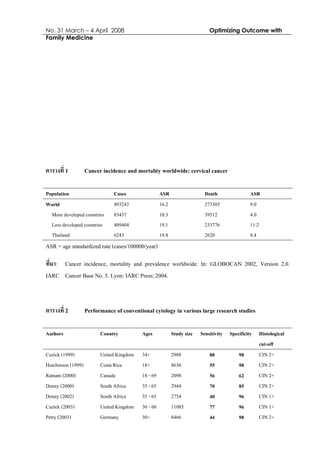
ตารางที่ 1 Cancer incidence and mortality worldwide: cervical cancer
Population Cases ASR Death ASR
World 493243 16.2 273505 9.0
More developed countries 83437 10.3 39512 4.0
Less developed countries 409404 19.1 233776 11.2
Thailand 6243 19.8 2620 8.4
ASR = age standardized rate (cases/100000/year)
ที่มา: Cancer incidence, mortality and prevalence worldwide. In: GLOBOCAN 2002, Version 2.0.
IARC Cancer Base No. 5. Lyon: IARC Press; 2004.
ตารางที่ 2 Performance of conventional cytology in various large research studies
Authors Country Ages Study size Sensitivity Specificity Histological
cut-off
Cuzick (1999) United Kingdom 34+ 2988 88 98 CIN 2+
Hutchinson (1999) Costa Rica 18+ 8636 55 98 CIN 2+
Ratnam (2000) Canada 18 - 69 2098 56 62 CIN 2+
Denny (2000) South Africa 35 - 65 2944 70 85 CIN 2+
Denny (2002) South Africa 35 - 65 2754 40 96 CIN 1+
Cuzick (2003) United Kingdom 30 - 60 11085 77 96 CIN 1+
Petry (2003) Germany 30+ 8466 44 98 CIN 2+
No. 31 March– 4 April 2008 Optimizing Outcome with
Family Medicine
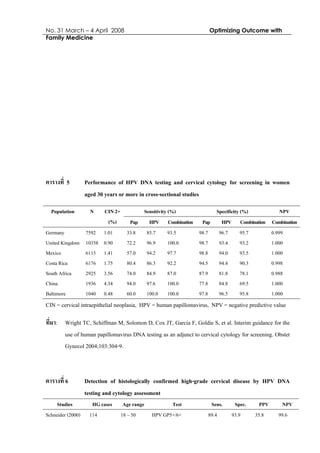
ตารางที่ 5 Performance of HPV DNA testing and cervical cytology for screening in women
aged 30 years or more in cross-sectional studies
Sensitivity (%) Specificity (%) NPVPopulation N CIN 2+
(%) Pap HPV Combination Pap HPV Combination Combination
Germany 7592 1.01 33.8 85.7 93.5 98.7 96.7 95.7 0.999
United Kingdom 10358 0.90 72.2 96.9 100.0 98.7 93.4 93.2 1.000
Mexico 6115 1.41 57.0 94.2 97.7 98.8 94.0 93.5 1.000
Costa Rica 6176 1.75 80.4 86.3 92.2 94.5 94.4 90.3 0.998
South Africa 2925 3.56 74.0 84.9 87.0 87.9 81.8 78.1 0.988
China 1936 4.34 94.0 97.6 100.0 77.8 84.8 69.5 1.000
Baltimore 1040 0.48 60.0 100.0 100.0 97.8 96.5 95.8 1.000
CIN = cervical intraepithelial neoplasia, HPV = human papillomavirus, NPV = negative predictive value
ที่มา: Wright TC, Schiffman M, Solomon D, Cox JT, Garcia F, Goldie S, et al. Interim guidance for the
use of human papillomavirus DNA testing as an adjunct to cervical cytology for screening. Obstet
Gynecol 2004;103:304-9.
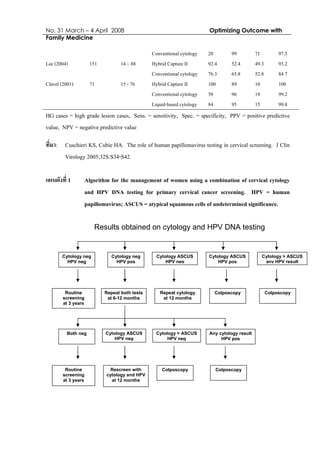
ตารางที่ 6 Detection of histologically confirmed high-grade cervical disease by HPV DNA
testing and cytology assessment
Studies HG cases Age range Test Sens. Spec. PPV NPV
Schneider (2000) 114 18 – 50 HPV GP5+/6+ 89.4 93.9 35.8 99.6
14.
No. 31 March– 4 April 2008 Optimizing Outcome with
Family Medicine
Conventional cytology 20 99 71 97.5
Lee (2004) 151 14 – 88 Hybrid Capture II 92.4 52.4 49.3 93.2
Conventional cytology 76.3 65.8 52.8 84.7
Clavel (2001) 71 15 - 76 Hybrid Capture II 100 89 10 100
Conventional cytology 58 96 18 99.2
Liquid-based cytology 84 95 15 99.8
HG cases = high grade lesion cases, Sens. = sensitivity, Spec. = specificity, PPV = positive predictive
value, NPV = negative predictive value
ที่มา: Cuschieri KS, Cubie HA. The role of human papillomavirus testing in cervical screening. J Clin
Virology 2005;32S:S34-S42.
แผนผังที่ 1 Algorithm for the management of women using a combination of cervical cytology
and HPV DNA testing for primary cervical cancer screening. HPV = human
papillomavirus; ASCUS = atypical squamous cells of undetermined significance.
Cytology neg
HPV neg
Cytology neg
HPV pos
Cytology ASCUS
HPV neg
Cytology ASCUS
HPV pos
Cytology > ASCUS
any HPV result
Routine
screening
at 3 years
Repeat both tests
at 6-12 months
Repeat cytology
at 12 months
Colposcopy Colposcopy
Results obtained on cytology and HPV DNA testing
Both neg Cytology ASCUS
HPV neg
Cytology > ASCUS
HPV neg
Any cytology result
HPV pos
Colposcopy ColposcopyRoutine
screening
at 3 years
Rescreen with
cytology and HPV
at 12 months
15.
No. 31 March– 4 April 2008 Optimizing Outcome with
Family Medicine
ที่มา: Wright TC, Schiffman M, Solomon D, Cox JT, Garcia F, Goldie S, et al. Interim guidance for the
use of human papillomavirus DNA testing as an adjunct to cervical cytology for screening. Obstet
Gynecol 2004;103:304-9.