English II (ENG-102)
3 Credit Hours, Spring 2015
Instructor: Aqsa Ijaz
Email: aqsa.ijaz@uogsialkot.edu.pk
Class: BBA
a summary of your skills,
experiences, achievements
and activities;
• a marketing tool presented
to employers in order to
obtain an interview.
• succinct, detailed and
action-oriented;
• organized with easy-to-
read headers, identifiable
sections and an effective
use of white space;
• and focuses the reader on
the information most
relevant to the position
applied for.
Types of Resume
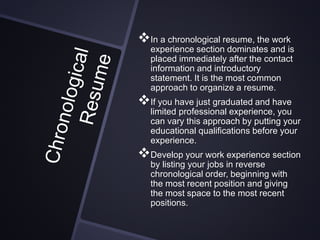
In a chronological resume, the work
experience section dominates and is
placed immediately after the contact
information and introductory
statement. It is the most common
approach to organize a resume.
If you have just graduated and have
limited professional experience, you
can vary this approach by putting your
educational qualifications before your
experience.
Develop your work experience section
by listing your jobs in reverse
chronological order, beginning with
the most recent position and giving
the most space to the most recent
positions.
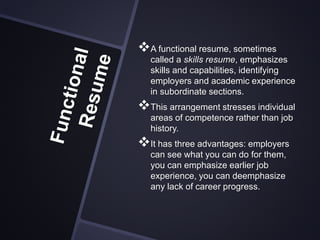
A functional resume, sometimes
called a skills resume, emphasizes
skills and capabilities, identifying
employers and academic experience
in subordinate sections.
This arrangement stresses individual
areas of competence rather than job
history.
It has three advantages: employers
can see what you can do for them,
you can emphasize earlier job
experience, you can deemphasize
any lack of career progress.
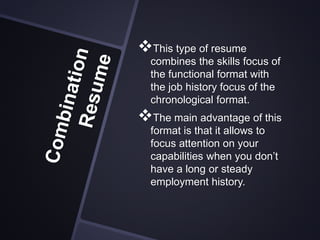
This type of resume
combines the skills focus of
the functional format with
the job history focus of the
chronological format.
The main advantage of this
format is that it allows to
focus attention on your
capabilities when you don’t
have a long or steady
employment history.
Resume Contents
• Name, address(es),
phone number(s), email
• Include both campus and
permanent address and
phone number if currently at
school
• Include day/evening/cell
phone number if
appropriate
• The reason you are
sending the resume to
the employer (optional)
• Objectives are not
required, but may be useful
to focus a resume
• Clear, concise and specific
to the position applied for
Institution(s) attended,
location, degree(s) earned,
major(s), minor(s),
cumulative GPA, major
GPA, correlate, thesis,
graduation date
• May include key courses
relevant to objective
• May highlight
achievements, such as a
high GPA
Internships, work experience,
research experience, volunteer
experience, fieldwork,
organizational leadership, etc.
• Include the following components
within this section for each entry:
o Position held (title)
o Name and location of
organization
o Dates of work
o Accomplishments and
responsibilities
o Demonstrated skills
Academic honors or other
awards, leadership roles in
activities
• If academic honors are listed
in Education, do not repeat
them here
• Include the length of your
affiliation/dates
• Include high school
activities/honors only if they
are highly pertinent to the job
you are seeking or this is your
first year in college
• Relevant skills to the
position such as
computer skills, language
proficiencies and key job
specific skills
• Indicate the level of your
understanding of a
language (such as fluent or
conversational) and
computer skills
• Indicates an interest
outside of your stated
experience
• Category is optional
• Irrelevant or assumed
interests need not be
included
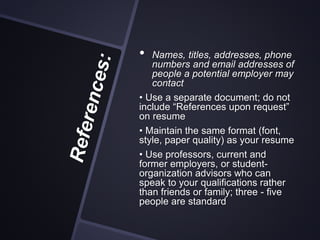
• Names, titles, addresses, phone
numbers and email addresses of
people a potential employer may
contact
• Use a separate document; do not
include “References upon request”
on resume
• Maintain the same format (font,
style, paper quality) as your resume
• Use professors, current and
former employers, or student-
organization advisors who can
speak to your qualifications rather
than friends or family; three - five
people are standard

Cv/ Resume

  • 1.
    English II (ENG-102) 3Credit Hours, Spring 2015 Instructor: Aqsa Ijaz Email: aqsa.ijaz@uogsialkot.edu.pk Class: BBA
  • 3.
    a summary ofyour skills, experiences, achievements and activities; • a marketing tool presented to employers in order to obtain an interview.
  • 4.
    • succinct, detailedand action-oriented; • organized with easy-to- read headers, identifiable sections and an effective use of white space; • and focuses the reader on the information most relevant to the position applied for.
  • 5.
  • 6.
    In a chronologicalresume, the work experience section dominates and is placed immediately after the contact information and introductory statement. It is the most common approach to organize a resume. If you have just graduated and have limited professional experience, you can vary this approach by putting your educational qualifications before your experience. Develop your work experience section by listing your jobs in reverse chronological order, beginning with the most recent position and giving the most space to the most recent positions.
  • 7.
    A functional resume,sometimes called a skills resume, emphasizes skills and capabilities, identifying employers and academic experience in subordinate sections. This arrangement stresses individual areas of competence rather than job history. It has three advantages: employers can see what you can do for them, you can emphasize earlier job experience, you can deemphasize any lack of career progress.
  • 8.
    This type ofresume combines the skills focus of the functional format with the job history focus of the chronological format. The main advantage of this format is that it allows to focus attention on your capabilities when you don’t have a long or steady employment history.
  • 9.
  • 10.
    • Name, address(es), phonenumber(s), email • Include both campus and permanent address and phone number if currently at school • Include day/evening/cell phone number if appropriate
  • 11.
    • The reasonyou are sending the resume to the employer (optional) • Objectives are not required, but may be useful to focus a resume • Clear, concise and specific to the position applied for
  • 12.
    Institution(s) attended, location, degree(s)earned, major(s), minor(s), cumulative GPA, major GPA, correlate, thesis, graduation date • May include key courses relevant to objective • May highlight achievements, such as a high GPA
  • 13.
    Internships, work experience, researchexperience, volunteer experience, fieldwork, organizational leadership, etc. • Include the following components within this section for each entry: o Position held (title) o Name and location of organization o Dates of work o Accomplishments and responsibilities o Demonstrated skills
  • 14.
    Academic honors orother awards, leadership roles in activities • If academic honors are listed in Education, do not repeat them here • Include the length of your affiliation/dates • Include high school activities/honors only if they are highly pertinent to the job you are seeking or this is your first year in college
  • 15.
    • Relevant skillsto the position such as computer skills, language proficiencies and key job specific skills • Indicate the level of your understanding of a language (such as fluent or conversational) and computer skills
  • 16.
    • Indicates aninterest outside of your stated experience • Category is optional • Irrelevant or assumed interests need not be included
  • 17.
    • Names, titles,addresses, phone numbers and email addresses of people a potential employer may contact • Use a separate document; do not include “References upon request” on resume • Maintain the same format (font, style, paper quality) as your resume • Use professors, current and former employers, or student- organization advisors who can speak to your qualifications rather than friends or family; three - five people are standard