Customer Management Assessment
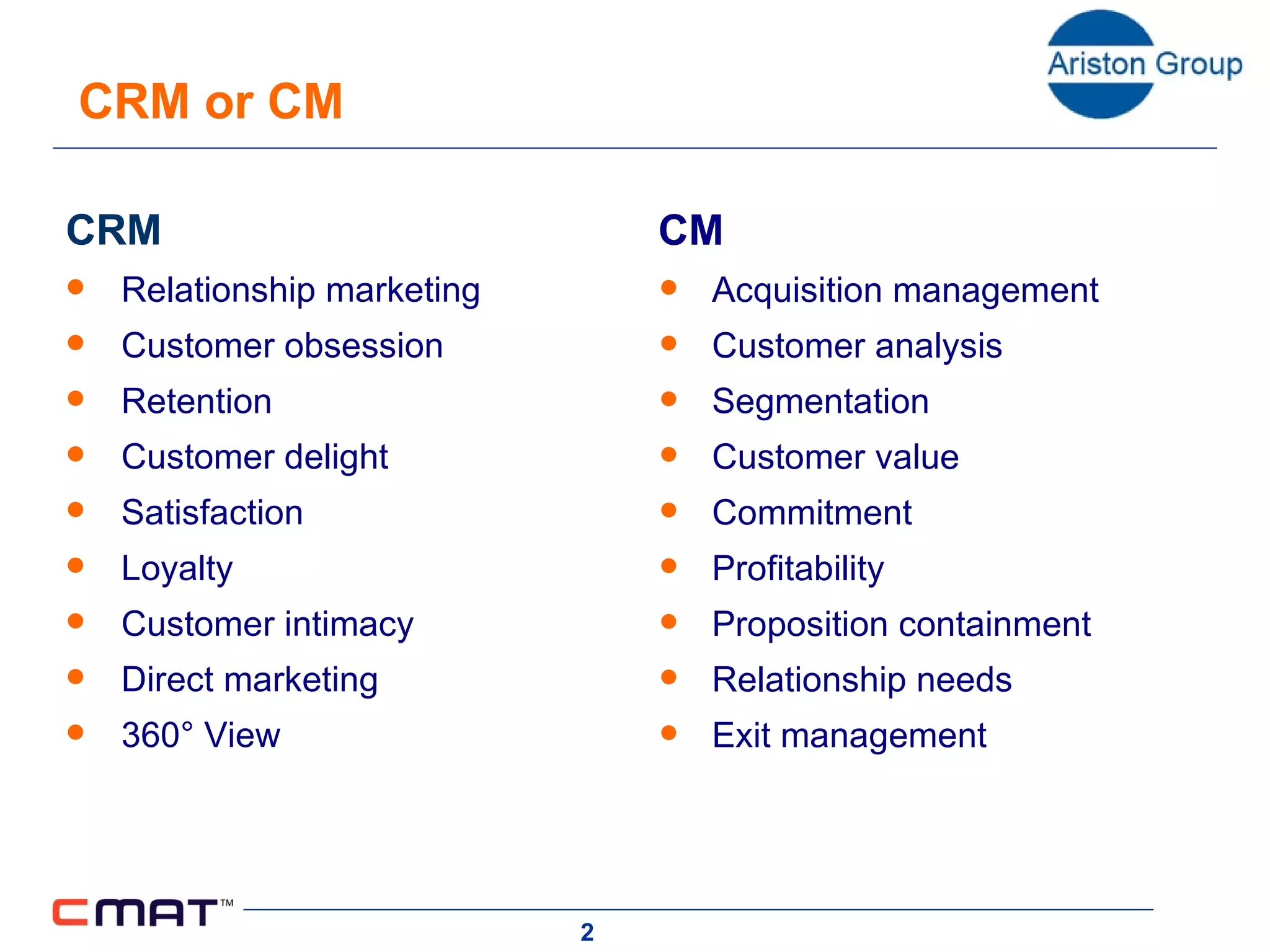
CRM or CM  CRM Relationship marketing Customer obsession Retention Customer delight Satisfaction Loyalty Customer intimacy Direct marketing 360 ° View CM Acquisition management  Customer analysis  Segmentation Customer value Commitment Profitability Proposition containment Relationship needs Exit management
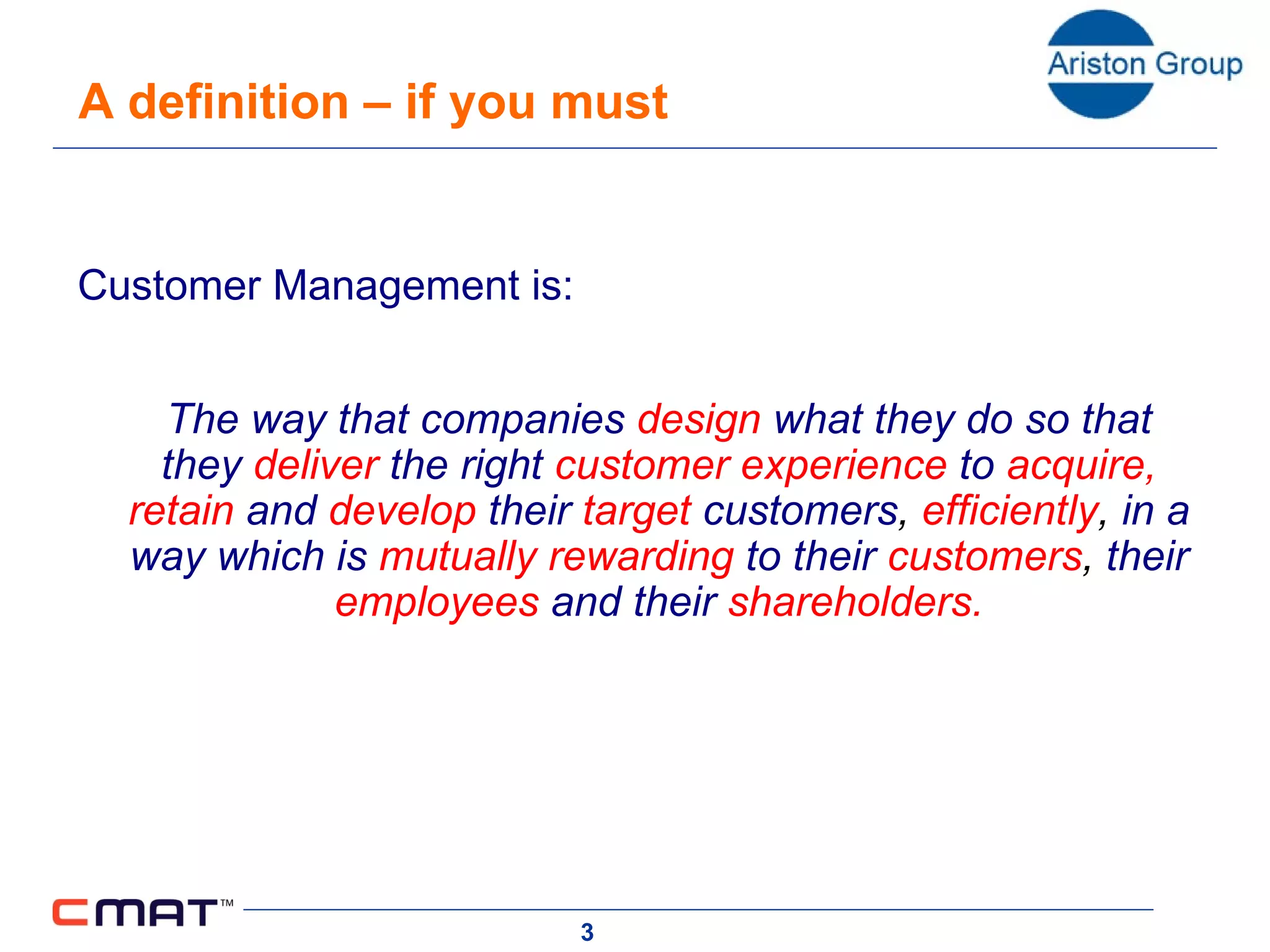
A definition – if you must   Customer Management is:   The way that companies   design  what they do so that they   deliver  the right   customer experience  to  acquire, retain  and   develop  their   target  customers ,  efficiently ,  in a way which is   mutually rewarding  to their   customers ,  their  employees  and their   shareholders.  
A scope
A scope
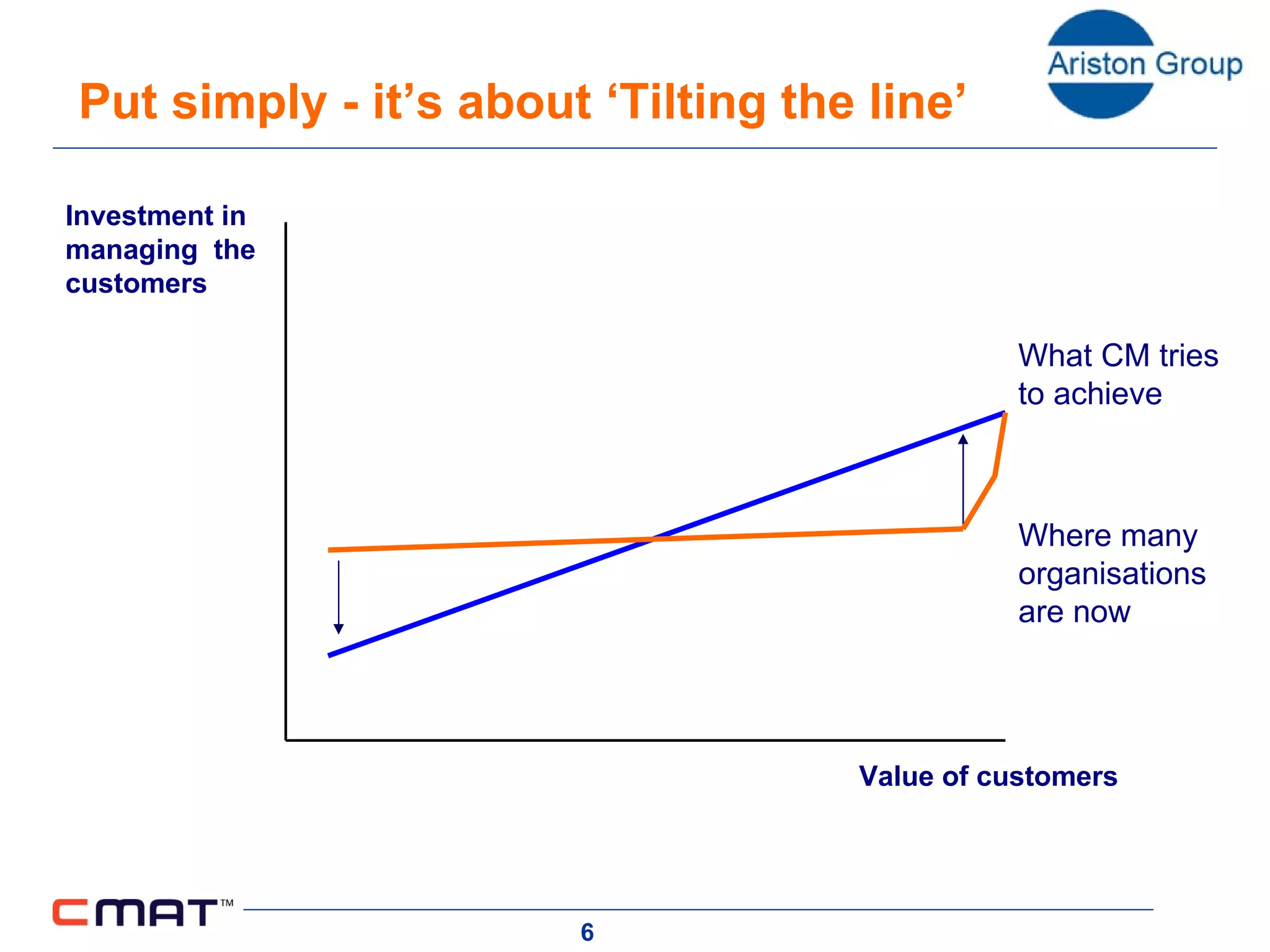
Put simply - it’s about ‘Tilting the line’ Investment in managing  the customers Value of customers Where many  organi s ations  are now What CM tries  to achieve
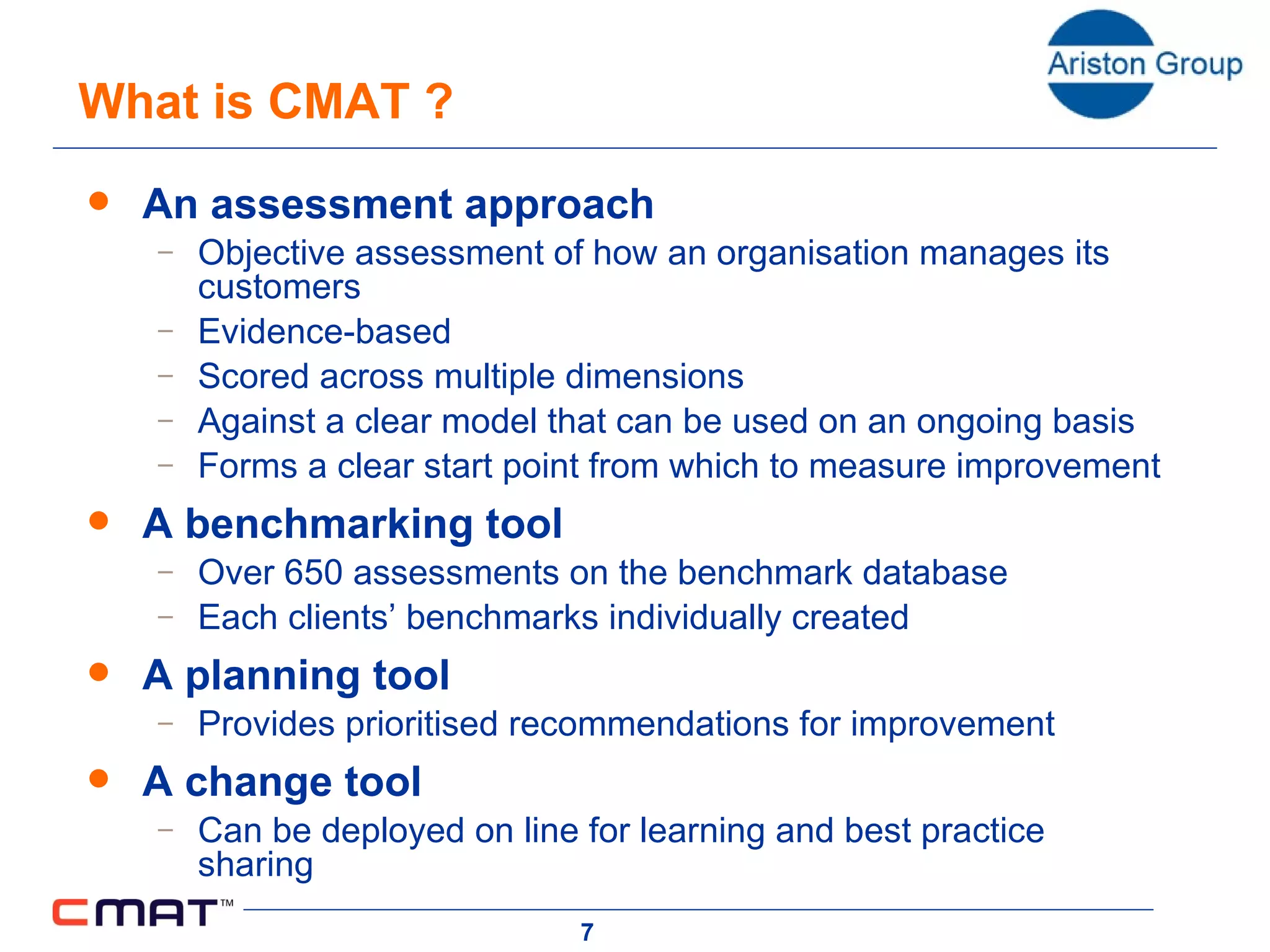
What is CMAT ?  An assessment approach Objective assessment of how an organisation manages its customers Evidence-based Scored across multiple dimensions Against a clear model that can be used on an ongoing basis Forms a clear start point from which to measure improvement A benchmarking tool Over 650 assessments on the benchmark database Each clients’ benchmarks individually created A planning tool Provides prioritised recommendations for improvement A change tool Can be deployed on line for learning and best practice sharing
The CMAT dimensions Intention Clear plans that have been  effectively communicated and  widely bought into Reality Evidence of full  implementation and full  adoption
CMAT Healthcheck Assesses against the whole customer management model but in less depth Examines 100 practices Interviews with 8 to 10 people Takes an elapsed 3 to 4 weeks Two dimension scoring Delivers a standard report against 13 sections Suitable for multiple business unit assessments
The types of scores being achieved Overall average score is just 35% Best score is 67%, worst is 17% To be top quartile you only need to score 41% Quartile scores by section of the model look like this:
What the scores are telling us Overall, things are not really  improving over time Best scores are also the  most well rounded scores There are clear but not huge sector  variations There are clear but not huge region variations Senior Managers over-estimate what is going on Big benefits still available but expectations need to be realistic Analysts are taking notice of CM performance Year  Average score 1999  33%  2000  33% 2001  32% 2002  33% 2003  34% 2004 35%
Who is using it AA
CMAT Assessment Approach Planning Preparation Interviews Feedback presentation Report Assessment completion Follow-up
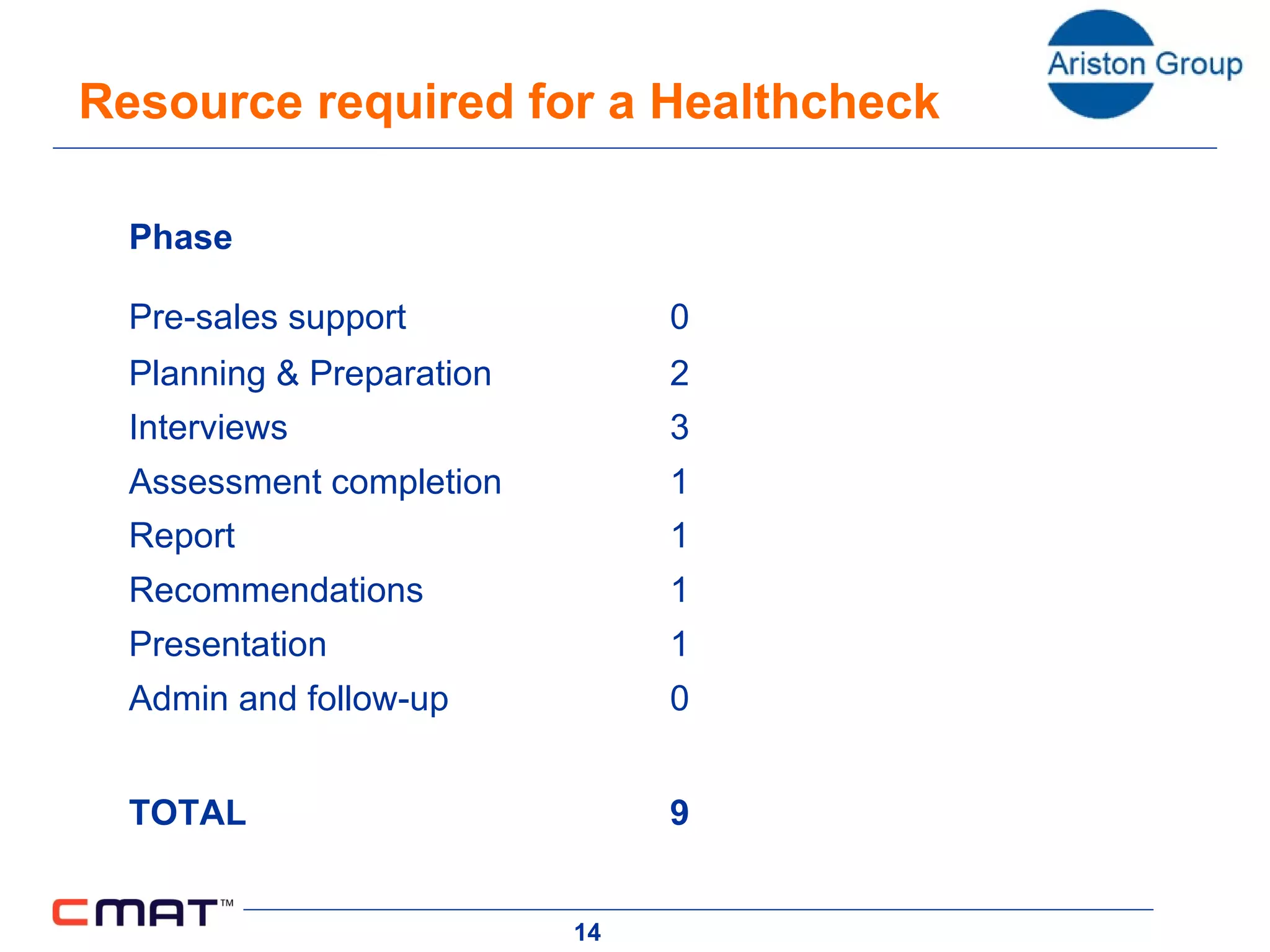
Resource required for a Healthcheck Phase Pre-sales support 0 Planning & Preparation 2 Interviews 3 Assessment completion 1 Report 1 Recommendations  1 Presentation 1 Admin and follow-up 0 TOTAL 9
‘ Vanilla’ role list for the Healthcheck CRM Leader Business Analyst Marketing planner Product Manager HR Manager Technologist Direct sales Indirect sales Campaign owner Service owner Call centre agent Researcher
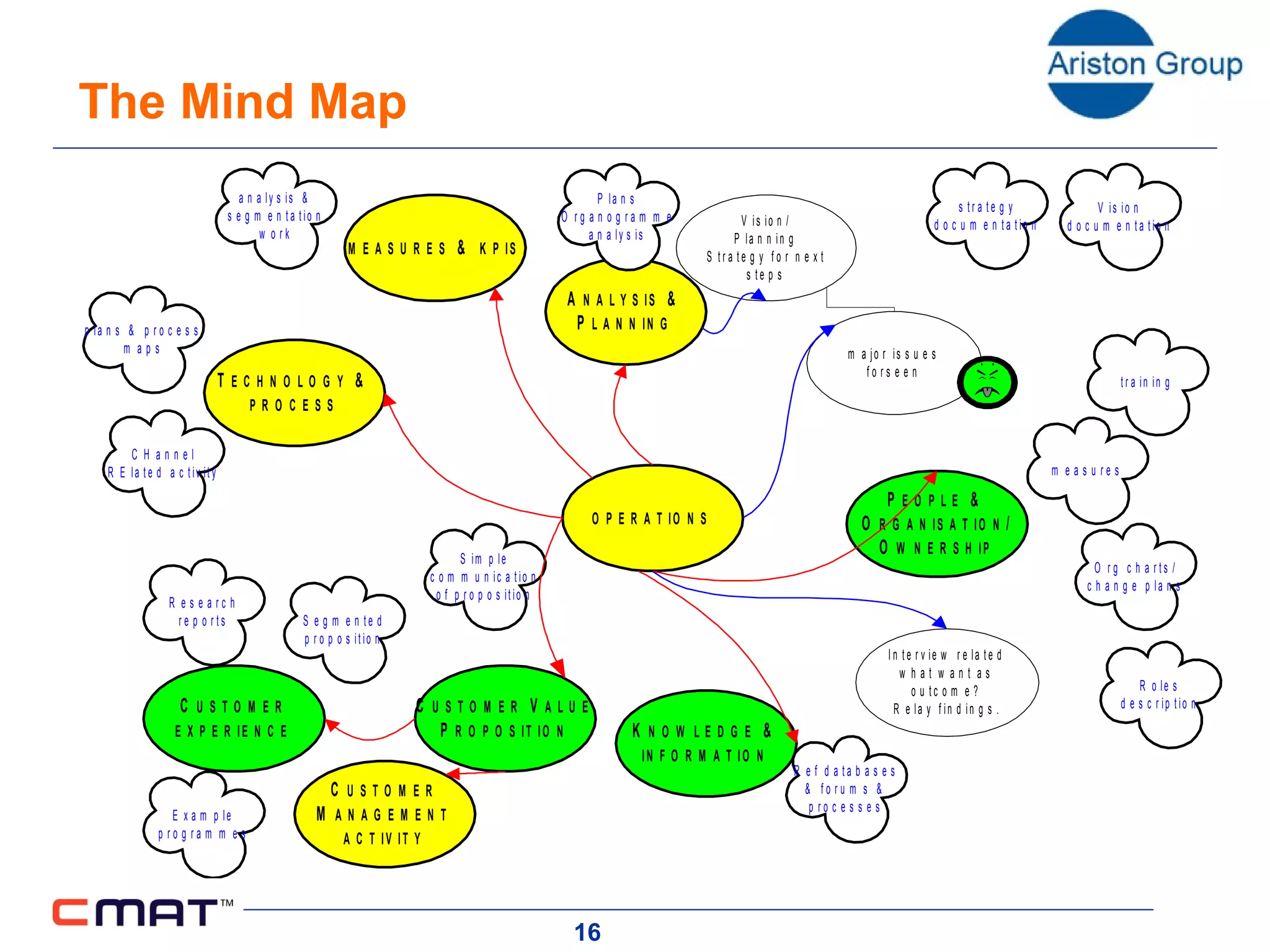
The Mind Map
Answering dimensions - Intention Full commitment and detailed plans All relevant groups and management teams are completely committed to doing this. There is a clear strategy in place and detailed plans exist with appropriate budgets agreed. Full commitment and some plans All relevant groups and management teams are completely committed to doing this. There is a developing strategy and the early stages of detailed planning have started. Full commitment but no real plans All relevant groups and management teams are completely committed to doing this. A budget may have been agreed but no planning work has started yet.     Some commitment and some plans Some of the relevant people are committed to doing this but not all. There will be some level of plans in place and may be some piloting work. Little or no commitment and plans Very few people who have the ability to make this happen are committed to doing so and no plans exist to make it happen.
Answering dimensions - Reality Fully implemented This has been implemented completely in all the places within the organisation where it needs to be. Substantially implemented This is either nearing completion in all the places where it is needed or is fully implemented in most of the places. Implementation in progress There is clear evidence that implementation will be fully completed but it is only part way through being implemented at the moment. Some isolated implementation There are places where this has been implemented but it is not part of an overall full implementation and may stop with just those places where it was observed. No real implementation There is little evidence of implementation in any of the places where it needs to be completed.
Overall scope and its sub-sections
The sub-sections on question set 1 Analysis & Planning Customer Management Strategy Analysis Activity Retention planning Efficiency planning Acquisition planning Penetration planning Proposition Understanding customer needs Proposition development Integration with the brand Embedding the proposition People & Organisation Leadership, organisation and culture Competencies and training Monitoring and measurement Motivation and reward Outsourcing
The sub-sections on the question set 2 Acquisition Targeting Conversion Winback Retention Welcoming & Getting to Know Delivering the basics Retention activity Managing dissatisfaction Efficiency Cost-to-serve management Penetration Value development
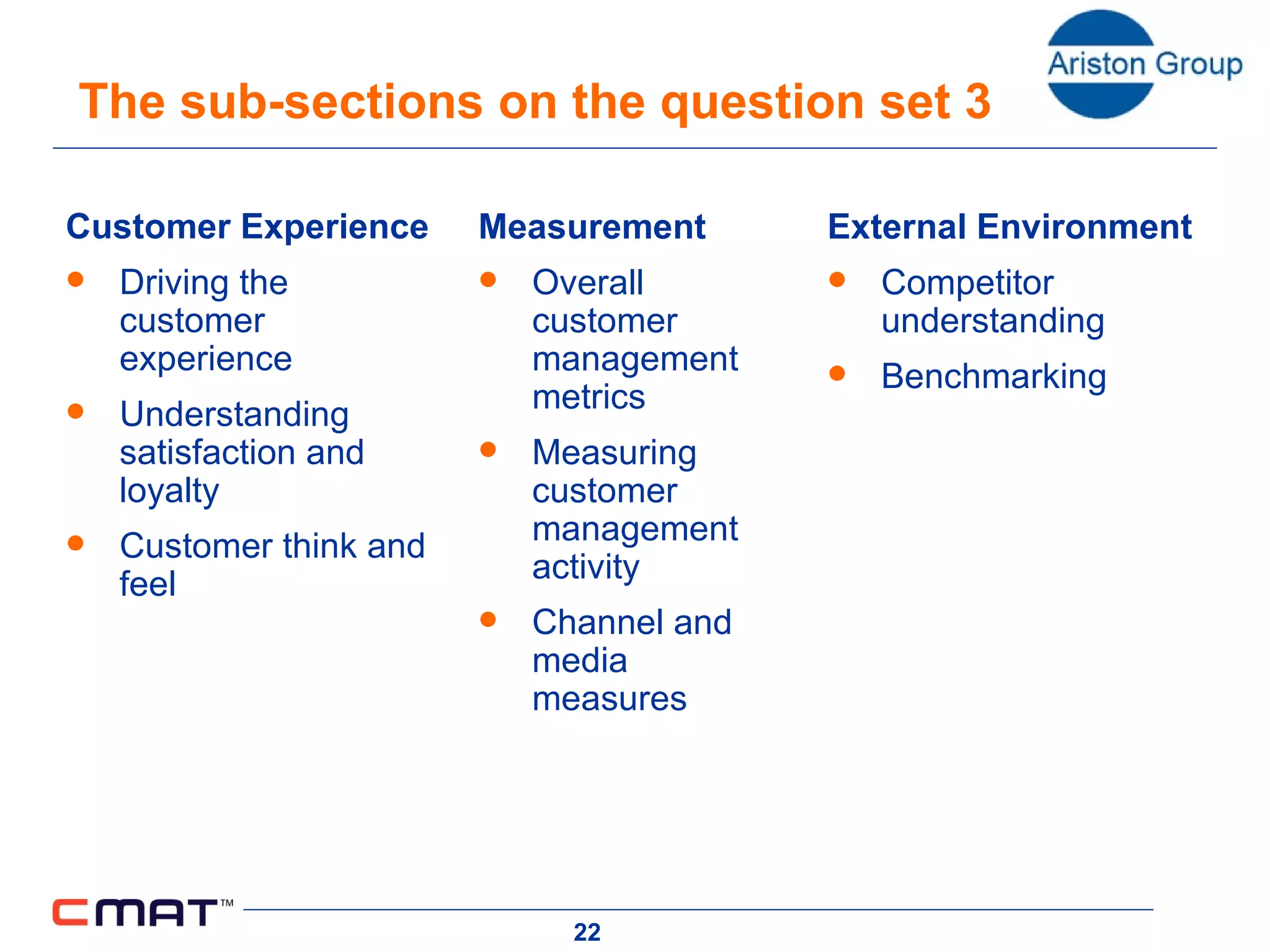
The sub-sections on the question set 3 Customer Experience Driving the customer experience Understanding satisfaction and loyalty Customer think and feel Measurement Overall customer management metrics Measuring customer management activity Channel and media measures External Environment Competitor understanding Benchmarking
The sub-sections of the question set 4 Processes Ongoing process management Process improvement Information Building customer information Managing customer information Security and privacy Customer knowledge management Technology Current technology capability Exploitation of new technology Management of technology resources

Customer management assessment

  • 1.
  • 2.
    CRM or CM CRM Relationship marketing Customer obsession Retention Customer delight Satisfaction Loyalty Customer intimacy Direct marketing 360 ° View CM Acquisition management Customer analysis Segmentation Customer value Commitment Profitability Proposition containment Relationship needs Exit management
  • 3.
    A definition –if you must   Customer Management is:   The way that companies design what they do so that they deliver the right customer experience to acquire, retain and develop their target customers , efficiently , in a way which is mutually rewarding to their customers , their employees and their shareholders.  
  • 4.
  • 5.
  • 6.
    Put simply -it’s about ‘Tilting the line’ Investment in managing the customers Value of customers Where many organi s ations are now What CM tries to achieve
  • 7.
    What is CMAT? An assessment approach Objective assessment of how an organisation manages its customers Evidence-based Scored across multiple dimensions Against a clear model that can be used on an ongoing basis Forms a clear start point from which to measure improvement A benchmarking tool Over 650 assessments on the benchmark database Each clients’ benchmarks individually created A planning tool Provides prioritised recommendations for improvement A change tool Can be deployed on line for learning and best practice sharing
  • 8.
    The CMAT dimensionsIntention Clear plans that have been effectively communicated and widely bought into Reality Evidence of full implementation and full adoption
  • 9.
    CMAT Healthcheck Assessesagainst the whole customer management model but in less depth Examines 100 practices Interviews with 8 to 10 people Takes an elapsed 3 to 4 weeks Two dimension scoring Delivers a standard report against 13 sections Suitable for multiple business unit assessments
  • 10.
    The types ofscores being achieved Overall average score is just 35% Best score is 67%, worst is 17% To be top quartile you only need to score 41% Quartile scores by section of the model look like this:
  • 11.
    What the scoresare telling us Overall, things are not really improving over time Best scores are also the most well rounded scores There are clear but not huge sector variations There are clear but not huge region variations Senior Managers over-estimate what is going on Big benefits still available but expectations need to be realistic Analysts are taking notice of CM performance Year Average score 1999 33% 2000 33% 2001 32% 2002 33% 2003 34% 2004 35%
  • 12.
  • 13.
    CMAT Assessment ApproachPlanning Preparation Interviews Feedback presentation Report Assessment completion Follow-up
  • 14.
    Resource required fora Healthcheck Phase Pre-sales support 0 Planning & Preparation 2 Interviews 3 Assessment completion 1 Report 1 Recommendations 1 Presentation 1 Admin and follow-up 0 TOTAL 9
  • 15.
    ‘ Vanilla’ rolelist for the Healthcheck CRM Leader Business Analyst Marketing planner Product Manager HR Manager Technologist Direct sales Indirect sales Campaign owner Service owner Call centre agent Researcher
  • 16.
  • 17.
    Answering dimensions -Intention Full commitment and detailed plans All relevant groups and management teams are completely committed to doing this. There is a clear strategy in place and detailed plans exist with appropriate budgets agreed. Full commitment and some plans All relevant groups and management teams are completely committed to doing this. There is a developing strategy and the early stages of detailed planning have started. Full commitment but no real plans All relevant groups and management teams are completely committed to doing this. A budget may have been agreed but no planning work has started yet.     Some commitment and some plans Some of the relevant people are committed to doing this but not all. There will be some level of plans in place and may be some piloting work. Little or no commitment and plans Very few people who have the ability to make this happen are committed to doing so and no plans exist to make it happen.
  • 18.
    Answering dimensions -Reality Fully implemented This has been implemented completely in all the places within the organisation where it needs to be. Substantially implemented This is either nearing completion in all the places where it is needed or is fully implemented in most of the places. Implementation in progress There is clear evidence that implementation will be fully completed but it is only part way through being implemented at the moment. Some isolated implementation There are places where this has been implemented but it is not part of an overall full implementation and may stop with just those places where it was observed. No real implementation There is little evidence of implementation in any of the places where it needs to be completed.
  • 19.
    Overall scope andits sub-sections
  • 20.
    The sub-sections onquestion set 1 Analysis & Planning Customer Management Strategy Analysis Activity Retention planning Efficiency planning Acquisition planning Penetration planning Proposition Understanding customer needs Proposition development Integration with the brand Embedding the proposition People & Organisation Leadership, organisation and culture Competencies and training Monitoring and measurement Motivation and reward Outsourcing
  • 21.
    The sub-sections onthe question set 2 Acquisition Targeting Conversion Winback Retention Welcoming & Getting to Know Delivering the basics Retention activity Managing dissatisfaction Efficiency Cost-to-serve management Penetration Value development
  • 22.
    The sub-sections onthe question set 3 Customer Experience Driving the customer experience Understanding satisfaction and loyalty Customer think and feel Measurement Overall customer management metrics Measuring customer management activity Channel and media measures External Environment Competitor understanding Benchmarking
  • 23.
    The sub-sections ofthe question set 4 Processes Ongoing process management Process improvement Information Building customer information Managing customer information Security and privacy Customer knowledge management Technology Current technology capability Exploitation of new technology Management of technology resources