Customer Journey Mapping
By Catherine Elder
December 2014
© 2014 Catherine Elder 1
Why do you want to map your
customer’s journey?
 To understand
◦ when a prospect becomes a
customer – for your sales and
marketing teams?
◦ the customer’s experience and how
to improve it?
© 2014 Catherine Elder 2
FROM PROSPECT TO
CUSTOMER
© 2014 Catherine Elder 3
Stages to becoming a
customer
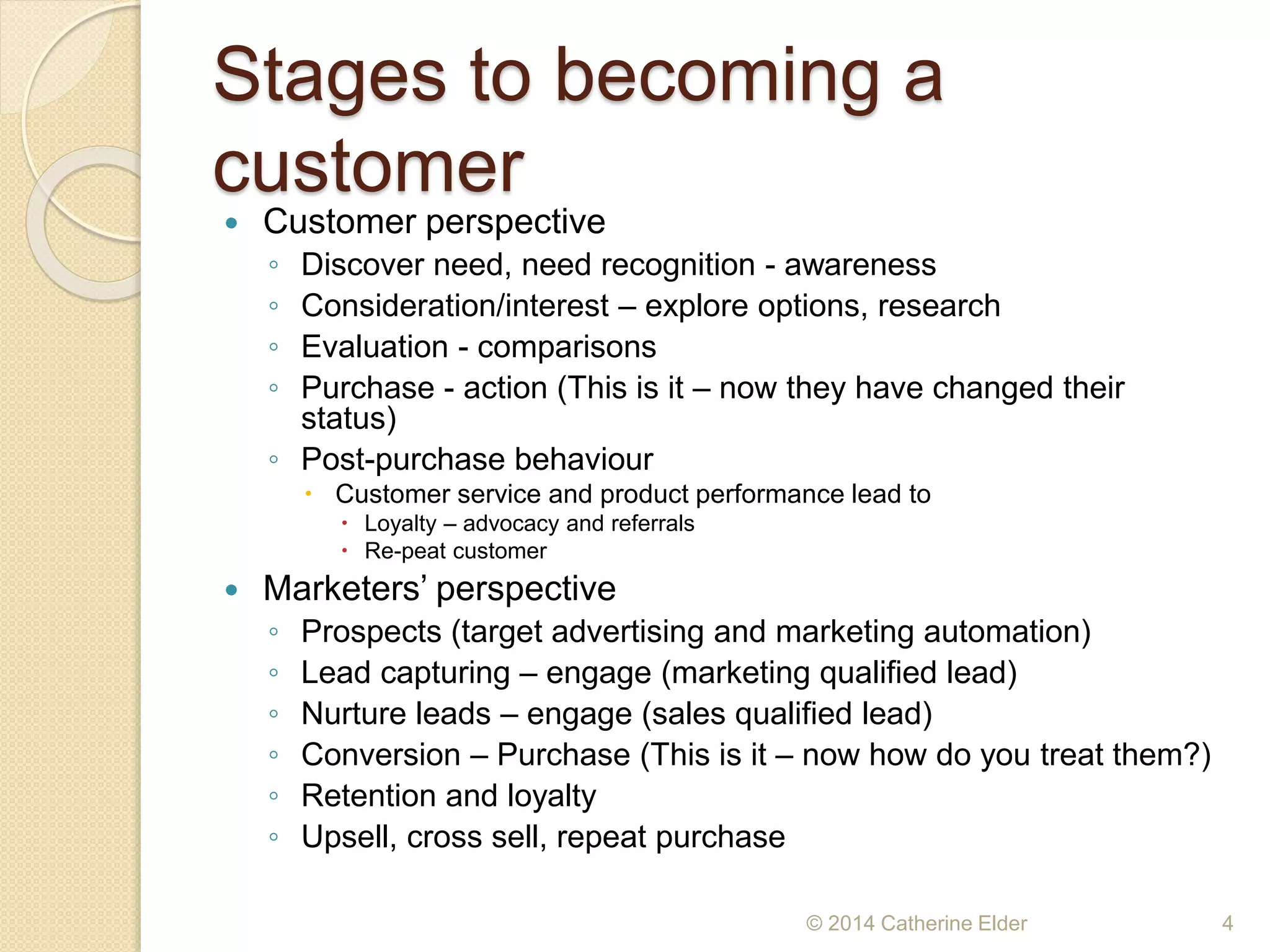
 Customer perspective
◦ Discover need, need recognition - awareness
◦ Consideration/interest – explore options, research
◦ Evaluation - comparisons
◦ Purchase - action (This is it – now they have changed their
status)
◦ Post-purchase behaviour
 Customer service and product performance lead to
 Loyalty – advocacy and referrals
 Re-peat customer
 Marketers’ perspective
◦ Prospects (target advertising and marketing automation)
◦ Lead capturing – engage (marketing qualified lead)
◦ Nurture leads – engage (sales qualified lead)
◦ Conversion – Purchase (This is it – now how do you treat them?)
◦ Retention and loyalty
◦ Upsell, cross sell, repeat purchase
© 2014 Catherine Elder 4
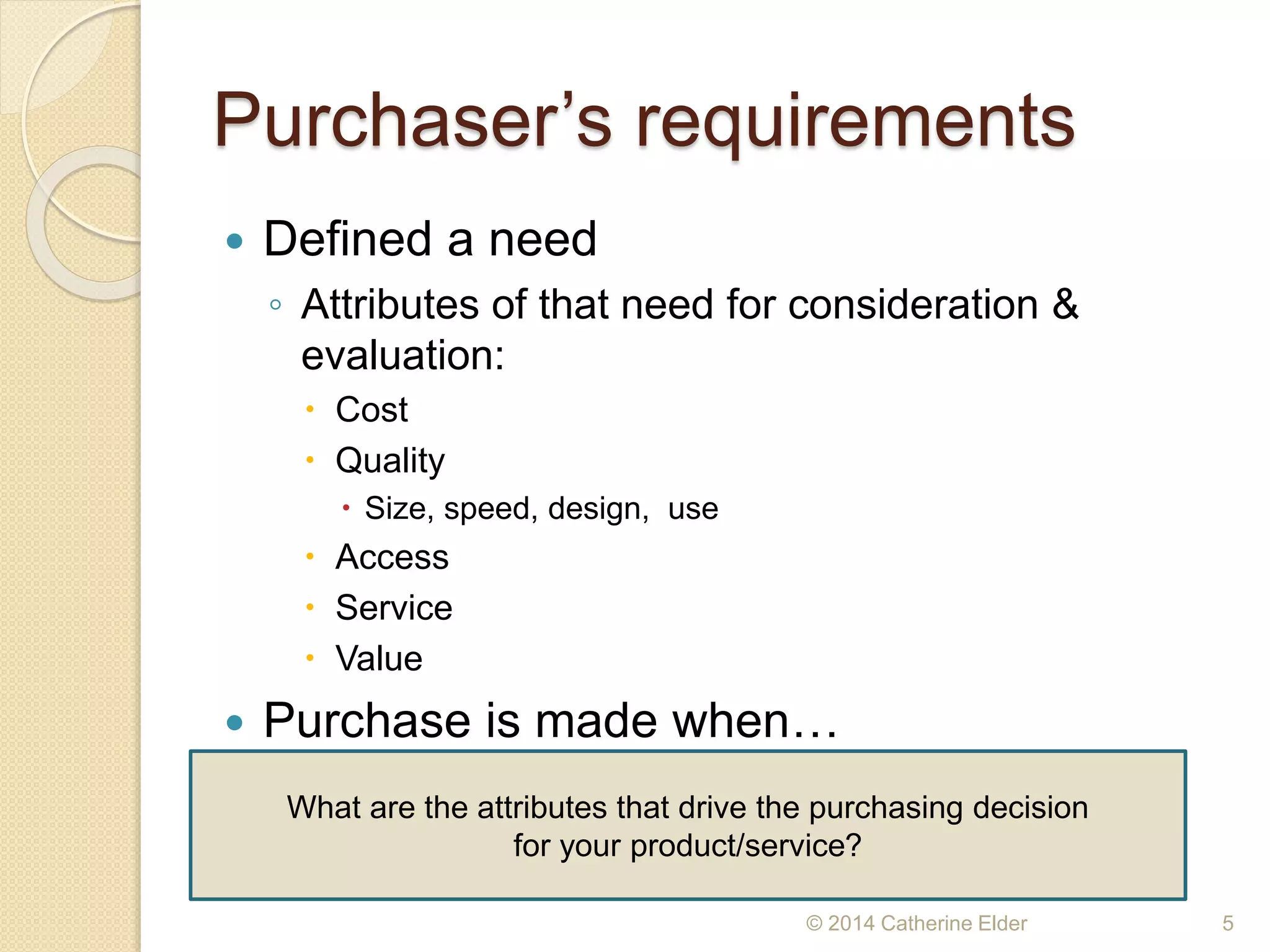
Purchaser’s requirements
 Defined a need
◦ Attributes of that need for consideration &
evaluation:
 Cost
 Quality
 Size, speed, design, use
 Access
 Service
 Value
 Purchase is made when…
© 2014 Catherine Elder 5
What are the attributes that drive the purchasing decision
for your product/service?
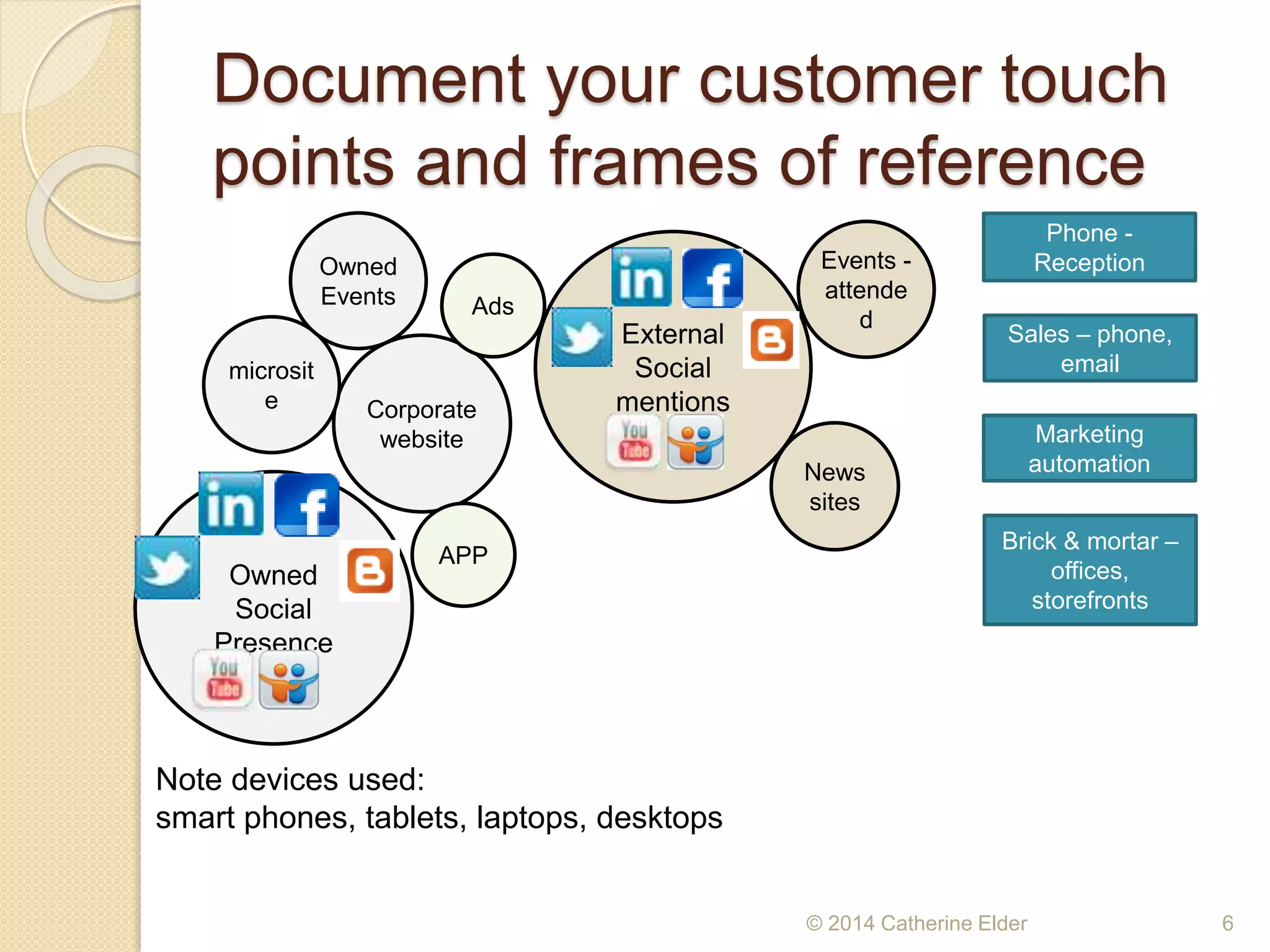
Document your customer touch
points and frames of reference
Corporate
website
News
sites
microsit
e
Owned
Social
Presence
APP
External
Social
mentions
Phone -
Reception
Brick & mortar –
offices,
storefronts
Sales – phone,
email
Owned
Events
Events -
attende
d
© 2014 Catherine Elder 6
Marketing
automation
Ads
Note devices used:
smart phones, tablets, laptops, desktops
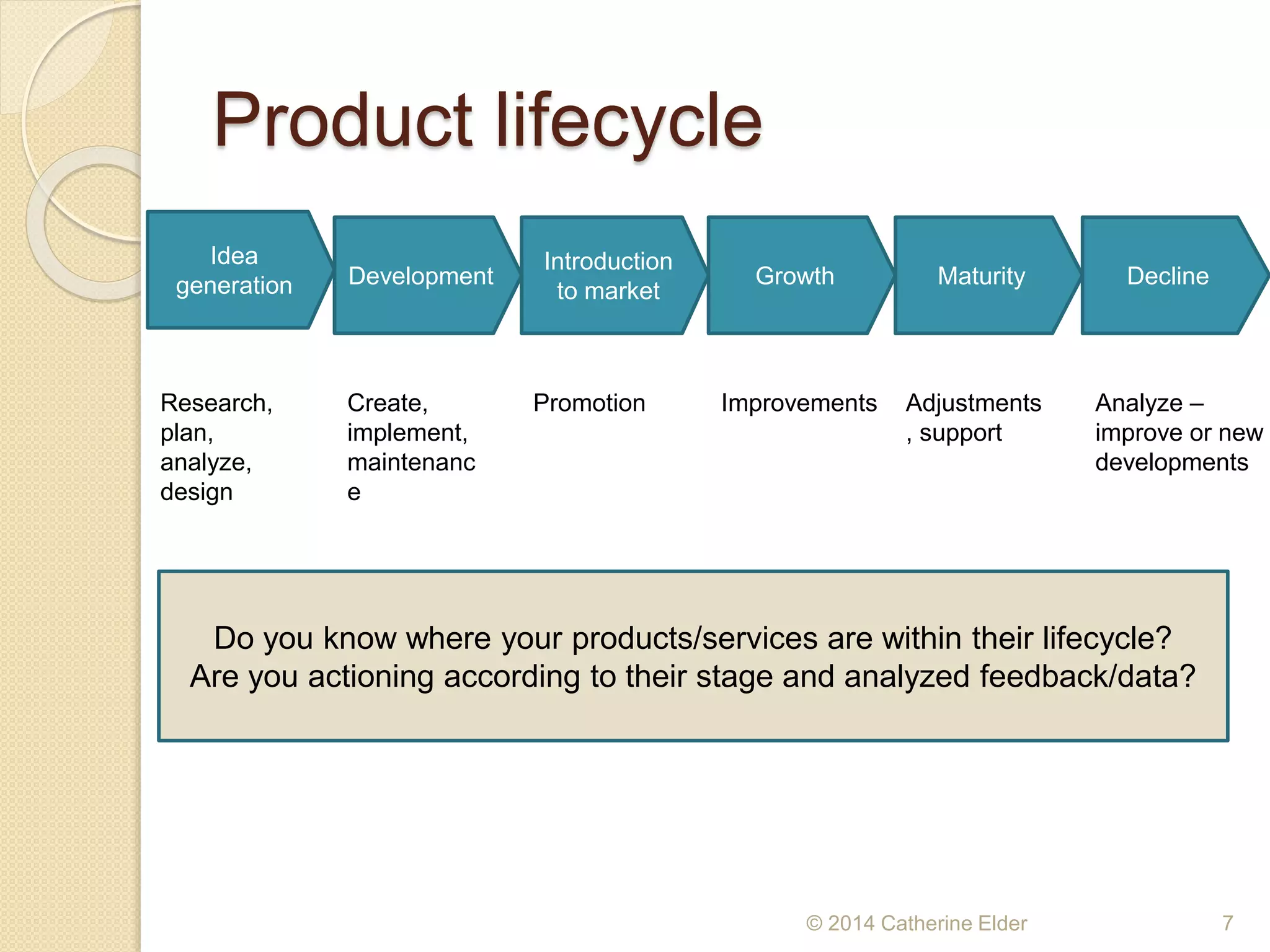
Product lifecycle
© 2014 Catherine Elder 7
Idea
generation Development
Introduction
to market
Growth Maturity Decline
Research,
plan,
analyze,
design
Create,
implement,
maintenanc
e
Promotion Improvements Adjustments
, support
Analyze –
improve or new
developments
Do you know where your products/services are within their lifecycle?
Are you actioning according to their stage and analyzed feedback/data?
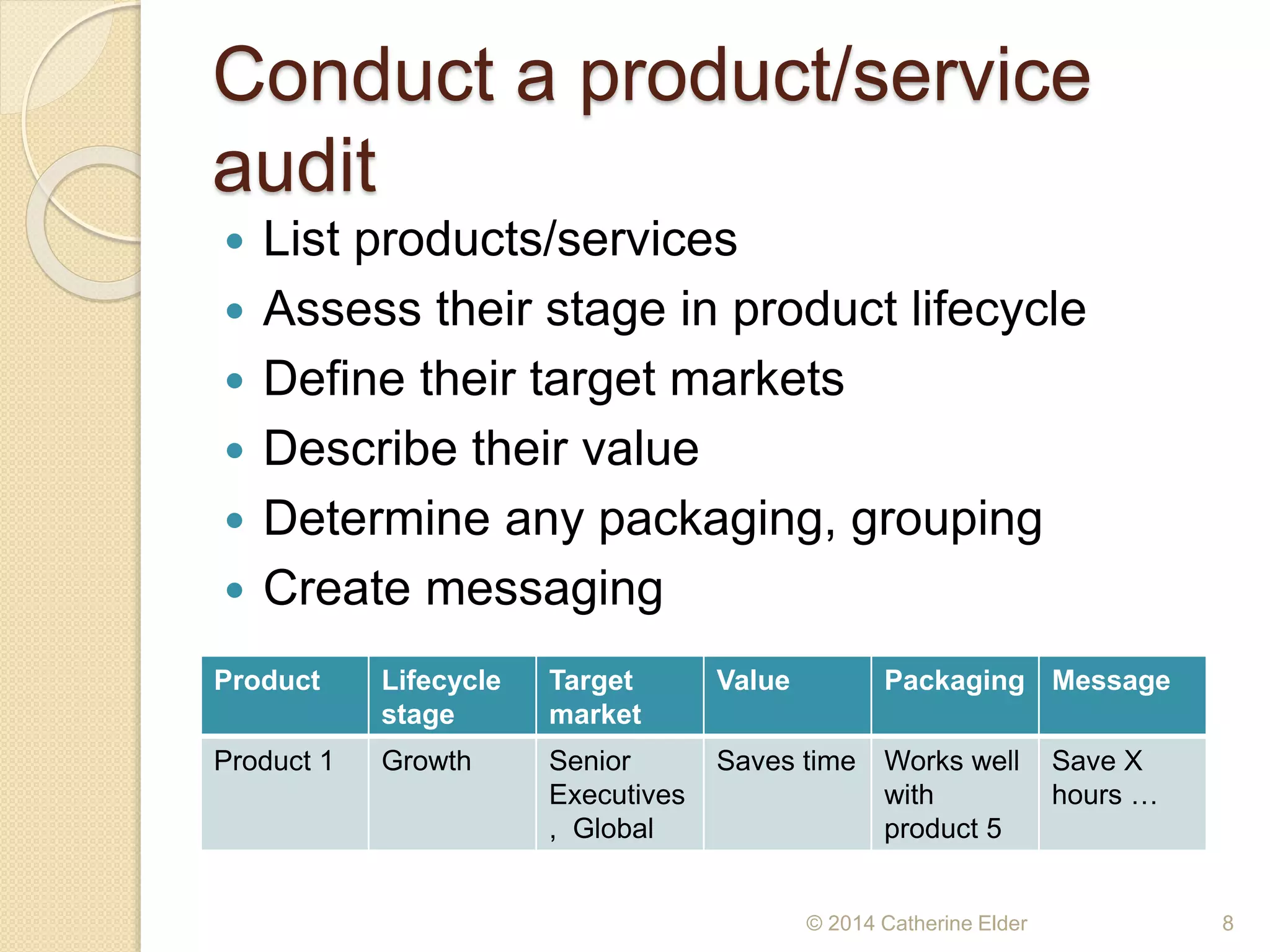
Conduct a product/service
audit
 List products/services
 Assess their stage in product lifecycle
 Define their target markets
 Describe their value
 Determine any packaging, grouping
 Create messaging
© 2014 Catherine Elder 8
Product Lifecycle
stage
Target
market
Value Packaging Message
Product 1 Growth Senior
Executives
, Global
Saves time Works well
with
product 5
Save X
hours …
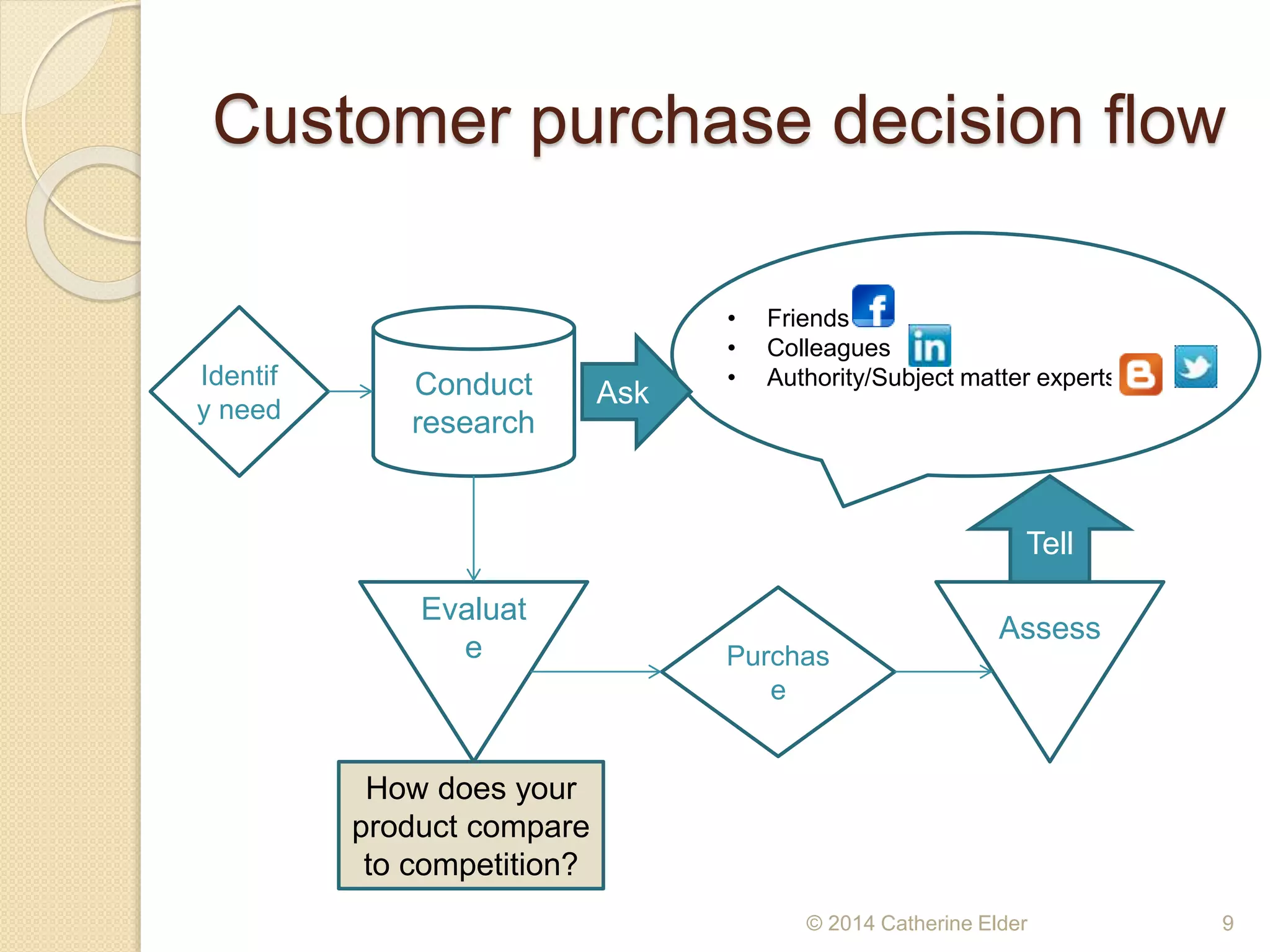
Customer purchase decision flow
© 2014 Catherine Elder 9
Identif
y need
Conduct
research
• Friends
• Colleagues
• Authority/Subject matter experts
Evaluat
e Purchas
e
Assess
Ask
Tell
How does your
product compare
to competition?
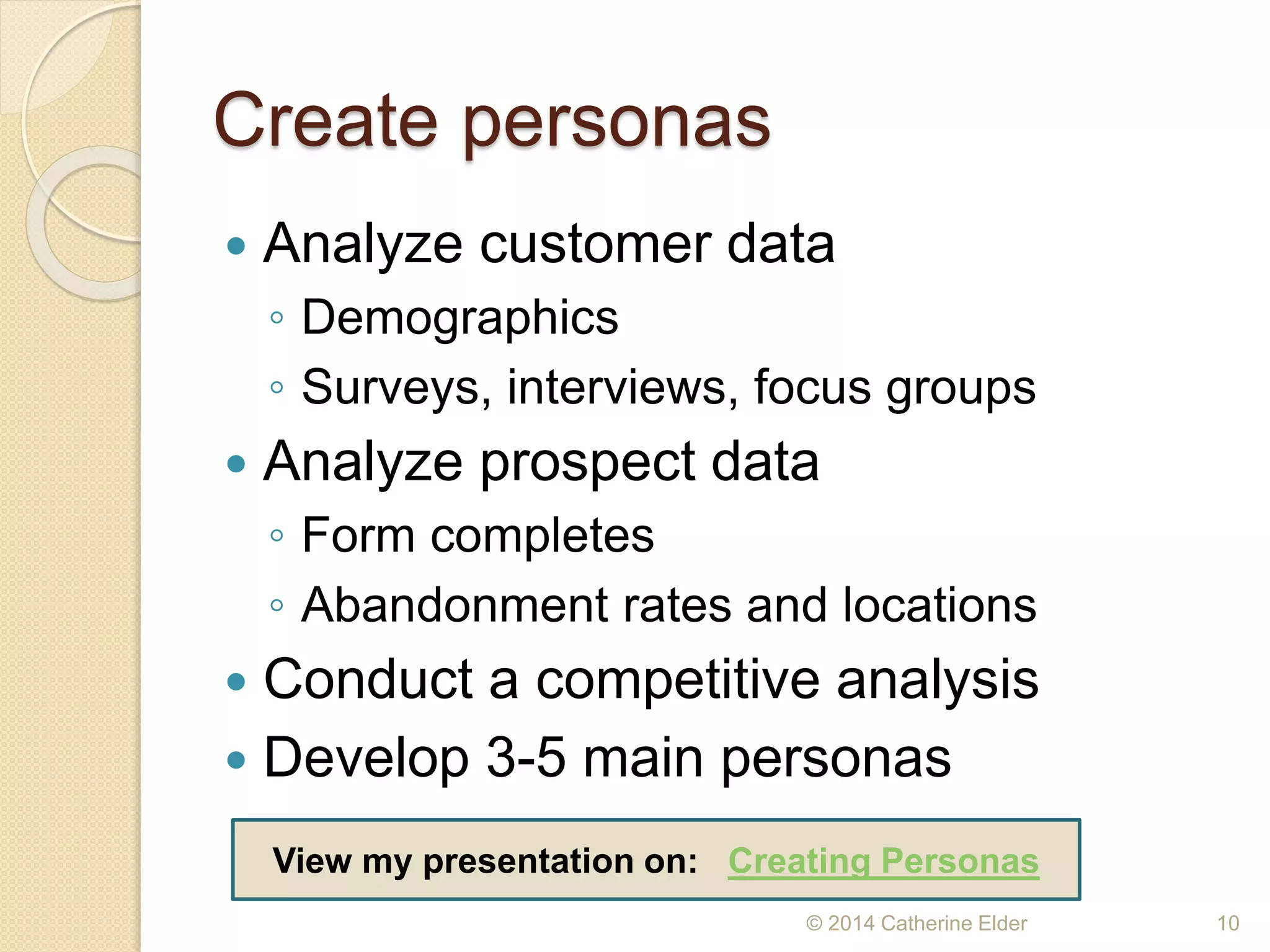
Create personas
 Analyze customer data
◦ Demographics
◦ Surveys, interviews, focus groups
 Analyze prospect data
◦ Form completes
◦ Abandonment rates and locations
 Conduct a competitive analysis
 Develop 3-5 main personas
View my presentation on: Creating Personas
© 2014 Catherine Elder 10
Mapping
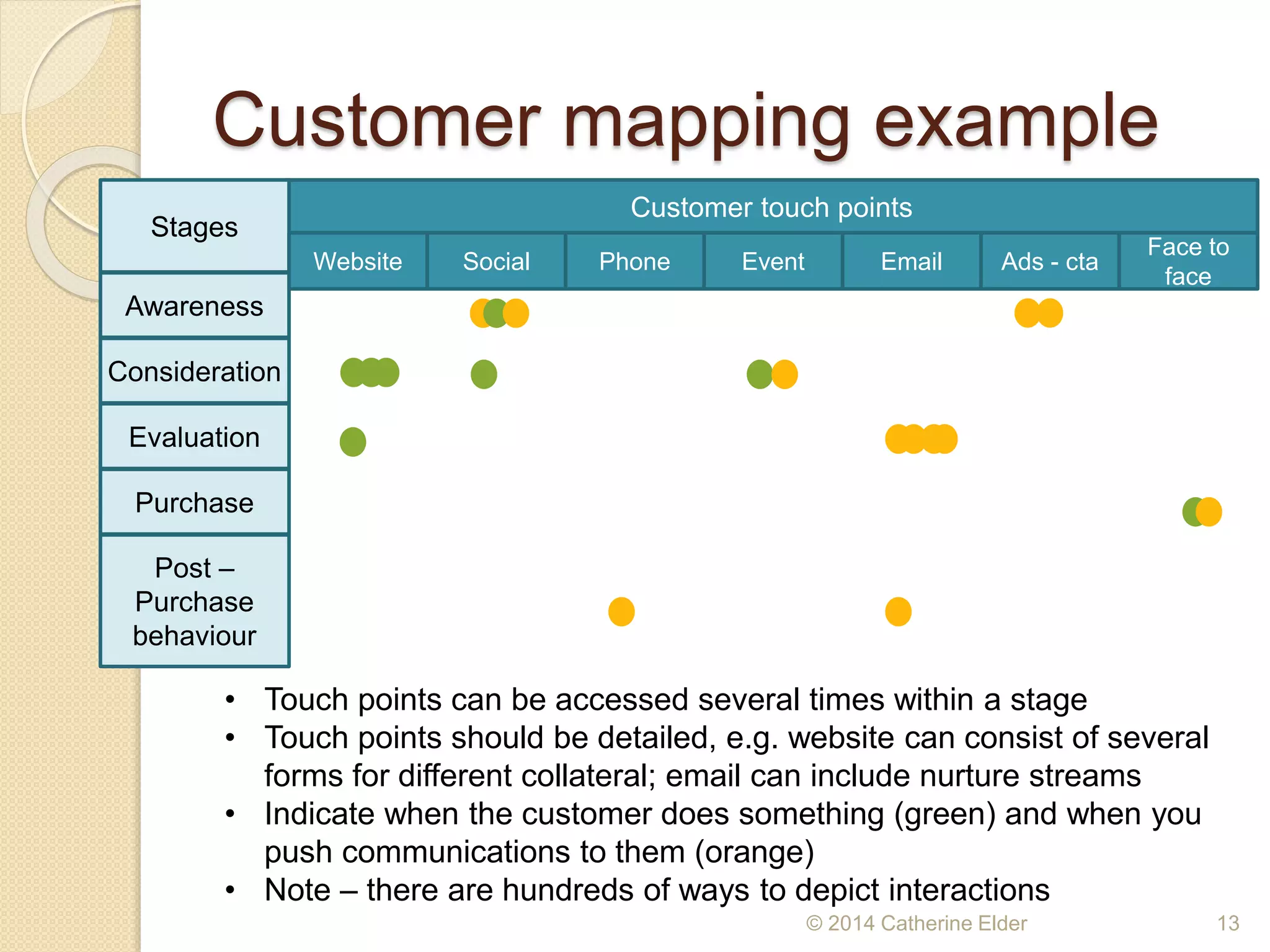
 For each persona map which touch
points they would access based on
defined scenarios for specific
product/service purchases
© 2014 Catherine Elder 11
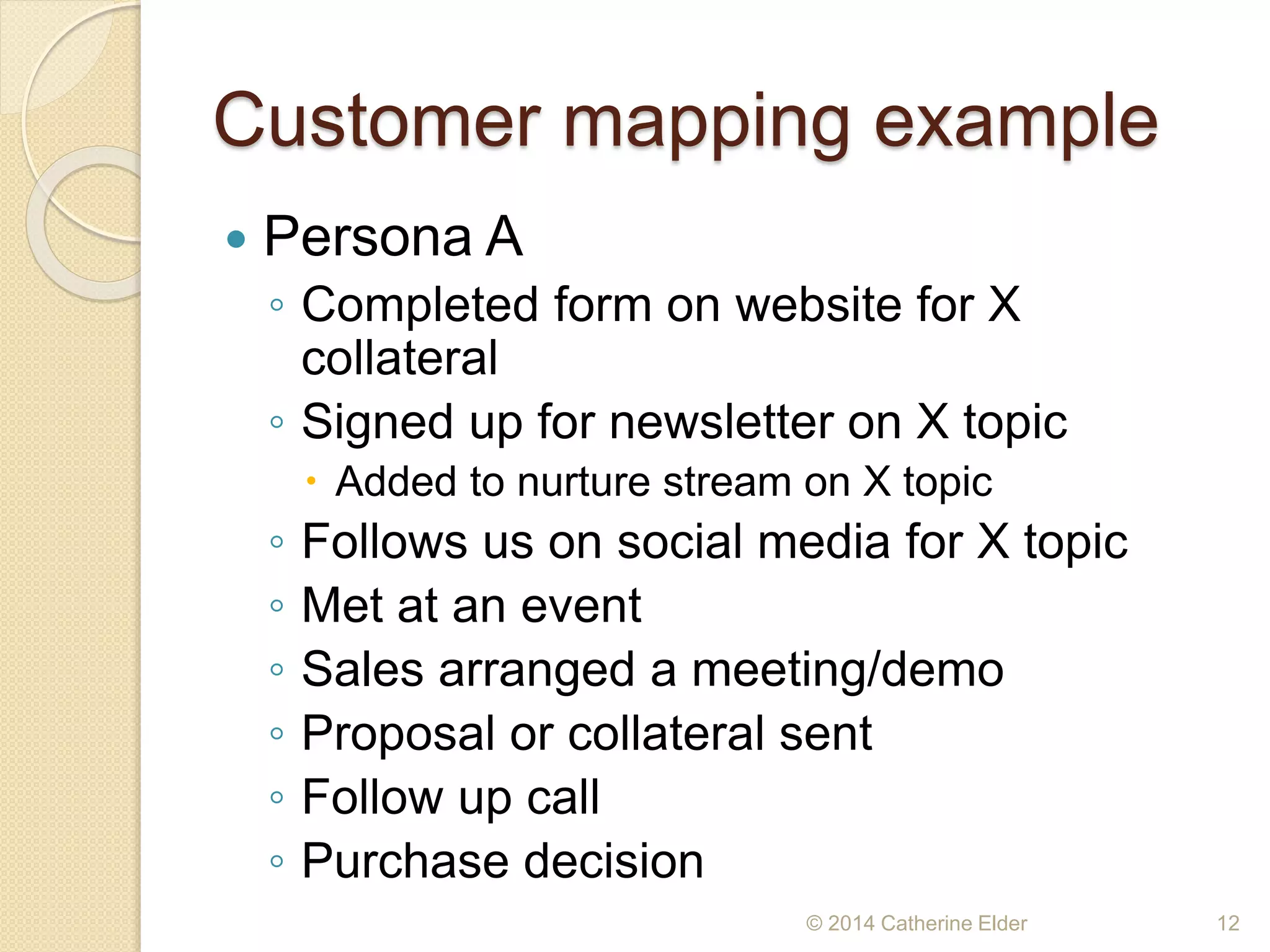
Customer mapping example
 Persona A
◦ Completed form on website for X
collateral
◦ Signed up for newsletter on X topic
 Added to nurture stream on X topic
◦ Follows us on social media for X topic
◦ Met at an event
◦ Sales arranged a meeting/demo
◦ Proposal or collateral sent
◦ Follow up call
◦ Purchase decision
© 2014 Catherine Elder 12
Customer mapping example
© 2014 Catherine Elder 13
Customer touch points
Stages
Awareness
Consideration
Evaluation
Purchase
Post –
Purchase
behaviour
Website Social Phone Event Email Ads - cta
Face to
face
• Touch points can be accessed several times within a stage
• Touch points should be detailed, e.g. website can consist of several
forms for different collateral; email can include nurture streams
• Indicate when the customer does something (green) and when you
push communications to them (orange)
• Note – there are hundreds of ways to depict interactions
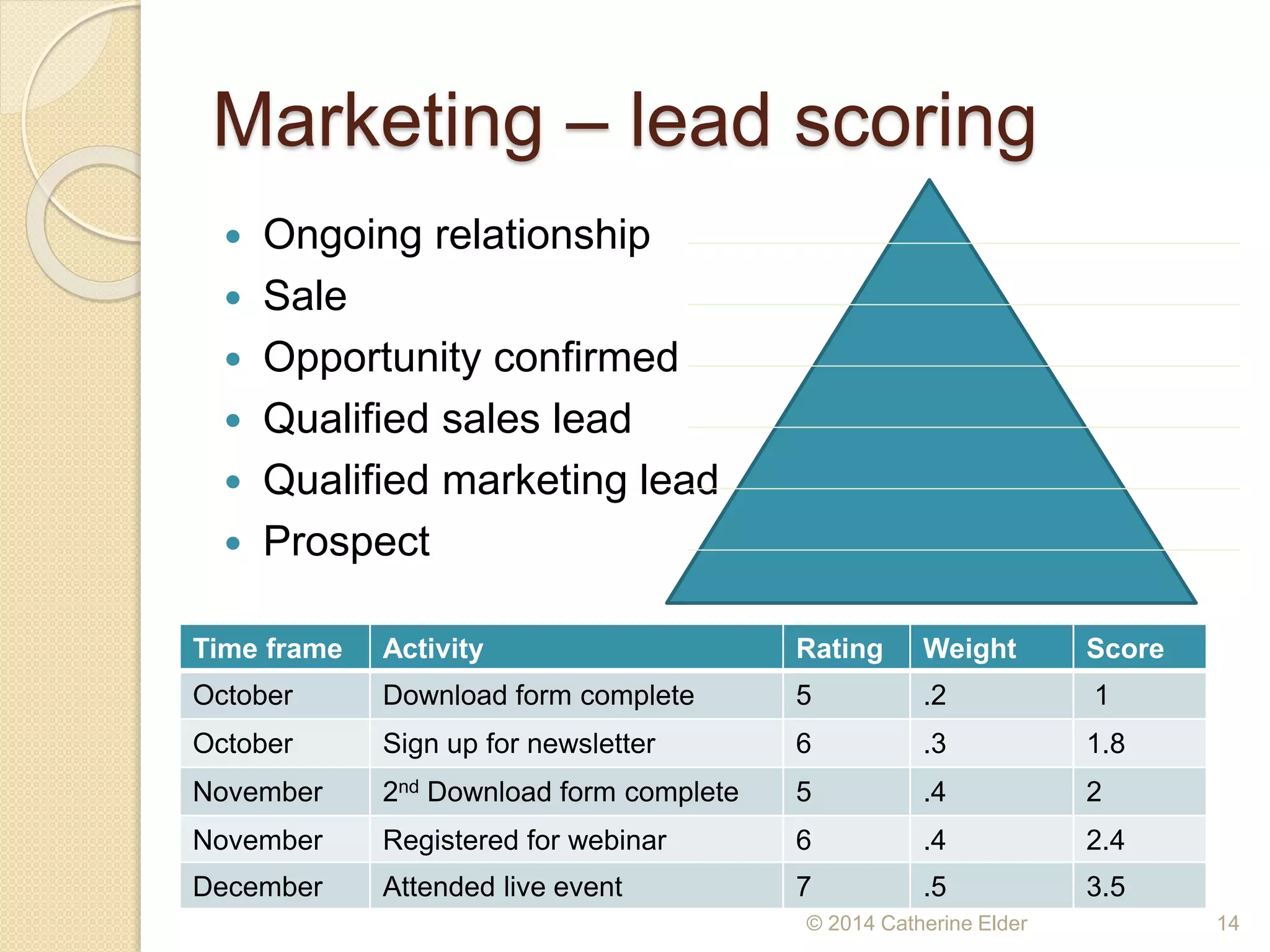
Marketing – lead scoring
 Ongoing relationship
 Sale
 Opportunity confirmed
 Qualified sales lead
 Qualified marketing lead
 Prospect
© 2014 Catherine Elder 14
Time frame Activity Rating Weight Score
October Download form complete 5 .2 1
October Sign up for newsletter 6 .3 1.8
November 2nd Download form complete 5 .4 2
November Registered for webinar 6 .4 2.4
December Attended live event 7 .5 3.5
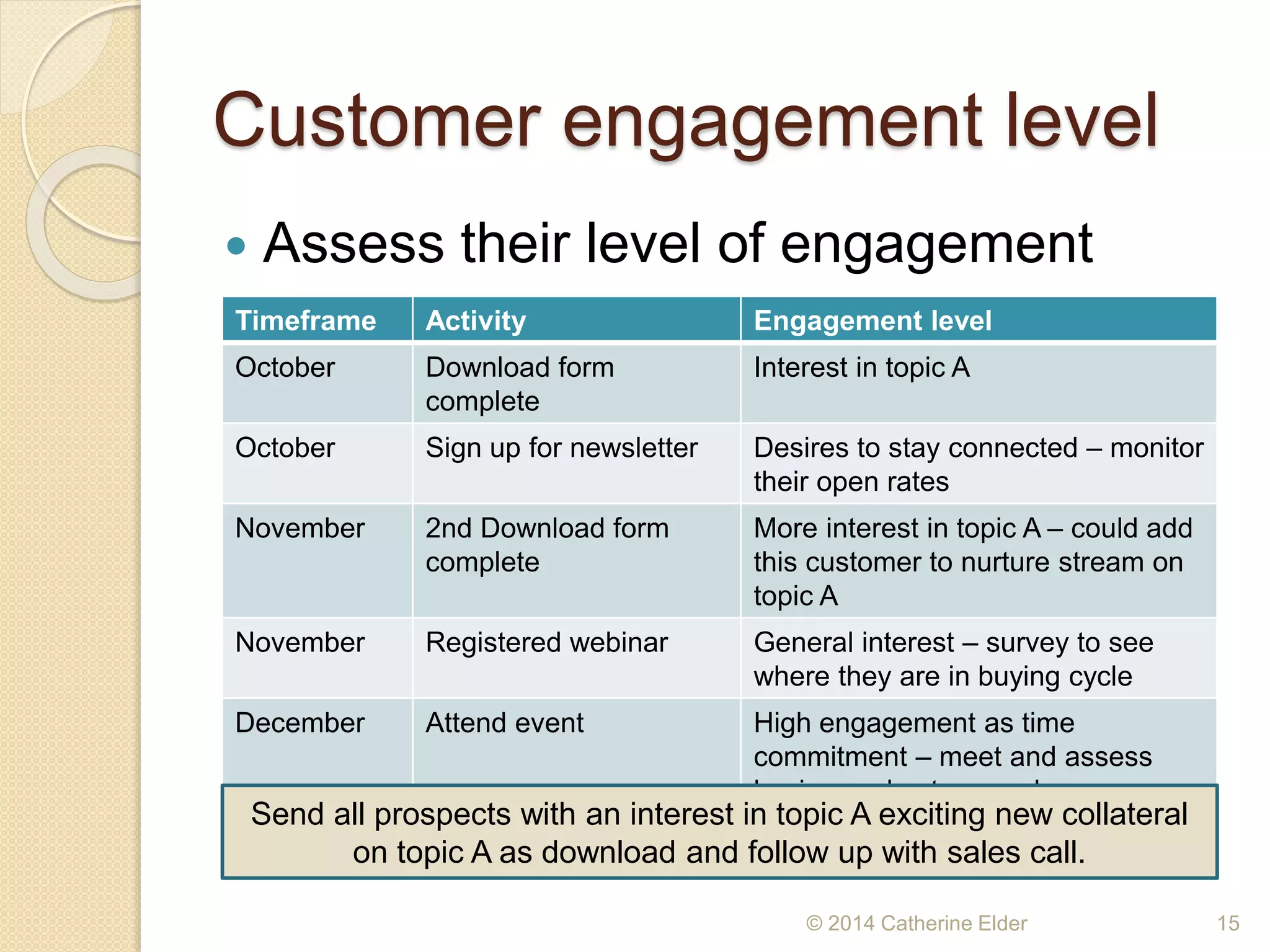
Customer engagement level
 Assess their level of engagement
© 2014 Catherine Elder 15
Timeframe Activity Engagement level
October Download form
complete
Interest in topic A
October Sign up for newsletter Desires to stay connected – monitor
their open rates
November 2nd Download form
complete
More interest in topic A – could add
this customer to nurture stream on
topic A
November Registered webinar General interest – survey to see
where they are in buying cycle
December Attend event High engagement as time
commitment – meet and assess
buying cycle stage and process
Send all prospects with an interest in topic A exciting new collateral
on topic A as download and follow up with sales call.
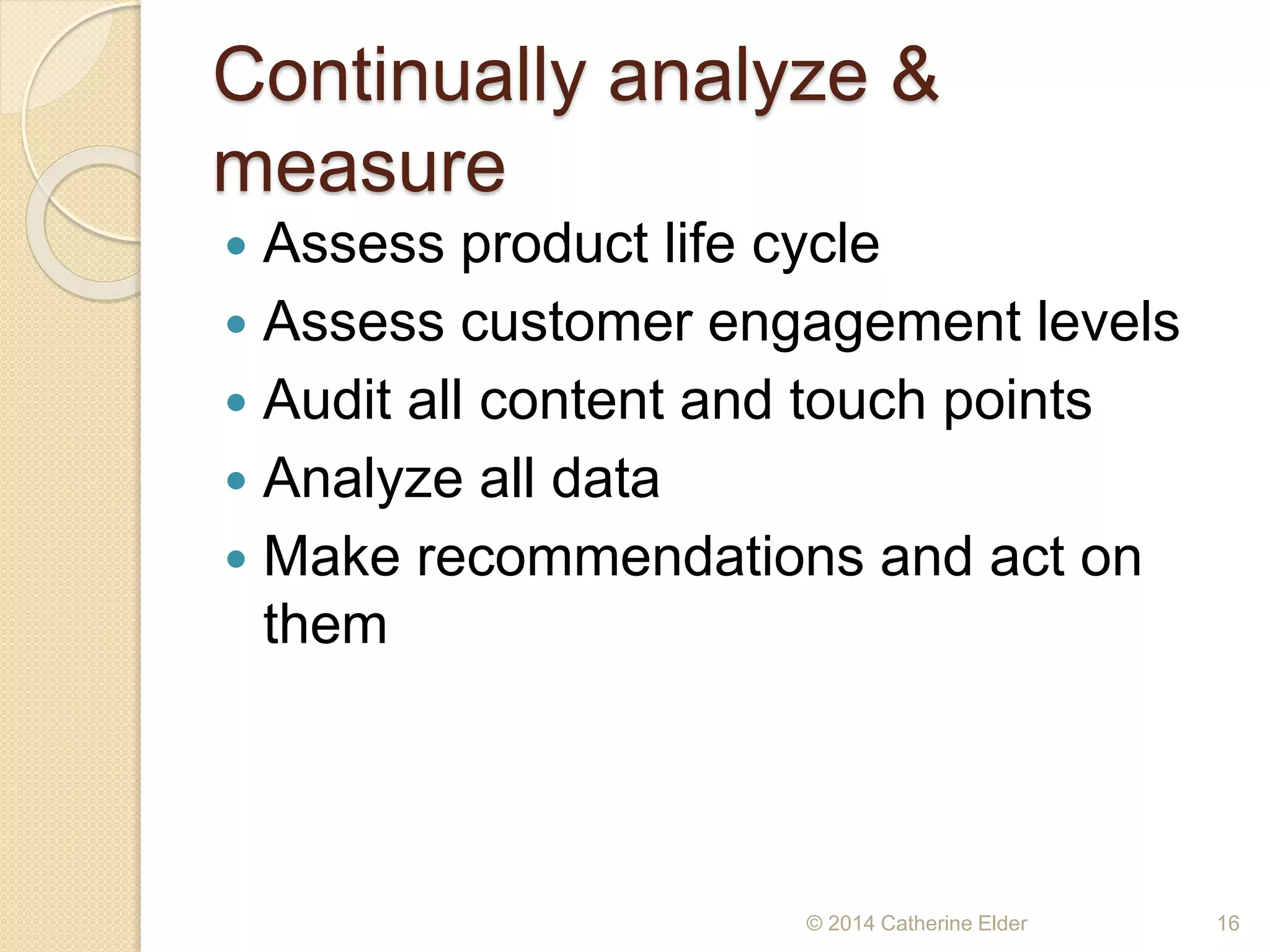
Continually analyze &
measure
 Assess product life cycle
 Assess customer engagement levels
 Audit all content and touch points
 Analyze all data
 Make recommendations and act on
them
© 2014 Catherine Elder 16
IMPROVING THE
CUSTOMER
EXPERIENCE
© 2014 Catherine Elder 17
Customer stage after
purchase
 Post-purchase behaviour
◦ Customer service and product
performance lead to
 Loyalty – advocacy and referrals
 Re-peat customer
© 2014 Catherine Elder 18
Customer requirements
 Is the product performing to promise?
 Are service requirements being met?
 Does customer feel valued?
 Is customer aware of additional
products/ services and cost
savings/offers?
 Customer satisfaction is reached
when…
© 2014 Catherine Elder 19
What are the attributes and commitments you’ve made
to customer service?
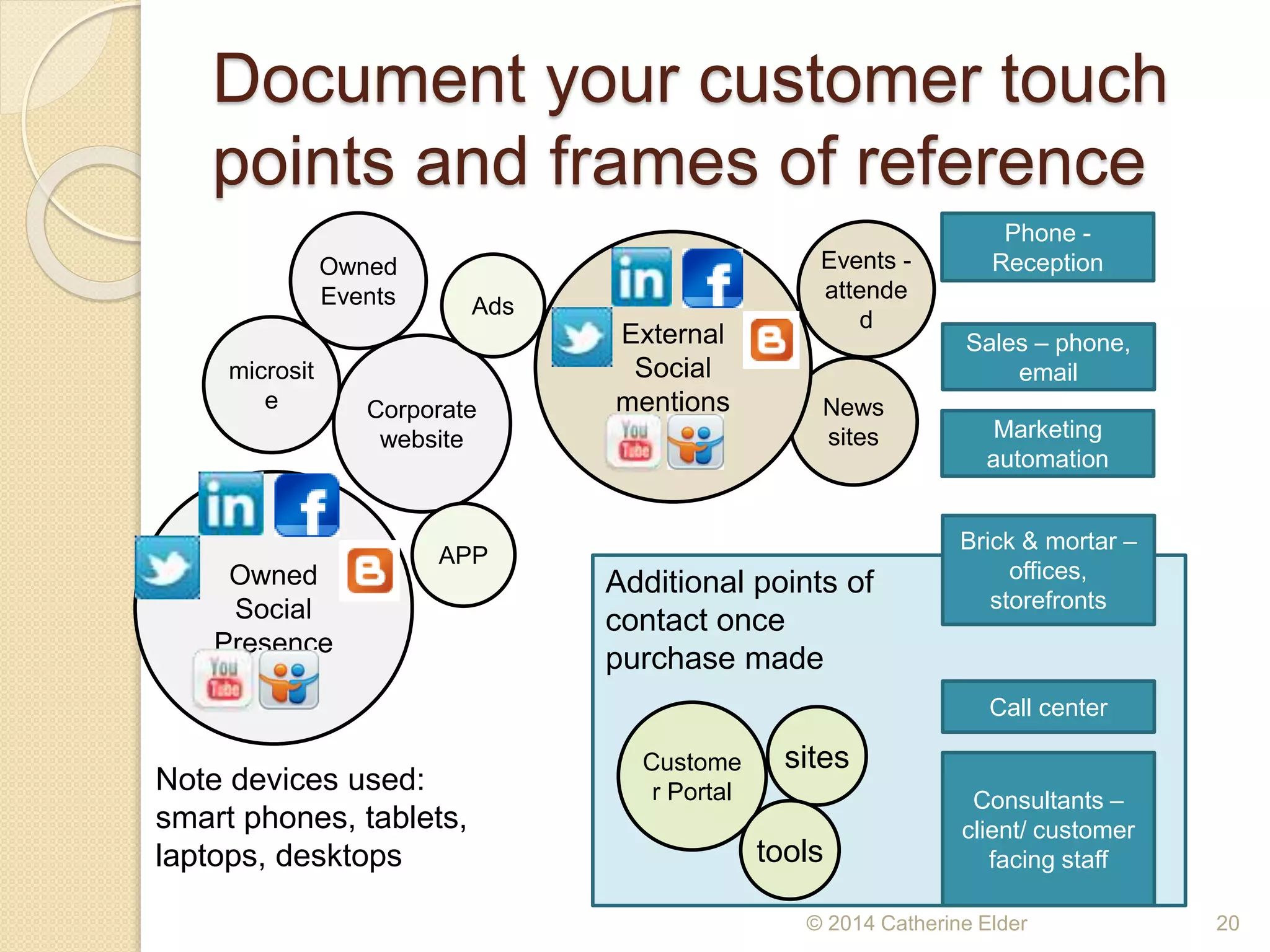
Additional points of
contact once
purchase made
Document your customer touch
points and frames of reference
Custome
r Portal
Corporate
website
News
sites
microsit
e
sites
tools
Owned
Social
Presence
APP
External
Social
mentions
Phone -
Reception
Call center
Brick & mortar –
offices,
storefronts
Sales – phone,
email
Consultants –
client/ customer
facing staff
Owned
Events
Events -
attende
d
© 2014 Catherine Elder 20
Marketing
automation
Ads
Note devices used:
smart phones, tablets,
laptops, desktops
Customer service
 Identify all roles and individual
employees that interact with
customers – do they have scripts for
responses to common questions
 What is the service level agreement –
e.g. response within 24 business
hours
 How do your customers get answers
and assistance?
 What do they think of your customer
service (survey and polls)?
© 2014 Catherine Elder 21
Customer lifecycle and
engagement
 Are your customers engaged?
 Are you moving them into loyalty and
advocate behaviour?
 Would your customers
◦ Give you a testimonial and approve a
case study?
◦ Give you a reference?
◦ Refer anyone to you?
© 2014 Catherine Elder 22
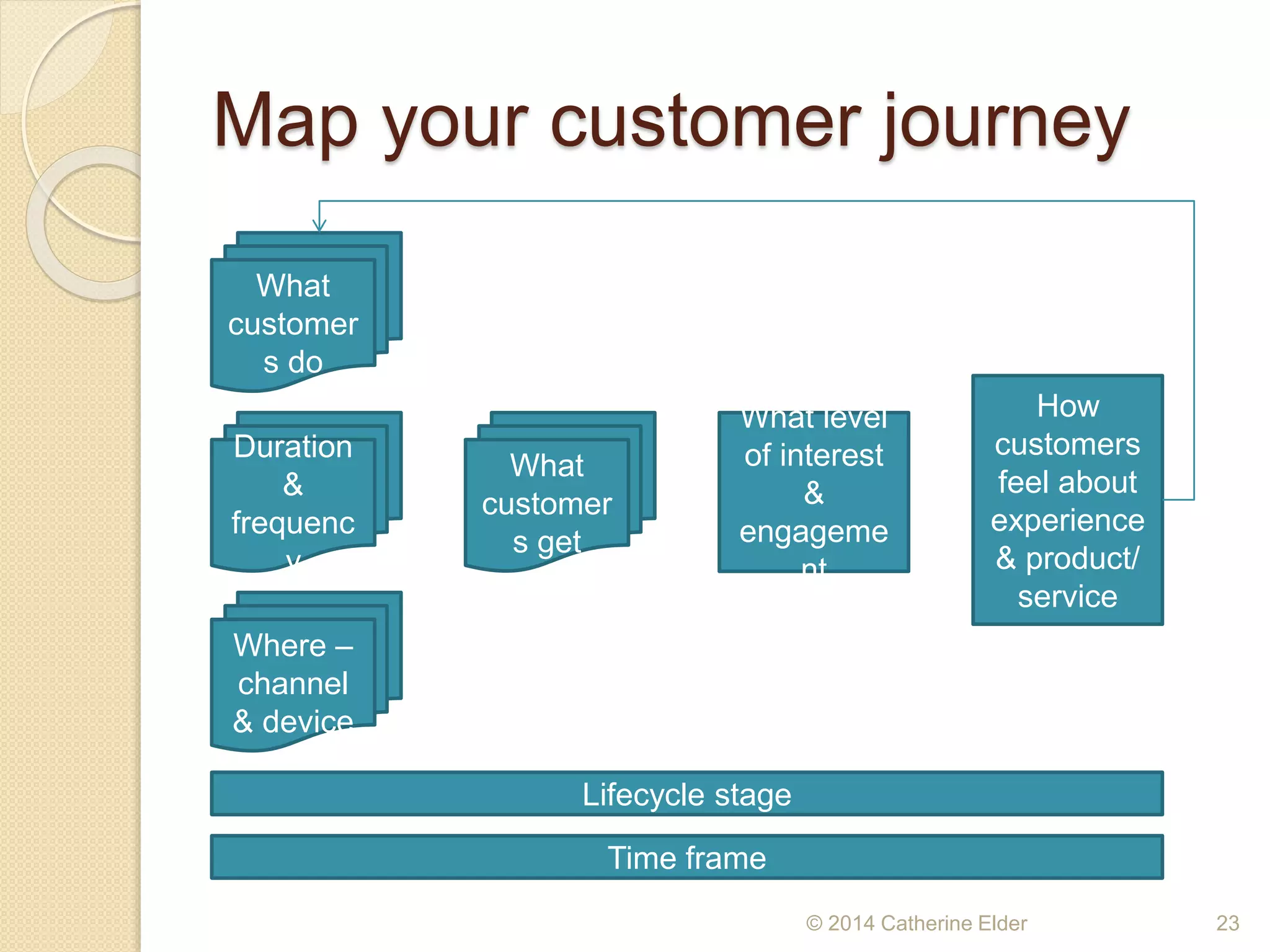
Map your customer journey
© 2014 Catherine Elder 23
What
customer
s do
What
customer
s get
How
customers
feel about
experience
& product/
service
Duration
&
frequenc
y
Where –
channel
& device
What level
of interest
&
engageme
nt
Lifecycle stage
Time frame

Customer journey mapping - a How to...

  • 1.
    Customer Journey Mapping ByCatherine Elder December 2014 © 2014 Catherine Elder 1
  • 2.
    Why do youwant to map your customer’s journey?  To understand ◦ when a prospect becomes a customer – for your sales and marketing teams? ◦ the customer’s experience and how to improve it? © 2014 Catherine Elder 2
  • 3.
    FROM PROSPECT TO CUSTOMER ©2014 Catherine Elder 3
  • 4.
    Stages to becominga customer  Customer perspective ◦ Discover need, need recognition - awareness ◦ Consideration/interest – explore options, research ◦ Evaluation - comparisons ◦ Purchase - action (This is it – now they have changed their status) ◦ Post-purchase behaviour  Customer service and product performance lead to  Loyalty – advocacy and referrals  Re-peat customer  Marketers’ perspective ◦ Prospects (target advertising and marketing automation) ◦ Lead capturing – engage (marketing qualified lead) ◦ Nurture leads – engage (sales qualified lead) ◦ Conversion – Purchase (This is it – now how do you treat them?) ◦ Retention and loyalty ◦ Upsell, cross sell, repeat purchase © 2014 Catherine Elder 4
  • 5.
    Purchaser’s requirements  Defineda need ◦ Attributes of that need for consideration & evaluation:  Cost  Quality  Size, speed, design, use  Access  Service  Value  Purchase is made when… © 2014 Catherine Elder 5 What are the attributes that drive the purchasing decision for your product/service?
  • 6.
    Document your customertouch points and frames of reference Corporate website News sites microsit e Owned Social Presence APP External Social mentions Phone - Reception Brick & mortar – offices, storefronts Sales – phone, email Owned Events Events - attende d © 2014 Catherine Elder 6 Marketing automation Ads Note devices used: smart phones, tablets, laptops, desktops
  • 7.
    Product lifecycle © 2014Catherine Elder 7 Idea generation Development Introduction to market Growth Maturity Decline Research, plan, analyze, design Create, implement, maintenanc e Promotion Improvements Adjustments , support Analyze – improve or new developments Do you know where your products/services are within their lifecycle? Are you actioning according to their stage and analyzed feedback/data?
  • 8.
    Conduct a product/service audit List products/services  Assess their stage in product lifecycle  Define their target markets  Describe their value  Determine any packaging, grouping  Create messaging © 2014 Catherine Elder 8 Product Lifecycle stage Target market Value Packaging Message Product 1 Growth Senior Executives , Global Saves time Works well with product 5 Save X hours …
  • 9.
    Customer purchase decisionflow © 2014 Catherine Elder 9 Identif y need Conduct research • Friends • Colleagues • Authority/Subject matter experts Evaluat e Purchas e Assess Ask Tell How does your product compare to competition?
  • 10.
    Create personas  Analyzecustomer data ◦ Demographics ◦ Surveys, interviews, focus groups  Analyze prospect data ◦ Form completes ◦ Abandonment rates and locations  Conduct a competitive analysis  Develop 3-5 main personas View my presentation on: Creating Personas © 2014 Catherine Elder 10
  • 11.
    Mapping  For eachpersona map which touch points they would access based on defined scenarios for specific product/service purchases © 2014 Catherine Elder 11
  • 12.
    Customer mapping example Persona A ◦ Completed form on website for X collateral ◦ Signed up for newsletter on X topic  Added to nurture stream on X topic ◦ Follows us on social media for X topic ◦ Met at an event ◦ Sales arranged a meeting/demo ◦ Proposal or collateral sent ◦ Follow up call ◦ Purchase decision © 2014 Catherine Elder 12
  • 13.
    Customer mapping example ©2014 Catherine Elder 13 Customer touch points Stages Awareness Consideration Evaluation Purchase Post – Purchase behaviour Website Social Phone Event Email Ads - cta Face to face • Touch points can be accessed several times within a stage • Touch points should be detailed, e.g. website can consist of several forms for different collateral; email can include nurture streams • Indicate when the customer does something (green) and when you push communications to them (orange) • Note – there are hundreds of ways to depict interactions
  • 14.
    Marketing – leadscoring  Ongoing relationship  Sale  Opportunity confirmed  Qualified sales lead  Qualified marketing lead  Prospect © 2014 Catherine Elder 14 Time frame Activity Rating Weight Score October Download form complete 5 .2 1 October Sign up for newsletter 6 .3 1.8 November 2nd Download form complete 5 .4 2 November Registered for webinar 6 .4 2.4 December Attended live event 7 .5 3.5
  • 15.
    Customer engagement level Assess their level of engagement © 2014 Catherine Elder 15 Timeframe Activity Engagement level October Download form complete Interest in topic A October Sign up for newsletter Desires to stay connected – monitor their open rates November 2nd Download form complete More interest in topic A – could add this customer to nurture stream on topic A November Registered webinar General interest – survey to see where they are in buying cycle December Attend event High engagement as time commitment – meet and assess buying cycle stage and process Send all prospects with an interest in topic A exciting new collateral on topic A as download and follow up with sales call.
  • 16.
    Continually analyze & measure Assess product life cycle  Assess customer engagement levels  Audit all content and touch points  Analyze all data  Make recommendations and act on them © 2014 Catherine Elder 16
  • 17.
  • 18.
    Customer stage after purchase Post-purchase behaviour ◦ Customer service and product performance lead to  Loyalty – advocacy and referrals  Re-peat customer © 2014 Catherine Elder 18
  • 19.
    Customer requirements  Isthe product performing to promise?  Are service requirements being met?  Does customer feel valued?  Is customer aware of additional products/ services and cost savings/offers?  Customer satisfaction is reached when… © 2014 Catherine Elder 19 What are the attributes and commitments you’ve made to customer service?
  • 20.
    Additional points of contactonce purchase made Document your customer touch points and frames of reference Custome r Portal Corporate website News sites microsit e sites tools Owned Social Presence APP External Social mentions Phone - Reception Call center Brick & mortar – offices, storefronts Sales – phone, email Consultants – client/ customer facing staff Owned Events Events - attende d © 2014 Catherine Elder 20 Marketing automation Ads Note devices used: smart phones, tablets, laptops, desktops
  • 21.
    Customer service  Identifyall roles and individual employees that interact with customers – do they have scripts for responses to common questions  What is the service level agreement – e.g. response within 24 business hours  How do your customers get answers and assistance?  What do they think of your customer service (survey and polls)? © 2014 Catherine Elder 21
  • 22.
    Customer lifecycle and engagement Are your customers engaged?  Are you moving them into loyalty and advocate behaviour?  Would your customers ◦ Give you a testimonial and approve a case study? ◦ Give you a reference? ◦ Refer anyone to you? © 2014 Catherine Elder 22
  • 23.
    Map your customerjourney © 2014 Catherine Elder 23 What customer s do What customer s get How customers feel about experience & product/ service Duration & frequenc y Where – channel & device What level of interest & engageme nt Lifecycle stage Time frame

Editor's Notes

  • #11 <iframe src="http://www.slideshare.net/cathcontact/slideshelf" width="615px" height="470px" frameborder="0" marginwidth="0" marginheight="0" scrolling="no" style="border:none;" allowfullscreen webkitallowfullscreen mozallowfullscreen></iframe>