Marketing
Cracking the Customer Code: Your Guide to the Customer Journey
Funnel
Cracking the Customer Code: Your Guide to the
Customer Journey Funnel
Marketing J une 20, 2024 10 Min
Question: Do you know that from the moment you think about buying
something until you actually purchase it,it comes under a well-defined
process called the customer journey?
Who needs it: Anyone who owns a business venture understands how
Listen to this article now 1.0✕
00:00 10:43
10 10
crucial it is to fully understand the customer to provide them with the best
possible experience.
Definition: You can describe the customer journey as a process or series of
actions a customer undergoes, beginning with their introduction to the
brand and culminating in their purchase.
Why do you need it: Basically, painting this picture helps you understand
what the pain point is, where inefficiencies are, and where there’s room for
improvement.
In this blog, we will be discussing everything that you need to know about a
customer’s journey. But first, what is it?
What is Customer Journey?
In simple terms, a customer journey involves the customer’s initial interaction
with the brand until he or she buys the product or service.It is a roadmap
that involves brand discovery, first purchase, active buyer, retention, and
beyond. Throughout a client’s lifecycle, the organization will seek to
generate
positive experiences, thus resulting in increased customer satisfaction,
increased loyalty, and ultimately repurchases. To continue, let’s discuss the
five stages that make up a customer’s journey.
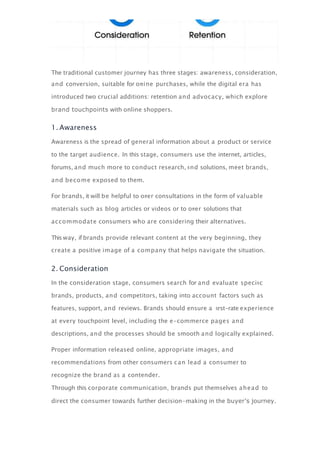
The Five Stages of a Customer Journey
The traditional customer journey has three stages: awareness, consideration,
and conversion, suitable for offline purchases, while the digital era has
introduced two crucial additions: retention and advocacy, which explore
brand touchpoints with online shoppers.
1. Awareness
Awareness is the spread of general information about a product or service
to the target audience. In this stage, consumers use the internet, articles,
forums, and much more to conduct research, find solutions, meet brands,
and become exposed to them.
For brands, it will be helpful to offer consultations in the form of valuable
materials such as blog articles or videos or to offer solutions that
accommodate consumers who are considering their alternatives.
This way, if brands provide relevant content at the very beginning, they
create a positive image of a company that helps navigate the situation.
2. Consideration
In the consideration stage, consumers search for and evaluate specific
brands, products, and competitors, taking into account factors such as
features, support, and reviews. Brands should ensure a first-rate experience
at every touchpoint level, including the e-commerce pages and
descriptions, and the processes should be smooth and logically explained.
Proper information released online, appropriate images, and
recommendations from other consumers can lead a consumer to
recognize the brand as a contender.
Through this corporate communication, brands put themselves ahead to
direct the consumer towards further decision-making in the buyer’s journey.
3. Conversion
The third stage is decision-making, where customers make a final decision
on what to purchase—either a product or a service. This stage compels
visitors to take a call-to-action (CTA) that encourages them to buy more,
subscribe, or sign up. This is the final evaluation stage, where customers look
at aspects like price, cost, quality of service, and the sharing of company
values before deciding to purchase the product.
Here, the consumer looks for a brand that he or she can trust to deliver a
quality solution to a given problem with an assured customer-friendly
experience. It is vital for brands to prepare for this stage in their strategies by
providing rewards, stating policies well, and training support staff to respond
to decision-making questions.
4. Retention
At this stage of the customer journey map, what was invested in planning
and building the assets has come to fruition since the consumer has
decided to purchase a product from your brand. Yet, their loyalty should not
be taken for granted and would require immense efforts to ensure it. It is
always
important to engage happy customers, as they provide loyalty and
continue to support an organization’s operations at a cheaper cost than
having to attract new customers.
In order to enhance the ease of transactions, businesses should guarantee
an effective e-commerce environment, or HS sales space. Make sure you
stay up-to-date with competitor strategies for customer touchpoint
improvement. Introduce a separate team whose job it is to ensure that all
satisfied customers do not switch to competitors’ products. Reach out to
these potential brand ambassadors, because they are already familiar with
your brand and are ready to invest money in your products and services.
5.Advocacy
This is the stage where customers take charge of promoting the product or
services by applying word-of-mouth or from any other social media
platform.
Word-of-mouth is acknowledged by most organizations as one of the forms
of effective communication; however, there are few systematic efforts to
increase customer advocacy. The other form of idea is contacting some
influencers, or guest posting, which is a feasible approach. Loyal customers
are specifically more likely to recommend brands, which improves the
overall experience of consumers.
Proactively engage the customers during the use of the product,
conduct surveys, and create referral options to encourage continued
usage by customers. Deliver informative supplementary material such as
blogging tips, a newsletter, or a survey about the product to enhance not
only the experience but also encourage activity.
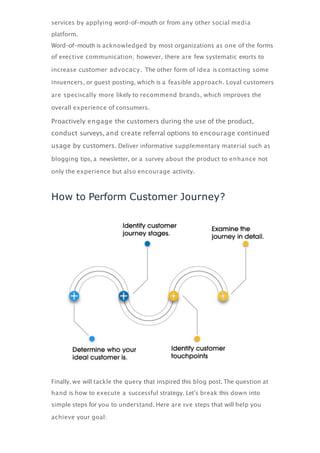
How to Perform Customer Journey?
Finally, we will tackle the query that inspired this blog post. The question at
hand is how to execute a successful strategy. Let’s break this down into
simple steps for you to understand. Here are five steps that will help you
achieve your goal:
Step 1: Determine who your ideal customer is.
Defining your ideal customer is crucial for tailoring your marketing efforts
and delivering a personalized experience. For example, if you’re a high-end
skinca re bra nd, your idea l customer might be a ffl uent women a ged 35–55
who prioritize quality over cost. Understanding their demographics, interests,
and pain points will help you create targeted campaigns and products that
resonate with them.
Step 2: Identify customer journey stages.
The customer journey typically includes stages like awareness,
consideration, purchase, and post-purchase. For instance, a potential
customer may first become aware of your brand through social media ads
(awareness stage), then read product reviews and compare prices
(considera tion sta ge), ma ke a purcha se (purcha se sta ge), a nd fi na lly lea ve
a review or make a repeat purchase (post-purchase stage).
Step 3: Identify customer touchpoints
Touchpoints are the various channels and interactions where customers
engage with your brand. These can include your website, social media
platforms, email campaigns, customer service interactions, and more.
According to a study by Salesforce, 76% of customers expect consistent
intera ctions a cross depa rtments, highlighting the importa nce of a cohesive
customer experience across touchpoints.
Step 4: Examine the journey in detail.
Analyze each stage of the customer purchase journey and identify areas
for improvement. For example, if you notice a high cart abandonment rate
on your e-commerce site, you may need to streamline the checkout
process or offer incentives to complete the purchase. According to the
Baymard Institute, the average cart abandonment rate is around 69.8%,
representing a significant opportunity for optimization.
Step 5: Take action and continue to iterate.
Based on your findings, implement changes to improve the customer
journey. This could involve optimizing your website for a better user
experience, providing more personalized recommendations, or improving
your customer service processes. Continuously ga ther feedba ck a nd
analyze the data to identify areas for further improvement. A study by Bain &
Company found that companies that prioritize customer experience
generate 60% higher profits than their competitors.
Additional Tips
1.Ma ke it a tea m eff ort.
2.Have a complete understanding of your customer base.
3.Make use of the omnichannel approach.
4.Customize your interactions with customers.
5. Foster an atmosphere of trust.
Why it’s Important to Understand Customer
Needs
“Focusing on the customer makes a company more resilient.” This
statement by Jeff Bezos clearly highlights the importance of a customer in
the business world. Companies that put in the work to improve the customer
experience see a 42% improvement in customer retention, a 33%
improvement in customer satisfaction, and a 32% increase in cross-selling
and up-selling. They are the masters who, at the end of the day, give you the
sales. Hence, understanding their needs becomes vital. Below are a few
benefi ts of it tha t one must go through.
Develop Products and Services They Actually Want: If the industry
knows what people are looking for and develops their products or
services accordingly, it will reach the target audience, ultimately boosting
sales.
Cra Effective Marketing Messages: When you know your customers,
you know how they will react to marketing strategies. For example, you will
be able to cra the messages according to their demands because you
already know where to hit.
Personalize the Customer Experience: Each customer is unique, with
their own wa ys a nd ta stes.You ca n give your a udience a persona lized
experience if you understa nd them well.
Fuel Innovation and Product Development: It can fuel innovation and
product development. You can always update your product and make
the necessary changes to meet the customer’s needs.
Improve Customer Service: Once you have a clear understanding of
your customers, you automatically improve the services you provide to
them.
The Journey may not Finish Here
Once you understand the entire concept of a customer journey, you are
ready to grow your business. There are many things you need to understand
in the entire process, but this blog has given you everything you need. Just
keep those importa nt points in mind, a nd you a re good to go. T
he
information provided in this blog serves as an excellent starting point;
nevertheless, you must continue to educate yourself and adapt to changing
market conditions.
Related Post
Omnicha nnel
Marketing:…
J une 21, 2024
Building a Strong
Brand Identity for…
J une 19, 2024
Wha t is bra nd trust,
and how can we…
J une 11, 2024
A Step-by-Step
Guide: How to Ru…
Ma y 16, 2024
The Impact of AI-
Generated Conte…
Ma y 8, 2024
Learn How to
Increase Organic…
Ma y 2, 2024
Subsc ribe T
o G et Latest Updates
Email
Subscribe
Cosmic Campaigns, Universal Impact: Your Brand's Odyssey Begins with
Stellar Marketing.
Copyright ©2023 Neoma.Media | All rights reserved.
Services
Marketing Strategy & Insights
Creative & Content Production
Media & Channel Activation
Customer Experience & Personalization
Measurement & Marketing ROI
Resourses
Services
About Us
Case Study
Contact US

Conquer Customer Journey: Map, Analyze, & Boost Sales

  • 1.
    Marketing Cracking the CustomerCode: Your Guide to the Customer Journey Funnel Cracking the Customer Code: Your Guide to the Customer Journey Funnel Marketing J une 20, 2024 10 Min Question: Do you know that from the moment you think about buying something until you actually purchase it,it comes under a well-defined process called the customer journey? Who needs it: Anyone who owns a business venture understands how Listen to this article now 1.0✕ 00:00 10:43 10 10
  • 2.
    crucial it isto fully understand the customer to provide them with the best possible experience. Definition: You can describe the customer journey as a process or series of actions a customer undergoes, beginning with their introduction to the brand and culminating in their purchase. Why do you need it: Basically, painting this picture helps you understand what the pain point is, where inefficiencies are, and where there’s room for improvement. In this blog, we will be discussing everything that you need to know about a customer’s journey. But first, what is it? What is Customer Journey? In simple terms, a customer journey involves the customer’s initial interaction with the brand until he or she buys the product or service.It is a roadmap that involves brand discovery, first purchase, active buyer, retention, and beyond. Throughout a client’s lifecycle, the organization will seek to generate positive experiences, thus resulting in increased customer satisfaction, increased loyalty, and ultimately repurchases. To continue, let’s discuss the five stages that make up a customer’s journey. The Five Stages of a Customer Journey
  • 3.
    The traditional customerjourney has three stages: awareness, consideration, and conversion, suitable for offline purchases, while the digital era has introduced two crucial additions: retention and advocacy, which explore brand touchpoints with online shoppers. 1. Awareness Awareness is the spread of general information about a product or service to the target audience. In this stage, consumers use the internet, articles, forums, and much more to conduct research, find solutions, meet brands, and become exposed to them. For brands, it will be helpful to offer consultations in the form of valuable materials such as blog articles or videos or to offer solutions that accommodate consumers who are considering their alternatives. This way, if brands provide relevant content at the very beginning, they create a positive image of a company that helps navigate the situation. 2. Consideration In the consideration stage, consumers search for and evaluate specific brands, products, and competitors, taking into account factors such as features, support, and reviews. Brands should ensure a first-rate experience at every touchpoint level, including the e-commerce pages and descriptions, and the processes should be smooth and logically explained. Proper information released online, appropriate images, and recommendations from other consumers can lead a consumer to recognize the brand as a contender. Through this corporate communication, brands put themselves ahead to direct the consumer towards further decision-making in the buyer’s journey.
  • 4.
    3. Conversion The thirdstage is decision-making, where customers make a final decision on what to purchase—either a product or a service. This stage compels visitors to take a call-to-action (CTA) that encourages them to buy more, subscribe, or sign up. This is the final evaluation stage, where customers look at aspects like price, cost, quality of service, and the sharing of company values before deciding to purchase the product. Here, the consumer looks for a brand that he or she can trust to deliver a quality solution to a given problem with an assured customer-friendly experience. It is vital for brands to prepare for this stage in their strategies by providing rewards, stating policies well, and training support staff to respond to decision-making questions. 4. Retention At this stage of the customer journey map, what was invested in planning and building the assets has come to fruition since the consumer has decided to purchase a product from your brand. Yet, their loyalty should not be taken for granted and would require immense efforts to ensure it. It is always important to engage happy customers, as they provide loyalty and continue to support an organization’s operations at a cheaper cost than having to attract new customers. In order to enhance the ease of transactions, businesses should guarantee an effective e-commerce environment, or HS sales space. Make sure you stay up-to-date with competitor strategies for customer touchpoint improvement. Introduce a separate team whose job it is to ensure that all satisfied customers do not switch to competitors’ products. Reach out to these potential brand ambassadors, because they are already familiar with your brand and are ready to invest money in your products and services. 5.Advocacy This is the stage where customers take charge of promoting the product or
  • 5.
    services by applyingword-of-mouth or from any other social media platform. Word-of-mouth is acknowledged by most organizations as one of the forms of effective communication; however, there are few systematic efforts to increase customer advocacy. The other form of idea is contacting some influencers, or guest posting, which is a feasible approach. Loyal customers are specifically more likely to recommend brands, which improves the overall experience of consumers. Proactively engage the customers during the use of the product, conduct surveys, and create referral options to encourage continued usage by customers. Deliver informative supplementary material such as blogging tips, a newsletter, or a survey about the product to enhance not only the experience but also encourage activity. How to Perform Customer Journey? Finally, we will tackle the query that inspired this blog post. The question at hand is how to execute a successful strategy. Let’s break this down into simple steps for you to understand. Here are five steps that will help you achieve your goal:
  • 6.
    Step 1: Determinewho your ideal customer is. Defining your ideal customer is crucial for tailoring your marketing efforts and delivering a personalized experience. For example, if you’re a high-end skinca re bra nd, your idea l customer might be a ffl uent women a ged 35–55 who prioritize quality over cost. Understanding their demographics, interests, and pain points will help you create targeted campaigns and products that resonate with them. Step 2: Identify customer journey stages. The customer journey typically includes stages like awareness, consideration, purchase, and post-purchase. For instance, a potential customer may first become aware of your brand through social media ads (awareness stage), then read product reviews and compare prices (considera tion sta ge), ma ke a purcha se (purcha se sta ge), a nd fi na lly lea ve a review or make a repeat purchase (post-purchase stage). Step 3: Identify customer touchpoints Touchpoints are the various channels and interactions where customers engage with your brand. These can include your website, social media platforms, email campaigns, customer service interactions, and more. According to a study by Salesforce, 76% of customers expect consistent intera ctions a cross depa rtments, highlighting the importa nce of a cohesive customer experience across touchpoints. Step 4: Examine the journey in detail. Analyze each stage of the customer purchase journey and identify areas for improvement. For example, if you notice a high cart abandonment rate on your e-commerce site, you may need to streamline the checkout process or offer incentives to complete the purchase. According to the Baymard Institute, the average cart abandonment rate is around 69.8%, representing a significant opportunity for optimization. Step 5: Take action and continue to iterate.
  • 7.
    Based on yourfindings, implement changes to improve the customer journey. This could involve optimizing your website for a better user experience, providing more personalized recommendations, or improving your customer service processes. Continuously ga ther feedba ck a nd analyze the data to identify areas for further improvement. A study by Bain & Company found that companies that prioritize customer experience generate 60% higher profits than their competitors. Additional Tips 1.Ma ke it a tea m eff ort. 2.Have a complete understanding of your customer base. 3.Make use of the omnichannel approach. 4.Customize your interactions with customers. 5. Foster an atmosphere of trust. Why it’s Important to Understand Customer Needs “Focusing on the customer makes a company more resilient.” This statement by Jeff Bezos clearly highlights the importance of a customer in the business world. Companies that put in the work to improve the customer experience see a 42% improvement in customer retention, a 33% improvement in customer satisfaction, and a 32% increase in cross-selling and up-selling. They are the masters who, at the end of the day, give you the sales. Hence, understanding their needs becomes vital. Below are a few benefi ts of it tha t one must go through. Develop Products and Services They Actually Want: If the industry knows what people are looking for and develops their products or services accordingly, it will reach the target audience, ultimately boosting sales. Cra Effective Marketing Messages: When you know your customers,
  • 8.
    you know howthey will react to marketing strategies. For example, you will be able to cra the messages according to their demands because you already know where to hit. Personalize the Customer Experience: Each customer is unique, with their own wa ys a nd ta stes.You ca n give your a udience a persona lized experience if you understa nd them well. Fuel Innovation and Product Development: It can fuel innovation and product development. You can always update your product and make the necessary changes to meet the customer’s needs. Improve Customer Service: Once you have a clear understanding of your customers, you automatically improve the services you provide to them. The Journey may not Finish Here Once you understand the entire concept of a customer journey, you are ready to grow your business. There are many things you need to understand in the entire process, but this blog has given you everything you need. Just keep those importa nt points in mind, a nd you a re good to go. T he information provided in this blog serves as an excellent starting point; nevertheless, you must continue to educate yourself and adapt to changing market conditions. Related Post Omnicha nnel Marketing:… J une 21, 2024 Building a Strong Brand Identity for… J une 19, 2024
  • 9.
    Wha t isbra nd trust, and how can we… J une 11, 2024 A Step-by-Step Guide: How to Ru… Ma y 16, 2024 The Impact of AI- Generated Conte… Ma y 8, 2024 Learn How to Increase Organic… Ma y 2, 2024 Subsc ribe T o G et Latest Updates Email Subscribe Cosmic Campaigns, Universal Impact: Your Brand's Odyssey Begins with Stellar Marketing.
  • 10.
    Copyright ©2023 Neoma.Media| All rights reserved. Services Marketing Strategy & Insights Creative & Content Production Media & Channel Activation Customer Experience & Personalization Measurement & Marketing ROI Resourses Services About Us Case Study Contact US