September 18, 2014
September 18, 2014 
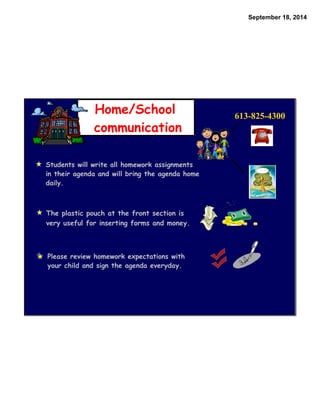
Home/School 
communication 
613-825-4300 
Students will write all homework assignments 
in their agenda and will bring the agenda home 
daily. 
The plastic pouch at the front section is 
very useful for inserting forms and money. 
Please review homework expectations with 
your child and sign the agenda everyday.
September 18, 2014 
HOMEWORK! DEVOIRS! 
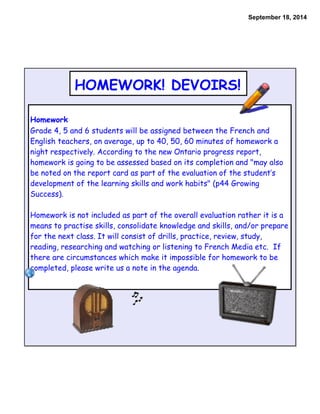
Homework 
Grade 4, 5 and 6 students will be assigned between the French and 
English teachers, on average, up to 40, 50, 60 minutes of homework a 
night respectively. According to the new Ontario progress report, 
homework is going to be assessed based on its completion and "may also 
be noted on the report card as part of the evaluation of the student’s 
development of the learning skills and work habits" (p44 Growing 
Success). 
Homework is not included as part of the overall evaluation rather it is a 
means to practise skills, consolidate knowledge and skills, and/or prepare 
for the next class. It will consist of drills, practice, review, study, 
reading, researching and watching or listening to French Media etc. If 
there are circumstances which make it impossible for homework to be 
completed, please write us a note in the agenda.
September 18, 2014 
HOMEWORK! DEVOIRS! 
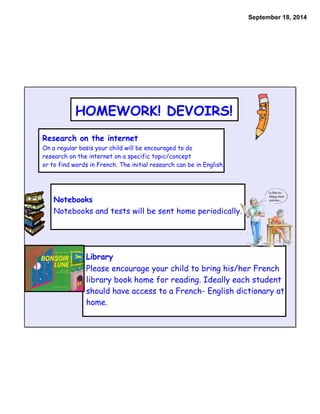
Research on the internet 
On a regular basis your child will be encouraged to do 
research on the internet on a specific topic/concept 
or to find words in French. The initial research can be in English. 
Notebooks 
Notebooks and tests will be sent home periodically. 
Library 
Please encourage your child to bring his/her French 
library book home for reading. Ideally each student 
should have access to a French- English dictionary at 
home.
September 18, 2014 
“ 
The Common European Framework of reference 
The CEFR has been developed from more than thirty years of work 
on language teaching, learning and assessment by the Council of 
europe. It is intended to provide a common basis for defining 
language proficiency […] not a uniform system of language 
learning or teaching, nor a national curriculum.” 
The Common European Framework of Reference for language learning is the 
inspiration behind the new Ontario FSL Curriculum. 
The CEFR is based on developing oral communication first through the action-oriented 
approach to language acquisition . 
The action-oriented approach to language acquisition views 
communication as a social activity designed to accomplish specific 
tasks. 
It recognizes students as active participants in the learning process. 
In Ontario, this reference tool is recognized as a valuable asset for 
informing instruction and assessment practices in FSL education.
September 18, 2014 
Why teach through inquiry 
Inquiry-based learning concerns itself with the creative 
approach of combining the best approaches to instruction, 
including explicit instruction and small-group and guided 
learning, in an attempt to build on students’ interests and 
ideas, ultimately moving students forward in their paths of 
intellectual curiosity and understanding. 
Inquiry-based learning offers promise in supporting 
students to become thoughtful, motivated, collaborative 
and innovative learners capable of engaging in their 
own inquiries and thriving in a world of constant 
change.
September 18, 2014 
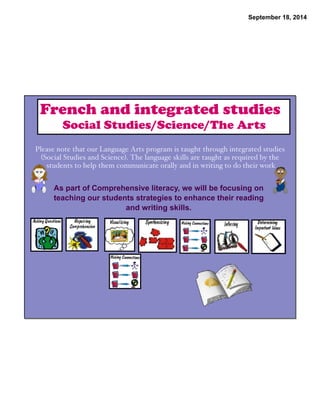
French and integrated studies 
Social Studies/Science/The Arts 
Please note that our Language Arts program is taught through integrated studies 
(Social Studies and Science). The language skills are taught as required by the 
students to help them communicate orally and in writing to do their work 
As part of Comprehensive literacy, we will be focusing on 
teaching our students strategies to enhance their reading 
and writing skills.
September 18, 2014 
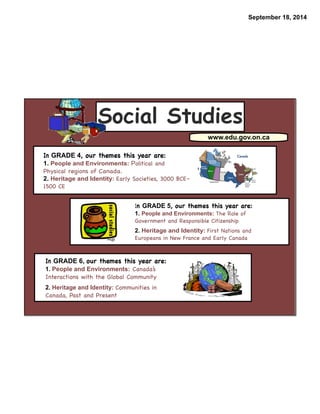
Social Studies 
In GRADE 4, our themes this year are: 
1. People and Environments: Political and 
Physical regions of Canada. 
2. Heritage and Identity: Early Societies, 3000 BCE– 
1500 CE 
In GRADE 5, our themes this year are: 
1. People and Environments: The Role of 
Government and Responsible Citizenship 
2. Heritage and Identity: First Nations and 
Europeans in New France and Early Canada 
In GRADE 6, our themes this year are: 
1. People and Environments: Canada’s 
Interactions with the Global Community 
2. Heritage and Identity: Communities in 
Canada, Past and Present 
www.edu.gov.on.ca
September 18, 2014 
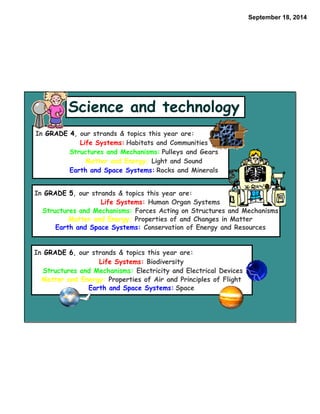
Science and technology 
In GRADE 4, our strands & topics this year are: 
Life Systems: Habitats and Communities 
Structures and Mechanisms: Pulleys and Gears 
Matter and Energy: Light and Sound 
Earth and Space Systems: Rocks and Minerals 
In GRADE 5, our strands & topics this year are: 
Life Systems: Human Organ Systems 
Structures and Mechanisms: Forces Acting on Structures and Mechanisms 
Matter and Energy: Properties of and Changes in Matter 
Earth and Space Systems: Conservation of Energy and Resources 
In GRADE 6, our strands & topics this year are: 
Life Systems: Biodiversity 
Structures and Mechanisms: Electricity and Electrical Devices 
Matter and Energy: Properties of Air and Principles of Flight 
Earth and Space Systems: Space
September 18, 2014
September 18, 2014 
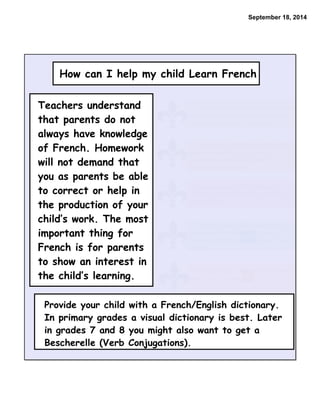
How can I help my child Learn French 
• Ask questions about what is being taught 
in class and suggest that the child teach 
you some vocabulary or structures. 
• Listen to your child read you the work 
they have written. If you do not 
understand listen then ask the child to 
explain what was read. 
• Encourage your child to interact in 
French with French speaking neighbors or 
acquaintances 
• Encourage your child to spend small 
amounts of time listening to French 
television (cartoons, sports, games, music 
videos). 
• Encourage your child to borrow French 
books from the library. 
Teachers understand 
that parents do not 
always have knowledge 
of French. Homework 
will not demand that 
you as parents be able 
to correct or help in 
the production of your 
child’s work. The most 
important thing for 
French is for parents 
to show an interest in 
the child’s learning. 
Provide your child with a French/English dictionary. 
In primary grades a visual dictionary is best. Later 
in grades 7 and 8 you might also want to get a 
Bescherelle (Verb Conjugations).

Curriculumnightsept17

  • 1.
  • 2.
    September 18, 2014 Home/School communication 613-825-4300 Students will write all homework assignments in their agenda and will bring the agenda home daily. The plastic pouch at the front section is very useful for inserting forms and money. Please review homework expectations with your child and sign the agenda everyday.
  • 3.
    September 18, 2014 HOMEWORK! DEVOIRS! Homework Grade 4, 5 and 6 students will be assigned between the French and English teachers, on average, up to 40, 50, 60 minutes of homework a night respectively. According to the new Ontario progress report, homework is going to be assessed based on its completion and "may also be noted on the report card as part of the evaluation of the student’s development of the learning skills and work habits" (p44 Growing Success). Homework is not included as part of the overall evaluation rather it is a means to practise skills, consolidate knowledge and skills, and/or prepare for the next class. It will consist of drills, practice, review, study, reading, researching and watching or listening to French Media etc. If there are circumstances which make it impossible for homework to be completed, please write us a note in the agenda.
  • 4.
    September 18, 2014 HOMEWORK! DEVOIRS! Research on the internet On a regular basis your child will be encouraged to do research on the internet on a specific topic/concept or to find words in French. The initial research can be in English. Notebooks Notebooks and tests will be sent home periodically. Library Please encourage your child to bring his/her French library book home for reading. Ideally each student should have access to a French- English dictionary at home.
  • 5.
    September 18, 2014 “ The Common European Framework of reference The CEFR has been developed from more than thirty years of work on language teaching, learning and assessment by the Council of europe. It is intended to provide a common basis for defining language proficiency […] not a uniform system of language learning or teaching, nor a national curriculum.” The Common European Framework of Reference for language learning is the inspiration behind the new Ontario FSL Curriculum. The CEFR is based on developing oral communication first through the action-oriented approach to language acquisition . The action-oriented approach to language acquisition views communication as a social activity designed to accomplish specific tasks. It recognizes students as active participants in the learning process. In Ontario, this reference tool is recognized as a valuable asset for informing instruction and assessment practices in FSL education.
  • 6.
    September 18, 2014 Why teach through inquiry Inquiry-based learning concerns itself with the creative approach of combining the best approaches to instruction, including explicit instruction and small-group and guided learning, in an attempt to build on students’ interests and ideas, ultimately moving students forward in their paths of intellectual curiosity and understanding. Inquiry-based learning offers promise in supporting students to become thoughtful, motivated, collaborative and innovative learners capable of engaging in their own inquiries and thriving in a world of constant change.
  • 7.
    September 18, 2014 French and integrated studies Social Studies/Science/The Arts Please note that our Language Arts program is taught through integrated studies (Social Studies and Science). The language skills are taught as required by the students to help them communicate orally and in writing to do their work As part of Comprehensive literacy, we will be focusing on teaching our students strategies to enhance their reading and writing skills.
  • 8.
    September 18, 2014 Social Studies In GRADE 4, our themes this year are: 1. People and Environments: Political and Physical regions of Canada. 2. Heritage and Identity: Early Societies, 3000 BCE– 1500 CE In GRADE 5, our themes this year are: 1. People and Environments: The Role of Government and Responsible Citizenship 2. Heritage and Identity: First Nations and Europeans in New France and Early Canada In GRADE 6, our themes this year are: 1. People and Environments: Canada’s Interactions with the Global Community 2. Heritage and Identity: Communities in Canada, Past and Present www.edu.gov.on.ca
  • 9.
    September 18, 2014 Science and technology In GRADE 4, our strands & topics this year are: Life Systems: Habitats and Communities Structures and Mechanisms: Pulleys and Gears Matter and Energy: Light and Sound Earth and Space Systems: Rocks and Minerals In GRADE 5, our strands & topics this year are: Life Systems: Human Organ Systems Structures and Mechanisms: Forces Acting on Structures and Mechanisms Matter and Energy: Properties of and Changes in Matter Earth and Space Systems: Conservation of Energy and Resources In GRADE 6, our strands & topics this year are: Life Systems: Biodiversity Structures and Mechanisms: Electricity and Electrical Devices Matter and Energy: Properties of Air and Principles of Flight Earth and Space Systems: Space
  • 10.
  • 11.
    September 18, 2014 How can I help my child Learn French • Ask questions about what is being taught in class and suggest that the child teach you some vocabulary or structures. • Listen to your child read you the work they have written. If you do not understand listen then ask the child to explain what was read. • Encourage your child to interact in French with French speaking neighbors or acquaintances • Encourage your child to spend small amounts of time listening to French television (cartoons, sports, games, music videos). • Encourage your child to borrow French books from the library. Teachers understand that parents do not always have knowledge of French. Homework will not demand that you as parents be able to correct or help in the production of your child’s work. The most important thing for French is for parents to show an interest in the child’s learning. Provide your child with a French/English dictionary. In primary grades a visual dictionary is best. Later in grades 7 and 8 you might also want to get a Bescherelle (Verb Conjugations).