Welcome to Parent Information Night Term 1, 2012
Teachers 3/4A  –   Felicity Maxwell 3/4B  –  Tim Hawkins 3/4C – Rachel Reilly Bilingual  –  Ms Chau Cong
General information Fruit and water break – varies in each class, usually between 10-10.30am Sunsmart policy:  During Terms 1 and 4 please make sure your child wears a hat Attendance – very important to attend every day and arrive ten minutes before class commences
At Footscray Primary School, students are encouraged to develop their skills and attitudes in accordance with the PYP Learner Profile, with the aim that students become: Inquirers Knowledgeable Thinkers Communicators Principled Open-Minded Caring Risk-Takers Balanced Reflective The Learner Profile has become part of the school’s classroom practice, assessment and reporting practices, daily life, management and leadership.
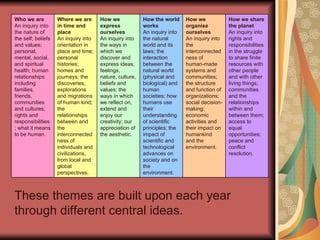
These themes are built upon each year through different central ideas. Who we are An inquiry into the nature of the self; beliefs and values; personal, mental, social, and spiritual health; human relationships including families, friends, communities and cultures; rights and responsibilities; what it means to be human. Where we are in time and place An inquiry into orientation in place and time; personal histories; homes and journeys; the discoveries, explorations and migrations of human kind; the relationships between and the interconnectedness of individuals and civilizations, from local and global perspectives. How we express ourselves An inquiry into the ways in which we discover and express ideas, feelings, nature, culture, beliefs and values; the ways in which we reflect on, extend and enjoy our creativity; our appreciation of the aesthetic.  How the world works An inquiry into the natural world and its laws; the interaction between the natural world (physical and biological) and human societies; how humans use their understanding of scientific principles; the impact of scientific and technological advances on society and on the environment. How we organise ourselves An inquiry into the interconnectedness of human-made systems and communities; the structure and function of organizations; social decision-making; economic activities and their impact on humankind and the environment. How we share the planet An inquiry into rights and responsibilities in the struggle to share finite resources with other people and with other living things; communities and the relationships within and between them; access to equal opportunities; peace and conflict resolution.
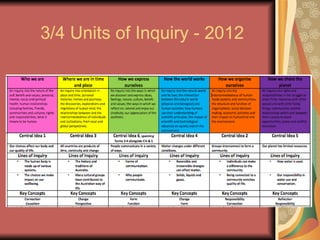
3/4 Units of Inquiry - 2012
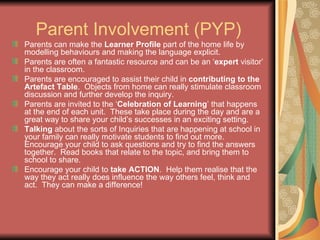
Parent Involvement (PYP) Parents can make the  Learner Profile  part of the home life by modelling behaviours and making the language explicit. Parents are often a fantastic resource and can be an ‘ expert  visitor’ in the classroom.  Parents are encouraged to assist their child in  contributing to the Artefact Table .  Objects from home can really stimulate classroom discussion and further develop the inquiry. Parents are invited to the ‘ Celebration of Learning ’ that happens at the end of each unit.  These take place during the day and are a great way to share your child’s successes in an exciting setting. Talking  about the sorts of Inquiries that are happening at school in your family can really motivate students to find out more.  Encourage your child to ask questions and try to find the answers together.  Read books that relate to the topic, and bring them to school to share.  Encourage your child to  take ACTION .  Help them realise that the way they act really does influence the way others feel, think and act.  They can make a difference!
Vietnamese Bilingual Programme The Vietnamese Bilingual programme encompasses many areas of the curriculum, enriching students’ learning
Specialist programs Library   - Janine Bell Library skills
 P.E.  –  Nathan Cuthbertson  Health-related activities, Body control and Spatial awareness, Athletic Activities, Games, Movement to music, Adventure challenge   Art  – Nancy Ventrice Creative processes, Elements & Principles of art & design, Reflection and appreciation, Visual Art in Society Italian  – Virginia Gardner Emersion in the Italian language and culture   Specialist programs compliment the Program of Inquiry where possible. One hour session per week.
Multimedia Room is also used by each grade for 1 session; Library lessons Online maths and literacy activities Further research Presentation of student learning through movie making, podcasts, music programs, photography programs etc Lunchtime computer use. Art Room is used by each grade as required; Responding to their learning through Art Cooking using the fully –equipped kitchen Science activities Theatrette and Gym are used by each grade as required; Drama Music  including African Drumming (30 mins per week) Dance Please Note:  Small group music tuition is also offered
Camps & Excursions 3/4 – Camp Doxa, all children are expected to attend Wednesday 13 th  – Friday 15 th  June
Parent Helpers All teachers and students appreciate having parents help the class in some way: Classroom – reading, writing, mathematics, inquiry Guest speaker  Covering books Helping with supervision on excursions Reading with students Bilingual sessions
Homework 30 minutes per night:  Home reading Number facts/tables Inquiry ( eg  survey, interview, research) Writing ( eg  diary, shopping lists, letters) Spelling Homework should be regarded as an extension of your child’s learning.  It should be enjoyable, challenging and strengthen an interest in learning.  It should provide opportunities in which you and your child can share school learning.
Mathletics Make sure you do not pay for this!  School has a licence, each student has login and password Use as often as you like Does eat up download time. Probably better if you have unlimited download. We encourage this as a home learning task.
3/4 Garden Planter boxes Seeds Organic gardening Organic pest control
Question Time

2012 34 info night

  • 1.
    Welcome to ParentInformation Night Term 1, 2012
  • 2.
    Teachers 3/4A – Felicity Maxwell 3/4B – Tim Hawkins 3/4C – Rachel Reilly Bilingual – Ms Chau Cong
  • 3.
    General information Fruitand water break – varies in each class, usually between 10-10.30am Sunsmart policy: During Terms 1 and 4 please make sure your child wears a hat Attendance – very important to attend every day and arrive ten minutes before class commences
  • 4.
    At Footscray PrimarySchool, students are encouraged to develop their skills and attitudes in accordance with the PYP Learner Profile, with the aim that students become: Inquirers Knowledgeable Thinkers Communicators Principled Open-Minded Caring Risk-Takers Balanced Reflective The Learner Profile has become part of the school’s classroom practice, assessment and reporting practices, daily life, management and leadership.
  • 5.
    These themes arebuilt upon each year through different central ideas. Who we are An inquiry into the nature of the self; beliefs and values; personal, mental, social, and spiritual health; human relationships including families, friends, communities and cultures; rights and responsibilities; what it means to be human. Where we are in time and place An inquiry into orientation in place and time; personal histories; homes and journeys; the discoveries, explorations and migrations of human kind; the relationships between and the interconnectedness of individuals and civilizations, from local and global perspectives. How we express ourselves An inquiry into the ways in which we discover and express ideas, feelings, nature, culture, beliefs and values; the ways in which we reflect on, extend and enjoy our creativity; our appreciation of the aesthetic. How the world works An inquiry into the natural world and its laws; the interaction between the natural world (physical and biological) and human societies; how humans use their understanding of scientific principles; the impact of scientific and technological advances on society and on the environment. How we organise ourselves An inquiry into the interconnectedness of human-made systems and communities; the structure and function of organizations; social decision-making; economic activities and their impact on humankind and the environment. How we share the planet An inquiry into rights and responsibilities in the struggle to share finite resources with other people and with other living things; communities and the relationships within and between them; access to equal opportunities; peace and conflict resolution.
  • 6.
    3/4 Units ofInquiry - 2012
  • 7.
    Parent Involvement (PYP)Parents can make the Learner Profile part of the home life by modelling behaviours and making the language explicit. Parents are often a fantastic resource and can be an ‘ expert visitor’ in the classroom. Parents are encouraged to assist their child in contributing to the Artefact Table . Objects from home can really stimulate classroom discussion and further develop the inquiry. Parents are invited to the ‘ Celebration of Learning ’ that happens at the end of each unit. These take place during the day and are a great way to share your child’s successes in an exciting setting. Talking about the sorts of Inquiries that are happening at school in your family can really motivate students to find out more. Encourage your child to ask questions and try to find the answers together. Read books that relate to the topic, and bring them to school to share. Encourage your child to take ACTION . Help them realise that the way they act really does influence the way others feel, think and act. They can make a difference!
  • 8.
    Vietnamese Bilingual ProgrammeThe Vietnamese Bilingual programme encompasses many areas of the curriculum, enriching students’ learning
  • 9.
    Specialist programs Library - Janine Bell Library skills
 P.E. – Nathan Cuthbertson Health-related activities, Body control and Spatial awareness, Athletic Activities, Games, Movement to music, Adventure challenge   Art – Nancy Ventrice Creative processes, Elements & Principles of art & design, Reflection and appreciation, Visual Art in Society Italian – Virginia Gardner Emersion in the Italian language and culture   Specialist programs compliment the Program of Inquiry where possible. One hour session per week.
  • 10.
    Multimedia Room isalso used by each grade for 1 session; Library lessons Online maths and literacy activities Further research Presentation of student learning through movie making, podcasts, music programs, photography programs etc Lunchtime computer use. Art Room is used by each grade as required; Responding to their learning through Art Cooking using the fully –equipped kitchen Science activities Theatrette and Gym are used by each grade as required; Drama Music including African Drumming (30 mins per week) Dance Please Note: Small group music tuition is also offered
  • 11.
    Camps & Excursions3/4 – Camp Doxa, all children are expected to attend Wednesday 13 th – Friday 15 th June
  • 12.
    Parent Helpers Allteachers and students appreciate having parents help the class in some way: Classroom – reading, writing, mathematics, inquiry Guest speaker Covering books Helping with supervision on excursions Reading with students Bilingual sessions
  • 13.
    Homework 30 minutesper night: Home reading Number facts/tables Inquiry ( eg survey, interview, research) Writing ( eg diary, shopping lists, letters) Spelling Homework should be regarded as an extension of your child’s learning. It should be enjoyable, challenging and strengthen an interest in learning. It should provide opportunities in which you and your child can share school learning.
  • 14.
    Mathletics Make sureyou do not pay for this! School has a licence, each student has login and password Use as often as you like Does eat up download time. Probably better if you have unlimited download. We encourage this as a home learning task.
  • 15.
    3/4 Garden Planterboxes Seeds Organic gardening Organic pest control
  • 16.