
ⓒ Rana Chakrabarti 2018. All Rights Reserved.
SHIFTING EDUCATION
How to intervene large systems
Via Stuart Rankins/ Flickr
“If you want to truly understand
something, change it
-Kurt Lewin
A BRIEF HISTORY
• 2016 - set out introduce design-thinking in
classrooms across the United States.
• 2017 - created tools & pedagogy and trained over
100 educators in 20+ universities.
• 2018 - seeing our work multiply
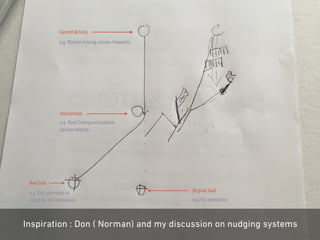
INTERVENTION
UNIT OF SCALE
intervene | ˌin(t)ərˈvēn |

verb [no object]

1 come between so as to prevent or alter a result or course of events:
ⓒRanaChakrabarti2018.AllRightsReserved.
Inspiration : Don ( Norman) and my discussion on nudging systems
Current Activity
Intervention
Original Goal
New Goal
e.g. Student missing classes frequently
e.g.Full attendance
e.g. Paid internship in
return for full attendance
e.g. Need finding and problem
solving meeting
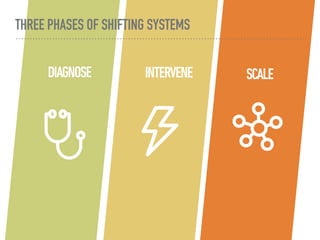
DIAGNOSE
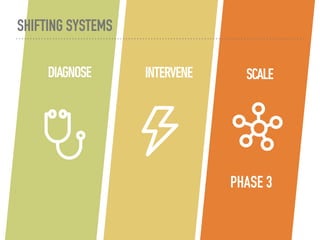
THREE PHASES OF SHIFTING SYSTEMS
SCALEINTERVENE
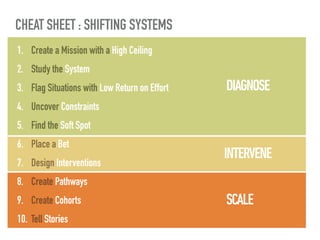
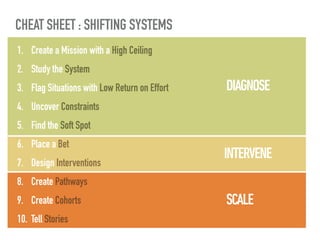
CHEAT SHEET : SHIFTING SYSTEMS
1. Create a Mission with a High Ceiling
2. Study the System
3. Flag Situations with Low Return on Effort
4. Uncover Constraints
5. Find the Soft Spot
6. Place a Bet
7. Design Interventions
8. Create Pathways
9. Create Cohorts
10. Tell Stories
DIAGNOSE
INTERVENE
SCALE
DIAGNOSE
PHASE 1
SHIFTING SYSTEMS
CREATE A MISSION WITH A
HIGH CEILING
Unambiguous + Unreasonable
1
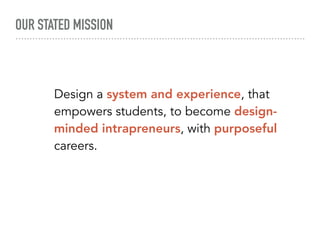
OUR STATED MISSION
Design a system and experience, that
empowers students, to become design-
minded intrapreneurs, with purposeful
careers.
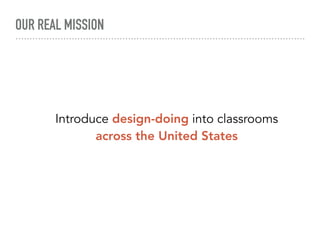
OUR REAL MISSION
Introduce design-doing into classrooms
across the United States
STUDY THE SYSTEM
Create systems artifacts
2
Via Stuart Rankins/ Flickr
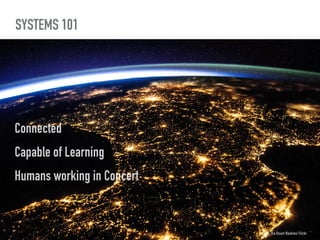
SYSTEMS 101
Connected
Capable of Learning
Humans working in Concert
SYSTEM FACTS
Inputs, Outputs, Levels, Rates, Friction2a
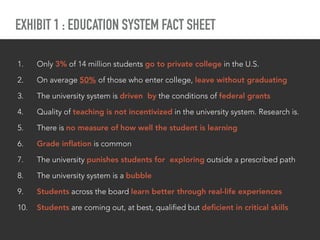
EXHIBIT 1 : EDUCATION SYSTEM FACT SHEET
1. Only 3% of 14 million students go to private college in the U.S.
2. On average 50% of those who enter college, leave without graduating
3. The university system is driven by the conditions of federal grants
4. Quality of teaching is not incentivized in the university system. Research is.
5. There is no measure of how well the student is learning
6. Grade inflation is common
7. The university punishes students for exploring outside a prescribed path
8. The university system is a bubble
9. Students across the board learn better through real-life experiences
10. Students are coming out, at best, qualified but deficient in critical skills
SYSTEM EXPERIENCE
What is it like to go through it ?2b
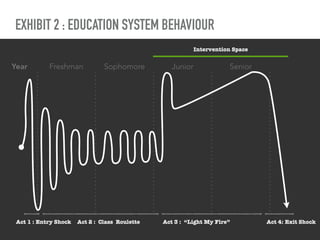
EXHIBIT 2 : EDUCATION SYSTEM BEHAVIOUR
Freshman Sophomore Junior SeniorYear
Act 1 : Entry Shock Act 2 : Class Roulette Act 3 : “Light My Fire” Act 4: Exit Shock
Intervention Space
SYSTEM ARCHETYPES
What behavioral “types” make up the system ?2c
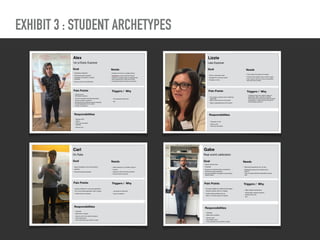
EXHIBIT 3 : STUDENT ARCHETYPES
SYSTEM STRUCTURE
What is the structure creating the behaviour ?2d
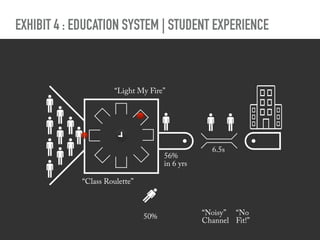
EXHIBIT 4 : EDUCATION SYSTEM | STUDENT EXPERIENCE
50%
56%
in 6 yrs
6.5s
“Noisy”
Channel
“No
Fit!”
“Class Roulette”
“Light My Fire”
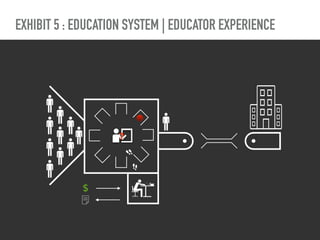
EXHIBIT 5 : EDUCATION SYSTEM | EDUCATOR EXPERIENCE
$
?
INTERVENTION SPACES
Which is the best spaces to intervene ?2e
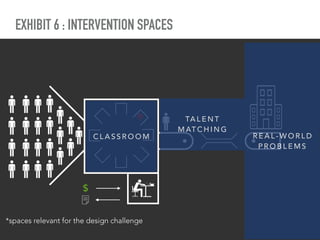
EXHIBIT 6 : INTERVENTION SPACES
$
C L A S S R O O M R E A L - W O R L D
P R O B L E M S
*spaces relevant for the design challenge
TA L E N T
M AT C H I N G
FLAG SITUATIONS WITH
LOW RETURN ON EFFORT
Which are the best situations to
intervene ?
3
BIO-COST
Where are you
leaking energy ?
Bio-cost is the energy, attention, and stress that people
expend over time to achieve their goals—to get what they
want” in Ashby’s sense. [Ashby 1956]
EXHIBIT 7 : STUDENT ENGAGEMENT LEVELS
source : advances in physiology education
EXHIBIT 8 : RESUME LOADS
source : Sarena Riggi @ SAP
UNCOVER CONSTRAINTS
What is keeping the situation in place?
4
THIS IS SYSTEM CHANGE
CONSTRAINTS FEELS LIKE
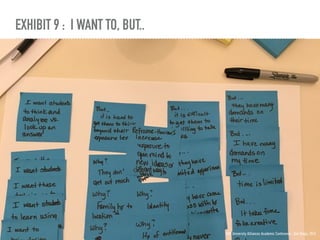
I want to… but..
EXHIBIT 9 : I WANT TO, BUT..
SAP University Alliances Academic Conference , San Diego, 2016
FIND THE SOFT SPOT5 Which constraints can you influence?
CHAIN OF CONSTRAINTS
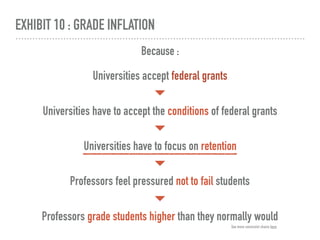
EXHIBIT 10 : GRADE INFLATION
Because :
Universities accept federal grants
Universities have to accept the conditions of federal grants
Universities have to focus on retention
Professors feel pressured not to fail students
Professors grade students higher than they normally would
See more constraint chains here
DIAGNOSE SCALEINTERVENE
PHASE 2
SHIFTING SYSTEMS
PLACE A BET
Predict how things will turn out
6
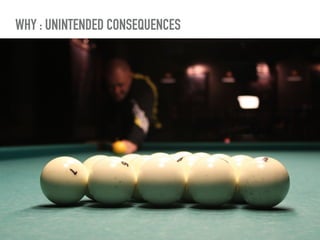
WHY : UNINTENDED CONSEQUENCES
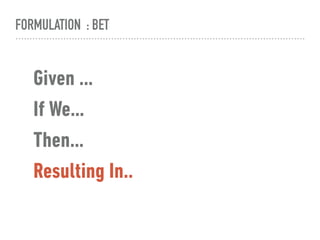
FORMULATION : BET
Given …
If We…
Then…
Resulting In..
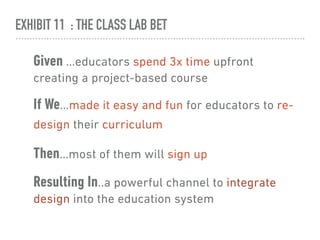
EXHIBIT 11 : THE CLASS LAB BET
Given …educators spend 3x time upfront
creating a project-based course
If We…made it easy and fun for educators to re-
design their curriculum
Then…most of them will sign up
Resulting In..a powerful channel to integrate
design into the education system
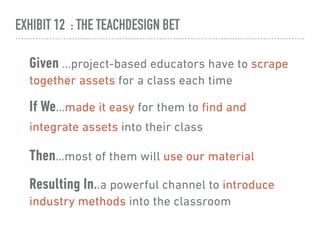
EXHIBIT 12 : THE TEACHDESIGN BET
Given …project-based educators have to scrape
together assets for a class each time
If We…made it easy for them to find and
integrate assets into their class
Then…most of them will use our material
Resulting In..a powerful channel to introduce
industry methods into the classroom
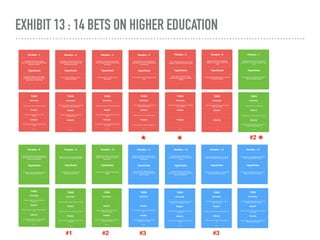
EXHIBIT 13 : 14 BETS ON HIGHER EDUCATION
#2
#1 #2 #3 #3
** *
DESIGN AN INTERVENTION
Change behavior
7
SYSTEM
How will the intervention fit in ?7a
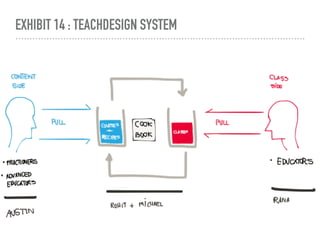
EXHIBIT 14 : TEACHDESIGN SYSTEM
FORM
How will intervention look & work ?7b
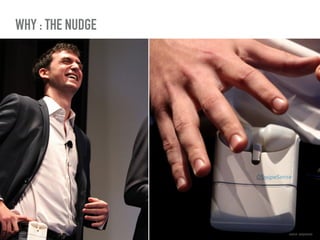
WHY : THE NUDGE
source: swipsesnse
FORMULATION : INTERVENTION
What Might..
EXAMPLE : FORMULATION
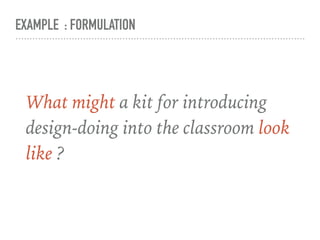
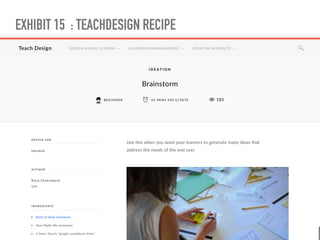
What might a kit for introducing
design-doing into the classroom look
like ?
EXHIBIT 15 : TEACHDESIGN RECIPE
EXAMPLE : FORMULATION
What might a safe space for
educators to learn a new approach
be like ?
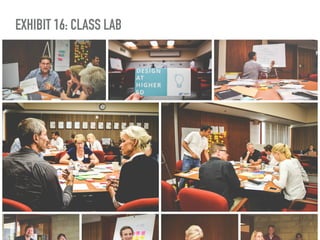
EXHIBIT 16: CLASS LAB
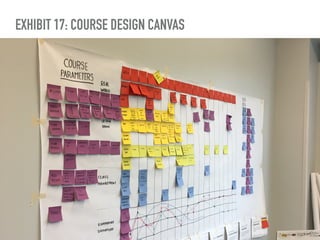
EXHIBIT 17: COURSE DESIGN CANVAS
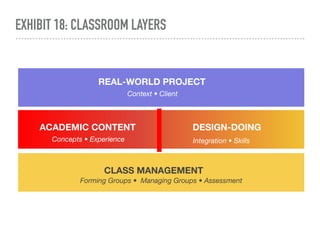
EXHIBIT 18: CLASSROOM LAYERS
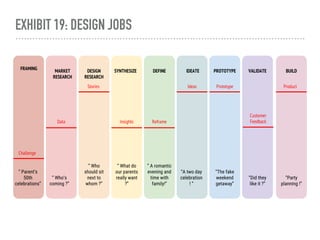
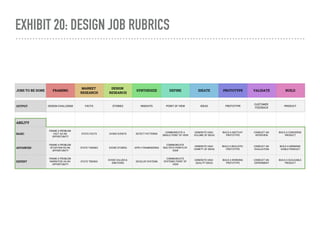
EXHIBIT 19: DESIGN JOBS
EXHIBIT 20: DESIGN JOB RUBRICS
Design Jobs
JOBS TO BE DONE FRAMING
MARKET
RESEARCH
DESIGN
RESEARCH
SYNTHESIZE DEFINE IDEATE PROTOTYPE VALIDATE BUILD
OUTPUT DESIGN CHALLENGE FACTS STORIES INSIGHTS POINT OF VIEW IDEAS PROTOTYPE
CUSTOMER
FEEDBACK
PRODUCT
ABILITY
BASIC
FRAME A PROBLEM
FACT AS AN
OPPORTUNITY
STATE FACTS EVOKE EVENTS DETECT PATTERNS
COMMUNICATE A
SINGLE POINT OF VIEW
GENERATE HIGH
VOLUME OF IDEAS
BUILD A SKETCHY
PROTOTYPE
CONDUCT AN
INTERVIEW
BUILD A CONCIERGE
PRODUCT
ADVANCED
FRAME A PROBLEM
SITUATION AS AN
OPPORTUNITY
STATE THEMES EVOKE STORIES APPLY FRAMEWORKS
COMMUNICATE
MULTIPLE POINTS OF
VIEW
GENERATE HIGH
VARIETY OF IDEAS
BUILD A REALISTIC
PROTOTYPE
CONDUCT AN
EVALUATION
BUILD A MINIMUM
VIABLE PRODUCT
EXPERT
FRAME A PROBLEM
NARRATIVE AS AN
OPPORTUNITY
STATE TRENDS
EVOKE VALUES &
EMOTIONS
DEVELOP SYSTEMS
COMMUNICATE
SYSTEMIC POINT OF
VIEW
GENERATE HIGH
QUALITY IDEAS
BUILD A WORKING
PROTOTYPE
CONDUCT AN
EXPERIMENT
BUILD A SCALEABLE
PRODUCT
DIAGNOSE
PHASE 3
SCALEINTERVENE
SHIFTING SYSTEMS
CREATE PATHWAYS
Stage for progressive commitment
8
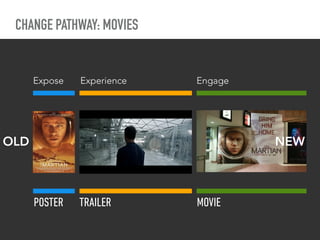
CHANGE PATHWAY: MOVIES
Expose
POSTER
Experience
TRAILER
Engage
MOVIE
NEWOLD
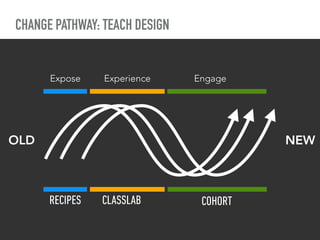
CHANGE PATHWAY: TEACH DESIGN
OLD NEW
Expose
RECIPES
Experience
CLASSLAB
Engage
COHORT
EXPOSE: TEACHDESIGN WEBSITE
#1 on Google
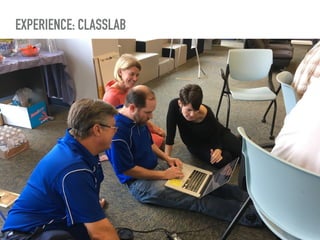
EXPERIENCE: CLASSLAB
ⓒRanaChakrabarti2018.AllRightsReserved. 
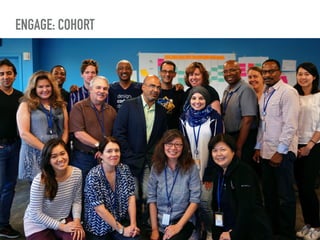
ENGAGE: COHORT
CREATE COHORTS
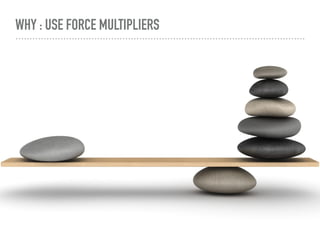
Use groups as force multipliers
9
WHY : USE FORCE MULTIPLIERS
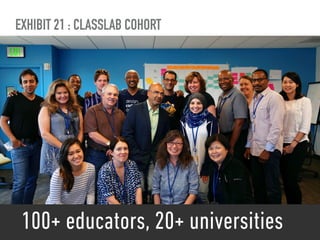
EXHIBIT 21 : CLASSLAB COHORT
100+ educators, 20+ universities
TELL STORIES
Show Change Is Possible
10
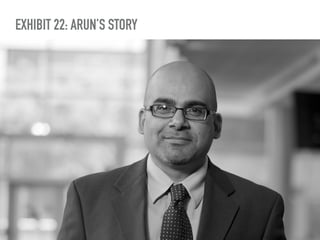
EXHIBIT 22: ARUN’S STORY
CHEAT SHEET : SHIFTING SYSTEMS
1. Create a Mission with a High Ceiling
2. Study the System
3. Flag Situations with Low Return on Effort
4. Uncover Constraints
5. Find the Soft Spot
6. Place a Bet
7. Design Interventions
8. Create Pathways
9. Create Cohorts
10. Tell Stories
DIAGNOSE
INTERVENE
SCALE
CONTACT CARD
RANA.CHAKRABARTI@SAP.COM
@TALKRANATALK
@RANA
ⓒ Rana Chakrabarti 2018. All Rights Reserved.
SHIFTING EDUCATION
How to intervene large systems
Via Stuart Rankins/ Flickr

Shifting Education