K to 12 BASIC EDUCATION CURRICULUM
Exploratory Course on
CARPENTRY
Republic of the Philippines
DEPARTMENT OF EDCUATION
TECHNOLOGY AND LIVELIHOOD EDUCATION
CURRICULUM GUIDE
K to 12 TECHNOLOGY AND LIVELIHOOD EDUCATION
INDUSTRIAL ARTS – CARPENTRY
(Exploratory)
2
Curriculum Guide for the Exploratory Course on CARPENTRY
For you to get a complete picture of the complete TLE exploratory course on Carpentry, you are hereby provided with the Curriculum Guide on
Carpentry.
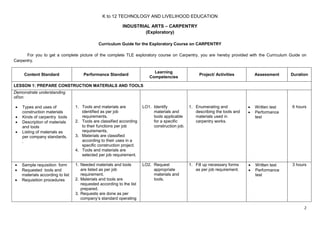
Content Standard Performance Standard
Learning
Competencies
Project/ Activities Assessment Duration
LESSON 1: PREPARE CONSTRUCTION MATERIALS AND TOOLS
Demonstrate understanding
of/on:
 Types and uses of
construction materials
 Kinds of carpentry tools
 Description of materials
and tools
 Listing of materials as
per company standards.
.
1. Tools and materials are
identified as per job
requirements.
2. Tools are classified according
to their functions per job
requirements.
3. Materials are classified
according to their uses in a
specific construction project.
4. Tools and materials are
selected per job requirement.
LO1. Identify
materials and
tools applicable
for a specific
construction job.
1. Enumerating and
describing the tools and
materials used in
carpentry works.
 Written test
 Performance
test
6 hours
 Sample requisition form
 Requested tools and
materials according to list
 Requisition procedures
1. Needed materials and tools
are listed as per job
requirement.
2. Materials and tools are
requested according to the list
prepared.
3. Requests are done as per
company’s standard operating
LO2. Request
appropriate
materials and
tools.
1. Fill up necessary forms
as per job requirement.
 Written test
 Performance
test
3 hours
K to 12 TECHNOLOGY AND LIVELIHOOD EDUCATION
INDUSTRIAL ARTS – CARPENTRY
(Exploratory)
3
Content Standard Performance Standard
Learning
Competencies
Project/ Activities Assessment Duration
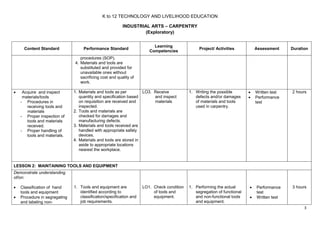
procedures (SOP).
4. Materials and tools are
substituted and provided for
unavailable ones without
sacrificing cost and quality of
work.
 Acquire and inspect
materials/tools
- Procedures in
receiving tools and
materials
- Proper inspection of
tools and materials
received.
- Proper handling of
tools and materials.
1. Materials and tools as per
quantity and specification based
on requisition are received and
inspected.
2. Tools and materials are
checked for damages and
manufacturing defects.
3. Materials and tools received are
handled with appropriate safety
devices.
4. Materials and tools are stored in
aside to appropriate locations
nearest the workplace.
LO3. Receive
and inspect
materials
1. Writing the possible
defects and/or damages
of materials and tools
used in carpentry.
 Written test
 Performance
test
2 hours
LESSON 2: MAINTAINING TOOLS AND EQUIPMENT
Demonstrate understanding
of/on:
 Classification of hand
tools and equipment
 Procedure in segregating
and labeling non-
1. Tools and equipment are
identified according to
classification/specification and
job requirements.
LO1. Check condition
of tools and
equipment.
1. Performing the actual
segregation of functional
and non-functional tools
and equipment.
 Performance
test
 Written test
3 hours
K to 12 TECHNOLOGY AND LIVELIHOOD EDUCATION
INDUSTRIAL ARTS – CARPENTRY
(Exploratory)
4
Content Standard Performance Standard
Learning
Competencies
Project/ Activities Assessment Duration
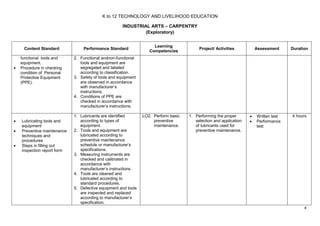
functional tools and
equipment.
 Procedure in checking
condition of Personal
Protective Equipment
(PPE).
2. Functional andnon-functional
tools and equipment are
segregated and labeled
according to classification.
3. Safety of tools and equipment
are observed in accordance
with manufacturer’s
instructions.
4. Conditions of PPE are
checked in accordance with
manufacturer’s instructions.
 Lubricating tools and
equipment
 Preventive maintenance
techniques and
procedures
 Steps in filling out
inspection report form
1. Lubricants are identified
according to types of
equipment.
2. Tools and equipment are
lubricated according to
preventive maintenance
schedule or manufacturer’s
specifications.
3. Measuring instruments are
checked and calibrated in
accordance with
manufacturer’s instructions.
4. Tools are cleaned and
lubricated according to
standard procedures.
5. Defective equipment and tools
are inspected and replaced
according to manufacturer’s
specification.
LO2. Perform basic
preventive
maintenance.
1. Performing the proper
selection and application
of lubricants used for
preventive maintenance.
 Written test
 Performance
test
4 hours
K to 12 TECHNOLOGY AND LIVELIHOOD EDUCATION
INDUSTRIAL ARTS – CARPENTRY
(Exploratory)
5
Content Standard Performance Standard
Learning
Competencies
Project/ Activities Assessment Duration
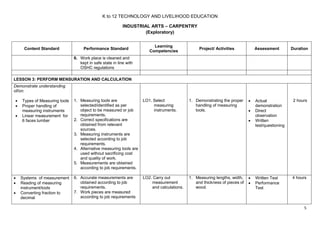
6. Work place is cleaned and
kept in safe state in line with
OSHC regulations
LESSON 3: PERFORM MENSURATION AND CALCULATION
Demonstrate understanding
of/on:
 Types of Measuring tools
 Proper handling of
measuring instruments
 Linear measurement for
6 faces lumber
1. Measuring tools are
selected/identified as per
object to be measured or job
requirements.
2. Correct specifications are
obtained from relevant
sources.
3. Measuring instruments are
selected according to job
requirements.
4. Alternative measuring tools are
used without sacrificing cost
and quality of work.
5. Measurements are obtained
according to job requirements.
LO1. Select
measuring
instruments.
1. Demonstrating the proper
handling of measuring
tools.
 Actual
demonstration
 Direct
observation
 Written
test/questioning
2 hours
 Systems of measurement
 Reading of measuring
instrument/tools
 Converting fraction to
decimal
6. Accurate measurements are
obtained according to job
requirements.
7. Work pieces are measured
according to job requirements
LO2. Carry out
measurement
and calculations.
1. Measuring lengths, width,
and thickness of pieces of
wood.
 Written Test
 Performance
Test
4 hours
K to 12 TECHNOLOGY AND LIVELIHOOD EDUCATION
INDUSTRIAL ARTS – CARPENTRY
(Exploratory)
6
Content Standard Performance Standard
Learning
Competencies
Project/ Activities Assessment Duration
 Converting units of
measure
 Taking Dimensions
 Calculating boardfoot of
lumber
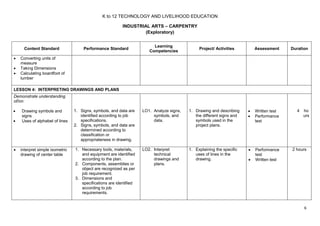
LESSON 4: INTERPRETING DRAWINGS AND PLANS
Demonstrate understanding
of/on:
 Drawing symbols and
signs
 Uses of alphabet of lines
1. Signs, symbols, and data are
identified according to job
specifications.
2. Signs, symbols, and data are
determined according to
classification or
appropriateness in drawing.
LO1. Analyze signs,
symbols, and
data.
1. Drawing and describing
the different signs and
symbols used in the
project plans.
 Written test
 Performance
test
4 ho
urs
 interpret simple isometric
drawing of center table
1. Necessary tools, materials,
and equipment are identified
according to the plan.
2. Components, assemblies or
object are recognized as per
job requirement.
3. Dimensions and
specifications are identified
according to job
requirements.
LO2. Interpret
technical
drawings and
plans.
1. Explaining the specific
uses of lines in the
drawing.
 Performance
test
 Written test
2 hours
K to 12 TECHNOLOGY AND LIVELIHOOD EDUCATION
INDUSTRIAL ARTS – CARPENTRY
(Exploratory)
7
Content Standard Performance Standard
Learning
Competencies
Project/ Activities Assessment Duration
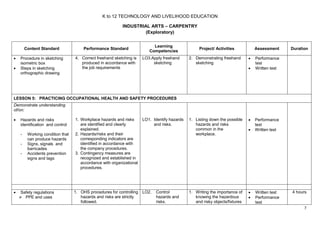
 Procedure in sketching
isometric box
 Steps in sketching
orthographic drawing
4. Correct freehand sketching is
produced in accordance with
the job requirements
LO3.Apply freehand
sketching
2. Demonstrating freehand
sketching
 Performance
test
 Written test
LESSON 5: PRACTICING OCCUPATIONAL HEALTH AND SAFETY PROCEDURES
Demonstrate understanding
of/on:
 Hazards and risks
identification and control
- Working condition that
can produce hazards
- Signs, signals and
barricades
- Accidents prevention
signs and tags
1. Workplace hazards and risks
are identified and clearly
explained.
2. Hazards/risks and their
corresponding indicators are
identified in accordance with
the company procedures.
3. Contingency measures are
recognized and established in
accordance with organizational
procedures.
LO1. Identify hazards
and risks.
1. Listing down the possible
hazards and risks
common in the
workplace.
 Performance
test
 Written test
 Safety regulations
 PPE and uses
1. OHS procedures for controlling
hazards and risks are strictly
followed.
LO2. Control
hazards and
risks.
1. Writing the importance of
knowing the hazardous
and risky objects/fixtures
 Written test
 Performance
test
4 hours
K to 12 TECHNOLOGY AND LIVELIHOOD EDUCATION
INDUSTRIAL ARTS – CARPENTRY
(Exploratory)
8
Content Standard Performance Standard
Learning
Competencies
Project/ Activities Assessment Duration
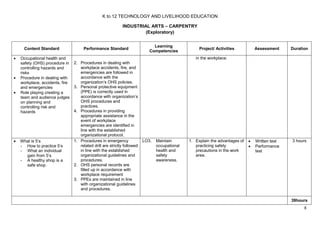
 Occupational health and
safety (OHS) procedure in
controlling hazards and
risks
 Procedure in dealing with
workplace, accidents, fire
and emergencies
 Role playing creating a
team and audience judges
on planning and
controlling risk and
hazards
2. Procedures in dealing with
workplace accidents, fire, and
emergencies are followed in
accordance with the
organization’s OHS policies.
3. Personal protective equipment
(PPE) is correctly used in
accordance with organization’s
OHS procedures and
practices.
4. Procedures in providing
appropriate assistance in the
event of workplace
emergencies are identified in
line with the established
organizational protocol.
in the workplace.
 What is 5’s
- How to practice 5’s
- What an individual
gain from 5’s
- A healthy shop is a
safe shop
1. Procedures in emergency
related drill are strictly followed
in line with the established
organizational guidelines and
procedures.
2. OHS personal records are
filled up in accordance with
workplace requirement
3. PPEs are maintained in line
with organizational guidelines
and procedures.
LO3. Maintain
occupational
health and
safety
awareness.
1. Explain the advantages of
practicing safety
precautions in the work
area.
 Written test
 Performance
test
3 hours
39hours
K to 12 TECHNOLOGY AND LIVELIHOOD EDUCATION
INDUSTRIAL ARTS – CARPENTRY
(Exploratory)
9
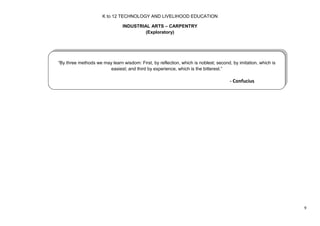
“By three methods we may learn wisdom: First, by reflection, which is noblest; second, by imitation, which is
easiest; and third by experience, which is the bitterest.”
- Confucius

CURRICULUM GUIDE K to 12 CARPENTRY DEPED

  • 1.
    K to 12BASIC EDUCATION CURRICULUM Exploratory Course on CARPENTRY Republic of the Philippines DEPARTMENT OF EDCUATION TECHNOLOGY AND LIVELIHOOD EDUCATION CURRICULUM GUIDE
  • 2.
    K to 12TECHNOLOGY AND LIVELIHOOD EDUCATION INDUSTRIAL ARTS – CARPENTRY (Exploratory) 2 Curriculum Guide for the Exploratory Course on CARPENTRY For you to get a complete picture of the complete TLE exploratory course on Carpentry, you are hereby provided with the Curriculum Guide on Carpentry. Content Standard Performance Standard Learning Competencies Project/ Activities Assessment Duration LESSON 1: PREPARE CONSTRUCTION MATERIALS AND TOOLS Demonstrate understanding of/on:  Types and uses of construction materials  Kinds of carpentry tools  Description of materials and tools  Listing of materials as per company standards. . 1. Tools and materials are identified as per job requirements. 2. Tools are classified according to their functions per job requirements. 3. Materials are classified according to their uses in a specific construction project. 4. Tools and materials are selected per job requirement. LO1. Identify materials and tools applicable for a specific construction job. 1. Enumerating and describing the tools and materials used in carpentry works.  Written test  Performance test 6 hours  Sample requisition form  Requested tools and materials according to list  Requisition procedures 1. Needed materials and tools are listed as per job requirement. 2. Materials and tools are requested according to the list prepared. 3. Requests are done as per company’s standard operating LO2. Request appropriate materials and tools. 1. Fill up necessary forms as per job requirement.  Written test  Performance test 3 hours
  • 3.
    K to 12TECHNOLOGY AND LIVELIHOOD EDUCATION INDUSTRIAL ARTS – CARPENTRY (Exploratory) 3 Content Standard Performance Standard Learning Competencies Project/ Activities Assessment Duration procedures (SOP). 4. Materials and tools are substituted and provided for unavailable ones without sacrificing cost and quality of work.  Acquire and inspect materials/tools - Procedures in receiving tools and materials - Proper inspection of tools and materials received. - Proper handling of tools and materials. 1. Materials and tools as per quantity and specification based on requisition are received and inspected. 2. Tools and materials are checked for damages and manufacturing defects. 3. Materials and tools received are handled with appropriate safety devices. 4. Materials and tools are stored in aside to appropriate locations nearest the workplace. LO3. Receive and inspect materials 1. Writing the possible defects and/or damages of materials and tools used in carpentry.  Written test  Performance test 2 hours LESSON 2: MAINTAINING TOOLS AND EQUIPMENT Demonstrate understanding of/on:  Classification of hand tools and equipment  Procedure in segregating and labeling non- 1. Tools and equipment are identified according to classification/specification and job requirements. LO1. Check condition of tools and equipment. 1. Performing the actual segregation of functional and non-functional tools and equipment.  Performance test  Written test 3 hours
  • 4.
    K to 12TECHNOLOGY AND LIVELIHOOD EDUCATION INDUSTRIAL ARTS – CARPENTRY (Exploratory) 4 Content Standard Performance Standard Learning Competencies Project/ Activities Assessment Duration functional tools and equipment.  Procedure in checking condition of Personal Protective Equipment (PPE). 2. Functional andnon-functional tools and equipment are segregated and labeled according to classification. 3. Safety of tools and equipment are observed in accordance with manufacturer’s instructions. 4. Conditions of PPE are checked in accordance with manufacturer’s instructions.  Lubricating tools and equipment  Preventive maintenance techniques and procedures  Steps in filling out inspection report form 1. Lubricants are identified according to types of equipment. 2. Tools and equipment are lubricated according to preventive maintenance schedule or manufacturer’s specifications. 3. Measuring instruments are checked and calibrated in accordance with manufacturer’s instructions. 4. Tools are cleaned and lubricated according to standard procedures. 5. Defective equipment and tools are inspected and replaced according to manufacturer’s specification. LO2. Perform basic preventive maintenance. 1. Performing the proper selection and application of lubricants used for preventive maintenance.  Written test  Performance test 4 hours
  • 5.
    K to 12TECHNOLOGY AND LIVELIHOOD EDUCATION INDUSTRIAL ARTS – CARPENTRY (Exploratory) 5 Content Standard Performance Standard Learning Competencies Project/ Activities Assessment Duration 6. Work place is cleaned and kept in safe state in line with OSHC regulations LESSON 3: PERFORM MENSURATION AND CALCULATION Demonstrate understanding of/on:  Types of Measuring tools  Proper handling of measuring instruments  Linear measurement for 6 faces lumber 1. Measuring tools are selected/identified as per object to be measured or job requirements. 2. Correct specifications are obtained from relevant sources. 3. Measuring instruments are selected according to job requirements. 4. Alternative measuring tools are used without sacrificing cost and quality of work. 5. Measurements are obtained according to job requirements. LO1. Select measuring instruments. 1. Demonstrating the proper handling of measuring tools.  Actual demonstration  Direct observation  Written test/questioning 2 hours  Systems of measurement  Reading of measuring instrument/tools  Converting fraction to decimal 6. Accurate measurements are obtained according to job requirements. 7. Work pieces are measured according to job requirements LO2. Carry out measurement and calculations. 1. Measuring lengths, width, and thickness of pieces of wood.  Written Test  Performance Test 4 hours
  • 6.
    K to 12TECHNOLOGY AND LIVELIHOOD EDUCATION INDUSTRIAL ARTS – CARPENTRY (Exploratory) 6 Content Standard Performance Standard Learning Competencies Project/ Activities Assessment Duration  Converting units of measure  Taking Dimensions  Calculating boardfoot of lumber LESSON 4: INTERPRETING DRAWINGS AND PLANS Demonstrate understanding of/on:  Drawing symbols and signs  Uses of alphabet of lines 1. Signs, symbols, and data are identified according to job specifications. 2. Signs, symbols, and data are determined according to classification or appropriateness in drawing. LO1. Analyze signs, symbols, and data. 1. Drawing and describing the different signs and symbols used in the project plans.  Written test  Performance test 4 ho urs  interpret simple isometric drawing of center table 1. Necessary tools, materials, and equipment are identified according to the plan. 2. Components, assemblies or object are recognized as per job requirement. 3. Dimensions and specifications are identified according to job requirements. LO2. Interpret technical drawings and plans. 1. Explaining the specific uses of lines in the drawing.  Performance test  Written test 2 hours
  • 7.
    K to 12TECHNOLOGY AND LIVELIHOOD EDUCATION INDUSTRIAL ARTS – CARPENTRY (Exploratory) 7 Content Standard Performance Standard Learning Competencies Project/ Activities Assessment Duration  Procedure in sketching isometric box  Steps in sketching orthographic drawing 4. Correct freehand sketching is produced in accordance with the job requirements LO3.Apply freehand sketching 2. Demonstrating freehand sketching  Performance test  Written test LESSON 5: PRACTICING OCCUPATIONAL HEALTH AND SAFETY PROCEDURES Demonstrate understanding of/on:  Hazards and risks identification and control - Working condition that can produce hazards - Signs, signals and barricades - Accidents prevention signs and tags 1. Workplace hazards and risks are identified and clearly explained. 2. Hazards/risks and their corresponding indicators are identified in accordance with the company procedures. 3. Contingency measures are recognized and established in accordance with organizational procedures. LO1. Identify hazards and risks. 1. Listing down the possible hazards and risks common in the workplace.  Performance test  Written test  Safety regulations  PPE and uses 1. OHS procedures for controlling hazards and risks are strictly followed. LO2. Control hazards and risks. 1. Writing the importance of knowing the hazardous and risky objects/fixtures  Written test  Performance test 4 hours
  • 8.
    K to 12TECHNOLOGY AND LIVELIHOOD EDUCATION INDUSTRIAL ARTS – CARPENTRY (Exploratory) 8 Content Standard Performance Standard Learning Competencies Project/ Activities Assessment Duration  Occupational health and safety (OHS) procedure in controlling hazards and risks  Procedure in dealing with workplace, accidents, fire and emergencies  Role playing creating a team and audience judges on planning and controlling risk and hazards 2. Procedures in dealing with workplace accidents, fire, and emergencies are followed in accordance with the organization’s OHS policies. 3. Personal protective equipment (PPE) is correctly used in accordance with organization’s OHS procedures and practices. 4. Procedures in providing appropriate assistance in the event of workplace emergencies are identified in line with the established organizational protocol. in the workplace.  What is 5’s - How to practice 5’s - What an individual gain from 5’s - A healthy shop is a safe shop 1. Procedures in emergency related drill are strictly followed in line with the established organizational guidelines and procedures. 2. OHS personal records are filled up in accordance with workplace requirement 3. PPEs are maintained in line with organizational guidelines and procedures. LO3. Maintain occupational health and safety awareness. 1. Explain the advantages of practicing safety precautions in the work area.  Written test  Performance test 3 hours 39hours
  • 9.
    K to 12TECHNOLOGY AND LIVELIHOOD EDUCATION INDUSTRIAL ARTS – CARPENTRY (Exploratory) 9 “By three methods we may learn wisdom: First, by reflection, which is noblest; second, by imitation, which is easiest; and third by experience, which is the bitterest.” - Confucius