1
CarpentryTechnology
Introduction to Carpentry(CAR701A)
Course Description
Introduction to Carpentry Technology allows the student to explore the trade of carpentry. Students
will be introduced to the tools, equipment, and practices common to the trade, with a constant emphasis
on safe work habits. Students will develop their knowledge of solid wood products and be able to describe
their characteristics and applications in industry. They will identify, explore, and apply various methods
of wood joinery while developing technical skills with various hand and power tools common to the
carpentry trade. They will also develop skills in communication through drafting, and apply basic math
concepts to solve trade-related problems. This is a recommended prerequisite course for all other
carpentry technology courses.
Classroom Component—Suggested time: 22 hours
This component of the curriculum is required to teach the knowledge and skills associated with the
learning outcomes of the curriculum.
Skill Development Component—Suggested time: 88 hours
This component of the curriculum is required by the student to apply the knowledge and develop the
skills related to the learning outcomes of the curriculum.
SCO - Identifies the Specific Curriculum Outcome (SCO)
Column 1
SCO - Delineations
Describes what the students are expected to
know, be able to do, and value in order to
achieve the SCO.
The teacher is responsible for the planning
and facilitation of learning as well as the
assessment of each SCO - Delineation.
Column 2
Student Knowledge, Abilities, and Competencies
Provides clarity to the SCO by describing the Knowledge,
Abilities, and Competencies that the students develop. This
column is designed to indicate the depth and breadth of the SCO.
It is not necessary to use all of these suggestions or that all of the
students be engaged in the same learning activity.
Column 3
Teacher Lessons / Demonstrations
Provides suggestions for developing and
delivering the content for student learning.
Student Activities / Assessments
Provides suggestions for creating
meaningful activities to allow the student
to achieve the SCO.
Column 4
Resources
Lists a variety of resources that support the teaching and learning
related to the SCO. These resources are suggested to support the
teacher in developing an effective instructional package for delivery
to the students.
4.
CAREER ANDTECHNICAL EDUCATIONCURRICULUM
2
CURRICULUM OUTCOMES
Module 1: Work Site Safety (~3 hours Classroom Component)
1. Students will be able to apply Occupational Health and Safety Regulations and safe work practices
in the workplace.
Students will be expected to
1.1 interpret occupational health and safety regulations
1.2 describe requirements related to personal protective equipment and safety measures
1.3 describe emergency procedures for dealing with injured workers
1.4 describe potential health hazards
Module 2: Solid Wood Products (~3 hours Classroom Component)
2. Students will be able to identify and describe solid wood products and joinery.
Students will be expected to
2.1 describe common types and characteristics of solid wood products
2.2 describe how wood is milled, seasoned, stored, and ordered
2.3 identify and describe the application of commonly used mouldings
2.4 identify and describe the application of wood joints for fabrication and installation
Module 3: Hand Tools (~32 of 88 hours Skill Development Component, ~4 hours Classroom Component)
3. Students will be able to identify common hand tools and describe their proper uses.
Students will be expected to
3.1 identify and describe the use of measuring, marking, layout, alignment, and squaring tools
3.2 identify and describe the use of cutting tools, boring tools, and drilling tools
3.3 identify and describe the use of assembling, clamping, and dismantling tools
3.4 demonstrate the use of hand tools to construct projects using wood materials
Module 4: Portable Power Tools (~16 of 88 hours Skill Development Component, ~2 hours Classroom
Component)
4. Students will be able to identify and describe the safe operation and maintenance of portable
power tools.
Students will be expected to
4.1 identify and describe the safe operation of portable saws
4.2 identify and describe the safe operation of portable planing and shaping equipment
4.3 identify and describe the safe operation of portable drilling and fastening equipment
4.4 identify and describe the safe operation of portable abrasive tools
4.5 demonstrate tool proficiency through selected shop projects using a variety of building materials
5.
CURRICULUM OUTCOMES
CAREER ANDTECHNICALEDUCATION CURRICULUM 3
Module 5: Stationary Power Tools (~16 of 88 hours Skill Development Component, ~2 hours Classroom
Component)
5. Students will be able to identify and describe the safe operation and maintenance of stationary
power tools and demonstrate tool proficiency through selected shop projects.
Students will be expected to
5.1 identify and describe the safe operation and regular maintenance of stationary saws
5.2 identify and describe the safe operation and regular maintenance of stationary planing tools
5.3 identify and describe the safe operation and regular maintenance of stationary drilling, grinding, and
sanding tools
Module 6: Drafting Basics (~4 hours Classroom Component)
6. Students will be able to identify and demonstrate the use of basic drawing instruments.
Students will be expected to
6.1 describe the function of basic drawing equipment
6.2 use drafting equipment to complete geometric exercises
6.3 describe the applications of geometry in trade situations
6.4 practise producing shapes and angles and drawing to scale with basic drafting instruments
Module 7: Basic Math Concepts (~4 hours Classroom Component)
7. Students will be able to use a calculator and apply basic math concepts to solve trade-related
problems using both metric and imperial systems of measurement.
Students will be expected to
7.1 describe basic math concepts and operations
7.2 describe the basic calculator functions and operations
7.3 describe the metric measurement system (SI)
7.4 describe the imperial measurement system
7.5 describe calculations involving fractions
7.6 convert measurements between metric and imperial systems
7.7 work with equations
7.8 describe calculations using the Pythagorean theorem
5
CAREER ANDTECHNICAL EDUCATIONCURRICULUM
CAR701A - INTRODUCTIONTO CARPENTRY
Work Site Safety
(~3 hours Classroom Component)
Introduction The Occupational Health and Safety Act provides employers and employees with
information on how to create and work in a safe working environment. The OHS Act
cannot prevent injuries. It is the responsibility of the apprentice to understand his/her
role as related to safety, and the role and responsibility of the employer.
Specific
Curriculum
Outcome
1. Students will be able to apply Occupational Health and Safety Regulations
and safe work practices in the workplace.
Assessment
Strategies
Paper/Pencil
Self/Peer-Assessments
Skills Performance
Teacher Observation
Career Portfolio
Resources Alberta Module 020101a, Work Site Safety
SCO - Delineations Students will be expected to
1.1 interpret occupational health and safety regulations
1.2 describe requirements related to personal protective equipment and safety measures
1.3 describe emergency procedures for dealing with injured workers
1.4 describe potential health hazards
8.
SCO - DelineationsStudent Knowledge, Abilities, and Competencies
Students will be expected to
CAR701A - INTRODUCTIONTO CARPENTRY - MODULE 1
CAREER ANDTECHNICAL EDUCATION CURRICULUM
6
Work Site Safety (~3 hours Classroom Component)
SCO 1. Students will be able to apply Occupational Health and Safety Regulations and safe work practices in
the workplace.
1.1 interpret occupational
health and safety regulations
1.2 describe requirements related
to personal protective
equipment and safety
measures
Topic: Occupational Heath and Safety
• Describe responsibilities of the employer regarding work site safety.
• Describe responsibilities of the employee regarding work site safety.
• Demonstrate a positive attitude towards safety.
• Explain general safety precautions related to
- work site planning
- joint work site health and safety committee
- housekeeping
- tool safety
- electrical safety
- accident prevention, and reporting of unsafe conditions.
• Describe safety training required by employers: (e.g., first aid,
WHMIS).
• Demonstrate an understanding of the Occupational Health and
Safety Act of PEI.
Topic: Personal Protective Equipment (PPE)
• Identify and describe the use of common personal protective
equipment (PPE) required in the carpentry trade:
- head protection
- eye protection
- ear protection
- foot protection
- limb and body protection
- respiratory protection
• Demonstrate the use of PPE in the workshop.
Topic: Safety Measures
• Describe responsibilities related to working alone (employee/
employer).
• Explain the hazards related to working with compressed air.
• Explain the purpose and function of equipment guards.
• Describe “lock-out/tag-out” procedures while maintaining
equipment.
• Describe safety practices related to working with or around trenches.
• Describe the proper method of installing and removing shoring,
stringers, and bracing of a trench.
• Describe the difference between a trench and an excavation.
• Define “spoil pile.”
• Describe the proper method for guarding and identifying floor
openings.
• Describe factors to consider when planning a fall arrest system.
• Compare and contrast a body belt and a body harness.
• Describe the risks in working with asbestos, along with
recommended safety precautions.
9.
7
Teacher Lessons /Demonstrations Resources
CAREER ANDTECHNICAL EDUCATION CURRICULUM
CAR701A - INTRODUCTIONTO CARPENTRY - MODULE 1
Work Site Safety (~3 hours Classroom Component)
SCO 1. Students will be able to apply Occupational Health and Safety Regulations and safe work practices in
the workplace.
7
Resources
CAREER ANDTECHNICAL EDUCATION CURRICULUM
Texts/Teacher Resources
Alberta Module 020101a
Work Site Safety
pp. 1-36
Occupational Health and Safety Act
SAS Resource Sharing
Videos
• Lost Youth
• It Only Takes a Second
• Things You’d Better Know...
Visuals/Handouts/Tests
• Lab safety rules
• Safety contract
• Rights and Responsibilities
• OHS exercise
• Guide to Workplace Safety for
Residential Construction Sites
Internet
WorkSafe
Topic: Occupational Health and Safety Discussion
• Introduce the topic of safety—not as a lesson, but as a way of
working and living every day, developing safe habits and thinking
“safety first.”
• Point out any P.E.I. rules and regulations which may differ from those
in the ILM.
• Introduce the Occupational Health and Safety Act of P.EI..
• Indicate the importance of basic first aid certification.
Literacy
Anticipation Guide: Create an anticipation guide to assess students’ prior
knowledge of personal protective equipment, (PPE).
Document Reading: Read relevant sections of
• the P.E.I. Occupational Health and Safety Act
• the Guide to Workplace Safety for Residential Construction Sites.
Topic: Personal Protective Equipment (PPE)
• Identify the location of and understand expectations for the use of PPE.
• Model and demonstrate the care of PPE.
• Model and demonstrate specific lab requirements for PPE.
Topic: Safety Measures
• Guide students through a “walkabout” around the lab, highlighting
all of the safety features (e.g., location of fire extinguishers, fire exits,
first-aid kits, PPE).
• Discuss fire safety and evacuation routes.
• As a follow-up the next day...
- before the class arrives, take the time to stage 10 work site safety
problems (e.g., remove the fire exit signs or switch the fire
extinguishers).
• Brainstorm in a class discussion the lab safety rules and safety contract.
• Show safety videos.
• Identify and demonstrate the various machine safety features and
guards.
• Model and demonstrate lock-out/tag-out procedures.
• Use a KWL chart as a prompt for students to discuss aspects of fall
protection.
Literacy
• Freewrite: Have students write about their current knowledge and
previous use of personal protective equipment.
Student Activities / Assessments
• Review lab safety rules and sign safety contract.
• Identify PPE equipment.
• Prepare a safety plan to be used in case of an accident.
• Write a test on safe work practices in the workplace.
• Draw a detailed floor plan of the lab on grid paper and locate all of
the safety areas and exits as defined during the walkabout.
• As a follow-up the next day...
- circulate through the lab to identify the work site safety
problems staged by the instructor.
10.
SCO - DelineationsStudent Knowledge, Abilities, and Competencies
Students will be expected to
CAR701A - INTRODUCTIONTO CARPENTRY - MODULE 1
CAREER ANDTECHNICAL EDUCATION CURRICULUM
8
Work Site Safety (~3 hours Classroom Component)
SCO 1. Students will be able to apply Occupational Health and Safety Regulations and safe work practices in
the workplace.
1.3 describe emergency
procedures for dealing with
injured workers
1.4 describe potential health
hazards
Topic: Lab Safety
• Locate and identify all emergency-related features in the lab
environment:
- eye wash stations
- emergency exits
- first-aid kit
- certified first aider
- fire extinguisher
- fire alarm
- telephone
- emergency phone numbers
• Describe how to properly handle an emergency situation should
one arise.
1. Take charge.
2. Call out for help.
3. Assess hazards and make the area safe.
4. Find out what happened.
5. Identify yourself and offer help.
6. If head or spinal injuries are suspected, support the head or
neck.
7. Assess responsiveness.
8. Send someone or go for help.
9. Administer first aid.
Topic: Impact Loading
• Define “static loading”, and “impact loading.”
• Explain the importance of not impact loading a scaffold.
Topic: Personal Safety
• Identify the characteristics of and preventative measures for the
following:
- heatstroke
- frostbite
- hypothermia
- fatigue
• Identify the hazards and preventative measures for exposure to the
following:
- natural wood dust
- lead-based paint
- carbon monoxide
- flammable liquids and gases
• Interpret MSDS and product label information.
• Demonstrate how to properly lift and handle heavy objects.
11.
9
Teacher Lessons /Demonstrations Resources
CAREER ANDTECHNICAL EDUCATION CURRICULUM
CAR701A - INTRODUCTIONTO CARPENTRY - MODULE 1
Work Site Safety (~3 hours Classroom Component)
SCO 1. Students will be able to apply Occupational Health and Safety Regulations and safe work practices in
the workplace.
Texts/Teacher Resources
Alberta Module 020101a
Work Site Safety
pp. 1-36
Occupational Health and Safety Act
SAS Resource Sharing
Videos
• Lost Youth
• It Only Takes a Second
• Things You’d Better Know...
Visuals/Handouts/Tests
• Lab floor plan
• PPE sheets
• MSDS
• Rules of Lifting
• ILM Self-Test
Work Site Safety
Student Activities / Assessments
Topic: Lab Safety
• Locate and discuss lab safety features.
• Discuss safety procedures.
• Introduce Material Safety Data Sheets (MSDS).
Topic: Impact Loading
• Use a hammer and nail to explain the difference between static and
impact loading.
- Start a nail in a piece of wood.
- Rest the hammer on the nail (static load).
- Push on the nail with the hammer (static load).
- Hammer the nail with the hammer (impact load).
Topic: Personal Safety
• Identify environmental hazards of working in various weather
conditions.
• Describe the dangers of fatigue in the workplace.
• Identify various hazardous materials that may be in the workplace.
• Describe the precautions required when working with, or around,
hazardous materials.
• Demonstrate proper lifting methods.
Literacy
• Read and interpret MSDS and product label information.
• Complete a workshop MSDS label.
• Draw a lab floor plan indicating the various safety features.
• Interpret a MSDS sheet.
• Complete a workshop MSDS label.
• Demonstrate PPE required for various situations (handout sheet).
• Explain the concepts of static and impact loading.
• Identify common work site hazardous materials.
• List PPE and safety requirements for working with hazardous
materials.
• Demonstrate proper lifting techniques.
11
CAREER ANDTECHNICAL EDUCATIONCURRICULUM
CAR701A - INTRODUCTIONTO CARPENTRY
Solid Wood Products
(~3 hours Classroom Component)
Introduction In residential construction the most common building material is wood. It is important
for the apprentice to identify the various common species, with their characteristics, uses,
and limitations. A solid knowledge of wood joinery is essential.
2. Students will be able to identify and describe solid wood products and joinery.
Assessment
Strategies
Paper/Pencil
Self/Peer-Assessments
Skills Performance
Teacher Observation
Career Portfolio
Resources Alberta Module 020102a, Solid Wood Products
Specific
Curriculum
Outcome
SCO - Delineations Students will be expected to
2.1 describe common types and characteristics of solid wood products
2.2 describe how wood is milled, seasoned, stored, and ordered
2.3 identify and describe the application of commonly used mouldings
2.4 identify and describe the application of wood joints for fabrication and installation
14.
Student Knowledge, Abilities,and Competencies
Students will be expected to
Solid Wood Products (~3 hours Classroom Component)
SCO 2. Students will be able to identity and describe solid wood products and joinery.
CAR701A - INTRODUCTIONTO CARPENTRY - MODULE 2
CAREER ANDTECHNICAL EDUCATION CURRICULUM
12
SCO - Delineations
2.1 describe common types
and characteristics of solid
wood products
2.2 describe how wood is milled,
seasoned, stored, and ordered
Topic: Growth and Structure of a Tree
• Explain (in a general way) how a tree grows, and the process of
photosynthesis.
• Identify the three main parts of a tree (roots, trunk, crown).
• Describe the annual growth cycle of trees.
• Explain the terms “annual rings,” “springwood,” and
“summerwood.”
• Describe the anatomy of a tree trunk.
• Explain tree classification: hardwoods (deciduous), and softwoods
(coniferous).
• Identify the characteristics and uses of some common species of
woods.
• Identify several common tree species in Eastern Canada.
Topic: Lumber Production
• Explain the two common methods for lumber production, flat-
sawn and quarter-sawn.
• List advantages and disadvantages of both flat-sawn and quarter-
sawn lumber.
• Describe the three classifications of milled lumber: rough,
surfaced, and worked.
Topic: Lumber Seasoning
• Explain the two methods of drying lumber. air drying and kiln
drying.
• Explain the moisture content of wood and how it is measured.
• List moisture contents for common uses of wood (green,
construction, furniture).
• Demonstrate a test for moisture content.
• List five reasons for properly seasoning and storing lumber.
• Explain the process of moisture loss and lumber shrinkage.
• Define the terms “free water,”“bound water,” “green lumber,”
and “fibre saturation point.”
• Explain the effects of lumber shrinkage (i.e., warp, twist, cup,
check).
Topic: Lumber Grading
• Explain lumber grading rules and standards.
• Interpret lumber grading stamps.
Topic: Lumber Defects
• Identify wood defects and determine appropriate actions.
• List three main groups of wood defects: natural flaws,
manufactured flaws, and seasoning flaws.
15.
13
Teacher Lessons /Demonstrations Resources
CAREER ANDTECHNICAL EDUCATION CURRICULUM
CAR701A - INTRODUCTIONTO CARPENTRY - MODULE 2
Solid Wood Products (~3 hours Classroom Component)
SCO 2. Students will be able to identity and describe solid wood products and joinery.
Texts/Teacher Resources
Alberta Module 020102a
Solid Wood Products
pp. 1-50
SAS Resources
Visuals/Handouts/Tests
• Growth and structure of trees
• Eastern tree species
• ILM Self-Test
Solid Wood Products
Topic: Characteristics of Wood
• Use visuals to teach about the growth and structure of trees.
• Assemble an assortment of various types and species of wood for the
student to examine.
• Display a sample cross-section of a tree.
Topic: Lumber Production
• Introduce and explain lumber production and seasoning.
• Display examples of quarter-sawn and plain-sawn lumber.
Topic: Lumber Seasoning
• Highlight the procedures for seasoning lumber.
• Explain moisture content requirements for kiln-dried lumber.
• Demonstrate a moisture content test (procedure sheet).
Topic: Lumber Grading
• Display an example of a lumber grading stamp.
• Explain lumber grading rules and standards.
Literacy
• Anticipation Guide: Use as a pre-reading strategy to assess students’
knowledge of the growth and structure of trees.
• Freewrite: Have students describe how a tree grows.
CBL
• Plan a field trip to a local lumber mill.
Student Activities / Assessments
Enrichment / Research Activities
• Label the parts of a tree.
• Describe the differences between hardwoods and softwoods.
• Select and identify specific types of wood for various applications.
• Identify quarter-sawn and plain-sawn lumber samples.
• Identify common lumber sizes (e.g., 2x4 , 2x8).
• Explain the difference between rough and nominal sizes.
• Describe the moisture requirements for kiln-dried lumber.
Literacy
Read and interpret a lumber grading stamp.
• Complete a moisture content lab experiment.
16.
Student Knowledge, Abilities,and Competencies
Students will be expected to
Solid Wood Products (~3 hours Classroom Component)
SCO 2. Students will be able to identity and describe solid wood products and joinery.
CAR701A - INTRODUCTIONTO CARPENTRY - MODULE 2
CAREER ANDTECHNICAL EDUCATION CURRICULUM
14
SCO - Delineations
2.2 describe how wood is milled,
seasoned, stored, and ordered
Topic: Lumber Defects
• Identify and describe the appropriate action to take in dealing with
natural flaws in lumber:
- grub or insect holes
- pitch pockets
- shake, through shake, ring shake
- honeycomb, peck, rot
- wane, bark pockets
- pith
- pitch streak, stain
- knots (shape and type, live, dead)
• Identify and describe various manufacturing flaws:
- machine offset, snipe
- skip
- trimming
- dog holes
- machine bite, chip channels
• Identify and describe various seasoning defects:
- check
- split
- bow
- crook
- cup
- twist
- stresses
- shakes
Topic: Lumber Grading, Sizing, and Ordering
• Explain the grading systems for hardwood and softwood lumber.
• Explain lumber size terminology (e.g., board, lumber, timber).
• Define the terms “nominal size” and “actual size.”
• Create a list of common dimensions and lengths of lumber.
• Calculate board feet.
Topic: Lumber Storage
• Describe and demonstrate proper methods for handling and
storing lumber products.
17.
15
Teacher Lessons /Demonstrations Resources
CAREER ANDTECHNICAL EDUCATION CURRICULUM
CAR701A - INTRODUCTIONTO CARPENTRY - MODULE 2
Solid Wood Products (~3 hours Classroom Component)
SCO 2. Students will be able to identity and describe solid wood products and joinery.
Texts/Teacher Resources
Alberta Module 020102a
Solid Wood Products
pp. 1-50
Visuals/Handouts/Tests
• Lumber defects
• ILM Self-Test
Solid Wood Products
Topic: Lumber Defects
• Hold class discussion on the various lumber defects and how to
deal with them.
• Create a slideshow using select images from the ILM graphics
CD to support learning about various lumber defects.
• Set up an ID station that includes examples of the most common
wood defects.
• Create a lumber ID activity:
- Have an assortment of lumber samples (2x4s, 2x6s, 4x4s,
pressure treated, spruce, manufactured, etc.).
- Create a lumber defect checklist/ID sheet for the students.
Topic: Lumber Grading, Sizing, and Ordering
• Explain the lumber grading system and grading stamps.
• Introduce and explain the process for ordering lumber using a
lumber ordering chart.
• Explain how to estimate for waste.
Topic: Materials Handling and Storage
• Demonstrate the proper methods used to store lumber.
Literacy
• Use a KWL strategy to facilitate learning about lumber defects.
• Read and interpret lumber grading stamps.
• Develop a lumber ordering chart.
• Anticipation Guide: Use as a pre-reading strategy to assess students’
knowledge of lumber defects.
Numeracy
• Demonstrate how to calculate board feet.
Student Activities / Assessments
Enrichment / Research Activities
• Select solid wood materials in the shop and identify and highlight
any defects.
• Identify various wood samples in a lumber ID station.
• Identify the size and type of material, and record any defects.
• Demonstrate proper lumber storage techniques, and housekeeping.
Literacy
• Complete a KWL strategy to learn about lumber defects.
• Read and interpret lumber grading stamps.
Numeracy
• Calculate board feet from samples.
• Estimate the length of various pieces of lumber.
• Estimate the amount of lumber required for a simple project.
• Complete a lumber ordering sheet.
• Develop a display of various lumber products.
• Develop a display of various lumber species.
• Develop a display of various lumber defects.
18.
Student Knowledge, Abilities,and Competencies
Students will be expected to
Solid Wood Products (~3 hours Classroom Component)
SCO 2. Students will be able to identity and describe solid wood products and joinery.
CAR701A - INTRODUCTIONTO CARPENTRY - MODULE 2
CAREER ANDTECHNICAL EDUCATION CURRICULUM
16
SCO - Delineations
2.3 identify and describe the
application of commonly
used mouldings
2.4 identify and describe the
application of wood joints
for fabrication and
installation
Topic: Mouldings
• State the function of different mouldings.
• Label molding locations on a typical room diagram.
• Describe moulding shapes and purpose.
• Differentiate among the following moulding materials:
- softwood
- hardwood
- available grades (paint, stain, solid, finger-jointed)
- manufactured wood products
- synthetic materials
• Identify several common router bits used to make mouldings.
• Identify a circular saw moulding head used to make mouldings.
Topic: Wood Joinery
• Identify the different wood joints:
- butt joint
- mitre joint
- rabbet joint
- dado joint
- groove joint
- half lap joint
- coped joints
- dowel joint
- mortise and tenon joints
- dovetail joints
• Identify common methods used to fasten wood joints:
- nails (end nailing and toe nailing)
- screws
- dowels
- biscuits
- splines
- glues
- speciality fasteners
19.
17
Teacher Lessons /Demonstrations Resources
CAREER ANDTECHNICAL EDUCATION CURRICULUM
CAR701A - INTRODUCTIONTO CARPENTRY - MODULE 2
Solid Wood Products (~3 hours Classroom Component)
SCO 2. Students will be able to identity and describe solid wood products and joinery.
Texts/Teacher Resources
Alberta Module 020102a
Solid Wood Products
pp. 1-50
SAS Resources
Visuals/Handouts/Tests
• Common mouldings
• Wood joints
• ILM Self-Test
Solid Wood Products
Topic: Mouldings
• Use samples of various mouldings used in residential construction to
help students develop an understanding of these products.
• Identify the various common mouldings.
• Illustrate and/or demonstrate various application and finishing
methods.
Topic: Wood Joinery
• Hold a class discussion on the various joints used to assemble wood
products. Have examples to display to the class to support the
discussion.
• Create slides of various wood joints from the ILM graphics CD.
• Demonstrate models of the most common joints in construction.
• Demonstrate how to properly cut/assemble the following joints:
- butt joints
- mitre joints
- rabbet joints
- dado joints
- biscuit joints
- coped joints
Literacy
• Develop a KWL to facilitate learning about common wood joints.
Student Activities / Assessments
• Identify several common router bits.
• Identify several common mouldings.
• Identify various wood joints.
• Suggest appropriate applications for wood joints.
• Cut and assemble models of the joints listed above.
- Note: This activity will also support skills in the hand tools,
portable power tools, and stationary power tools modules.
Enrichment / Research Activities
• Create a display of mouldings.
• Create a display of wood joinery.
• Develop the various wood joints into shop projects.
19
CAREER ANDTECHNICAL EDUCATIONCURRICULUM
CAR701A - INTRODUCTIONTO CARPENTRY
HandTools
(~4 hours Classroom Component)
Introduction The ability to use hand tools effectively and efficiently is one of the most basic skills
required in carpentry. The apprentice must be able to identify and demonstrate
the proper use and maintenance of these basic tools of the trade. Considerable time
must be devoted to building and honing hand tool skills.
3. Students will be able to identify common hand tools and describe their proper uses.
Assessment
Strategies
Paper/Pencil
Self/Peer-Assessments
Skills Performance
Teacher Observation
Career Portfolio
Resources Alberta Module 020103a, Hand Tools
Specific
Curriculum
Outcome
SCO - Delineations Students will be expected to
3.1 identify and describe the use of measuring, marking, layout, alignment, and
squaring tools
3.2 identify and describe the use of cutting tools, boring tools, and drilling tools
3.3 identify and describe the use of assembling, clamping, and dismantling tools
3.4 demonstrate the use of hand tools to construct projects using wood materials
22.
20
Student Knowledge, Abilities,and Competencies
Students will be expected to
Hand Tools (~4 hours Classroom Component)
SCO 3. Students will be able to identify common hand tools and describe their proper uses.
CAR701A - INTRODUCTIONTO CARPENTRY - MODULE 3
CAREER ANDTECHNICAL EDUCATION CURRICULUM
SCO - Delineations
3.1 identify and describe the use
of measuring, marking,
layout, alignment, and
squaring tools
3.2 identify and describe the use
of cutting tools, boring tools,
and drilling tools
Topic: Measuring and Layout Tools
• Identify and describe the function of the following hand tools:
- tape measure
- framing square, combination square, angle (speed) square,
tri-square
- spirit level, line level
- chalk line, dry line
- plumb bob
- sliding t-bevel
- compass, dividers, trammel points
- centre punches, self-centring punches
Topic: Cutting and Shaping Tools
• Identify and describe the function of the following hand tools:
- handsaws (crosscut, rip, back, coping, keyhole, hacksaw)
- planes (jointer, jack, smoothing, block, spoke shave)
- chisels
- bevel utility knives
- sheers and aviation snips
- files and rasps
- sanding blocks
- sand paper (grit identification)
Topic: Boring and Drilling Tools
• Identify hand drills (brace and bit, Yankee push drill, geared hand drill).
• Identify the various systems for drill bit sizing (fractional, imperial,
metric).
23.
21
Teacher Lessons /Demonstrations Resources
CAREER ANDTECHNICAL EDUCATION CURRICULUM
CAR701A - INTRODUCTIONTO CARPENTRY - MODULE 3
Hand Tools (~4 hours Classroom Component)
SCO 3. Students will be able to identify common hand tools and describe their proper uses.
Student Activities / Assessments
Enrichment / Research Activities
Texts/Teacher Resources
Alberta Module 020103a
Hand Tools
pp. 1-62
SAS Resources
Visuals/Handouts/Tests
• Tool ID sheets
• Measuring task sheets
• Task Block Plan
• ILM Self-Test
Hand Tools
Internet
• Tool manufacturers’ sites
• Retail tool sites
Topic: Measuring and Layout Tools
• Demonstrate layout and marking tools.
• Develop a pre-test with a slide show of the measuring tools in your
shop:
- Use the supporting graphics CD for images of tools.
- Use a matching format for the test.
• Demonstrate how to read a measuring tape or ruler, with accuracy
to 1/16th in. (imperial), and 1 mm (metric, SI).
Topic: Cutting and Shaping Tools
• Display the common cutting and shaping tools in the lab.
• Identify the specific parts of each tool.
• Demonstrate the proper use of cutting and shaping tools.
• Demonstrate the proper care and storage of each of the tools.
• Use a video on the proper use and care of hand tools.
• Develop a task block that the students must duplicate. This activity
could include some of the following tasks:
- Square a piece of stock to a pre-determined size.
- Cut one end square, the other on a set angle that the students
must measure.
- Plane a bevel to a specific angle on one edge.
- Cut out a square hole (specific location).
- Drill a variety of sized holes (specific locations).
- Lay out and mortise a small hinge.
- Cut a rabbet or dado joint.
• Demonstrate the use of a brace and bit and other boring tools.
• Identify the various measuring tools.
• Demonstrate the use of measuring tools to complete assigned tasks
and worksheets.
• Demonstrate proficiency in measuring to a specified accuracy.
• Identify the various cutting and shaping tools.
• Demonstrate the use of cutting and shaping tools to complete
assigned tasks and worksheets.
• Sharpen chisels using a grinder and water stones.
• Build a task block (see above).
Literacy
• Create a list of the layout, measuring, and cutting tools in the workshop.
Numeracy
• Develop competency in measuring fractions and decimals,
accurate to 1/16th in. (imperial) and 1 mm (metric, SI).
• Create a small simple project using only hand tools (e.g., small shelf,
tool box).
24.
22
Student Knowledge, Abilities,and Competencies
Students will be expected to
Hand Tools (~4 hours Classroom Component)
SCO 3. Students will be able to identify common hand tools and describe their proper uses.
CAR701A - INTRODUCTIONTO CARPENTRY - MODULE 3
CAREER ANDTECHNICAL EDUCATION CURRICULUM
SCO - Delineations
3.3 identify and describe the
use of assembling, clamping,
and dismantling tools
3.4 demonstrate the use of hand
tools to construct projects
using wood materials
Topic: Assembling Tools
• Identify and describe the function of each of the following
assembling tools:
- hammers—claw, ripping (framing), hatchet (Gyproc),
sledgehammers
- staplers—staple gun, hammer tacker
- nail sets
- screwdrivers—Robertson, Phillips, slot
- pliers—slip joint, groove joint, linesman, needle nose, locking
(vice-grip), diagonal (side cutting), end nipper
- wrenches—open/box end, combination, adjustable, Allen
Topic: Clamping Tools
• Identify and describe the function of each of the following
clamping tools:
- bar clamps
- spring clamps
- pipe clamps
- c-clamps
- hand screw clamps
- web or band clamps
Topic: Dismantling Tools
• Identify and describe the function of each of the following
dismantling tools:
- wrecking bars, ripping chisels, flat bars
- nail pullers, nail claws (cat’s-paw)
- hammers
Topic: Hand Tool Skill Development
• Hand tool skill development is intended to be an integrated
component of the course. Students will develop their skills
through work on meaningful projects designed to offer
a variety of learning opportunities. They will develop the
knowledge, ability, and competency to
- use the hand tools listed in the ILM for construction of
projects using solid wood and manufactured materials
- demonstrate the effective use of PPE
- demonstrate safe practices
- demonstrate the ability to read and follow plans and procedures
- sharpen and maintain hand tools.
25.
23
Teacher Lessons /Demonstrations Resources
CAREER ANDTECHNICAL EDUCATION CURRICULUM
CAR701A - INTRODUCTIONTO CARPENTRY - MODULE 3
Hand Tools (~4 hours Classroom Component)
SCO 3. Students will be able to identify common hand tools and describe their proper uses.
Student Activities / Assessments
Enrichment / Research Activities
Texts/Teacher Resources
Alberta Module 020103a
Hand Tools
pp. 1-62
Trade catalogues and magazines
SAS Resources
Visuals/Handouts/Tests
• selected videos at provincial
library
• Power Tool Institute CD
Internet
• Tool manufacturers’ sites
• Retail tool sites
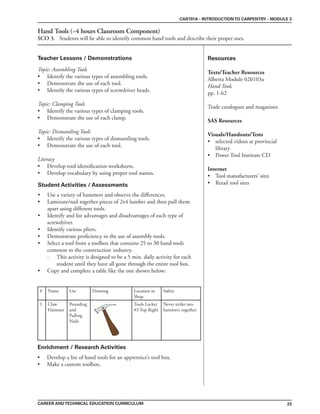
# Name Use Drawing Location in
Shop
Safety
1 Claw
Hammer
Pounding
and
Pulling
Nails
Tools Locker
#3 Top Right
Never strike two
hammers together.
Topic: Assembling Tools
• Identify the various types of assembling tools.
• Demonstrate the use of each tool.
• Identify the various types of screwdriver heads.
Topic: Clamping Tools
• Identify the various types of clamping tools.
• Demonstrate the use of each clamp.
Topic: Dismantling Tools
• Identify the various types of dismantling tools.
• Demonstrate the use of each tool.
Literacy
• Develop tool identification worksheets.
• Develop vocabulary by using proper tool names.
• Use a variety of hammers and observe the differences.
• Laminate/nail together pieces of 2x4 lumber and then pull them
apart using different tools.
• Identify and list advantages and disadvantages of each type of
screwdriver.
• Identify various pliers.
• Demonstrate proficiency in the use of assembly tools.
• Select a tool from a toolbox that contains 25 to 30 hand tools
common to the construction industry.
- This activity is designed to be a 5 min. daily activity for each
student until they have all gone through the entire tool box.
• Copy and complete a table like the one shown below:
• Develop a list of hand tools for an apprentice’s tool box.
• Make a custom toolbox.
25
CAREER ANDTECHNICAL EDUCATIONCURRICULUM
CAR701A - INTRODUCTIONTO CARPENTRY
Portable PowerTools
(~2 hours Classroom Component)
Introduction Portable power tools are used every day by carpenters to improve efficiency and reduce
the effort required to complete construction-related tasks. Portable power tools can be
hazardous and cause injury if they are not used or maintained properly. The apprentice
must become familiar with many portable power tools, demonstrating effective use and
care, while always working in a safe manner.
4. Students will be able to identify and describe the safe operation and
maintenance of portable power tools.
Assessment
Strategies
Paper/Pencil
Self/Peer-Assessments
Skills Performance
Teacher Observation
Career Portfolio
Resources Alberta Module 020103b, Portable Power Tools
Specific
Curriculum
Outcome
Students will be expected to
4.1 identify and describe the safe operation of portable saws
4.2 identify and describe the safe operation of portable planing and shaping equipment
4.3 identify and describe the safe operation of portable drilling and fastening equipment
4.4 identify and describe the safe operation of portable abrasive tools
4.5 demonstrate tool proficiency through selected shop projects using a variety of building
materials
SCO - Delineations
28.
26
Student Knowledge, Abilities,and Competencies
Students will be expected to
Portable Power Tools (~ 2 hours Classroom Component)
SCO 4. Students will be able to identify and describe the safe operation and maintenance of portable power tools.
CAR701A - INTRODUCTIONTO CARPENTRY - MODULE 4
CAREER ANDTECHNICAL EDUCATION CURRICULUM
SCO - Delineations
4.1 identify and describe the safe
operation of portable saws
4.2 identify and describe the safe
operation of portable planing
and shaping equipment
Topic: Power Saws
• Identify various portable power saws used in the carpentry trade.
• Operate the following portable saws in a safe and proper manner:
- circular saw
- power mitre saw
- sliding compound mitre saw
- jigsaw
- reciprocating saw
• Maintain power saws and accessories, including
- extension/power cords
- blades
- guards.
• Demonstrate an understanding of the safety issues specific to each
power tool.
• Demonstrate the proper use and safety precautions to be taken
with each of the above power tools.
Topic: Power Planers and Routers
• Identify portable planing and shaping equipment and recognize
the safety issues involved with the use of each:
- routers
- laminate trimmers
- rotary cut out tools
- power hand planes
- various accessories
• Describe the use and function of portable planing and shaping
tools.
• Demonstrate an understanding of the safety issues specific to each
power tool.
• Demonstrate the use of the appropriate PPE.
• Demonstrate the proper use and safety precautions to be taken
with each of the above power planing and shaping tools.
• Maintain portable planing and shaping equipment.
• Develop proficiency in the proper use of the above power tools.
• Complete projects designed to build skills in the use of these
power tools.
29.
27
Teacher Lessons /Demonstrations Resources
CAREER ANDTECHNICAL EDUCATION CURRICULUM
CAR701A - INTRODUCTIONTO CARPENTRY - MODULE 4
Portable Power Tools (~ 2 hours Classroom Component)
SCO 4. Students will be able to identify and describe the safe operation and maintenance of portable power tools.
Texts/Teacher Resources
Alberta Module 020103b
Portable Power Tools
pp. 1-42
SAS Resources
Videos
• Selected videos at provincial
library
Visuals/Handouts/Tests
• Power tool information and safety
sheets
• ILM Self-Test
Portable Power Tools
Internet
• Retail suppliers
• Manufacturers’ sites
• Power Tool Institute, Inc.
• OHS, WorkSafe sites
Enrichment / Research Activities
Student Activities /Assessments
Topic: Power Saws
• Display and identify various portable power saws.
• Demonstrate how to safely use, handle, and care for portable power saws.
• Demonstrate the use of the appropriate saw for the following
applications:
- crosscutting operations
- ripping
- notching
- plunge cutting
• Develop the following materials:
- power tool use and safety information sheets
- written test covering operation and safety
- practical user operation tests
Topic: Power Planers and Routers
• Identify various routers, spiral saws, and planers.
• Demonstrate how to safely use, handle, and care for portable
routers, spiral saws, and planing tools.
• Develop the following materials:
- power tool use and safety information sheets
- written test covering operation and safety
- practical, user operation tests
• Identify the different saws, planers, and routers, with their various
components and accessories.
• Select the appropriate tools for specific tasks.
• Demonstrate the proper, safe use of each tool.
• Complete a tool identification quiz on saws, planers, and routers.
• Demonstrate the proper storage and maintenance of each tool.
• Develop skill proficiency through projects designed around each tool.
Literacy
• Develop vocabulary by using proper tool names.
• Interpret tool information and safety sheets.
• As a carpenter or hobby woodworker you will be purchasing
portable powered tools. Complete this consumer exercise in
purchasing power tools:
1. Select a tool that you would like to have (e.g., circular saw).
2. Research three similar tools, listing their specifications and prices.
3. Choose the one you would buy, giving reasons why.
Literacy
• Read and interpret the owners’ manuals for the various tools.
• Complete a one-page briefing sheet on a portable power tool.
30.
28
Student Knowledge, Abilities,and Competencies
Students will be expected to
Portable Power Tools (~ 2 hours Classroom Component)
SCO 4. Students will be able to identify and describe the safe operation and maintenance of portable power tools.
CAR701A - INTRODUCTIONTO CARPENTRY - MODULE 4
CAREER ANDTECHNICAL EDUCATION CURRICULUM
SCO - Delineations
4.3 identify and describe the safe
operation of portable drilling
and fastening equipment
4.4 identify and describe the
safe operation of portable
abrasive tools
4.5 demonstrate tool proficiency
through selected shop
projects using a variety of
building materials
Topic: Drills, Fastening Tools
• Identify portable drilling and fastening equipment.
• Demonstrate an understanding of the safety issues and precautions
to be taken with the following drilling and fastening tools:
- drills
- hammer drills
- concrete and masonry tool bits
- screw guns
- biscuit joiners
- electric/pneumatic powered nailers
• Describe the function and use of portable drilling and fastening
equipment.
• Describe the advantages and disadvantages of corded and cordless
power tools.
Topic: Sanders, Grinders
• Identify portable abrasive tools.
• Demonstrate safe work habits related to portable abrasive power tools:
- belt sanders
- finishing sanders
- disc sanders
- grinders
• Demonstrate the use of the appropriate PPE.
• Demonstrate the proper use and safety precautions to be take with
each of the above power planing and shaping tools.
• Maintain portable planing and shaping equipment.
Topic: Portable Power Tool Skill Development
• Develop proficiency in the proper use of the above power tools.
• Complete projects designed to build skills in the use of these
power tools.
• Students will develop the knowledge, ability, and competency to
- use the hand tools listed in the ILM for construction projects
using solid wood and manufactured materials
- demonstrate the effective use of PPE
- demonstrate safe practices
- demonstrate the ability to read and follow plans and procedures
- sharpen and maintain hand tools.
31.
29
Teacher Lessons /Demonstrations Resources
CAREER ANDTECHNICAL EDUCATION CURRICULUM
CAR701A - INTRODUCTIONTO CARPENTRY - MODULE 4
Portable Power Tools (~ 2 hours Classroom Component)
SCO 4. Students will be able to identify and describe the safe operation and maintenance of portable power tools.
Texts/Teacher Resources
Alberta Module 020103b
Portable Power Tools
pp. 1-42
SAS Resources
Videos
• selected videos at provincial library
Visuals/Handouts/Tests
• power tool information and safety
sheets
• ILM Self-Test
Portable Power Tools
Internet
• Retail suppliers
• Manufacturers’ sites
• Power Tool Institute
• OHS, WorkSafe sites
Topic: Drills, Fastening Tools
• Demonstrate how to safely use, handle, and care for portable drilling
and fastening tools.
• Demonstrate the safe and effective use of
- drills
- screw guns
- biscuit joiners
- pneumatic fastening tools.
• Develop the following materials:
- tool use and safety information sheets
- written test covering operation and safety
Topic: Sanders, Grinders
• Demonstrate how to safely use, handle, and care for portable
abrasive sanding tools.
• Demonstrate the safe and effective use of
- belt sanders
- orbital sanders
- grinders.
• Develop the following materials:
- tool use and safety information sheet
- written test covering operation and safety
Enrichment / Research Activities
Student Activities / Assessments
• Identify various drills and fastening tools.
• Demonstrate the safe and effective use of:
drills, screw guns, fastening tools, biscuit joiner, pneumatic nailers
• Demonstrate the safe and effective use of portable powered sanders
and grinders.
• Complete a quiz to identify the various tools, their components and
accessories.
• Demonstrate the proper storage and maintenance of each tool.
• Develop skill proficiency through projects designed around each tool.
Literacy
• Develop vocabulary by using proper tool names.
• Interpret tool information and safety sheets.
• As a carpenter or hobby woodworker you will be purchasing
portable power tools. Complete this consumer exercise in
purchasing power tools:
1. Select a tool that you would like to have (e.g., circular saw).
2. Research three similar tools, listing their specifications and prices.
3. Choose the one you would buy, giving reasons why.
Literacy
• Read and interpret owner/operator manuals.
• Complete a one-page briefing sheet on a portable power tool.
31
CAREER ANDTECHNICAL EDUCATIONCURRICULUM
CAR701A - INTRODUCTIONTO CARPENTRY
Stationary PowerTools
(~2 hours Classroom Component)
Introduction Stationary power tools may be found on some larger job sites, or in wood manufacturing
workshops. Carpenters must become familiar with the operation of the various stationary
power tools and the basic operations of wood product manufacturing. The apprentice
must develop skills in wood product manufacturing and machine operations. The safe
and effective use of machines and personal protective equipment must be applied at all
times.
5. Students will be able to identify and describe the safe operation and
maintenance of stationary power tools and demonstrate tool proficiency
through selected projects.
Assessment
Strategies
Paper/Pencil
Self/Peer Assessments
Skills Performance
Teacher Observation
Career Portfolio
Resources Alberta Module 020103c, Stationary Power Tools
Specific
Curriculum
Outcome
SCO - Delineations Students will be expected to
5.1 identify and describe the safe operation and regular maintenance of stationary saws
5.2 identify and describe the safe operation and regular maintenance of stationary
planing tools
5.3 identify and describe the safe operation and regular maintenance of stationary
drilling, grinding, and sanding tools
34.
32
Student Knowledge, Abilities,and Competencies
Students will be expected to
Stationary Power Tools (~2 hours Classroom Component)
SCO 5. Students will be able to identify and describe the safe operation and maintenance of stationary power
tools and demonstrate tool proficiency through selected shop projects.
CAR701A - INTRODUCTIONTO CARPENTRY - MODULE 5
CAREER ANDTECHNICAL EDUCATION CURRICULUM
SCO - Delineations
5.1 identify and describe the
safe operation and regular
maintenance of stationary
saws
Topic: Stationary Saws
• Identify and describe the main parts of a table saw, radial arm saw,
and band saw.
• Describe the proper and safe operation of stationary saws:
- table saw (rip, crosscut, bevel, angles, mitre)
- radial arm, or sliding compound mitre saw (crosscutting,
mitre, single angles, compound angles)
- band saw (curves, angles, relief cuts)
• Demonstrate safety procedures needed when using stationary saws:
- set saw blade height and angle
- proper installation and functionong of guards
- proper set-up and use of mitre gauge and fence
• Demonstrate lock-out/tag-out procedures while performing
maintenance on stationary power tools.
• Practise basic maintenance:
- table saw (change blades, clean)
- band saw (set blade tension and track, set guides)
- radial arm saw (change blades, check alignment, set height,
change fence)
• Demonstrate and practise safe operation of stationary saws.
- Maintain a clear working area around saw.
- Do not talk to operator.
- Follow safety rules.
- Wear appropriate PPE.
• Develop proficiency in the proper use of the above power tools.
• Complete projects designed to build skills in the use of these
power tools.
• Demonstrate the proper cleaning and maintenance of stationary saws.
35.
33
Teacher Lessons /Demonstrations Resources
CAREER ANDTECHNICAL EDUCATION CURRICULUM
CAR701A - INTRODUCTIONTO CARPENTRY - MODULE 5
Stationary Power Tools (~2 hours Classroom Component)
SCO 5. Students will be able to identify and describe the safe operation and maintenance of stationary power
tools and demonstrate tool proficiency through selected shop projects.
Texts/Teacher Resources
Alberta Module 020103c
Stationary Power Tools
pp. 1-42
SAS Resources
Videos
• selected videos at provincial library
Visuals/Handouts/Tests
• Machine safety sheets
• ILM Self-Test
Stationary Power Tools, pp. 38-40
Internet
• Retail suppliers
• Manufacturers’ sites
• Power Tool Institute
• OHS, WorkSafe sites
Enrichment / Research Activities
Student Activities / Assessments
Topic: Stationary Saws
• Identify the various stationary saws.
• Demonstrate the use of appropriate PPE.
• Demonstrate the proper machine set-up, including the use of all
safety equipment and machine guards.
• Present a a lesson and demonstration on the safe operation of each
of the following machines:
table saw
- Identify the parts of the saw
- Demonstrate the proper and safe operation to perform
> crosscuts with mitre gauge
> ripping with the fence
> various angle cuts
sliding compound mitre saw, and/or radial arm saw
- Identify the parts of the saw
- Demonstrate the proper and safe operation to perform
> crosscuts
> single angle cuts
> compound angle cuts
band saw
- Identify the parts of the saw
- Demonstrate the proper and safe operation to perform
> relief cuts
> cutting curves
> angle cuts
• Prepare a demonstration lesson on proper maintenance procedures
for each of the machines, including proper lock-out/tagout
procedures.
• Demonstrate the use of appropriate PPE.
• Demonstrate use of guards and push sticks.
• Demonstrate the safe operation and maintenance of the tools listed above.
• Perform the cutting operations listed above.
• Label the parts of the following stationary power tools and describe
their functions: table saw, radial arm saw, sliding compound mitre
saw, and band saw.
• Perform maintenance, and change and set blades.
• Demonstrate the proper use of the above tools while working on
shop projects.
• Construct a push stick for the table saw.
• Select a stationary tool and write the specifications for the purchase
of the tool through a tender process.
• Investigate publications that compare stationary tools.
36.
34
Student Knowledge, Abilities,and Competencies
Students will be expected to
Stationary Power Tools (~2 hours Classroom Component)
SCO 5. Students will be able to identify and describe the safe operation and maintenance of stationary power
tools and demonstrate tool proficiency through selected shop projects.
CAR701A - INTRODUCTIONTO CARPENTRY - MODULE 5
CAREER ANDTECHNICAL EDUCATION CURRICULUM
SCO - Delineations
5.2 identify and describe the
safe operation and regular
maintenance of stationary
planing tools
Topic: Jointers and Planers
Jointer
• Identify and describe the parts of a stationary jointer.
• Describe the function and use of a jointer.
• Describe the cutting action of a jointer.
• Demonstrate jointing a face.
• Demonstrate jointing an edge.
• Describe special cuts (e.g., rabbet, chamfer, angle).
• Practise basic maintenance (e.g., replacing blades and setting
tables).
• Ensure guards are working properly.
Planer
• Identify and describe the parts of a stationary planer.
• Describe the function and use of a planer.
• Describe the cutting action of a planer.
• Demonstrate planing a board.
• Practise basic maintenance (e.g., replacing blades and checking
tables).
• Ensure guards are working properly.
• Demonstrate and practise safe operation of jointers and planers:
- Maintain a clear working area around equipment.
- Do not talk to operator.
- Follow safety rules.
- Wear appropriate PPE.
• Develop proficiency in the proper use of the above power tools.
• Complete projects designed to build skills in the use of these
power tools.
• Demonstrate the proper cleaning and maintenance of jointers and
planers.
37.
35
Teacher Lessons /Demonstrations Resources
CAREER ANDTECHNICAL EDUCATION CURRICULUM
CAR701A - INTRODUCTIONTO CARPENTRY - MODULE 5
Stationary Power Tools (~2 hours Classroom Component)
SCO 5. Students will be able to identify and describe the safe operation and maintenance of stationary power
tools and demonstrate tool proficiency through selected shop projects.
Texts/Teacher Resources
Alberta Module 020103c
Stationary Power Tools
pp. 1-42
SAS Resources
Visuals/Handouts/Tests
• Machine Safety Sheets
• ILM Self-Test
Stationary Power Tools, pp. 38-40
Internet
• Manufacturers’ sites
Enrichment / Research Activities
Student Activities / Assessments
Topic: Jointers and Planers
• Demonstrate the proper use of PPE.
• Demonstrate use of push sticks and blocks.
• Present a safety lesson and demonstration on the operation of each
of the following machines:
jointer
- planing a face
- planing an edge
planer
- planing to thickness
• Conduct a demonstration lesson on proper maintenance procedures
for the jointer and thickness planer.
• Demonstrate the safe operation and maintenance of the jointer and
thickness planer.
• Square a piece of rough stock.
• Plane to a specified thickness.
• Label the parts of the following stationary power tools and describe
their functions:
- jointer
- thickness planer
• Demonstrate the proper use of the above tools in building projects.
Literacy
• Read and interpret machine safety sheets and manuals.
• Investigate the purchase of a jointer or planer.
• Change and set the blades on a jointer or planer.
38.
36
Student Knowledge, Abilities,and Competencies
Students will be expected to
Stationary Power Tools (~2 hours Classroom Component)
SCO 5. Students will be able to identify and describe the safe operation and maintenance of stationary power
tools and demonstrate tool proficiency through selected shop projects.
CAR701A - INTRODUCTIONTO CARPENTRY - MODULE 5
CAREER ANDTECHNICAL EDUCATION CURRICULUM
SCO - Delineations
5.3 identify and describe the
safe operation and regular
maintenance of stationary
drilling, grinding, and sanding
tools
Topic: Drills, Grinders, and Sanders
• Identify and describe the parts of a stationary drill press, a grinder,
and a sander.
• Describe the actions and application of the following tools:
- drill press (boring holes, changing bits, drum sanding)
- sander: disc and belt sanders
- grinder: tool rest grinding wheels, guards
• Explain why one never grinds aluminum, brass, or copper.
• Practise basic sander maintenance (e.g., cleaning/changing belts
and discs, setting tables, checking tracking of belt).
• Demonstrate and practise the safe operation of a stationary sander,
grinder, and drill press.
- Maintain a clear working area around equipment.
- Do not talk to operator.
- Follow safety rules.
- Wear appropriate PPE.
• Develop proficiency in the proper use of the above power tools.
• Complete projects designed to build skills in the use of these
power tools.
• Demonstrate the proper cleaning and maintenance of a drill press,
grinder, and sander.
39.
37
Teacher Lessons /Demonstrations Resources
CAREER ANDTECHNICAL EDUCATION CURRICULUM
CAR701A - INTRODUCTIONTO CARPENTRY - MODULE 5
Stationary Power Tools (~2 hours Classroom Component)
SCO 5. Students will be able to identify and describe the safe operation and maintenance of stationary power
tools and demonstrate tool proficiency through selected shop projects.
Texts/Teacher Resources
Alberta Module 020103c
Stationary Power Tools
pp. 1-42
Manufacturers’ manuals
SAS Resources
Visuals/Handouts/Tests
• Machine Safety Sheets
• ILM Self-Test
Stationary Power Tools, pp. 38-40
Internet
• Investigate Manufacturers sites
Enrichment / Research Activities
Student Activities / Assessments
Topic: Drills, Grinders, and Sanders
• Prepare a demonstration on the proper operation and safety
precautions to be taken with each of the following machines:
drill press
- boring holes
- changing bits, changing speeds
- setting tables and stops
- drum sanding
sander
- identifying belts and discs
- installing belts and discs
- cleaning belts and discs
grinder
- locating the tool rest
- sharpening procedures
- changing a grinding wheel
- truing a wheel
• Prepare a demonstration lesson on proper maintenance procedures
for each of the following machines:
- drill press
- sander
- grinder
• Demonstrate the safe operation (including use of PPE) and
maintenance of the tools listed above.
• Perform the operations listed above.
• Label the parts of the following stationary power tools and describe
their functions:
- drill press
- sanders
- grinders
• Demonstrate the proper use of the above tools in building projects.
Literacy
• Read and interpret machine safety sheets and manuals.
• Investigate the purchase of a drill press, grinder, or sander.
• Set up and produce mortise joints on the drill press.
• Change the grinder wheel.
• Change the sander disc or belt (under supervision).
39
CAREER ANDTECHNICAL EDUCATIONCURRICULUM
CAR701A - INTRODUCTIONTO CARPENTRY
Drafting Basics
(~4 hours Classroom Component)
Introduction Drawing is one of the most effective methods of communication, and drawings are an
integral part of the everyday work of a carpenter. An apprentice must be familiar with
the instruments used and the procedures followed for creating effective and meaningful
drawings.
6. Students will be able to identify and demonstrate the use of basic drawing
instruments.
Assessment
Strategy
Paper/Pencil
Self/Peer-Assessments
Skills Performance
Teacher Observation
Career Portfolio
Resources Alberta Module 020107a, Drafting Basics - Part A
Alberta Module 020107b, Drafting Basics - Part B
Specific
Curriculum
Outcome
SCO - Delineations Students will be expected to
6.1 describe the function of basic drawing equipment
6.2 use drafting equipment to complete geometric exercises
6.3 describe the applications of geometry in trade situations
6.4 practise producing shapes, angles, and drawing to scale with the basic drafting
instruments
42.
40
Student Knowledge, Abilities,and Competencies
Students will be expected to
Drafting Basics (~4 hours Classroom Component)
SCO 6. Students will be able to identify and demonstrate the use of basic drawing instuments.
CAR701A - INTRODUCTIONTO CARPENTRY - MODULE 6
CAREER ANDTECHNICAL EDUCATION CURRICULUM
SCO - Delineations
6.1 describe the function of
basic drawing equipment
6.2 use drafting equipment to
complete geometric exercises
Topic: Drafting Tools
• List various sizes of paper and describe their intended use.
• Identify the following drawing instruments and describe their
intended use:
- pencils (various grades)
- t-square
- set squares: 30-60˚ , 45˚
- scale rules
- protractor
- compass/dividers
- templates
- drafting board
Topic: Sheet Layout
• Demonstrate how to properly mount a sheet of paper in
preparation for drawing.
• Demonstrate sheet layout with border and title block.
• Demonstrate the proper method for drawing horizontal, vertical,
and angular lines.
Topic: Measuring and Scale
• Read and interpret a metric scale rule.
• Read and interpret an imperial scale rule.
• Compare and contrast a metric and imperial scale.
Topic: Geometric Construction
• Demonstrate the proper use of set squares to determine standard
angles.
• Perform the following basic geometric procedures:
- Bisect an angle at 90˚.
- Draw a line at 90˚ to a baseline.
- Bisect an angle.
- Draw the following angles: 60˚, 30˚, 45˚, 22.5˚, 15˚.
- Find the centre of a circle or arc.
- Draw a hexagon within a circle.
- Draw an octagon within a square.
- Draw parallel lines.
- Divide lengths into equal spaces.
- Divide a line into equal spaces.
- Find the centre of a line or space.
43.
41
Teacher Lessons /Demonstrations Resources
CAREER ANDTECHNICAL EDUCATION CURRICULUM
CAR701A - INTRODUCTIONTO CARPENTRY - MODULE 6
Drafting Basics (~4 hours Classroom Component)
SCO 6. Students will be able to identify and demonstrate the use of basic drawing instuments.
Texts/Teacher Resources
Alberta Module 020107a
Drafting Basics - Part A
pp. 1-49
Enrichment / Research Activities
Student Activities / Assessments
Topic: Drafting Tools
• Identify basic drawing tools.
• Demonstrate how to properly use the drawing equipment.
Topic: Sheet Layout
• Demonstrate the proper method of setting up a sheet.
• Demonstrate a sheet layout, including borderlines and title block.
Topic: Measuring and Scale
• Create overheads/slides to help explain how to read a ruler.
• Create overheads/slides to help explain how to read a scale.
• Demonstrate measuring with both metric and imperial scales.
Topic: Geometric Construction
• Demonstrate the proper use of set squares.
• Demonstrate the proper use of the compass.
• Demonstrate basic geometric constructions.
• Identify all drawing equipment on a component ID table.
• Complete a worksheet on reading metric and imperial rulers.
• Complete a worksheet on reading scales.
• Complete selected activities as described in the ILM.
• Demonstrate sheet set-up and layout.
• Demonstrate basic geometric constructions.
CBL
• Participate in a field trip to a drafting, design, engineering, or
survey firm.
44.
42
Student Knowledge, Abilities,and Competencies
Students will be expected to
Drafting Basics (~4 hours Classroom Component)
SCO 6. Students will be able to identify and demonstrate the use of basic drawing instuments.
CAR701A - INTRODUCTIONTO CARPENTRY - MODULE 6
CAREER ANDTECHNICAL EDUCATION CURRICULUM
SCO - Delineations
6.3 describe the applications of
geometry in trade situations
6.4 practise producing shapes
and angles, and drawing to
scale with basic drafting
instruments
Topic: Geometry for Carpenters
• Demonstrate how to properly square a frame using a measuring tape.
• Demonstrate how to use a framing square to determine common
angles (e.g., 90˚, 45˚, 30˚, 60˚).
• Demonstrate the proper method of marking a 90˚ angle using the
Pythagorean theorem (3-4-5 triangle).
• Demonstrate how to use two tape measures to bisect a line at 90˚.
• Demonstrate how to lay out a mitre for an unusual angle.
• Demonstrate how to check the following tools for accuracy:
- framing square
- levels
Topic: Drawing Practice
• Draw lines to scale.
• Draw an octagon centred on the page.
• Draw a solid wooden door.
45.
43
Teacher Lessons /Demonstrations Resources
CAREER ANDTECHNICAL EDUCATION CURRICULUM
CAR701A - INTRODUCTIONTO CARPENTRY - MODULE 6
Drafting Basics (~4 hours Classroom Component)
SCO 6. Students will be able to identify and demonstrate the use of basic drawing instuments.
Enrichment / Research Activities
Texts/Teacher Resources
Alberta Module 020107b
Drafting Basics - Part B
pp. 1-17
Student Activities / Assessments
Topic: Geometry for Carpenters
• Demonstrate checking for square by using a tape measure.
• Demonstrate checking for square by using calculations.
• Demonstrate marking 45˚, 30˚, and 60˚ angles using a framing square.
• Demonstrate the 3-4-5 triangle method to obtain a 90˚ angle.
• Demonstrate using two tape measures to bisect a line at 90˚.
• Demonstrate how to lay out a mitre for unusual angles.
• Demonstrate how to check levels and squares for accuracy.
Topic: Drawing Practice
• Demonstrate the importance of measuring and drawing with accuracy.
• Demonstrate the use of construction lines.
• Demonstrate the construction of an octagon.
• Demonstrate the construction of a hexagon.
• Complete selected activities to support the above geometric
constructions.
• Complete a “tricks of the trade”worksheet to support the use of these
geometric constructions on the work site.
• Demonstrate accuracy in measuring and drawing lines.
• Demonstrate the construction of an octagon.
• Demonstrate the drawing of the wood door in the ILM.
• Demonstrate drawing cleanliness.
• Provide additional drafting exercises for advanced students.
45
CAREER ANDTECHNICAL EDUCATIONCURRICULUM
CAR701A - INTRODUCTIONTO CARPENTRY
Basic Math Concepts
(~4 hours Classroom Component)
Introduction Carpenters are constantly using basic math skills to measure lengths, estimate materials,
and calculate quantities. Measuring and layout skills are arguably the most important
skills that a professional carpenter can possess. Developing the apprentices basic math
and geometry skills will prove to be invaluable on the work site. Practice in the use of
fractions and decimals are very important in the ability to work in both the imperial and
metric systems.
7. Students will be able to use a calculator and apply basic math concepts to solve
trade-related math problems in both metric and imperial systems of
measurement.
Assessment
Strategies
Paper/Pencil
Self/Peer-Assessments
Skills Performance
Teacher Observation
Career Portfolio
Resources Alberta Module 020108a, Basic Math Concepts - Part A
Alberta Module 020108b, Basic Math Concepts - Part B
Students will be expected to
7.1 describe basic math concepts and operations
7.2 describe the basic calculator functions and operations
7.3 describe the metric measurement system (SI)
7.4 describe the imperial measurement system
7.5 describe calculations involving fractions
7.6 convert measurements between metric and imperial systems
7.7 working with equations
7.8 describe calculations using the Pythagorean theorem
Specific
Curriculum
Outcome
SCO - Delineations
48.
CAR701A - INTRODUCTIONTOCARPENTRY - MODULE 7
Basic Math Concepts (~4 hours Classroom Component)
SCO 7. Students will be able to use a calculator and apply basic math concepts to solve trade-related math
problems using both metric and imperial systems of measurement.
CAREER ANDTECHNICAL EDUCATION CURRICULUM
SCO - Delineations Student Knowledge, Abilities, and Competencies
Students will be expected to
46
7.1 describe basic math concepts
and operations
7.2 describe the basic calculator
functions and operations
7.3 describe the metric
measurement system (SI)
7.4 describe the imperial
measurement system
Topic: Number Sense
• Read and interpret large numbers.
• Demonstrate an understanding of the concept of whole numbers.
• Demonstrate an ability to read decimal numbers (as separate
numbers).
• Round numbers.
• Demonstrate the proper order of operations in completing
mathematical operations (BEDMAS).
Topic: Calculator Use
• Demonstrate the operation of a calculator, and the proper order of
operations:
- addition and subtraction
- multiplication and division
- squaring and cubing a number
- square root
- memory function
Topic: Metric System
• Demonstrate effective use of the metric system (SI).
• Explain that the basic unit of linear measurement is the metre (m).
• Demonstrate the ability to measure to the nearest millimetre.
• Demonstrate the ability to covert within the metric system (metres,
millimetres, centimetres, kilometres).
• Demonstrate the ability to complete calculations relating to area
and volume.
Topic: Imperial System
• Demonstrate the effective use of the imperial system.
• Demonstrate the ability to convert within the imperial system
(inches, feet, yards, fractions).
• Demonstrate the ability to measure to the nearest 1/16th of an inch.
• Demonstrate the ability to complete calculations relating to area
and volume.
49.
CAR701A - INTRODUCTIONTOCARPENTRY - MODULE 7
CAREER ANDTECHNICAL EDUCATION CURRICULUM
Teacher Lessons / Demonstrations Resources
47
Basic Math Concepts (~4 hours Classroom Component)
SCO 7. Students will be able to use a calculator and apply basic math concepts to solve trade-related math
problems using both metric and imperial systems of measurement.
Texts/Teacher Resources
Alberta Module 020108a
Basic Math Concepts - Part A
pp. 1-36
SAS Resources
Visuals/Handouts/Tests
• Activity sheets
• Material estimate sheets
• ILM Self-Test
Basic Math Concepts - Part A,
pp. 38-40
Math in CTE
Review and integrate the 7-Step
Pedagogical Model for teaching
embedded math concepts in technical
education.
See Appendix
Student Activities / Assessments
Topic: Number Sense
• Introduce the number value chart (figure 1 in ILM).
• Describe whole numbers and arrange them in groups of three, with
commas or spaces between the groups.
• Describe decimals and the places to the right of the decimal point.
• Read decimals as separate numbers.
• Demonstrate the rounding of numbers.
• List and review the rules for rounding numbers.
• Integrate the rounding of numbers to estimate building materials
(e.g., plywood, concrete, shingles).
• Demonstrate the order of operations (BEDMAS).
Topic: Calculator Use
• Demonstrate calculator use and common functions.
- addition, subtraction
- multiplication, division
- exponents (square and cubed), square root, memory function
Topic: Metric System
• Introduce the history of the SI (System International) system of
measurement (base of 10, using decimals).
• Link linear measurements to area, volume, and mass measurements
(using water as the base unit—1 cc H2
O = 1 gram = 1 mL).
• Explain linear measures: metre (m); kilometre (km); centimetre (cm).
• Explain volume measures: litre (L); milliletre (mL); cubic metre (m3
).
• Explain mass (weight): gram (g); kilogram (kg); tonne (t).
Topic: Imperial System
• Ensure that students have a basic understanding of the history of the
imperial system. They should also know how we are still influenced
by the use of the imperial system in the United States.
• Explain linear measures: foot (ft.); inch (in.); yard (yd.); mile (mi.).
• Convert between units of measurement. (in - ft - yd - mi).
• Introduce measures of area, volume, and mass.
• Emphasize the importance of understanding fractions.
Numeracy
• Stress the importance of using proper units in all calculations.
• Develop a pre-test strategy which could be used in a KWL .
• Complete examples and exercises in the ILM.
• Complete a number value chart (figure 1 in ILM).
• Practise rounding numbers and relate this to estimating materials.
• Practise the order of operations (BEDMAS).
• Demonstrate the use of a calculator to complete basic operations and
use the common functions.
• Practise measuring, demonstrating accuracy to 1/16 in. and 1 mm.
• Complete various activity sheets to support basic math concepts
(identify math concepts throughout all of the ILMs).
50.
CAR701A - INTRODUCTIONTOCARPENTRY - MODULE 7
Basic Math Concepts (~4 hours Classroom Component)
SCO 7. Students will be able to use a calculator and apply basic math concepts to solve trade-related math
problems using both metric and imperial systems of measurement.
CAREER ANDTECHNICAL EDUCATION CURRICULUM
SCO - Delineations Student Knowledge, Abilities, and Competencies
Students will be expected to
48
7.5 describe calculations
involving fractions
7.6 convert measurements
between metric and imperial
systems
Topic: Working with Fractions
• Explain the concept of fractions.
• Explain why a good knowledge of fractions is important to
carpenters.
• Define the basic fraction terminology:
- numerator
- denominator
- common denominator
• Find common denominators in calculations.
• Define the term “mixed number” (give examples).
• Define the term “improper fraction”, and give examples.
(Improper fractions may be used to describe board thickness, such
as 5/4", 8/4").
• Demonstrate the addition of fractions.
• Add mixed numbers.
• Subtract fractions.
• Multiply fractions.
• Divide fractions.
• Convert between fractions and decimals.
• Convert feet and inches to decimals.
• Convert decimals to feet and inches.
• Demonstrate rounding answers to an accuracy of 1/16th".
Topic: Converting Between Metric and Imperial Systems
• Convert linear measurements between metric and imperial (table 2).
• Convert area measurements between metric and imperial (table 3).
• Convert volume measurements between metric and imperial (table 4).
• Convert mass measurements between metric and imperial (table 5).
• Demonstrate the use of “soft conversions” in simple calculations
and in the use of building code tables.
51.
CAR701A - INTRODUCTIONTOCARPENTRY - MODULE 7
CAREER ANDTECHNICAL EDUCATION CURRICULUM
Teacher Lessons / Demonstrations Resources
49
Basic Math Concepts (~4 hours Classroom Component)
SCO 7. Students will be able to use a calculator and apply basic math concepts to solve trade-related math
problems using both metric and imperial systems of measurement.
Texts
Alberta Module 020108b
Basic Math Concepts - Part B
pp. 1-34
SAS Resources
Visuals/Handouts/Tests
• Activity sheets
• Material estimate sheets
• ILM Self-Test
Basic Math Concepts - Part B
Math in CTE
Review and integrate the 7-Step
Pedagogical Model for teaching
embedded math concepts in technical
education.
See Appendix
Enrichment / Research Activities
Student Activities / Assessments
Topic: Working with Fractions
• Explain the concept of fractions.
• Explain why a good understanding of fractions is important to
carpenters.
• Develop a pre-test on fractions and decimals to determine the
students’ prior knowledge.
• Review measurement in the imperial system to establish the trade
related context for understanding fractions.
• Describe fractions, using the proper terminology.
• Demonstrate the four basic mathematical operations with fractions:
addition, subtraction, multiplication, and division.
• Present examples of fractions being used in the trade.
• Demonstrate the relationship between fractions and decimals.
• Demonstrate conversion between fractions and decimals.
• Demonstrate conversion from decimals to feet and inches with
fractions (develop accuracy to 1/16th").
Topic: Converting Between Metric and Imperial Systems
• Convert linear measurements (table 2).
• Convert area, volume, and mass measurements.
• Introduce the soft conversions used in building codes.
• Complete a pre-test to demonstrate prior knowledge.
• Identify the anatomy of a fraction, using proper terminology.
• Demonstrate the four basic mathematical operations with fractions.
• Demonstrate conversion between decimals and fractions (round
to 1/16th").
• Demonstrate conversion between fractions and decimals (round
to three decimal places).
• Demonstrate various metric (SI) to imperial conversions.
• Develop a conversion table between fractions and decimals
(completing the conversions in 1/16 " increments).
E.g.
1/16" = 0.063"
1/8" = 0.125"
• Measure lumber samples to determine the metric sizes.
52.
CAR701A - INTRODUCTIONTOCARPENTRY - MODULE 7
Basic Math Concepts (~4 hours Classroom Component)
SCO 7. Students will be able to use a calculator and apply basic math concepts to solve trade-related math
problems using both metric and imperial systems of measurement.
CAREER ANDTECHNICAL EDUCATION CURRICULUM
SCO - Delineations Student Knowledge, Abilities, and Competencies
Students will be expected to
50
7.7 working with equations
7.8 describe calculations using
the Pythagorean theorem
Topic: Working with Equations
• Demonstrate an understanding that an equation must balance or
be equal on both sides.
• Demonstrate an understanding that equations may be
manipulated.
• Solve equations involving addition, subtraction, multiplication,
and division.
Topic: Pythagorean Theorem
• Identify and describe a right triangle.
• Demonstrate the ability to square numbers and find the square root
of numbers.
• State the Pythagorean theorem (c² = a² +b²).
• Identify the parts of a right triangle:
a = height
b = base
c = hypotenuse
90˚ angle
• Solve problems using the Pythagorean theorem.
• Demonstrate the 3-4-5 rule (6-8-10 works also).
• Demonstrate the 3-4-5 rule to lay out and square framing members.
53.
CAR701A - INTRODUCTIONTOCARPENTRY - MODULE 7
CAREER ANDTECHNICAL EDUCATION CURRICULUM
Teacher Lessons / Demonstrations Resources
51
Basic Math Concepts (~4 hours Classroom Component)
SCO 7. Students will be able to use a calculator and apply basic math concepts to solve trade-related math
problems using both metric and imperial systems of measurement.
Texts
Alberta Module 020108b
Basic Math Concepts - Part B
pp. 1-34
SAS Resources
Visuals/Handouts/Tests
• Activity sheets
• Material estimate sheets
• ILM Self-Test
Basic Math Concepts - Part B
Math in CTE
Review and integrate the 7-Step
Pedagogical Model for teaching
embedded math concepts in technical
education.
See Appendix
Topic: Working with Equations
• Explain that an equation must balance, or be equal on both sides.
• Explain that equations may be manipulated (solved/transposed)
by adding or subtracting the same value on each side.
• Explain that equations may be manipulated (solved/transposed) by
multiplying or dividing the same value on each side.
• Demonstrate solution of examples on the board.
• Demonstrate the concept of balancing equations by using a science
balance (or teeter-totter). If you add or subtract the same amount
from each side, it will stay balanced.
• Develop trade-based examples and share on SAS.
Topic: Pythagorean Theorem
• Introduce the Pythagorean theorem as a simple formula for use in
solving right angle triangles.
• Explain the importance of solving right triangles.
• Explain that the triangle is the most important geometric shape used
in construction.
• Demonstrate where you find triangles in construction (e.g., roofs,
trusses, ramps, bracing, diagonals for squaring).
• Demonstrate how to solve right triangle problems.
• Demonstrate how to manipulate the formula to solve (transpose)
right triangle problems.
• Demonstrate solutions of examples on the board.
• Develop trade-based examples and share on SAS.
Student Activities / Assessments
• Demonstrate the ability to work with and balance equations.
• Demonstrate the ability to use the Pythagorean theorem to solve
triangles.
• Demonstrate an understanding of the use of these mathematical
skills in a trades context.
• Complete exercises in the ILM.
• Complete worksheets.
• Solve trade-based problems and estimates.
Enrichment / Research Activities
• Concrete weighs 150# per cubic foot. Create an equation to find the
weight of concrete in a truck carrying 9 cubic yards of concrete.
• Find the length of one side of a gable roof if the house is 24' wide
with a 18" overhang. The roof slope is 5/12.