Current legislative framework on energy audits in Ukraine.
Potential adaptation of the Concept of mandatory energy audits into
Ukrainian legislation framework
Oleksandr Ovdiienko, Kyiv, 22 March 2016
B U I L D I N G P A R T N E R S H I P S F O R E N E R G Y S E C U R I T Y
www.inogate.org
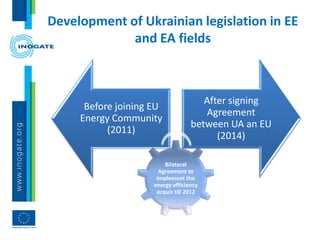
Development of Ukrainian legislation in EE
and EA fields
Before joining EU
Energy Community
(2011)
After signing
Agreement
between UA an EU
(2014)
Bilateral
Agreement to
implement the
energy efficiency
acquis till 2012
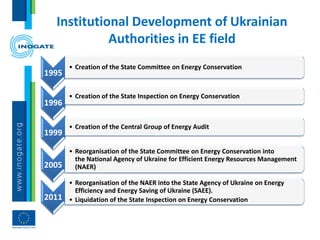
Institutional Development of Ukrainian
Authorities in EE field
1995
• Creation of the State Committee on Energy Conservation
1996
• Creation of the State Inspection on Energy Conservation
1999
• Creation of the Central Group of Energy Audit
2005
• Reorganisation of the State Committee on Energy Conservation into
the National Agency of Ukraine for Efficient Energy Resources Management
(NAER)
2011
• Reorganisation of the NAER into the State Agency of Ukraine on Energy
Efficiency and Energy Saving of Ukraine (SAEE).
• Liquidation of the State Inspection on Energy Conservation
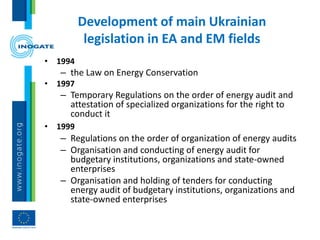
Development of main Ukrainian
legislation in EA and EM fields
• 1994
– the Law on Energy Conservation
• 1997
– Temporary Regulations on the order of energy audit and
attestation of specialized organizations for the right to
conduct it
• 1999
– Regulations on the order of organization of energy audits
– Organisation and conducting of energy audit for
budgetary institutions, organizations and state-owned
enterprises
– Organisation and holding of tenders for conducting
energy audit of budgetary institutions, organizations and
state-owned enterprises
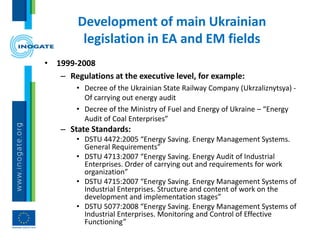
• 1999-2008
– Regulations at the executive level, for example:
• Decree of the Ukrainian State Railway Company (Ukrzaliznytsya) -
Of carrying out energy audit
• Decree of the Ministry of Fuel and Energy of Ukraine – “Energy
Audit of Coal Enterprises”
– State Standards:
• DSTU 4472:2005 “Energy Saving. Energy Management Systems.
General Requirements”
• DSTU 4713:2007 “Energy Saving. Energy Audit of Industrial
Enterprises. Order of carrying out and requirements for work
organization”
• DSTU 4715:2007 “Energy Saving. Energy Management Systems of
Industrial Enterprises. Structure and content of work on the
development and implementation stages”
• DSTU 5077:2008 “Energy Saving. Energy Management Systems of
Industrial Enterprises. Monitoring and Control of Effective
Functioning”
Development of main Ukrainian
legislation in EA and EM fields
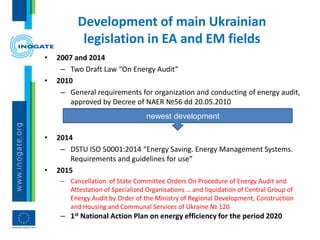
Development of main Ukrainian
legislation in EA and EM fields
• 2007 and 2014
– Two Draft Law “On Energy Audit”
• 2010
– General requirements for organization and conducting of energy audit,
approved by Decree of NAER №56 dd 20.05.2010
• 2014
– DSTU ISO 50001:2014 “Energy Saving. Energy Management Systems.
Requirements and guidelines for use”
• 2015
– Cancellation of State Committee Orders On Procedure of Energy Audit and
Attestation of Specialized Organisations … and liquidation of Central Group of
Energy Audit by Order of the Ministry of Regional Development, Construction
and Housing and Communal Services of Ukraine № 120
– 1st National Action Plan on energy efficiency for the period 2020
newest development
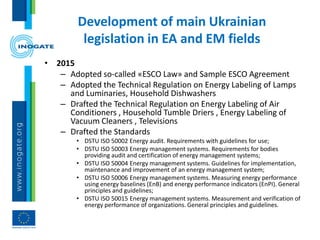
Development of main Ukrainian
legislation in EA and EM fields
• 2015
– Adopted so-called «ESCO Law» and Sample ESCO Agreement
– Adopted the Technical Regulation on Energy Labeling of Lamps
and Luminaries, Household Dishwashers
– Drafted the Technical Regulation on Energy Labeling of Air
Conditioners , Household Tumble Driers , Energy Labeling of
Vacuum Cleaners , Televisions
– Drafted the Standards
• DSTU ISO 50002 Energy audit. Requirements with guidelines for use;
• DSTU ISO 50003 Energy management systems. Requirements for bodies
providing audit and certification of energy management systems;
• DSTU ISO 50004 Energy management systems. Guidelines for implementation,
maintenance and improvement of an energy management system;
• DSTU ISO 50006 Energy management systems. Measuring energy performance
using energy baselines (EnB) and energy performance indicators (EnPI). General
principles and guidelines;
• DSTU ISO 50015 Energy management systems. Measurement and verification of
energy performance of organizations. General principles and guidelines.
Main points of current Ukrainian
legislation in EA and EM fields
• the Law on Energy Conservation of 1994 which is not
compliant with the acquis, still applies in Ukraine
– should be replaced by a modern law compliant with the Energy
Efficiency Directive 2012/27/EU
• Only State Standards and Executive Regulations left
• There is NO system of state accreditation for energy
service/energy audit companies and financial instruments of
support for their activity
• 1st National Action Plan on energy efficiency for the period
2020 was approved
• SAEE creates working group on development of draft Law
“On Energy Efficiency” according to requirements of EU
legislation
• Ministry of Regional Development and SAEE publish Draft of
Concept of Energy Efficiency Fund
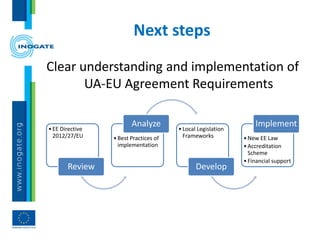
Next steps
Clear understanding and implementation of
UA-EU Agreement Requirements
•EE Directive
2012/27/EU
Review
•Best Practices of
implementation
Analyze •Local Legislation
Frameworks
Develop
•New EE Law
•Accreditation
Scheme
•Financial support
Implement
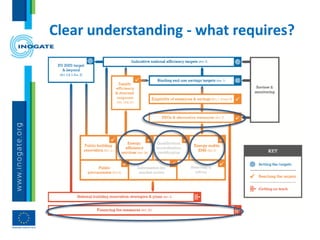
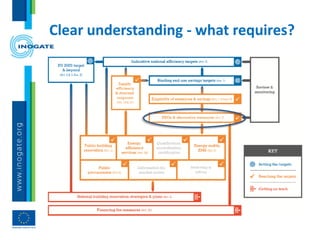
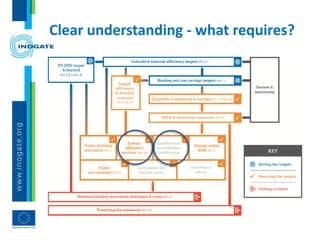
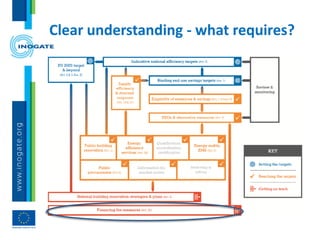
Clear understanding - what requires?
Best Practises – Main Sources
• EU Member States:
– Transposed in Austria, Bulgaria, Czech Republic, Denmark, Finland,
France, Germany, Ireland, Italy, Malta, Portugal, Romania, Slovenia,
Slovakia, Spain, Sweden, The Netherlands, United Kingdom
– Partly transposed in Belgium, Croatia
• International:
– EU and International Standards (ISO and EN).
– EU Energy Efficiency Directive (2012/27/EU). Guidebook for
Strong Implementation. The Coalition for Energy Savings – 2013
– Best Practices in Designing and Implementing Energy Efficiency
Obligation Schemes. Research Report Task XXII of the
International Energy Agency Demand Side Management
Programme – 2012
– Energy efficiency obligations – the EU experience. European
Council for an Energy Efficient Economy – 2012
Clear understanding - what requires?
Energy efficiency obligation (EEO)
• EEO schemes use the force of law to require obligated
parties to achieve energy savings through investments
in end-use energy efficiency. They are typically enforced
by regulation and by the threat of financial penalties.
• Typically, obligations in EEO schemes are placed on
providers of networked energy (e.g., electricity and
natural gas distributors or standalone retail suppliers).
• Obligations can also be placed on providers of other
energy forms (e.g., LPG, heating oil, transport fuels,
district heating), and even on end-users of energy.
• In some jurisdictions, energy savings to meet the
obligation are delivered by a third party “energy
efficiency utility”.
Energy efficiency obligation (EEO)
For obligated energy providers in competitive
energy markets, there are two possible cost
recovery paths:
• Option 1: the costs of meeting energy savings
targets are treated as a cost of doing business and
energy providers adjust their prices to recover
these costs; or
• Option 2: the costs of meeting energy savings
targets are either funded by the government
through direct budgetary appropriations, or price
surcharges are imposed on regulated “wires and
pipes” energy providers.
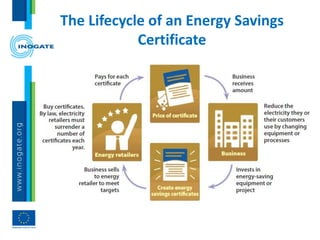
The Lifecycle of an Energy Savings
Certificate
Clear understanding - what requires?
Certification and quality assurance
• Article 16 of the EED requires MSs to ensure the availability
of certification, accreditation and/or qualification schemes
for providers of energy audits and for energy managers and,
if necessary, to establish suitable training programmes for
them.
• The criteria for determining the necessity of establishing such
schemes and training programmes are left up to MSs to
determine, based on a judgment of whether the existing
national level of technical competence, objectivity, and
reliability is considered sufficient or not.
• Fulfilling the national certification, accreditation or
qualification scheme also allows “in-house” experts or
auditors to carry out energy audits of their own installations
and buildings.
How to build up personnel
certification body
ISO/IEC 17024:2012 “Conformity assessment -
General requirements for bodies operating
certification of persons”
– an advanced standard which is aimed on
harmonizing of different procedures that are
used globally for confirmation of competence of
personnel in various professions
– the standard provides a benchmark for
collaboration of personnel certification programs
acting on a consistent, comparable and reliable
manner across the world which would allow
professionals to demonstrate their competence
irrespective of national borders
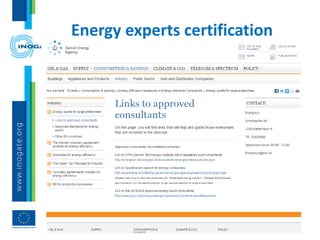
Energy experts certification
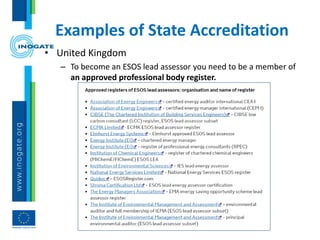
Examples of State Accreditation
• United Kingdom
– To become an ESOS lead assessor you need to be a member of
an approved professional body register.
Examples of State Accreditation
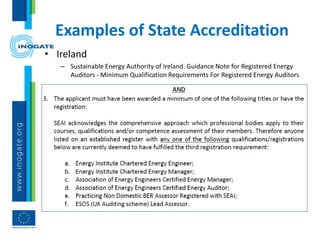
• Ireland
– Sustainable Energy Authority of Ireland. Guidance Note for Registered Energy
Auditors - Minimum Qualification Requirements For Registered Energy Auditors
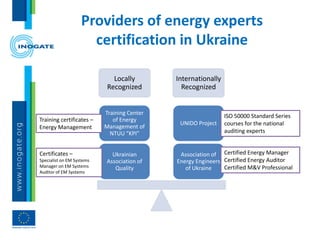
Providers of energy experts
certification in Ukraine
Locally
Recognized
Internationally
Recognized
Association of
Energy Engineers
of Ukraine
UNIDO Project
Ukrainian
Association of
Quality
Training Center
of Energy
Management of
NTUU “KPI”
Training certificates –
Energy Management
Certificates –
Specialist on EM Systems
Manager on EM Systems
Auditor of EM Systems
ISO 50000 Standard Series
courses for the national
auditing experts
Certified Energy Manager
Certified Energy Auditor
Certified M&V Professional
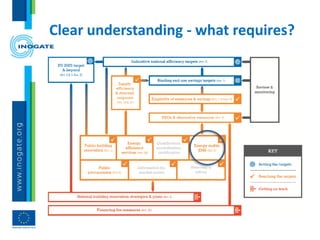
Clear understanding - what requires?
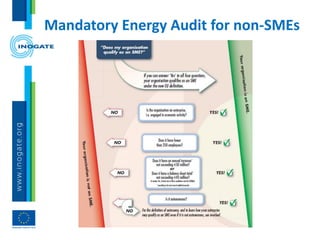
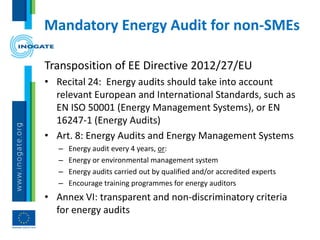
Mandatory Energy Audit for non-SMEs
Transposition of EE Directive 2012/27/EU
• Recital 24: Energy audits should take into account
relevant European and International Standards, such as
EN ISO 50001 (Energy Management Systems), or EN
16247-1 (Energy Audits)
• Art. 8: Energy Audits and Energy Management Systems
– Energy audit every 4 years, or:
– Energy or environmental management system
– Energy audits carried out by qualified and/or accredited experts
– Encourage training programmes for energy auditors
• Annex VI: transparent and non-discriminatory criteria
for energy audits
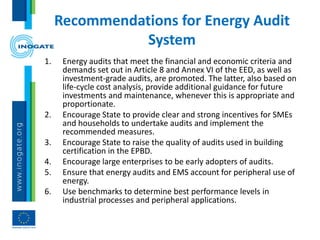
Recommendations for Energy Audit
System
1. Energy audits that meet the financial and economic criteria and
demands set out in Article 8 and Annex VI of the EED, as well as
investment-grade audits, are promoted. The latter, also based on
life-cycle cost analysis, provide additional guidance for future
investments and maintenance, whenever this is appropriate and
proportionate.
2. Encourage State to provide clear and strong incentives for SMEs
and households to undertake audits and implement the
recommended measures.
3. Encourage State to raise the quality of audits used in building
certification in the EPBD.
4. Encourage large enterprises to be early adopters of audits.
5. Ensure that energy audits and EMS account for peripheral use of
energy.
6. Use benchmarks to determine best performance levels in
industrial processes and peripheral applications.
Clear understanding - what requires?
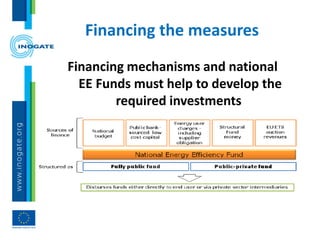
Financing the measures
Financing mechanisms and national
EE Funds must help to develop the
required investments
Decisions on Governmental Level
1. Set up dedicated Energy Efficiency Funds capable of blending
various streams of financing and dedicated to backing high
standard national energy efficiency investment programmes.
2. Use public financing institutions to drive energy efficiency
investment.
3. Design effective policy instruments to ensure take-up of funds.
4. Consider how to structure offerings to leverage the maximum
amount of private sector investment possible.
5. Develop a long-term plan for driving demand across all sectors of
the economy that offers sufficient scale of opportunity to meet
targets and confidence that the plan will match or exceed the
expected period required for private capital invested to be repaid
(traditionally 15 years or more).
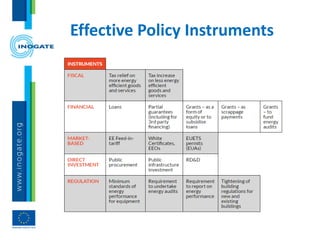
Effective Policy Instruments
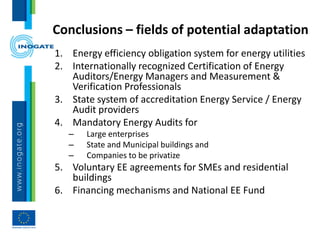
Conclusions – fields of potential adaptation
1. Energy efficiency obligation system for energy utilities
2. Internationally recognized Certification of Energy
Auditors/Energy Managers and Measurement &
Verification Professionals
3. State system of accreditation Energy Service / Energy
Audit providers
4. Mandatory Energy Audits for
– Large enterprises
– State and Municipal buildings and
– Companies to be privatize
5. Voluntary EE agreements for SMEs and residential
buildings
6. Financing mechanisms and National EE Fund
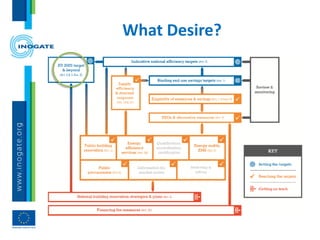
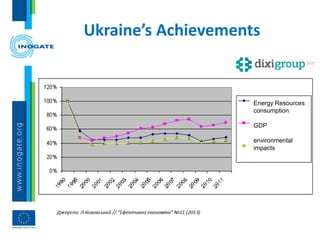
What Desire?
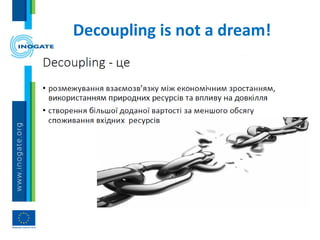
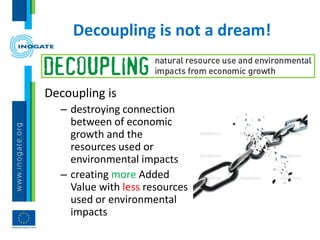
Decoupling is not a dream!
Decoupling is
– destroying connection
between of economic
growth and the
resources used or
environmental impacts
– creating more Added
Value with less resources
used or environmental
impacts
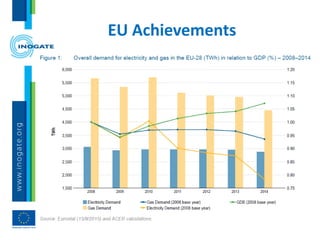
EU Achievements
Ukraine’s Achievements
Energy Resources
consumption
GDP
environmental
impacts
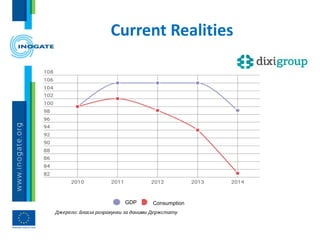
Current Realities
GDP Consumption
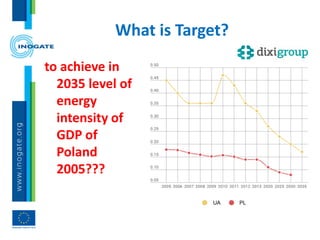
What is Target?
to achieve in
2035 level of
energy
intensity of
GDP of
Poland
2005???
UA PL
INOGATE Technical Secretariat
Oleksandr Ovdiienko, Local Expert
member of AEE Ukraine
lexovd@gmail.com
39

Current legislative framework on energy audits in Ukraine

  • 1.
    Current legislative frameworkon energy audits in Ukraine. Potential adaptation of the Concept of mandatory energy audits into Ukrainian legislation framework Oleksandr Ovdiienko, Kyiv, 22 March 2016 B U I L D I N G P A R T N E R S H I P S F O R E N E R G Y S E C U R I T Y www.inogate.org
  • 2.
    Development of Ukrainianlegislation in EE and EA fields Before joining EU Energy Community (2011) After signing Agreement between UA an EU (2014) Bilateral Agreement to implement the energy efficiency acquis till 2012
  • 3.
    Institutional Development ofUkrainian Authorities in EE field 1995 • Creation of the State Committee on Energy Conservation 1996 • Creation of the State Inspection on Energy Conservation 1999 • Creation of the Central Group of Energy Audit 2005 • Reorganisation of the State Committee on Energy Conservation into the National Agency of Ukraine for Efficient Energy Resources Management (NAER) 2011 • Reorganisation of the NAER into the State Agency of Ukraine on Energy Efficiency and Energy Saving of Ukraine (SAEE). • Liquidation of the State Inspection on Energy Conservation
  • 4.
    Development of mainUkrainian legislation in EA and EM fields • 1994 – the Law on Energy Conservation • 1997 – Temporary Regulations on the order of energy audit and attestation of specialized organizations for the right to conduct it • 1999 – Regulations on the order of organization of energy audits – Organisation and conducting of energy audit for budgetary institutions, organizations and state-owned enterprises – Organisation and holding of tenders for conducting energy audit of budgetary institutions, organizations and state-owned enterprises
  • 5.
    • 1999-2008 – Regulationsat the executive level, for example: • Decree of the Ukrainian State Railway Company (Ukrzaliznytsya) - Of carrying out energy audit • Decree of the Ministry of Fuel and Energy of Ukraine – “Energy Audit of Coal Enterprises” – State Standards: • DSTU 4472:2005 “Energy Saving. Energy Management Systems. General Requirements” • DSTU 4713:2007 “Energy Saving. Energy Audit of Industrial Enterprises. Order of carrying out and requirements for work organization” • DSTU 4715:2007 “Energy Saving. Energy Management Systems of Industrial Enterprises. Structure and content of work on the development and implementation stages” • DSTU 5077:2008 “Energy Saving. Energy Management Systems of Industrial Enterprises. Monitoring and Control of Effective Functioning” Development of main Ukrainian legislation in EA and EM fields
  • 6.
    Development of mainUkrainian legislation in EA and EM fields • 2007 and 2014 – Two Draft Law “On Energy Audit” • 2010 – General requirements for organization and conducting of energy audit, approved by Decree of NAER №56 dd 20.05.2010 • 2014 – DSTU ISO 50001:2014 “Energy Saving. Energy Management Systems. Requirements and guidelines for use” • 2015 – Cancellation of State Committee Orders On Procedure of Energy Audit and Attestation of Specialized Organisations … and liquidation of Central Group of Energy Audit by Order of the Ministry of Regional Development, Construction and Housing and Communal Services of Ukraine № 120 – 1st National Action Plan on energy efficiency for the period 2020 newest development
  • 7.
    Development of mainUkrainian legislation in EA and EM fields • 2015 – Adopted so-called «ESCO Law» and Sample ESCO Agreement – Adopted the Technical Regulation on Energy Labeling of Lamps and Luminaries, Household Dishwashers – Drafted the Technical Regulation on Energy Labeling of Air Conditioners , Household Tumble Driers , Energy Labeling of Vacuum Cleaners , Televisions – Drafted the Standards • DSTU ISO 50002 Energy audit. Requirements with guidelines for use; • DSTU ISO 50003 Energy management systems. Requirements for bodies providing audit and certification of energy management systems; • DSTU ISO 50004 Energy management systems. Guidelines for implementation, maintenance and improvement of an energy management system; • DSTU ISO 50006 Energy management systems. Measuring energy performance using energy baselines (EnB) and energy performance indicators (EnPI). General principles and guidelines; • DSTU ISO 50015 Energy management systems. Measurement and verification of energy performance of organizations. General principles and guidelines.
  • 8.
    Main points ofcurrent Ukrainian legislation in EA and EM fields • the Law on Energy Conservation of 1994 which is not compliant with the acquis, still applies in Ukraine – should be replaced by a modern law compliant with the Energy Efficiency Directive 2012/27/EU • Only State Standards and Executive Regulations left • There is NO system of state accreditation for energy service/energy audit companies and financial instruments of support for their activity • 1st National Action Plan on energy efficiency for the period 2020 was approved • SAEE creates working group on development of draft Law “On Energy Efficiency” according to requirements of EU legislation • Ministry of Regional Development and SAEE publish Draft of Concept of Energy Efficiency Fund
  • 9.
    Next steps Clear understandingand implementation of UA-EU Agreement Requirements •EE Directive 2012/27/EU Review •Best Practices of implementation Analyze •Local Legislation Frameworks Develop •New EE Law •Accreditation Scheme •Financial support Implement
  • 10.
    Clear understanding -what requires?
  • 11.
    Best Practises –Main Sources • EU Member States: – Transposed in Austria, Bulgaria, Czech Republic, Denmark, Finland, France, Germany, Ireland, Italy, Malta, Portugal, Romania, Slovenia, Slovakia, Spain, Sweden, The Netherlands, United Kingdom – Partly transposed in Belgium, Croatia • International: – EU and International Standards (ISO and EN). – EU Energy Efficiency Directive (2012/27/EU). Guidebook for Strong Implementation. The Coalition for Energy Savings – 2013 – Best Practices in Designing and Implementing Energy Efficiency Obligation Schemes. Research Report Task XXII of the International Energy Agency Demand Side Management Programme – 2012 – Energy efficiency obligations – the EU experience. European Council for an Energy Efficient Economy – 2012
  • 12.
    Clear understanding -what requires?
  • 13.
    Energy efficiency obligation(EEO) • EEO schemes use the force of law to require obligated parties to achieve energy savings through investments in end-use energy efficiency. They are typically enforced by regulation and by the threat of financial penalties. • Typically, obligations in EEO schemes are placed on providers of networked energy (e.g., electricity and natural gas distributors or standalone retail suppliers). • Obligations can also be placed on providers of other energy forms (e.g., LPG, heating oil, transport fuels, district heating), and even on end-users of energy. • In some jurisdictions, energy savings to meet the obligation are delivered by a third party “energy efficiency utility”.
  • 14.
    Energy efficiency obligation(EEO) For obligated energy providers in competitive energy markets, there are two possible cost recovery paths: • Option 1: the costs of meeting energy savings targets are treated as a cost of doing business and energy providers adjust their prices to recover these costs; or • Option 2: the costs of meeting energy savings targets are either funded by the government through direct budgetary appropriations, or price surcharges are imposed on regulated “wires and pipes” energy providers.
  • 15.
    The Lifecycle ofan Energy Savings Certificate
  • 16.
    Clear understanding -what requires?
  • 17.
    Certification and qualityassurance • Article 16 of the EED requires MSs to ensure the availability of certification, accreditation and/or qualification schemes for providers of energy audits and for energy managers and, if necessary, to establish suitable training programmes for them. • The criteria for determining the necessity of establishing such schemes and training programmes are left up to MSs to determine, based on a judgment of whether the existing national level of technical competence, objectivity, and reliability is considered sufficient or not. • Fulfilling the national certification, accreditation or qualification scheme also allows “in-house” experts or auditors to carry out energy audits of their own installations and buildings.
  • 18.
    How to buildup personnel certification body ISO/IEC 17024:2012 “Conformity assessment - General requirements for bodies operating certification of persons” – an advanced standard which is aimed on harmonizing of different procedures that are used globally for confirmation of competence of personnel in various professions – the standard provides a benchmark for collaboration of personnel certification programs acting on a consistent, comparable and reliable manner across the world which would allow professionals to demonstrate their competence irrespective of national borders
  • 19.
  • 20.
    Examples of StateAccreditation • United Kingdom – To become an ESOS lead assessor you need to be a member of an approved professional body register.
  • 21.
    Examples of StateAccreditation • Ireland – Sustainable Energy Authority of Ireland. Guidance Note for Registered Energy Auditors - Minimum Qualification Requirements For Registered Energy Auditors
  • 22.
    Providers of energyexperts certification in Ukraine Locally Recognized Internationally Recognized Association of Energy Engineers of Ukraine UNIDO Project Ukrainian Association of Quality Training Center of Energy Management of NTUU “KPI” Training certificates – Energy Management Certificates – Specialist on EM Systems Manager on EM Systems Auditor of EM Systems ISO 50000 Standard Series courses for the national auditing experts Certified Energy Manager Certified Energy Auditor Certified M&V Professional
  • 23.
    Clear understanding -what requires?
  • 24.
  • 25.
    Mandatory Energy Auditfor non-SMEs Transposition of EE Directive 2012/27/EU • Recital 24: Energy audits should take into account relevant European and International Standards, such as EN ISO 50001 (Energy Management Systems), or EN 16247-1 (Energy Audits) • Art. 8: Energy Audits and Energy Management Systems – Energy audit every 4 years, or: – Energy or environmental management system – Energy audits carried out by qualified and/or accredited experts – Encourage training programmes for energy auditors • Annex VI: transparent and non-discriminatory criteria for energy audits
  • 26.
    Recommendations for EnergyAudit System 1. Energy audits that meet the financial and economic criteria and demands set out in Article 8 and Annex VI of the EED, as well as investment-grade audits, are promoted. The latter, also based on life-cycle cost analysis, provide additional guidance for future investments and maintenance, whenever this is appropriate and proportionate. 2. Encourage State to provide clear and strong incentives for SMEs and households to undertake audits and implement the recommended measures. 3. Encourage State to raise the quality of audits used in building certification in the EPBD. 4. Encourage large enterprises to be early adopters of audits. 5. Ensure that energy audits and EMS account for peripheral use of energy. 6. Use benchmarks to determine best performance levels in industrial processes and peripheral applications.
  • 27.
    Clear understanding -what requires?
  • 28.
    Financing the measures Financingmechanisms and national EE Funds must help to develop the required investments
  • 29.
    Decisions on GovernmentalLevel 1. Set up dedicated Energy Efficiency Funds capable of blending various streams of financing and dedicated to backing high standard national energy efficiency investment programmes. 2. Use public financing institutions to drive energy efficiency investment. 3. Design effective policy instruments to ensure take-up of funds. 4. Consider how to structure offerings to leverage the maximum amount of private sector investment possible. 5. Develop a long-term plan for driving demand across all sectors of the economy that offers sufficient scale of opportunity to meet targets and confidence that the plan will match or exceed the expected period required for private capital invested to be repaid (traditionally 15 years or more).
  • 30.
  • 31.
    Conclusions – fieldsof potential adaptation 1. Energy efficiency obligation system for energy utilities 2. Internationally recognized Certification of Energy Auditors/Energy Managers and Measurement & Verification Professionals 3. State system of accreditation Energy Service / Energy Audit providers 4. Mandatory Energy Audits for – Large enterprises – State and Municipal buildings and – Companies to be privatize 5. Voluntary EE agreements for SMEs and residential buildings 6. Financing mechanisms and National EE Fund
  • 32.
  • 33.
  • 34.
    Decoupling is nota dream! Decoupling is – destroying connection between of economic growth and the resources used or environmental impacts – creating more Added Value with less resources used or environmental impacts
  • 35.
  • 36.
  • 37.
  • 38.
    What is Target? toachieve in 2035 level of energy intensity of GDP of Poland 2005??? UA PL
  • 39.
    INOGATE Technical Secretariat OleksandrOvdiienko, Local Expert member of AEE Ukraine lexovd@gmail.com 39