Say goodbye to the Fries: Education
and the shape of the creative
economy
Stuart Cunningham
Addressing two big debates
• The fries story...
• The arts and humanities don't deliver adequate employment
prospects for students
• But when they do, the nature of the work in the so-called creative
economy doesn't live up to its shiny, romantic image
• From the right comes the attack that education (unis, maybe
schools?) and training are oversupplying arts and humanities
graduates into the workforce
• And the left wants to prick the bubble of inflated claims about the
nature of work in the creative economy
• Addressing both debates with research from the bottom up and from
the top down, showcasing two different methodologies....
The broad context for the first debate
•The broadest level: benefits of education to society
•Endogenous growth theory - Romer
•Education is an investment in human capital - Freebairn
•Blair: the three highest priorities of government are ‘education,
education, education’
•At this level of abstraction, the argument for the humanities and
social sciences is similar to that for physical and biological
sciences
Key differentiators
•compulsory vs further and higher education
•public and private good
•enduring demand for disciplines which have relatively less
efficient translation into productivity, high income and thereby
enhanced tax returns (private good), but also a less clearly
articulated contribution to the public good (science, engineering
and maths are seen as platform knowledges in danger of
enduring market failure) – may have contributed to the dramatic
decisions in the fiscally-challenged UK to withdraw public subsidy
from much of arts and humanities
The task
•to articulate the public good of the arts and humanities while also
painting a more complete, accurate picture of the capturing of
private good by studying much more closely the career outcomes
of arts and humanities graduates. It may be that a much deeper
empirics of career outcome, together with a much more
sophisticated account of public good, may contribute to
understanding distinctive ways in which arts and humanities’
private good also contributes to the public good
Graduate Destinations in
Cultural and Communication Studies
•almost no longer-term career tracking research of graduate
outcomes in Australia
•Graduate Destination Survey
•The Go8 PhD study
•Centre of Excellence: measuring the ‘creative workforce’
•QUT Media, Communication and Cultural Studies Graduate
Career Outcomes
Research questions
1. What are the early career destinations and paths of
graduates from cultural and communication studies courses? Is
there evidence for portfolio career arrangements, embeddedness,
early career churn and mobility, underemployment,
underemployment at a graduate level, etc?
2. What ‘special value’ do cultural and communication
studies graduates seem to add by virtue of their educational
backgrounds?
3. To what degree is there evidence of congruence
between skills developed during the course and skills required at
work?
4. What are the career aspirations of early career
graduates from cultural and communication studies courses?
5. What additional education/professional training do early
career graduates undertake, and how does this contribute to their
career paths?
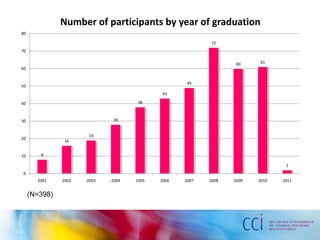
8
16
19
28
38
43
49
72
60 61
2
0
10
20
30
40
50
60
70
80
2001 2002 2003 2004 2005 2006 2007 2008 2009 2010 2011
Number of participants by year of graduation
(N=398)
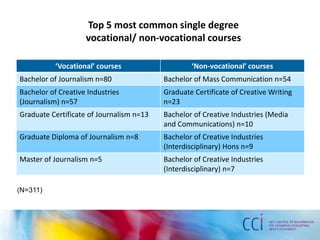
(N=311)
‘Vocational’ courses ‘Non-vocational’ courses
Bachelor of Journalism n=80 Bachelor of Mass Communication n=54
Bachelor of Creative Industries
(Journalism) n=57
Graduate Certificate of Creative Writing
n=23
Graduate Certificate of Journalism n=13 Bachelor of Creative Industries (Media
and Communications) n=10
Graduate Diploma of Journalism n=8 Bachelor of Creative Industries
(Interdisciplinary) Hons n=9
Master of Journalism n=5 Bachelor of Creative Industries
(Interdisciplinary) n=7
Top 5 most common single degree
vocational/ non-vocational courses
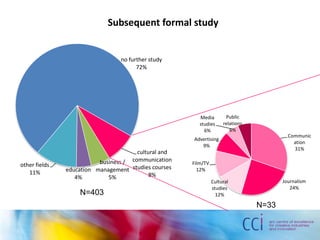
no further study
72%
cultural and
communication
studies courses
8%
business /
management
5%
education
4%
other fields
11%
Communic
ation
31%
Journalism
24%
Cultural
studies
12%
Film/TV
12%
Advertising
9%
Media
studies
6%
Public
relations
6%
N=403
N=33
Subsequent formal study
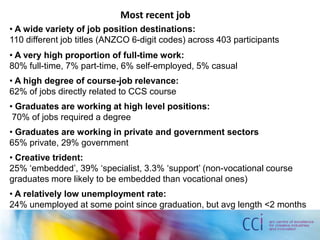
Most recent job
• A wide variety of job position destinations:
110 different job titles (ANZCO 6-digit codes) across 403 participants
• A very high proportion of full-time work:
80% full-time, 7% part-time, 6% self-employed, 5% casual
• A high degree of course-job relevance:
62% of jobs directly related to CCS course
• Graduates are working at high level positions:
70% of jobs required a degree
• Graduates are working in private and government sectors
65% private, 29% government
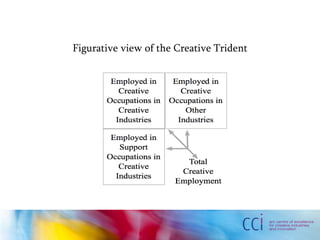
• Creative trident:
25% ‘embedded’, 39% ‘specialist, 3.3% ‘support’ (non-vocational course
graduates more likely to be embedded than vocational ones)
• A relatively low unemployment rate:
24% unemployed at some point since graduation, but avg length <2 months
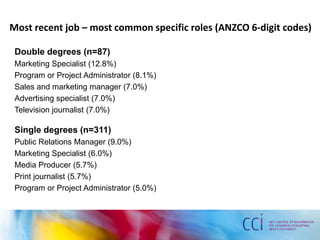
Most recent job – most common specific roles (ANZCO 6-digit codes)
Double degrees (n=87)
Marketing Specialist (12.8%)
Program or Project Administrator (8.1%)
Sales and marketing manager (7.0%)
Advertising specialist (7.0%)
Television journalist (7.0%)
Single degrees (n=311)
Public Relations Manager (9.0%)
Marketing Specialist (6.0%)
Media Producer (5.7%)
Print journalist (5.7%)
Program or Project Administrator (5.0%)
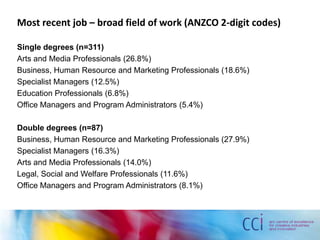
Most recent job – broad field of work (ANZCO 2-digit codes)
Single degrees (n=311)
Arts and Media Professionals (26.8%)
Business, Human Resource and Marketing Professionals (18.6%)
Specialist Managers (12.5%)
Education Professionals (6.8%)
Office Managers and Program Administrators (5.4%)
Double degrees (n=87)
Business, Human Resource and Marketing Professionals (27.9%)
Specialist Managers (16.3%)
Arts and Media Professionals (14.0%)
Legal, Social and Welfare Professionals (11.6%)
Office Managers and Program Administrators (8.1%)
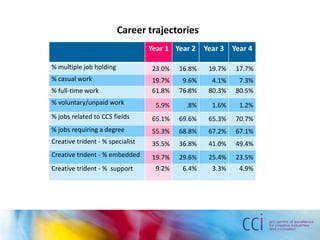
Career trajectories
Year 1 Year 2 Year 3 Year 4
% multiple job holding 23.0% 16.8% 19.7% 17.7%
% casual work 19.7% 9.6% 4.1% 7.3%
% full-time work 61.8% 76.8% 80.3% 80.5%
% voluntary/unpaid work 5.9% .8% 1.6% 1.2%
% jobs related to CCS fields 65.1% 69.6% 65.3% 70.7%
% jobs requiring a degree 55.3% 68.8% 67.2% 67.1%
Creative trident - % specialist 35.5% 36.8% 41.0% 49.4%
Creative trident - % embedded 19.7% 29.6% 25.4% 23.5%
Creative trident - % support 9.2% 6.4% 3.3% 4.9%
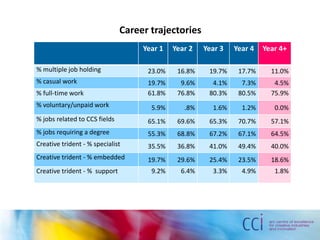
Career trajectories
Year 1 Year 2 Year 3 Year 4 Year 4+
% multiple job holding 23.0% 16.8% 19.7% 17.7% 11.0%
% casual work 19.7% 9.6% 4.1% 7.3% 4.5%
% full-time work 61.8% 76.8% 80.3% 80.5% 75.9%
% voluntary/unpaid work 5.9% .8% 1.6% 1.2% 0.0%
% jobs related to CCS fields 65.1% 69.6% 65.3% 70.7% 57.1%
% jobs requiring a degree 55.3% 68.8% 67.2% 67.1% 64.5%
Creative trident - % specialist 35.5% 36.8% 41.0% 49.4% 40.0%
Creative trident - % embedded 19.7% 29.6% 25.4% 23.5% 18.6%
Creative trident - % support 9.2% 6.4% 3.3% 4.9% 1.8%
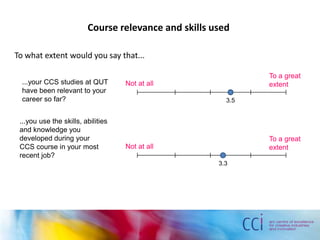
To what extent would you say that...
Course relevance and skills used
...your CCS studies at QUT
have been relevant to your
career so far?
...you use the skills, abilities
and knowledge you
developed during your
CCS course in your most
recent job?
Not at all
To a great
extent
Not at all
To a great
extent
3.5
3.3
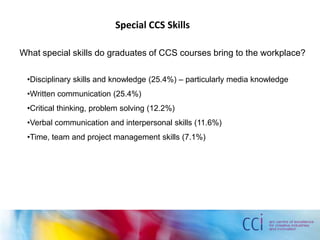
Special CCS Skills
•Disciplinary skills and knowledge (25.4%) – particularly media knowledge
•Written communication (25.4%)
•Critical thinking, problem solving (12.2%)
•Verbal communication and interpersonal skills (11.6%)
•Time, team and project management skills (7.1%)
What special skills do graduates of CCS courses bring to the workplace?
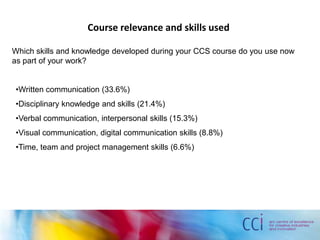
Course relevance and skills used
Which skills and knowledge developed during your CCS course do you use now
as part of your work?
•Written communication (33.6%)
•Disciplinary knowledge and skills (21.4%)
•Verbal communication, interpersonal skills (15.3%)
•Visual communication, digital communication skills (8.8%)
•Time, team and project management skills (6.6%)
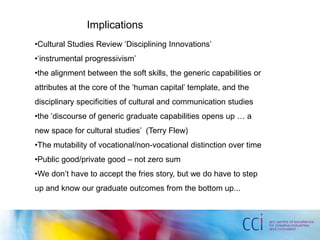
Implications
•Cultural Studies Review ‘Disciplining Innovations’
•‘instrumental progressivism’
•the alignment between the soft skills, the generic capabilities or
attributes at the core of the ‘human capital’ template, and the
disciplinary specificities of cultural and communication studies
•the ‘discourse of generic graduate capabilities opens up … a
new space for cultural studies’ (Terry Flew)
•The mutability of vocational/non-vocational distinction over time
•Public good/private good – not zero sum
•We don’t have to accept the fries story, but we do have to step
up and know our graduate outcomes from the bottom up...
The broad context for the second debate
•Creative labour and its discontents: pricking the bubble of the
‘creative class’ (Florida, Leadbeater, Howkins, and us!)
•Research from the top down and a different methodology – what
can Census data tell us about the creative economy?
Figurative view of the Creative Trident
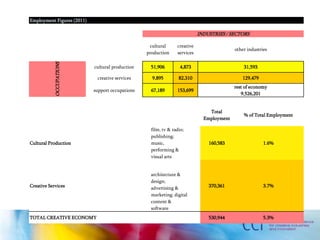
Employment Figures (2011)
INDUSTRIES / SECTORS
cultural
production
creative
services
other industries
OCCUPATIONS
cultural production 51,906 4,873 31,593
creative services 9,895 82,310 129,479
support occupations 67,189 153,699
rest of economy
9,526,201
Total
Employment
% of Total Employment
Cultural Production
film, tv & radio;
publishing;
music,
performing &
visual arts
160,583 1.6%
Creative Services
architecture &
design;
advertising &
marketing; digital
content &
software
370,361 3.7%
TOTAL CREATIVE ECONOMY 530,944 5.3%
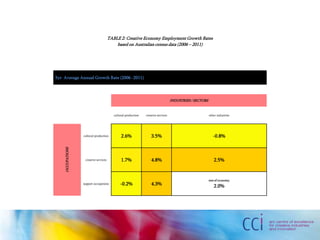
TABLE 2: Creative Economy Employment Growth Rates
based on Australian census data (2006 – 2011)
5yr Average Annual Growth Rate (2006 -2011)
INDUSTRIES / SECTORS
cultural production creative services other industries
OCCUPATIONS
cultural production 2.6% 3.5% -0.8%
creative services 1.7% 4.8% 2.5%
support occupations -0.2% 4.3%
rest of economy
2.0%
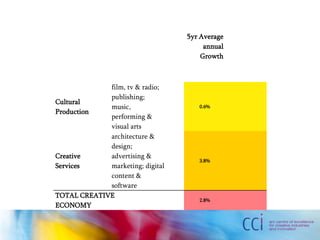
5yr Average
annual
Growth
Cultural
Production
film, tv & radio;
publishing;
music,
performing &
visual arts
0.6%
Creative
Services
architecture &
design;
advertising &
marketing; digital
content &
software
3.8%
TOTAL CREATIVE
ECONOMY
2.8%
Implications
•The creative economy is real, growing at faster rates than the
economy as a whole
•The creative economy exhibits ‘precariousness’ but also quite
different characteristics
•Our approach to the creative economy poses a challenge to
educators and trainers to align learning experiences
/teaching/curriculum to the new knowledge about creative
services and embedded creatives (wider view of creative
labour), to growth in creative-digital industries, and to risk
mitigation over the life cycle and in portfolio careers.

Say goodbye to the fries: Higher education and the creative economy - D Prof. Stuart Cunningham

  • 1.
    Say goodbye tothe Fries: Education and the shape of the creative economy Stuart Cunningham
  • 2.
    Addressing two bigdebates • The fries story... • The arts and humanities don't deliver adequate employment prospects for students • But when they do, the nature of the work in the so-called creative economy doesn't live up to its shiny, romantic image • From the right comes the attack that education (unis, maybe schools?) and training are oversupplying arts and humanities graduates into the workforce • And the left wants to prick the bubble of inflated claims about the nature of work in the creative economy • Addressing both debates with research from the bottom up and from the top down, showcasing two different methodologies....
  • 3.
    The broad contextfor the first debate •The broadest level: benefits of education to society •Endogenous growth theory - Romer •Education is an investment in human capital - Freebairn •Blair: the three highest priorities of government are ‘education, education, education’ •At this level of abstraction, the argument for the humanities and social sciences is similar to that for physical and biological sciences
  • 4.
    Key differentiators •compulsory vsfurther and higher education •public and private good •enduring demand for disciplines which have relatively less efficient translation into productivity, high income and thereby enhanced tax returns (private good), but also a less clearly articulated contribution to the public good (science, engineering and maths are seen as platform knowledges in danger of enduring market failure) – may have contributed to the dramatic decisions in the fiscally-challenged UK to withdraw public subsidy from much of arts and humanities
  • 5.
    The task •to articulatethe public good of the arts and humanities while also painting a more complete, accurate picture of the capturing of private good by studying much more closely the career outcomes of arts and humanities graduates. It may be that a much deeper empirics of career outcome, together with a much more sophisticated account of public good, may contribute to understanding distinctive ways in which arts and humanities’ private good also contributes to the public good
  • 6.
    Graduate Destinations in Culturaland Communication Studies •almost no longer-term career tracking research of graduate outcomes in Australia •Graduate Destination Survey •The Go8 PhD study •Centre of Excellence: measuring the ‘creative workforce’ •QUT Media, Communication and Cultural Studies Graduate Career Outcomes
  • 7.
    Research questions 1. Whatare the early career destinations and paths of graduates from cultural and communication studies courses? Is there evidence for portfolio career arrangements, embeddedness, early career churn and mobility, underemployment, underemployment at a graduate level, etc? 2. What ‘special value’ do cultural and communication studies graduates seem to add by virtue of their educational backgrounds? 3. To what degree is there evidence of congruence between skills developed during the course and skills required at work? 4. What are the career aspirations of early career graduates from cultural and communication studies courses? 5. What additional education/professional training do early career graduates undertake, and how does this contribute to their career paths?
  • 8.
    8 16 19 28 38 43 49 72 60 61 2 0 10 20 30 40 50 60 70 80 2001 20022003 2004 2005 2006 2007 2008 2009 2010 2011 Number of participants by year of graduation (N=398)
  • 9.
    (N=311) ‘Vocational’ courses ‘Non-vocational’courses Bachelor of Journalism n=80 Bachelor of Mass Communication n=54 Bachelor of Creative Industries (Journalism) n=57 Graduate Certificate of Creative Writing n=23 Graduate Certificate of Journalism n=13 Bachelor of Creative Industries (Media and Communications) n=10 Graduate Diploma of Journalism n=8 Bachelor of Creative Industries (Interdisciplinary) Hons n=9 Master of Journalism n=5 Bachelor of Creative Industries (Interdisciplinary) n=7 Top 5 most common single degree vocational/ non-vocational courses
  • 10.
    no further study 72% culturaland communication studies courses 8% business / management 5% education 4% other fields 11% Communic ation 31% Journalism 24% Cultural studies 12% Film/TV 12% Advertising 9% Media studies 6% Public relations 6% N=403 N=33 Subsequent formal study
  • 11.
    Most recent job •A wide variety of job position destinations: 110 different job titles (ANZCO 6-digit codes) across 403 participants • A very high proportion of full-time work: 80% full-time, 7% part-time, 6% self-employed, 5% casual • A high degree of course-job relevance: 62% of jobs directly related to CCS course • Graduates are working at high level positions: 70% of jobs required a degree • Graduates are working in private and government sectors 65% private, 29% government • Creative trident: 25% ‘embedded’, 39% ‘specialist, 3.3% ‘support’ (non-vocational course graduates more likely to be embedded than vocational ones) • A relatively low unemployment rate: 24% unemployed at some point since graduation, but avg length <2 months
  • 12.
    Most recent job– most common specific roles (ANZCO 6-digit codes) Double degrees (n=87) Marketing Specialist (12.8%) Program or Project Administrator (8.1%) Sales and marketing manager (7.0%) Advertising specialist (7.0%) Television journalist (7.0%) Single degrees (n=311) Public Relations Manager (9.0%) Marketing Specialist (6.0%) Media Producer (5.7%) Print journalist (5.7%) Program or Project Administrator (5.0%)
  • 13.
    Most recent job– broad field of work (ANZCO 2-digit codes) Single degrees (n=311) Arts and Media Professionals (26.8%) Business, Human Resource and Marketing Professionals (18.6%) Specialist Managers (12.5%) Education Professionals (6.8%) Office Managers and Program Administrators (5.4%) Double degrees (n=87) Business, Human Resource and Marketing Professionals (27.9%) Specialist Managers (16.3%) Arts and Media Professionals (14.0%) Legal, Social and Welfare Professionals (11.6%) Office Managers and Program Administrators (8.1%)
  • 14.
    Career trajectories Year 1Year 2 Year 3 Year 4 % multiple job holding 23.0% 16.8% 19.7% 17.7% % casual work 19.7% 9.6% 4.1% 7.3% % full-time work 61.8% 76.8% 80.3% 80.5% % voluntary/unpaid work 5.9% .8% 1.6% 1.2% % jobs related to CCS fields 65.1% 69.6% 65.3% 70.7% % jobs requiring a degree 55.3% 68.8% 67.2% 67.1% Creative trident - % specialist 35.5% 36.8% 41.0% 49.4% Creative trident - % embedded 19.7% 29.6% 25.4% 23.5% Creative trident - % support 9.2% 6.4% 3.3% 4.9%
  • 15.
    Career trajectories Year 1Year 2 Year 3 Year 4 Year 4+ % multiple job holding 23.0% 16.8% 19.7% 17.7% 11.0% % casual work 19.7% 9.6% 4.1% 7.3% 4.5% % full-time work 61.8% 76.8% 80.3% 80.5% 75.9% % voluntary/unpaid work 5.9% .8% 1.6% 1.2% 0.0% % jobs related to CCS fields 65.1% 69.6% 65.3% 70.7% 57.1% % jobs requiring a degree 55.3% 68.8% 67.2% 67.1% 64.5% Creative trident - % specialist 35.5% 36.8% 41.0% 49.4% 40.0% Creative trident - % embedded 19.7% 29.6% 25.4% 23.5% 18.6% Creative trident - % support 9.2% 6.4% 3.3% 4.9% 1.8%
  • 16.
    To what extentwould you say that... Course relevance and skills used ...your CCS studies at QUT have been relevant to your career so far? ...you use the skills, abilities and knowledge you developed during your CCS course in your most recent job? Not at all To a great extent Not at all To a great extent 3.5 3.3
  • 17.
    Special CCS Skills •Disciplinaryskills and knowledge (25.4%) – particularly media knowledge •Written communication (25.4%) •Critical thinking, problem solving (12.2%) •Verbal communication and interpersonal skills (11.6%) •Time, team and project management skills (7.1%) What special skills do graduates of CCS courses bring to the workplace?
  • 18.
    Course relevance andskills used Which skills and knowledge developed during your CCS course do you use now as part of your work? •Written communication (33.6%) •Disciplinary knowledge and skills (21.4%) •Verbal communication, interpersonal skills (15.3%) •Visual communication, digital communication skills (8.8%) •Time, team and project management skills (6.6%)
  • 19.
    Implications •Cultural Studies Review‘Disciplining Innovations’ •‘instrumental progressivism’ •the alignment between the soft skills, the generic capabilities or attributes at the core of the ‘human capital’ template, and the disciplinary specificities of cultural and communication studies •the ‘discourse of generic graduate capabilities opens up … a new space for cultural studies’ (Terry Flew) •The mutability of vocational/non-vocational distinction over time •Public good/private good – not zero sum •We don’t have to accept the fries story, but we do have to step up and know our graduate outcomes from the bottom up...
  • 20.
    The broad contextfor the second debate •Creative labour and its discontents: pricking the bubble of the ‘creative class’ (Florida, Leadbeater, Howkins, and us!) •Research from the top down and a different methodology – what can Census data tell us about the creative economy?
  • 21.
    Figurative view ofthe Creative Trident
  • 22.
    Employment Figures (2011) INDUSTRIES/ SECTORS cultural production creative services other industries OCCUPATIONS cultural production 51,906 4,873 31,593 creative services 9,895 82,310 129,479 support occupations 67,189 153,699 rest of economy 9,526,201 Total Employment % of Total Employment Cultural Production film, tv & radio; publishing; music, performing & visual arts 160,583 1.6% Creative Services architecture & design; advertising & marketing; digital content & software 370,361 3.7% TOTAL CREATIVE ECONOMY 530,944 5.3%
  • 23.
    TABLE 2: CreativeEconomy Employment Growth Rates based on Australian census data (2006 – 2011) 5yr Average Annual Growth Rate (2006 -2011) INDUSTRIES / SECTORS cultural production creative services other industries OCCUPATIONS cultural production 2.6% 3.5% -0.8% creative services 1.7% 4.8% 2.5% support occupations -0.2% 4.3% rest of economy 2.0%
  • 24.
    5yr Average annual Growth Cultural Production film, tv& radio; publishing; music, performing & visual arts 0.6% Creative Services architecture & design; advertising & marketing; digital content & software 3.8% TOTAL CREATIVE ECONOMY 2.8%
  • 25.
    Implications •The creative economyis real, growing at faster rates than the economy as a whole •The creative economy exhibits ‘precariousness’ but also quite different characteristics •Our approach to the creative economy poses a challenge to educators and trainers to align learning experiences /teaching/curriculum to the new knowledge about creative services and embedded creatives (wider view of creative labour), to growth in creative-digital industries, and to risk mitigation over the life cycle and in portfolio careers.