“The purpose of anthropology is to make the
world safe for human differences.”
Ruth Benedict, Ph.D.
Culture
Anthropology
• Anthropology: the holistic study of
humanity.
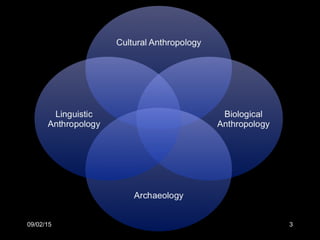
• In the US, Anthropology is broken up
into four main sub-fields.
09/02/15 2
09/02/15 3
Cultural Anthropology
• Cultural Anthropology represents the
study of human cultural variation.
• This leads to the question, what exactly
is culture?
Culture: one definition
• Culture is a collection of learned ideas
and behaviors shared by a particular
group of people.
Characteristics of Culture
• All people are cultured.
Characteristics of Culture
• Culture is learned.
Characteristics of Culture
• Culture is shared.
Characteristics of Culture
• Culture incorporates ideas (beliefs,
attitudes, values…etc.).
Characteristics of Culture
• Culture incorporates behaviors
(economic activities, cooking,
celebrations, rituals…etc.).
Culture:
• Culture changes and adapts.
Characteristics of Culture
• Culture is symbolic.
• A symbol is anything that represents an
idea, a sound, an activity…etc. Symbols
communicate meaning.
Symbolic Culture
“ Man is an animal suspended in webs of
significance he himself has spun.”
Max Weber
Characteristics of Culture
• Culture is integrated.
• Part of the holistic perspective of
anthropology is the attempt to see the
various parts of culture connect to each
other.
Culture and Biology
• If we didn’t have large, developed
brains we would not have complex
culture…
• Yet, our culture is learned and not
encoded in our genes.
Culture and Biology
• The relationship between culture and
biology is complex: culture shapes how
we satisfy biological needs.
• How we satisfy sexual urges, hunger
and need for shelter are shaped by
culture.
Enculturation
• Enculturation: the process by which we
internalize the values and behaviors of
our culture.
• Enculturation is a process that begins
immediately after birth and well into
adulthood.
Ethnocentrism
• Ethnocentrism: the belief in the
superiority of one’s own culture…and
the tendency to judge other societies by
YOUR culture’s standards.
Bias
• Bias: “a particular tendency or
inclination, especially one that prevents
unprejudiced consideration of a
question; prejudice”.
Naturalization and
Normalization
• Naturalization: the process by which
something takes on an aura or feeling
of “naturalness.”
• Normalization: the process by which
something takes on the aura or feeling
of “normality.”
Cultural Relativism
 Cultural Relativism involves judging
other societies by that societies
standards rather than one’s own.
 Anthropologists, by and large, attempt
to be culturally relativistic in their
studies of other societies.
Cultural Relativism
• The degree to which we can be truly
culturally relativistic is heavily debated.
• It is very common for contemporary
ethnographers to discuss their own
backgrounds and biases.
Etic and Emic
• Etic: From the perspective of the
outsider or observer.
• Emic: from the perspective of the
“native”.
Culture Shock
• Culture shock refers to the anxiety and
disorientation caused by operating in a
foreign culture where you don’t
understand “the rules.”
• Culture shock is experienced, to a
greater or lesser extent, by all
immigrants, migrant workers and
anthropologists.
Anthropology vs. Sociology
• Cultural Anthropology and Sociology
both study human social groups and
examine human ideas and behaviors.
• However, these fields have different
origins and different methods.
Anthropology and Sociology
• Anthropology is the child of colonialism:
it has its origins in Europeans studying
non-Western, indigenous cultures.
• Anthropology has a reputation for
studying so-called “primitive” and
“exotic” people.
Sociology
• Sociology is the child of the Industrial.
Revolution: it has historically focused on
large scale, Western, urban societies.
• Sociology’s methods tend to focus on
survey research, reflecting their study of
large, literate societies
Doing Anthropology
• Anthropologist typically live and interact
with the people they study. This is what
is meant by fieldwork.
Fieldwork
• Participant-observation = observing a
group of people while participating in
their day-to-day lives.
Ethnography
• An ethnography is a piece of literature
describing a particular culture or group
of people.
Sociology and Anthropology
Redux
• Currently, the differences between
cultural anthropology and sociology are
becoming increasingly small.
• Plenty of anthropologists study large,
urbanized cultures. And many
sociologists are engaged in participant-
observation based research.
Agency
• Agency refers to the capacity of
individuals to act independently and to
make their own free choices
• Our cultural context, gender, class and
ethnic background all shape the
choices we make and the values we
hold.
The Individual in Society
• As individuals, we make choices on
everything from what we wear, to the
foods we eat, to the way we greet
others…
• Most of us don’t consider how much
symbolic value lies in these choices.

Culture

  • 1.
    “The purpose ofanthropology is to make the world safe for human differences.” Ruth Benedict, Ph.D. Culture
  • 2.
    Anthropology • Anthropology: theholistic study of humanity. • In the US, Anthropology is broken up into four main sub-fields. 09/02/15 2
  • 3.
  • 4.
    Cultural Anthropology • CulturalAnthropology represents the study of human cultural variation. • This leads to the question, what exactly is culture?
  • 5.
    Culture: one definition •Culture is a collection of learned ideas and behaviors shared by a particular group of people.
  • 6.
    Characteristics of Culture •All people are cultured.
  • 7.
    Characteristics of Culture •Culture is learned.
  • 8.
  • 9.
    Characteristics of Culture •Culture incorporates ideas (beliefs, attitudes, values…etc.).
  • 10.
    Characteristics of Culture •Culture incorporates behaviors (economic activities, cooking, celebrations, rituals…etc.).
  • 11.
  • 12.
    Characteristics of Culture •Culture is symbolic. • A symbol is anything that represents an idea, a sound, an activity…etc. Symbols communicate meaning.
  • 13.
    Symbolic Culture “ Manis an animal suspended in webs of significance he himself has spun.” Max Weber
  • 14.
    Characteristics of Culture •Culture is integrated. • Part of the holistic perspective of anthropology is the attempt to see the various parts of culture connect to each other.
  • 15.
    Culture and Biology •If we didn’t have large, developed brains we would not have complex culture… • Yet, our culture is learned and not encoded in our genes.
  • 16.
    Culture and Biology •The relationship between culture and biology is complex: culture shapes how we satisfy biological needs. • How we satisfy sexual urges, hunger and need for shelter are shaped by culture.
  • 17.
    Enculturation • Enculturation: theprocess by which we internalize the values and behaviors of our culture. • Enculturation is a process that begins immediately after birth and well into adulthood.
  • 18.
    Ethnocentrism • Ethnocentrism: thebelief in the superiority of one’s own culture…and the tendency to judge other societies by YOUR culture’s standards.
  • 19.
    Bias • Bias: “aparticular tendency or inclination, especially one that prevents unprejudiced consideration of a question; prejudice”.
  • 20.
    Naturalization and Normalization • Naturalization:the process by which something takes on an aura or feeling of “naturalness.” • Normalization: the process by which something takes on the aura or feeling of “normality.”
  • 21.
    Cultural Relativism  CulturalRelativism involves judging other societies by that societies standards rather than one’s own.  Anthropologists, by and large, attempt to be culturally relativistic in their studies of other societies.
  • 22.
    Cultural Relativism • Thedegree to which we can be truly culturally relativistic is heavily debated. • It is very common for contemporary ethnographers to discuss their own backgrounds and biases.
  • 23.
    Etic and Emic •Etic: From the perspective of the outsider or observer. • Emic: from the perspective of the “native”.
  • 24.
    Culture Shock • Cultureshock refers to the anxiety and disorientation caused by operating in a foreign culture where you don’t understand “the rules.” • Culture shock is experienced, to a greater or lesser extent, by all immigrants, migrant workers and anthropologists.
  • 25.
    Anthropology vs. Sociology •Cultural Anthropology and Sociology both study human social groups and examine human ideas and behaviors. • However, these fields have different origins and different methods.
  • 26.
    Anthropology and Sociology •Anthropology is the child of colonialism: it has its origins in Europeans studying non-Western, indigenous cultures. • Anthropology has a reputation for studying so-called “primitive” and “exotic” people.
  • 27.
    Sociology • Sociology isthe child of the Industrial. Revolution: it has historically focused on large scale, Western, urban societies. • Sociology’s methods tend to focus on survey research, reflecting their study of large, literate societies
  • 28.
    Doing Anthropology • Anthropologisttypically live and interact with the people they study. This is what is meant by fieldwork.
  • 29.
    Fieldwork • Participant-observation =observing a group of people while participating in their day-to-day lives.
  • 30.
    Ethnography • An ethnographyis a piece of literature describing a particular culture or group of people.
  • 31.
    Sociology and Anthropology Redux •Currently, the differences between cultural anthropology and sociology are becoming increasingly small. • Plenty of anthropologists study large, urbanized cultures. And many sociologists are engaged in participant- observation based research.
  • 32.
    Agency • Agency refersto the capacity of individuals to act independently and to make their own free choices • Our cultural context, gender, class and ethnic background all shape the choices we make and the values we hold.
  • 33.
    The Individual inSociety • As individuals, we make choices on everything from what we wear, to the foods we eat, to the way we greet others… • Most of us don’t consider how much symbolic value lies in these choices.

Editor's Notes

  • #6 Anthropologists disagree amongst themselves about what exactly culture is: some focus on symbols, other adaptive strategies to the environment. Most anthropologists agree on a few things, though.
  • #7 All humans are cultured beings.
  • #9 National boundaries, borders, ethnic groups, businesses, sub-cultures…etc.
  • #10 Religious beliefs, beliefs about the nature/origin of disease. Political values. Valuing independence, money…etc.
  • #13 Language is symbolic. Hand-shaking. Religious, political symbols. Etc.
  • #30 Anthropologist as professional stranger
  • #31 Ethnographic Writing Who is the ethnography about? What is being described? Where is this taking place? What questions do you have for the author?