Proposal: ​The Studio Arts High School of New York
Cultural Equity Final
Professor Marta M. Vega
Camonghne Felix
December 5th, 2015
I grew up in the Bronx, the poorest congressional district in the country, a district known best for                                   
its creation of Hip Hop, political corruption and mismanagement. After transferring to three different                           
schools, I finally graduated from Bronx Community High School in 2010 with a 1.2 GPA. Of the fifteen                                   
other students I graduated with, only five of them have chosen to pursue college degrees. This is not from                                     
lack of desire or ambition or cognitive ability but a failed public educational system and a lack of options.                                     
We were a diverse group of students, but there were some basic things that made us alike: We were young                                       
people who had experienced significant childhood trauma, had learning and behavioral disorders, and                         
were chronically depressed and convinced of our intellectual inferiority. We wanted to learn, but had no                               
clue where, or how, to begin.  
At sixteen, I discovered Urban Word NYC. Urban Word NYC is a non­profit organization                           
dedicated to the development of young writers through various forms of poetry, prose, and musicianship​.                             
It serves young people between th ages of 12 and 21, and most facilitators are practicing artists of prestige                                     
who dedicate valuable afternoon hours to young people like myself ­­ frustrated, thrown away by public                               
schools, and artistically inclined. Through my experiences with this organization, I fell in love with                             
creative and expository writing, developed a concentrated practice that would eventually make me one of                             
the youngest published poets in my city, and gained a community of young artists, scholars, and                               
incredibly successful mentors who helped me cultivate the political, academic, and artistic talents I didn’t                             
know I had. My exposure to the arts as a young woman allowed me to begin an investigation into the                                       
systemic and sociological limitations that led me and so many other students like me, to believe that we                                   
were ‘unable.’Arts Education has made me feel fully equipped when entering any academic space. Arts                             
education helped me learn how to discipline myself, and how to let my work speak for me. It made me                                       
able to exceed my own expectations while dealing with the pressure of being the only black and youngest                                   
person in my MFA program. Arts education has led me to activism and given me agency to take on the                                       
big issues, locally and globally. It has made me aware of what I bring to any table, and dully aware of                                         
what I’ve yet to gain. 
In the years following that transformation, the word “exception” has been a point of contention                             
and frustration for me. When people refer to me as an exception, they insinuate that people who share                                   
similar backgrounds would not be able to achieve my level of success. It insinuates that I am more special                                     
than my counterpart. This notion of exceptionalism is disruptive, and erases the many ways that race and                                 
class are socially constructed and, therefore, destructible. I believe that disrupting that notion lies in                             
transforming the way we educate young people who come from urban communities. The educational                           
opportunities we provide must respond to and engage with the contexts and truths that young people bring                                 
into the classroom with them when they enter. In this proposal, I intend to present a new educational                                   
framework: New York City’s Premiere Studio Arts High School. 
The Problem 
In 2012, 90% of the Bronx’s High School students were deemed unfit for college­level work. In                               
2010, 76% of all New York City High School Students were deemed unfit for college­level work. On a                                   
national scale, this means that New York City students underperform when compared to students in other                               
states. When our students go to college, they have a hard time competing with their peers. This leads to                                     
higher dropout levels and a culture of catchup.  
Why is it that NYC students underperform? There are a few factors that hold relevance. New                               
York City is an Urban City, which means that the experiences young people have here differ greatly from                                   
the comfort of rural settings.  
“Where detailed urban data are available, they reveal wide disparities in                     
children’s rates of survival, nutritional status and education resulting from unequal access                       
to services. Where detailed urban data are available, they reveal disparities in children’s                         
rates of survival, nutritional status and education resulting from unequal access to                       
services. All over the world, hundreds of millions of children in impoverished urban                         
neighbourhoods and informal settlements confront daily violations of their rights despite                     
living close to institutions and services. In many countries, children living in urban                         
poverty fare as badly as, or worse than, children living in rural poverty when it comes to                                 
undernutrition and underfive mortality. ” (Unicef, 2012) 
As of 2015, 22% of New York City’s children were living under the poverty line. In a report                                   
released by the Southern Education Foundation, researchers found that 51 percent of children in                           
public schools qualified for the lunches in 2013, which means that most of them come from                               
low­income families.  
 
 
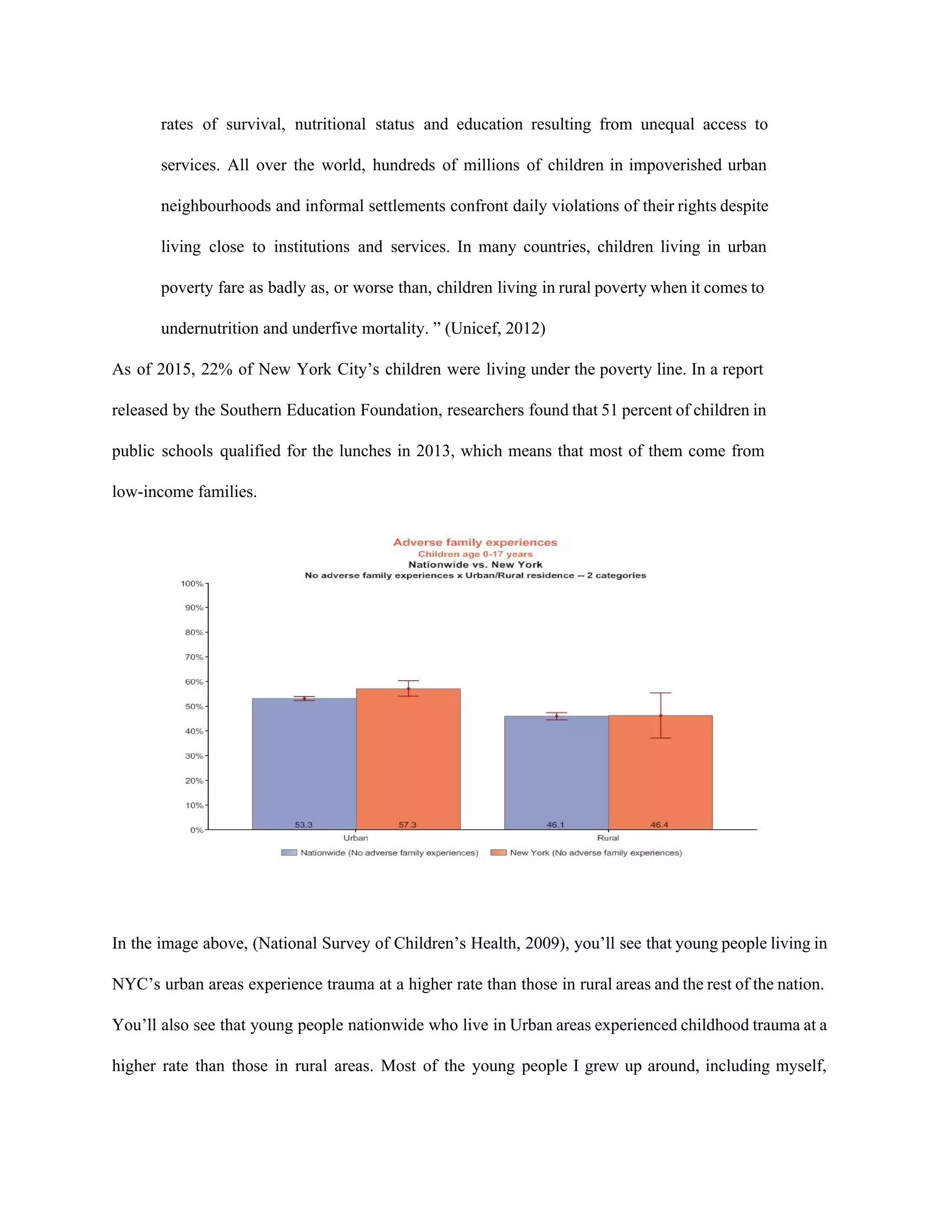
In the image above, (National Survey of Children’s Health, 2009), you’ll see that young people living in                                 
NYC’s urban areas experience trauma at a higher rate than those in rural areas and the rest of the nation.                                       
You’ll also see that young people nationwide who live in Urban areas experienced childhood trauma at a                                 
higher rate than those in rural areas. Most of the young people I grew up around, including myself,                                   
experienced very early events of significant trauma, which made interactions with spaces of authority feel                             
inherently violent. This is something that goes unaddressed in conversations about education reform. If                           
this is true for most of the nation, why is there such limited focus on trauma­centered education?  
“Changes in society, employment, entertainment, and family have               
contributed to changes in early childhood experiences of many students                   
which has resulted in altered brain development and traumatic stress.                   
[Schore,2001; ; Siegel, 2007;Solomon & Siegel, 2004]. Effectively               
teaching today’s students requires alternative techniques and school               
policies in order for the school to meet academic expectations. Electronic                     
imaging techniques clearly illustrate that brain structure and chemistry is                   
altered for children who are anxious, insecure, and have experienced                   
uncompleted attachments.” (Oehlburg, Trauma and Loss, 2008) 
To successfully educate students with histories of trauma, new approaches have to be taken with                             
curriculum. The quote above demonstrates the fact that students who have histories of trauma learn                             
differently from students without. It is becoming increasingly important that our methods of education are                             
student­centered and consider the holistic child before choosing courses of action.  
In the early 90’s, Arts Education was understood as a possibly innovative solution to the problem                               
I outline above. In 2009 Johns Hopkins researchers shared findings from a study entitled                           
“Neuroeducation: Learning, Arts and the Brain” showing that arts education can help rewire the brain in                               
positive ways. In this John Hopkins study, In this John Hopkin’s study, Michael Gazzaniga, director of                               
the Sage Center for the Study of Mind at the University of California, Santa Barbara, summarized some                                 
key highlights of the consortium’s finding:  
“1. An interest in a performing art leads to a high state of motivation that                             
produces the sustained attention necessary to improve performance and                 
the training of attention that leads to improvement in other domains of                       
cognition.  
2. Genetic studies have begun to yield candidate genes that may help                       
explain individual differences in interest in the arts.  
3. Specific links exist between high levels of music training and the                       
ability to manipulate information in both working and long term                   
memory; these links extend beyond the domain of music training.  
4. In children, there appear to be specific links between the practice of                         
music and skills in geometrical representation, though not in other forms                     
of numerical representation.” (Gazzaniga, Neuroeducation: Learning,           
Arts and the Brain, 2009) 
Here are some preexisting interventionist methods that have been created in response to this                           
problem. Each carries its own socio­political or academic blind spot and none have been able to                               
fully fulfill the intent behind their individual mission statements.  
1. There are many non and non­for­profits that work with large cultural institutions like                         
Guggenheim, MoMA, and Studio Museum, that bring young people from local high                       
schools across the city to workshops on site. They are either one­off workshops (a one                             
time event) or a series of workshops that may run through the semester or for a few                                 
weeks.  
2. Some of those non­for­profits hire their own rosters of working/teaching artists (some                       
who are connected to large cultural institutions) who go into Public Schools and teach                           
workshops. Content typically depends on availability and the school’s budget. Both of                       
these methods are generally unsuccessful because the children get unstructured and                     
non­scaffolded instruction that is divorced from in­class curriculum. It is typically                     
described to children as a reward for good behavior in school, but never described as an                               
essential aspect of school.  
3. Another method used by Public Schools and the nonprofits that serve them is after                           
school arts­programming. In some scenarios, Public Schools will hire non­profits who                     
have developed their own arts curriculums and ask them to develop after school arts                           
instruction. This is a little bit more of a substantive experience for the student because                             
they learn to expect and look forward to the programming, but often times funding for                             
programming is cut on a year to year basis, and a student who began a particular arts                                 
practice with a certain facilitator or mentor would subsequently lose access to that                         
resource.   
4. The fourth method is a format made famous by organizations like Harlem Children Zone                           
and Dreamyard Academy. Here is Harlem Children’s Zone’s Truce Academy mission                     
statement: ​“Students who go through the award­winning TRUCE® Media and Arts                     
after­school program are aspiring filmmakers, artists, writers, producers, and much                   
more. Through rich and varied exposure and project­based activities, they receive                     
hands­on experiential learning in a wide range of artistic disciplines, as well as the                           
wraparound academic support they need to pursue their passions and do their work                         
well.” When I spent time as a teaching artist at Harlem Children’s Zone, I often felt                               
misled by the mission statement. While it’s true that students are exposed to new and                             
various forms of content, most students attend program from anywhere between two to                         
four hours a day. Most students have an hour of “club”, which is when the exposure                               
happens, and then the rest of the time is spent on homework, or discussing grades and                               
college expectations with student advocates. While I had the opportunity to see my                         
students evolve as thinkers and as artists, I felt limited once I understood that they would                               
be much better served they if their exposure to the arts lasted longer than an hour a day. 
5. The final method I’ll share with you is a format made famous by the movie ​Fame​, which                                 
is based on NYC’s first Performing Arts high school, Fiorello H. LaGuardia High                         
School. It’s audition based and allows students the opportunity to study the following                         
disciplines: Art, Dance, Drama and Technical Theater. This method is the most                       
successful framework because it gives students the opportunity to have an immersive                       
arts education, instead of a supplemental one. The problem lies in its admission process                           
and its discipline offerings. Students graduating from Middle School who are applying                       
to the program must have maintained an 85 ­ 90 average ​and ​audition well. Asking                             
students to audition presupposes that students may have been trained (officially or                       
unofficially) before applying to the program. Evidence provided above shows that                     
students who would benefit most from arts education do not always have access to                           
cultural education and may always display their individual aptitudes with good grades.                       
Because of its focus on the Performing Arts, it alienates students who would benefit                           
from a more individual studio arts process, and leaves students who like the performing                           
arts in the dark about different methods of art production and dissemination.  
None of these methods feature specifically trauma or student centered approaches.  
The Solution 
We are seeking $50 Million for the development of New York City’s Premiere Studio & Fine 
Arts based High School that will be a public magnet, charter, specialized or alternative high school. The 
$70 Million would be used towards development, construction of housing, and four years of employment.  
 
How It Would Work: 
First year students will be given introductions to all of the disciplines (Painting, Sculpture, Film, 
Photography, Writing, Code, Architecture) and as sophomores will pick a discipline and begin building a 
studio practice. Coupled with traditional core classes, AP courses and SAT prep, our students will leave 
our school with full academic readiness, and an active studio practice that they can pursue in college or 
abandon for whatever else they may discover later. In the interest of trauma and student centered 
education, our school will also be equipped with mental health staff to offer consistent care to students 
dealing with trauma. Our mental health staff and academic/arts facilitators will build curriculum together 
to ensure holistic consideration of the child. IEP (Individual Educational Plan) will be issued to each 
student, and together, school, student, and family a plan is built to help carry the child to graduation. This 
IEP will consider social, artistic, academic, and physical development of the child. Regardless of the 
disciplines they choose, our students will graduate with the social and intellectual benefits of a full arts 
education and have access to the exclusivity of the contemporary Fine Arts community, a community that 
has been overwhelmingly white and male for a long time.  
Admissions 
The hope is that all kinds of students and caregivers will be attracted to our vision, but also that 
students who are artistically inclined but struggling academically will see us as a last resort instead of 
other alternative schools with a focus on trade when they feel like their options are limited. We also want 
it to attract students who do well in school but seek a rigorous studio practice that they can’t afford if their 
schools are not able to offer it them. For the sake of the student community, variety in experience, 
background and intent are important. Students should not be made to feel like they go to a High School 
for “troubled” or “complicated” students, but for students who might one day be thought of as artistic 
geniuses who are not receiving the kinds of cultivation they need to evolve. 
Dissimilar from LaGuardia High School, admission to Studio High would be solely interview 
based. The goal of the interview would be to assess the students needs, current abilities, and to assess how 
likely it is that the student might benefit from the program. Present in that interview would be a mental 
health specialist, to help assess the child’s psychological standing and how our resources (or lack thereof) 
would fit into the student’s life. Though many students have strained home lives and complicated family 
dynamics, it’s important to have the family as involved in the student’s studio practice and academic 
process as possible. A healthy child is supported from sun up to sun down, not just in the eight hours 
spent inside the schoolhouse.  
Space and Location 
While Studio Arts High School of course has aspirations of world domination, at launch, our 
school would serve between 200 and 300 students every year. It’s important that we start with a pilot 
group so that we can streamline intention and really make results visible. Our ideal location would be 
somewhere in a culturally rich but fiscally underserved community (like the Melrose section of the South 
Bronx), because these are the neighborhoods that most public school students come from, but also 
because learning while immersed in culture makes for a healthier and more authentic arts education. 
Because we want each student to have their own studio, ideally it would be a location that could house 
300 studios. Based on the specifics, we’re interested in building the institute from the ground up. We’re 
currently working with developers to create a first blueprint.  
Model 
While we’d love to be a standard NYC Public High School, our vision requires the kinds of 
flexibility that the charter school model could offer us. We need to be able to continue to seek private 
funding while still receiving public and federal subsidies. Our student’s success depends on access to 
resources and we’ll need a constant cashflow to make that possible. It’s also imperative that we offer free 
breakfast and lunch. The charter school model is the only model that allows us to continue that cash flow, 
without having to charge our students tuition or any out of pocket fees.  
 
Conclusion 
If the research I’ve provided and the evidence of my personal experience of transformation could be 
considered proof of concept, I would like to offer it as such. This is an unproven method, but I ask that 
you remain excited about innovation and about the possibility of creating a true solution to a modern and 
increasingly important problem. Over the past 10 years, Harlem Children’s Zone has become the main 
stakeholder in education reform and the educational framework that many charter schools are built to 
model. In 10 years, I believe that Studio Arts High School of New York will be the most successful and 
most reproduced educational model available. If there is any hope for equity in regards to educating the 
community of young urban people of here in New York City, it lies in Arts Education, and Studio Arts 
High School of New York will prove that fact to the world.  

CulturalEquityFinal