Jong Chul Ye
Bio-Imaging & Signal Processing Lab.
Dept. Bio & Brain Engineering
Dept. Mathematical Sciences
KAIST, Korea
Refresher Course
Deep Learning for CT Reconstruction:
From Concept to Practices
This can be downloaded from http://bispl.weebly.com
Course Overview
• Introduction
• CNN review
• Deep learning: biological origin
• Deep learning: mathematical origin
• Applications to CT
• Programming Example
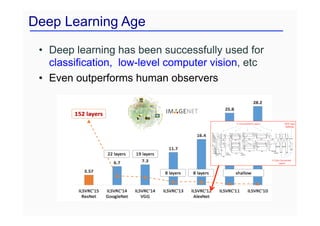
Deep Learning Age
• Deep learning has been successfully used for
classification, low-level computer vision, etc
• Even outperforms human observers
3
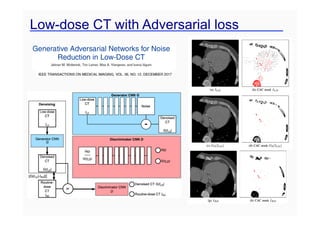
Low-dose CT with Adversarial loss
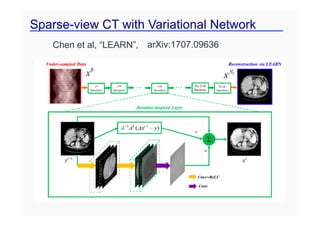
Sparse-view CT with Variational Network
Chen et al, “LEARN”, arXiv:1707.09636
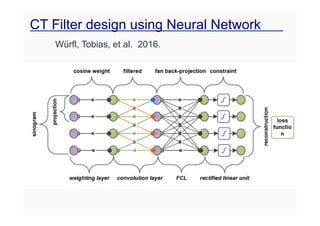
CT Filter design using Neural Network
Würfl, Tobias, et al. 2016.
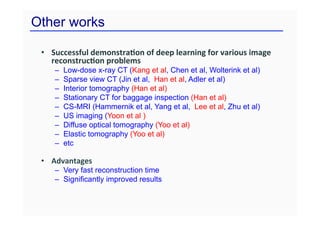
• Successful demonstra5on of deep learning for various image
reconstruc5on problems
– Low-dose x-ray CT (Kang et al, Chen et al, Wolterink et al)
– Sparse view CT (Jin et al, Han et al, Adler et al)
– Interior tomography (Han et al)
– Stationary CT for baggage inspection (Han et al)
– CS-MRI (Hammernik et al, Yang et al, Lee et al, Zhu et al)
– US imaging (Yoon et al )
– Diffuse optical tomography (Yoo et al)
– Elastic tomography (Yoo et al)
– etc
• Advantages
– Very fast reconstruction time
– Significantly improved results
Other works
WHY DEEP LEARNING WORKS
FOR RECON ?
DOES IT CREATE ANY
ARTIFICIAL FEATURES ?
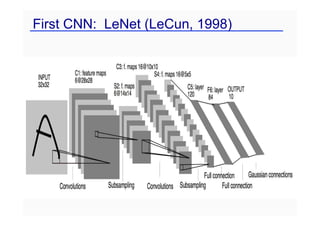
First CNN: LeNet (LeCun, 1998)
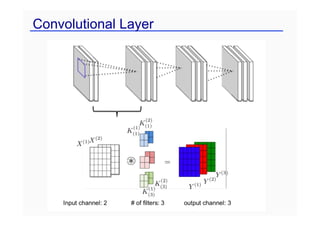
Convolutional Layer
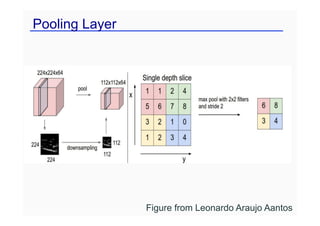
Pooling Layer
Figure from Leonardo Araujo Aantos
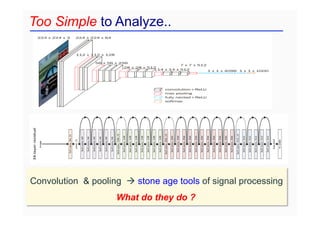
Too Simple to Analyze..
Convolution & pooling à stone age tools of signal processing
What do they do ?
Dark Age of Applied Mathematics ?
CNN – BIOLOGICAL ORIGIN
A LAYMAN’S EXPLANATION
15
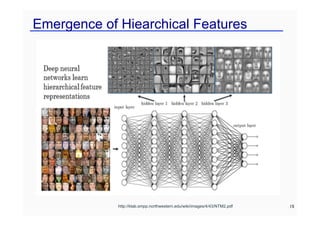
http://klab.smpp.northwestern.edu/wiki/images/4/43/NTM2.pdf
Emergence of Hiearchical Features
16
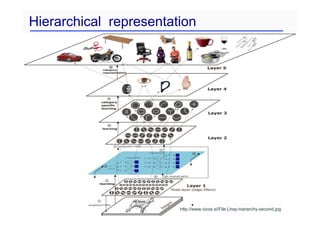
http://www.vicos.si/File:Lhop-hierarchy-second.jpg
• LeCun et al, Nature, 2015
Hierarchical representation
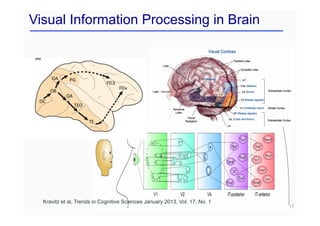
Visual Information Processing in Brain
17
Kravitz et al, Trends in Cognitive Sciences January 2013, Vol. 17, No. 1
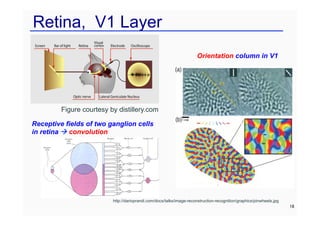
Retina, V1 Layer
18
Receptive fields of two ganglion cells
in retina à convolution
Orientation column in V1
http://darioprandi.com/docs/talks/image-reconstruction-recognition/graphics/pinwheels.jpg
Figure courtesy by distillery.com
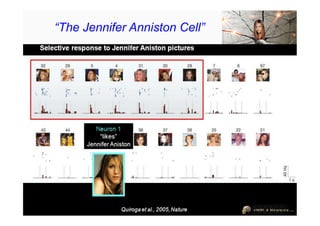
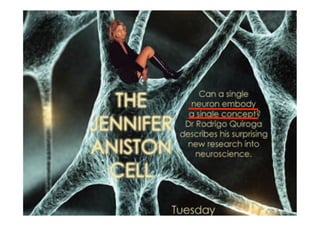
“The Jennifer Anniston Cell”
19
Quiroga et al, Nature, Vol 435, 24, June 2005
20
CNN – MATHEMATICAL
UNDERSTANDING
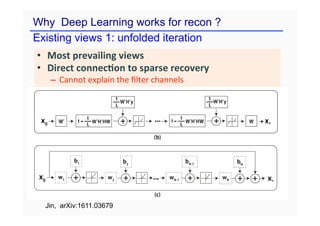
Why Deep Learning works for recon ?
Existing views 1: unfolded iteration
• Most prevailing views
• Direct connec5on to sparse recovery
– Cannot explain the filter channels
Jin, arXiv:1611.03679
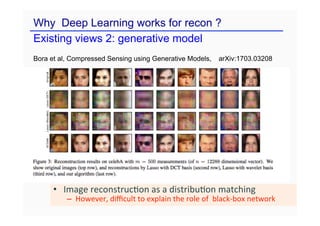
Why Deep Learning works for recon ?
Existing views 2: generative model
• Image reconstruc5on as a distribu5on matching
– However, difficult to explain the role of black-box network
Bora et al, Compressed Sensing using Generative Models, arXiv:1703.03208
Our Proposal:
Deep Learning == Deep Convolutional
Framelets
• Ye et al, “Deep convolutional framelets: A general deep
learning framework for inverse problems”, SIAM Journal
Imaging Sciences, 11(2), 991-1048, 2018.
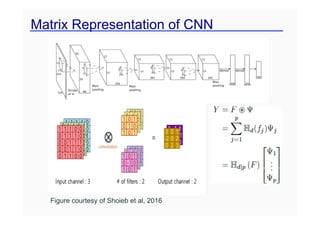
Matrix Representation of CNN
Figure courtesy of Shoieb et al, 2016
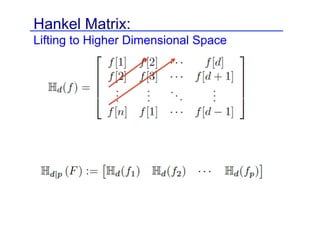
Hankel Matrix:
Lifting to Higher Dimensional Space
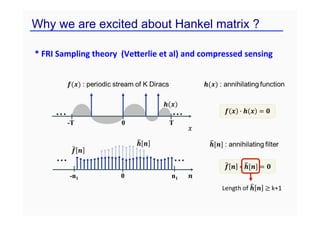
Why we are excited about Hankel matrix ?
T
-T 0
n1
-n1 0
* FRI Sampling theory (VeEerlie et al) and compressed sensing
︙
︙
1
2
3
4
5
6
7
8
9
-1
0 1
2
3
4
5
6
7
8
9
1
2
3
4
5
6
7
8
9
12
2
3
4
5
6
7
8
9
12
13
3
4
5
6
7
8
9
10
10
10
10
0
11
11
11
1
2
3
4
5
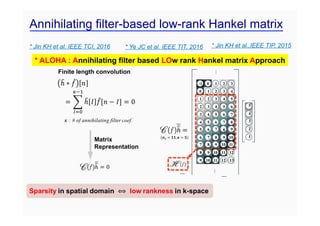
Finite length convolution
Matrix
Representation
* ALOHA : Annihilating filter based LOw rank Hankel matrix Approach
* Jin KH et al. IEEE TCI, 2016 * Jin KH et al.,IEEE TIP, 2015
* Ye JC et al. IEEE TIT, 2016
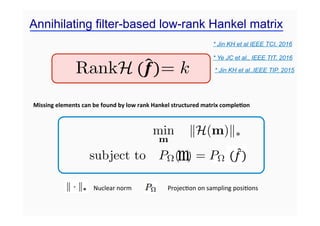
Annihilating filter-based low-rank Hankel matrix
Missing elements can be found by low rank Hankel structured matrix comple5on
Nuclear norm Projec5on on sampling posi5ons
min
m
kH(m)k⇤
subject to P⌦(b) = P⌦(f)
RankH(f) = k
* Jin KH et al IEEE TCI, 2016
* Jin KH et al.,IEEE TIP, 2015
* Ye JC et al., IEEE TIT, 2016
m
Annihilating filter-based low-rank Hankel matrix
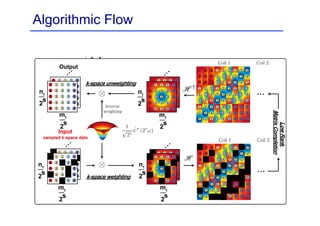
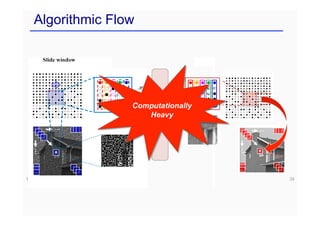
Algorithmic Flow
18. APR. 2015. 31
*
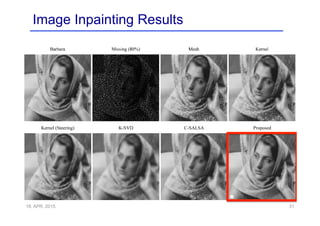
Image Inpainting Results
32
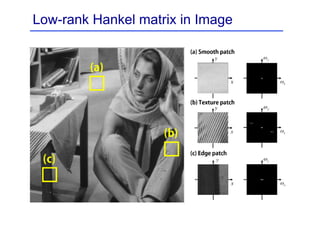
Low-rank Hankel matrix in Image
18. APR. 2015. 34
Algorithmic Flow
ALOHA
Computationally
Heavy
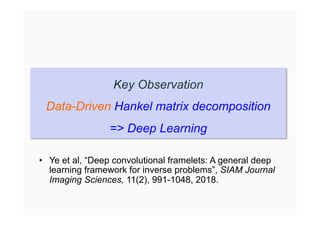
Key Observation
Data-Driven Hankel matrix decomposition
=> Deep Learning
• Ye et al, “Deep convolutional framelets: A general deep
learning framework for inverse problems”, SIAM Journal
Imaging Sciences, 11(2), 991-1048, 2018.
Hd(f) Hd(f)
= ˜T
˜ T C
C = T
Hd(f)
C = T
(f ~ )
Encoder:
˜ T
= I
˜ = PR(V )
Hd(f) = U⌃V T
Unlifting: f = (˜C) ~ ⌧(˜)
: Non-local basis
: Local basis
: Frame condition
: Low-rank condition
convolution
pooling
un-pooling
convolution
: User-defined pooling
: Learnable filters
Hpi
(gi) =
X
k,l
[Ci]kl
e
Bkl
i
Decoder:
Deep Convolutional Framelets (Y, Han, Cha; 2018)
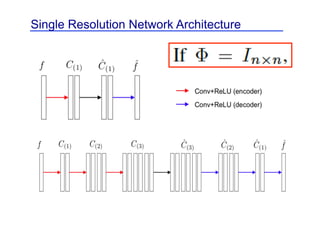
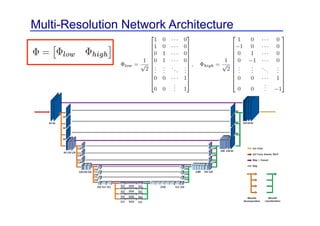
Single Resolution Network Architecture
Multi-Resolution Network Architecture
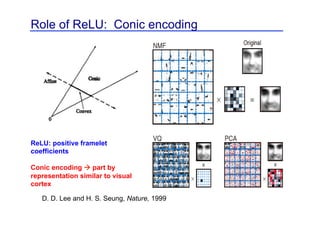
Role of ReLU: Conic encoding
D. D. Lee and H. S. Seung, Nature, 1999
ReLU: positive framelet
coefficients
Conic encoding à part by
representation similar to visual
cortex
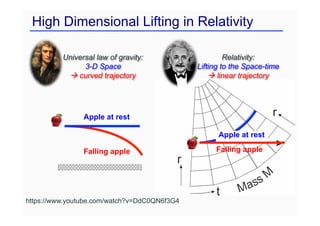
https://www.youtube.com/watch?v=DdC0QN6f3G4
Relativity:
Lifting to the Space-time
à linear trajectory
High Dimensional Lifting in Relativity
Falling apple
Apple at rest
Universal law of gravity:
3-D Space
à curved trajectory
Falling apple
Apple at rest
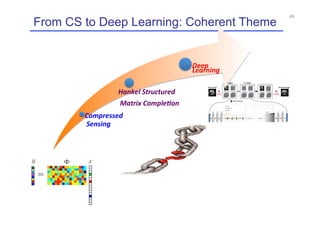
Compressed
Sensing
Hankel Structured
Matrix Comple7on
Deep
Learning
49
From CS to Deep Learning: Coherent Theme
DEEP NETWORKS FOR CT
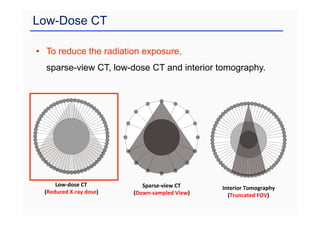
Low-Dose CT
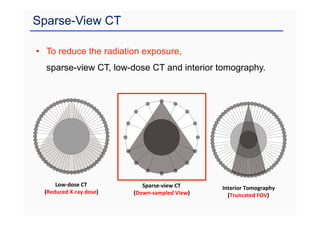
• To reduce the radiation exposure,
sparse-view CT, low-dose CT and interior tomography.
Sparse-view CT
(Down-sampled View)
Low-dose CT
(Reduced X-ray dose)
Interior Tomography
(Truncated FOV)
52
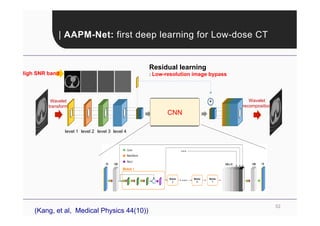
Wavelet
transform
level 2
level 1 level 3 level 4
Wavelet
recomposition
+
Residual learning
: Low-resolution image bypass
High SNR band
CNN
(Kang, et al, Medical Physics 44(10))
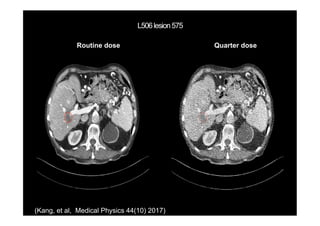
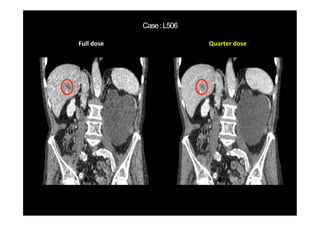
Routine dose Quarter dose
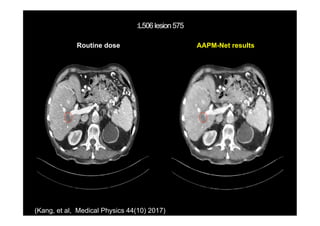
(Kang, et al, Medical Physics 44(10) 2017)
Routine dose AAPM-Net results
(Kang, et al, Medical Physics 44(10) 2017)
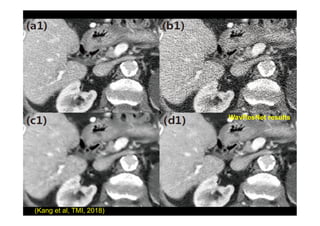
WavResNet results
(Kang et al, TMI, 2018)
WavResNet results
(Kang et al, TMI, 2018)
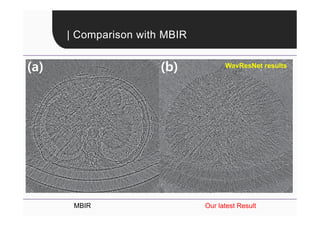
MBIR Our latest Result
C D WavResNet results
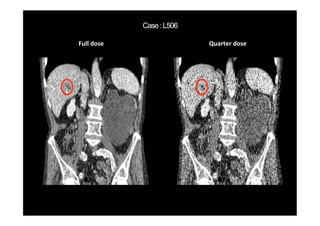
Full dose Quarter dose
Sparse-View CT
• To reduce the radiation exposure,
sparse-view CT, low-dose CT and interior tomography.
Sparse-view CT
(Down-sampled View)
Low-dose CT
(Reduced X-ray dose)
Interior Tomography
(Truncated FOV)
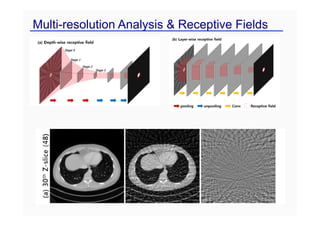
Multi-resolution Analysis & Receptive Fields
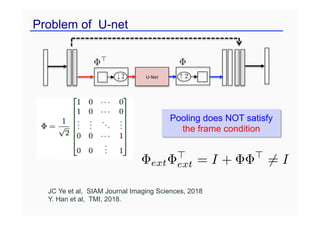
Problem of U-net
Pooling does NOT satisfy
the frame condition
JC Ye et al, SIAM Journal Imaging Sciences, 2018
Y. Han et al, TMI, 2018.
ext
>
ext = I + >
6= I
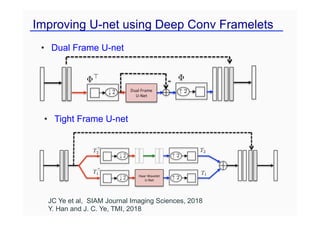
Improving U-net using Deep Conv Framelets
• Dual Frame U-net
• Tight Frame U-net
JC Ye et al, SIAM Journal Imaging Sciences, 2018
Y. Han and J. C. Ye, TMI, 2018
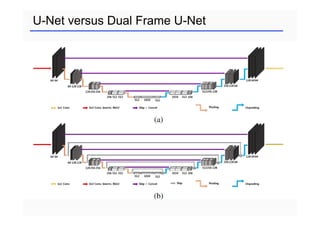
U-Net versus Dual Frame U-Net
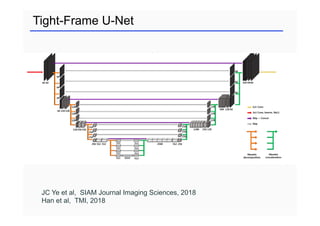
Tight-Frame U-Net
JC Ye et al, SIAM Journal Imaging Sciences, 2018
Han et al, TMI, 2018
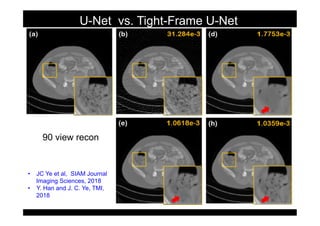
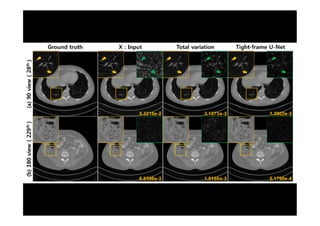
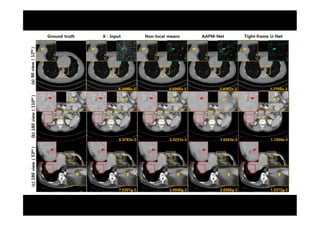
90 view recon
U-Net vs. Tight-Frame U-Net
• JC Ye et al, SIAM Journal
Imaging Sciences, 2018
• Y. Han and J. C. Ye, TMI,
2018
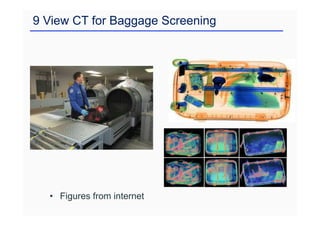
• Figures from internet
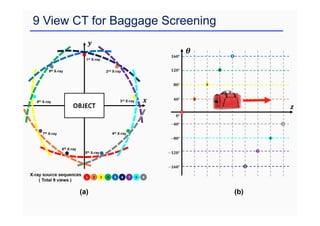
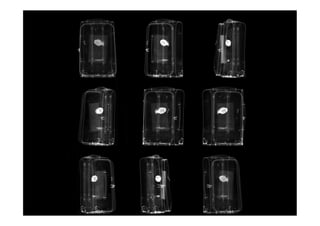
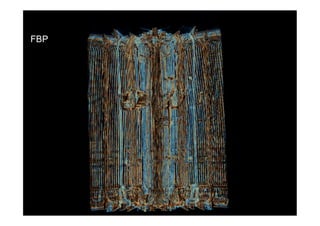
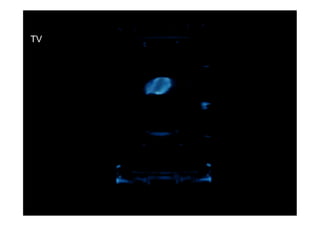
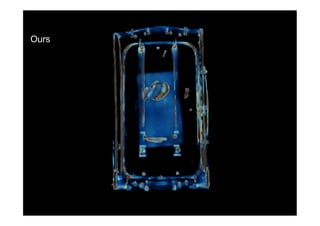
9 View CT for Baggage Screening
1st view 2nd view 3rd view
4th view 5th view 6th view
7th view 8th view 9th view
FBP
TV
Ours
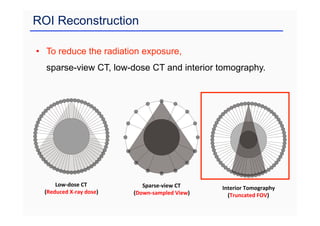
ROI Reconstruction
• To reduce the radiation exposure,
sparse-view CT, low-dose CT and interior tomography.
Sparse-view CT
(Down-sampled View)
Low-dose CT
(Reduced X-ray dose)
Interior Tomography
(Truncated FOV)
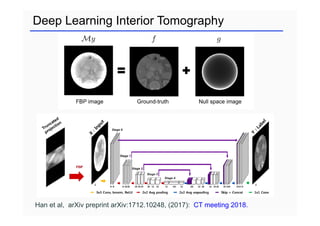
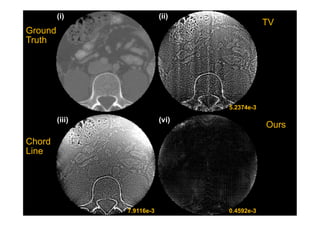
Deep Learning Interior Tomography
Han et al, arXiv preprint arXiv:1712.10248, (2017): CT meeting 2018.
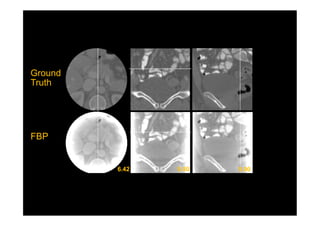
Ground
Truth
FBP
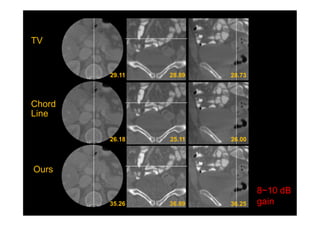
TV
Chord
Line
Ours
8~10 dB
gain
Ground
Truth
Chord
Line
TV
Ours
Still Unresolved Problems..
• Cascaded geometry of deep neural network
• Generalization capability
• Optimization landscape
• Training procedure
• Extension to classification problems
DEEP LEARNING - PRACTICES
Dataset of Natural Images
• MNIST (http://yann.lecun.com/exdb/mnist/)
– Handwritten digits.
• SVHN (http://ufldl.stanford.edu/housenumbers/)
– House numbers from Google Street View.
• ImageNet (http://www.image-net.org/)
– The de-facto image dataset.
• LSUN (http://lsun.cs.princeton.edu/2016/)
– Large-scale scene understanding challenge.
• Pascal VOC (
http://host.robots.ox.ac.uk/pascal/VOC/)
– Standardized image dataset.
• MS COCO (http://cocodataset.org/#home)
– Common Objects in Context.
• CIFAR-10 / -100
(https://www.cs.utoronto.ca/~kriz/cifar.html)
– Tiny images data set.
• BSDS300 / 500 (
https://www2.eecs.berkeley.edu/Research/
Projects/CS/vision/grouping/resources.html)
– Contour detection and image Segmentation
resources.
https://en.wikipedia.org/wiki/List_of_datasets_for_machine_learning_research
https://www.kaggle.com/datasets
Dataset for Medical Images
• HCP (https://www.humanconnectome.org/)
– Behavioral and 3T / 7T MR imaging dataset.
• MRI Data (http://mridata.org/)
– Raw k-space dataset acquired on
a GE clinical 3T scanner.
• LUNA (https://luna16.grand-challenge.org/data/)
– Lung Nodule analysis dataset acquired on a CT scanner.
• Data Science Bowl
(https://www.kaggle.com/c/data-science-bowl-2017)
– A thousand low-dose CT images.
• NIH Chest X-rays
(https://nihcc.app.box.com/v/ChestXray-NIHCC)
– X-ray images with disease labels.
http://www.cancerimagingarchive.net/
https://www.kaggle.com/datasets
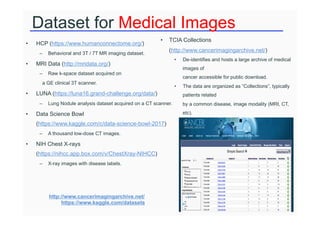
• TCIA Collections
(http://www.cancerimagingarchive.net/)
• De-identifies and hosts a large archive of medical
images of
cancer accessible for public download.
• The data are organized as “Collections”, typically
patients related
by a common disease, image modality (MRI, CT,
etc).
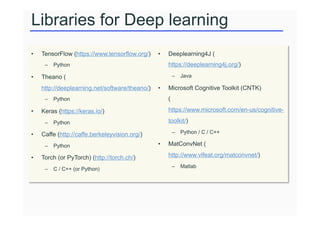
Libraries for Deep learning
• TensorFlow (https://www.tensorflow.org/)
– Python
• Theano (
http://deeplearning.net/software/theano/)
– Python
• Keras (https://keras.io/)
– Python
• Caffe (http://caffe.berkeleyvision.org/)
– Python
• Torch (or PyTorch) (http://torch.ch/)
– C / C++ (or Python)
• Deeplearning4J (
https://deeplearning4j.org/)
– Java
• Microsoft Cognitive Toolkit (CNTK)
(
https://www.microsoft.com/en-us/cognitive-
toolkit/)
– Python / C / C++
• MatConvNet (
http://www.vlfeat.org/matconvnet/)
– Matlab
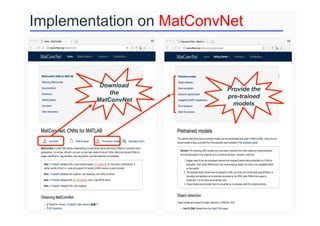
Implementation on MatConvNet
Download
the
MatConvNet
Provide the
pre-trained
models
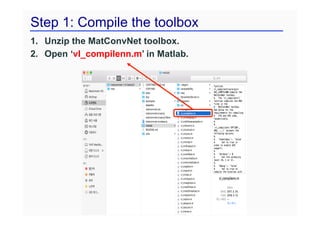
Step 1: Compile the toolbox
1. Unzip the MatConvNet toolbox.
2. Open ‘vl_compilenn.m’ in Matlab.
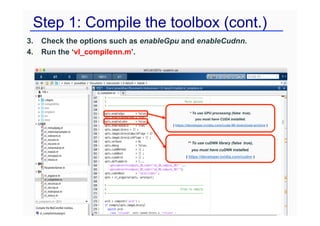
Step 1: Compile the toolbox (cont.)
3. Check the options such as enableGpu and enableCudnn.
4. Run the ‘vl_compilenn.m’.
* To use GPU processing (false true),
you must have CUDA installed.
( https://developer.nvidia.com/cuda-90-download-archive )
** To use cuDNN library (false true),
you must have cuDNN installed.
( https://developer.nvidia.com/cudnn )
Step 2: Prepare dataset
As a classification example, MNIST consists of as follows,
Images % struct-type
Data % handwritten digit image
labels % [1, …, 10]
set % [1, 2, 3],
1, 2, and 3 indicate
train, valid, and test set, respectively.
Data Labels
6
Step 2: Prepare dataset (cont.)
• As a segmentation example, U-Net dataset consists of as follows,
– Images % struct-type
Ø data % Cell image
Ø labels % [1, 2], Mask image.
1 and 2 indicate
back- and for-ground, respectively.
Ø set % [1, 2, 3]
Data Labels
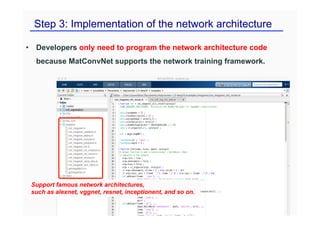
Step 3: Implementation of the network architecture
• Developers only need to program the network architecture code
because MatConvNet supports the network training framework.
Support famous network architectures,
such as alexnet, vggnet, resnet, inceptionent, and so on.
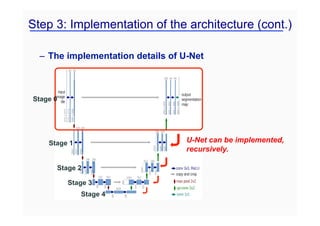
Step 3: Implementation of the architecture (cont.)
– The implementation details of U-Net
U-Net can be implemented,
recursively.
Stage 0
Stage 1
Stage 2
Stage 3
Stage 4
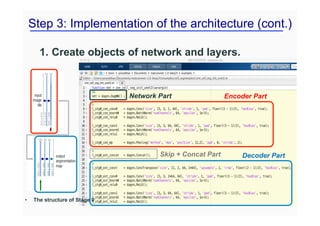
Step 3: Implementation of the architecture (cont.)
1. Create objects of network and layers.
Encoder Part
Skip + Concat Part Decoder Part
• The structure of Stage 0
Network Part
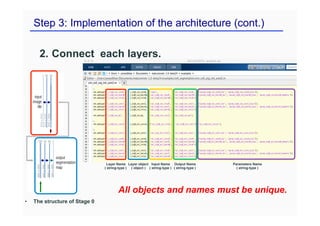
Step 3: Implementation of the architecture (cont.)
2. Connect each layers.
• The structure of Stage 0
Layer Name
( string-type )
Layer object
( object )
Input Name
( string-type )
Output Name
( string-type )
Parameters Name
( string-type )
All objects and names must be unique.
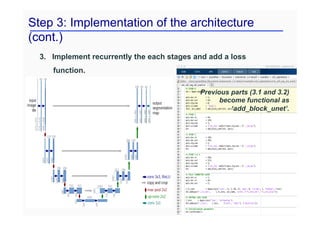
Step 3: Implementation of the architecture
(cont.)
3. Implement recurrently the each stages and add a loss
function.
Previous parts (3.1 and 3.2)
become functional as
‘add_block_unet’.
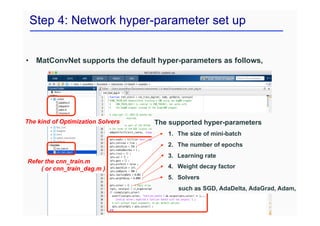
Step 4: Network hyper-parameter set up
• MatConvNet supports the default hyper-parameters as follows,
Refer the cnn_train.m
( or cnn_train_dag.m )
The supported hyper-parameters
1. The size of mini-batch
2. The number of epochs
3. Learning rate
4. Weight decay factor
5. Solvers
such as SGD, AdaDelta, AdaGrad, Adam, and RMS
The kind of Optimization Solvers
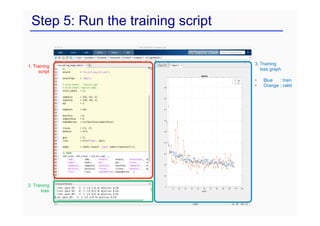
Step 5: Run the training script
1. Training
script
2. Training
loss
3. Training
loss graph
• Blue : train
• Orange : valid
Acknowledgements
CT Team
• Yoseob Han
• Eunhee Kang
• Jawook Goo
US Team
• Shujaat Khan
• Jaeyong Hur
MR Team
• Dongwook Lee
• Juyoung Lee
• Eunju Cha
• Byung-hoon Kim
Image Analysis Team
• Boa Kim
• Junyoung Kim
Optics Team
• Sungjun Lim
• Junyoung Kim
• Jungsol Kim
• Taesung Kwon
THANK YOU
This presentation material can be downloaded from
http://bispl.weebly.com

ct_meeting_final_jcy (1).pdf

  • 1.
    Jong Chul Ye Bio-Imaging& Signal Processing Lab. Dept. Bio & Brain Engineering Dept. Mathematical Sciences KAIST, Korea Refresher Course Deep Learning for CT Reconstruction: From Concept to Practices This can be downloaded from http://bispl.weebly.com
  • 2.
    Course Overview • Introduction •CNN review • Deep learning: biological origin • Deep learning: mathematical origin • Applications to CT • Programming Example
  • 3.
    Deep Learning Age •Deep learning has been successfully used for classification, low-level computer vision, etc • Even outperforms human observers
  • 4.
  • 5.
    Low-dose CT withAdversarial loss
  • 6.
    Sparse-view CT withVariational Network Chen et al, “LEARN”, arXiv:1707.09636
  • 7.
    CT Filter designusing Neural Network Würfl, Tobias, et al. 2016.
  • 8.
    • Successful demonstra5onof deep learning for various image reconstruc5on problems – Low-dose x-ray CT (Kang et al, Chen et al, Wolterink et al) – Sparse view CT (Jin et al, Han et al, Adler et al) – Interior tomography (Han et al) – Stationary CT for baggage inspection (Han et al) – CS-MRI (Hammernik et al, Yang et al, Lee et al, Zhu et al) – US imaging (Yoon et al ) – Diffuse optical tomography (Yoo et al) – Elastic tomography (Yoo et al) – etc • Advantages – Very fast reconstruction time – Significantly improved results Other works
  • 9.
    WHY DEEP LEARNINGWORKS FOR RECON ? DOES IT CREATE ANY ARTIFICIAL FEATURES ?
  • 10.
    First CNN: LeNet(LeCun, 1998)
  • 11.
  • 12.
    Pooling Layer Figure fromLeonardo Araujo Aantos
  • 13.
    Too Simple toAnalyze.. Convolution & pooling à stone age tools of signal processing What do they do ?
  • 14.
    Dark Age ofApplied Mathematics ?
  • 15.
    CNN – BIOLOGICALORIGIN A LAYMAN’S EXPLANATION
  • 16.
  • 17.
    16 http://www.vicos.si/File:Lhop-hierarchy-second.jpg • LeCun etal, Nature, 2015 Hierarchical representation
  • 18.
    Visual Information Processingin Brain 17 Kravitz et al, Trends in Cognitive Sciences January 2013, Vol. 17, No. 1
  • 19.
    Retina, V1 Layer 18 Receptivefields of two ganglion cells in retina à convolution Orientation column in V1 http://darioprandi.com/docs/talks/image-reconstruction-recognition/graphics/pinwheels.jpg Figure courtesy by distillery.com
  • 20.
    “The Jennifer AnnistonCell” 19 Quiroga et al, Nature, Vol 435, 24, June 2005
  • 21.
  • 22.
  • 23.
    Why Deep Learningworks for recon ? Existing views 1: unfolded iteration • Most prevailing views • Direct connec5on to sparse recovery – Cannot explain the filter channels Jin, arXiv:1611.03679
  • 24.
    Why Deep Learningworks for recon ? Existing views 2: generative model • Image reconstruc5on as a distribu5on matching – However, difficult to explain the role of black-box network Bora et al, Compressed Sensing using Generative Models, arXiv:1703.03208
  • 25.
    Our Proposal: Deep Learning== Deep Convolutional Framelets • Ye et al, “Deep convolutional framelets: A general deep learning framework for inverse problems”, SIAM Journal Imaging Sciences, 11(2), 991-1048, 2018.
  • 26.
    Matrix Representation ofCNN Figure courtesy of Shoieb et al, 2016
  • 27.
    Hankel Matrix: Lifting toHigher Dimensional Space
  • 28.
    Why we areexcited about Hankel matrix ? T -T 0 n1 -n1 0 * FRI Sampling theory (VeEerlie et al) and compressed sensing
  • 29.
    ︙ ︙ 1 2 3 4 5 6 7 8 9 -1 0 1 2 3 4 5 6 7 8 9 1 2 3 4 5 6 7 8 9 12 2 3 4 5 6 7 8 9 12 13 3 4 5 6 7 8 9 10 10 10 10 0 11 11 11 1 2 3 4 5 Finite lengthconvolution Matrix Representation * ALOHA : Annihilating filter based LOw rank Hankel matrix Approach * Jin KH et al. IEEE TCI, 2016 * Jin KH et al.,IEEE TIP, 2015 * Ye JC et al. IEEE TIT, 2016 Annihilating filter-based low-rank Hankel matrix
  • 30.
    Missing elements canbe found by low rank Hankel structured matrix comple5on Nuclear norm Projec5on on sampling posi5ons min m kH(m)k⇤ subject to P⌦(b) = P⌦(f) RankH(f) = k * Jin KH et al IEEE TCI, 2016 * Jin KH et al.,IEEE TIP, 2015 * Ye JC et al., IEEE TIT, 2016 m Annihilating filter-based low-rank Hankel matrix
  • 31.
  • 32.
    18. APR. 2015.31 * Image Inpainting Results
  • 33.
  • 34.
  • 35.
    18. APR. 2015.34 Algorithmic Flow ALOHA Computationally Heavy
  • 36.
    Key Observation Data-Driven Hankelmatrix decomposition => Deep Learning • Ye et al, “Deep convolutional framelets: A general deep learning framework for inverse problems”, SIAM Journal Imaging Sciences, 11(2), 991-1048, 2018.
  • 37.
    Hd(f) Hd(f) = ˜T ˜T C C = T Hd(f) C = T (f ~ ) Encoder: ˜ T = I ˜ = PR(V ) Hd(f) = U⌃V T Unlifting: f = (˜C) ~ ⌧(˜) : Non-local basis : Local basis : Frame condition : Low-rank condition convolution pooling un-pooling convolution : User-defined pooling : Learnable filters Hpi (gi) = X k,l [Ci]kl e Bkl i Decoder: Deep Convolutional Framelets (Y, Han, Cha; 2018)
  • 38.
  • 39.
  • 40.
    Role of ReLU:Conic encoding D. D. Lee and H. S. Seung, Nature, 1999 ReLU: positive framelet coefficients Conic encoding à part by representation similar to visual cortex
  • 41.
    https://www.youtube.com/watch?v=DdC0QN6f3G4 Relativity: Lifting to theSpace-time à linear trajectory High Dimensional Lifting in Relativity Falling apple Apple at rest Universal law of gravity: 3-D Space à curved trajectory Falling apple Apple at rest
  • 42.
  • 43.
  • 44.
    Low-Dose CT • Toreduce the radiation exposure, sparse-view CT, low-dose CT and interior tomography. Sparse-view CT (Down-sampled View) Low-dose CT (Reduced X-ray dose) Interior Tomography (Truncated FOV)
  • 45.
    52 Wavelet transform level 2 level 1level 3 level 4 Wavelet recomposition + Residual learning : Low-resolution image bypass High SNR band CNN (Kang, et al, Medical Physics 44(10))
  • 46.
    Routine dose Quarterdose (Kang, et al, Medical Physics 44(10) 2017)
  • 47.
    Routine dose AAPM-Netresults (Kang, et al, Medical Physics 44(10) 2017)
  • 48.
  • 49.
  • 50.
    MBIR Our latestResult C D WavResNet results
  • 51.
  • 52.
  • 53.
    Sparse-View CT • Toreduce the radiation exposure, sparse-view CT, low-dose CT and interior tomography. Sparse-view CT (Down-sampled View) Low-dose CT (Reduced X-ray dose) Interior Tomography (Truncated FOV)
  • 54.
  • 55.
    Problem of U-net Poolingdoes NOT satisfy the frame condition JC Ye et al, SIAM Journal Imaging Sciences, 2018 Y. Han et al, TMI, 2018. ext > ext = I + > 6= I
  • 56.
    Improving U-net usingDeep Conv Framelets • Dual Frame U-net • Tight Frame U-net JC Ye et al, SIAM Journal Imaging Sciences, 2018 Y. Han and J. C. Ye, TMI, 2018
  • 57.
    U-Net versus DualFrame U-Net
  • 58.
    Tight-Frame U-Net JC Yeet al, SIAM Journal Imaging Sciences, 2018 Han et al, TMI, 2018
  • 59.
    90 view recon U-Netvs. Tight-Frame U-Net • JC Ye et al, SIAM Journal Imaging Sciences, 2018 • Y. Han and J. C. Ye, TMI, 2018
  • 62.
    • Figures frominternet 9 View CT for Baggage Screening
  • 63.
    9 View CTfor Baggage Screening
  • 64.
    1st view 2ndview 3rd view 4th view 5th view 6th view 7th view 8th view 9th view
  • 65.
  • 66.
  • 67.
  • 68.
    ROI Reconstruction • Toreduce the radiation exposure, sparse-view CT, low-dose CT and interior tomography. Sparse-view CT (Down-sampled View) Low-dose CT (Reduced X-ray dose) Interior Tomography (Truncated FOV)
  • 69.
    Deep Learning InteriorTomography Han et al, arXiv preprint arXiv:1712.10248, (2017): CT meeting 2018.
  • 70.
  • 71.
  • 72.
  • 73.
    Still Unresolved Problems.. •Cascaded geometry of deep neural network • Generalization capability • Optimization landscape • Training procedure • Extension to classification problems
  • 74.
    DEEP LEARNING -PRACTICES
  • 75.
    Dataset of NaturalImages • MNIST (http://yann.lecun.com/exdb/mnist/) – Handwritten digits. • SVHN (http://ufldl.stanford.edu/housenumbers/) – House numbers from Google Street View. • ImageNet (http://www.image-net.org/) – The de-facto image dataset. • LSUN (http://lsun.cs.princeton.edu/2016/) – Large-scale scene understanding challenge. • Pascal VOC ( http://host.robots.ox.ac.uk/pascal/VOC/) – Standardized image dataset. • MS COCO (http://cocodataset.org/#home) – Common Objects in Context. • CIFAR-10 / -100 (https://www.cs.utoronto.ca/~kriz/cifar.html) – Tiny images data set. • BSDS300 / 500 ( https://www2.eecs.berkeley.edu/Research/ Projects/CS/vision/grouping/resources.html) – Contour detection and image Segmentation resources. https://en.wikipedia.org/wiki/List_of_datasets_for_machine_learning_research https://www.kaggle.com/datasets
  • 76.
    Dataset for MedicalImages • HCP (https://www.humanconnectome.org/) – Behavioral and 3T / 7T MR imaging dataset. • MRI Data (http://mridata.org/) – Raw k-space dataset acquired on a GE clinical 3T scanner. • LUNA (https://luna16.grand-challenge.org/data/) – Lung Nodule analysis dataset acquired on a CT scanner. • Data Science Bowl (https://www.kaggle.com/c/data-science-bowl-2017) – A thousand low-dose CT images. • NIH Chest X-rays (https://nihcc.app.box.com/v/ChestXray-NIHCC) – X-ray images with disease labels. http://www.cancerimagingarchive.net/ https://www.kaggle.com/datasets • TCIA Collections (http://www.cancerimagingarchive.net/) • De-identifies and hosts a large archive of medical images of cancer accessible for public download. • The data are organized as “Collections”, typically patients related by a common disease, image modality (MRI, CT, etc).
  • 77.
    Libraries for Deeplearning • TensorFlow (https://www.tensorflow.org/) – Python • Theano ( http://deeplearning.net/software/theano/) – Python • Keras (https://keras.io/) – Python • Caffe (http://caffe.berkeleyvision.org/) – Python • Torch (or PyTorch) (http://torch.ch/) – C / C++ (or Python) • Deeplearning4J ( https://deeplearning4j.org/) – Java • Microsoft Cognitive Toolkit (CNTK) ( https://www.microsoft.com/en-us/cognitive- toolkit/) – Python / C / C++ • MatConvNet ( http://www.vlfeat.org/matconvnet/) – Matlab
  • 78.
  • 79.
    Step 1: Compilethe toolbox 1. Unzip the MatConvNet toolbox. 2. Open ‘vl_compilenn.m’ in Matlab.
  • 80.
    Step 1: Compilethe toolbox (cont.) 3. Check the options such as enableGpu and enableCudnn. 4. Run the ‘vl_compilenn.m’. * To use GPU processing (false true), you must have CUDA installed. ( https://developer.nvidia.com/cuda-90-download-archive ) ** To use cuDNN library (false true), you must have cuDNN installed. ( https://developer.nvidia.com/cudnn )
  • 81.
    Step 2: Preparedataset As a classification example, MNIST consists of as follows, Images % struct-type Data % handwritten digit image labels % [1, …, 10] set % [1, 2, 3], 1, 2, and 3 indicate train, valid, and test set, respectively. Data Labels 6
  • 82.
    Step 2: Preparedataset (cont.) • As a segmentation example, U-Net dataset consists of as follows, – Images % struct-type Ø data % Cell image Ø labels % [1, 2], Mask image. 1 and 2 indicate back- and for-ground, respectively. Ø set % [1, 2, 3] Data Labels
  • 83.
    Step 3: Implementationof the network architecture • Developers only need to program the network architecture code because MatConvNet supports the network training framework. Support famous network architectures, such as alexnet, vggnet, resnet, inceptionent, and so on.
  • 84.
    Step 3: Implementationof the architecture (cont.) – The implementation details of U-Net U-Net can be implemented, recursively. Stage 0 Stage 1 Stage 2 Stage 3 Stage 4
  • 85.
    Step 3: Implementationof the architecture (cont.) 1. Create objects of network and layers. Encoder Part Skip + Concat Part Decoder Part • The structure of Stage 0 Network Part
  • 86.
    Step 3: Implementationof the architecture (cont.) 2. Connect each layers. • The structure of Stage 0 Layer Name ( string-type ) Layer object ( object ) Input Name ( string-type ) Output Name ( string-type ) Parameters Name ( string-type ) All objects and names must be unique.
  • 87.
    Step 3: Implementationof the architecture (cont.) 3. Implement recurrently the each stages and add a loss function. Previous parts (3.1 and 3.2) become functional as ‘add_block_unet’.
  • 88.
    Step 4: Networkhyper-parameter set up • MatConvNet supports the default hyper-parameters as follows, Refer the cnn_train.m ( or cnn_train_dag.m ) The supported hyper-parameters 1. The size of mini-batch 2. The number of epochs 3. Learning rate 4. Weight decay factor 5. Solvers such as SGD, AdaDelta, AdaGrad, Adam, and RMS The kind of Optimization Solvers
  • 89.
    Step 5: Runthe training script 1. Training script 2. Training loss 3. Training loss graph • Blue : train • Orange : valid
  • 90.
    Acknowledgements CT Team • YoseobHan • Eunhee Kang • Jawook Goo US Team • Shujaat Khan • Jaeyong Hur MR Team • Dongwook Lee • Juyoung Lee • Eunju Cha • Byung-hoon Kim Image Analysis Team • Boa Kim • Junyoung Kim Optics Team • Sungjun Lim • Junyoung Kim • Jungsol Kim • Taesung Kwon
  • 91.
    THANK YOU This presentationmaterial can be downloaded from http://bispl.weebly.com