African cattle genomic reference resource, SNP
assays, and signatures of selection
Speaker name: Abdulfatai Tijjani
Speaker organisation/s: ILRI – Addis Ababa
Investigators: Karen Marshall (ILRI), Kellie Watson (CTLGH), James
Prendergast (Roslin) and Olivier Hanotte (ILRI)
CTLGH Annual Meeting, Edinburgh, 24-25 September 2019
 Genomic reference resource for African cattle (GRRFAC)
 Assessment of the commercial Bovine HD SNP chip
 Genome-wide scans for signatures of positive selection in African cattle
Outline
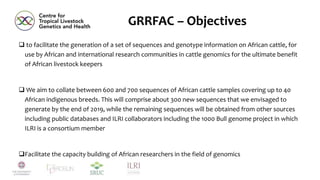
GRRFAC – Objectives
 to facilitate the generation of a set of sequences and genotype information on African cattle, for
use by African and international research communities in cattle genomics for the ultimate benefit
of African livestock keepers
 We aim to collate between 600 and 700 sequences of African cattle samples covering up to 40
African indigenous breeds. This will comprise about 300 new sequences that we envisaged to
generate by the end of 2019, while the remaining sequences will be obtained from other sources
including public databases and ILRI collaborators including the 1000 Bull genome project in which
ILRI is a consortium member
Facilitate the capacity building of African researchers in the field of genomics
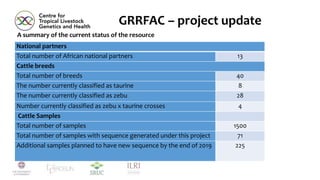
GRRFAC – project update
National partners
Total number of African national partners 13
Cattle breeds
Total number of breeds 40
The number currently classified as taurine 8
The number currently classified as zebu 28
Number currently classified as zebu x taurine crosses 4
Cattle Samples
Total number of samples 1500
Total number of samples with sequence generated under this project 71
Additional samples planned to have new sequence by the end of 2019 225
A summary of the current status of the resource
GRRFAC – project update
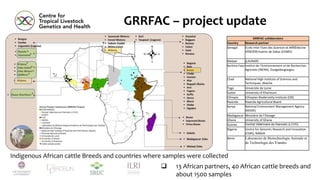
Indigenous African cattle Breeds and countries where samples were collected
GRRFAC collaborators
Country Research partner
Senegal Ecole Inter Etats des Sciences et Médecine
Vétérinaires de Dakar (EISMV)
Malawi (LAUNAR)
Burkina Faso Institut de l’Environnement et de Recherches
Agricoles (INERA), Ouagadougougou
Chad National High Institute of Sciences and
Techniques, Abeche
Togo Universite de Lome
Sudan University of Khartoum
Ethiopia Ethiopian Biodervisity Institute (EBI)
Rwanda Rwanda Agricultural Board
Kenya National Environment Management Agency
(NEMA)
Madagascar Ministère de l’Elevage
Ghana University of Ghana
Guinea Central Vétérinaire de Dianostic (LCVD)
Nigeria Centre for Genomic Research and Innovation
(CGRI), NABDA
Benin Laboratoire de Biotechnologie Animale et
de Technologie des Viandes
 13 African partners, 40 African cattle breeds and
about 1500 samples
GRRFAC – project update
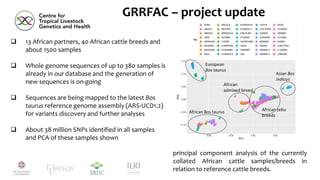
principal component analysis of the currently
collated African cattle samples/breeds in
relation to reference cattle breeds.
 13 African partners, 40 African cattle breeds and
about 1500 samples
 Whole genome sequences of up to 380 samples is
already in our database and the generation of
new sequences is on-going
 Sequences are being mapped to the latest Bos
taurus reference genome assembly (ARS-UCD1.2)
for variants discovery and further analyses
 About 38 million SNPs identified in all samples
and PCA of these samples shown
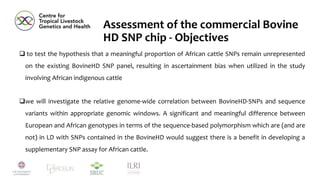
 to test the hypothesis that a meaningful proportion of African cattle SNPs remain unrepresented
on the existing BovineHD SNP panel, resulting in ascertainment bias when utilized in the study
involving African indigenous cattle
we will investigate the relative genome-wide correlation between BovineHD-SNPs and sequence
variants within appropriate genomic windows. A significant and meaningful difference between
European and African genotypes in terms of the sequence-based polymorphism which are (and are
not) in LD with SNPs contained in the BovineHD would suggest there is a benefit in developing a
supplementary SNP assay for African cattle.
Assessment of the commercial Bovine
HD SNP chip - Objectives
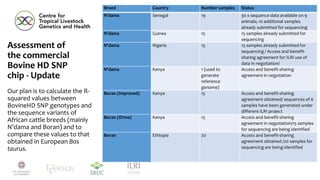
Our plan is to calculate the R-
squared values between
BovineHD SNP genotypes and
the sequence variants of
African cattle breeds (mainly
N’dama and Boran) and to
compare these values to that
obtained in European Bos
taurus.
Assessment of
the commercial
Bovine HD SNP
chip - Update
Breed Country Number samples Status
N’dama Senegal 19 30 x sequence data available on 9
animals; 10 additional samples
already submitted for sequencing
N’dama Guinea 15 15 samples already submitted for
sequencing
N’dama Nigeria 15 15 samples already submitted for
sequencing / Access and benefit-
sharing agreement for ILRI use of
data in negotiation/
N’dama Kenya 1 (used to
generate
reference
genome)
Access and benefit-sharing
agreement in negotiation
Boran (Improved) Kenya 15 Access and benefit-sharing
agreement obtained/ sequences of 6
samples have been generated under
different ILRI project
Boran (Orma) Kenya 15 Access and benefit-sharing
agreement in negotiation/15 samples
for sequencing are being identified
Boran Ethiopia 20 Access and benefit-sharing
agreement obtained /20 samples for
sequencing are being identified
Bovine HD SNP chip - Update
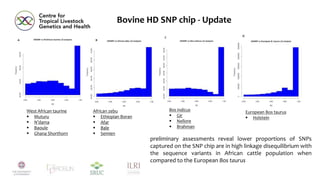
preliminary assessments reveal lower proportions of SNPs
captured on the SNP chip are in high linkage disequilibrium with
the sequence variants in African cattle population when
compared to the European Bos taurus
West African taurine
 Muturu
 N’dama
 Baoule
 Ghana Shorthorn
African zebu
 Ethiopian Boran
 Afar
 Bale
 Semien
Bos indicus
 Gir
 Nellore
 Brahman
European Bos taurus
 Holstein
 Genome-wide investigation of signature of positive selection underpinning adaptability/resilience
and productivity traits in African indigenous cattle
 Initial focus is on thermotolerance , trypanotolerance and milk production traits
 Several widely used selection scan approaches will be adopted for this investigation, including
1. Within-population tests (e.g. Integrated Haplotype Score (iHS), Composite Likelihood Ratio
(CLR), pooled heterozygosity (Hp), and
2. Between-population tests (eg. Population differentiation (FST), Cross-population Extended
Haplotype Homozygosity (XPEHH), Cross-population Composite Likelihood Ratio (XPCLR)
and Haplotype differentiation (hapFLK))
Signature of Selection analysis : Objectives
Signature of Selection analysis : Update
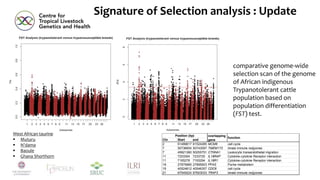
comparative genome-wide
selection scan of the genome
of African indigenous
Trypanotolerant cattle
population based on
population differentiation
(FST) test.
Chr Start end
2 61489617 61524285 MCM6 cell cycle
7 50736654 50743097 TMEM173 innate immune res[ponse
7 49921360 50255751 CTNNA1 Leukocyte transendothelial migration
11 7203304 7233720 IL18RAP Cytokine-cytokine Receptor interaction
11 7165278 7193294 IL18R1 Cytokine-cytokine Receptor interaction
19 27879985 27895903 PFAS Purine metabolism
19 40524612 40546357 CDC6 cell cycle
21 67549224 67603033 TRAF3 innate immune res[ponse
Position (bp) overlapping
gene
function
West African taurine
 Muturu
 N’dama
 Baoule
 Ghana Shorthorn
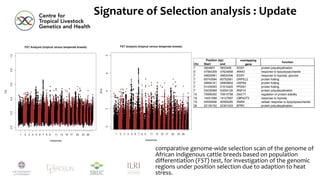
comparative genome-wide selection scan of the genome of
African indigenous cattle breeds based on population
differentiation (FST) test, for investigation of the genomic
regions under position selection due to adaption to heat
stress.
Signature of Selection analysis : Update
Chr Start end
1 3824601 3833406 SOD1 protein polyubiquitination
5 47564309 47624668 IRAK3 response to lipopolysaccharide
7 49825961 49830306 EGR1 response to hypoxia, glucose
7 60743594 60752561 GRPEL2 protein folding
7 49894161 49909804 HSPA9 protein folding
7 51435093 51510425 PFDN1 protein folding
7 53035569 53054126 RNF14 protein polyubiquitination
10 70906350 70915756 DACT1 regulation of protein stability
18 14051588 14127897 CBFA2T3 response to hypoxia
19 40559946 40595285 RARA cellular response to lipopolysaccharide
26 22130152 22301533 BTRC protein polyubiquitination
Position (bp) overlapping
gene
function
Continued efforts are being undertaken to ensure the resource is compliant re-access and benefit-
sharing legislation of provider countries (i.e. the African partner countries), as well as user countries
(Kenya and the United Kingdom)
Discussions with partners are on-going in relation to establishing a consortium around the obtained
samples and data generated.
 sequencing of more samples are expected soonest and much more samples are being prepared for
sequencing
 further downstream analysis will be performed to meet set objectives
Going forward . . . . . .
Olivier Hanotte
Karen Marshall
 James Prendergast
Kellie Watson
Acknowledgements
CTLGH Funders
www.ctlgh.org

African cattle genomic reference resource, SNP assays, and signatures of selection

  • 1.
    African cattle genomicreference resource, SNP assays, and signatures of selection Speaker name: Abdulfatai Tijjani Speaker organisation/s: ILRI – Addis Ababa Investigators: Karen Marshall (ILRI), Kellie Watson (CTLGH), James Prendergast (Roslin) and Olivier Hanotte (ILRI) CTLGH Annual Meeting, Edinburgh, 24-25 September 2019
  • 2.
     Genomic referenceresource for African cattle (GRRFAC)  Assessment of the commercial Bovine HD SNP chip  Genome-wide scans for signatures of positive selection in African cattle Outline
  • 3.
    GRRFAC – Objectives to facilitate the generation of a set of sequences and genotype information on African cattle, for use by African and international research communities in cattle genomics for the ultimate benefit of African livestock keepers  We aim to collate between 600 and 700 sequences of African cattle samples covering up to 40 African indigenous breeds. This will comprise about 300 new sequences that we envisaged to generate by the end of 2019, while the remaining sequences will be obtained from other sources including public databases and ILRI collaborators including the 1000 Bull genome project in which ILRI is a consortium member Facilitate the capacity building of African researchers in the field of genomics
  • 4.
    GRRFAC – projectupdate National partners Total number of African national partners 13 Cattle breeds Total number of breeds 40 The number currently classified as taurine 8 The number currently classified as zebu 28 Number currently classified as zebu x taurine crosses 4 Cattle Samples Total number of samples 1500 Total number of samples with sequence generated under this project 71 Additional samples planned to have new sequence by the end of 2019 225 A summary of the current status of the resource
  • 5.
    GRRFAC – projectupdate Indigenous African cattle Breeds and countries where samples were collected GRRFAC collaborators Country Research partner Senegal Ecole Inter Etats des Sciences et Médecine Vétérinaires de Dakar (EISMV) Malawi (LAUNAR) Burkina Faso Institut de l’Environnement et de Recherches Agricoles (INERA), Ouagadougougou Chad National High Institute of Sciences and Techniques, Abeche Togo Universite de Lome Sudan University of Khartoum Ethiopia Ethiopian Biodervisity Institute (EBI) Rwanda Rwanda Agricultural Board Kenya National Environment Management Agency (NEMA) Madagascar Ministère de l’Elevage Ghana University of Ghana Guinea Central Vétérinaire de Dianostic (LCVD) Nigeria Centre for Genomic Research and Innovation (CGRI), NABDA Benin Laboratoire de Biotechnologie Animale et de Technologie des Viandes  13 African partners, 40 African cattle breeds and about 1500 samples
  • 6.
    GRRFAC – projectupdate principal component analysis of the currently collated African cattle samples/breeds in relation to reference cattle breeds.  13 African partners, 40 African cattle breeds and about 1500 samples  Whole genome sequences of up to 380 samples is already in our database and the generation of new sequences is on-going  Sequences are being mapped to the latest Bos taurus reference genome assembly (ARS-UCD1.2) for variants discovery and further analyses  About 38 million SNPs identified in all samples and PCA of these samples shown
  • 7.
     to testthe hypothesis that a meaningful proportion of African cattle SNPs remain unrepresented on the existing BovineHD SNP panel, resulting in ascertainment bias when utilized in the study involving African indigenous cattle we will investigate the relative genome-wide correlation between BovineHD-SNPs and sequence variants within appropriate genomic windows. A significant and meaningful difference between European and African genotypes in terms of the sequence-based polymorphism which are (and are not) in LD with SNPs contained in the BovineHD would suggest there is a benefit in developing a supplementary SNP assay for African cattle. Assessment of the commercial Bovine HD SNP chip - Objectives
  • 8.
    Our plan isto calculate the R- squared values between BovineHD SNP genotypes and the sequence variants of African cattle breeds (mainly N’dama and Boran) and to compare these values to that obtained in European Bos taurus. Assessment of the commercial Bovine HD SNP chip - Update Breed Country Number samples Status N’dama Senegal 19 30 x sequence data available on 9 animals; 10 additional samples already submitted for sequencing N’dama Guinea 15 15 samples already submitted for sequencing N’dama Nigeria 15 15 samples already submitted for sequencing / Access and benefit- sharing agreement for ILRI use of data in negotiation/ N’dama Kenya 1 (used to generate reference genome) Access and benefit-sharing agreement in negotiation Boran (Improved) Kenya 15 Access and benefit-sharing agreement obtained/ sequences of 6 samples have been generated under different ILRI project Boran (Orma) Kenya 15 Access and benefit-sharing agreement in negotiation/15 samples for sequencing are being identified Boran Ethiopia 20 Access and benefit-sharing agreement obtained /20 samples for sequencing are being identified
  • 9.
    Bovine HD SNPchip - Update preliminary assessments reveal lower proportions of SNPs captured on the SNP chip are in high linkage disequilibrium with the sequence variants in African cattle population when compared to the European Bos taurus West African taurine  Muturu  N’dama  Baoule  Ghana Shorthorn African zebu  Ethiopian Boran  Afar  Bale  Semien Bos indicus  Gir  Nellore  Brahman European Bos taurus  Holstein
  • 10.
     Genome-wide investigationof signature of positive selection underpinning adaptability/resilience and productivity traits in African indigenous cattle  Initial focus is on thermotolerance , trypanotolerance and milk production traits  Several widely used selection scan approaches will be adopted for this investigation, including 1. Within-population tests (e.g. Integrated Haplotype Score (iHS), Composite Likelihood Ratio (CLR), pooled heterozygosity (Hp), and 2. Between-population tests (eg. Population differentiation (FST), Cross-population Extended Haplotype Homozygosity (XPEHH), Cross-population Composite Likelihood Ratio (XPCLR) and Haplotype differentiation (hapFLK)) Signature of Selection analysis : Objectives
  • 11.
    Signature of Selectionanalysis : Update comparative genome-wide selection scan of the genome of African indigenous Trypanotolerant cattle population based on population differentiation (FST) test. Chr Start end 2 61489617 61524285 MCM6 cell cycle 7 50736654 50743097 TMEM173 innate immune res[ponse 7 49921360 50255751 CTNNA1 Leukocyte transendothelial migration 11 7203304 7233720 IL18RAP Cytokine-cytokine Receptor interaction 11 7165278 7193294 IL18R1 Cytokine-cytokine Receptor interaction 19 27879985 27895903 PFAS Purine metabolism 19 40524612 40546357 CDC6 cell cycle 21 67549224 67603033 TRAF3 innate immune res[ponse Position (bp) overlapping gene function West African taurine  Muturu  N’dama  Baoule  Ghana Shorthorn
  • 12.
    comparative genome-wide selectionscan of the genome of African indigenous cattle breeds based on population differentiation (FST) test, for investigation of the genomic regions under position selection due to adaption to heat stress. Signature of Selection analysis : Update Chr Start end 1 3824601 3833406 SOD1 protein polyubiquitination 5 47564309 47624668 IRAK3 response to lipopolysaccharide 7 49825961 49830306 EGR1 response to hypoxia, glucose 7 60743594 60752561 GRPEL2 protein folding 7 49894161 49909804 HSPA9 protein folding 7 51435093 51510425 PFDN1 protein folding 7 53035569 53054126 RNF14 protein polyubiquitination 10 70906350 70915756 DACT1 regulation of protein stability 18 14051588 14127897 CBFA2T3 response to hypoxia 19 40559946 40595285 RARA cellular response to lipopolysaccharide 26 22130152 22301533 BTRC protein polyubiquitination Position (bp) overlapping gene function
  • 13.
    Continued efforts arebeing undertaken to ensure the resource is compliant re-access and benefit- sharing legislation of provider countries (i.e. the African partner countries), as well as user countries (Kenya and the United Kingdom) Discussions with partners are on-going in relation to establishing a consortium around the obtained samples and data generated.  sequencing of more samples are expected soonest and much more samples are being prepared for sequencing  further downstream analysis will be performed to meet set objectives Going forward . . . . . .
  • 14.
    Olivier Hanotte Karen Marshall James Prendergast Kellie Watson Acknowledgements
  • 15.
  • 16.