CT HEAD SCAN
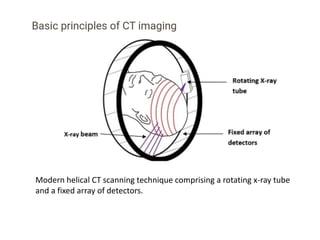
Modern helical CT scanning technique comprising a rotating x-ray tube
and a fixed array of detectors.
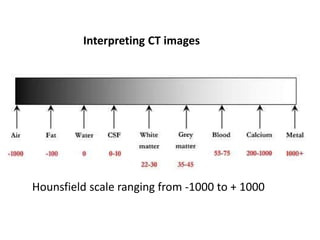
Hounsfield scale ranging from -1000 to + 1000
Interpreting CT images
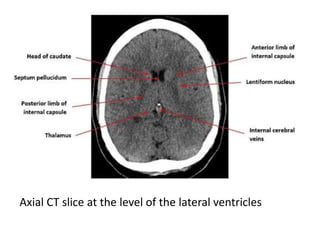
Axial CT slice at the level of the lateral ventricles
Axial CT slice at the level of the third ventricle
Axial CT slice at the level of the pituitary fossa
Axial CT slice at the level of the pons
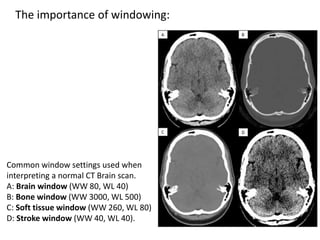
The importance of windowing:
Common window settings used when
interpreting a normal CT Brain scan.
A: Brain window (WW 80, WL 40)
B: Bone window (WW 3000, WL 500)
C: Soft tissue window (WW 260, WL 80)
D: Stroke window (WW 40, WL 40).
Hydrocephalus results from an excess of CSF, due to an
imbalance between CSF production and absorption, resulting
in increased intraventricular pressure.
B - blood
C - cisterns
B - brain
V - ventricles
B - bones
Blood Can Be Very Bad is a mnemonic that can be used
when faced with interpreting a CT head scan:
Blood
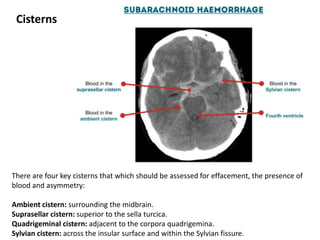
Cisterns
There are four key cisterns that which should be assessed for effacement, the presence of
blood and asymmetry:
Ambient cistern: surrounding the midbrain.
Suprasellar cistern: superior to the sella turcica.
Quadrigeminal cistern: adjacent to the corpora quadrigemina.
Sylvian cistern: across the insular surface and within the Sylvian fissure.
Brain
Ventricles
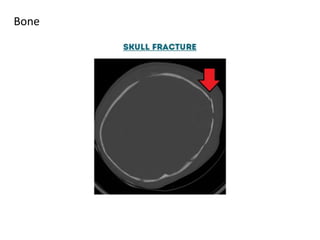
Bone
THANK YOU

CT scan.pptx

  • 1.
  • 2.
    Modern helical CTscanning technique comprising a rotating x-ray tube and a fixed array of detectors.
  • 3.
    Hounsfield scale rangingfrom -1000 to + 1000 Interpreting CT images
  • 7.
    Axial CT sliceat the level of the lateral ventricles
  • 8.
    Axial CT sliceat the level of the third ventricle
  • 9.
    Axial CT sliceat the level of the pituitary fossa
  • 10.
    Axial CT sliceat the level of the pons
  • 11.
    The importance ofwindowing: Common window settings used when interpreting a normal CT Brain scan. A: Brain window (WW 80, WL 40) B: Bone window (WW 3000, WL 500) C: Soft tissue window (WW 260, WL 80) D: Stroke window (WW 40, WL 40).
  • 12.
    Hydrocephalus results froman excess of CSF, due to an imbalance between CSF production and absorption, resulting in increased intraventricular pressure. B - blood C - cisterns B - brain V - ventricles B - bones Blood Can Be Very Bad is a mnemonic that can be used when faced with interpreting a CT head scan:
  • 13.
  • 14.
    Cisterns There are fourkey cisterns that which should be assessed for effacement, the presence of blood and asymmetry: Ambient cistern: surrounding the midbrain. Suprasellar cistern: superior to the sella turcica. Quadrigeminal cistern: adjacent to the corpora quadrigemina. Sylvian cistern: across the insular surface and within the Sylvian fissure.
  • 15.
  • 16.
  • 17.
  • 19.