Law and Science in Japan:
from a viewpoint of legal philosophy

                      2013.3.11 CSTL Meeting


Fumiaki Kobayashi (Meiji University, speaker)
          Takayuki Kira (Tokiwa University)


                                            1
Purpose of this Presentation

 To explain the social circumstance in Japan
 after “3.11”

  To explain the aim of our research project
 from viewpoints of legal philosophy
 and STS (Science, Technology and Society)

→ What role can “Law and Science” studies
  take in Japan ?

                                               2
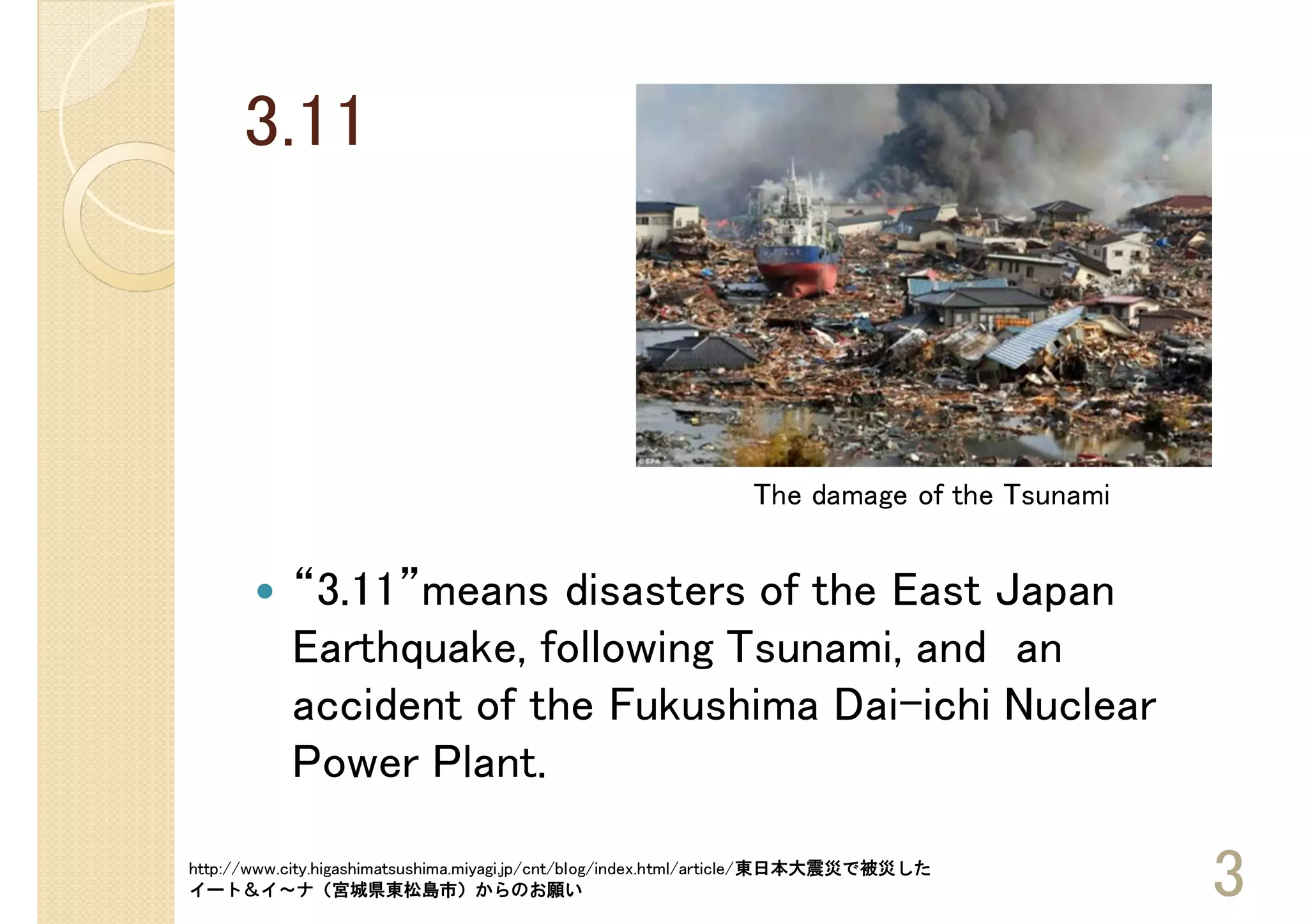
3.11


                                                               The damage of the Tsunami


           “3.11”means disasters of the East Japan
           Earthquake, following Tsunami, and an
           accident of the Fukushima Dai-ichi Nuclear
           Power Plant.

http://www.city.higashimatsushima.miyagi.jp/cnt/blog/index.html/article/東日本大震災で被災した
イート&イ~ナ(宮城県東松島市)からのお願い                                                                     3
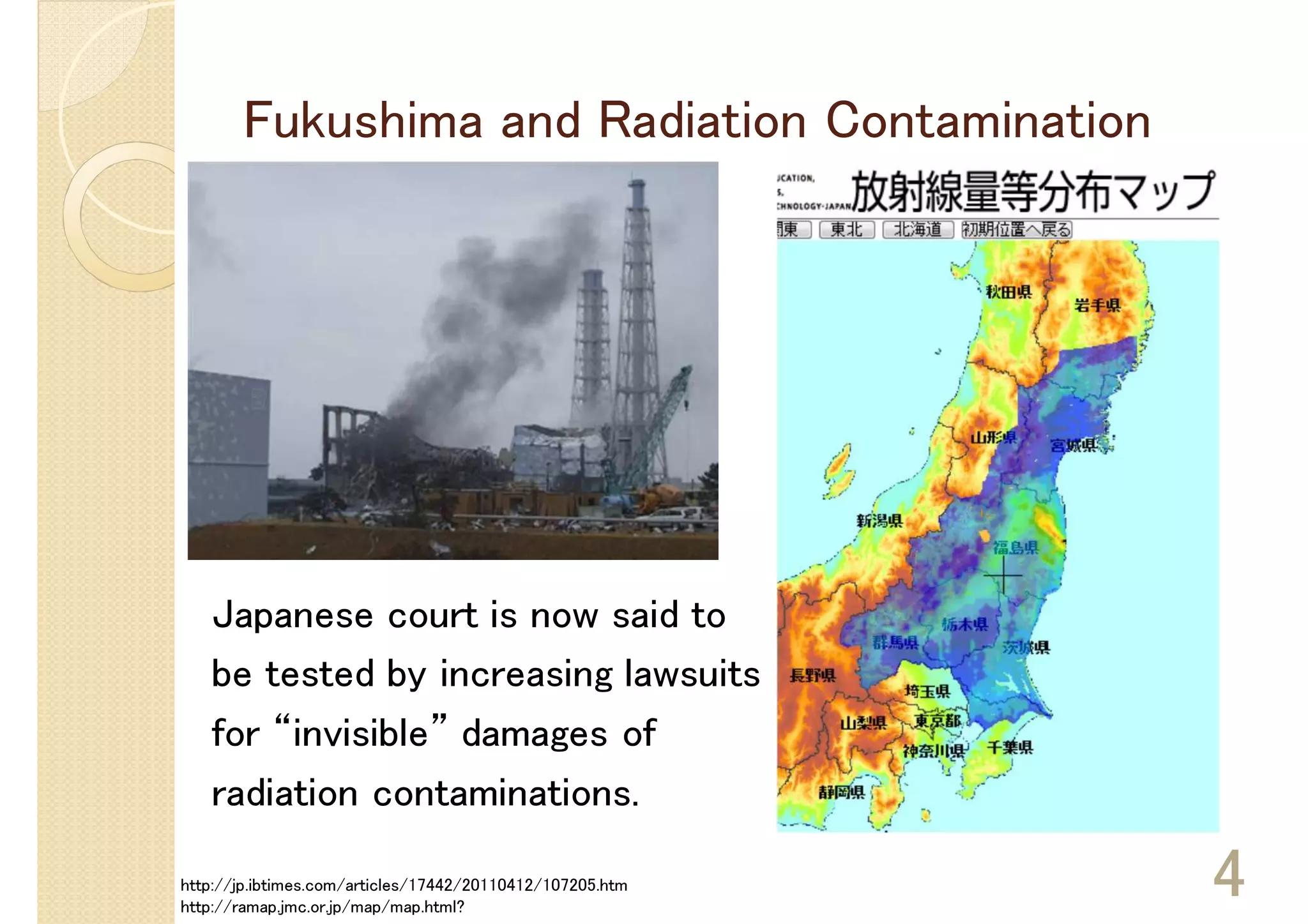
Fukushima and Radiation Contamination


   Japanese court is now said to
   be tested by increasing lawsuits
   for “invisible” damages of
   radiation contaminations.

http://jp.ibtimes.com/articles/17442/20110412/107205.htm
http://ramap.jmc.or.jp/map/map.html?
                                                           4
New Social Issues
  “Fukushima” accident and radiation
  contamination brought enormous and
  invisible fear to many Japanese people
  and makes them distrust scientist and
  technicians in general, not only those who
  have supported nuclear energy policy

If scientist and technicians, or politicians and
administrators are all incredible...,
whom can we trust ? Judges (by elimination) ?
                                                   5
New Legal Issues 1
            Our research project has focused
            on “Legal Decision-making under
            Scientific Uncertainty”


       ex. Lawsuit for injunction of…
         nuclear plant activation
         distribution of genetically-modified crop
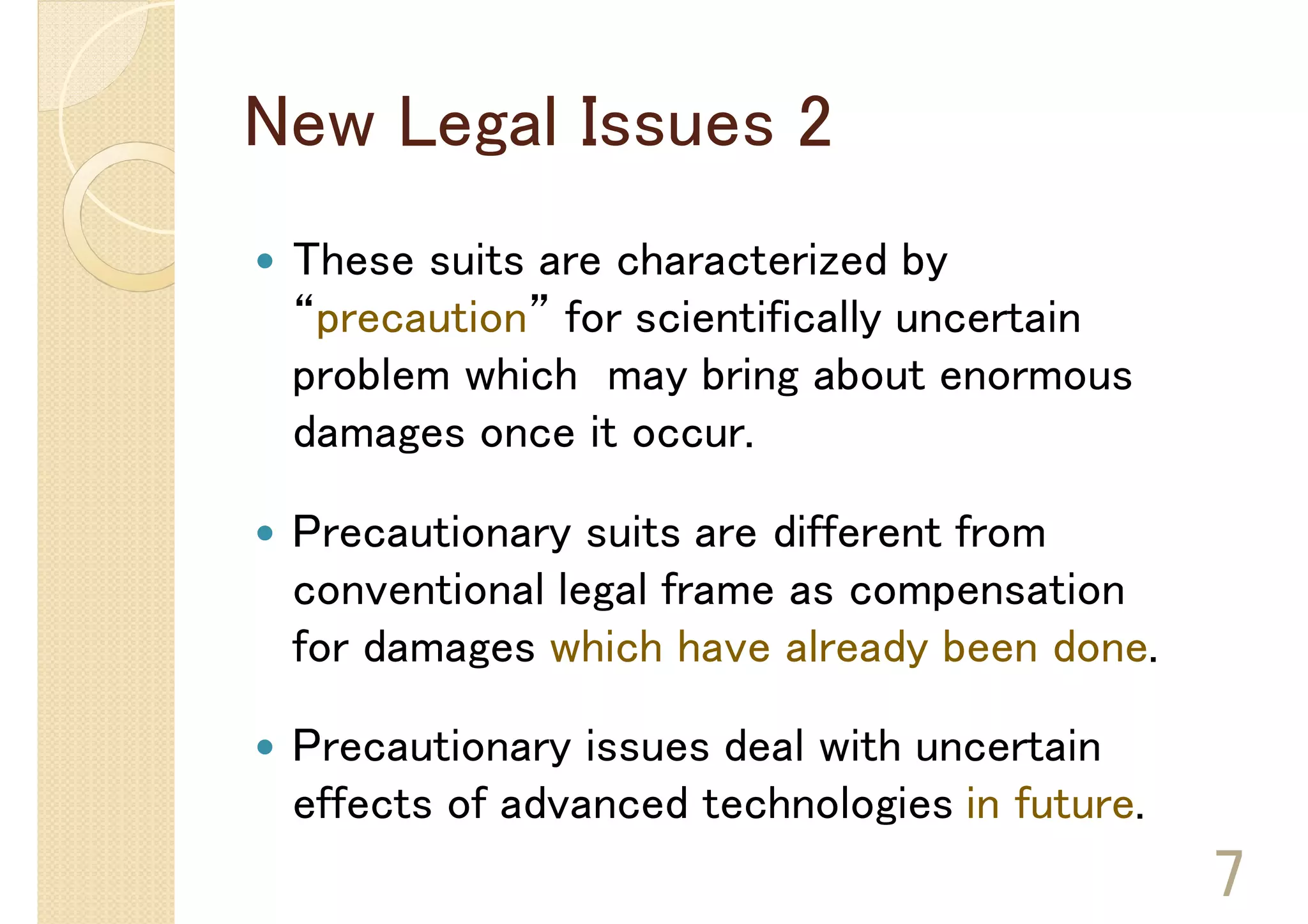
         building of a tower for electromagnetic wave

http://blog.jcan.jp/k1295/12331/                        6
New Legal Issues 2
 These suits are characterized by
 “precaution” for scientifically uncertain
 problem which may bring about enormous
 damages once it occur.

 Precautionary suits are different from
 conventional legal frame as compensation
 for damages which have already been done.

 Precautionary issues deal with uncertain
 effects of advanced technologies in future.
                                               7
How and Who Can Decide ?
 Judges are not experts of advanced science
 and technology, and don’t have enough
 knowledge.
 It is necessary for lawyers and scientists to
 co-operate together toward scientifically valid
 legal decision-making,
…but how can do it ?
 ◦ Many scientists in court regard lawyers as those
   who urge to answer “Yes-No Question” and distort
   scientific truth for their interests in suits....

                                                   8
Undoing Hard View of
Law/Science
 To dissolve such problems, we thought it is
 necessary to undo too hard view of lawyers for
 science and it of scientists for law.
  ◦ Ex. Such an unreal assumptions that science (or law)
    can dissolve any issues all alone, or that scientific proof
    permit no doubt (notorious Lumbar Sentence in 1974)

 As its beginning point, we made The Handbook of
 Law and Science in order to resolve mutual
 misunderstandings and over-expectations.
→ Please see the list of contents.

                                                                  9
Beyond Conventional Adversary System?

             For productive co-operation of lawyers and
             scientists, and for legitimate legal decision-making,
             what constructional changes are needed?
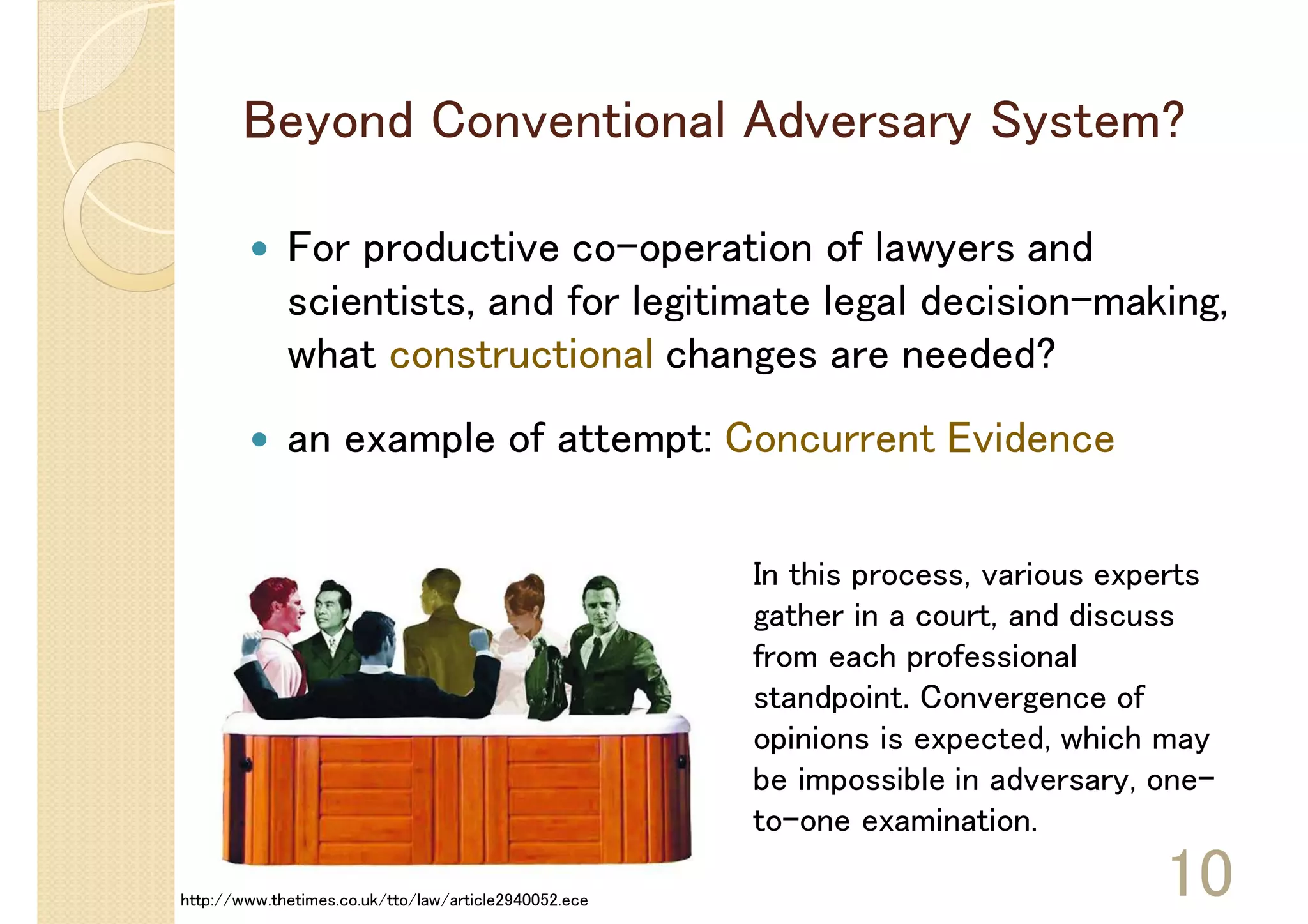
             an example of attempt: Concurrent Evidence

                                                       In this process, various experts
                                                       gather in a court, and discuss
                                                       from each professional
                                                       standpoint. Convergence of
                                                       opinions is expected, which may
                                                       be impossible in adversary, one-
                                                       to-one examination.

http://www.thetimes.co.uk/tto/law/article2940052.ece
                                                                                   10
Common Problems in East Asia

              Precautionary lawsuits will increase as science
              and technology progress.
         → In particular, nuclear energy policy will be focused on.


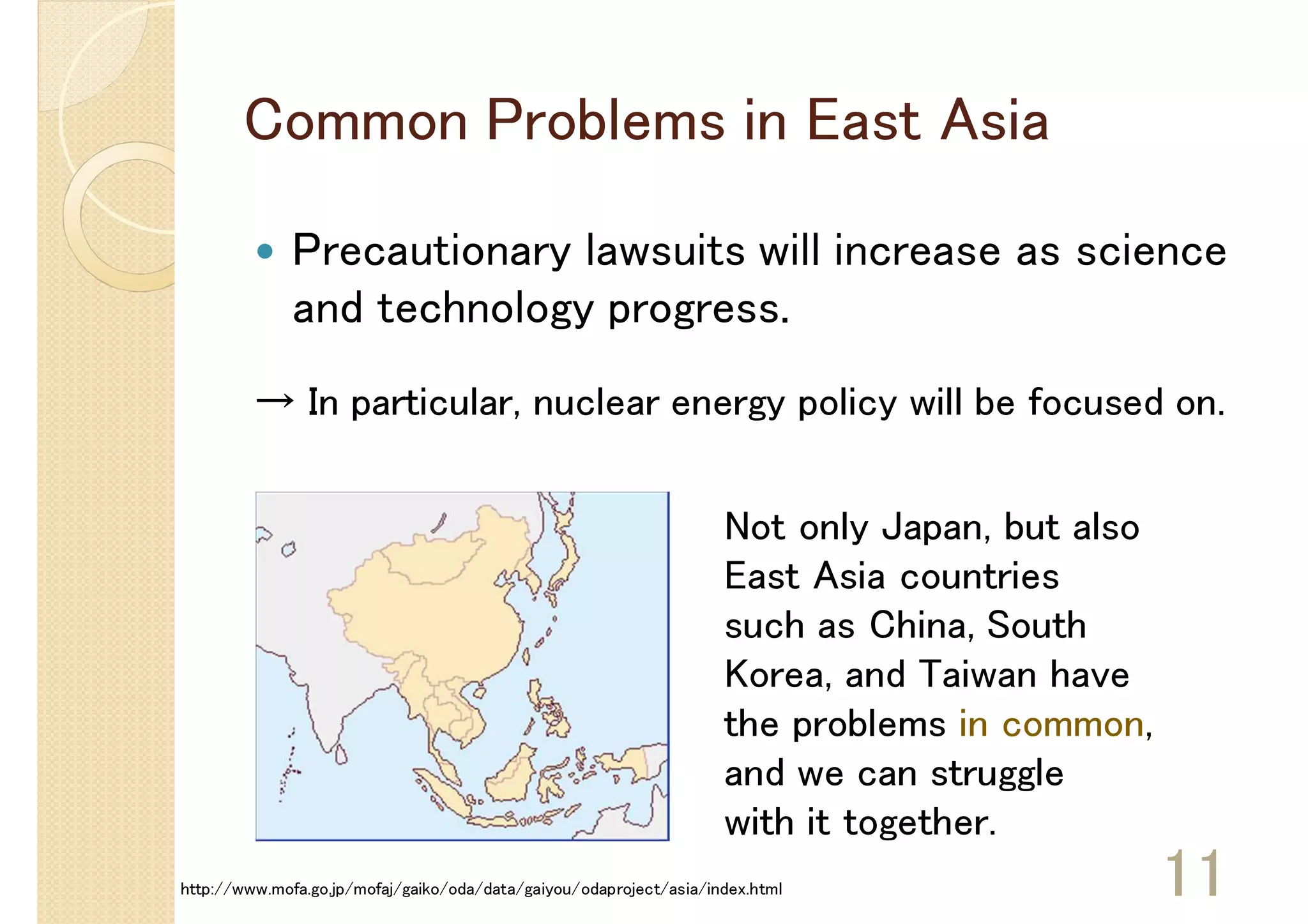
                                                                    Not only Japan, but also
                                                                    East Asia countries
                                                                    such as China, South
                                                                    Korea, and Taiwan have
                                                                    the problems in common,
                                                                    and we can struggle
                                                                    with it together.
http://www.mofa.go.jp/mofaj/gaiko/oda/data/gaiyou/odaproject/asia/index.html                   11
Global Justice in Energy Policy
 Japanese Energy policy is now seeking
  the possibility of post-nuclear age
 but other east Asia countries are still building
 nuclear power plants.

 Can only rich countries abandon such
 dangerous nuclear power plants and
 “transport” it to developing countries ?
 This can be a problem of “global justice”

                                               12

2013.03.11 CSTL meeting

  • 1.
    Law and Sciencein Japan: from a viewpoint of legal philosophy 2013.3.11 CSTL Meeting Fumiaki Kobayashi (Meiji University, speaker) Takayuki Kira (Tokiwa University) 1
  • 2.
    Purpose of thisPresentation To explain the social circumstance in Japan after “3.11” To explain the aim of our research project from viewpoints of legal philosophy and STS (Science, Technology and Society) → What role can “Law and Science” studies take in Japan ? 2
  • 3.
    3.11 The damage of the Tsunami “3.11”means disasters of the East Japan Earthquake, following Tsunami, and an accident of the Fukushima Dai-ichi Nuclear Power Plant. http://www.city.higashimatsushima.miyagi.jp/cnt/blog/index.html/article/東日本大震災で被災した イート&イ~ナ(宮城県東松島市)からのお願い 3
  • 4.
    Fukushima and RadiationContamination Japanese court is now said to be tested by increasing lawsuits for “invisible” damages of radiation contaminations. http://jp.ibtimes.com/articles/17442/20110412/107205.htm http://ramap.jmc.or.jp/map/map.html? 4
  • 5.
    New Social Issues “Fukushima” accident and radiation contamination brought enormous and invisible fear to many Japanese people and makes them distrust scientist and technicians in general, not only those who have supported nuclear energy policy If scientist and technicians, or politicians and administrators are all incredible..., whom can we trust ? Judges (by elimination) ? 5
  • 6.
    New Legal Issues1 Our research project has focused on “Legal Decision-making under Scientific Uncertainty” ex. Lawsuit for injunction of… nuclear plant activation distribution of genetically-modified crop building of a tower for electromagnetic wave http://blog.jcan.jp/k1295/12331/ 6
  • 7.
    New Legal Issues2 These suits are characterized by “precaution” for scientifically uncertain problem which may bring about enormous damages once it occur. Precautionary suits are different from conventional legal frame as compensation for damages which have already been done. Precautionary issues deal with uncertain effects of advanced technologies in future. 7
  • 8.
    How and WhoCan Decide ? Judges are not experts of advanced science and technology, and don’t have enough knowledge. It is necessary for lawyers and scientists to co-operate together toward scientifically valid legal decision-making, …but how can do it ? ◦ Many scientists in court regard lawyers as those who urge to answer “Yes-No Question” and distort scientific truth for their interests in suits.... 8
  • 9.
    Undoing Hard Viewof Law/Science To dissolve such problems, we thought it is necessary to undo too hard view of lawyers for science and it of scientists for law. ◦ Ex. Such an unreal assumptions that science (or law) can dissolve any issues all alone, or that scientific proof permit no doubt (notorious Lumbar Sentence in 1974) As its beginning point, we made The Handbook of Law and Science in order to resolve mutual misunderstandings and over-expectations. → Please see the list of contents. 9
  • 10.
    Beyond Conventional AdversarySystem? For productive co-operation of lawyers and scientists, and for legitimate legal decision-making, what constructional changes are needed? an example of attempt: Concurrent Evidence In this process, various experts gather in a court, and discuss from each professional standpoint. Convergence of opinions is expected, which may be impossible in adversary, one- to-one examination. http://www.thetimes.co.uk/tto/law/article2940052.ece 10
  • 11.
    Common Problems inEast Asia Precautionary lawsuits will increase as science and technology progress. → In particular, nuclear energy policy will be focused on. Not only Japan, but also East Asia countries such as China, South Korea, and Taiwan have the problems in common, and we can struggle with it together. http://www.mofa.go.jp/mofaj/gaiko/oda/data/gaiyou/odaproject/asia/index.html 11
  • 12.
    Global Justice inEnergy Policy Japanese Energy policy is now seeking the possibility of post-nuclear age but other east Asia countries are still building nuclear power plants. Can only rich countries abandon such dangerous nuclear power plants and “transport” it to developing countries ? This can be a problem of “global justice” 12