Normative Range Problem
on Intergenerational Justice
22 Mar 2019
International Workshop on Meta-Science & Technology,
Kobe University, Japan.
Takayuki Kira
(吉良 貴之)
Utsunomiya Kyowa Univ., JP
jj57010@gmail.com
SNS: tkira26
JSPS Grant Number: 18K12616
[My website]
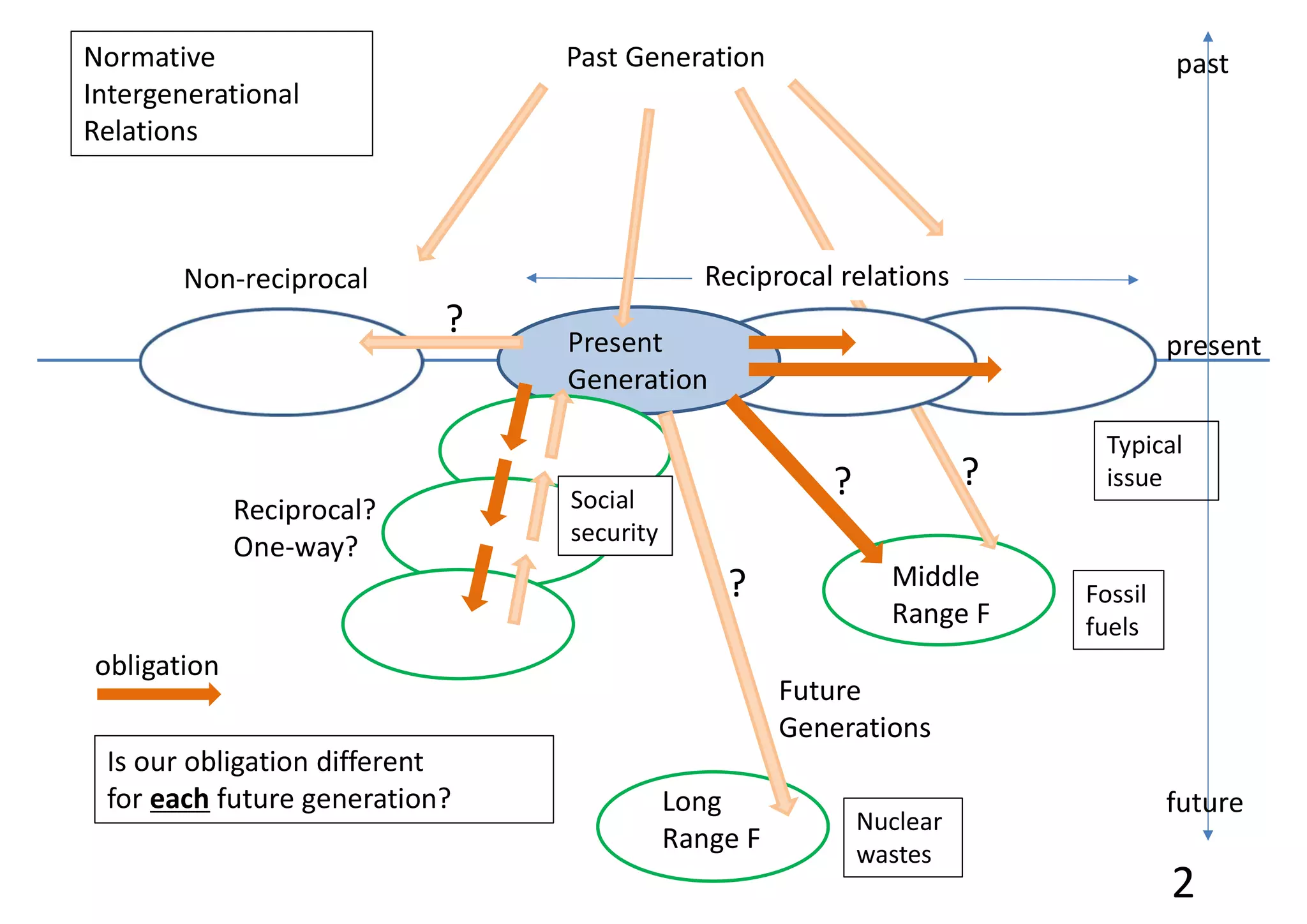
Reciprocal?
One-way?
2
Reciprocal relationsNon-reciprocal
Present
Generation
?
Future
Generations
?
?
Past Generation
obligation
Normative
Intergenerational
Relations
Middle
Range F
Long
Range F
past
future
present
Is our obligation different
for each future generation?
?
Fossil
fuels
Nuclear
wastes
Social
security
Typical
issue
Introduction
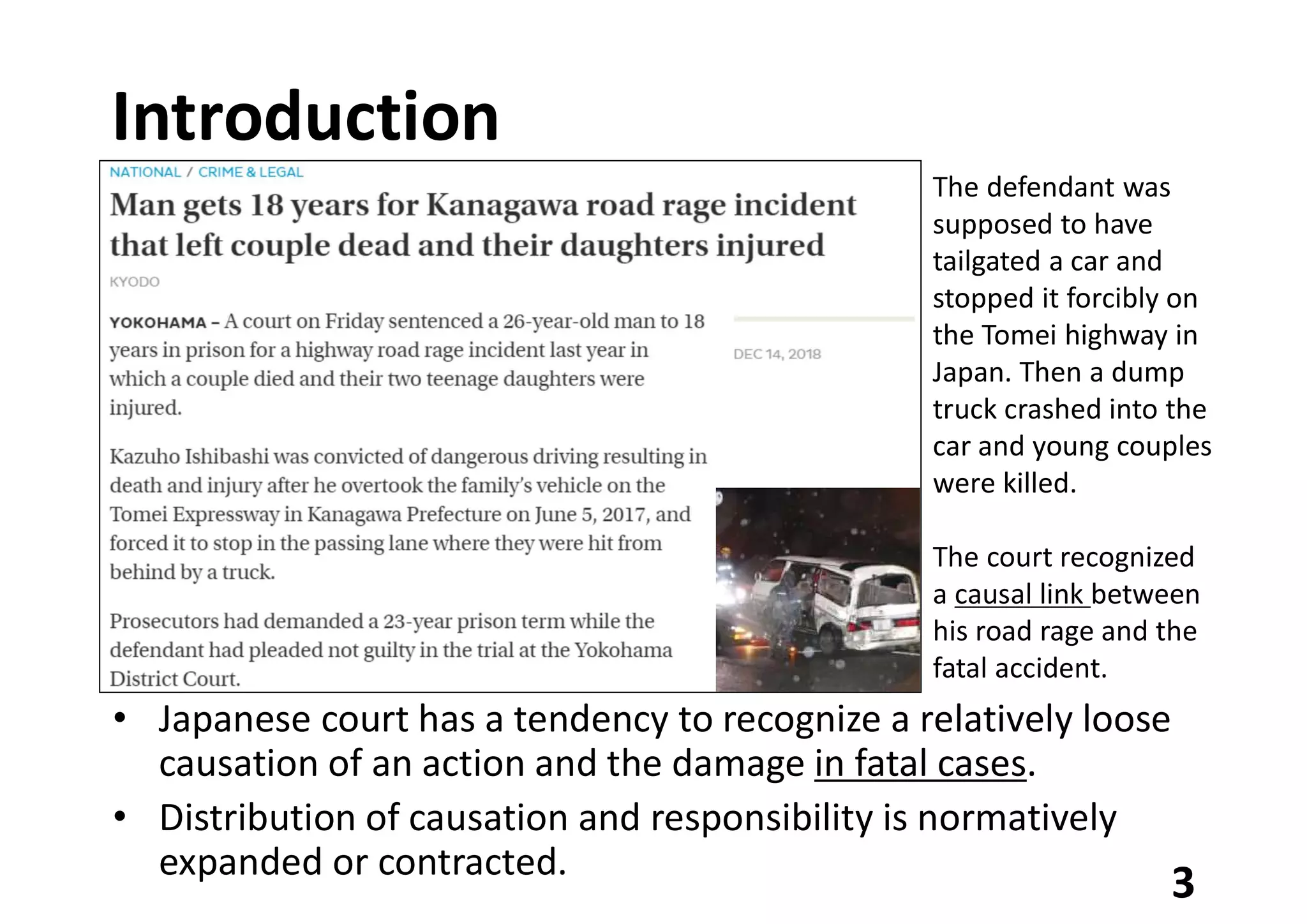
• Japanese court has a tendency to recognize a relatively loose
causation of an action and the damage in fatal cases.
• Distribution of causation and responsibility is normatively
expanded or contracted.
3
The defendant was
supposed to have
tailgated a car and
stopped it forcibly on
the Tomei highway in
Japan. Then a dump
truck crashed into the
car and young couples
were killed.
The court recognized
a causal link between
his road rage and the
fatal accident.
(non-)identity problem
in causation and agencies
• Parfit (1983) presented the famous “non-identity problem.”
• According to him, our care to future beings will change their
genetic identity, and the original object will be vanished.
• This paradox has been regarded as a serious obstacle to
“person-affecting-principle-based” intergenerational theories.
• This paradox resulted from a conception of gene-based,
restricted human identity (inspired by Kripke).
• Our sense of identity (of person, causation, responsibility,
etc.) is expanded or contracted on a case by case basis.
• Particularly in fatal circumstances, it will be extremely
loosened.
4
However….
Purpose of this presentation
In keeping with it….
• Examining “intergenerational justice (for short, IJ )”
from a view of legal philosophy
• Can we justify our normative relation to future
generation, or non-existence ?
• If possible, then, how far? (distance of the “future”)
• The normative range problem has been often
dismissed in the discussion of IJ, but it matters.
5
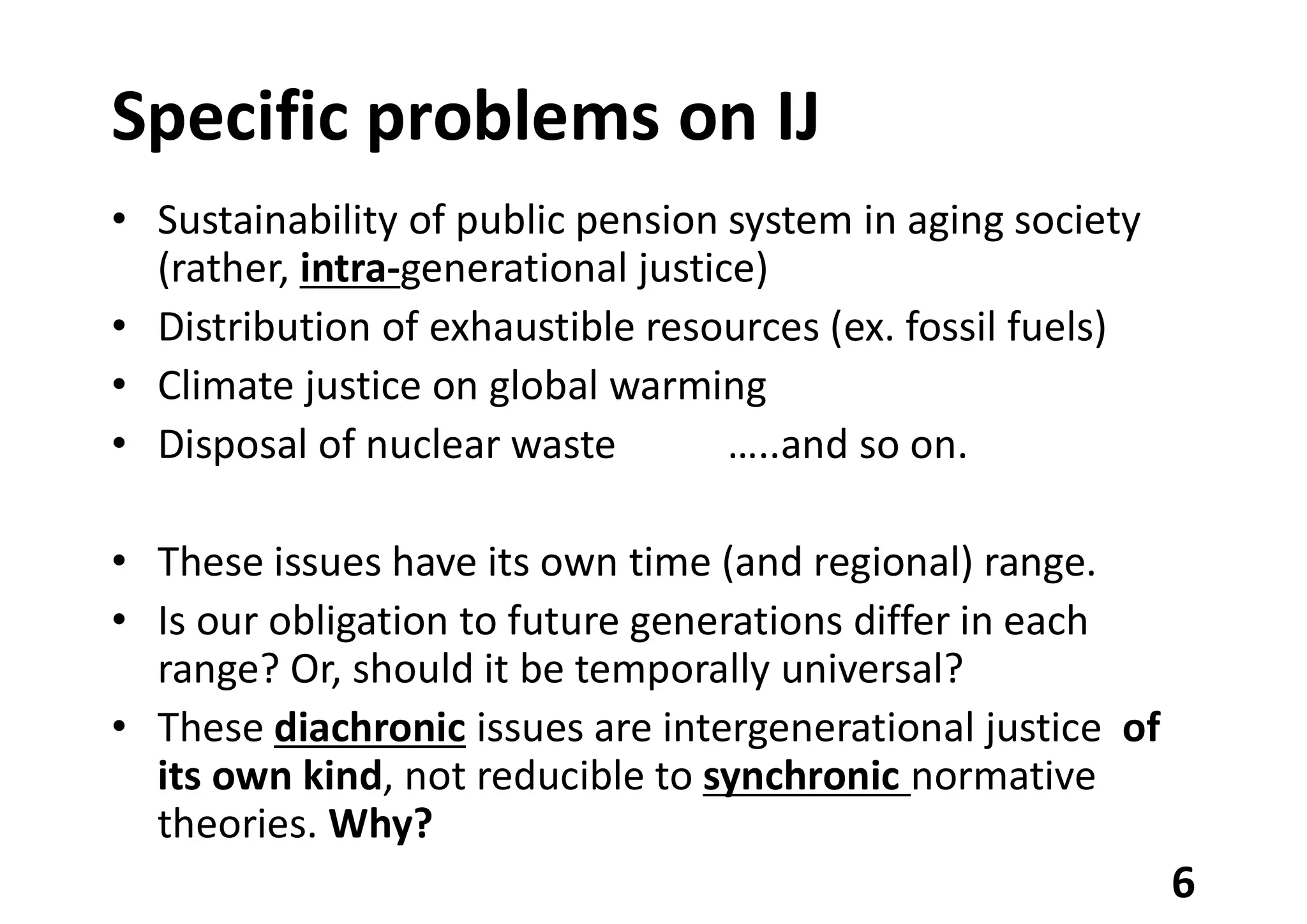
Specific problems on IJ
• Sustainability of public pension system in aging society
(rather, intra-generational justice)
• Distribution of exhaustible resources (ex. fossil fuels)
• Climate justice on global warming
• Disposal of nuclear waste …..and so on.
• These issues have its own time (and regional) range.
• Is our obligation to future generations differ in each
range? Or, should it be temporally universal?
• These diachronic issues are intergenerational justice of
its own kind, not reducible to synchronic normative
theories. Why?
6
Particular problems of IJ
• In general, if the time distance of the normative
relation (here, present and future generations) is
extended, IJ will be more difficult.
• Why? – the features are uncertain and issue-relative
– Uncertainty of the number and identity of the
affected people in future [Parfit 1983]
– Changeability of the preferences of future people
– Priority problem with contemporary distributive
justice
7
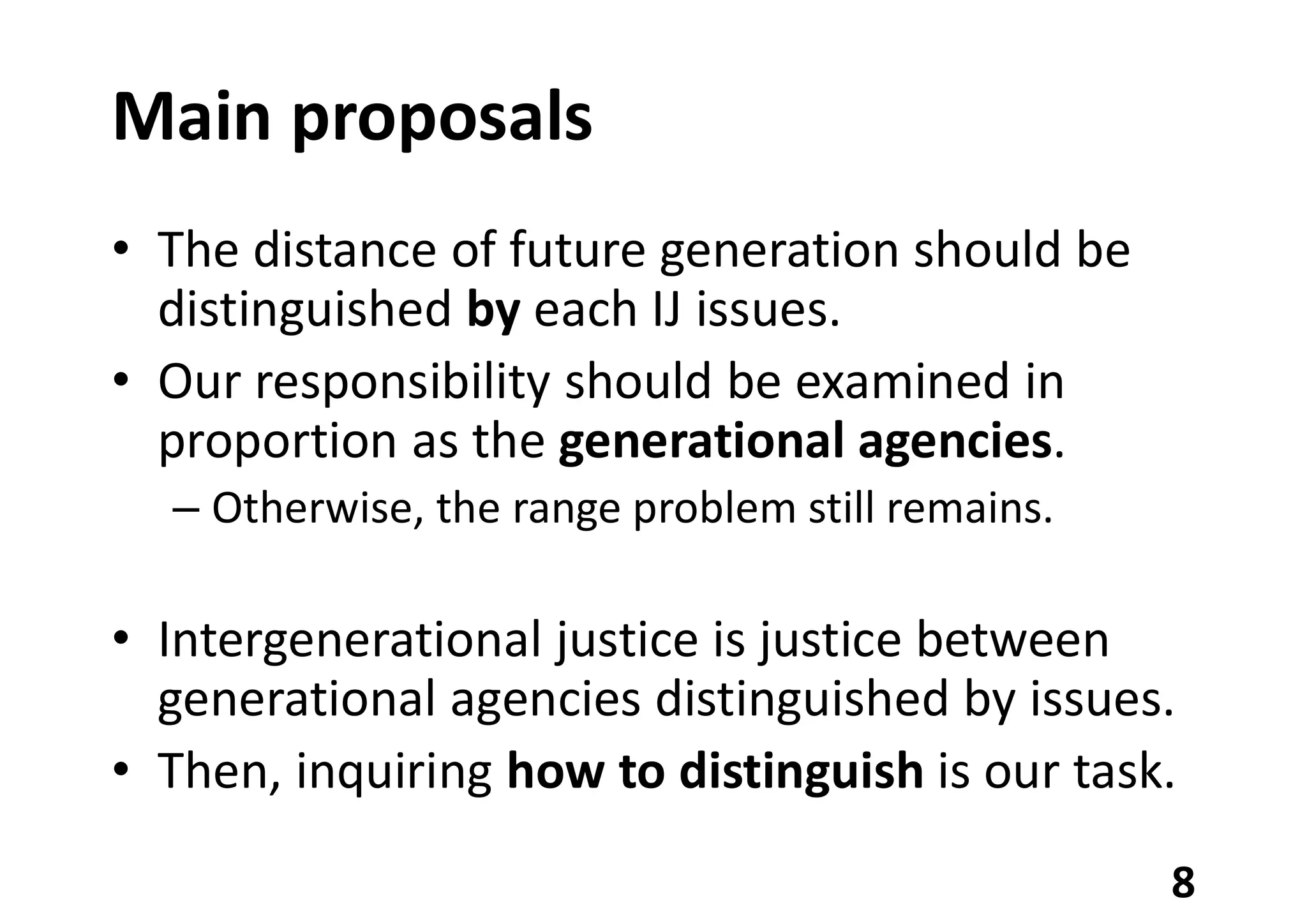
Main proposals
• The distance of future generation should be
distinguished by each IJ issues.
• Our responsibility should be examined in
proportion as the generational agencies.
– Otherwise, the range problem still remains.
• Intergenerational justice is justice between
generational agencies distinguished by issues.
• Then, inquiring how to distinguish is our task.
8
Approach and institutional design
[Approach]
• Showing the theoretical limits of reciprocal/universal
approach in IJ with regard to range problem
• Adapting one-way approach (ex. Jonas’s
responsibility) and articulating the ranges [Jonas 1979]
[Institutional design]
• Identifying the most appropriate legal branch for
each IJ issues [Vermeule 2014]
– Under what institutions, can we deliberate well on value
conflict issues, i.e. about disposal of nuclear waste?
9
Contemporary Circumstance:
From Kyoto to Paris
About 20 years later…
[Paris Agreement 2015]
• Now, preventing global warming is
understood not just as duty of
advanced countries but as universal
responsibility.
– Macron “Make our planet great again.”
10
[Kyoto Protocol 1997]
Compromise resolution of the conflict
among advanced and developing
countries
Ex. emissions trading system
Distribution problem?
• In Kyoto, multi-layer distribution justice was considered.
– [agents] present/future, advanced/developing…
– [issues] resources, pollution, and historical responsibility…
• The Paris scheme seems to deny these distribution
problems and to make IJ universal diachronically and
synchronically.
• Now, should our intergenerational responsibility not
solve our internal distribution problems, but sustain
humankind and this planet categorically?
I don’t think so.
11
Two conceptions of IJ:
Generational agencies
Ex. with regard to disposal of nuclear waste…
(1) Sustainable balance of benefit and burden
– The balance should be closed in each generation.
– If we, present generation, have gained benefit from
nuclear power, then we should take the burden of final
disposal of the waste, and should not postpone it to future
generation.
(2) Autonomy of each generation
– “Final disposal” is impossible for (present) technology.
– Then, IJ demands us to entrust it to future generation, and
in turn, to guarantee their autonomy condition.
12
Cf.[Teramoto 2011]
Time theoretical backgrounds
• The two IJ conceptions may correspond to particular time
perspective – presentism and eternalism.
[Conception 1] presentistic view
• important values : present freedom, self-decision, benefit
principle, etc.
• Democracy is often characterize as a present-centric regime.
– “We, the present people” should not be ruled by the dead or unborn.
[Conception 2] eternalistic view
• important values : integrity, continuity, prospectiveness
– Our political community exists of all the generations, the past, present,
and future.
13
Comparison:
As answers to future uncertainty
[Conception 1]
• The benefit principle is indeed intuition-suitable.
• However, generational relationship is not generally so
independent. Both benefit and burden are always postponed.
– On the nuclear waste problem, can we say that the circle
of benefit and burden is relatively closed?
[Conception 2]
• If we, present generation have obligation to guarantee the
autonomy conditions of future generations, how far?
• If the range problem is unsolved, we have to care infinite
future generations…? It is impossible.
– On the nuclear waste problem, can we decide the
responsibility-range on our technology level?
14
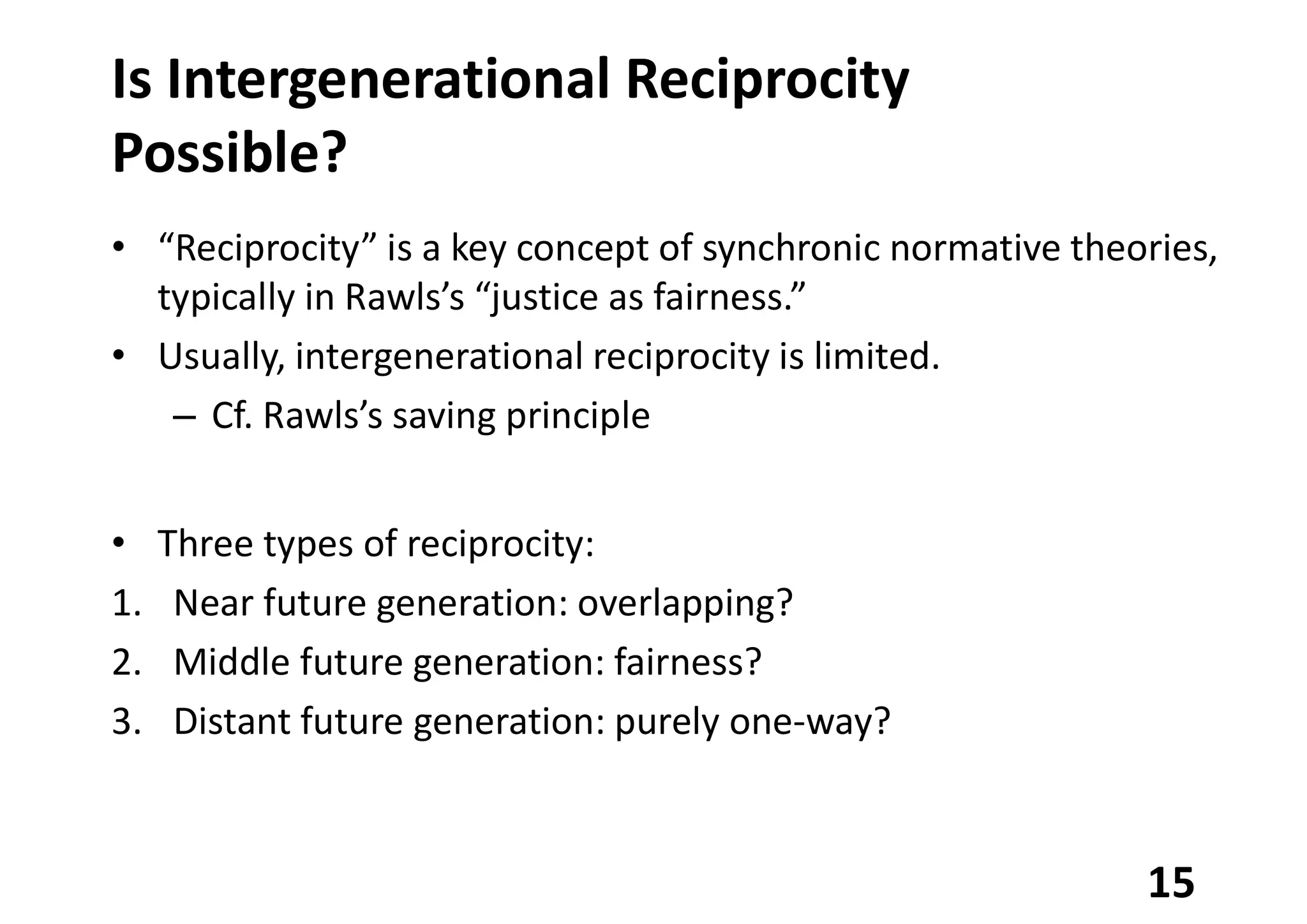
Is Intergenerational Reciprocity
Possible?
• “Reciprocity” is a key concept of synchronic normative theories,
typically in Rawls’s “justice as fairness.”
• Usually, intergenerational reciprocity is limited.
– Cf. Rawls’s saving principle
• Three types of reciprocity:
1. Near future generation: overlapping?
2. Middle future generation: fairness?
3. Distant future generation: purely one-way?
15
Possibility of
inter-generational democracy
• Present-centric feature of democracy always bothers IJ.
• But we should make collective decisions about IJ.
– “Choosing not to choose” is may be the worst choice…
16
[Gerontocracy / Silver democracy]
Can we cooperate with all generations
about IJ problems under extreme
population imbalance?
There are so many severe value conflicts
on intergenerational issues.
Can we avoid “polarization”?
IJ and democratic legitimacy
• Justness (scientific, moral, or…?) and democratic
legitimacy may be distinguished.
• Democratic legitimacy generally depends on
everyday updating acceptance and convincing.
– [Conception 2] emphasizes the long-term uncertainty of
technology with regard to IJ, and lay weight of the value of
legitimacy rather than scientific justness.
– However, the excessive emphasis of uncertainty may
undermine our moral consensus. It may be risky in the
“Post Truth” era.
• Ex. Backlash to climate change…
17
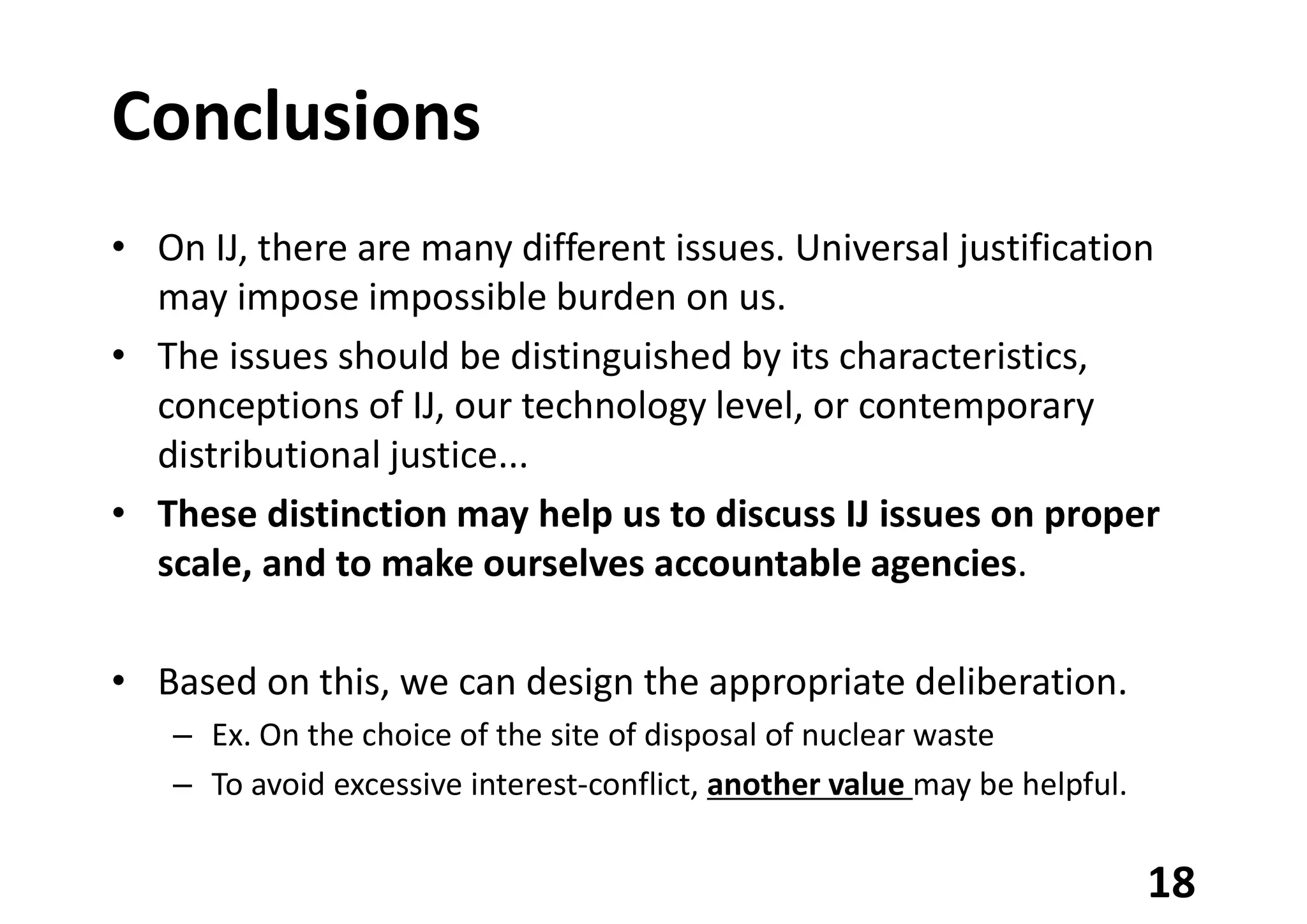
Conclusions
• On IJ, there are many different issues. Universal justification
may impose impossible burden on us.
• The issues should be distinguished by its characteristics,
conceptions of IJ, our technology level, or contemporary
distributional justice...
• These distinction may help us to discuss IJ issues on proper
scale, and to make ourselves accountable agencies.
• Based on this, we can design the appropriate deliberation.
– Ex. On the choice of the site of disposal of nuclear waste
– To avoid excessive interest-conflict, another value may be helpful.
18

2019.3.22 International Workshop on Meta-Science & Technology

  • 1.
    Normative Range Problem onIntergenerational Justice 22 Mar 2019 International Workshop on Meta-Science & Technology, Kobe University, Japan. Takayuki Kira (吉良 貴之) Utsunomiya Kyowa Univ., JP jj57010@gmail.com SNS: tkira26 JSPS Grant Number: 18K12616 [My website]
  • 2.
    Reciprocal? One-way? 2 Reciprocal relationsNon-reciprocal Present Generation ? Future Generations ? ? Past Generation obligation Normative Intergenerational Relations Middle RangeF Long Range F past future present Is our obligation different for each future generation? ? Fossil fuels Nuclear wastes Social security Typical issue
  • 3.
    Introduction • Japanese courthas a tendency to recognize a relatively loose causation of an action and the damage in fatal cases. • Distribution of causation and responsibility is normatively expanded or contracted. 3 The defendant was supposed to have tailgated a car and stopped it forcibly on the Tomei highway in Japan. Then a dump truck crashed into the car and young couples were killed. The court recognized a causal link between his road rage and the fatal accident.
  • 4.
    (non-)identity problem in causationand agencies • Parfit (1983) presented the famous “non-identity problem.” • According to him, our care to future beings will change their genetic identity, and the original object will be vanished. • This paradox has been regarded as a serious obstacle to “person-affecting-principle-based” intergenerational theories. • This paradox resulted from a conception of gene-based, restricted human identity (inspired by Kripke). • Our sense of identity (of person, causation, responsibility, etc.) is expanded or contracted on a case by case basis. • Particularly in fatal circumstances, it will be extremely loosened. 4 However….
  • 5.
    Purpose of thispresentation In keeping with it…. • Examining “intergenerational justice (for short, IJ )” from a view of legal philosophy • Can we justify our normative relation to future generation, or non-existence ? • If possible, then, how far? (distance of the “future”) • The normative range problem has been often dismissed in the discussion of IJ, but it matters. 5
  • 6.
    Specific problems onIJ • Sustainability of public pension system in aging society (rather, intra-generational justice) • Distribution of exhaustible resources (ex. fossil fuels) • Climate justice on global warming • Disposal of nuclear waste …..and so on. • These issues have its own time (and regional) range. • Is our obligation to future generations differ in each range? Or, should it be temporally universal? • These diachronic issues are intergenerational justice of its own kind, not reducible to synchronic normative theories. Why? 6
  • 7.
    Particular problems ofIJ • In general, if the time distance of the normative relation (here, present and future generations) is extended, IJ will be more difficult. • Why? – the features are uncertain and issue-relative – Uncertainty of the number and identity of the affected people in future [Parfit 1983] – Changeability of the preferences of future people – Priority problem with contemporary distributive justice 7
  • 8.
    Main proposals • Thedistance of future generation should be distinguished by each IJ issues. • Our responsibility should be examined in proportion as the generational agencies. – Otherwise, the range problem still remains. • Intergenerational justice is justice between generational agencies distinguished by issues. • Then, inquiring how to distinguish is our task. 8
  • 9.
    Approach and institutionaldesign [Approach] • Showing the theoretical limits of reciprocal/universal approach in IJ with regard to range problem • Adapting one-way approach (ex. Jonas’s responsibility) and articulating the ranges [Jonas 1979] [Institutional design] • Identifying the most appropriate legal branch for each IJ issues [Vermeule 2014] – Under what institutions, can we deliberate well on value conflict issues, i.e. about disposal of nuclear waste? 9
  • 10.
    Contemporary Circumstance: From Kyototo Paris About 20 years later… [Paris Agreement 2015] • Now, preventing global warming is understood not just as duty of advanced countries but as universal responsibility. – Macron “Make our planet great again.” 10 [Kyoto Protocol 1997] Compromise resolution of the conflict among advanced and developing countries Ex. emissions trading system
  • 11.
    Distribution problem? • InKyoto, multi-layer distribution justice was considered. – [agents] present/future, advanced/developing… – [issues] resources, pollution, and historical responsibility… • The Paris scheme seems to deny these distribution problems and to make IJ universal diachronically and synchronically. • Now, should our intergenerational responsibility not solve our internal distribution problems, but sustain humankind and this planet categorically? I don’t think so. 11
  • 12.
    Two conceptions ofIJ: Generational agencies Ex. with regard to disposal of nuclear waste… (1) Sustainable balance of benefit and burden – The balance should be closed in each generation. – If we, present generation, have gained benefit from nuclear power, then we should take the burden of final disposal of the waste, and should not postpone it to future generation. (2) Autonomy of each generation – “Final disposal” is impossible for (present) technology. – Then, IJ demands us to entrust it to future generation, and in turn, to guarantee their autonomy condition. 12 Cf.[Teramoto 2011]
  • 13.
    Time theoretical backgrounds •The two IJ conceptions may correspond to particular time perspective – presentism and eternalism. [Conception 1] presentistic view • important values : present freedom, self-decision, benefit principle, etc. • Democracy is often characterize as a present-centric regime. – “We, the present people” should not be ruled by the dead or unborn. [Conception 2] eternalistic view • important values : integrity, continuity, prospectiveness – Our political community exists of all the generations, the past, present, and future. 13
  • 14.
    Comparison: As answers tofuture uncertainty [Conception 1] • The benefit principle is indeed intuition-suitable. • However, generational relationship is not generally so independent. Both benefit and burden are always postponed. – On the nuclear waste problem, can we say that the circle of benefit and burden is relatively closed? [Conception 2] • If we, present generation have obligation to guarantee the autonomy conditions of future generations, how far? • If the range problem is unsolved, we have to care infinite future generations…? It is impossible. – On the nuclear waste problem, can we decide the responsibility-range on our technology level? 14
  • 15.
    Is Intergenerational Reciprocity Possible? •“Reciprocity” is a key concept of synchronic normative theories, typically in Rawls’s “justice as fairness.” • Usually, intergenerational reciprocity is limited. – Cf. Rawls’s saving principle • Three types of reciprocity: 1. Near future generation: overlapping? 2. Middle future generation: fairness? 3. Distant future generation: purely one-way? 15
  • 16.
    Possibility of inter-generational democracy •Present-centric feature of democracy always bothers IJ. • But we should make collective decisions about IJ. – “Choosing not to choose” is may be the worst choice… 16 [Gerontocracy / Silver democracy] Can we cooperate with all generations about IJ problems under extreme population imbalance? There are so many severe value conflicts on intergenerational issues. Can we avoid “polarization”?
  • 17.
    IJ and democraticlegitimacy • Justness (scientific, moral, or…?) and democratic legitimacy may be distinguished. • Democratic legitimacy generally depends on everyday updating acceptance and convincing. – [Conception 2] emphasizes the long-term uncertainty of technology with regard to IJ, and lay weight of the value of legitimacy rather than scientific justness. – However, the excessive emphasis of uncertainty may undermine our moral consensus. It may be risky in the “Post Truth” era. • Ex. Backlash to climate change… 17
  • 18.
    Conclusions • On IJ,there are many different issues. Universal justification may impose impossible burden on us. • The issues should be distinguished by its characteristics, conceptions of IJ, our technology level, or contemporary distributional justice... • These distinction may help us to discuss IJ issues on proper scale, and to make ourselves accountable agencies. • Based on this, we can design the appropriate deliberation. – Ex. On the choice of the site of disposal of nuclear waste – To avoid excessive interest-conflict, another value may be helpful. 18