2010 CSR
PERFORMANCE
DIGEST
The global benchmark in environmental solutions

Veolia Environnement operates in 77 countries around the world, serving
local public authorities and industrial companies. Veolia Environnement’s
clients enjoy access to expertise in four complementary areas: water
cycle management, waste management and resource recovery, energy
management, and travel mobility services. The company designs and
implements tailored solutions for its clients that combine economic
efficiency with control over environmental impacts, thereby helping
to combat climate change, save resources and conserve ecosystems.

Four divisions:
Veolia Water
Veolia Environmental Services
Veolia Energy – Dalkia
Veolia Transport

€34,787 million in consolidated revenue*
€2,056 million in adjusted operating income
317,034 employees in 77 countries (at December 31, 2010)
* Revenue from continuing operations as defined by International Financial Reporting Standards (IFRS).


                                                                                                        1
MANAGING CORPORATE                                                    In the face of major issues concerning the sharing of scarce resources
     RESPONSIBILITY                                                        and access to basic services, being the benchmark in sustainable
5    Committed to sustainable development
7    Structured organization
                                                                           development is a demanding ambition that is based on a shared strategic
11   Assessment and management procedures                                  vision and an efficient, coherent and legible managerial structure.
                                                                           This ambition obliges us to be exemplary and transparent in the eyes
     MANAGING
     SOCIETAL PERFORMANCE                                                  of all our stakeholders.
17   Contributing to societal development
     within the framework of contractual services
21   Active social responsibility
                                                                           Innovation, teaching skills, building expertise and measuring performance
23   Partnering with international organizations                           are the foundations that Veolia Environnement relies on to manage
                                                                           its Corporate Social Responsability (CSR) program.
     MANAGING ENVIRONMENTAL
     PERFORMANCE
28   Manage environmental performance                                      Preparing company-wide indicators is a difficult and delicate undertaking,
29   Combat climate change                                                 and we take pains to publish pertinent, verifiable and transparent data.
33   Mitigate our impact
35   Conserve ecosystems and biodiversity                                  The aim of this Performance Digest is to bring together in a single
39   Protect natural resources                                             document all the data that form the basis of our company’s CSR approach.
     MANAGING SOCIAL PERFORMANCE
45   Employment trends, a reflection of the company’s business activities
47   Managing employees to reflect local needs
50   Four HR priorities underpinning Corporate Social Responsibility

     MANAGING RESPONSIBLE PURCHASING
59   Sustainable purchasing policy
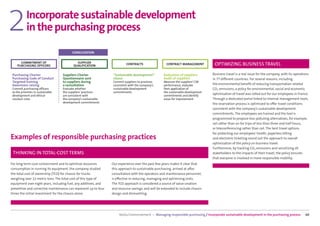
60   Incorporate sustainable development in the purchasing process
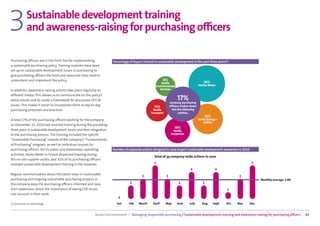
61   Sustainable development training and awareness-raising
     for purchasing officers
62   Commit our suppliers to sustainable development
63   Evaluate our suppliers’ CSR commitment and performance

     REPORTING INDICATORS
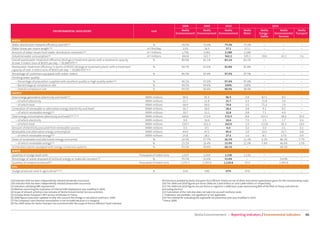
65   Environmental indicators
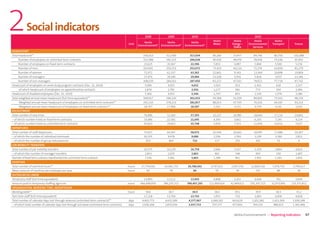
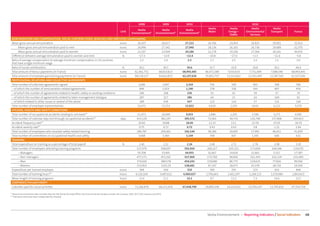
67   Social indicators
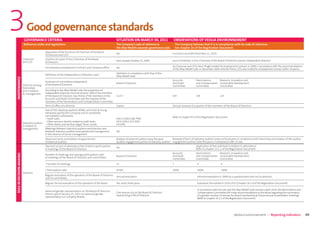
69   Good governance standards

71   INDEPENDENT OPINIONS
78   DETAILS OF METHODOLOGY

                                                                                                                                                        2
MANAGING
CORPORATE
RESPONSIBILITY


                 3
As the world leader in environmental solutions, Veolia Environnement must adapt
its activities to the social and environmental upheaval caused by resource depletion.
This is why sustainable development issues form an integral part of the contract policies
that are incorporated in our day-to-day operations.


In a clear display of commitment at the operating level, we reinforced our Sustainable Development
Department in 2010 so that it could focus on serving the company’s businesses and on providing
all the support needed to ensure that the various facets of sustainable development are factored
into our activities and cater as closely as possible for needs on the ground.
The department’s main activities are:

■ Coordinating management    systems in areas of corporate social responsibility;

■ Supporting the development  of commercial offers that incorporate the three aspects
 of sustainable development, thus ensuring our ability to support our clients’ sustainable
 development strategies;

■ Designing contract
                   models and innovative partnerships in social business, so that disadvantaged
 populations may have access to basic services, notably in emerging countries.

In addition to its commitments, Veolia Environnement has established suitable governance
and measures its performance using relevant indicators.


                                                                              Veolia Environnement — Managing corporate responsibility   4
1       Committed to sustainable development

Whatever the geographical context,                    The “Ethics, Commitment and Responsibility” program                   3. Raise awareness of environmental challenges and the ensuing
Veolia Environnement’s activities must be             In 2003, Veolia Environnement introduced the “Ethics,                 need for behavioral changes among all concerned with our
                                                      Commitment and Responsibility” program to serve as guiding            activities.
carried out in compliance with both national
                                                      principles for all its employees. This program outlines the           4. Adapt our service offers, through dialog, the quality of
standards and the recommendations                     fundamental values our employees share and must reflect in             the advice we provide and our expertise, to meet the needs
of international organizations like the ILO           their behavior under all circumstances. This includes strict          and expectations of clients.
and OECD, in particular as concerns respect           respect for the law in effect in all the countries where we operate,   5. Ensure our employees’ health and safety and help improve
for basic rights, accounting for cultural diversity   loyalty within the company and toward all our stakeholders,           public health.
and protecting the environment.                       social responsibility, risk management, quality company               6. Provide working conditions in which fundamental human
                                                      information and governance, and commitment to sustainable             rights and international labor standards are complied with.
                                                      development.                                                          7. Promote diversity and combat discrimination to guarantee
                                                      For more information please consult the “Ethics, Commitment           equal opportunities.
                                                      and Responsibility Program” report on our website.                    8. Encourage skills development and upward mobility for
                                                                                                                            our employees throughout their career.
                                                      Sustainable Development Charter                                       9. Gradually set our own environmental and social standards
                                                      In line with our “Ethics, Commitment and Responsibility”              to be applied to all our operations around the world.
                                                      Program, in 2006 we outlined our commitment to sustainable            10. Base our corporate governance on transparent
                                                      development in a 12-point Charter:                                    communication, anticipation of risks and the definition of rules
                                                                                                                            for ethical conduct and compliance.
                                                      1. Protect the environment; contribute to conserving natural          11. Contribute to local economic and social development,
                                                      resources and biodiversity, and combat climate change.                and to meeting international goals for access to essential services.
                                                      2. Promote—through innovation, research and development—              12. Encourage partners, subcontractors and suppliers to adhere
                                                      environmental, economic and social solutions that will meet           to our values and make their own contribution to our sustainable
                                                      the needs of future generations.                                      development commitments.


                                                                                  Veolia Environnement — Managing corporate responsibility / Committed to sustainable development              5
RECOGNITION OF THE RIGHT TO WATER

                                                                     Veolia Environnement welcomed the official recognition of the Right to Water that was
                                                                     proclaimed when the United Nations General Assembly and Human Rights Council adopted
                                                                     respectively one resolution in 2010. These two resolutions have already contributed to
Our commitment under the Global Compact
                                                                     furthering the cause of water as a vital human right.
Veolia Environnement joined the United Nations Global Compact
on June 12, 2003 as a result of an official decision of its
                                                                     Since 2007, Veolia Environnement has been asked regularly by the Human Rights Council for
governance bodies followed by a declaration of membership
                                                                     its viewpoint on this matter and has always responded and contributed actively to the work
signed by its Senior Executive Vice-President. Since then,
                                                                     that culminated in 2010 with this important declaration. The resolution stipulates that public
a permanent correspondent has been monitoring our close
                                                                     authorities are the guarantors of the effective implementation of the Right to Water and that
relations and contacts with the Global Compact Board
                                                                     they may engage third-party players to provide water and sanitation services while respecting
in New York, which meets regularly with Veolia representatives.
                                                                     the principles of transparency, non-discrimination and empowerment. Given that nearly 1 billion
Our participation in the Global Compact has become a major
                                                                     people do not have access to safe drinking water and 2.6 billion do not have access to sanitation,
consideration in all aspects of our company’s social
                                                                     by clarifying the roles, the resolution will help advance the successful completion of new and
responsibility policy.
                                                                     more ambitious projects that will increase access to these basic services.

Our commitment to human rights
                                                                     Veolia Environnement is a modest contributor given the size of the challenge, but it is a part of
By joining the United Nations Global Compact,
                                                                     the solution to turn the Right to Water into a concrete and effective reality.
Veolia Environnement committed notably to supporting and
respecting the protection of internationally proclaimed human
rights within its sphere of influence and to ensuring that its own
companies were not complicit in human rights abuses.
For several years now, Veolia Environnement has committed
to respecting human rights in both its activities and in the
countries where it operates. For example, tests conducted
in several developing countries (Morocco, Niger, India, Ecuador,
etc.) demonstrate that it is possible to reconcile service quality
and accessibility and to encourage respect for the human rights
of the populations it serves.


                                                                                                 Veolia Environnement — Managing corporate responsibility / Committed to sustainable development   6
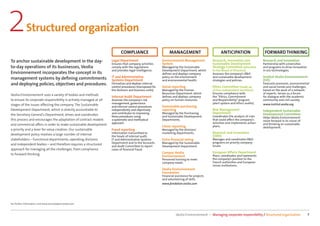
2             Structured organization
                                                                           COMPLIANCE                         MANAGEMENT                           ANTICIPATION                   FORWARD THINKING
To anchor sustainable development in the day-                       Legal Department                     Environmental Management            Research, Innovation and            Research and Innovation
                                                                    Ensures that company activities      System                              Sustainable Development             Partnership with universities
to-day operations of its businesses, Veolia                         comply with the regulations          Managed by the Sustainable          Strategy Committee (attached        and programs to drive innovation
                                                                    and provides legal intelligence.     Development Department, which       to the Board of Directors)          in eco-technologies.
Environnement incorporates the concept in its                                                            defines and deploys company          Assesses the company’s R&D
management systems by defining commitments                           IT and Administrative                policy on the environment           and sustainable development         Institut Veolia Environnement
                                                                    Systems Department                   and environmental health.           strategies and policies.            (IVE)
and deploying policies, objectives and procedures.                  Formalizes and deploys internal                                                                              Forecasts economic, environmental
                                                                    control procedures (transposed for   Social reporting                    Ethics Committee (made up           and social trends and challenges,
                                                                    the divisions and business units).   Managed by the Human                of four independent members)        based on the work of a network
                                                                                                         Resources Department, which         Ensures compliance with             of experts. Serves as a forum
Veolia Environnement uses a variety of bodies and methods
                                                                    Internal Audit Department            defines and deploys company          the “Ethics, Commitment             for dialogue with the academic
to ensure its corporate responsibility is actively managed at all   Assesses the company’s risk          policy on human resources.          and Responsibility” program         community and civil society.
                                                                    management, governance                                                   (alert system and ethics audits).   www.institut.veolia.org
stages of the issues affecting the company. The Sustainable                                               Sustainable purchasing
                                                                    and internal control procedures
Development Department, which is directly accountable to            independently and objectively        reporting                           Risk Management                     Independent Sustainable
the Secretary General’s Department, drives and coordinates          and contributes to improving         Managed by the Purchasing           Department                          Development Committee
                                                                    these procedures using               and Sustainable Development         Coordinates the analysis of risks   Helps Veolia Environnement
this process and encourages the adaptation of contract models       a systematic and methodical          Departments.                        that could affect the company’s      move forward in its vision of
                                                                    approach.                                                                activities and implements action    and thinking on sustainable
and commercial offers in order to make sustainable development
                                                                                                         Client reporting                    plans.                              development.
a priority and a lever for value creation. Our sustainable          Fraud reporting                      Managed by the divisions’
                                                                    Information transmitted to           marketing departments.              Research and Innovation
development policy involves a large number of internal                                                                                       (VERI)
                                                                    the heads of internal audit,
stakeholders—functional departments, operating divisions            IT and Administrative Systems        Extra-financial rating               Manages and coordinates R&D
                                                                    Department and to the Accounts       Managed by the Sustainable          programs on priority company
and independent bodies—and therefore requires a structured                                                                                   issues.
                                                                    and Audit Committee to report        Development Department.
approach for managing all the challenges, from compliance           cases of financial fraud.
                                                                                                         Campus Veolia                       European Affairs Department
to forward thinking.                                                                                                                         Plans, coordinates and represents
                                                                                                         Environnement
                                                                                                         Personnel training to meet          the company’s position to the
                                                                                                         company needs.                      French authorities and European
                                                                                                                                             Union institutions.
                                                                                                         Veolia Environnement
                                                                                                         Foundation
                                                                                                         Financial assistance for projects
                                                                                                         and volunteering of skills.
                                                                                                         www.fondation.veolia.com


For further information, visit www.annualreport.veolia.com


                                                                                                                   Veolia Environnement — Managing corporate responsibility / Structured organization               7
2.1 Coordinated anticipation of risks


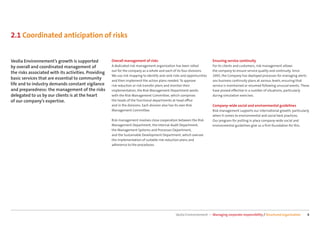
Veolia Environnement’s growth is supported            Overall management of risks                                        Ensuring service continuity
by overall and coordinated management of              A dedicated risk management organization has been rolled           For its clients and customers, risk management allows
                                                      out for the company as a whole and each of its four divisions.     the company to ensure service quality and continuity. Since
the risks associated with its activities. Providing
                                                      We use risk mapping to identify and rank risks and opportunities   2005, the Company has deployed processes for managing alerts
basic services that are essential to community        and then implement the action plans needed. To approve             ans business continuity plans at various levels, ensuring that
life and to industry demands constant vigilance       risk reduction or risk transfer plans and monitor their            service is maintained or resumed following unusual events. These
and preparedness: the management of the risks         implementation, the Risk Management Department works               have proved effective in a number of situations, particularly
delegated to us by our clients is at the heart        with the Risk Management Committee, which comprises                during simulation exercises.
of our company’s expertise.                           the heads of the functional departments at head office
                                                      and in the divisions. Each division also has its own Risk          Company-wide social and environmental guidelines
                                                      Management Committee.                                              Risk management supports our international growth, particularly
                                                                                                                         when it comes to environmental and social best practices.
                                                      Risk management involves close cooperation between the Risk        Our program for putting in place company-wide social and
                                                      Management Department, the Internal Audit Department,              environmental guidelines give us a firm foundation for this.
                                                      the Management Systems and Processes Department,
                                                      and the Sustainable Development Department, which oversee
                                                      the implementation of suitable risk reduction plans and
                                                      adherence to the procedures.


                                                                                                 Veolia Environnement — Managing corporate responsibility / Structured organization    8
2.2 Ethics and governance


In 2010, Veolia Environnement’s executive                                These documents are available on our intranet site and training      In recent years, a member of the Ethics Committee visited Egypt,
management decided that the Secretary                                    courses are also available to supplement them.                       the United Arab Emirates, Norway and Japan. In 2010, as part of
                                                                         Furthermore, control procedures to ensure compliance with            his duties, the chairman of the Ethics Committee visited sites in
General’s Department would be responsible
                                                                         the company’s ethical principles are deployed in the functional      Germany. The Ethics Committee has also conducted an internal
for applying and monitoring the company’s                                departments concerned and by the Internal Control Department.        profile-raising communication campaign aimed especially at the
policy on ethics.                                                        Last, ethical questions have been systematically incorporated in     company’s non-executive employees.
                                                                         the auditing duties of the Internal Audit Department since 2008.
The “Ethics, Commitment and Responsibility” Program                      In 2009, an internal audit was conducted on the implementation       Raising awareness and training employees
Veolia Environnement’s “Ethics, Commitment and Responsibility”           of corruption prevention.                                            Veolia Environnement uses training to ingrain its ethical culture
program(1), introduced in 2003 and translated into nine languages,                                                                            in its employees. In 2004 and 2005, the “Ethics and Business Life”
is binding on all our employees. It is a corporate project designed to   The Ethics Committee                                                 awareness-raising campaign targeted over 400 senior executives
guide the behavior of our employees in their day-to-day activities.      In March 2004, we established an Ethics Committee comprising         in France and other countries. From 2008 over 3,500 managers
Veolia Environnement uses a number of internal mechanisms                independent members to examine any issues pertaining to the          attended the “Competition law compliance” training program,
to reduce the risk of non-compliance with ethical principles:            “Ethics, Commitment and Responsibility” program. It can be           which consisted of seminars, support material and online
■ the “Competition Law Compliance Guide”(1) (published in 2008)          contacted by any employee or can itself take the initiative to       training in France and other countries. Lastly, the new “Preventing
   and the “Guide to Managing and Minimizing Criminal Risk               analyze any issue concerning ethics and conduct visits to check      criminal risk exposure and raising awareness of corruption risks”
   Exposure in Group Operations” (published in 2010) have been           ethics in all of the company’s operations. The Ethics Committee’s    training program was rolled out in France and attended by
   distributed to managers;                                              mission is to make recommendations concerning Veolia                 around 800 managers in 2010. It is being deployed outside
■ we also have mechanisms to ensure strict control over                  Environnement’s fundamental values, either on a subject it has       France in 2011.
   subcontracting. The Purchasing Charter(1) and the Purchasing          analyzed at its own initiative or following questions submitted by
   Code of Conduct have sections describing the ethical practices        others. The Ethics Committee remains the ultimate body to receive
   to be respected and promoted by anyone involved in company            alerts that cannot be communicated to the managers in charge.
   procurement;                                                          The committee reports on this whistleblowing system to
■ our contract model applying to commercial intermediaries and           the Accounts and Audit Committee. The Ethics Committee’s code
   business introducers also contains a detailed “ethics and             of conduct stipulates that it must treat matters with strict
   anticorruption clause” and;                                           impartiality and confidentiality.
■ our sponsorship and patronage activities must follow a special
   procedure(1).

(1) Documents available on our website.


                                                                                                                    Veolia Environnement — Managing corporate responsibility / Structured organization         9
2.3 Representing our interests


Veolia Environnement contributes to reflection,                          In 2010, Veolia Environnement’s main contributions were as          Last, Veolia Environnement renewed its listing on the register
discussions and work initiated by the French                            follows:                                                            of Interest Representatives of the European Commission.
                                                                                                                                            Our Brussels employees in direct contact with the European
and European government authorities,                                    – European institutions:
                                                                                                                                            Parliament are also accredited lobbyists to it. In France,
professional associations, think-tanks, NGOs                            ■ Revision of directive 86/278/EEC on sewage sludge management.
                                                                                                                                            Veolia Environnement is registered on the public list of interest
                                                                        ■ Development of the EU’s climate policy.
and international institutions on changes in                                                                                                representatives of the French National Assembly and is currently
                                                                        ■ Development of the EU’s energy policy (“Towards a New Energy
the management of environmental solutions.                                                                                                  being added to the French Senate’s list.
                                                                         Strategy for Europe 2011-2020”).
                                                                        ■ Assessment of the regional policy (5th Cohesion Report).
We share our expertise with these stakeholders at their behest          ■ EU Initiative on Concessions.
or on issues that have a direct or indirect impact on our activities.   ■ State aid and the Monti-Kroes package.


Given the importance of the European environmental and                  – The French Parliament, as part of hearings organized by the
internal market regulatory framework, we set up a European              rapporteurs of the information missions and workgroups:
Affairs Department in 2010 to coordinate the representation of           ■ “Treating household waste: what options in the wake of

Veolia Environnement’s interests to French and EU authorities.            the Grenelle Environment Forum?”, French Senate report.
                                                                        ■ “Carbon contribution”, the workgroup of the French Senate’s
                                                                          Commission for the economy, sustainable development and
                                                                          spatial planning.
                                                                        ■ “European cohesion policy after 2013”, French Senate’s
                                                                          European Affairs Commission.
                                                                        ■ “Implementation of the law on guidance and lifelong
                                                                          vocational training”, National Assembly Report.
                                                                        ■ “What can researchers and public authorities do about
                                                                          the influenza A (H1N1) virus and virus mutation?”,
                                                                          the Parliamentary Office of Scientific and Technological
                                                                          Assessment’s Report.


                                                                                                                    Veolia Environnement — Managing corporate responsibility / Structured organization     10
3      Assessment and management procedures

Progress is impossible unless we measure what
has been done and evaluate what remains to
                                                 3.1 Internal procedures                                             ANTICIPATING SUSTAINABLE
                                                                                                                     DEVELOPMENT ISSUES
be done. We have to manage performance
                                                 Environmental reporting
by making ambitious commitments, produce                                                                            At the end of 2009, Veolia Environnement began
                                                 ■ Around 100 indicators monitored since 2001 using
accurate and complete reports and take                                                                              drafting the “Atlas of Responsibilities and Opportunities
                                                  the Environmental Information System (EIS).
into account external views and judgments.                                                                          for Sustainability”. The objective is to use an e-device to
                                                 ■ Procedures defined in the Protocol for the Measurement
                                                                                                                    centralize, region by region, information on external
As a company listed on France’s CAC 40 index,      and Reporting of Environmental Indicators.
                                                                                                                    sustainability factors provided by international
Veolia Environnement is rated for its extra-     ■ Deployed in 2,197 local business units where data are entered.
                                                                                                                    organizations and acknowledged institutional players.
financial performance based on published                                                                             This tool stimulates thinking on the management of
information and statements. In addition, our     Social reporting                                                   our sustainable development strategy. It enables us
                                                 ■ Actual human resources situation measured using 200 social
company can solicit ratings. The Independent                                                                        to improve our understanding of the characteristics of
                                                  indicators.
Sustainable Development Committee also                                                                              the regions where we operate that could affect the
                                                 ■ The scope covers 77 countries where the company operates,
                                                                                                                    implementation of our social and environmental
gives its opinion on the company’s CSR policy.     for a total of 1,239 separate legal entities.
                                                                                                                    responsibility policies. In this way, it supplements
All this information allows us to see where      ■ A network of 700 correspondents to collect annual data using
                                                                                                                    our internal information and helps us identify priority
we stand and serves as a guide for continuous      dedicated software.
                                                                                                                    areas by region and by issue, and also feeds other
improvement of our sustainable development                                                                          mechanisms and financial decision-making procedures
performance.                                     Purchasing reporting                                               with information on sustainable development.
                                                 Tracking of five performance indicators set up gradually
                                                 since 2009 for the following subject areas:
                                                 ■ Sustainable development training and awareness-raising
                                                   of purchasing officers.
                                                 ■ Relations with suppliers.


                                                 Client reporting
                                                 ■ Annual assessment of client relations in each business using
                                                  relevant indicators.
                                                 ■ Procedures defined in the “Client Reporting Procedures” guide.


                                                                          Veolia Environnement — Managing corporate responsibility / Assessment and management procedures         11
3.2 Selection by extra-financial indexes and company rankings


Extra-financial ratings and inclusion          Evaluation by SAM                                                                              ASPI Eurozone (Vigeo)
in specialized stock market indexes provide a In 2010, Veolia Environnement was not selected in the Dow Jones                                The European Index ASPI Eurozone comprises the 120 most
measure of companies’ sustainable development Sustainability Indexes (DJSI). The “best in class” methodology used                            competitive companies in terms of social and environmental
                                              by the agency and applied to the “Water Utilities” sector led this                             responsibility listed in the eurozone. In 2010, Veolia
performance. The principal areas evaluated
                                              year to the selection of only one company even though results of                               Environnement was included once again in the index,
are governance, human resources management,                                                                                                  as it was from 2004 to June 2008.
                                              other companies were good. The rating of Veolia Environnement’s
environmental performance, ethics, human      sustainable development performance remains at a high level
rights, customer care, supplier relations and (71/100). The company’s scores were higher than 2009 for                                       Classified “Prime” by Oekom Research
dialogue with civil society.                  11 criteria out of 20 and received a grade above the average of                                In 2010, Veolia Environnement maintained the “Prime” category
                                                                       the “Water Utilities” sector concerning 17 criteria. In addition,     classification assigned by Oekom Research to companies that are
                                                                       Veolia Environnement received the highest scores in six categories.   among the best in their industry for social and environmental
                                                                       Since 2003, Veolia Environnement has been selected for inclusion      responsibility.
FTSE4Good                                                              in these indexes every year, except for 2005 and 2010.
Veolia Environment has been listed on the FTSE4Good since
                                                                       The Dow Jones Sustainability indexes rate the performance             Carbon disclosure project
2004. It is assessed by Eiris (United Kingdom) and Ethifinance
                                                                       of companies that are leaders in sustainable development. In 2010,                           Veolia Environnement was ranked eighth out
(France). Considering that inclusion criteria are regularly reviewed
                                                                       of the 2,500 largest companies on the Dow Jones Global Total                                  of the 20 leading companies in the Carbon
and tightened, Veolia Environnement’s recurrent inclusion
                                                                       Stock Market Index (DJGTSMI), only 323 were selected for inclusion                            Disclosure Leadership Index (CDLI) France
in these indexes is an acknowledgment of the company’s
                                                                       in the DJSI World. Some 163 companies of the DJGTSMI composed                                 in 2010 with a score of 82/100, which
performance and long-term commitment to sustainable
                                                                       the European selection of the DJSI (Dow Jones Sustainability                                  is an improvement on the previous year
development. The FTSE4Good index comprises about
                                                                       Europe Index).                                                        (+6 points). CDLI selects the companies with the best quality
900 companies listed on the FTSE Global Equity indexes.
                                                                                                                                             responses at the Carbon Disclosure Project (CDP) and rewards
These companies are selected on the basis of a series of
                                                                       Ethibel Sustainability Indexes (Vigeo)                                transparent communication on climate change. The CDP’s aim
internationally recognized corporate responsibility and
                                                                       Veolia Environnement’s inclusion in the Ethibel Excellence Europe     is to assist investment decisions so they account for the effects
sustainable development criteria and standards.
                                                                       and Ethibel Excellence Global indexes was confirmed in 2010,           of climate change on companies. The association is supported
                                                                       on the basis of assessments by Vigeo. The Ethibel Sustainability      by several institutional investors with worldwide assets worth
                                                                       indexes offer an overall view of the financial performance of the       $64 billion.
                                                                       world’s largest companies in terms of sustainable development.
                                                                       These two indexes are composed of companies listed in the
                                                                       Excellence Register compiled by the independent organization
                                                                       Forum Ethibel.

                                                                                                 Veolia Environnement — Managing corporate responsibility / Assessment and management procedures           12
3.3 Solicited external ratings


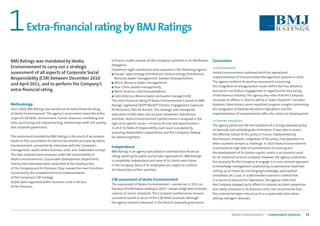
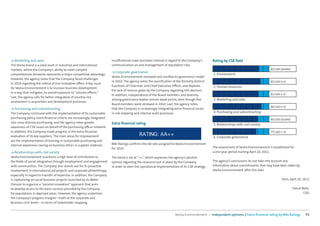
Every year, for the last seven years, Veolia        BMJ Ratings evaluates the company’s activities in its four
Environnement has asked to be evaluated by          divisions and covers the environment, human resources,               2005 2006 2007 2008 2009 2010
BMJ Ratings, an extra-financial rating agency,
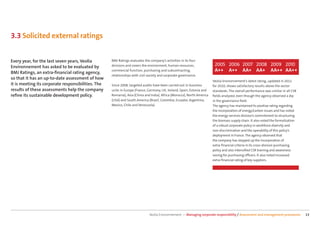
                                                    commercial function, purchasing and subcontracting,                  A++ A++ AA+ AA+ AA++ AA++
                                                    relationships with civil society and corporate governance.
so that it has an up-to-date assessment of how
                                                                                                                        Veolia Environnement’s latest rating, updated in 2011
it is meeting its corporate responsibilities. The   Since 2008, targeted audits have been carried out in business       for 2010, shows satisfactory results above the sector
results of these assessments help the company       units in Europe (France, Germany, UK, Ireland, Spain, Estonia and   standards. The overall performance was similar in all CSR
refine its sustainable development policy.           Romania), Asia (China and India), Africa (Morocco), North America   fields analyzed, even though the agency observed a dip
                                                    (USA) and South America (Brazil, Colombia, Ecuador, Argentina,      in the governance field.
                                                    Mexico, Chile and Venezuela).                                       The agency has maintained its positive rating regarding
                                                                                                                        the incorporation of energy/carbon issues and has noted
                                                                                                                        the energy services division’s commitment to structuring
                                                                                                                        the biomass supply chain. It also noted the formalization
                                                                                                                        of a robust corporate policy in workforce diversity and
                                                                                                                        non-discrimination and the operability of this policy’s
                                                                                                                        deployment in France. The agency observed that
                                                                                                                        the company has stepped up the incorporation of
                                                                                                                        extra-financial criteria in its cross-division purchasing
                                                                                                                        policy and also intensified CSR training and awareness
                                                                                                                        raising for purchasing officers. It also noted increased
                                                                                                                        extra-financial rating of key suppliers.


                                                                             Veolia Environnement — Managing corporate responsibility / Assessment and management procedures        13
3.4 The Independent Sustainable Development Committee’s view
of Veolia Environnement’s sustainable development policy

The Independent Committee (IC) has continued its work                                      The IC has also reviewed the Company’s policies and programs
in advising the company on sustainability and corporate                                    for research and development, in particular the Innovation
responsibility. The new Chairman of the company, Antoine Frérot,                           Accelerator and advances in biotechnology. Through our
has reaffirmed his commitment to the process and to his                                      oversight of this work, we aim to ensure that Veolia retains
involvement in the deliberations of the Committee. In future,                              its leadership as a cutting-edge innovator—particularly
IC will have at least two formal meetings together with regular                            in water technology.
informal updates and advice.                                                               At our meetings in 2011, we would expect to look again at the
The IC has reviewed the work of the Ethics Committee, which                                issues raised by the Jerusalem Tramway (1), consider what lessons
it sees as carrying out an important function in a company with                            should be learned, and make recommendations to management.
so large and diverse a workforce. The IC has made a number                                 We will also consider, among other things, Veolia’s sustainability
of recommendations to improve its workings including an                                    targets and methodology and the company’s involvement
extension of its membership, the strengthening of its local                                and expectations for the World Water Summit in Marseilles
mechanisms, and the particular consideration of protection                                 and Rio+20.
of workers in countries where cultural considerations militate
against filing legitimate complaints. In some countries with
no tradition of whistleblowing, special care needs to be taken
to ensure that management makes itself approachable                                                                                         John Gummer
in a way which is clearly understood by the whole workforce.                                Chairman of the Independent Sustainable Development Committee


(1) Up-to-date information is available on our corporate website: www.veolia.com/en/medias/focus-on/jlrt.htm


                                                                                                                    Veolia Environnement — Managing corporate responsibility / Assessment and management procedures   14
MANAGING
SOCIETAL
PERFORMANCE


              15
Through the services it provides, Veolia Environnement develops deep roots in local
communities by playing a direct part in their everyday lives.
We feel it is our responsibility to develop trustful relationships with our stakeholders so that
they can help us better meet our contractual obligations and become a better corporate citizen.
Veolia Environnement’s contribution to these communities is a particularly vital one, since
the public services it manages are indispensable to ensuring a quality of life that is satisfactory
and consistent with the UN’s International Covenant on Economic, Social and Cultural Rights.
Our expertise and the original support solutions we provide enable us to help increase access
to basic services across a diverse spectrum of contexts and countries and thus meet the needs
of the public authorities that entrust us with the management of their services.

To manage the societal contributions of our activities more effectively, in late 2010
we set up a Social Commitment and Perspective Unit within our Sustainable Development
Department. The unit’s role is, on the one hand, to consolidate and develop our company’s
expertise in the area of social innovation so as to respond more effectively to the needs
and demands of local communities, public authorities and stakeholders for essential services,
and on the other to report on the company’s societal performance internally and externally.


                                                                              Veolia Environnement — Managing societal performance   16
1        Contributing to societal development
         within the framework of contractual services

1.1 Dialogue and support
All of our company’s four divisions develop local initiatives    To accurately assess social costs and benefits, develop
to inform local communities of the services they provide         appropriate solutions and inform and support the families
and promote dialogue. These initiatives include neighborhood     concerned, Veolia Environnement forms special teams locally
meetings, meetings with elected representatives and local        that include employees who have been trained in social
non-profit organizations, visits to sites and “open-house”        expertise. New types of tools are also created to make customers’
events to inform the general public. In Romania, for example,    lives easier and meet their needs, such as:
Veolia Water helped set up an ongoing process to promote         ■ mobile customer service centers near large urban areas
dialogue about its water service with its customers through         that are available at times agreed with local populations,
weekly meetings with “CAB” building-management associations         as is the case in Morocco;
and owner and renter associations. In late 2009, HABITAT,        ■ prepaid solutions for water and energy service;
a Romanian consumers’ association, took over this process        ■ neighborhood meetings to explain projects and take
and via the IDEA system that Veolia Water proposed and              the suggestions and comments of local communities
set up, now provides Veolia Water with innovative suggestions       into account.
submitted by customers to continuously improve service.
                                                                 Providing social support to disadvantaged populations
                                                                 is increasingly becoming a distinct activity for
                                                                 Veolia Environnement.


                                                     Veolia Environnement — Managing societal performance / Contributing to societal development within the framework of contractual services   17
1.2 Enabling access to basic services                                                                                                     1.3 Creating business models
                                                                                                                                          that reflect social and
                                                                                                                                          economic realities
One of the Millennium Development Goals (MDG) is to “Halve,        The body of expertise Veolia Water has developed for this              In the developing countries, waste, water, transportation
by 2015, the proportion of people without sustainable access       purpose is referred to as ACCES and is based on the following          and energy services are often provided by small companies
to safe drinking water and to basic sanitation services”.          eight principles, of which the first five seek to adapt its activities   and individuals, who are sometimes not even formally organized
Veolia Water is the largest private-sector provider of these       provided under public service management contracts to                  and play an important part in the local and economic fabric.
services in the emerging and developing countries. Under public    low-income customers, while the last three directly concern            Modern service systems must therefore take these providers
service management contracts, Veolia Water works with              Veolia Water’s corporate social responsibility:                        into account, by either eliminating the most unacceptable
the authorities that delegate the services to conduct programs     1. Do more with the same infrastructure.                               practices, such as child labor, while providing the social
to provide these basic services to communities that do not have    2. Implement pricing policies that are appropriate and socially        and educational support this requires, or by seeking to find
water supply and sanitation systems. This activity has lead        acceptable.                                                            a balance between conflicting interests.
Veolia Water to adopt a social approach that covers technical,     3. Increase the number of subsidized connections.                      For example, at the Presidente landfill site in Colombia, solid
financial, marketing, communication and legal aspects               4. Create a new collective, secure and personalized way of             waste had traditionally been recovered by rag-collectors.
of its operations and to work with numerous stakeholders           distributing water to people without access to home-service            To improve the situation of this highly disadvantaged population
that offer expertise that is complementary to its own.              pipes.                                                                 while preserving its employment, Proactiva Colombia set up
                                                                   5. Develop customer services that meet the needs of local              a training and social integration program in partnership
                                                                   communities.                                                           with local authorities. It includes a variety of actions: workshops
                                                                   6. Explain how water should be used to optimize the benefits            in health education, projects to create microenterprises, literacy
                                                                   of access to services.                                                 training, efforts to improve self-esteem, and training in various
                                                                   7. Research and Innovation: develop new service models                 occupations such as preparing compost and medicinal plants.
                                                                   for rural environments.
                                                                   8. Assess the impact of actions on the quality of life
                                                                   of local residents.

                                                                   For more information see the document titled “Veolia Water’s
                                                                   ACCES expertise”.

                                                                   Since Veolia Water began operations in Morocco, Gabon, Niger
                                                                   and India, it has provided 2.6 million more people with access
                                                                   to water and 1.3 million with access to sanitation.


                                                       Veolia Environnement — Managing societal performance / Contributing to societal development within the framework of contractual services             18
1.4 Adapting tarifs and prices to local markets


Service charges for the users of water, energy and transportation   In 2006, in the Greater Paris region, Veolia Water’s customer       These programs require innovative marketing, engineering,
services are systematically set by the public authority under       service department set up a special unit to assist customers        financial and legal techniques to meet the needs and capabilities
each service contract. However, Veolia Environnement can            who are having difficulty making their payments. This unit,           of local populations. Achieving these innovations effectively
propose pricing arrangements to make these services more            which works with social workers in the field, handled                requires not only partnership with the public authorities
accessible to the most disadvantaged populations. Particular        1,700 individual cases in 2010. Its work involves helping           and elected representatives, but also with sociologists
care must also be taken to ensure that service charges are          customers pay their bills by providing those who benefit             and other specialists (local neighborhood associations,
aligned with the demand for services and income of local            from subsidized housing payments or are over-indebted with          NGOs and other civil society actors), as well as with social
communities. In some countries, contractual pricing                 information and administrative assistance. This unit also           entrepreneurs and local public services that can provide
commitments can be made under locally established policies          participates in plans to rehabilitate apartment buildings           complementary expertise.
to ensure sustainable development and reduce social disparities.    and closely monitors the situations of buildings that are under     To ensure that the families involved in these programs
                                                                    rehabilitation or in receivership, working closely with community   are able to bear these costs, in accordance with the principle
In Varna, Bulgaria, where households have little disposable         officials, apartment building operators and receivers. In 2010,       of social acceptability Veolia Environnment works with
income in comparison with heating costs, Veolia Energy – Dalkia     some 310 cases involving such buildings were handled.               its partners to design and implement innovative financing
has made a commitment to ensuring long-term price stability.                                                                            mechanisms such as zero-interest loans of up to 10 years,
Efforts to increase energy production and the efficiency               But solidarity is not just a question of the price charged to use   social funds financed from various service revenues,
of facilities have made it possible to reduce energy costs          a service. It sometimes also involves the cost of accessing         and external sources of financing.
and therefore the price charged for heating service. The number     the service, such as the cost of connection to a water or sewer     In Morocco this policy has made it possible to connect
of unpaid bills has been halved and the average time required       pipe or a power cable. In some countries that are experiencing      350,000 people to potable water systems since the first
to collect payments has decreased by three months.                  particularly rapid urban growth, at the request of its public-      contracts were signed in 2002.
In addition to increasing the efficiency of energy production         authority clients Veolia Environnement develops programs
and distribution, Veolia Energy-Dalkia can improve the insulation   to provide subsidized connections to pipe and power systems
of its customers’ buildings and homes and thus help them reduce     in accordance with the local social and economic context.
their energy bills.


                                                        Veolia Environnement — Managing societal performance / Contributing to societal development within the framework of contractual services      19
1.5 Measuring the social impact of the company’s activities


People’s well-being, the smooth functioning of communities
and human development are key concerns at Veolia
Environnement and are at the foundation of everything we do,
covering the entire spectrum of water, transportation, waste
management and energy services, all of which are essential.
This means that the services we provide must gradually improve
the living conditions of local populations and have a positive
impact in general on human development. In some cases,
these improvements are clearly expected by clients and                ASSESSMENT OF THE IMPACT OF SUBSIDIZED
are explicit contractual objectives.                                  UTILITY CONNECTIONS IN MOROCCO
Yet we are also quite vigilant about the potential negative social
impacts that our activities may have locally. These negative         In 2006, Veolia Environnement Morocco and its Tangier-based subsidiary Amendis decided to assess
impacts must be systematically controlled and minimized              the actual impact on human development (health, well-being, education, independence, and so on)
in so far as possible.                                               of the subsidized water and sanitation system individual connections it had completed in Tangier
As in the area of environmental performance, Veolia Environnement    since 2002. This assessment was made in conjunction with the Abdul Latif Jameel Poverty
considers that it must now measure and evaluate the social           Action Lab (J-PAL), an economic-research laboratory at the Massachussetts Institute of Technology,
impacts of its activities and implement action plans that improve    headed by Esther Duflo, and a leading authority in the assessment of development programs.
the societal performance of the services it provides.                This assessment was conducted in close cooperation with all stakeholders, which include J-PAL,
                                                                     the City of Tangier (elected representatives and municipal services), the Wilaya (prefecture)
                                                                     of Tangier-Tetouan, the Tangier-Assilah Province Health Ministry, Veolia Environnement
                                                                     Morocco and Amendis. This was the first time that the randomized trial method was used
                                                                     for a home-service drinking water program. The measured effects on social integration,
                                                                     increased free time and well-being were clearly positive.
                                                                     For more information see the brochure titled “Evaluation of the Impact of Social Connection
                                                                     Programmes”.


                                                        Veolia Environnement — Managing societal performance / Contributing to societal development within the framework of contractual services   20
2         Active social responsibility

2.1 Contributing to local development
Veolia Environnement contributes to the economic and social          Promoting eco-citizenship and employment                           in these communities. Also participating in this project,
development of the areas it serves, not only due to the inherent     with “MédiaTerre” and “Unis-Cité”                                  which was a joint initiative of Veolia Environmental Services
nature of the services it provides but also through its investment   Through its foundation and its Northwest and Ile-de-France         and the Nantes metropolitan area, are a variety of local actors
in these areas and the direct and indirect jobs its services         Delegations, Veolia Environnement has been working in              that include the Maison de L’Emploi, the social integration
generate.                                                            partnership with the Unis-Cités agency to support the MédiaTerre   associations L’Homme Debout and Océan, and the recycling
                                                                     project, which aims to help lower-income families adopt more       and refurbishing association Ecorev.
The company’s subsidiaries also develop local initiatives            sustainable consumption behavior. This assistance—which            Thanks to the REFLET project, some 15 visits to Veolia
to promote social integration through employment.                    among other things includes promoting the adoption of              Environmental Services’ facilities and various employment
                                                                     eco-friendly behavior to reduce waste and water and energy         and furniture restoration workshops were organized for
Veolia Environnement, a founding member and supporter                                                                                   and by local communities in 2009 and 2010. This project has
                                                                     consumption—is provided by young volunteers as part
of PIMMS                                                             of their civil service. The pilot project conducted                so far enabled eight people with critically low resources to find
In France “Multiservice Mediation and Information Points”,           in 2009-2010 involved 100 volunteers, including 64 in              jobs, including three under permanent employment contracts
known as PIMMS, serve as a liaison between communities               the two Delegations assisting 114 families. These young            at a materials recovery facility, three temporary jobs
that have little access to public services and those who provide     people, who received eco-behavior training from Campus             and two with L’Homme Debout.
these services. Managed by local non-profit organizations,            Veolia Environnement, receive support and guidance in civic
PIMMS have two objectives: helping people have acess to public                                                                          The “100 000 Rencontres Solidaires” back-to-work project
                                                                     education and career planning to ensure that this phase
services more effectively and helping people with limited                                                                                Launched in France, in June 2009, by the Horizons Club
                                                                     of their service will make them better citizens and improve
education and skills find employment.                                                                                                    in partnership with the New Agency for Active Solidarity,
                                                                     their employment prospects.
Veolia Water helped found the PIMMS in Lyons, France, in 1995.                                                                          the “100 000 Rencontres Solidaires” project brings together
Veolia Environnement is now a founding member of UPIMMS,             The “REFLET” project to get people back into society               employees who volunteer their services and recipients of the RSA
the federation of PIMMS that owns the PIMMS trademark                and employment                                                     earned income supplement. Working in small groups in partner
and manages the network of local PIMMS, in partnership               Veolia Environmental Services in central-western France            companies, the RSA recipients have the opportunity to make
with the French government, local authorities and other local        is actively involved in the REFLET project, which seeks to         contacts and get the advice they need to encourage them
actors and stakeholders. The company has played an active role       help people with low employability near Nantes find jobs in         in their search for employment. This project, which was extended
in creating 21 of the 42 PIMMS currently in operation in France      the environment and waste management sectors, thereby              in 2010 to Veolia Energy – Dalkia and Veolia Transport, was
and helps monitor their activities.                                  strengthening social bonds and improving living conditions         perceived very positively by the volunteers and 30 job-seekers alike.


                                                                                                                Veolia Environnement — Managing societal performance / Active social responsibility        21
2.2 Supporting innovation                                               2.3 New business models                                                    2.4 The Veolia
through start-ups                                                       for the most difficult situations                                            Environnement
                                                                                                                                                   Foundation’s
                                                                                                                                                   commitment in the field
The company-wide Veolia Innovation Accelerator (VIA) program            Goalmari project assessment                                                Since its creation in 2004, the Veolia Environnement
was designed to facilitate the identification, assessment                The Goalmari project, conducted in partnership with Grameen Bank,          Foundation has supported over 1,000 outreach, workforce
and implementation of the eco-technologies capable of most              the winner of the 2006 Nobel Peace Prize, continues. Three years after     development and environmental conservation projects
effectively meeting the needs of our clients as well as those of         the creation of a joint subsidiary with Veolia Water, Grameen-Veolia       and has an annal budget of €7.2 million.
the industry as a whole. VIA encourages cooperation between             Water’s first drinking water plant in Bangladesh currently serves
start-ups and investors throughout the innovation process,              two villages with a total population of 40,000. This plant’s objective     Veoliaforce, the Foundation’s network of volunteer
providing access to the network of Veolia researchers and               is to supply drinking water that meets WHO standards to poor rural         employees, stands ready to assist in emergency
research tools, enabling full-scale testing of solutions at 200 pilot   populations that live in areas where groundwater naturally contains        humanitarian and international development aid
industrial facilities, and promoting technological innovations          high concentrations of arsenic.                                            assignments. In 2010, 100 new projects were undertaken
commercially by dissiminating them massively through                    This first social business venture is currently undergoing a sanitary       and Veoliaforce volunteers spent 1,300 days in the field.
the company’s vast network of diverse and geographically                and socioeconomic assessment under a research partnership
extensive operations. Just one year after the VIA program               agreement that Veolia Water signed in early 2010 with the Innovation       For more information see the Veolia Environnement
was launched some 200 applications had been evaluated                   and Social Entrepreneurship Institute of the French business school        Foundation Report.
and five have led to partnerships with start-ups offering                 Essec. The objective is to assess the performance of these first two
the most innovative eco-technologies capable of meeting                 rural water projects and find ways to improve the business model.
the environmental challenges that lie ahead.
                                                                        Support for Agrisud
For more information about Veolia Environnement’s research              Since 1992, NGO Agrisud International has been supporting
endeavors, see the Research & Innovation section of the company’s       the creation of very small family-run farms and agricultural enterprises
website at www.veolia.com for the Research & Innovation Report          in underdeveloped countries, thereby stimulating economic activity
and the eight R&D program booklets (available in French only).          that creates jobs and wealth by meeting local market needs and
                                                                        thus reducing the need to import food. Veolia Environnement provided
                                                                        financial assistance that enabled AgriSud to publish a guidebook
                                                                        on agro-ecological practices in 2010 and is supporting a research
                                                                        program conducted with the University of Antananarivo to try
                                                                        to assess the impact of the very small farm models that Agrisud
                                                                        has been implementing in Africa and Asia on carbon sequestration
                                                                        and emissions.


                                                                                                                    Veolia Environnement — Managing societal performance / Active social responsibility       22
3         Partnerships with international organizations

Veolia Environnement continued to work with major UN agencies         ■ Veolia Environnement has joined the World Urban Campaign          ■ The company has also joined the “R20” Climate Action Coalition
and various civil society organizations to achieve the Millennium      and the “100 Cities” initiative, both launched by UN-Habitat        composed of the world’s 20 largest regions and headed by
Development Goals and meet its commitments as a member                 at the World Urban Forum in Rio de Janeiro, Brazil, in February     the United Nations Development Program (UNDP)
of the Global Compact. Through its development partnerships            2010. Veolia Environnement, in partnership with the city            and the United Nations Environment Program (UNEP),
Veolia Environnement seeks to foster solidarity between regions        of Rabat, Morocco, is to participate in these initiatives, which    the objective of which is to establish Regional Climate Plans.
and communities by promoting the exchange of experience and            will enable many of the world’s largest cities to improve           For this novel initiative, Veolia Environnement will work with
knowledge between cities and towns and applying methodological         their environmental performance and benefit from the                 the International Chamber of Commerce and the Association
approaches. Here are some examples:                                    exchange of experience and knowledge in a decentralized             of European Regions to provide a comprehensive analysis
                                                                       framework of cooperation between the developing countries.          of the factors that influence climate in a given region.
■ For eight years, Veolia Environnement has served as official           Veolia Environnement sits on the World Urban Campaign
 expert to the UN-Habitat working group that prepared                  Steering Committee, which held its first meeting in Shanghai        ■ Last, Veolia Environnement is regularly invited by the United
 the International Guidelines on Decentralization and Access           in October 2010.                                                    Nations Global Compact to participate in focus and working
 to Basic Services for All (i.e., water, sanitation, transportation                                                                        groups on such issues as water resource management
 and energy services). In 2010, the municipality of Aguascalientes,   ■ For the past eight years, Veolia Environnement has also been       (the Water Mandate), climate disruption (as a member
 Mexico, where ProActiva Medio Ambiente, a joint subsidiary            supporting the program to Strengthen Local Governance               of the Caring for Climate working group at the Seoul conference
 of Veolia Environnement and the Spanish company FCC,                  to Improve the Management of Urban Services, sponsored by           in April 2010), and doing business in conflict zones.
 operates water and sanitation services, served as a pilot site        UNITAR, the United Nations Institute for Training and Research.
 for testing the effectiveness of these guidelines in preventing        Many country managers from the company’s various divisions
 social exclusion. For this project the company developed              contributed their expertise in such areas as urban mobility,
 a methodological evaluation framework that it presented               waste collection and water services management
 at a meeting organized by the French Ministry of Foreign              at 12 seminars organized in 2010.
 and European Affairs in October 2010 and that could serve
 to extend this approach to other regions on other continents.


                                                                                              Veolia Environnement — Managing societal performance / Partnerships with international organizations          23
COMMUNICATION ON PROGRESS
 IN IMPLEMENTING SUSTAINABLE DEVELOPMENT BEST PRACTICE

Veolia Environnement regularly informs the Global Compact of the best practices      ■ A public lighting program in the city of Fortaleza, Brazil, to foster social
it has implemented in the area of sustainable development and has reported 10 best     development and sustainable urbanization by optimizing energy consumption,
practices so far in its “Communication on Progress”. Here are some examples:           decreasing crime and highlighting the city’s architectural heritage; and
                                                                                       two public lighting projects in the cities of Kunming, China, and Sant Fost, Spain,
■ Integrated waste management in Alexandria, Egypt, with the implementation            with specific energy savings targets.
  of a clean development mechanism, in compliance with the Kyoto Protocol.           ■ Integrated water supply and sanitation services in Aguascalientes, Mexico, using
   This project was awarded the UN-Habitat’s Scroll of Honor Award in 2005             a new optimized management model that won the municipality a national prize
   for exemplary cooperation between the public and private sectors and                in 2007 for the efficiency of its water and wastewater systems in meeting
   in particular for the excellent training and employability of waste collection      the needs of the local residents, particularly those of the lowest income families.
   and treatment personnel.                                                          ■ Two environment-friendly wastewater treatment processes: Géolide
■ Integrated management of water and wastewater services in Bucharest,                 (in Marseilles, France) and Organica (in Hungary) that reduce impact on urban
  Romania, with quality performance indicators.                                        environments and help protect biodiversity.
■ A public-private partnership to create and operate a Bus Rapid Transit (BRT)       ■ Industrial waste management at ArcelorMittal’s plant in Vega do Sul, Brazil,
  system in Bogotá, Colombia, that facilitates access to and from the city’s           that deals effectively with environmental externalities.
  poorest neighborhoods, ensures faster transportation and significantly reduces
  pollution and the risk of accident. One novel feature of this partnership
  is that Veolia Environnement is a member of a local public transportation
  organization that is composed of seven companies, including several small
  and medium-sized operators.


                                                                                            Veolia Environnement — Managing societal performance / Partnerships with international organizations   24
MANAGING
ENVIRONMENTAL
PERFORMANCE


                25
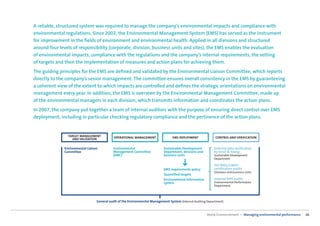
A reliable, structured system was required to manage the company’s environmental impacts and compliance with
environmental regulations. Since 2002, the Environmental Management System (EMS) has served as the instrument
for improvement in the fields of environment and environmental health. Applied in all divisions and structured
around four levels of responsibility (corporate, division, business units and sites), the EMS enables the evaluation
of environmental impacts, compliance with the regulations and the company’s internal requirements, the setting
of targets and then the implementation of measures and action plans for achieving them.
The guiding principles for the EMS are defined and validated by the Environmental Liaison Committee, which reports
directly to the company’s senior management. The committee ensures overall consistency in the EMS by guaranteeing
a coherent view of the extent to which impacts are controlled and defines the strategic orientations on environmental
management every year. In addition, the EMS is overseen by the Environmental Management Committee, made up
of the environmental managers in each division, which transmits information and coordinates the action plans.
In 2007, the company put together a team of internal auditors with the purpose of ensuring direct control over EMS
deployment, including in particular checking regulatory compliance and the pertinence of the action plans.


                TARGET MANAGEMENT            OPERATIONAL MANAGEMENT                EMS DEPLOYMENT              CONTROL AND VERIFICATION
                  AND VALIDATION

              Environmental Liaison         Environmental                    Sustainable Development          External data verification
              Committee                     Management Committee             Department, divisions and        by Ernst & Young
                                            (EMC)                            business units                   Sustainable Development
                                                                                                              Department

                                                                                                              ISO 9001/14001
                                                                             EMS requirements policy          certification audits
                                                                                                              Divisions and business units
                                                                             Quantified targets
                                                                             Environmental information        Internal EMS audits
                                                                             system                           Environmental Performance
                                                                                                              Department


                                  General audit of the Environmental Management System (Internal Auditing Department)


                                                                                                          Veolia Environnement — Managing environmental performance   26
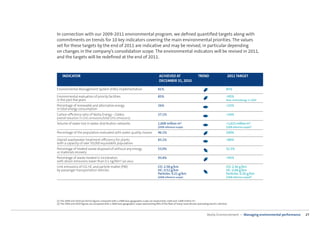
In connection with our 2009-2011 environmental program, we defined quantified targets along with
commitments on trends for 10 key indicators covering the main environmental priorities. The values
set for these targets by the end of 2011 are indicative and may be revised, in particular depending
on changes in the company’s consolidation scope. The environmental indicators will be revised in 2011,
and the targets will be redefined at the end of 2011.


     INDICATOR                                                                                ACHIEVED AT                         TREND                      2011 TARGET
                                                                                              DECEMBER 31, 2010

Environmental Management System (EMS) implementation                                         81%                                                            85%

Environmental evaluation of priority facilities                                              85%                                                            >95%
in the past five years                                                                                                                                       New methodology in 2009

Percentage of renewable and alternative energy                                               26%                                                            >25%
in total energy consumption
Carbon efficiency ratio of Veolia Energy – Dalkia                                              27.1%                                                          >24%
(overall reduction in GHG emissions/total GHG emissions)
Volume of water lost in water distribution networks                                          1,608 million m3                                               <1,615 million m3
                                                                                             (2008 reference scope)                                         (2008 reference scope)(1)

Percentage of the population evaluated with water quality classes                            96.1%                                                          100%

Overall wastewater treatment efficiency for plants                                             83.1%                                                          >80%
with a capacity of over 50,000 equivalent population
Percentage of treated waste disposed of without any energy                                   53.0%                                                          51.5%
or materials recovery
Percentage of waste treated in incinerators                                                  93.4%                                                          >95%
with dioxin emissions lower than 0.1 ng/Nm3 (all sites)
Unit emissions of CO, HC and particle matter (PM)                                            CO: 2.58 g/km                                                  CO: 2.36 g/km
by passenger transportation vehicles                                                         HC: 0.52 g/km                                                  HC: 0.48 g/km
                                                                                             Particles: 0.21 g/km                                           Particles: 0.20 g/km
                                                                                             (2008 reference scope)                                         (2008 reference scope)(2)


(1) The 2009 and 2010 pro forma figures compared with a 2008 base geographic scope are respectively 1,644 and 1,608 million m3.
(2) The 2009 and 2010 figures are compared with a 2008 base geographic scope representing 84% of the fleet of heavy road vehicles (excluding electric vehicles).


                                                                                                                                          Veolia Environnement — Managing environmental performance   27
1           Manage environmental performance

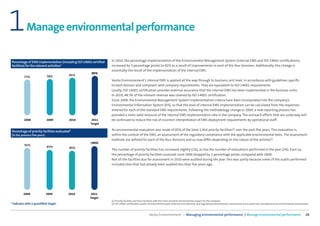
Percentage of EMS implementation (including ISO 14001 certified   In 2010, the percentage implementation of the Environmental Management System (internal EMS and ISO 14001 certifications)
facilities) for the relevant activities*                         increased by 3 percentage points to 81% as a result of improvements in each of the four divisions. Additionally, this change is
                                                                 essentially the result of the implementation of the internal EMS.
                                                     85%
                            78%           81%
          77%
                                                                 Veolia Environnement’s internal EMS is applied all the way through to business unit level, in accordance with guidelines specific
                                                                 to each division and compliant with company requirements. They are equivalent to ISO 14001 requirements.
                                                                 Locally, ISO 14001 certification provides external assurance that the internal EMS has been implemented in the business units.
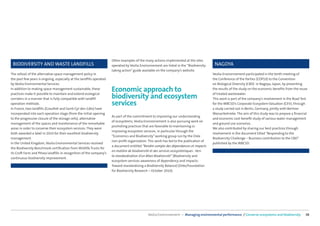
                                                                 In 2010, 48.3% of the relevant revenue was covered by ISO 14001 certification.
                                                                 Since 2009, the Environmental Management System implementation criteria have been incorporated into the company’s
                                                                 Environmental Information System (EIS), so that the level of internal EMS implementation can be calculated from the responses
                                                                 entered for each of the standard EMS requirements. Following the methodology change in 2009, a new reporting process has
                                                                 provided a more valid measure of the internal EMS implementation rate in the company. The outreach efforts that are underway will
          2008              2009          2010       2011        be continued to reduce the risk of incorrect interpretation of EMS deployment requirements by operational staff.
                                                    Target

Percentage of priority facilities evaluated*                     An environmental evaluation was made of 85% of the total 1,454 priority facilities(1) over the past five years. This evaluation is,
(in the previous five years)                                      within the context of the EMS, an assessment of the regulatory compliance with the applicable environmental texts. The assessment
                                                                 methods are defined for each of the four divisions and so may differ depending on the nature of the activity(2).
                                                    >95%
          91%
                            87%           85%
                                                                 The number of priority facilities has increased slightly (1%), as has the number of evaluations performed in the year (2%). Even so,
                                                                 the percentage of priority facilities assessed since 2006 dropped by 2 percentage points compared with 2009.
                                                                 Not all the facilities due for assessment in 2010 were audited during the year; this was partly because some of the audits performed
                                                                 included sites that had already been audited less than five years ago.


          2008             2009           2010       2011
                                                    Target
                                                                 (1) Priority facilities are those facilities with the most sensitive environmental impact for the company.
* Indicator with a quantified Target.                             (2) ISO 14001 certification audits, environmental audits (internal and external), and regulatory environmental assessments are in particular considered to be environmental assessments.


                                                                                                   Veolia Environnement — Managing environmental performance / Manage environmental performance                                                     28
2              Combat climate change
 Total direct and indirect GHG emissions                            In 2010, our total direct and indirect greenhouse gas (GHG)            As in 2009, a reasonable level of assurance was obtained through
 (million metric tons CO2 eq.)                                      emissions fell 5% overall to 47 million metric tons CO2                external verification of the key data relating to climate change
                                                                    equivalent.                                                            (total energy consumption, direct CO2 emissions and total direct
                                                                    The main changes are as follows:                                       and indirect GHG emissions). This assurance level was reached
                                                     4.9 5.0
                                                                    ■ For Veolia Environmental Services, direct emissions fell sharply     directly through the work done by the main business units that
                                                    44.9 44.5 5.4
                                                                      by 17% as a result of the divestment of the incineration             contributed data to the company during the visits made this year
                                                               42.1
                                                                      activity’s assets in the United States as well as the improved       and indirectly through the historical trust acquired over previous
                                                                      calibration of the methane emission calculation model used           years, when moderate assurance was associated with the data.
                                                                      at landfills, the installation of innovative biogas collection        (See the Ernst & Young assurance report.)
                                                                      systems, and the ongoing efforts to manage biogas collection.
                                                                      This improvement work will be continued next year and
                                                                      will also result in specific variations.
                                                                    ■ For Veolia Energy – Dalkia, the slight 2% rise in direct emissions
                            2.0 2.2 2.1
                           23.6 23.4 23.9                             is in particular due to increased activity in China combined
                                                                      with harsher weather in 2010. Indirect emissions fell 2%,
              0.2 0.2
             18.6 18.3
                                                                      particularly as a result of lower purchases of heat from outside
                        0.2                                           production units.
                        15.2
                                                                                                                                            METHODOLOGY
                                                                    ■ For Veolia Water, indirect emissions increased 11% compared
                                                                      with the previous year(1). This increase is due to electricity       For each of its activities, the company measures the direct
                                                                      consumption for new contracts in Asia and updating                   emissions of the industrial processes, vehicles, facilities
                                                                      the emission factor at sites in Reunion and Guadeloupe.              and equipment it manages, and the indirect emissions from
2.2 2.5   2.9                            0.4 0.1 0.1                ■ For Veolia Transport, direct emissions increased 7% because          the electricity and heat it consumes. The greenhouse gases
0.2 0.3 0.3                              2.4 2.5 2.6                  of increased business (new contracts), and the incorporation         concerned are:
                                                                      of consumption of heating oil and gas at facilities. Indirect        ■ CO2 emitted by combustion facilities, the incineration of
                                                                      emissions rose 43%, because of the integration of Line 9 of            the fossil content of waste and the combustion of fuel
   08

    *
   10

   08

   09

   10

   08

   09

   10

   08

   09

   10

   08

    *
   10
  09


  09


                                                                      the Seoul metro. Despite this rise, indirect emissions remain
 20


 20

 20

 20

 20

 20

 20

 20

 20

 20

 20

 20


 20


                                                                                                                                             by mobile sources (75.9% of direct emissions);
20


20


   Veolia        Veolia         Veolia      Veolia       Veolia       limited in comparison with the fuel consumption of vehicles.         ■ CH4 from the biogas emitted by landfills that is not collected
   Water         Environmental          Energy –          Transport       Environnement                                                      by the collection systems installed, and the combustion
                    Services             Dalkia
                                                                                                                                             of compressed natural gas (23.8% of direct emissions);
                        Direct emissions          Indirect emissions                                                                       ■ N2O from the waste incineration process (0.4% of direct
                                                                                                                                             emissions).
(1) Following a reporting error in the electricity consumption at one site, the 2009 figure
for indirect emissions at Veolia Water and the company as a whole has been adjusted
to enable comparison with the 2008-2010 figures.


                                                                                                             Veolia Environnement — Managing environmental performance / Combat climate change               29
Overall reduction in GHG emissions                                                           In addition, the company helps decrease overall GHG(1)                is an example of the increased use of renewable energy sources
 (million metric tons CO2 eq.)                                                                by reducing emissions at the facilities it manages and                by our activities. Last, Veolia Energy – Dalkia applies its expertise
                                                                                              by enabling others to avoid emissions.                                in integrated energy management to achieve significant
                                                                                              In 2010, Veolia Environnement improved the overall GHG                reductions in greenhouse gas emissions.
                                                                                      27.5
                                                                         26.9 26.8            emission reduction by 3% with 27.5 million metric tons              ■ For Veolia Environmental Services, the reduction reversed by
                                                                                              CO2 equivalent.                                                       2%, attributable to the drop in energy recovery following asset
                                                                                              ■ For Veolia Energy – Dalkia, the reduction improved by 18% as        divestments in the United States. However, it should be noted
                                                                                                the result of more use of wood in the energy mix and improved       that the GHG emissions avoided by recycling improved by 1%
                                                                                                recovery of alternative energies. The commissioning of              following the upturn in metals recovery, especially in France.
                 19.1 19.5 19.1                                                                 a cogeneration plant fired by biomass in Biganos, France,


                                                                                               METHODOLOGY
                                                7.0
                                     5.6 5.9                                                  Veolia Energy – Dalkia                                              Veolia Transport
                                                                                 Reduction of CO2 emissions through:                                              CO2 emissions avoided by:
                                                                                 ■ using renewable and alternative energy instead of fossil fuels;                ■ replacing transportation in private vehicles with mass transit.
                                                        2.1
                                                            1.25 1.21            ■ proper use of energy transformation facilities (energy
0.1 0.1 0.1
                                                                                   efficiency);                                                                     Veolia Environmental Services
                                                                                 ■ optimum supply of energy services (integrated energy                           CO2 emissions avoided through:
   Veolia           Veolia              Veolia             Veolia       Veolia
                                                                                   management);                                                                   ■ the sale of energy produced from the biogas collected
   Water        Environmental          Energy –          Transport Environnement
                   Services             Dalkia                                   ■ combined production of heat and electricity (cogeneration).                      at landfills;
                                                                                                                                                                  ■ the sale of heat and electricity from the combustion
                                2008         2009         2010
                                                                                              Veolia Water                                                          of incinerated waste;
                                                                                              Reduction of CO2 emissions and emissions avoided through:           ■ the recovery of raw materials contained in waste.
                                                                                              ■ the on-site consumption of part of the heat and electricity
                                                                                                from the production of renewable energy on site;                  Reduction of GHG emissions through:
                                                                                              ■ the sale of energy produced from renewable energy sources         ■ the on-site consumption of part of the electricity generated
                                                                                                on site (biogas from sludge digestion, hydraulic microturbines,     by the incineration of waste and recovery of biogas;
                                                                                                heat pumps, etc.).                                                ■ the collection of biogas at landfills.
(1) The overall reduction in GHG emissions corresponds to reductions in direct and indirect
emissions (CO2 not emitted as a result of certain operating methods implemented by
the company), and the emissions third parties avoid as a result of a company activity.


                                                                                                                                     Veolia Environnement — Managing environmental performance / Combat climate change                30
Carbon efficiency ratio (Veolia Environnement)                For a more accurate reflection of the company’s performance,            Carbon performance of Veolia Energy – Dalkia’s
                                                            a method applying to the four business areas has been                  combustion facilities
                                                            developed.                                                             (metric tons of CO2 per thermal MWh produced)
                                                    59%     The method takes into account all the positive impacts from
               55%                54%
                                                            the overall decrease in GHG emissions. Refined from year to year,                             0.294
                                                            the method provides a carbon efficiency ratio that reflects the                                                      0.264                 0.257
                                                            overall reduction in GHG emissions attributable to the company’s
                                                            activity and the total GHG emissions (direct and indirect)                                              ➞
                                                            managed on behalf of its clients.
                                                            In 2010, the ratio was 59%, up 5 percentage points on 2009.
                                                                                                                                                                   –10.2%
                                                                                                                                                                                          ➞
                                                            Therefore, the positive actions and impacts of Veolia                                                                         –2.7%
                                                            Environnement’s activity in decreasing overall GHG emissions
               2008              2009               2010    offsets more than half of the GHG emissions attributable
                                                            to its activities.
                                                                                                                                                          2008                 2009                 2010
                                                            In addition, Veolia Energy-Dalkia, which has a specific objective
                                                            on this indicator, has also improved its carbon efficiency ratio
                                                            by four points.                                                       In 2010, Veolia Energy – Dalkia managed close to 115 TWh of input
                                                                                                                                  energy, corresponding to direct emissions of 23.9 million metric
                                                                                                                                  tons of CO2. While the figures were similar to those in 2009,
                                                                                                                                  the “carbon content” of the heat produced(1) fell by 2.7%.
                                                                                                                                  This improvement in carbon performance is related to:
Carbon intensity of revenue                                 Taking a very broad approach, it is also possible to assess
                                                                                                                                  ■ the decreased use of coal and heating oil and its replacement
(million metric tons CO2 eq. by billion euros of revenue)   the carbon intensity of Veolia Environnement’s revenue.
                                                                                                                                    with gas for which the carbon equivalent emission factor
                                                            Between 2009 and 2010, the figure was stable at 1.4 million
                                                                                                                                    is lower;
                                                            metric tons CO2 equivalent per billion euros of revenue. Thus,
                1.4                1.4               1.4                                                                          ■ the increased use of wood in Veolia Energy – Dalkia’s energy
                                                            while continuing to develop its activities (2.5% of total revenue),
                                                                                                                                    mix, especially in France. This result reflects the application
                                                            Veolia Environnement has been able to maintain the carbon
                                                                                                                                    of the policy on increasing biomass use, which was developed
                                                            intensity of its contracts at a steady level.
                                                                                                                                    in 2007 and implemented in 2008.


               2008               2009              2010
                                                                                                                                  (1) CO2 emissions associated with electricity generation are evaluated according
                                                                                                                                  to the energy mix of the business unit.


                                                                                                    Veolia Environnement — Managing environmental performance / Combat climate change                                31
Methane collection rate in landfills           Waste decomposition in landfills generates biogas that is            To improve the reliability of these results, Veolia Environmental
(sites under operation)                       composed of between 40% and 60% methane. By mixing with             Services is continuing its research, in particular for
                                              air in the atmosphere, this biogas contributes to global warming,   the determination of fugitive methane emissions, and has
                                              all the more so as methane has a high global warming potential.     undertaken to introduce an indicator/target to assess
                            48.9%     54.0%
             46.5%                                                                                                its methane collection performance.
                                              In 2010, fugitive methane emissions accounted for nearly
                                              24% of Veolia Environnement’s direct GHG emissions. Given
                                              this significant percentage, Veolia Environnement is motivated        ESTIMATING FUGITIVE METHANE
                                              to continually improve:                                              EMISSIONS
                                              ■ the precision of its calculation methodologies;
                                              ■ knowledge of the typology of landfilled waste;                     Until 2008, various models were used to calculate theoretical
                                              ■ the performance of landfill cell capping techniques, biogas        methane production at landfills in different countries
                                                collection and its recovery as heat, electricity or as a fuel.    (LandGEM in the United States, GasSIM in the United Kingdom,
              2008           2009     2010                                                                        Swana-Ademe in France, NGERS in Australia and Tier 2, which
                                              For this reason, the calculation of methane production at waste     was recommended by the Intergovernmental Panel on Climate
                                              landfills was fine-tuned this year with the integration in            Change, for other countries). It is in fact impossible to
                                              the model of a more precise typology of the waste (percentage       continuously measure the emissions from sites directly because
                                              of fermentable waste) at some sites. This change to the model is    the sources are too diffuse.
                                              the main reason for the reduction in methane emissions in 2010.     Given the uncertainty due to differences in the design and use
                                              Additionally, efforts were made to install innovative biogas         of the various models (use of factors by default or calculated for
                                              collection systems and improve management techniques,               methanogenic power, type of waste, oxidation factor, the actual
                                              resulting in improved performances at these sites. These two        collection rate, etc.), Veolia Environmental Services has used
                                              factors combined led to a reduction in methane emissions            a single model (Tier 2) to consolidate the data from all its landfills
                                              of 20.5%, and so to a 6 percentage points improvement in            worldwide since 2009.
                                              the collection rate, which was 54% in 2010.


                                                                                     Veolia Environnement — Managing environmental performance / Combat climate change                32
3            Mitigate our impact
3.1 Limiting the discharge                                                                3.2 Environmental health
of pollutants into water
Treatment efficiency of wastewater treatment plants*                                        To assess the quality of the water it supplies throughout the            The target remains to adapt our tools and organization
(capacity above 50,000 eq. pop.)                                                          world, in 2007, Veolia Water created the “Quality class” indicator       to achieve a 100% coverage rate.
                                                                                          based on the chemical and bacteriological parameters deemed              With respect to the population for which it was possible
         90.7%               91.6%                92.8%                                   to be priorities by the WHO(2).                                          to calculate this indicator in 2010, the percentage served by
                                                                                          In 2010, Veolia Water was able to calculate this indicator for           Veolia Water benefiting from water of excellent or high quality
                                                                                          96.1% of the total population it serves throughout the world,            remained unchanged on the previous year (97.4% in 2010
                                                         80%
                                                                                          up 5.8 percentage points compared with 2009. This noticeable             compared with 97% in 2009). The presence of chronic chemical
                                                                 BOD5 treatment
                                                                                          improvement in the coverage rate is attributable to the rollout          parameters reflecting a problem with the water resource
                                                                 efficiency               of a specific tool making water quality data collection more              was noted for the remaining 2.6%.
 80.9%               81.1%               83.1%                   Overall treatment        reliable, along with personalized assistance for the
                                                                 efficiency               implementation of this indicator for new contracts.                      (2) The WHO considers five parameters as being widely distributed worldwide
                                                                                                                                                                   and able to present a significant danger for human health due to water-borne exposure
                                                                 Target set for overall
                                                                                                                                                                   (Escherichia Coli, fluorides, selenium, arsenic and nitrates).
                                                                 efficiency


          2008                2009                2010                                    Sanitary quality of drinking water
In 2010, the pollution abatement rate expressed as BOD5 rose
1.2 percentage points to 92.8% – which results in highly effective                               8.9%              9.7%              3.9%
treatment. This improvement is due to the excellent treatment
rates of new contracts, up to 97.3%, and a one-point improvement
                                                                                                                                                                                                             Excellent or
in the performance at plants already operated. This applies                                    91.1%             90.3%             96.1%                                             97.4%                   high-quality water
particularly to Asia with the implementation of new biological
treatment systems at certain sites. Similarly, the overall
treatment efficiency(1) rose 2 points to 83.1% in 2010.

                                                                                                       2008              2009              2010
                                                                                                                                                                           Non-compliant
                                                                                                                                                                   2.6%
                                                                                                                                                                           water quality
* Indicator with a quantified Target.                                                          Percentage of                     Percentage of
                                                                                              the population evaluated          the population evaluated
(1) A composite indicator that takes into account and weights the different forms
of pollution based on the impact analysis model developed by the French river basin
                                                                                              by water quality class            solely by compliance rate
agencies: five-day Biological Oxygen Demand (BOD5), Chemical Oxygen Demand (COD),
nitrogen (N), phosphorus (P) and suspended solids (SS).


                                                                                                                                           Veolia Environnement — Managing environmental performance / Mitigate our impact                            33
3.2 Environmental health                                         3.3 Limit air pollution
Managing dioxin emissions from waste treated in incinerators     Waste incineration plant emissions (hazardous and non-hazardous)                           Unit emissions per passenger transportation vehicle*
is a major public health issue for the company. Veolia           in grams/metric ton of incinerated waste                                                   (g/km)
Environmental Services has adopted the most stringent                              18                  16
regulatory yardstick, i.e., that set by the European Union.                        55                  52                   14
In 2010, Veolia Environmental Services saw its performance                                                                  42                                     2.70 2.58            0.64                       0.27
                                                                                                                                                            2.49               2.37            0.56 0.52                  0.24
drop due to an incomplete data set outside the European Union.                                                                                                                                             0.49                  0.21 0.20
Conservatively, the tonnage concerned has been considered                        871                  853
as having been treated in an incinerator that does not meet                                                                763
the target.

                                                                                   83                  91                   87
                                                                                                                                                             CO unit emissions           HC unit emissions         Particle matter (PM)
                                                                                        2008                2009                 2010                             (g/km)                      (g/km)              unit emissions (g/km)
Percentage of non-hazardous waste treated in incinerators
with dioxin emissions lower than 0.1 ng/Nm3*
                                                                                           SOx        NOx         HCl        Dusts                                         2008       2009     2010    Target pro forma 2008


     96.6%            98.6%                                      In 2010, SOx, NOx, HCl and dust emissions at incineration plants                           In 2008, Veolia Transport developed a new reference base
                                       93.4%      >95%
                                                                 declined due to the ongoing improvement in the performance of                              corresponding to 84%(1) of the vehicle fleet (excluding electric road
                                                                 flue gas treatment systems and to the divestment of incinerators                            vehicles) and undertook to reach by 2011 three reduction targets:
                                                                 in the United States and South Korea.                                                      ■ –5%(2) for carbon monoxide (CO), i.e., 2.37g/km;
                                                                 Furthermore, the company is working on enhancing the reliability                           ■ –24% for hydrocarbons (HC), i.e., 0.49g/km;
                                                                 of an indicator for measuring NOx and SOx for energy production                            ■ –27% for particle matter (PM), i.e., 0.20g/km.
                                                                 (Veolia Energy – Dalkia).
                                                                                                                                                            At the end of 2010, HC and PM unit emissions had fallen 17%
                                                                                                                                                            and 22% respectively compared with 2008. These results are due to
                                                                                                                                                            upgrades to fleet vehicles compliant with the Euro 4 and 5 standards
     2008              2009            2010       2011
                                                 Target
                                                                                                                                                            (up 22%), and the improved environmental performance as a result
                                                                                                                                                            of a greater number of vehicles being fitted with particle filters
* Indicator with a quantified Target.                                                                                                                        (up 15%).
                                                                                                                                                            The drop in the number of petrol vehicles (down 5%) reduced unit
                                                                 (1) The 2009 and 2010 figures are compared pro forma with the 2008 reference geographic     CO emissions by 5% compared with 2009, to a level comparable
                                                                 scope representing 84% of the fleet of heavy road vehicles (excluding electric vehicles).
                                                                 (2) After adjustment of the figures at March 31, 2010.                                      with that in 2008.


                                                                                                                         Veolia Environnement — Managing environmental performance / Mitigate our impact                                34
4              Conserve ecosystems and biodiversity

The United Nations declared 2010 the “International Year
of Biodiversity” to boost awareness among the international
                                                                                             COMMITTED TO WORKING ALONGSIDE
community of the major issues surrounding the decrease                                       THE IUCN
in the number of species and the declining quality of ecosystem
                                                                                                             In 2008, Veolia Environnement signed
services.
                                                                                                            a partnership agreement with the French
                                                                                                            Committee of the International Union for
Within this context, and in direct conjunction with the first
                                                                                            the Conservation of Nature (IUCN). The aim of the action
two principles of the Convention on Biological Diversity (CBD)(1),
                                                                                            program defined by the two parties is:
Veolia Environnement remains committed in particular to:
                                                                                            ■ for the IUCN to work with the company on integrating
■ conserving ecosystems and their vitality by characterizing
                                                                                              biodiversity in its corporate strategy;
  the company’s impacts and dependency on ecosystems;
                                                                                            ■ to underscore the directions adopted in Research and
■ restoring and developing urban biodiversity;
                                                                                              Development through a network of renowned experts;
■ protecting remarkable ecological areas;
                                                                                            ■ to participate in boosting employees’ awareness through
■ understanding ecosystems better to inform, educate and boost
                                                                                              training programs.
  awareness of biodiversity issues.
                                                                                            IUCN France has 55 members (ministries, state entities and
                                                                                            NGOs) as well as a network of around 250 experts. At the global
These commitments are set out in the “Biodiversity: taking
                                                                                            level, IUCN has had UN observer status since 1999.
action” guide that was widely distributed inside and outside
the company in 2010, and is available on the company’s website.
They are monitored by the Biodiversity Steering Committee,
which comprises members drawn from the departments
responsible for this topic in the company’s four divisions.


(1) The Convention on Biological Diversity (CBD) is an international treaty that was
adopted at the Earth Summit in Rio de Janeiro (Brazil) in 1992. It has three main aims:
• the conservation of biological diversity;
• the sustainable use of its components;
• the fair and equitable sharing of the benefits arising out of the utilization of genetic
resources.


                                                                                                                    Veolia Environnement — Managing environmental performance / Conserve ecosystems and biodiversity   35
The challenge for the company is to ensure the management of
its impacts while promoting the contribution its activities make
to conserving or restoring ecosystem services.


The impact of the company’s                                          Interdependency                                                     Evaluation tools
activities
By their very nature, Veolia Environnement’s activities help         Veolia Environnement needs ecosystems to function properly          The company’s approach is above all based on identifying those
conserve ecosystems by reducing environmental pollution.             in order to provide some of its services. Veolia Water makes sure   zones where it needs to take priority action, and then rolling out
The services provided by Veolia Water and Veolia Environmental       it can continue to benefit from the ecosystem service that           an evaluation method to define an action plan.
Services collect and treat wastewater and waste to contain           regulates the quality of water resources by working closely with    Since 2010, the company has used information from the IBAT
various forms of urban and industrial pollution and prevent them     municipal and industrial clients to reduce accidental and chronic   (Integrated Biodiversity Assessment Tool) database developed
from contaminating the soil, air, and rivers, lakes and oceans.      pollution, and to protect water withdrawal points. By doing so,     by BirdLife International, Conservation International, IUCN
In energy services, the development of centralized district          treatment to make the raw water potable can be kept to              and the United Nations Environment Program in its “Atlas of
heating networks, operated under continuous supervision and          a minimum.                                                          Responsibilities and Opportunities for Sustainability”. This tool
subject to strict regulations, helps reduce air pollution compared   Veolia Energy – Dalkia ensures it benefits from the ecosystem        was developed internally to identify, for any given site, all
to more polluting individual systems burning heating oil or coal.    service that supplies biomass for its combustion facilities,        the sustainability challenges involved, including its ecological
The promotion of public transportation also helps reduce air          while rigorously protecting resources by directly controlling      context. Ongoing additions to the Atlas will make it possible
pollution—the use of a private car can emit up to three times        and ensuring the sustainable management of supply, both             to include data from a geolocation data system for company
the amount of local air pollution per person transported than        from forestry and agriculture.                                      facilities.
a bus for a given trip (Source: Ademe, French agency for             Lastly, Veolia Water’s wastewater services and Veolia               Furthermore, the company has developed a biodiversity
the environment and energy management, 2007).                        Environmental Services’ composting and soil remediation             diagnostic tool. The method chosen factors in the characteristics
Nonetheless, Veolia Environnement’s activities generate              activities use biological processes to break down organic           of the natural environment and the development and
secondary impacts, especially due to the consumption of              components. The conservation of ecosystems is therefore             management methods applied at each site in order to compile
natural resources and the residual pollution in the discharge        central to the development and even the future of Veolia            an action plan reflecting local issues. The aim is to give priority
from its facilities.                                                 Environnement’s activities.                                         to implementing this tool at sites located in areas of ecological
                                                                                                                                         interest. Its use will in particular encourage the implementation
                                                                                                                                         of alternative management of the spaces at a greater number
                                                                                                                                         of sites.


                                                                                             Veolia Environnement — Managing environmental performance / Conserve ecosystems and biodiversity            36
PROTECTION AND ENHANCEMENT                                        Action plans                                                       Management of discharges and emissions
                                                                                                                                      Conventional physical-chemical approaches that involve
 OF WETLANDS                                                       at our sites                                                       measuring the pollutant content in the water discharged are not
                                                                                                                                      on their own sufficient for evaluating the state of conservation
The many ecosystem services provided by wetlands have
                                                                   Land management                                                    of the biological diversity of a given environment. Because
been identified, but the manner in which these services are
                                                                   The aim here is to develop an alternative way of managing sites    they largely focus on so-called “remarkable” species, current
qualified and enhanced can be improved. Consequently,
                                                                   to drive standard methods forward by incorporating conservation    conservation tools are also insufficient. Today, new overall
Veolia Environnement, Conservatoire du Littoral and Rivages
                                                                   into the design and management of the land at operational sites.   approaches are being developed to define the ecological state
de France (French association of authorities and organizations
                                                                   In particular, this involves:                                      of an environment. The results obtained with these new tools
managing natural coastal and lakeside areas) have committed
                                                                   ■ reducing the frequency of lawn maintenance by late mowing;       are currently difficult to translate into operational management.
to a partnership with a dual purpose:
                                                                   ■ promoting the regeneration of native species;                    As a result, the company is developing its own expertise in
■ develop research on pilot projects or sites helping to compile
                                                                   ■ combating (through thermal, mechanical and manual weeding)       biological tools to evaluate the level of danger and impact of its
  a method for qualifying wetlands in terms of the services
                                                                     invasive exotics that colonize the environment in an             discharges on aquatic environments, its air emissions and its
  rendered;
                                                                     uncontrolled and rampant manner, pushing out native species;     products (organic soil improvers and secondary raw materials).
■ develop awareness tools for these areas for stakeholders in
                                                                   ■ creating ground-level and aboveground havens for fauna           In particular, the Research and Development teams are extending
  regional development.
                                                                     at these sites.                                                  the scope of their work to include ecological engineering that
                                                                                                                                      can identify impact-reducing techniques (lagooning, grass filter
This program in particular reflects the company’s commitment to
                                                                                                                                      strips, etc.), and developing expertise in environment restoration.
improving our knowledge of ecosystems and the appreciation
of our dependency on remarkable ecosystems.


                                                                                           Veolia Environnement — Managing environmental performance / Conserve ecosystems and biodiversity           37
Other examples of the many actions implemented at the sites
 BIODIVERSITY AND WASTE LANDFILLS                                    operated by Veolia Environnement are listed in the “Biodiversity:    NAGOYA
                                                                     taking action” guide available on the company’s website.
The rollout of the alternative space management policy in                                                                                Veolia Environnement participated in the tenth meeting of
the past few years is ongoing, especially at the landfills operated                                                                       the Conference of the Parties (COP10) to the Convention
by Veolia Environmental Services.                                                                                                        on Biological Diversity (CBD) in Nagoya, Japan, by presenting
In addition to making space management sustainable, these
practices make it possible to maintain and extend ecological
                                                                     Economic approach to                                                the results of the study on the economic benefits from the reuse
                                                                                                                                         of treated wastewater.
corridors in a manner that is fully compatible with landfill          biodiversity and ecosystem                                          This work is part of the company’s involvement in the Road Test
operation methods.                                                   services                                                            for the WBCSD’s Corporate Ecosystem Valuation (CEV), through
In France, two landfills (Graulhet and Saint-Cyr-des-Gâts) have                                                                           a study carried out in Berlin, Germany, jointly with Berliner
incorporated into each operation stage (from the initial opening                                                                         Wasserbetriebe. The aim of this study was to prepare a financial
                                                                     As part of the commitment to improving our understanding
to the progressive closure of the storage cells), alternative                                                                            and economic cost-benefit study of various water management
                                                                     of ecosystems, Veolia Environnement is also pursuing work on
management of the spaces and maintenance of the remarkable                                                                               and ground use scenarios.
                                                                     promoting practices that are favorable to maintaining or
areas in order to conserve their ecosystem services. They were                                                                           We also contributed by sharing our best practices through
                                                                     improving ecosystem services, in particular through the
both awarded a label in 2010 for their excellent biodiversity                                                                            involvement in the document titled “Responding to the
                                                                     “Economics and Biodiversity” working group run by the Orée
management.                                                                                                                              Biodiversity Challenge – Business contribution to the CBD”
                                                                     non-profit organization. This work has led to the publication of
In the United Kingdom, Veolia Environmental Services received                                                                            published by the WBCSD.
                                                                     a document entitled “Rendre compte des dépendances et impacts
the Biodiversity Benchmark certification from Wildlife Trusts for
                                                                     en matière de biodiversité et des services ecosystémiques : Vers
its Croft Farm and Pitsea landfills in recognition of the company’s
                                                                     la standardisation d’un Bilan Biodiversité” (Biodiversity and
continuous biodiversity improvement.
                                                                     ecosystem services awareness of dependency and impacts:
                                                                     Toward standardizing a Biodiversity Balance) (Orée/Foundation
                                                                     for Biodiversity Research – October 2010).


                                                                                             Veolia Environnement — Managing environmental performance / Conserve ecosystems and biodiversity         38
5           Protect natural resources

Percentage of waste per treatment process                                                            Percentage of waste disposed of*
(with energy or materials recovery)                                                                  (without energy or materials recovery)

                                                                                                                55.5%
                                                                                                                                     51.6%               53.0%                 51.5%

                          17.2%          17.8%
        14.7%                                              Energy recovery from landfills(1)
                                                           Energy recovery from incineration
        18.0%             18.8%          16.8%             Materials recovery


        11.7%             12.5%          12.5%

                2008              2009           2010                                                            2008                 2009                 2010                 2011
                                                                                                                                                                               Target


Source-separated collection and sorting of the waste (wood, paper, board, glass, metals, plastics,   In 2010, materials recovery remained stable. Progress was made in energy recovery from landfills
etc.) generated by industrial companies and households enables the waste to be recycled and          (up 0.6 percentage points) through the increased percentage of biogas recovered (up 2 percentage
transformed into reusable materials. Waste that is not suitable for materials recovery can be        points). The divestment of a number of incinerators resulted in the reduction in percentage of
treated with processes allowing energy recovery. It is possible to recover the heat produced         waste incinerated with energy recovery (down 2 percentage points).
by incinerators fitted with energy recovery systems and to collect the biogas emitted by              The percentage of waste disposed of(2) without energy or materials recovery increased in 2010
the decomposition of waste in landfills(1).                                                           to 53%.


                                                                                                     (1) Calculated from a ratio between methane emissions produced and tonnages landfilled at the French sites of Veolia Environmental
                                                                                                     Services. The changes linked to the typology of waste worldwide have not been yet applied to the constants used for this indicator;
                                                                                                     this development will be reviewed in 2011.
                                                                                                     (2) The following data is excluded from the indicator’s scope:
                                                                                                     • waste generated by the treatment activities of Veolia Environmental Services (metals, hazardous waste, etc.);
                                                                                                     • biological treatment;
                                                                                                     • physical-chemical treatment;
                                                                                                     • soil remediation.
* Indicator with a quantified Target.                                                                 As a consequence, the indicator covers 93.5% of waste treated (excluding transfer) by Veolia Environmental Services.


                                                                                                         Veolia Environnement — Managing environmental performance / Protect natural resources                                             39
Preserving energy resources
Renewable and alternative energy consumption                         The divisions contribute at different rates to the company’s overall consumption of renewable and alternative(1) energy.
(thousands of MWh – Veolia Environnement)                            Veolia Environmental Services accounted for 72% due to the incineration of waste and combustion of biogas recovered in its landfills.
                                                                     Veolia Energy – Dalkia contributed 23% of this consumption due in particular to the use of wood, solar and geothermal power in
                      19,293                17,572                   the energy mix in its combustion facilities. For its part, Veolia Water consumes renewable or alternative energy through the use of
    19,074
                                                                     biogas from treatment sludge and the purchase of hydro, wind and solar power. Last, Veolia Transport also promotes the consumption
                                                                     of non-fossil energy by increasingly using clean fuels (biogas, diester and bioethanol). For example, the consumption of biogas was up
                      28,226                27,455                   sharply in Sweden and Norway.
    25,833

                                                                     In 2010, Veolia Environnement’s consumption of renewable and alternative energy fell 5%, again due to the divestment of part of
              2008              2009                 2010            the incineration activity in the United States. Nonetheless, improved biogas recovery at landfills, the increasing use of biomass as
  Renewable energy     Alternative energy                            a source of energy and improved recovery of alternative energies at municipal waste incineration plants helped offset the decrease
                                                                     at the company level.
Production of renewable and alternative energy
(thousands of MWh – Veolia Environnement)

                                             5,603
                        5,799
      5,990                                                          Renewable and alternative energy production largely involves the direct consumption of renewable and alternative resources, mainly
                                                                     by Veolia Energy – Dalkia. However, it also refers to the production of energy at facilities (methane from anaerobic digestion and
                                            12,778                   energy recovery at landfills).
    10,709            12,179
                                                                     Veolia Environmental Services and Veolia Energy – Dalkia contribute 46% and 50% respectively to the company’s energy sales.
                                                                     In 2010, renewable and alternative energy production rose 2% because of the increase in wood consumption in the energy mix
                                                                     of Veolia Energy – Dalkia and the improved recovery of alternative energy at municipal waste incineration plants.
              2008              2009                 2010
  Renewable energy     Alternative energy


Renewable and alternative energy as a percentage
of total energy consumption*

          26.5%            27.7%
                                               26.1%        >25%

                     11.2%             10.2%
  11.3%
                                                                     In 2010, renewable and alternative energy as a percentage of the total energy consumed by the company was 26.1%, which remained
                                                                     above target.
  15.2%              16.4%             15.9%


          2008               2009              2010          2011
                                                            Target
  Renewable energy     Alternative energy
                                                                     (1) Alternative energies are natural or industrial sources of energy that would be lost if not immediately recovered. Renewable energies are indefinitely and inexhaustibly renewed or
* Indicator with a quantified Target.                                 regenerated sources.


                                                                                                                        Veolia Environnement — Managing environmental performance / Protect natural resources                                                40
Saving water resources


Water distribution network efficiency                               Linear loss index in m3/km/day                                       Water losses (in millions of m3)*

        76.5%             77.1%         75.1%      75.3%                                                               17.1
                                                                                                       14.9
                                                                        13.9            13.4

                                                                                                                                        5,541          5,549          5,473                    6,661


                                                                                                                                        1,700          1,644          1,608       1,615        2,188

        2008              2009           2010       2010                2008           2009            2010            2010                     2008         2009           2010      2011 Target      2010
                        pro forma      pro forma                                     pro forma       pro forma                                             pro forma      pro forma    pro forma
                          2008           2008                                          2008            2008                                                  2008           2008         2008

                                                                                                                                        Volume consumed (in millions of m3)

                                                                                                                                        Volume lost (in millions of m3)


In 2010, the efficiency of water distribution networks was 75.3%,   Expressed as a linear index, water losses totaled 17.11 m3 per day   Veolia Water’s target of reducing the volume of water lost by 5%
which is virtually unchanged compared with 2009. The same         and per kilometer for 2010. In terms of the constant 2008 scope,     by 2011 compared with the 2008 reporting scope.
applies at a constant scope, for which the efficiency rate was      this linear loss index is 14.9 m3 per day and per kilometer, which
75.1%. The trend reflects the excellent performance of new         corresponds to 1,608 million cubic meters of water lost, down
contracts and the persistence of a good efficiency rate for         2.2% compared with the volume of water lost in 2009, and 5.4%
existing contracts.                                               compared with 2008. The results are therefore in line with


* Indicator with a quantified Target.


                                                                                                       Veolia Environnement — Managing environmental performance / Protect natural resources                  41
MANAGING
SOCIAL
PERFORMANCE


              42
As the leader in environmental solutions, Veolia Environnement has particular economic
and social responsibility in all countries where it operates. Its industrial model has always
encouraged the implementation of a human resources policy across all businesses and
all countries.

Ensuring the company’s continued growth, whether viewed in terms of its globalization,
its commercial choices or the economic crisis, requires regularly reviewing its social model.
In 2010, Veolia Environnement reasserted its aims in this area and set the priorities for
the years ahead. Four strategic areas were identified with a view to maintaining skills
development, ensuring social equity, strengthening health and safety measures,
and ensuring solidarity within the company for all employees.

To carry out the necessary analyses and contribute to human resources management,
an annual HR reporting procedure was introduced in 2001. The data provides an insight
into HR management in the company’s various entities, in particular through the division
and geographic area breakdowns. A summary table of the main data is provided on p. 67.


                                                                             Veolia Environnement — Managing social performance   43
Veolia Environnement worldwide


                                                                                                      Europe
                                                                                                      209,327 employees


                                    North America
                                    29,721 employees                                                                                                            Asia-Pacific
                                                                                                                                                                33,406 employees


                                                                                                                  Africa/
                                                                                                                  Middle East
                                                                                                                  23,247 employees

           South America
       21,333 employees


More than 10,000 employees   Between 5,000 and 10,000 employees   Between 1,000 and 5,000 employees   Fewer than 1,000 employees     Fewer than 100 employees     Campus Veolia Environnement


                                                                                                                                   Veolia Environnement — Managing social performance     44
1                             Employment trends, a reflection
                              of the company’s business activities

At December 31, 2010, Veolia Environnement                                                             Veolia Environnement’s growth strategy has been implemented            Breakdown of workforce by division in 2010
had 317,034 employees, 1.4% more than at                                                               over several years, as reflected in the comparative changes in          Excluding Veolia Environnement head office employees: 1,821
                                                                                                       its four divisions.
the end of 2009. In mainland France, there were
                                                                                                       ■ Veolia Water remains the company’s main division with
100,840 employees, including 13,300 managers,                                                            96,260 employees in 67 countries. Its workforce increased 0.5%                                30%        Veolia Water: 96,260
compared with 100,524 and 13,141 respectively                                                                                                                                    17%                              Veolia Environmental
                                                                                                         over 2009. This growth is attributable to the development of                                             Services: 84,740
in 2009.                                                                                                 its positions internationally and the loss of employees in France
                                                                                                                                                                                                                  Veolia Transport: 80,756
                                                                                                         following the phasedown of certain activities with Suez
                                                                                                                                                                                                                  Veolia Energy – Dalkia: 53,457
This controlled growth is the result of:                                                                 Environnement.
■ Scope effects: the balance from mergers & acquisitions and new                                        ■ Veolia Energy – Dalkia has 53,457 employees and experienced
  contracts for the one part, and divestment & subsidiarization and                                      1.7% growth in its workforce. In 2010, this business activity                               27%
  loss of contracts for the other, with an end result of 637 additional                                  entered Turkey but closed operations in Algeria and Saudi                      26%
  employees, illustrating an overall balance. This relative stability in                                 Arabia.
  the company does, however, mask some significant movements.                                           ■ Veolia Environmental Services, with 84,740 employees, saw
                                                                                                                                                                              Change in workforce by division
■ Organic growth: the difference between hires and departures                                             its workforce shrink 1%. After the divestment of the industrial
  is an additional 3,807 new employees.                                                                  cleaning business in 2009, the division continued to refocus its       Change 2009-2010
                                                                                                         business by acquiring market share in Estonia, Ukraine, Latvia,        Average annual change 2006-2010
                                       16,758 internal transfers
                                                                                                         Lithuania and Qatar, while at the same time closing down
                          Departures                               Entries                                                                                                           4.7%
                                                                                                         operations in Romania and South Africa.                                                                                      4.1%
                                     –38,361 Unlimited- +35,748                                        ■ Veolia Transport gained an additional 4% employees, bringing
                                                  term
2009 workforce: 312,590


                                                                             2010 workforce: 317,034


                                                contract                                                 its total workforce to 80,756, in particular because of its
                                   5,803
                            fixed-term contracts                                                          business in France and the United States.
                          converted to unlimited-                                                                                                                                                1.7% 1.9%
                              term contracts
                                     –15,225             +21,645                                                                                                              0.5%
                                                 Fixed-
                                                  term
                                                contract

                                                                                                                                                                                                                                             –0.3%
                                                                                                                                                                                                                  –1.0% –1.1%
                                   –13,327     Change     +13,964
                                                                                                                                                                             Veolia Water      Veolia Energy –        Veolia            Veolia
                                               in scope
                                                                                                                                                                                                   Dalkia         Environmental       Transport
                                                                                                                                                                                                                     Services


                                                                                                          Veolia Environnement — Managing social performance / Employment trends, a reflection of the company’s business activities                45
In all businesses, the company continued to grow internationally.     Breakdown of workforce by geographic area in 2010                      Change in workforce by geographic area
In Europe, especially in France, contract renewals and the
distribution of assets made it possible to seize the best
                                                                                                                                              Change 2009-2010
opportunities.                                                                                                                                Average annual change 2006-2010
                                                                                  7%                         34%
Europe remains the company’s strongest geographic area,                                                                                                                                                           9.2%
                                                                                                                                                                            8.9%
accounting for almost two-thirds of its workforce, despite a 0.6%          7%
drop in the number of employees. In the past five years, this area                                                                                                                                          7.2%
has gained 12,502 employees. In 2010, the aim was to refocus                                                                                                                                 5.9%
                                                                                                                 32%                                                               5.5%
certain activities through contract renewals and new contracts.              9%                                                                                                                     5.1%
For example, Veolia Environmental Services withdrew from                                                                                                             4.4%
Romania but entered Ukraine, while Veolia Energy – Dalkia
withdrew from some business areas in Poland but stepped up its                             11%
                                                                                                                                               1.5%
activity in the Czech Republic. In France, the contract with SEDIF,                                                                                     0.3%                          0.5%
the Greater Paris water authority, was renewed for 12 years,
and Veolia Transport won new intercity contracts.                           Europe (excluding France): 108,487
                                                                            France: 100,840
                                                                                                                                         –1.4%
In the past five years, the Asia-Pacific area gained                          Asia-Pacific: 33,406                                                                –2.1%
16,017 employees, an increase of more than 90%. At the end                  North America: 29,721                                             Europe        France      Asia-       North     South         Africa/
of 2010, there were 1,393 more employees than at the end of                                                                              (excluding France)            Pacific      America   America        Middle
                                                                            Africa/Middle East: 23,247
the previous year (a 4.3% increase). China gained 616 employees                                                                                                                                              East
                                                                            South America: 21,333
and India 475. Veolia Water also entered into Indonesia.

In 2010, the workforce in North America rose by 5.5%. The
United States ended the year with 1,548 additional employees
attributable to the growth of the company’s transportation
business. With 27,533 employees, it is the company’s second           In the Africa/Middle East area, the 7.3% growth in the workforce
largest geographic area.                                              was driven by Morocco, especially the waste management
                                                                      division and the transportation contract in Rabat. Veolia
In Latin America, workforce growth, particularly in Brazil and        Environmental Services in Egypt and Veolia Water in Qatar
Mexico, was further augmented by the entry of Peru. As a result,      also contributed to this growth. In the past five years,
the number of employees grew by 5.9% in 2010, or 32% in               the Africa/Middle East area has gained 8,979 employees,
five years.                                                            or an additional 63%.


                                                                         Veolia Environnement — Managing social performance / Employment trends, a reflection of the company’s business activities                 46
2         Managing employees to reflect local needs

The nature of the company’s businesses requires                      Breakdown of employees by socio-professional category               Percentage of female employees by socio-professional category
local management of personnel. The structure
                                                                                  9%                                                         Men     Women
of the company’s workforce therefore reflects
                                                                                                              Manual workers /
the labor markets in which we operate.                                                                        Operatives: 197,573                   23%               20%                                  12%
                                                                                                              Supervisory /
Of the company’s total workforce, 63% are manual workers                                                      Technical: 51,624                                                       59%
and 80% are men. Depending on the level of an activity’s                                                      Office workers: 38,753
development and the structure of the local labor market,
                                                                     12%
                                                                                                              Managers: 29,084
these ratios are subject to considerable variations. In Lebanon,
for example, 15 of the 29 employees are managers, and women
                                                                                              63%
occupy 40% of the positions. In Brazil, 76% of the 6,531                    16%
employees are manual workers and women account for 37%                                                                                        Managers       Supervisory /       Office              Manual
of the workforce for cultural reasons specific to this country.                                                                                                 Technical        workers           workers /
Nonetheless, these local situations aside, the company’s                                                                                                                                          Operatives
commitment to diversity is very active and the percentage
                                                                     Age pyramid (average age 41.8 years)
of women in the workforce at Veolia Environnement is tending
to increase (see p. 51).                                                                               Men (average age 42.2 years)                      Women (average age 40.3 years)
                                                                                                                 4.5%                    Over 60             2.5%
The distribution of employees by age bracket reflects the
demographics of the countries where Veolia Environnement                                     9.5%                                        56-60                               6.9%
operates. The average age in the company is 41.8 years. It is               13.3%                                                        51-55                                            10.6%
higher in Europe (42.5 years) and the United States (44 years)      15.0%                                                                46-50                                                        14.4%
than in Africa (39 years) and Asia (39.7 years). The distribution
                                                                     14.5%                                                               41-45                                                               16.0%
of employees by age bracket also corresponds to the structure
                                                                        13.7%                                                            36-40                                                            15.0%
of the labor market. In France, in the company as a whole,
employees aged over 50 account for 24% of the workforce.                          12.0%                                                  31-35                                                       14.0%
This figure rises to 41% in Sweden and 49% in the Netherlands.                             10.4%                                          26-30                                                    12.8%
The Nordic countries are pioneers in employment management,                                                                                                                  6.8%
                                                                                                          6.0%                           20-25
especially for the older worker cohort.
                                                                                                                           1.1%         Under 20           1.0%


                                                                                                    Veolia Environnement — Managing social performance / Managing employees to reflect local needs                47
Whatever the characteristics of the labor market where              Breakdown by type of contract                                      Hires and departures 2010
we operate, Veolia Environnement subsidiaries are committed
to promoting stable employment: 93% of employees have
an unlimited-term contract.

                                                                     Unlimited-                                                                                       13,964              Gain of new contracts
Given the continuous growth in our businesses and employee          term contract
turnover, Veolia Environnement has to continually hire. In 2010,        93%
the employee turnover rose slightly to 13.3%, but this figure
is compared with 2009, an exceptional year because of the
economic crisis. Overall, the trend is downwards when viewed                                                                                                          35,748              Hires under unlimited-term
                                                                                                                                                                                          contracts *
over five years.                                                     Fixed-term
                                                                      contract
                                                                        7%
Voluntary departure (16,598) is the main reason for employees
leaving. In 2010, 722 employees were made redundant in some
30 entities, especially in Veolia Environmental Services in the                                                                                                       21,645              Hires under fixed-term
                                                                                                                                                                                          contracts
United States (202 employees) and in Norway (63 employees);
Veolia Water in Armenia (60 employees); and Veolia Energy –         Change in employee turnover
Dalkia in Romania (43 employees). This type of departure involves
                                                                                                                                                       16,598             Voluntary departures
consultation managed locally reflecting the relevant entity’s                        16.3%
legal and employment situation.                                        14.9%                   14.8%                                                    2,028            Contract terminations by mutual consent
                                                                                                                        13.3%                          10,408             Redundancies
                                                                                                            12.6%
Employee turnover and business growth led Veolia Environnement
to hire 57,393 employees, of whom 35,748 directly under                                                                                                15,225            End of fixed-term contracts **
an unlimited-term contract. 4% of these external hires
were managers. Additionally, 26% of the hires under fixed-term                                                                                           3,385             Retirements
                                                                                                                                                        5,942             Departures for other reasons
contracts were transformed into unlimited-term contracts
in the year.                                                                                                                                           13,327             Contract losses
In mainland France, there were 14,841 external hires,
                                                                       2006         2007       2008          2009        2010
of whom almost 7% were managers.


                                                                                                                                      * Excluding fixed-term contracts that evolved into unlimited-term contracts (5,803).
                                                                                                                                      ** Including fixed-term contract departures due to unlimited-term hires (5,803).


                                                                                                  Veolia Environnement — Managing social performance / Managing employees to reflect local needs                             48
A Veolia Environnement employee works an average of 1,613 hours
a year (excluding overtime). To meet additional business
or to replace an employee, fixed-term contracts, temporary
employment and overtime are contingencies used to varying
degrees depending on the country. From the graph, it is
evident that North American entities, especially those in the
United States, tend to resort to overtime, whereas in Europe,        Fixed-term contracts, temporary employment and overtime
the preference is to hire additional employees on fixed-term
contracts.                                                            Percentage of fixed-term contracts
                                                                      Percentage of temporary employees
                                                                      Number of hours overtime per employee in 2010
Whereas the average number of overtime hours dropped
markedly by 6% between 2008 and 2009, it rose again in 2010
to 84.5 overtime hours on average per employee (compared with
78 in 2009). This figure varies by a factor of one to three between          165.7                           162.6
Europe and the Africa/Middle East and North America areas.
The use of temporary employees rose marginally from 4.1% to 4.4%.

                                                                                                                                        109.9                     107.7


                                                                                                                                                                                                 57.4


                                                                        0.3%     3.6%                   6.6%    7.6%             8.8%   3.9%               5.9%    3.9%               6.7%   4.4%
                                                                       North America                 Africa/Middle East          South America              Asia-Pacific                 Europe


                                                                                                     Veolia Environnement — Managing social performance / Managing employees to reflect local needs      49
3         Four HR priorities underpinning
          Corporate Social Responsibility

In 2010, the Human Resources Department                           (representing around one-third of the company’s employees).          Type of collective bargaining agreements signed in 2010
defined a three-year strategic plan based                          Its implementation initially involved the allocation of resources
                                                                  to help negotiation, and also the creation of a partnership with
on four priorities.
                                                                  the Institut d’études politiques in Paris (France) and the
                                                                                                                                                               56%          Pay
                                                                  “Dialogues” association. The aim of this partnership is to
                                                                                                                                          11%                               Other
                                                                  strengthen the management of union careers through training
                                                                                                                                                                            Labor-management
3.1 Guarantee social equity                                       courses planned throughout 2011.                                                                          dialogue
                                                                                                                                                                            Health and safety and
Structuring labor-management dialogue worldwide                   Additionally, a new internal assessment campaign of the quality                                           working conditions
Labor-management dialogue is a key component of the               of labor-management dialogue was carried out in December                                  20%
company’s human resources policy, and is structured at several    2010. It revealed overall satisfaction in the 21 countries covered             13%
levels in the organization:                                       by the European Works Council, and reiterated the areas
■ at the subsidiary or entity level, which remains the most       for improvement to be explored in 2011, in particular in Poland
  natural forum for negotiations. It is at this level that many   and Portugal.
  issues impacting on employees’ day-to-day activity are
  addressed and discussed with the objective of reflecting as      Worldwide, 95% of the company’s employees are covered
                                                                  by a worker protection mechanism. This means that in these
                                                                                                                                       2,143 collective bargaining
  closely as possible the entity’s economic and employment
  conditions (working hours, leave, training, salaries, etc.);    countries at least one agreement was signed and/or an employee       agreements
■ at the country level, which includes the joint information      representative nominated in 2010. The number of agreements
  and negotiation bodies addressing all national issues;
■ at the transnational level in Europe through the European
                                                                  signed increased 4.7% between 2009 and 2010, and the number
                                                                  of employee representatives also increased 1.7%.
                                                                                                                                       95% of employees covered
  Works Council, which represents almost two-thirds of the                                                                             by a worker protection mechanism
  company’s workforce.                                            With regard to the countries less well covered by worker
                                                                  protection systems, the company contracted Vigeo in 2008 to
To consolidate the basis for the company’s commitment and its     perform audits in Niger and Egypt to gain a better understanding
                                                                  of the cultural context, and in particular to identify the hurdles
                                                                                                                                       15,822 employee
labor policy, a new collective bargaining agreement specifically
                                                                  to overcome in implementing labor-management dialogue.
                                                                                                                                       representatives
covering the quality of labor relations was signed in February
2010 by the general management and all unions in France


                                                                           Veolia Environnement — Managing social performance / Four HR priorities underpinning Corporate Social Responsibility     50
Promote diversity and combat discrimination                           Priority employees under the “Diversity” approach as a percentage of the total workforce (at December 31)
The “Diversity Label” awarded in July 2010 to 132 entities
in France is testimony to Veolia Environnement’s commitment              2008     2009       2010
to combating discrimination and promoting equal opportunity.
After a comprehensive study launched in 2007, the “Diversity
& Equal Opportunity” action plan defined three levers for action                    25.1%       25.8%
                                                                         24.2%
                                                                                                                                                                         22.1%       22.6% 23.0%
and five categories of employees for which actions needed                                                                21.4%
                                                                                                                                    19.9%      20.0%
to be implemented: women, employees of various ethnic origin,
disabled employees, older workers and future top managers.

The actions implemented in favor of these so-called “priority”
populations enabled the company to improve the employment                                                                                                                                                                 1.6%         1.6%       1.7%
rate of older workers (aged 50 and over) and disabled employees
in 2010. The position of women in managerial positions is
continuing to improve: they accounted for 24.7% of external hires                >50 years                                         Women                                       Female managers                              Disabled employees*
of managers in 2010.
                                                                     * The number of employees having declared they have a disability as a ratio of the total workforce at December 31, and not the ratio of disabled employees according to the definition
For more details, consult the “Diversity is our Wealth” brochure     of Agefiph (a French non-profit organization that specializes in providing assistance in the employment of disabled people).

and the “Diversity” video on the company’s internal website.

The main outcomes from this “2008-2011 Diversity & Equal
                                                                     These systems provide employees with a gateway to expressing                                  ■   cross-division management of seven disabled employee
Opportunity” plan include:
                                                                     any discomfort, in the event of discrimination, harassment                                        projects dealing with access to premises, workstation
■ the adoption and gradual international rollout of a common
                                                                     or any other ethical problem that may arise in the workplace.                                     arrangements to promote job retention of disabled employees,
  recruitment portal, which will ensure compliance with
                                                                                                                                                                       and the development of subcontracting to the protected
  the recruitment process and non-discriminatory management
                                                                     Other actions:                                                                                    employment sector;
  of job mobility;
                                                                     ■ training for recruiters, the diversity network, trade union                                 ■   the signing in France of an agreement on older workers
■ the use in France of a tool to create awareness of and assess
                                                                       representatives, employee representation entities,                                              (aged over 50).
  stereotypes and prejudiced behavior, in partnership
                                                                       and managers in the conceptual and legal framework
  with the Discrimination Observatory;
                                                                       of discrimination, as well as how to manage this risk;
■ the creation and management in France of a unit to hear and
                                                                     ■ the inclusion of a chapter on union careers in the agreement
  process discrimination complaints, as well as provide “diversity
                                                                       on labor-management dialogue signed in February 2010
  referee” training for this system. It complements the action
                                                                       in France;
  of the Ethics Committee, which remains the independent
  reference body for all questions regarding compliance
  with ethics and human rights in the company.


                                                                                  Veolia Environnement — Managing social performance / Four HR priorities underpinning Corporate Social Responsibility                                                       51
Toward reducing the pay gap between men and women                    Gap between the average pay of men and women employees
Pay policy rules are set locally as a function of the labor market
and local situation.
                                                                                2008            2009             2010

At the company level, there are several overarching trends:
average annual men’s pay is 13.4% higher than that of women,
and for male managers it is 22.8% higher than that of female
managers.

Pay gaps vary considerably from one region of the world
to another; the breakdown of female employees by                                               – 13.9%         – 13.4%
socio-professional category or age does not explain these
                                                                               – 17.3%
differences. On average within the company in 2010, the gross
annual wage was 27,222 euros; 23,771 euros for non-executives
and 60,038 euros for managers.
                                                                     Gap between the average pay of men and women employees
                                                                      2010   2009      2008
Promote employee share-ownership
Since 2002, Veolia Environnement has offered its employees                                                                   –5.8%
the possibility of investing in various instruments under the                                                              – 6.2%           France
Employee Stock Purchase Plan. Initially reserved for employees                                                 –13.0%
in France, this option has gradually been extended to other                                                   –14.3%
countries. In 2010, 1,692,862 new shares, representing                                                      –16.2%                          Europe (excluding France)
                                                                                                       –20.3%
0.34% of the company’s share capital, were offered to
185,000 employees in 24 countries.                                         – 39.5%
Today, there are around 56,500 employees who own shares                    – 39.9%                                                          Asia-Pacific
                                                                      – 43.0%
in Veolia Environnement; they hold 1.91% of the share capital.
                                                                                        – 29.7%
                                                                                       – 30.7%                                              South America
                                                                                             – 26.3%
                                                                                                       – 18.4%
                                                                                                       – 18.1%                              North America
                                                                                                 – 22.5%

                                                                                                                                               3.1%
                                                                                                                       Africa/Middle East                               19.2%
                                                                                                                                                                                         38.8%


                                                                             Veolia Environnement — Managing social performance / Four HR priorities underpinning Corporate Social Responsibility   52
3.2 Boost solidarity


Job mobility and the employment ladder                                 Even so, job transfers that result in changing subsidiaries within   Support for the most vulnerable
Veolia Environnement has for many years promoted internal              Veolia Environnement remain limited as they accounted for only       In 2009, an Active Solidarity Plan was implemented in consultation
transfers for all categories of employees, with the aim of enriching   9.8% of all movements. Transfers between divisions, in particular,   with the French Works Council to support the most vulnerable
their careers throughout their professional life.                      accounted for only 1.6% of the total.                                employees in a difficult economic environment.
                                                                       The Human Resources and Skills Planning agreement signed             “Allô Solidarité”, an organization that employees can contact to
To encourage this mobility, the “Veolia pour tous” (Veolia for         in France on February 3, 2011 (known as “GPEC” from its name in      talk about their problems and to obtain support, was implemented
everyone) program was introduced in France. It supports                French) supplements the 2004 agreement on “skills development        with the backing of an external non-profit. The system’s pilot
employees with their mobility project, in particular by providing      and professional training”. This new agreement aims to make          phase initially concerned the Greater Paris area, which has more
them with mobility correspondents and online tools enabling            recruitment and skills requirements clearer in each of the           than 30,000 employees. A card with the freephone call number
them to apply for positions within the company.                        company’s businesses and to encourage job transfers between          and basic explanations was included with pay slips. After the first
                                                                       subsidiaries.                                                        year’s operation, more than 600 cases had been handled, mainly
In 2010, there were 16,758 internal job transfers within               Alongside job transfers, 10,968 promotions were recorded             concerning housing and/or financial issues; of these, 250 cases
the company, an increase of 3.8% on 2009. As a result, 9.8%            in 2010 within Veolia Environnement subsidiaries, covering 3.5%      were considered urgent. Given these initial results, “Allô Solidarité”
of managers and 4.8% of non-managers took up the possibility           of the workforce present at December 31, 2009.                       was extended at the end of 2010 to three French regions with the
of job transfers in 2010.                                                                                                                   most pressing housing issues: southeastern France, Rhône-Alpes
                                                                                                                                            and North & Normandy.


                                                                       Job mobility in 2010


                                                                                               90.2%          Within a subsidiary
                                                                                                              Between subsidiaries
                                                                                                              within the same division
                                                                                                              Between divisions
                                                                        1.6%                  8.2%


                                                                                Veolia Environnement — Managing social performance / Four HR priorities underpinning Corporate Social Responsibility           53
3.3 Developing professional skills


Improving employees’ training qualifications                              Average number of training courses per employee                          Total number of training hours
Professional training and skills development for all employees are
also a priority for Veolia Environnement. Training courses are                          Male                                  Female
                                                                                                                                    2.4                            6,526,100                            6,060,027
provided throughout the employee’s career, with targets to maintain               2.2                                   2.3                                                           5,687,612
a level of skills in accordance with the company’s activities, improve
                                                                                               1.8
people’s employability and provide fulfilling career paths.

In 2010, the training budget equated to 2.24% of the total payroll,
relatively unchanged on 2009. The number of training courses
per employee has risen steadily over the past four years. On average,
each employee has access to 1.9 training courses per year. Of the                                                                                           27.8%              28.8%                29.6%
participants in training courses, 23% are women (whereas women
represent 20% of the total workforce), and 89% are non-managers.                 Managers Non-                        Managers     Non-                              2008                2009               2010
                                                                                        managers                                  managers
Veolia Environnement has adopted an ambitious training policy                                                                                      Percentage of training hours devoted to safety
that is evidenced in particular by the introduction of new Campus
Veolia centers focusing on local needs. This worldwide network
now has 18 campuses and training centers in 12 countries,                Percentage of payroll devoted to training
covering two-thirds of the company’s employees (see map
on page 44). These centers develop and deliver training that              2008    2009     2010

corresponds to the businesses’ needs. There are 95 full-time                                                                                                                                         3.2%            3.2%
                                                                                                                                                                                                             3.1%
trainers and 893 employees are assigned from around the
                                                                                                                                                 2.4%   2.4%
company to deliver courses, as they are best placed for passing
                                                                                          1.9%                                                                              2.0%
on their professional skills. Additionally, the company has adopted      1.8% 1.8%                                                                              1.8%
                                                                                                                                                                                    1.6% 1.7%
                                                                                                     1.4% 1.4% 1.5%                       1.3%
the model of a “diploma-conferring company” and offers a range                                                             1.3%
                                                                                                                                   1.0%
of certificates and diplomas in its four business areas, at all levels
of training. In France, there are eight vocational certificates, three
secondary vocational diplomas, two undergraduate degrees and
one master’s degree; four additional certificates are being prepared       Africa/Middle East          North America           South America         Asia-Pacific                   Europe                    France
by the Campus network.                                                                                                                                                      (excluding France)


                                                                                  Veolia Environnement — Managing social performance / Four HR priorities underpinning Corporate Social Responsibility                      54
Hire through work-study programs                                    Change in the number of work-study contracts and internships
Veolia Environnement has asserted its commitment to providing
young people with access to employment and wants to continue        Work-study      Internships
to focus on work-study programs. In 2010, 1,486 contracts of this
type were signed in France, representing 10% of external hires,
similar to the level in 2009 (11%).
The number of people on work-study programs at December 31,
2010 was down 5.5% compared with 2009, but at the same time            3,337              3,505          3,749
the number of people on internships was up 7%, providing
opportunities for young graduates to gain experience.

                                                                       5,096              4,925          4,652
There are also 108 employees on a VIE (Volunteer for
International Experience) contract providing a breeding ground
for young managers destined to work abroad.
                                                                                 2008             2009           2010


                                                                            Veolia Environnement — Managing social performance / Four HR priorities underpinning Corporate Social Responsibility   55
3.4 Strengthen health and safety


In 2008, the company sought to boost its health
and safety action plans. A company Health
                                                                                                                                           3,149 bodies dedicated to studying


                                                                                                        Information
                                                                                                                                           health and safety issues


                                                                                                        feedback
and Safety Department was created, and seven


                                                                                      Co
                                                                                         m
                                                                                          m
                                                                                           un
priority action areas were defined with a view


                                                                                             ica
                                                                                                tio
                                                                                                                            rks


                                                                                                   ns
                                                                                                                          wo
to progressing toward “zero accidents”. In France,
a Workplace Risk Prevention, Health and Safety
                                                                                  Management
                                                                                                                       Net
                                                                                                                                           230 collective agreements regarding
agreement was signed by management and                                                                                 Trai
                                                                                                                            nin
                                                                                                                                           health, safety and working conditions
                                                                                                                                  g
labor in December 2008. Between 2008 and                                                                                                   signed in 2010


                                                                                                   s
                                                                                                ard


                                                                                                          Monito
2010, the number of agreements signed


                                                                                               nd
                                                                                            Sta
regarding occupational health and safety issues


                                                                                                                ring
increased 25%.

The seven priority action areas are:
■ information feedback through a shared software program for
  reporting and in-depth analysis of the root causes of accidents,     he set the company the priority target of a 10% annual reduction      the workforce in 2010, with 192,144 employees trained for
  which is still being rolled out across the company. More than        in the frequency of workplace accidents. To pass this message         a total of 1,793,617 hours dedicated to safety, or nearly 30%
  two-thirds of operations were using this system at the end           on to its managers, Veolia Energy – Dalkia, for example, arranged     of the total number of training hours;
  of 2010;                                                             a videoconference with 26 countries during which its chairman       ■ establishment and dissemination of health and safety
■ communication of safety results. In addition to the annual           presented a review of the previous year and underlined the            standards. To ensure the compliance of practices with these
  publication of workplace accident indicators, two reports            targets. Similarly, safety seminars were held by Veolia Water         standards, several hundred audits are performed each year
  are presented each year to management and labor under                in the various regions around the world. Lastly, at a more            by the network of health and safety officers. These standards
  the Workplace Risk Prevention, Health and Safety agreement;          grassroots level, 3,149 bodies dedicated to health and safety         may have specific versions for each division. Veolia Transport
■ management of the health and safety networks. Experience             issues were identified in 2010 (up 2.6% compared with 2009),           has, for example, developed its own standard in France and
  feedback emphasizes the need to mobilize the entire                  including in countries where these legal obligations do not           has begun an exhaustive audit of its sites, which will take until
  managerial chain. In this respect, in May 2010, the Chief            exist, such as the initiative taken by Veolia Environmental           2013 to complete;
  Executive Officer of Veolia Environnement reiterated the               Services in Switzerland;
  essential need for the involvement of all managers, employees,     ■ training of employees by providing specific health and safety
  and labor-management bodies. Furthermore,                            courses. These courses covered almost two-thirds of


                                                                              Veolia Environnement — Managing social performance / Four HR priorities underpinning Corporate Social Responsibility          56
■ safety management by drawing up and deploying road maps;           Change in the workplace accident frequency rate
■ monitoring of health needs and risks. Risk prevention implies
 adopting an identification and assessment approach very early                                                                                              29.16
 in the process. The risks linked to the use of chemical products,                                                                                                 25.22                                25.05
                                                                                                                                                                           22.59                23.36
 for example, are the subject of particular attention as part          20.84                                                                                                            21.92
 of the European REACH regulations. In 2010, Veolia                             18.88 18.09
                                                                                                                               17.71
 Environnement launched a study on inaptitude in partnership                                                                           13.94 13.10
                                                                                                   12.65 12.30
 with ANACT (French agency for the improvement of working                                                      11.23
 conditions). Similarly, a study on absenteeism, its causes
 and costs has been commenced in conjunction with the École
 d’économie in Paris, under the supervision of Professor
 P. Askenazy.                                                           08       09      10         08       09          10     08      09       10         08       09      10          08       09      10

                                                                        Veolia Environnement             Veolia Water          Veolia Energy – Dalkia   Veolia Environmental Services      Veolia Transport
All these actions have led to a significant 13% reduction in the
accident frequency rate for the company as a whole in the past
three years.

The 2010 workplace accident frequency rate fell 4.2% from
18.88 in 2009 to 18.09 in 2010.                                      Change in the workplace accident severity rate

The workplace accident severity rate also fell in all divisions                                                                                                                                         1.21
except transportation. Overall, the severity rate for the company                                                                                                                               1.09
                                                                                                                                                           1.00                         0.98
remained unchanged at 0.72.
                                                                                                                                                                   0.83     0.80
                                                                       0.75      0.72   0.72

                                                                                                   0.44     0.48        0.43   0.48    0.45     0.43


                                                                        08       09      10         08       09          10     08      09       10         08       09      10          08       09      10

                                                                        Veolia Environnement             Veolia Water          Veolia Energy – Dalkia   Veolia Environmental Services      Veolia Transport


                                                                               Veolia Environnement — Managing social performance / Four HR priorities underpinning Corporate Social Responsibility             57
MANAGING
RESPONSIBLE
PURCHASING


              58
1         Sustainable purchasing policy

Purchasing expresses Veolia Environnement’s social and              Development of responsible purchasing actions
environmental commitments through its processes and approach        Purchasing officers’ involvement in sustainable development            SURVEY ON THE PERCEPTION
to suppliers. The sustainable purchasing policy deployed in         issues motivates them to establish responsible purchasing            OF PURCHASING
the company helps to improve its economic performance,              practices. This means that they are more likely to take
anticipate and prevent risks, and build long-term relationships     environmental certification, eco-design or total cost of ownership   In 2010, the Purchasing Department launched an international
with suppliers. It is supported by the following principles:        (TCO) into account in managing their purchases. Similarly,          consultation on the perception of purchasing within the
                                                                    the purchasing officers also promote responsible practices in       company. Over 300 suppliers and close to 250 purchasing officers
Purchasing officers’ commitment to sustainable                        contract users, for example by encouraging better consumption       from around the world were asked to express their opinions
development                                                         habits, or by rewarding paperless orders or fewer deliveries.       using an online questionnaire. After one month, the results were
Purchasing officers are given responsibilities toward the                                                                                 analyzed anonymously and the findings used to define priorities
environmental and social implications of the company’s activities   Consideration of suppliers’ CSR commitment                          for action, such as increasing the added value of purchases,
so that those considerations enter into the officers’ management      and performance                                                     in particular by an emphasis on sustainable purchasing.
of their specific purchasing areas. Thus, CSR issues are covered     Purchasing officers make sure that suppliers share the company’s
in Veolia Environnement’s purchasing guidelines, actions to raise   position on CSR and that the associated risks are managed
awareness take place regularly and training modules are offered.     throughout the process, from supplier selection to monitoring
                                                                    relations with the supplier. Procedures for supplier evaluation
                                                                    and audits are used to measure suppliers’ CSR performance
                                                                    and implement improvement plans where necessary.


                                                                                                         Veolia Environnement — Managing responsible purchasing / Sustainable purchasing policy      59
2           Incorporate sustainable development
            in the purchasing process

                                          CONSULTATION


       COMMITMENT OF                         SUPPLIER
     PURCHASING OFFICERS                   QUALIFICATION                   CONTRACTS                  CONTRACT MANAGEMENT           OPTIMIZING BUSINESS TRAVEL

 Purchasing Charter                 Suppliers Charter             “Sustainable development”         Evaluation of suppliers       Business travel is a real issue for the company, with its operations
 Purchasing Code of Conduct         Questionnaire sent            clause                            Audit of suppliers            in 77 different countries. For several reasons, including
 Targeted training                  to suppliers during           Commit suppliers to practices     Measure the suppliers’ CSR
 Awareness raising                  a consultation                consistent with the company’s     performance, evaluate         the environmental benefit of reducing transportation-related
 Commit purchasing officers         Evaluate whether              sustainable development           their application of          CO2 emissions, a policy for environmental, social and economic
 to the priorities in sustainable   the suppliers’ practices      commitments                       the sustainable development
 development and ethical            are consistent with                                             commitments and identify
                                                                                                                                  optimization of travel was rolled out for our employees in France.
 conduct rules                      the company’s sustainable                                       areas for improvement         Through a dedicated portal linked to internal management tools,
                                    development commitments                                                                       the reservation process is optimized to offer travel conditions
                                                                                                                                  consistent with the company’s sustainable development
                                                                                                                                  commitments. The employees are trained and the tool is
                                                                                                                                  programmed to propose less-polluting alternatives, for example,
                                                                                                                                  rail rather than air for trips of less than three and half hours,
                                                                                                                                  or teleconferencing rather than rail. The best travel options
                                                                                                                                  for protecting our employees’ health, paperless billing
Examples of responsible purchasing practices                                                                                      and electronic ticketing round out the approach to overall
                                                                                                                                  optimization of the policy on business travel.
                                                                                                                                  Furthermore, by tracking CO2 emissions and sensitizing all
 THINKING IN TOTAL-COST TERMS                                                                                                     stakeholders to the impacts of their travel, the policy ensures
                                                                                                                                  that everyone is involved in more-responsible mobility.
For long-term cost-containment and to optimize resources         Our experience over the past few years makes it clear that
consumption in running its equipment, the company studied        this approach to sustainable purchasing, arrived at after
the total cost of ownership (TCO) for chassis for trucks         consultation with the operators and maintenance personnel,
weighing over 12 metric tons. The total cost of this type of     is effective in reducing, managing and optimizing costs.
equipment over eight years, including fuel, any additives, and   The TCO approach is considered a source of value creation
preventive and corrective maintenance can represent up to four   and resource savings, and will be extended to include chassis
times the initial investment for the chassis alone.              design and dismantling.


                                                                      Veolia Environnement — Managing responsible purchasing / Incorporate sustainable development in the purchasing process       60
3             Sustainable development training
              and awareness-raising for purchasing officers

Purchasing officers are in the front line for implementing            Percentage of buyers trained in sustainable development in the past three years(1)
a sustainable purchasing policy. Training modules have been
set up on sustainable development issues in purchasing to
give purchasing officers the tools and resources they need to
understand and implement the policy.                                                                      8%
                                                                                                        Veolia                              36%
                                                                                                    Environmental                       Veolia Water
In addition, awareness-raising actions take place regularly on                                         Services

different media. This allows us to communicate on the policy’s
latest results and to create a framework for discussion of CSR                                                        17%
                                                                                                                company purchasing
issues. This makes it easier to incorporate them in day-to-day                                     14%          officers, broken down
purchasing processes and practices.                                                               Veolia          into the following
                                                                                                Transport              entities:
                                                                                                                                               25%
A total 17% of the purchasing officers working for the company                                                                            Veolia Energy –
                                                                                                                                            Dalkia
on December 31, 2010 had received training during the preceding
                                                                                                                    18%
three years in sustainable development issues and their integration                                                Veolia
to the purchasing process. The training included the specific                                                     Corporate
“Sustainable Purchasing” module of the company’s “Fundamentals
of Purchasing” program, as well as individual courses for
purchasing officers. For its water and wastewater operating           Number of corporate actions designed to raise buyers’ sustainable development awareness in 2010
activities, Veolia Water in France dispensed training during
                                                                                                   Total of 34 company-wide actions in 2010
the on-site supplier audits, and 31% of its purchasing officers
received sustainable development training in the modules.                                          5                                                                        5

                                                                                                                                4                     4
Regular communication about the latest news in sustainable
                                                                                          3                 3                                                        3
purchasing and ongoing sustainable purchasing projects in                                                                                                                         Monthly average: 2.88
the company keep the purchasing officers informed and raise                         2                                    2                   2
their awareness about the importance of taking CSR issues                                                                                                    1
into account in their work.
                                                                         0
(1) See Details of methodology.                                         Jan.     Feb.   March     April     May      June      July        Aug.      Sept.   Oct.   Nov.   Dec.


                                                          Veolia Environnement — Managing responsible purchasing / Sustainable development training and awareness-raising for purchasing officers           61
4             Commit our suppliers
              to sustainable development

Veolia Environnement’s sustainable development commitments         New reporting methods were introduced in 2010. They enable           Percentage of contracts integrating
are contained in the company’s purchasing policy and are           monitoring of the inclusion of sustainable development               sustainable development requirements(1)
gradually being included in a dedicated clause in the contracts    requirements in contracts and measurement of progress in
                                                                                                                                                                                 32%              33%
signed with suppliers.                                             this area.
The company has introduced the clause in order to ensure
compliance and in preparation for regulatory changes in certain
                                                                   At the end of 2010, 17% of the current contracts in the company’s
                                                                   portfolio were declared by purchasing officers to contain
                                                                                                                                              17%
                                                                                                                                           of company
                                                                                                                                           contracts(1),
markets, as well as to formalize its commitments and involve       formalized sustainable development requirements. Some                 representing for
suppliers in its sustainable development approach.                 of these contracts concern more than one company division,             each division:                                                            15%
                                                                                                                                                                13%
                                                                   which breaks down into the percentages for each division
Updated in 2010 primarily to include the company’s new             shown in the diagram.
commitments in occupational health and safety and in diversity,
the standard sustainable development clause, which covers
the environment, ethical standards and social considerations,                                                                                                 Veolia            Veolia      Veolia      Veolia
                                                                                                                                                              Water*           Energy – Environmental Transport
may be adapted to the particular issues associated with                                                                                                                         Dalkia     Services
the products or services being purchased. The clause and its
                                                                                                                                       * 24% in contracts applicable to Veolia Water in France for its water and wastewater
appendixes are available to purchasing officers on the company’s                                                                       activities.
purchasing intranet site.


(1) See Details of methodology.


                                                                                    Veolia Environnement — Managing responsible purchasing / Commit our suppliers to sustainable development                                  62
5            Evaluate our suppliers’ CSR commitment
             and performance

A system for evaluating our suppliers’ CSR performance               Percentage of preferred suppliers evaluated                       Percentage of strategic suppliers audited by Veolia Water
was introduced in 2010. It is managed by an independent              on their CSR performance(2)                                       in France for its water and wastewater operating activities(2)
international service provider and is based on 21 criteria,
divided into environmental, social and ethical aspects,                                                                                  Percentage of suppliers audited (cumulative since 2008)
as well as supplier relations. The results of the evaluations                                                                                                                        47%
form the basis for targeted improvement actions: action plans
                                                                                                              Highlight
or on-site audits are set up.
                                                                                                      ties      best
                                                                                                rtuni
                                                                                          Oppo                practices
Besides this system, some divisions have for several years                    7%
                                                                           of preferred                                                                             17%
been carrying out on-site audits of their strategic suppliers
                                                                            suppliers                                                              14%
using methodologies appropriate to their issues.                                               Risks
                                                                                                              Action
In 2010, pilot CSR evaluations were carried out on over                                                       plans
100 suppliers serving one or more divisions. This evaluation                                                                                       2008             2009             2010
covered preferred suppliers(1) and consultant suppliers.                                                               On-site
At the end of 2010, preferred suppliers represented 7% of                                                               audit
our suppliers under contract. As internal company suppliers,                                                                           Percentage of strategic suppliers audited
and to serve as examples, some of Veolia Environnement’s                                                                               by Veolia Environmental Services in France(2)
business units were also evaluated.
                                                                                                                                          Percentage of suppliers audited (cumulative since 2008)
Based on their priorities, all of Veolia Environnement’s divisions                                                                                                                     19%
established their definition of strategic suppliers for their         For its water and wastewater operating activities, Veolia Water
particular activity, considering, for example, the amount spent      in France audited 47% of its strategic suppliers over the three
or risks (economic, environmental, social, etc.). Specific actions    preceding years.                                                                               12%
can be introduced for these suppliers, for example, on-site audits   Veolia Environmental Services in France had audited 19%                        9%
that include, as a minimum, a part relating to sustainable           of its strategic suppliers since 2008.
development issues.


(1) Suppliers under framework agreements.
(2) See Details of methodology.                                                                                                                    2008             2009              2010


                                                                               Veolia Environnement — Managing responsible purchasing / Evaluate our suppliers’ CSR commitment and performance          63
REPORTING
INDICATORS


             64
1          Environmental indicators
                                                                                                                                        2008          2009          2010                              2010
                                 ENVIRONMENTAL INDICATORS                                                       Unit                    Veolia        Veolia        Veolia       Veolia     Veolia         Veolia      Veolia
                                                                                                                                   Environnement Environnement Environnement     Water     Energy –    Environmental Transport
                                                                                                                                                                                            Dalkia        Services
MANAGEMENT
EMS deployment ratio (including ISO 14001 certified facilities) for relevant activities(1a)(3)           % relevant revenue             77%           78%           81%            87%       94%              81%        58%
Relevant revenue covered by a certified management system (ISO 9000 or 14001)(5)                                 %                      71%           72%           71%            81%       85%              75%        26%
Number of sites covered by ISO 14001 certification(2)                                                         Number                   27,575        21,826        26,086         1,333     23,753            932         68
Veolia Transport drivers (working at Dec. 31, 2009, hired since Dec. 31, 2006)                                  %                     61.8%         60.9%         60.5%            –         –                –        60.5%
who have been trained in eco-driving
Percentage of priority facilities audited over the past five years(1a)                                             %                    91%           87%           85%           82%        86%              95%        78%
Revenue from relevant activities(4)                                                                       Billions of euros            23.5          27.6          29.6          7.0        7.5              9.8        5.2
RESPONSIBLE PURCHASING
Percentage of buyers trained in sustainable development in the past three years (World 2010)(1a)                %                       –            10%*          17%             –          –               –          –
Number of corporate actions designed to raise buyers’ sustainable development awareness(1a)                   Number                    –             12            34             –          –               –          –
Percentage of contracts integrating sustainable development requirements(1a)                                    %                       –              –           17%             –          –               –          –
Percentage of preferred suppliers evaluated on their CSR performance(1a)                                        %                       –              –            7%             –          –               –          –
AIR
Carbon efficiency ratio(1a)(6)(8)                                                                                    %                   55%            54%           59%           5%         27%             124%       52%
Direct CO2 emissions(1b)                                                                              Million metric tons CO2          32.0           31.7          31.9          0.3        23.9              5.1      2.6
Direct CH4 emissions(6)                                                                                         kt CH4                603.3          598.7         476.0           –           –             474.7      1.3
Direct N2O emissions (Veolia Environmental Services)                                                            kt N2O                 0.58           0.57          0.49           –           –              0.49       –
Total direct greenhouse gas emissions(1b)(2)(6)                                                      Million metric tons CO2 eq.       44.9           44.5          42.1          0.3        23.9             15.2      2.6
Indirect emissions of greenhouse gases related to energy consumption (electricity and heat)(1a)       Million metric tons CO2          4.9            5.0            5.4          2.9         2.1              0.2      0.1
Total direct and indirect (electricity and heat) emissions of greenhouse gases(1b)(2)(6)             Million metric tons CO2 eq.       49.8           49.5          47.4          3.2        26.0             15.4      2.7
Total reduction of greenhouse gas emissions(1a)(9)                                                    Million metric tons CO2          26.9           26.8          27.5          0.1        7.0              19.1      1.2
    – of which overall reduction of greenhouse gas emissions                                          Million metric tons CO2          16.3           17.1          18.2          0.1        7.0              11.0       –
    – of which greenhouse gas emissions avoided through energy(9)                                     Million metric tons CO2          5.1            4.2           3.8          0.02          –              2.6       1.2
    – of which greenhouse gas emissions avoided through materials recovery                            Million metric tons CO2          5.5            5.5           5.5            –           –              5.5        –
Carbon performance of combustion facilities (world)(1a)                                            Metric tons CO2/MWh produced       0.294          0.264         0.257           –        0.257               –        –
CH4 collection rate at landfill sites (in operation)(1a)(6)(12)                                                     %                  46.5%          48.9%         54.0%           –           –             54.0%       –
Emissions from hazardous and non-hazardous waste incineration plants per metric ton
of waste incinerated
    – SOx(2)                                                                                          g/metric ton incinerated         83             91             87            –          –              87          –
    – NOx                                                                                             g/metric ton incinerated         871           853            763            –          –              763         –
    – Dusts                                                                                           g/metric ton incinerated          18            16             14            –          –              14          –
    – HCl                                                                                             g/metric ton incinerated          55            52             42            –          –              42          –
Emissions per unit of passenger transportation vehicles
   – CO(1a)(6)(11)                                                                                             g/km                    2.49           2.70          2.58           –         –                 –        2.58
   – HC(1a)(6)(11)                                                                                             g/km                    0.64           0.56          0.52           –         –                 –        0.52
   – PM(1a)(6)(11)                                                                                             g/km                    0.27           0.24          0.21           –         –                 –        0.21
Completion of Legionella risk prevention plan(1a)(14)                                                            %                     89%            86%           76%            –        76%                –         –
Waste treated in incinerators with dioxin emissions lower than 0.1 ng/Nm3 (all plants)(1a)(2)                    %                    96.6%          98.6%         93.4%           –         –               93.4%        –


                                                                                                                                                                           Veolia Environnement — Reporting indicators         65
2008          2009          2010                                                       2010
                                        ENVIRONMENTAL INDICATORS                                                       Unit                        Veolia        Veolia        Veolia                         Veolia          Veolia            Veolia            Veolia
                                                                                                                                              Environnement Environnement Environnement                       Water          Energy –       Environmental       Transport
                                                                                                                                                                                                                              Dalkia           Services
 WATER
 Water distribution network efficiency (world)(1a)                                                                        %                           76.5%               75.0%                75.3%             75.3%             –                 –                 –
 Water losses per mains length (1a)                                                                                 m3/km/day                        13.9                16.3                 17.1              17.1             –                 –                 –
 Amount of water losses from water distribution networks(10)                                                        m3 millions                     1,700               2,082                2,188             2,188             –                 –                 –
 Industrial water consumption(2)                                                                                    m3 millions                     494.8               541.7                562.2             505.5            39.0              10.1              7.6
 Overall wastewater treatment efficiency (biological treatment plants with a treatment capacity                           %                           80.9%               81.1%                83.1%             83.1%             –                 –                 –
 of over 3 metric tons of BOD5 per day —50,000 EP)(1a)
 Wastewater treatment efficiency in terms of BOD5 (biological treatment plants with a treatment                            %                          90.7%               91.6%                92.8%             92.8%              –                 –                –
 capacity of over 3 metric tons of BOD5 per day —50,000 EP)(1a) (2)
 Percentage of customers equipped with water meters                                                                      %                          96.5%               97.4%                97.5%             97.5%              –                 –                –
 Drinking water quality
    – Percentage of population supplied with excellent quality or high quality water(1a)                                 %                          96.1%               97.0%                97.4%             97.4%              –                 –                –
    – Bacteriological compliance rate                                                                                    %                          99.5%               99.6%                100%              100%               –                 –                –
    – Overall compliance rate                                                                                            %                          99.3%               99.4%                98.9%             98.9%              –                 –                –
 ENERGY
 Total energy generation (electricity and heat)(1a)                                                                MWh millions                      90.6                91.4                 96.5              0.8             87.2               8.5               –
    – of which electricity                                                                                         MWh millions                      21.7                21.8                 21.7              0.3             15.8               5.6               –
    – of which heat                                                                                                MWh millions                      68.9                69.6                 74.8              0.5             71.4               2.9               –
 Generation of renewable or alternative energy (electricity and heat)                                              MWh millions                      16.7                18.0                 18.4              0.8             9.1               8.5                –
    – of which renewable energy(1a)                                                                                MWh millions                      10.7                12.2                 12.8              0.8              7.1               4.9               –
 Total energy consumption (electricity and heat)(1b) (2) (7)                                                       MWh millions                     169.6               171.9                172.5              8.9            115.2              38.0             10.3
    – of which electricity                                                                                         MWh millions                       9.9                10.6                 10.6              7.0              1.5               1.7              0.4
    – of which heat                                                                                                MWh millions                     159.7               161.4                162.0              1.9            113.8              36.3             10.0
 Amount of electricity procured from renewable sources                                                             MWh millions                       0.5                 0.5                  0.4              0.2              0.0               0.1              0.1
 Renewable and alternative energy consumption                                                                      MWh millions                      44.9                47.5                 45.0              1.0             10.5              32.7              0.8
    – of which renewable energy(1a)                                                                                MWh millions                      25.8                28.2                 27.5              1.0              8.5              17.6              0.4
 Share of renewable and alternative energy consumed                                                                    %                            26.5%               27.7%                26.1%             11.0%           9.1%              86.1%             7.7%
    – of which renewable energy(1a)                                                                                    %                            15.2%               16.4%                15.9%             11.0%           7.4%              46.4%             3.5%
 Incineration plants equipped with energy conversion systems                                                           %                            93.5%               94.9%                68.1%               –                –              68.1%               –
 WASTE
 Quantity of sludge dealt with                                                                                Thousands of metric tons              1,027                1,018               1,130             1,130              –                 –                –
 Percentage of waste disposed of without energy or materials recovery(1a)                                               %                           55.5%                51.6%               53.0%               –                –               53.0%              –
 Quantity of compost produced(2)                                                                              Thousands of metric tons             1,231.5              1,293.6             1,129.8             35.9              –              1,093.8             –
 SOIL
 Sludge produced used in agriculture(1a) (2)                                                                             %                           52%                 54%                  47%               47%               –                 –                –


(1a) Indicator that has been independently checked (moderate assurance).                                                          (9) Emissions avoided by Veolia Transport (Eco-Efficient Travel) are net of direct and indirect greenhouse gases for the corresponding scope.
(1b) Indicator that has been independently checked (reasonable assurance).                                                        (10) The 2009 and 2010 figures pro forma 2008 are 1,644 million m3 and 1,608 million m3 respectively.
(2) Indicators satisfying NRE requirement.                                                                                        (11) The 2009 and 2010 figures are pro forma in regard to a 2008 base scope representing 84% of the fleet of heavy road vehicles
(3) Method concerning the evaluation of internal EMS deployment was modified in 2009.                                              (excluding electric).
(4) Scope of relevant activities now includes all Veolia Environmental Services activities.                                       (12) Calculation of the indicator does not take into account methane oxide.
(5) Includes Veolia Transport’s NFS service certificates in France.                                                                (–) Indicators not available, not significant or not applicable.
(6) 2008 figures have been updated to take into account the change in calculation method in 2009.                                  (14) The method for evaluating the Legionella risk prevention plan was modified in 2010.
(7) The Company’s own thermal consumption is not included because it is marginal.                                                 * France 2009.
(8) The 2009 values for Veolia Transport are consistent with the scope of the Eco-Efficient Travel indicator.


                                                                                                                                                                Veolia Environnement — Reporting indicators / Environmental indicators                                    66
2           Social indicators
                                                                                              Unit
                                                                                                          2008

                                                                                                           Veolia
                                                                                                                           2009

                                                                                                                            Veolia
                                                                                                                                            2010

                                                                                                                                             Veolia
                                                                                                                                                           Veolia
                                                                                                                                                           Water
                                                                                                                                                                         Veolia
                                                                                                                                                                        Energy –
                                                                                                                                                                                         2010
                                                                                                                                                                                        Veolia
                                                                                                                                                                                    Environmental
                                                                                                                                                                                                      Veolia
                                                                                                                                                                                                    Transport      France
                                                                                                      Environnement*   Environnement*   Environnement*
                                                                                                                                                                         Dalkia        Services
HEADCOUNT
Total headcount**                                                                                        336,013          312,590          317,034         96,260       53,457         84,740        80,756       101,088
     Number of employees on unlimited-term contracts                                                     312,388          292,223          294,638         90,428       48,470         78,936        75,196        95,932
     Number of employees on fixed-term contracts                                                           23,625           20,367           22,396          5,832        4,987          5,804         5,560         5,156
     Number of men                                                                                       263,941          250,253          253,672         73,419       44,114         71,376        63,858        81,279
     Number of women                                                                                     72,072           62,337            63,362         22,841        9,343         13,364        16,898        19,809
     Number of managers                                                                                  27,974           28,580            29,084         13,108        5,956          5,818         3,037        13,346
     Number of non-managers                                                                              308,039          284,010          287,950         83,152       47,501         78,922        77,719        87,742
Headcount of employees on work-study program contracts (Dec. 31, 2010)                                    5,096            4,925             4,652          1,563         923           1,452          628          2,327
      of which headcount of employees on apprenticeship contracts                                          2,870            2,791            2,932          1,177         582            772           354         1,493
Headcount of disabled employees (Dec. 31, 2010)                                                            5,366            4,932            5,546         1,747          855           1,543         1,379        3,286
Total weighted annual mean headcount (full-time equivalent)**                                            309,917          296,120          301,433         93,368       51,939         80,903        73,561       98,234
      Weighted annual mean headcount of employees on unlimited-term contracts**                          291,210          278,223          282,857         88,013       47,705         76,320        69,287       93,214
      Weighted annual mean headcount of employees on fixed-term contracts**                               18,707           17,908            18,587         5,352        4,232           4,579         4,291        5,020
RECRUITMENT
Total number of new hires                                                                                 76,896           52,183           57,393         10,227       10,985         18,644        17,214        14,841
– of which number hired on fixed-term contracts                                                            33,086           22,581           21,645          4,393        3,662          6,205         7,193         9,214
– of which number hired on unlimited-term contracts                                                       43,810           29,602           35,748          5,834        7,323         12,439        10,021         5,627
DEPARTURES
Total number of staff departures                                                                           75,657           64,397           58,072         10,544       10,601         19,595        17,088        16,307
– of which the number of individual dismissals                                                            10,355            9,478           9,686          1,506        1,760           3,230         3,184        1,812
– of which the number of group redundancies                                                                923               860             722            117          250             302           53            4
JOB MOBILITY TRANSFERS
Total number of job mobility transfers                                                                    16,575           16,139           16,758          3,966        3,337          5,359         3,864         4,824
– of which the number of manager transfers                                                                 2,853            2,670           2,863            902          548            903           330          1,497
Number of fixed-term contracts transformed into unlimited-term contracts                                   7,506            5,961            5,803           1,289         902           1,992         1,583         1,856
OVERTIME
Total number of overtime hours**                                                              hours     27,754,016       24,381,733       26,780,561      4,797,621    2,097,350     12,800,518     7,078,750     3,799,617
Mean amount of overtime per employee per year                                                 hours         83               78               84              50           39            151           88            38
OUTSOURCED LABOR
Temporary staff (full-time equivalent)                                                                    13,893           12,112           13,443           4,808        1,202          6,644          761          5,649
Amount paid to temporary staffing agencies                                                      euros    466,498,956      386,205,315      390,407,292     121,909,926   42,949,621    191,307,325    32,973,845   235,375,852
ORGANIZATION, WORKING TIME, ABSENTEEISM
Working week**                                                                                hours        38.6             38.7             38.9            38.4        39.1            39.9          38.3          35.2
Part-time staff (full-time equivalent)                                                                    17,218           13,700           13,743           2,955         733           3,001         6,939         4,928
Total number of calendar days lost through absence (unlimited-term contracts)**               days      4,403,771        4,431,589        4,377,067       1,069,162     663,629       1,201,382     1,425,300     1,930,248
– of which total number of calendar days lost through sick leave (unlimited-term contracts)   days      2,936,208        2,835,636        2,937,715        707,277      477,801        764,231       980,615      1,301,406


                                                                                                                                                                         Veolia Environnement — Reporting indicators          67
2008                       2009         2010                                         2010
                                                                                                                                                                                       Veolia        Veolia         Veolia        Veolia
                                                                                                                              Veolia                   Veolia            Veolia
                                                                                                              Unit                                                                     Water        Energy –    Environmental   Transport       France
                                                                                                                         Environnement*           Environnement*    Environnement*
                                                                                                                                                                                                     Dalkia        Services
 REMUNERATION AND COMPENSATION, SOCIAL CONTRIBUTIONS, BONUSES AND EMPLOYEE GAINSHARING
 Mean gross annual remuneration                                                      euros    26,107                                                       26,617       27,222        26,766        24,954         26,825         29,001        32,014
      Mean gross annual remuneration paid to men                                     euros    26,996                                                       27,341       27,940        28,136        26,165         26,736         29,689        32,370
      Mean gross annual remuneration paid to women                                   euros    22,337                                                       23,549       24,186        22,278        19,100         27,364         26,241        30,476
 Difference between average remuneration paid to women and men                          %       –17.3                                                        –13.9        –13.4        –20.8         –27.0           +2.3          –11.6          –5.8
 Ratio of average compensation to average minimum compensation in 19 countries                  2.2                                                          2.4          2.3          2.7           2.5            2.2            2.1            2.0
 that have a legal minimum wage
 Ratio of social contributions                                                         %       30.1                                                     30.5             30.6           32.7           32.8          26.8          30.1          46.4
 Total amount of bonus payments (in France)                                          euros 62,361,751                                                68,810,823       68,993,445     46,471,588     7,033,633     7,731,009     7,088,596     68,993,445
 Total amount of employee gainsharing payments (in France)                           euros 68,139,127                                                64,616,872       62,107,636     25,001,753    13,315,642    12,565,497     12,387,565    62,107,636
 PROFESSIONAL RELATIONS AND COLLECTIVE AGREEMENTS
 Total number of collective agreements signed                                                  1,606                                                       2,047         2,143          556           339            463           768            766
 – of which the number of remuneration-related agreements                                       846                                                        1,023         1,190          278           158            343           407            456
 – of which the number of agreements related to health, safety or working conditions            184                                                         268           230            91            42             39            57             74
 – of which the number of agreements related to labor-management dialogue                       287                                                         317           286            64            25             24           169             92
 – of which related to other issues or several of the above                                     289                                                         439           437           123           114             57           135            144
 Total number of employee representatives                                                     16,471                                                       15,553       15,822         4,620         2,193          4,641         4,223          9,370
 HYGIENE, HEALTH AND SAFETY CONDITIONS
 Total number of occupational accidents leading to sick leave**                               11,471                                                    10,049          9,933          1,846         1,205         3,596          3,275          4,585
 Total number of calendar days lost through occupational accidents**                 days    413,129                                                   382,247         395,572        71,063        39,733        126,748        157,806        244,913
 Accident frequency rate**                                                                    20.83                                                     18.88           18.09          11.23          13.1         22.59          25.05          30.70
 Accident severity rate**                                                                      0.75                                                      0.72           0.72            0.43          0.43          0.8            1.21          1.64
 Total number of employees who received safety-related training                              186,787                                                   200,442         192,144        58,180        29,005         57,991         46,451        41,839
 Total number of committees on occupational health and safety                                  3,068                                                     3,360          3,149           708           447          1,345           640            631
 TRAINING
 Total expenditure on training as a percentage of total payroll                        %        2.40                                                     2.22            2.24           2.48          2.72           1.78          2.08           3.20
 Total number of employees attending training programs                                       527,979                                                   508,697         592,924        206,227       105,252        173,004       106,546        119,070
      – Managers                                                                              50,708                                                    53,405         64,955          32,467        14,426         11,661         5,317        17,587
      – Non-managers                                                                         477,271                                                   455,292         527,969        173,760        90,826        161,343       101,229        101,483
      – Men                                                                                  374,026                                                   389,578         454,243        159,080        86,775        129,625        77,826         99,566
      – Women                                                                                153,953                                                   119,119         138,681         47,147        18,477         43,379        28,720        19,504
 Expenditure per trained employee                                                    euros      368                                                      344             310            300           335            223            416           846
 Total number of training hours**                                                    hours  6,526,100                                                 5,687,612       6,060,027      1,794,663     1,402,297      1,269,123     1,559,084      1,843,653
 Mean length of training programs                                                    hours      12.4                                                     11.1            10.2            8.7          13.3           7.3           14.6           15.5
 CORPORATE PHILANTHROPY
 Subsidies paid for social activities                                                euros 72,266,878                                                66,151,454       67,438,790     29,890,206    14,231,032    10,704,147     11,795,810    47,354,758

* Veolia Environnement data includes data for the Veolia SA Head Office, the Environmental Analysis Center, the Campus, VERI, VEIT, DES, Seureca and OFIS.
** Indicators that have been independently checked.


                                                                                                                                                                                      Veolia Environnement — Reporting indicators / Social indicators      68
3                            Good governance standards
                          GOVERNANCE CRITERIA
                          Reference codes and regulations
                                                                                                             SITUATION ON MARCH 30, 2011
                                                                                                             The Company’s code of reference is
                                                                                                                                                                OBSERVATIONS OF VEOLIA ENVIRONNEMENT
                                                                                                                                                                   The Company believes that it is in compliance with its code of reference.
                                                                                                             the Afep-Medef corporate governance code.             See chapter 16 of the Registration Document.
                                             Separation of the functions of Chairman of the Board
                                                                                                             No                                                Functions reunited December 12, 2010.
                                             of Directors and CEO
                          Chairman           Creation of a post of Vice-Chairman of the Board
                                                                                                             Post created October 21, 2009                     Louis Schweitzer is Vice-Chairman of the Board of Directors (senior independent director).
                          and CEO            of Directors
                                                                                                                                                               As Chairman and CEO, Henri Proglio ended his employment contract in 2009, in accordance with the recommendations
                                             Simultaneous employment contract and Company office               No
                                                                                                                                                               of the Afep-Medef code. In December 2009, Antoine Frérot, CEO, also ended his employment contract (after 19 years).
                                                                                                             Definition in compliance with that of the
                                             Definition of the independence of directors used
                                                                                                             Afep-Medef code
INDEPENDENCE


                                                                                                                                                               Accounts              Nominations      Research, Innovation and
                                             Existence of committees independent
                                                                                                             Board of Directors                                and Audit             and Compensation Sustainable Development
                          Directors among    of the Board of Directors
                                                                                                                                                               Committee             Committee        Committee
                          themselves
                          and in relation    According to the Afep-Medef code, the proportion of
                          to management      independent directors must be at least: 50% of the members
                                             of the Board of Directors, two-thirds of the members of the     11/17                                             4/4                   3/4                   2/3
                                             Accounts and Audit Committee and the majority of the
                                             members of the Nominations and Compensation Committee
                                             Term of office of a director                                      4 years                                           Annual renewal of a quarter of the members of the Board of Directors.
                                             Fees of the statutory auditors (KPMG and Ernst & Young
                                             networks) paid by the Company and its worldwide
                                             consolidated subsidiaries:
                                                                                                                                                               Refer to chapter 9.5 of the Registration Document.
                                             – Audit tasks:                                                  €30.1 million (86.74%)
                                             – Other services directly related to audit tasks:               €4.6 million (13.26%)
                          Statutory auditors – Other duties and services (legal, fiscal, social):             0.0 (0%)
                          in relation to
                          management         Meetings between statutory auditors and directors and
                                             between statutory auditors and operational management           Yes
                                             in the absence of senior management
                                             Maximum term and rotation of appointment                        Rotation of external auditors every five years     Renewal of term of statutory auditors every six fiscal years in compliance with French law and rotation of the auditor
                                             of external auditors                                            (auditor engagement partner of statutory auditor) engagement partner every five years in compliance with US law.
                                             Payment of part of attendance fees linked to participation                                                                              Application of fees withheld in relation to attendance.
                                                                                                             Yes
                                             in meetings of the Board of Directors                                                                                                   Refer to chapter 15.1.2 of the Registration Document.
                                                                                                                                                               Accounts              Nominations      Research, Innovation and
ROLE IN DECISION-MAKING


                                             Number of meetings and average participation ratio
                                                                                                             Board of Directors                                and Audit             and Compensation Sustainable Development
                                             at meetings of the Board of Directors and committees:
                                                                                                                                                               Committee             Committee        Committee
                                             • Number of meetings                                            11                                                7                      6                     6

                                             • Participation ratio                                           83.6%                                             100%                   100%                  100%
                          Directors
                                             Regular evaluation of the operation of the Board of Directors
                                                                                                             Annual evaluation                                                        Informal evaluation in 2009 via a questionnaire sent out to directors.
                                             and its committees
                                             Regular formal evaluation of the operation of the Board         Yes, every three years                                                   Evaluation formalized in 2010-2011 (chapter 16.1.4 of the Registration Document).

                                                                                                                                                                                      In accordance with this law and the Afep-Medef code revised in April 2010, the Nominations and
                                             Balanced gender representation on the Board of Directors.
                                                                                                             One woman sits on the Board of Directors                                 Compensation Committee will make recommendations to the Board regarding the nomination
                                             French Law of January 27, 2011 on balanced gender
                                                                                                             representing 5.9% of Directors                                           of a greater number of women for Board membership at future annual shareholders’ meetings.
                                             representation on company Boards.
                                                                                                                                                                                      (Refer to chapter 16.1.2 of the Registration Document.)


                                                                                                                                                                                                                        Veolia Environnement — Reporting indicators                    69
GOVERNANCE CRITERIA                                                                SITUATION ON MARCH 30, 2011                                                OBSERVATIONS OF VEOLIA ENVIRONNEMENT
 ROLE IN DECISION-MAKING (CONTINUED)

                                       Reference codes and regulations                                                    The Company’s code of reference is                                          The Company believes that it is in compliance with its code of reference.
                                                                                                                          the Afep-Medef corporate governance code.                                   See chapter 16 of the Registration Document.


                                                         Participation ratio (quorum) at the last Shareholders’ Meeting
                                                                                                                          60.10%
                                                         (2010)
                                                         Minimum percentage of share capital to submit a resolution
                                                                                                                          One or more shareholders representing at least 0.5% of the share capital   In compliance with Article R. 225-71 of the French Commercial Code.
                                                         to the Annual Shareholders’ Meeting
                                                                                                                          On March 31, 2011 shareholders were provided with the Registration
                                       Shareholders                                                                       Document containing the draft resolutions for the Annual Shareholders’
                                                         Means of obtaining information and voting made available
                                                                                                                          Meeting on May 17, 2011.
                                                         to shareholders
                                                                                                                          Information via the www.finance.veolia.com website,
                                                                                                                          with direct retransmission from the meeting.
                                                         Criteria for adoption of a resolution (minimum percentage        50% for ordinary business resolutions
                                                                                                                                                                                                     In compliance with the French Commercial Code.
                                                         of shares present or represented)                                66.7% for extraordinary business resolutions
                                        Remuneration paid to the Company representatives (Henri Proglio, Chairman         €1,334,415
                                                                                                                                                                                                     Refer to chapter 15.1 of the Registration Document.
                                        of the Board of Directors up to December 12, 2010)                                (including 2009 variable remuneration paid in 2010)
                                                                                                                          €1,188,743
                                        Remuneration paid to the Company representatives in 2010
                                                                                                                          (of which 28% in respect of 2009 variable remuneration prior to being      Refer to chapter 15.1 of the Registration Document.
                                        (Antoine Frérot, CEO)*
                                                                                                                          appointed CEO of Veolia Environnement)
 FINANCIAL INFORMATION


                                                                                                                          €5,021,651
                                        Remuneration paid to the senior management in 2010 (Executive Committee)          (of which 36% in respect of 2009 variable remuneration)                    Refer to chapter 15.2 of the Registration Document.
                                                                                                                          (Executive Committee as of December 31, 2010)
                                        Criteria for determining the 2010 and 2011 variable remuneration                  70% quantitative share on criteria determined by the Board of Directors    2010 and 2011 quantitative criteria.
                                        or subscription of the Chairman and CEO                                           30% qualitative share determined by the Board of Directors                 Refer to chapters 15.1 and 15.2 of the Registration Document.
                                        Number of share purchase options awarded to the Chairman and CEO                  285,000 share purchase options awarded to Executive Committee
                                                                                                                                                                                                     Refer to chapter 17.3.1 of the Registration Document.
                                        and to the senior managers (Executive Committee) in 2010                          members (excluding CEO)
                                        Number of bonus shares allotted to the Chairman and CEO                                                                                                      The Company’s current policy does not provide for the allotment of bonus shares
                                                                                                                          0
                                        and senior managers (Executive Committee) in 2010                                                                                                            to the Chairman and CEO or senior managers (Executive Committee).
                                                                                                                                                                                                     The conditions for fixing and disbursing the termination payment that will be granted
                                                                                                                                                                                                     to Antoine Frérot if his functions as CEO are terminated are in compliance with the
                                                                                                                          The principle of a termination payment was approved by the Board of        French Commercial Code (ascertainment of performance condition). The payment
                                        Termination payments (“golden parachutes”) provided for the Chairman              Directors on December 17, 2009, subject to the approval of the May 7,      will be calculated on the basis of the remuneration received by Mr. Frérot during the
                                        and CEO and senior managers (Executive Committee)                                 2010 Annual Shareholders’ Meeting, in application of the French            base period (fixed amount of the remuneration received during the previous year, to
                                                                                                                          Commercial Code (TEPA law).                                                which the performance rate will be applied, plus the average variable remuneration).
                                                                                                                                                                                                     In application of the Afep-Medef code, the termination payment may not exceed
                                                                                                                                                                                                     two years of remuneration (fixed and variable).


* Amounts paid during the 2010 fiscal year including fixed 2010 remuneration, variable 2009 remuneration paid in 2010, benefits in kind and attendance fees paid during the year by the Company and its subsidiaries.


                                                                                                                                                                                         Veolia Environnement — Reporting indicators / Good governance standards                             70
INDEPENDENT
OPINIONS


              71
1          Extra-financial rating by BMJ Ratings

BMJ Ratings was mandated by Veolia                                        In France, audits covered all the Company’s activities in its Northwest      Conclusions
                                                                          delegation.
Environnement to carry out a strategic                                                                                                                 → Environment
                                                                          Elsewhere, eight subsidiaries were assessed in the following regions:
assessment of all aspects of Corporate Social                             ■ Europe: Spain (energy distribution), Estonia (energy distribution),
                                                                                                                                                       Veolia Environnement continued with the operational
Responsibility (CSR) between December 2010                                   Romania (water management), Sweden (transportation);                      implementation of Environmental Management Systems in 2010.
                                                                          ■ Africa: Morocco (water management);                                        The agency confirms its positive assessment concerning
and April 2011, and to perform the Company’s                                                                                                           the integration of energy/carbon issues within the four divisions,
                                                                          ■ Asia: China (waste management);
extra-financial rating.                                                    ■ North America: USA (transportation);                                       and points out Dalkia’s engagement in regard to the structuring
                                                                          ■ Latin America: Mexico (water and waste management).                        of the biomass industry. The agency also notes that the Company
                                                                          The extra-financial rating of Veolia Environnement is based on BMJ            increased its efforts in 2010 to define a “water footprint” standard.
Methodology                                                               Ratings’ registered DEEPP Model® (Drivers, Engagement, Exposure,             However, there remain some important progress margins concerning
Since 2004, BMJ Ratings has carried out an extra-financial rating          Performance, Plan for Action). This strategic and managerial                 the integration of biodiversity within Operations and the
of Veolia Environnement. The agency’s assessment covers the entire        evaluation model takes into account companies’ operational                   implementation of comprehensive offers for urban eco-development.
scope of CSR fields: environment, human resources, marketing and           activities. Veolia Environnement’s performance is analyzed in the
                                                                                                                                                       → Human resources
sales, purchasing and subcontracting, relationships with civil society,   light of its specific issues—in terms of risks and opportunities—
                                                                                                                                                       The agency points out the formalization of a strong corporate policy
and corporate governance.                                                 in all of its fields of responsibility. Each issue is analyzed by
                                                                                                                                                       on diversity and combating discrimination. It was able to assess
                                                                          assessing stakeholders’ expectations and the Company’s leeway
                                                                                                                                                       the effective rollout of this policy in France, implemented by
The assessment provided by BMJ Ratings is the result of an analysis       for addressing these.
                                                                                                                                                       the Divisions; however, integration of the policy into operations in
based on the consultation of internal documents provided by Veolia
                                                                                                                                                       other countries remains a challenge. In 2010 Veolia Environnement
Environnement, completed by interviews with the Company’s                 Independence                                                                 maintained its high level of commitments to training and
management, audits within business units, and stakeholder surveys.        BMJ Ratings is an agency specialized in solicited extra-financial             the development of its human capital, which is an essential asset
The data analyzed were prepared under the responsibility of               rating, working for public and private organizations. BMJ Ratings            for an industrial services company. However, the agency underlines
Veolia Environnement’s Sustainable Development Department.                is completely independent and none of its clients own shares                 the necessity for the Company to engage in a cross-division approach
Twenty-two interviews were conducted at the headquarters                  in the company. None of its employees are subject to conflicts                to knowledge management (capitalizing on operational expertise,
of the Company and its Divisions; they covered the main functions         of interest due to their activities.                                         setting up of means for exchanging knowledge, participative
concerned by the establishment and implementation
                                                                                                                                                       innovation, etc.) Last, in a deteriorated economic context that
of the Company’s CSR strategy.
                                                                          CSR assessment of Veolia Environnement                                       is a source of pressure for Operations, the agency notes that
Audits were organized within business units in all four
                                                                          The assessment of Veolia Environnement—carried out in 2011 on                the Company stepped up its efforts to improve accident prevention
of the Divisions.
                                                                          the basis of information relating to 2010—reveals a high level of results,   and safety measures in its Business Units, but recommends that
                                                                          superior to sector standards. The Company’s performance remains              this criterion be taken into account as a systematic item when
                                                                          consistent overall in all six of the CSR fields assessed, although            setting managers’ bonuses.
                                                                          the agency noticed a decrease in the field of corporate governance.


                                                                                                                                                                    Veolia Environnement — Independent opinions         72
→ Marketing and sales                                                     Insufficiencies have also been noticed in regard to the Company’s         Rating by CSR field
The Veolia brand is a solid asset in industrial and international         communication on and management of reputation risks.
markets, where the Company’s ability to meet complex                                                                                                                                      82/100 (stable)
                                                                          → Corporate governance
comprehensive demands represents a major competitive advantage.                                                                                   1. Environment
                                                                          Veolia Environnement reviewed and clarified its governance model
However, the agency notes that the Company faced challenges
                                                                          in 2010. The agency notes the reunification of the formerly distinct                                             85/100 (+1)
in 2010 regarding the rollout of eco-innovative offers. A key issue
                                                                          functions of Chairman and Chief Executive Officer, and deplores           2. Human resources
for Veolia Environnement is to increase business development
                                                                          the lack of reasons given by the Company regarding this decision.
in a way that mitigates its overall exposure to “volume effects.”
                                                                          In addition, independence of the Board members and diversity                                                    81/100 (–1)
Last, the agency calls for better integration of country-risk
                                                                          among governance bodies remain weak points, even though five             3. Marketing and sales
assessment in acquisition and development processes.
                                                                          Board members were renewed in 2010. Last, the agency notes
                                                                                                                                                                                          86/100 (+1)
→ Purchasing and subcontracting                                           that the Company is increasingly integrating extra-financial issues
The Company continued with the implementation of its sustainable          in risk mapping and internal audit processes.                           4. Purchasing and subcontracting
purchasing policy. Extra-financial criteria are increasingly integrated                                                                                                                    80/100 (stable)
into cross-division purchasing, and the agency notes greater              Extra-financial rating                                                   5. Relationships with civil society
awareness of CSR issues on behalf of the purchasing officer network.
In addition, the Company made progress in the extra-financial                                                                                                                              77/100 (–3)
evaluation of its key suppliers. The main areas for improvement                               RATING: AA++                                        6. Corporate governance
are the implementation of training in sustainable purchasing and
internal awareness-raising on business ethics in supplier relations.      BMJ Ratings confirms the AA rate assigned to Veolia Environnement
                                                                          for 2010.                                                               The assessment of Veolia Environnement is established for
→ Relationships with civil society                                                                                                                a one-year period starting April 20, 2011.
Veolia Environnement maintains a high level of contribution to            The trend is set at ‘‘++,” which expresses the agency’s positive
the fields of social integration through employment and engagement         opinion regarding the resources put in place by the Company             The agency’s conclusions do not take into account any
with communities. The Company also stands out for its proactive           in order to steer the operational implementation of its CSR strategy.   information about commitments that may have been taken by
involvement in international aid projects and corporate philanthropy,                                                                             Veolia Environnement after this date.
especially in regard to transfer of expertise. In addition, the Company
is capitalizing on social business projects launched by its Water                                                                                                                                 Paris, April 20, 2011
Division to organize a “societal innovation” approach that aims
to develop access to the basic services provided by the Company                                                                                                                                             Pascal Bello,
for populations in deprived areas. However, the agency underlines                                                                                                                                                   CEO
the Company’s progress margins—both at the corporate and
Business Unit levels—in terms of stakeholder mapping.


                                                                                                                        Veolia Environnement — Independent opinions / Extra-financial rating by BMJ Ratings            73
2            E&Y independent opinion
Statutory Auditor’s assurance report on a selection
of sustainable development environmental indicators
                                                                               the Indicators according to the Criteria. It is our responsibility to
                                                                               express on the basis of our review a conclusion on the Indicators.
                                                                                                                                                         Division
                                                                                                                                                         Veolia Water
                                                                                                                                                                           France
                                                                                                                                                                           Centre Est, Ouest*,
                                                                                                                                                                                                  Europe
                                                                                                                                                                                                  SORICAL (Italy),
                                                                                                                                                                                                                          Rest of the world
                                                                                                                                                                                                                          Pudong (China),
                                                                                                                                                                           Flandres-Artois-       Berliner Wasser         Veolia Water
(environment and sustainable purchasing)                                                                                                                                   Picardie*              Betriebe, Veolia        North America*
                                                                               Nature and scope of our review
                                                                                                                                                                           Île-de-France          Wasser (MIDEWA          (USA),
This is a free English translation of the original report issued in            → Limited assurance on the Environmental Indicators                                         Centre**,              and OEWA,               Shenzen SEZ*
the French language.                                                           We conducted the following review for all the Environmental                                 Normandie**,           Germany),               (China),
                                                                                                                                                                           Banlieue de Paris***   Veolia Voda* (PVK,      CGE Australia
                                                                               Indicators:
Further to Veolia Environnement’s request and in our capacity                                                                                                                                     SCVK and Movo,          and United Water***
                                                                               ■ we have assessed the Environmental Criteria with respect to their                                                Czech Republic),        (Australia)
as Statutory Auditor of Veolia Environnement, we have performed                  accuracy, understandability, neutrality, completeness and relevance                                              Three Valleys**
a review in order to express:                                                    with respect to the Company’s activities and the environmental                                                   (United Kingdom)
■ limited or reasonable assurance that the Environmental Indicators
                                                                                 reporting practices published in 2010 using a sample of                 Veolia            The five regions        SIRAM (Italy),          Veolia Energy
   for the financial year 2010 identified by the symbols (1a) or (1b)              comparable environmental services companies (water, energy,             Energy-           of Dalkia France       Dalkia UK               North America*
   in the 2010 environmental performance dashboard of the 2010 CSR               waste management and transportation);                                   Dalkia            (Île-de-France,        (United Kingdom),       (USA)
   performance digest (1) (the “Environmental Indicators”) have been           ■ at the Company level and for its four divisions (water, energy
                                                                                                                                                                           Est, Nord,             Dalkia
   prepared in accordance with the Protocol for the measurement                                                                                                            Centre                 Czech Republic *,
                                                                                 services, waste management and transportation), we have                                   Méditerranée and       Dalkia Hungary**,
   and reporting of environmental indicators dated December 23, 2010             interviewed those in charge of environmental reporting;                                   Atlantique)            Dalkia Polska
   (the “Environmental Criteria”), a summary of which is included in           ■ at these levels, based on a materiality and risk analysis, we have
                                                                                                                                                                                                  (Poland)+,
   the “Details of methodology used in environmental and purchasing                                                                                                                               Eraküte and Tallinn+
                                                                                 verified the application of the Environmental Criteria, implemented                                               (Estonia),
   reporting” section (2) of the 2010 CSR performance digest, completed by       analytical procedures and verified, on a sample basis,                                                            Litesko and Vilnius+
   the notes associated with the environmental performance dashboard.            the calculations and consolidation of data;                                                                      (Lithuania),
■ Limited assurance that the Sustainable Purchasing Indicators for                                                                                                                                Dalkia Romania+,
                                                                               ■ we have selected a sample of more than 40 Business Units (newly
   the financial year 2010, identified by the symbol (1a) in the 2010                                                                                                                               Dalkia Slovakia+
                                                                                 selected Business Units or Business Units which were reviewed the
   environmental performance dashboard of the 2010 CSR performance               two previous years and for which we performed a remote follow-up        Veolia            Île-de-France          Veolia                  VES Asia* (China),
   digest(3) (the “Sustainable Purchasing Indicators”), have been prepared       review) in 13 countries in France, Europe (Germany, Poland, Czech       Environmental     and Bartin,            Umweltservice           VES Solid Waste**
   in accordance with the Protocol for the measurement and reporting of                                                                                  Services          Sud Ouest*,            Deutschland,            (United States),
                                                                                 Republic, Hungary, United Kingdom, the Netherlands and Belgium),                          SARPI*,                VES UK*                 Proactiva
   purchasing indicators dated February 9, 2011 (the “Purchasing Criteria”),     the Americas (United States, Mexico, Venezuela) and Asia (China                           Rhin Rhône**,          (United Kingdom)        Medioambiente+
   a summary of which is also included in the “Details of methodology            and Australia), based on their activity, their geographical location,                     Nord Normandie**,                              (Mexico and
   used in environmental and purchasing reporting” section(2) of the             their contribution to the Environmental Indicators and the anomaly
                                                                                                                                                                           France+                                        Venezuela)
   2010 CSR performance digest, with the addition of the footnotes               risks identified beforehand;                                             Veolia            Centre Ouest           Veolia Transport        Veolia
   associated with the environmental performance dashboard.                    ■ the selected Business Units account on average for 62% of the           Transport         and Sud Ouest,         Germany,                Transportation
Our review was conducted in accordance with the professional                                                                                                               Est*, Nord Ouest*,     Netherlands*            (USA)
                                                                                 consolidated value of the Environmental Indicators at the Company                         SNCM**                 and Belgium*
practice defined by IFAC’s (International Federation of Accountants)              level and between 47% and 77% of the indicators or themes
ISAE 3000 (International Standards on Assurance Engagement).                     considered (environmental management systems, sanitary risks,           * Business Unit subject to a remote follow-up of the review performed
It is Veolia Environnement‘s responsibility to establish the Criteria,                                                                                   for the 2009 financial year.
                                                                                 greenhouse gases and energy, water and wastewater, waste,               ** Business Unit subject to a remote follow-up of the review performed
ensure their accessibility on its website (3) and establish                      transportation).                                                        for the 2008 financial year.
                                                                                                                                                         *** Business Unit subject to a remote follow-up of the review performed
                                                                                                                                                         for the 2007 financial year.
(1) Page 65 of the 2010 CSR performance digest.
(2) Page 79 of the 2010 CSR performance digest.                                                                                                          + Specific approaches (GHG cross audits, methane, regional approaches, etc.).
(3) http://www.veolia.vom/en/group/performance/environmental-performance


                                                                                                                                                                         Veolia Environnement — Independent opinions                           74
Themes                Average            Contribution                                   At this level:                                                          ■ at these levels, based on a materiality and risk analysis, we have
                      contribution       by indicator                                   – For newly selected Business Units, we have verified the                  verified the application of the Sustainable Purchasing Criteria,
Environmental               64%          62% of revenue from relevant activities*         appreciation and application of the Environmental Criteria,             implemented analytical procedures and verified, on a sample basis,
management                               and 66% of priority facilities                   and tested the data by means of random checks which consisted           the calculations and consolidation of data.
systems                                                                                   in verifying calculations and comparing source data with              For the Sustainable Purchasing Indicators, the review described above
Sanitary risks              51%          49% of the population served with drinking       supporting documents.                                                 allows us to provide limited assurance that the selected data,
                                         water, 56% of sites involved in legionella
                                                                                        – For Business Units for which a review was performed the two           identified by the symbol (1a), are free of any significant anomaly.
                                         risk prevention plan (hot water production
                                         plants and cooling towers of Veolia Energy),     previous years and followed up on this year, we have analyzed in      A higher level of assurance would have required more extensive work.
                                         and 47% of incinerated non-hazardous             detail the anomaly risks, analyzed material variations of data with
                                         waste                                            respect to the previous year and verified the correct application of   Information about the Criteria
Climate                     74%*         77% of direct CO2 emissions*, 72% of             observations stated during the review performed the previous year.    The Environmental and Sustainable Purchasing Criteria call from
change                                   direct and indirect emissions (electricity     For the Environmental Indicators identified by the symbol (1a),
                                         and heat) of total greenhouse gases*,                                                                                  our part for the following remarks.
                                         73% of total energy consumption*               the review described above allows us to provide limited assurance
                                                                                        that the selected data are free of any significant anomaly. A higher
                            68%          66% direct CH4 emissions, 58% of                                                                                       Relevance
                                         the overall reduction of greenhouse gas        level of assurance would have required more extensive work.
                                                                                                                                                                ■ The Company remains innovative in the field of the measurement
                                         emissions, 67% of total energy production,
                                         and 56% of renewable energy
                                                                                                                                                                  of sanitary risks by publishing quantitative indicators of the quality
                                                                                        → Reasonable assurance on the Environmental Indicators                    of drinking water (water quality classes), of legionella (advancement of
                                         consumption
                                                                                        For the Environmental Indicators identified by the symbol (1b),            the risk prevention plan) and of dioxins. However, the Company does
Water and                   58%          56% of drinking water volumes introduced
                                                                                        specifically EMS deployment, total energy consumption, direct CO2          not report information on the treatment of leachates from landfills.
wastewater                               into networks, 63% of the water
                                         distribution network length and 54%            emissions, and total direct and indirect emissions of greenhouse        ■ Indicators related to NOx and SOx emissions measure the impact
                                         of the installed capacity of wastewater        gases, the degree of precision with which our review was conducted,       of waste incineration activities but do not cover the impacts
                                         treatment plants                               similar to the procedure described above but in greater detail,           of energy production and transportation.
Waste                       55%          47% of treated waste and 63% of                and particularly concerning the detailed tests, allows us to provide    ■ For 2010, the Company has improved the publication of
                                         wastewater sludge
                                                                                        reasonable assurance.                                                     Sustainable Purchasing Indicators and added indicators related
Transportation              51%          51% of the total road vehicles fleet
                                                                                                                                                                  to the contractualization and evaluation of sustainability
* These indicators are subject to reasonable assurance.                                 → Limited assurance on the Sustainable Purchasing Indicators              requirements of suppliers.
                                                                                        We conducted the following review, for all the Sustainable              ■ The Company could:
                                                                                        Purchasing Indicators:                                                    – complete its reporting by monitoring the performance of its
                                                                                        ■ we have assessed the Sustainable Purchasing Criteria with respect         suppliers relative to sustainability issues, by measuring the level
                                                                                          to their accuracy, understandability, neutrality, completeness and        of customer satisfaction and by following environmental events
                                                                                          relevance with respect to the Company’s activities and the                (incidents or accidents);
                                                                                          sustainable purchasing reporting practices published in 2010 using      – reinforce the environmental reporting of activities not currently
                                                                                          a selected sample of 15 comparable environmental services                 reported (engineering and works or services to industrial
                                                                                          companies;                                                                activities, specifically in the water sector);
                                                                                        ■ at the Company level and for its four divisions (water, energy          – extend its accounting of the environment beyond the scope of
                                                                                          services, waste management and transportation), we have                   its operational activities (demand management, water resource
                                                                                          interviewed those in charge of sustainable purchasing reporting;          management, management of subcontractors, etc.) as part of
                                                                                                                                                                    an eco-design rationale.


                                                                                                                                                Veolia Environnement — Independent opinions / E&Y independent opinion                  75
Completeness                                                                     also in total greenhouse gas emissions), as well as a mechanical   ■   Conclusions
■ The reporting scope is described in the “Details of methodology                increase in the methane capture rate;                              → Limited assurance
  used in environmental and purchasing reporting” section of                   – this update was, however, not reflected in the estimate             Based on our review, nothing has come to our attention that causes
  the 2010 CSR performance digest (with the addition of                          of the recovered portion of landfilled waste that is used           us to believe that the Environmental Indicators identified by
  the footnotes associated with the environmental performance                    in the calculation of the waste disposal rate.                     the symbol (1a) and the Sustainable Purchasing Indicators identified
  dashboard), most importantly regarding the scope of                        ■ The cross-division “carbon efficiency ratio” evolves mainly with       by the symbol (1a) were not established, in all material respects,
  the Company’s activities worldwide.                                          the activity of the Company and is very complex to drive.            in accordance with the Environmental and Purchasing Criteria.
■ The Company could be more specific with respect to the definition              The numerator is composed of the overall reduction of greenhouse
  of operational control, particularly in the case of joint control            gas emissions as related to the Company’s base scenarios, which      → Reasonable assurance
  (for example, the Proactiva joint venture in South America), control         include CO2 emission reductions or avoided CO2 emissions from        In our opinion, the Environmental Indicators identified by the symbol
  of multi-division activities (for example, BS Energy or waste and            very varied sources cumulated over several years while their         (1b) as related to EMS deployment, total energy consumption,
  energy activities in Porto), direct Company control (multiservice            relevance or coherence was not consistently evaluated.               direct CO2 emissions, and total direct and indirect greenhouse gas
  subsidiaries), subcontracted activities or financial year acquisitions      ■ Within the sustainable purchasing reporting, “sustainable clauses”
                                                                                                                                                    emissions were established, in all material respects, in accordance
  and transfers.                                                               and “sustainable training” could be defined more precisely            with the Environmental Criteria.
■ The purchasing reporting scope has been specified this year and               and communicated more forcefully in order to reduce the risk
  henceforth refers to purchasing officers, suppliers and contracts              of diverging interpretations.                                                                           Neuilly-sur-Seine (France), May 2, 2011
  referenced in an online tool implemented in 2010. This significant
  improvement ensures that the reporting will extensively cover              Reliability                                                                      The Statutory Auditor,            Assisted by ERNST&YOUNG
  the Company’s worldwide activities.                                        ■ The environmental reporting reliability has been strengthened                    ERNST&YOUNG                           Climate Change
                                                                               by the extension of the Company’s environmental information                          et Autres                   and Sustainability Services
Understandability and neutrality                                               system to all divisions. Only a limited number of indicators are                  Nicolas Pfeuty                         Éric Duvaud
■ The Company assesses the deployment of its Environmental                     still reported outside of this system.
  Management System based on a set of criteria that helps                    ■ Data management of the Environmental Indicators could

  understand the progress of the EMS (policy, impacts, measures,               be improved by more frequent reporting of a limited set of key
  audits, etc.). The definition of these criteria is not yet precise enough     indicators and by analyzing variations on a stable scope
  to ensure an unequivocal interpretation at the operational level.            (at the level of Business Units, contracts or facilities).
■ The Company reports the proportion of priority facilities evaluated
  during the previous five years. In the absence of a precise
  definition, the evaluations that are accounted for (ISO 14001
  audits, environmental audits, self-evaluation, etc.) can be
  heterogeneous. The various types of evaluation are not specified
  at the Company or division level.
■ The estimation methodology used for methane emissions was
  updated again this year in order to exclude fermentable waste
  from treated waste:
  – This update was only applied to the current year, which generates
    a significant mechanical drop in methane emissions (therefore


                                                                                                                                       Veolia Environnement — Independent opinions / E&Y independent opinion                  76
3           KPMG independent opinion
Statutory Auditor’s report providing limited assurance
on a selection of social indicators for the Veolia
                                                                           ■ interviewed the people in charge of the social reporting process
                                                                             at the Holding company and at the four divisions(2) of the Company.
                                                                                                                                                      Conclusion
                                                                                                                                                      Based on our review, we did not identify any material misstatements
Environnement group                                                          It enabled us to assess the correct application of the Protocol          which could call into question the fact that the Data mentioned
                                                                             and to verify, on a test basis, the calculations and Data                on pages 67 and 68 of the 2010 CSR Performance Digest, identified
Period ended December 31, 2010                                               consolidation. We also carried out an analytical review of the Data;     by the ** symbol, have not, in all material respects, been prepared
This is a free translation into English of the original report issued      ■ performed detailed tests on several business units(3) selected on        in accordance with the above-mentioned Protocol.
in the French language and is provided solely for the convenience            the basis of their activities, locations and contributions
of English-speaking readers. This report should be read                                                                                                                                                 Paris-la Défense, April 26, 2011
                                                                             to the Company’s consolidated Data, as well as the results of the
in conjunction with, and construed in accordance with, French                work performed over the previous years. The selected business
law and professional auditing standards applicable in France.                                                                                                                       The statutory auditor
                                                                             units represent 18.6% of the Company’s consolidated headcount.
                                                                                                                                                                                         KPMG Audit
As requested and in our capacity as Statutory Auditor of Veolia              We verified that the units had understood and applied the Protocol.
                                                                                                                                                                                    Department of KPMG SA
Environnement, we have performed a review to enable us to provide            On a test basis, we verified the calculations, performed consistency
a limited level of assurance on a selection of 2010 social indicators(1)     controls and reconciled the Data with the supporting
                                                                                                                                                            Jay Nirsimloo             Baudouin Griton                 Philippe Arnaud
(“the Data”) selected by the Veolia Environnement group and                  documentation.
identified by the ** symbol on pages 67 and 68 of the 2010 CSR              The environment and sustainability specialists of our firm assisted                  Partner                      Partner                        Partner
Performance Digest which is available on the Company’s website             us in the completion of our work.                                                                                                           in charge of
at www.veolia.com.                                                                                                                                                                                                  the Sustainability
                                                                           Information on the procedures                                                                                                           and Climate Change
The conclusions expressed below relate solely to these Data
                                                                           We have the following comments to make on the reporting process:                                                                              Services
and not to all the indicators presented.
                                                                           ■ Detailed reporting procedures have been set out.
The Data were prepared under the responsibility of the Human
                                                                             They are updated annually and sent to all the Company
Resources Department in accordance with the internal
                                                                             contributors in five languages.
protocol “List and Definition of Human Resources Indicators”
                                                                           ■ All the business units in the scope use the same IT tool for reporting
(“the Protocol”). The reporting methodology provided on page 80
                                                                             purposes. This ensures that the collection and consolidation of the
of the 2010 CSR Performance Digest specifies the data collection
                                                                             Data is reliable, particularly due to automatic controls.
or calculation methodologies used to calculate the published
                                                                           ■ A stringent control environment is in place, in particular at division
performance indicators. It is our responsibility, based on the work
                                                                             level and our work at site level enabled us to observe that
performed, to express a conclusion on the selected Data.
                                                                             the Protocol was understood and properly followed by the verified
                                                                                                                                                      (1) Total headcount at 31/12/N, Total annual headcount (full-time equivalent), Headcount
Nature and scope of the review                                               business units. However:                                                 full-time equivalent (unlimited-term contracts), Hours of training, Weekly work time
                                                                             – The reporting process could be further improved at site level          (in hours), Annual amount of working days per employee, Average number of working
We performed our review in accordance with the ISAE 3000 standards,                                                                                   days per week for a full-time employee, Absenteeism in calendar days (employees
in compliance with applicable professional guidelines in France.               with an increased involvement of the hierarchy regarding               with an unlimited-term contract), Absenteeism in calendar days (fixed-term contract),
                                                                               the validation of the reported Data;                                   Total number of overtime hours, Work accidents with sick leave (excluding the journey
We planned and performed the assurance engagement described                                                                                           to and from work), Work days lost due in calendar days to work accidents (excluding
below to provide limited assurance that the selected Data are free           – The control of the correct application of the calculation              the journey to and from work) (unlimited-term and fixed-term contracts), Work accident
                                                                               methodologies should be further strengthened at site level,            frequency rate, Work accident severity rate.
of material misstatement. A higher level of assurance would have                                                                                      (2) Veolia Water, Veolia Energy – Dalkia, Veolia Environmental Services, Veolia Transport.
required a more extensive review.                                              in particular regarding the “Total number of calendar days lost        (3) Veolia Water: OTV France and Société des Eaux de Marseille (France), Berlinwasser
                                                                                                                                                      Gruppe (Germany), Veolia Water North America (US), Veolia Water Central (UK), Lanzhou
                                                                               through occupational accidents” performance indicator;                 Veolia Water Co (China), SC Apa Nova Bucuresti (Romania), Veolia Energy: Dalkia France
For the selected Data, we have:                                              – The performance indicator related to the number of training hours      (France), DK Energia (Spain), Veolia Environmental Services: SARP France, OTUS France,
■ assessed the Protocol with respect to its relevance, reliability,                                                                                   TAIS France and Veolia Propreté Ile-de-France (France), Veolia Environmental Services
                                                                               needs to be defined more precisely in the Protocol, in order to         Holdings (UK), Veolia Transport: TCAR (France), Veolia Transportation Services (US)
  neutrality, understandability and completeness;                              ensure consistency of the Data calculated by the business units.       and Veolia Transport Sverige (Sweden).


                                                                                                                                                                       Veolia Environnement — Independent opinions                           77
DETAILS OF
METHODOLOGY


              78
1          Details of methodology used in environmental
           and purchasing reporting

In the absence of any recognized and relevant reporting baseline for    Consolidation method                                                   ■ the Company’s policy of incorporating sustainable development
its activities, the Company has defined its own reporting procedures     The environmental data within the scope described above                  into purchasing;
based on best practices and draft international standards.              are fully consolidated. In general, purchasing data are also fully     ■ regulatory obligations (NRE law in France).

                                                                        consolidated, unless it is specifically stated that only data for
Methodological procedures                                               France are consolidated.                                               Consolidation and checks
The procedures of the Company are composed of:                                                                                                 Environmental data are consolidated and checked by each Division
■ for its environmental indicators, a company-wide Measurement and      Scope variations for environmental data                                and by the Environment Department, based on data collected from
  Reporting Protocol, available on the corporate website                Scope variations are taken into account on the date on which           the business units. For certain indicators, data are calculated or
  (www.veolia.com/en/group/performance/environmental-performance/)      they become effective. Acquisitions, the creation of companies          estimated directly at the divisional level.
  supplemented by specific instructions for each Division;               or contracts won may, however, only be taken into account after        The most relevant environmental indicators have been
■ for its sustainable purchasing indicators, a Reporting Protocol       a full year of operation. For 2010, the main changes in scope          independently appraised since 2001 by Ernst & Young, the
  available on the corporate website                                    or activity were:                                                      Company’s Statutory Auditor. The detailed report can be found
  (www.veolia.com/en/group/performance/sustainable-purchasing).         ■ Veolia Water: acquisition of new contracts in Belgium, Qatar,        on pages 74-76.
                                                                          Oman, China, Thailand and Japan, inclusion in the reporting scope    Purchasing data are consolidated and checked by the Company’s
                                                                          of Monégasque des Eaux et St Martin and the sale of contracts in     Purchasing Department, and were also checked by the Statutory
Scope of reporting and consolidation method
                                                                          France and Thailand.                                                 Auditor for the second year.
The scope of environmental reporting covers all worldwide activities
                                                                        ■ Veolia Energy – Dalkia: inclusion in the reporting scope of Turkey
over which the Company has operational control. Activities in the
                                                                          and exclusion of Algeria, business development in France, Italy,     Limits to the methodology
construction and operation of industrial water systems are excluded
                                                                          Czech Republic, Sweden, UK, USA and South Korea.
from the scope of reporting. Some subcontracted activities may                                                                                 There can be limits to the environmental and purchasing
                                                                        ■ Veolia Transport: acquisition of various contracts in China,
also be included in the scope, in particular in the field of waste                                                                              indicators due to:
                                                                          South Korea and Morocco, and the sale of contracts, mainly
management (e.g., biogas conversion) or transportation.                                                                                        ■ the lack of harmonization between national and international
                                                                          in the UK.
                                                                                                                                                 legislation;
                                                                        ■ Veolia Environmental Services: acquisition of new business units,
The scope of purchasing reporting covers all of the Company’s                                                                                  ■ the unrepresentative nature of certain measurements and
                                                                          mainly in the UK and France, and the sale of contracts, mainly
purchasing officers registered on the Veolia Environnement                                                                                       estimations;
                                                                          in France, UK and USA.
Purchasing Information System, and covers the contracts and                                                                                    ■ changes in definition that may affect comparison of the indicators;
approved suppliers listed on this same tool (except for specific cases                                                                          ■ the practicalities of collection methods.
set out in the Protocol). The purchasing Information System lists       Choice of indicators                                                   Taking into account these elements, we consider the accuracy
principally all cross-division and cross-function contracts that are    The indicators have been chosen in order to track:
                                                                                                                                               of most of our data to be within 5-10%.
handled by joint managerial groupings (Corporate, Division, Country,    ■ the Company’s commitments and policy (EMS, environmental

Business Units and Regions). In addition, some Business Units have        audits, etc.);
the possibility of listing their local contracts in this same tool.     ■ performance related to the Company’s main challenges and

                                                                          impacts;


                                                                                                                                                          Veolia Environnement — Details of methodology          79
2          Details of methodology
           used in social reporting

In the absence of any recognized and relevant reporting baseline for   This broke down as:                                                  ■ changes in definition that may affect comparison of the indicators;
its activities, the Company has defined its own reporting procedures    ■ Veolia Water: 471 new employees, for a 0.49% increase              ■ particularities of labor laws in some countries;
for social data based on best practices and draft international          in the division’s workforce;                                       ■ the practicalities of collection methods;

standards.                                                             ■ Veolia Energy – Dalkia: 900 new employees, for a 1.71% increase;   ■ the availability of source data when the reporting process must

                                                                       ■ Veolia Environmental Services: 860 fewer employees than in 2009,     be completed.
Methodological procedures                                                for a 1% decrease;
                                                                       ■ Veolia Transport: 3,165 more employees than in 2009,
The procedures of the Company are composed of:                                                                                              Additional details
■ a protocol for the indicators reported, which is available             for a 4% increase.                                                 In 2010, the calculation methods for the staff turnover rate were
  in five languages and can be consulted by contacting the Veolia                                                                            modified:
  Environnement Human Resources Department;                            Choice of indicators                                                 ■ The calculation was made by including certain departures under

■ a methodology for gathering, checking, analyzing and                 The indicators have been chosen in order to track:                     fixed-term contracts in the figures for unlimited-term contracts as
  consolidating the data, based on reporting software that includes    ■ performance related to the Company’s main human resources            a full-time equivalent. To be more precise, departures under
  a workflow process.                                                     challenges;                                                          fixed-term contracts for reasons other than the end of the contract
                                                                       ■ effects of the Company’s labor practices;                             were taken into account;
                                                                       ■ regulatory obligations (NRE law in France).                        ■ It was modified in order to ensure that only departures under
Scope and consolidation methods
The scope of social reporting covers all consolidated companies                                                                               unlimited-term contracts were counted in the figures for the
whose human resources are managed by the Company.                      Consolidation and checks                                               workforce under unlimited-term contracts as a full-time equivalent;
                                                                                                                                            ■ The figures for the previous years were adjusted in accordance with
In the case of Proactiva (water and waste management activities        Automated checks are performed at the business unit level
in South America), the companies owned 50-50 by Veolia                 by the software package used.                                          the new calculation methods in order to provide comparable data.
Environnement and a Spanish company partner are included               Social data are consolidated and checked by each Division and
in the reporting scope.                                                by the Veolia Environnement Human Resources Department.              As concerns the accident severity rate, the definition chosen by
                                                                       The most relevant social indicators set by the Company have been     the Company is the number of days lost to workplace accidents,
Consolidation method                                                   subject to an independent audit by KPMG since the 2007 financial      including days lost during the year under review due to accidents
The social data within this scope are fully consolidated.                                                                                   that occurred in previous years. Differences in the application
                                                                       year. The report is available page 77.
                                                                                                                                            of this method can occur in some business units.
Scope variations
Scope variations are taken into account on the date on which           Limits to the methodology
they become effective. Acquisitions, the creation of companies          There can be limits to the social indicators due to:
or contracts won may, however, only be taken into account after        ■ the lack of harmonization between national and international
a full year of operation. For 2010, there was very little change         legislation;
in the workforce (a total increase of 1.4%).                           ■ the mix of data managed and of tools in the Company’s many

                                                                         subsidiaries;


                                                                                                                                                       Veolia Environnement — Details of methodology            80
Veolia Environnement
       Sustainable Development Department
        developpement.durable@veolia.com
     36-38, avenue Kléber – 75116 Paris – France
Tel: +33 (0)1 71 75 00 00 – Fax: +33 (0)1 71 75 10 00

                  www.veolia.com

      2010 Annual and Sustainability Report
         www.annualreport.veolia.com


            Designed and produced by:

CSR Performance digest

  • 1.
  • 2.
    The global benchmarkin environmental solutions Veolia Environnement operates in 77 countries around the world, serving local public authorities and industrial companies. Veolia Environnement’s clients enjoy access to expertise in four complementary areas: water cycle management, waste management and resource recovery, energy management, and travel mobility services. The company designs and implements tailored solutions for its clients that combine economic efficiency with control over environmental impacts, thereby helping to combat climate change, save resources and conserve ecosystems. Four divisions: Veolia Water Veolia Environmental Services Veolia Energy – Dalkia Veolia Transport €34,787 million in consolidated revenue* €2,056 million in adjusted operating income 317,034 employees in 77 countries (at December 31, 2010) * Revenue from continuing operations as defined by International Financial Reporting Standards (IFRS). 1
  • 3.
    MANAGING CORPORATE In the face of major issues concerning the sharing of scarce resources RESPONSIBILITY and access to basic services, being the benchmark in sustainable 5 Committed to sustainable development 7 Structured organization development is a demanding ambition that is based on a shared strategic 11 Assessment and management procedures vision and an efficient, coherent and legible managerial structure. This ambition obliges us to be exemplary and transparent in the eyes MANAGING SOCIETAL PERFORMANCE of all our stakeholders. 17 Contributing to societal development within the framework of contractual services 21 Active social responsibility Innovation, teaching skills, building expertise and measuring performance 23 Partnering with international organizations are the foundations that Veolia Environnement relies on to manage its Corporate Social Responsability (CSR) program. MANAGING ENVIRONMENTAL PERFORMANCE 28 Manage environmental performance Preparing company-wide indicators is a difficult and delicate undertaking, 29 Combat climate change and we take pains to publish pertinent, verifiable and transparent data. 33 Mitigate our impact 35 Conserve ecosystems and biodiversity The aim of this Performance Digest is to bring together in a single 39 Protect natural resources document all the data that form the basis of our company’s CSR approach. MANAGING SOCIAL PERFORMANCE 45 Employment trends, a reflection of the company’s business activities 47 Managing employees to reflect local needs 50 Four HR priorities underpinning Corporate Social Responsibility MANAGING RESPONSIBLE PURCHASING 59 Sustainable purchasing policy 60 Incorporate sustainable development in the purchasing process 61 Sustainable development training and awareness-raising for purchasing officers 62 Commit our suppliers to sustainable development 63 Evaluate our suppliers’ CSR commitment and performance REPORTING INDICATORS 65 Environmental indicators 67 Social indicators 69 Good governance standards 71 INDEPENDENT OPINIONS 78 DETAILS OF METHODOLOGY 2
  • 4.
  • 5.
    As the worldleader in environmental solutions, Veolia Environnement must adapt its activities to the social and environmental upheaval caused by resource depletion. This is why sustainable development issues form an integral part of the contract policies that are incorporated in our day-to-day operations. In a clear display of commitment at the operating level, we reinforced our Sustainable Development Department in 2010 so that it could focus on serving the company’s businesses and on providing all the support needed to ensure that the various facets of sustainable development are factored into our activities and cater as closely as possible for needs on the ground. The department’s main activities are: ■ Coordinating management systems in areas of corporate social responsibility; ■ Supporting the development of commercial offers that incorporate the three aspects of sustainable development, thus ensuring our ability to support our clients’ sustainable development strategies; ■ Designing contract models and innovative partnerships in social business, so that disadvantaged populations may have access to basic services, notably in emerging countries. In addition to its commitments, Veolia Environnement has established suitable governance and measures its performance using relevant indicators. Veolia Environnement — Managing corporate responsibility 4
  • 6.
    1 Committed to sustainable development Whatever the geographical context, The “Ethics, Commitment and Responsibility” program 3. Raise awareness of environmental challenges and the ensuing Veolia Environnement’s activities must be In 2003, Veolia Environnement introduced the “Ethics, need for behavioral changes among all concerned with our Commitment and Responsibility” program to serve as guiding activities. carried out in compliance with both national principles for all its employees. This program outlines the 4. Adapt our service offers, through dialog, the quality of standards and the recommendations fundamental values our employees share and must reflect in the advice we provide and our expertise, to meet the needs of international organizations like the ILO their behavior under all circumstances. This includes strict and expectations of clients. and OECD, in particular as concerns respect respect for the law in effect in all the countries where we operate, 5. Ensure our employees’ health and safety and help improve for basic rights, accounting for cultural diversity loyalty within the company and toward all our stakeholders, public health. and protecting the environment. social responsibility, risk management, quality company 6. Provide working conditions in which fundamental human information and governance, and commitment to sustainable rights and international labor standards are complied with. development. 7. Promote diversity and combat discrimination to guarantee For more information please consult the “Ethics, Commitment equal opportunities. and Responsibility Program” report on our website. 8. Encourage skills development and upward mobility for our employees throughout their career. Sustainable Development Charter 9. Gradually set our own environmental and social standards In line with our “Ethics, Commitment and Responsibility” to be applied to all our operations around the world. Program, in 2006 we outlined our commitment to sustainable 10. Base our corporate governance on transparent development in a 12-point Charter: communication, anticipation of risks and the definition of rules for ethical conduct and compliance. 1. Protect the environment; contribute to conserving natural 11. Contribute to local economic and social development, resources and biodiversity, and combat climate change. and to meeting international goals for access to essential services. 2. Promote—through innovation, research and development— 12. Encourage partners, subcontractors and suppliers to adhere environmental, economic and social solutions that will meet to our values and make their own contribution to our sustainable the needs of future generations. development commitments. Veolia Environnement — Managing corporate responsibility / Committed to sustainable development 5
  • 7.
    RECOGNITION OF THERIGHT TO WATER Veolia Environnement welcomed the official recognition of the Right to Water that was proclaimed when the United Nations General Assembly and Human Rights Council adopted respectively one resolution in 2010. These two resolutions have already contributed to Our commitment under the Global Compact furthering the cause of water as a vital human right. Veolia Environnement joined the United Nations Global Compact on June 12, 2003 as a result of an official decision of its Since 2007, Veolia Environnement has been asked regularly by the Human Rights Council for governance bodies followed by a declaration of membership its viewpoint on this matter and has always responded and contributed actively to the work signed by its Senior Executive Vice-President. Since then, that culminated in 2010 with this important declaration. The resolution stipulates that public a permanent correspondent has been monitoring our close authorities are the guarantors of the effective implementation of the Right to Water and that relations and contacts with the Global Compact Board they may engage third-party players to provide water and sanitation services while respecting in New York, which meets regularly with Veolia representatives. the principles of transparency, non-discrimination and empowerment. Given that nearly 1 billion Our participation in the Global Compact has become a major people do not have access to safe drinking water and 2.6 billion do not have access to sanitation, consideration in all aspects of our company’s social by clarifying the roles, the resolution will help advance the successful completion of new and responsibility policy. more ambitious projects that will increase access to these basic services. Our commitment to human rights Veolia Environnement is a modest contributor given the size of the challenge, but it is a part of By joining the United Nations Global Compact, the solution to turn the Right to Water into a concrete and effective reality. Veolia Environnement committed notably to supporting and respecting the protection of internationally proclaimed human rights within its sphere of influence and to ensuring that its own companies were not complicit in human rights abuses. For several years now, Veolia Environnement has committed to respecting human rights in both its activities and in the countries where it operates. For example, tests conducted in several developing countries (Morocco, Niger, India, Ecuador, etc.) demonstrate that it is possible to reconcile service quality and accessibility and to encourage respect for the human rights of the populations it serves. Veolia Environnement — Managing corporate responsibility / Committed to sustainable development 6
  • 8.
    2 Structured organization COMPLIANCE MANAGEMENT ANTICIPATION FORWARD THINKING To anchor sustainable development in the day- Legal Department Environmental Management Research, Innovation and Research and Innovation Ensures that company activities System Sustainable Development Partnership with universities to-day operations of its businesses, Veolia comply with the regulations Managed by the Sustainable Strategy Committee (attached and programs to drive innovation and provides legal intelligence. Development Department, which to the Board of Directors) in eco-technologies. Environnement incorporates the concept in its defines and deploys company Assesses the company’s R&D management systems by defining commitments IT and Administrative policy on the environment and sustainable development Institut Veolia Environnement Systems Department and environmental health. strategies and policies. (IVE) and deploying policies, objectives and procedures. Formalizes and deploys internal Forecasts economic, environmental control procedures (transposed for Social reporting Ethics Committee (made up and social trends and challenges, the divisions and business units). Managed by the Human of four independent members) based on the work of a network Resources Department, which Ensures compliance with of experts. Serves as a forum Veolia Environnement uses a variety of bodies and methods Internal Audit Department defines and deploys company the “Ethics, Commitment for dialogue with the academic to ensure its corporate responsibility is actively managed at all Assesses the company’s risk policy on human resources. and Responsibility” program community and civil society. management, governance (alert system and ethics audits). www.institut.veolia.org stages of the issues affecting the company. The Sustainable Sustainable purchasing and internal control procedures Development Department, which is directly accountable to independently and objectively reporting Risk Management Independent Sustainable the Secretary General’s Department, drives and coordinates and contributes to improving Managed by the Purchasing Department Development Committee these procedures using and Sustainable Development Coordinates the analysis of risks Helps Veolia Environnement this process and encourages the adaptation of contract models a systematic and methodical Departments. that could affect the company’s move forward in its vision of approach. activities and implements action and thinking on sustainable and commercial offers in order to make sustainable development Client reporting plans. development. a priority and a lever for value creation. Our sustainable Fraud reporting Managed by the divisions’ Information transmitted to marketing departments. Research and Innovation development policy involves a large number of internal (VERI) the heads of internal audit, stakeholders—functional departments, operating divisions IT and Administrative Systems Extra-financial rating Manages and coordinates R&D Department and to the Accounts Managed by the Sustainable programs on priority company and independent bodies—and therefore requires a structured issues. and Audit Committee to report Development Department. approach for managing all the challenges, from compliance cases of financial fraud. Campus Veolia European Affairs Department to forward thinking. Plans, coordinates and represents Environnement Personnel training to meet the company’s position to the company needs. French authorities and European Union institutions. Veolia Environnement Foundation Financial assistance for projects and volunteering of skills. www.fondation.veolia.com For further information, visit www.annualreport.veolia.com Veolia Environnement — Managing corporate responsibility / Structured organization 7
  • 9.
    2.1 Coordinated anticipationof risks Veolia Environnement’s growth is supported Overall management of risks Ensuring service continuity by overall and coordinated management of A dedicated risk management organization has been rolled For its clients and customers, risk management allows out for the company as a whole and each of its four divisions. the company to ensure service quality and continuity. Since the risks associated with its activities. Providing We use risk mapping to identify and rank risks and opportunities 2005, the Company has deployed processes for managing alerts basic services that are essential to community and then implement the action plans needed. To approve ans business continuity plans at various levels, ensuring that life and to industry demands constant vigilance risk reduction or risk transfer plans and monitor their service is maintained or resumed following unusual events. These and preparedness: the management of the risks implementation, the Risk Management Department works have proved effective in a number of situations, particularly delegated to us by our clients is at the heart with the Risk Management Committee, which comprises during simulation exercises. of our company’s expertise. the heads of the functional departments at head office and in the divisions. Each division also has its own Risk Company-wide social and environmental guidelines Management Committee. Risk management supports our international growth, particularly when it comes to environmental and social best practices. Risk management involves close cooperation between the Risk Our program for putting in place company-wide social and Management Department, the Internal Audit Department, environmental guidelines give us a firm foundation for this. the Management Systems and Processes Department, and the Sustainable Development Department, which oversee the implementation of suitable risk reduction plans and adherence to the procedures. Veolia Environnement — Managing corporate responsibility / Structured organization 8
  • 10.
    2.2 Ethics andgovernance In 2010, Veolia Environnement’s executive These documents are available on our intranet site and training In recent years, a member of the Ethics Committee visited Egypt, management decided that the Secretary courses are also available to supplement them. the United Arab Emirates, Norway and Japan. In 2010, as part of Furthermore, control procedures to ensure compliance with his duties, the chairman of the Ethics Committee visited sites in General’s Department would be responsible the company’s ethical principles are deployed in the functional Germany. The Ethics Committee has also conducted an internal for applying and monitoring the company’s departments concerned and by the Internal Control Department. profile-raising communication campaign aimed especially at the policy on ethics. Last, ethical questions have been systematically incorporated in company’s non-executive employees. the auditing duties of the Internal Audit Department since 2008. The “Ethics, Commitment and Responsibility” Program In 2009, an internal audit was conducted on the implementation Raising awareness and training employees Veolia Environnement’s “Ethics, Commitment and Responsibility” of corruption prevention. Veolia Environnement uses training to ingrain its ethical culture program(1), introduced in 2003 and translated into nine languages, in its employees. In 2004 and 2005, the “Ethics and Business Life” is binding on all our employees. It is a corporate project designed to The Ethics Committee awareness-raising campaign targeted over 400 senior executives guide the behavior of our employees in their day-to-day activities. In March 2004, we established an Ethics Committee comprising in France and other countries. From 2008 over 3,500 managers Veolia Environnement uses a number of internal mechanisms independent members to examine any issues pertaining to the attended the “Competition law compliance” training program, to reduce the risk of non-compliance with ethical principles: “Ethics, Commitment and Responsibility” program. It can be which consisted of seminars, support material and online ■ the “Competition Law Compliance Guide”(1) (published in 2008) contacted by any employee or can itself take the initiative to training in France and other countries. Lastly, the new “Preventing and the “Guide to Managing and Minimizing Criminal Risk analyze any issue concerning ethics and conduct visits to check criminal risk exposure and raising awareness of corruption risks” Exposure in Group Operations” (published in 2010) have been ethics in all of the company’s operations. The Ethics Committee’s training program was rolled out in France and attended by distributed to managers; mission is to make recommendations concerning Veolia around 800 managers in 2010. It is being deployed outside ■ we also have mechanisms to ensure strict control over Environnement’s fundamental values, either on a subject it has France in 2011. subcontracting. The Purchasing Charter(1) and the Purchasing analyzed at its own initiative or following questions submitted by Code of Conduct have sections describing the ethical practices others. The Ethics Committee remains the ultimate body to receive to be respected and promoted by anyone involved in company alerts that cannot be communicated to the managers in charge. procurement; The committee reports on this whistleblowing system to ■ our contract model applying to commercial intermediaries and the Accounts and Audit Committee. The Ethics Committee’s code business introducers also contains a detailed “ethics and of conduct stipulates that it must treat matters with strict anticorruption clause” and; impartiality and confidentiality. ■ our sponsorship and patronage activities must follow a special procedure(1). (1) Documents available on our website. Veolia Environnement — Managing corporate responsibility / Structured organization 9
  • 11.
    2.3 Representing ourinterests Veolia Environnement contributes to reflection, In 2010, Veolia Environnement’s main contributions were as Last, Veolia Environnement renewed its listing on the register discussions and work initiated by the French follows: of Interest Representatives of the European Commission. Our Brussels employees in direct contact with the European and European government authorities, – European institutions: Parliament are also accredited lobbyists to it. In France, professional associations, think-tanks, NGOs ■ Revision of directive 86/278/EEC on sewage sludge management. Veolia Environnement is registered on the public list of interest ■ Development of the EU’s climate policy. and international institutions on changes in representatives of the French National Assembly and is currently ■ Development of the EU’s energy policy (“Towards a New Energy the management of environmental solutions. being added to the French Senate’s list. Strategy for Europe 2011-2020”). ■ Assessment of the regional policy (5th Cohesion Report). We share our expertise with these stakeholders at their behest ■ EU Initiative on Concessions. or on issues that have a direct or indirect impact on our activities. ■ State aid and the Monti-Kroes package. Given the importance of the European environmental and – The French Parliament, as part of hearings organized by the internal market regulatory framework, we set up a European rapporteurs of the information missions and workgroups: Affairs Department in 2010 to coordinate the representation of ■ “Treating household waste: what options in the wake of Veolia Environnement’s interests to French and EU authorities. the Grenelle Environment Forum?”, French Senate report. ■ “Carbon contribution”, the workgroup of the French Senate’s Commission for the economy, sustainable development and spatial planning. ■ “European cohesion policy after 2013”, French Senate’s European Affairs Commission. ■ “Implementation of the law on guidance and lifelong vocational training”, National Assembly Report. ■ “What can researchers and public authorities do about the influenza A (H1N1) virus and virus mutation?”, the Parliamentary Office of Scientific and Technological Assessment’s Report. Veolia Environnement — Managing corporate responsibility / Structured organization 10
  • 12.
    3 Assessment and management procedures Progress is impossible unless we measure what has been done and evaluate what remains to 3.1 Internal procedures ANTICIPATING SUSTAINABLE DEVELOPMENT ISSUES be done. We have to manage performance Environmental reporting by making ambitious commitments, produce At the end of 2009, Veolia Environnement began ■ Around 100 indicators monitored since 2001 using accurate and complete reports and take drafting the “Atlas of Responsibilities and Opportunities the Environmental Information System (EIS). into account external views and judgments. for Sustainability”. The objective is to use an e-device to ■ Procedures defined in the Protocol for the Measurement centralize, region by region, information on external As a company listed on France’s CAC 40 index, and Reporting of Environmental Indicators. sustainability factors provided by international Veolia Environnement is rated for its extra- ■ Deployed in 2,197 local business units where data are entered. organizations and acknowledged institutional players. financial performance based on published This tool stimulates thinking on the management of information and statements. In addition, our Social reporting our sustainable development strategy. It enables us ■ Actual human resources situation measured using 200 social company can solicit ratings. The Independent to improve our understanding of the characteristics of indicators. Sustainable Development Committee also the regions where we operate that could affect the ■ The scope covers 77 countries where the company operates, implementation of our social and environmental gives its opinion on the company’s CSR policy. for a total of 1,239 separate legal entities. responsibility policies. In this way, it supplements All this information allows us to see where ■ A network of 700 correspondents to collect annual data using our internal information and helps us identify priority we stand and serves as a guide for continuous dedicated software. areas by region and by issue, and also feeds other improvement of our sustainable development mechanisms and financial decision-making procedures performance. Purchasing reporting with information on sustainable development. Tracking of five performance indicators set up gradually since 2009 for the following subject areas: ■ Sustainable development training and awareness-raising of purchasing officers. ■ Relations with suppliers. Client reporting ■ Annual assessment of client relations in each business using relevant indicators. ■ Procedures defined in the “Client Reporting Procedures” guide. Veolia Environnement — Managing corporate responsibility / Assessment and management procedures 11
  • 13.
    3.2 Selection byextra-financial indexes and company rankings Extra-financial ratings and inclusion Evaluation by SAM ASPI Eurozone (Vigeo) in specialized stock market indexes provide a In 2010, Veolia Environnement was not selected in the Dow Jones The European Index ASPI Eurozone comprises the 120 most measure of companies’ sustainable development Sustainability Indexes (DJSI). The “best in class” methodology used competitive companies in terms of social and environmental by the agency and applied to the “Water Utilities” sector led this responsibility listed in the eurozone. In 2010, Veolia performance. The principal areas evaluated year to the selection of only one company even though results of Environnement was included once again in the index, are governance, human resources management, as it was from 2004 to June 2008. other companies were good. The rating of Veolia Environnement’s environmental performance, ethics, human sustainable development performance remains at a high level rights, customer care, supplier relations and (71/100). The company’s scores were higher than 2009 for Classified “Prime” by Oekom Research dialogue with civil society. 11 criteria out of 20 and received a grade above the average of In 2010, Veolia Environnement maintained the “Prime” category the “Water Utilities” sector concerning 17 criteria. In addition, classification assigned by Oekom Research to companies that are Veolia Environnement received the highest scores in six categories. among the best in their industry for social and environmental Since 2003, Veolia Environnement has been selected for inclusion responsibility. FTSE4Good in these indexes every year, except for 2005 and 2010. Veolia Environment has been listed on the FTSE4Good since The Dow Jones Sustainability indexes rate the performance Carbon disclosure project 2004. It is assessed by Eiris (United Kingdom) and Ethifinance of companies that are leaders in sustainable development. In 2010, Veolia Environnement was ranked eighth out (France). Considering that inclusion criteria are regularly reviewed of the 2,500 largest companies on the Dow Jones Global Total of the 20 leading companies in the Carbon and tightened, Veolia Environnement’s recurrent inclusion Stock Market Index (DJGTSMI), only 323 were selected for inclusion Disclosure Leadership Index (CDLI) France in these indexes is an acknowledgment of the company’s in the DJSI World. Some 163 companies of the DJGTSMI composed in 2010 with a score of 82/100, which performance and long-term commitment to sustainable the European selection of the DJSI (Dow Jones Sustainability is an improvement on the previous year development. The FTSE4Good index comprises about Europe Index). (+6 points). CDLI selects the companies with the best quality 900 companies listed on the FTSE Global Equity indexes. responses at the Carbon Disclosure Project (CDP) and rewards These companies are selected on the basis of a series of Ethibel Sustainability Indexes (Vigeo) transparent communication on climate change. The CDP’s aim internationally recognized corporate responsibility and Veolia Environnement’s inclusion in the Ethibel Excellence Europe is to assist investment decisions so they account for the effects sustainable development criteria and standards. and Ethibel Excellence Global indexes was confirmed in 2010, of climate change on companies. The association is supported on the basis of assessments by Vigeo. The Ethibel Sustainability by several institutional investors with worldwide assets worth indexes offer an overall view of the financial performance of the $64 billion. world’s largest companies in terms of sustainable development. These two indexes are composed of companies listed in the Excellence Register compiled by the independent organization Forum Ethibel. Veolia Environnement — Managing corporate responsibility / Assessment and management procedures 12
  • 14.
    3.3 Solicited externalratings Every year, for the last seven years, Veolia BMJ Ratings evaluates the company’s activities in its four Environnement has asked to be evaluated by divisions and covers the environment, human resources, 2005 2006 2007 2008 2009 2010 BMJ Ratings, an extra-financial rating agency, commercial function, purchasing and subcontracting, A++ A++ AA+ AA+ AA++ AA++ relationships with civil society and corporate governance. so that it has an up-to-date assessment of how Veolia Environnement’s latest rating, updated in 2011 it is meeting its corporate responsibilities. The Since 2008, targeted audits have been carried out in business for 2010, shows satisfactory results above the sector results of these assessments help the company units in Europe (France, Germany, UK, Ireland, Spain, Estonia and standards. The overall performance was similar in all CSR refine its sustainable development policy. Romania), Asia (China and India), Africa (Morocco), North America fields analyzed, even though the agency observed a dip (USA) and South America (Brazil, Colombia, Ecuador, Argentina, in the governance field. Mexico, Chile and Venezuela). The agency has maintained its positive rating regarding the incorporation of energy/carbon issues and has noted the energy services division’s commitment to structuring the biomass supply chain. It also noted the formalization of a robust corporate policy in workforce diversity and non-discrimination and the operability of this policy’s deployment in France. The agency observed that the company has stepped up the incorporation of extra-financial criteria in its cross-division purchasing policy and also intensified CSR training and awareness raising for purchasing officers. It also noted increased extra-financial rating of key suppliers. Veolia Environnement — Managing corporate responsibility / Assessment and management procedures 13
  • 15.
    3.4 The IndependentSustainable Development Committee’s view of Veolia Environnement’s sustainable development policy The Independent Committee (IC) has continued its work The IC has also reviewed the Company’s policies and programs in advising the company on sustainability and corporate for research and development, in particular the Innovation responsibility. The new Chairman of the company, Antoine Frérot, Accelerator and advances in biotechnology. Through our has reaffirmed his commitment to the process and to his oversight of this work, we aim to ensure that Veolia retains involvement in the deliberations of the Committee. In future, its leadership as a cutting-edge innovator—particularly IC will have at least two formal meetings together with regular in water technology. informal updates and advice. At our meetings in 2011, we would expect to look again at the The IC has reviewed the work of the Ethics Committee, which issues raised by the Jerusalem Tramway (1), consider what lessons it sees as carrying out an important function in a company with should be learned, and make recommendations to management. so large and diverse a workforce. The IC has made a number We will also consider, among other things, Veolia’s sustainability of recommendations to improve its workings including an targets and methodology and the company’s involvement extension of its membership, the strengthening of its local and expectations for the World Water Summit in Marseilles mechanisms, and the particular consideration of protection and Rio+20. of workers in countries where cultural considerations militate against filing legitimate complaints. In some countries with no tradition of whistleblowing, special care needs to be taken to ensure that management makes itself approachable John Gummer in a way which is clearly understood by the whole workforce. Chairman of the Independent Sustainable Development Committee (1) Up-to-date information is available on our corporate website: www.veolia.com/en/medias/focus-on/jlrt.htm Veolia Environnement — Managing corporate responsibility / Assessment and management procedures 14
  • 16.
  • 17.
    Through the servicesit provides, Veolia Environnement develops deep roots in local communities by playing a direct part in their everyday lives. We feel it is our responsibility to develop trustful relationships with our stakeholders so that they can help us better meet our contractual obligations and become a better corporate citizen. Veolia Environnement’s contribution to these communities is a particularly vital one, since the public services it manages are indispensable to ensuring a quality of life that is satisfactory and consistent with the UN’s International Covenant on Economic, Social and Cultural Rights. Our expertise and the original support solutions we provide enable us to help increase access to basic services across a diverse spectrum of contexts and countries and thus meet the needs of the public authorities that entrust us with the management of their services. To manage the societal contributions of our activities more effectively, in late 2010 we set up a Social Commitment and Perspective Unit within our Sustainable Development Department. The unit’s role is, on the one hand, to consolidate and develop our company’s expertise in the area of social innovation so as to respond more effectively to the needs and demands of local communities, public authorities and stakeholders for essential services, and on the other to report on the company’s societal performance internally and externally. Veolia Environnement — Managing societal performance 16
  • 18.
    1 Contributing to societal development within the framework of contractual services 1.1 Dialogue and support All of our company’s four divisions develop local initiatives To accurately assess social costs and benefits, develop to inform local communities of the services they provide appropriate solutions and inform and support the families and promote dialogue. These initiatives include neighborhood concerned, Veolia Environnement forms special teams locally meetings, meetings with elected representatives and local that include employees who have been trained in social non-profit organizations, visits to sites and “open-house” expertise. New types of tools are also created to make customers’ events to inform the general public. In Romania, for example, lives easier and meet their needs, such as: Veolia Water helped set up an ongoing process to promote ■ mobile customer service centers near large urban areas dialogue about its water service with its customers through that are available at times agreed with local populations, weekly meetings with “CAB” building-management associations as is the case in Morocco; and owner and renter associations. In late 2009, HABITAT, ■ prepaid solutions for water and energy service; a Romanian consumers’ association, took over this process ■ neighborhood meetings to explain projects and take and via the IDEA system that Veolia Water proposed and the suggestions and comments of local communities set up, now provides Veolia Water with innovative suggestions into account. submitted by customers to continuously improve service. Providing social support to disadvantaged populations is increasingly becoming a distinct activity for Veolia Environnement. Veolia Environnement — Managing societal performance / Contributing to societal development within the framework of contractual services 17
  • 19.
    1.2 Enabling accessto basic services 1.3 Creating business models that reflect social and economic realities One of the Millennium Development Goals (MDG) is to “Halve, The body of expertise Veolia Water has developed for this In the developing countries, waste, water, transportation by 2015, the proportion of people without sustainable access purpose is referred to as ACCES and is based on the following and energy services are often provided by small companies to safe drinking water and to basic sanitation services”. eight principles, of which the first five seek to adapt its activities and individuals, who are sometimes not even formally organized Veolia Water is the largest private-sector provider of these provided under public service management contracts to and play an important part in the local and economic fabric. services in the emerging and developing countries. Under public low-income customers, while the last three directly concern Modern service systems must therefore take these providers service management contracts, Veolia Water works with Veolia Water’s corporate social responsibility: into account, by either eliminating the most unacceptable the authorities that delegate the services to conduct programs 1. Do more with the same infrastructure. practices, such as child labor, while providing the social to provide these basic services to communities that do not have 2. Implement pricing policies that are appropriate and socially and educational support this requires, or by seeking to find water supply and sanitation systems. This activity has lead acceptable. a balance between conflicting interests. Veolia Water to adopt a social approach that covers technical, 3. Increase the number of subsidized connections. For example, at the Presidente landfill site in Colombia, solid financial, marketing, communication and legal aspects 4. Create a new collective, secure and personalized way of waste had traditionally been recovered by rag-collectors. of its operations and to work with numerous stakeholders distributing water to people without access to home-service To improve the situation of this highly disadvantaged population that offer expertise that is complementary to its own. pipes. while preserving its employment, Proactiva Colombia set up 5. Develop customer services that meet the needs of local a training and social integration program in partnership communities. with local authorities. It includes a variety of actions: workshops 6. Explain how water should be used to optimize the benefits in health education, projects to create microenterprises, literacy of access to services. training, efforts to improve self-esteem, and training in various 7. Research and Innovation: develop new service models occupations such as preparing compost and medicinal plants. for rural environments. 8. Assess the impact of actions on the quality of life of local residents. For more information see the document titled “Veolia Water’s ACCES expertise”. Since Veolia Water began operations in Morocco, Gabon, Niger and India, it has provided 2.6 million more people with access to water and 1.3 million with access to sanitation. Veolia Environnement — Managing societal performance / Contributing to societal development within the framework of contractual services 18
  • 20.
    1.4 Adapting tarifsand prices to local markets Service charges for the users of water, energy and transportation In 2006, in the Greater Paris region, Veolia Water’s customer These programs require innovative marketing, engineering, services are systematically set by the public authority under service department set up a special unit to assist customers financial and legal techniques to meet the needs and capabilities each service contract. However, Veolia Environnement can who are having difficulty making their payments. This unit, of local populations. Achieving these innovations effectively propose pricing arrangements to make these services more which works with social workers in the field, handled requires not only partnership with the public authorities accessible to the most disadvantaged populations. Particular 1,700 individual cases in 2010. Its work involves helping and elected representatives, but also with sociologists care must also be taken to ensure that service charges are customers pay their bills by providing those who benefit and other specialists (local neighborhood associations, aligned with the demand for services and income of local from subsidized housing payments or are over-indebted with NGOs and other civil society actors), as well as with social communities. In some countries, contractual pricing information and administrative assistance. This unit also entrepreneurs and local public services that can provide commitments can be made under locally established policies participates in plans to rehabilitate apartment buildings complementary expertise. to ensure sustainable development and reduce social disparities. and closely monitors the situations of buildings that are under To ensure that the families involved in these programs rehabilitation or in receivership, working closely with community are able to bear these costs, in accordance with the principle In Varna, Bulgaria, where households have little disposable officials, apartment building operators and receivers. In 2010, of social acceptability Veolia Environnment works with income in comparison with heating costs, Veolia Energy – Dalkia some 310 cases involving such buildings were handled. its partners to design and implement innovative financing has made a commitment to ensuring long-term price stability. mechanisms such as zero-interest loans of up to 10 years, Efforts to increase energy production and the efficiency But solidarity is not just a question of the price charged to use social funds financed from various service revenues, of facilities have made it possible to reduce energy costs a service. It sometimes also involves the cost of accessing and external sources of financing. and therefore the price charged for heating service. The number the service, such as the cost of connection to a water or sewer In Morocco this policy has made it possible to connect of unpaid bills has been halved and the average time required pipe or a power cable. In some countries that are experiencing 350,000 people to potable water systems since the first to collect payments has decreased by three months. particularly rapid urban growth, at the request of its public- contracts were signed in 2002. In addition to increasing the efficiency of energy production authority clients Veolia Environnement develops programs and distribution, Veolia Energy-Dalkia can improve the insulation to provide subsidized connections to pipe and power systems of its customers’ buildings and homes and thus help them reduce in accordance with the local social and economic context. their energy bills. Veolia Environnement — Managing societal performance / Contributing to societal development within the framework of contractual services 19
  • 21.
    1.5 Measuring thesocial impact of the company’s activities People’s well-being, the smooth functioning of communities and human development are key concerns at Veolia Environnement and are at the foundation of everything we do, covering the entire spectrum of water, transportation, waste management and energy services, all of which are essential. This means that the services we provide must gradually improve the living conditions of local populations and have a positive impact in general on human development. In some cases, these improvements are clearly expected by clients and ASSESSMENT OF THE IMPACT OF SUBSIDIZED are explicit contractual objectives. UTILITY CONNECTIONS IN MOROCCO Yet we are also quite vigilant about the potential negative social impacts that our activities may have locally. These negative In 2006, Veolia Environnement Morocco and its Tangier-based subsidiary Amendis decided to assess impacts must be systematically controlled and minimized the actual impact on human development (health, well-being, education, independence, and so on) in so far as possible. of the subsidized water and sanitation system individual connections it had completed in Tangier As in the area of environmental performance, Veolia Environnement since 2002. This assessment was made in conjunction with the Abdul Latif Jameel Poverty considers that it must now measure and evaluate the social Action Lab (J-PAL), an economic-research laboratory at the Massachussetts Institute of Technology, impacts of its activities and implement action plans that improve headed by Esther Duflo, and a leading authority in the assessment of development programs. the societal performance of the services it provides. This assessment was conducted in close cooperation with all stakeholders, which include J-PAL, the City of Tangier (elected representatives and municipal services), the Wilaya (prefecture) of Tangier-Tetouan, the Tangier-Assilah Province Health Ministry, Veolia Environnement Morocco and Amendis. This was the first time that the randomized trial method was used for a home-service drinking water program. The measured effects on social integration, increased free time and well-being were clearly positive. For more information see the brochure titled “Evaluation of the Impact of Social Connection Programmes”. Veolia Environnement — Managing societal performance / Contributing to societal development within the framework of contractual services 20
  • 22.
    2 Active social responsibility 2.1 Contributing to local development Veolia Environnement contributes to the economic and social Promoting eco-citizenship and employment in these communities. Also participating in this project, development of the areas it serves, not only due to the inherent with “MédiaTerre” and “Unis-Cité” which was a joint initiative of Veolia Environmental Services nature of the services it provides but also through its investment Through its foundation and its Northwest and Ile-de-France and the Nantes metropolitan area, are a variety of local actors in these areas and the direct and indirect jobs its services Delegations, Veolia Environnement has been working in that include the Maison de L’Emploi, the social integration generate. partnership with the Unis-Cités agency to support the MédiaTerre associations L’Homme Debout and Océan, and the recycling project, which aims to help lower-income families adopt more and refurbishing association Ecorev. The company’s subsidiaries also develop local initiatives sustainable consumption behavior. This assistance—which Thanks to the REFLET project, some 15 visits to Veolia to promote social integration through employment. among other things includes promoting the adoption of Environmental Services’ facilities and various employment eco-friendly behavior to reduce waste and water and energy and furniture restoration workshops were organized for Veolia Environnement, a founding member and supporter and by local communities in 2009 and 2010. This project has consumption—is provided by young volunteers as part of PIMMS of their civil service. The pilot project conducted so far enabled eight people with critically low resources to find In France “Multiservice Mediation and Information Points”, in 2009-2010 involved 100 volunteers, including 64 in jobs, including three under permanent employment contracts known as PIMMS, serve as a liaison between communities the two Delegations assisting 114 families. These young at a materials recovery facility, three temporary jobs that have little access to public services and those who provide people, who received eco-behavior training from Campus and two with L’Homme Debout. these services. Managed by local non-profit organizations, Veolia Environnement, receive support and guidance in civic PIMMS have two objectives: helping people have acess to public The “100 000 Rencontres Solidaires” back-to-work project education and career planning to ensure that this phase services more effectively and helping people with limited Launched in France, in June 2009, by the Horizons Club of their service will make them better citizens and improve education and skills find employment. in partnership with the New Agency for Active Solidarity, their employment prospects. Veolia Water helped found the PIMMS in Lyons, France, in 1995. the “100 000 Rencontres Solidaires” project brings together Veolia Environnement is now a founding member of UPIMMS, The “REFLET” project to get people back into society employees who volunteer their services and recipients of the RSA the federation of PIMMS that owns the PIMMS trademark and employment earned income supplement. Working in small groups in partner and manages the network of local PIMMS, in partnership Veolia Environmental Services in central-western France companies, the RSA recipients have the opportunity to make with the French government, local authorities and other local is actively involved in the REFLET project, which seeks to contacts and get the advice they need to encourage them actors and stakeholders. The company has played an active role help people with low employability near Nantes find jobs in in their search for employment. This project, which was extended in creating 21 of the 42 PIMMS currently in operation in France the environment and waste management sectors, thereby in 2010 to Veolia Energy – Dalkia and Veolia Transport, was and helps monitor their activities. strengthening social bonds and improving living conditions perceived very positively by the volunteers and 30 job-seekers alike. Veolia Environnement — Managing societal performance / Active social responsibility 21
  • 23.
    2.2 Supporting innovation 2.3 New business models 2.4 The Veolia through start-ups for the most difficult situations Environnement Foundation’s commitment in the field The company-wide Veolia Innovation Accelerator (VIA) program Goalmari project assessment Since its creation in 2004, the Veolia Environnement was designed to facilitate the identification, assessment The Goalmari project, conducted in partnership with Grameen Bank, Foundation has supported over 1,000 outreach, workforce and implementation of the eco-technologies capable of most the winner of the 2006 Nobel Peace Prize, continues. Three years after development and environmental conservation projects effectively meeting the needs of our clients as well as those of the creation of a joint subsidiary with Veolia Water, Grameen-Veolia and has an annal budget of €7.2 million. the industry as a whole. VIA encourages cooperation between Water’s first drinking water plant in Bangladesh currently serves start-ups and investors throughout the innovation process, two villages with a total population of 40,000. This plant’s objective Veoliaforce, the Foundation’s network of volunteer providing access to the network of Veolia researchers and is to supply drinking water that meets WHO standards to poor rural employees, stands ready to assist in emergency research tools, enabling full-scale testing of solutions at 200 pilot populations that live in areas where groundwater naturally contains humanitarian and international development aid industrial facilities, and promoting technological innovations high concentrations of arsenic. assignments. In 2010, 100 new projects were undertaken commercially by dissiminating them massively through This first social business venture is currently undergoing a sanitary and Veoliaforce volunteers spent 1,300 days in the field. the company’s vast network of diverse and geographically and socioeconomic assessment under a research partnership extensive operations. Just one year after the VIA program agreement that Veolia Water signed in early 2010 with the Innovation For more information see the Veolia Environnement was launched some 200 applications had been evaluated and Social Entrepreneurship Institute of the French business school Foundation Report. and five have led to partnerships with start-ups offering Essec. The objective is to assess the performance of these first two the most innovative eco-technologies capable of meeting rural water projects and find ways to improve the business model. the environmental challenges that lie ahead. Support for Agrisud For more information about Veolia Environnement’s research Since 1992, NGO Agrisud International has been supporting endeavors, see the Research & Innovation section of the company’s the creation of very small family-run farms and agricultural enterprises website at www.veolia.com for the Research & Innovation Report in underdeveloped countries, thereby stimulating economic activity and the eight R&D program booklets (available in French only). that creates jobs and wealth by meeting local market needs and thus reducing the need to import food. Veolia Environnement provided financial assistance that enabled AgriSud to publish a guidebook on agro-ecological practices in 2010 and is supporting a research program conducted with the University of Antananarivo to try to assess the impact of the very small farm models that Agrisud has been implementing in Africa and Asia on carbon sequestration and emissions. Veolia Environnement — Managing societal performance / Active social responsibility 22
  • 24.
    3 Partnerships with international organizations Veolia Environnement continued to work with major UN agencies ■ Veolia Environnement has joined the World Urban Campaign ■ The company has also joined the “R20” Climate Action Coalition and various civil society organizations to achieve the Millennium and the “100 Cities” initiative, both launched by UN-Habitat composed of the world’s 20 largest regions and headed by Development Goals and meet its commitments as a member at the World Urban Forum in Rio de Janeiro, Brazil, in February the United Nations Development Program (UNDP) of the Global Compact. Through its development partnerships 2010. Veolia Environnement, in partnership with the city and the United Nations Environment Program (UNEP), Veolia Environnement seeks to foster solidarity between regions of Rabat, Morocco, is to participate in these initiatives, which the objective of which is to establish Regional Climate Plans. and communities by promoting the exchange of experience and will enable many of the world’s largest cities to improve For this novel initiative, Veolia Environnement will work with knowledge between cities and towns and applying methodological their environmental performance and benefit from the the International Chamber of Commerce and the Association approaches. Here are some examples: exchange of experience and knowledge in a decentralized of European Regions to provide a comprehensive analysis framework of cooperation between the developing countries. of the factors that influence climate in a given region. ■ For eight years, Veolia Environnement has served as official Veolia Environnement sits on the World Urban Campaign expert to the UN-Habitat working group that prepared Steering Committee, which held its first meeting in Shanghai ■ Last, Veolia Environnement is regularly invited by the United the International Guidelines on Decentralization and Access in October 2010. Nations Global Compact to participate in focus and working to Basic Services for All (i.e., water, sanitation, transportation groups on such issues as water resource management and energy services). In 2010, the municipality of Aguascalientes, ■ For the past eight years, Veolia Environnement has also been (the Water Mandate), climate disruption (as a member Mexico, where ProActiva Medio Ambiente, a joint subsidiary supporting the program to Strengthen Local Governance of the Caring for Climate working group at the Seoul conference of Veolia Environnement and the Spanish company FCC, to Improve the Management of Urban Services, sponsored by in April 2010), and doing business in conflict zones. operates water and sanitation services, served as a pilot site UNITAR, the United Nations Institute for Training and Research. for testing the effectiveness of these guidelines in preventing Many country managers from the company’s various divisions social exclusion. For this project the company developed contributed their expertise in such areas as urban mobility, a methodological evaluation framework that it presented waste collection and water services management at a meeting organized by the French Ministry of Foreign at 12 seminars organized in 2010. and European Affairs in October 2010 and that could serve to extend this approach to other regions on other continents. Veolia Environnement — Managing societal performance / Partnerships with international organizations 23
  • 25.
    COMMUNICATION ON PROGRESS IN IMPLEMENTING SUSTAINABLE DEVELOPMENT BEST PRACTICE Veolia Environnement regularly informs the Global Compact of the best practices ■ A public lighting program in the city of Fortaleza, Brazil, to foster social it has implemented in the area of sustainable development and has reported 10 best development and sustainable urbanization by optimizing energy consumption, practices so far in its “Communication on Progress”. Here are some examples: decreasing crime and highlighting the city’s architectural heritage; and two public lighting projects in the cities of Kunming, China, and Sant Fost, Spain, ■ Integrated waste management in Alexandria, Egypt, with the implementation with specific energy savings targets. of a clean development mechanism, in compliance with the Kyoto Protocol. ■ Integrated water supply and sanitation services in Aguascalientes, Mexico, using This project was awarded the UN-Habitat’s Scroll of Honor Award in 2005 a new optimized management model that won the municipality a national prize for exemplary cooperation between the public and private sectors and in 2007 for the efficiency of its water and wastewater systems in meeting in particular for the excellent training and employability of waste collection the needs of the local residents, particularly those of the lowest income families. and treatment personnel. ■ Two environment-friendly wastewater treatment processes: Géolide ■ Integrated management of water and wastewater services in Bucharest, (in Marseilles, France) and Organica (in Hungary) that reduce impact on urban Romania, with quality performance indicators. environments and help protect biodiversity. ■ A public-private partnership to create and operate a Bus Rapid Transit (BRT) ■ Industrial waste management at ArcelorMittal’s plant in Vega do Sul, Brazil, system in Bogotá, Colombia, that facilitates access to and from the city’s that deals effectively with environmental externalities. poorest neighborhoods, ensures faster transportation and significantly reduces pollution and the risk of accident. One novel feature of this partnership is that Veolia Environnement is a member of a local public transportation organization that is composed of seven companies, including several small and medium-sized operators. Veolia Environnement — Managing societal performance / Partnerships with international organizations 24
  • 26.
  • 27.
    A reliable, structuredsystem was required to manage the company’s environmental impacts and compliance with environmental regulations. Since 2002, the Environmental Management System (EMS) has served as the instrument for improvement in the fields of environment and environmental health. Applied in all divisions and structured around four levels of responsibility (corporate, division, business units and sites), the EMS enables the evaluation of environmental impacts, compliance with the regulations and the company’s internal requirements, the setting of targets and then the implementation of measures and action plans for achieving them. The guiding principles for the EMS are defined and validated by the Environmental Liaison Committee, which reports directly to the company’s senior management. The committee ensures overall consistency in the EMS by guaranteeing a coherent view of the extent to which impacts are controlled and defines the strategic orientations on environmental management every year. In addition, the EMS is overseen by the Environmental Management Committee, made up of the environmental managers in each division, which transmits information and coordinates the action plans. In 2007, the company put together a team of internal auditors with the purpose of ensuring direct control over EMS deployment, including in particular checking regulatory compliance and the pertinence of the action plans. TARGET MANAGEMENT OPERATIONAL MANAGEMENT EMS DEPLOYMENT CONTROL AND VERIFICATION AND VALIDATION Environmental Liaison Environmental Sustainable Development External data verification Committee Management Committee Department, divisions and by Ernst & Young (EMC) business units Sustainable Development Department ISO 9001/14001 EMS requirements policy certification audits Divisions and business units Quantified targets Environmental information Internal EMS audits system Environmental Performance Department General audit of the Environmental Management System (Internal Auditing Department) Veolia Environnement — Managing environmental performance 26
  • 28.
    In connection withour 2009-2011 environmental program, we defined quantified targets along with commitments on trends for 10 key indicators covering the main environmental priorities. The values set for these targets by the end of 2011 are indicative and may be revised, in particular depending on changes in the company’s consolidation scope. The environmental indicators will be revised in 2011, and the targets will be redefined at the end of 2011. INDICATOR ACHIEVED AT TREND 2011 TARGET DECEMBER 31, 2010 Environmental Management System (EMS) implementation 81% 85% Environmental evaluation of priority facilities 85% >95% in the past five years New methodology in 2009 Percentage of renewable and alternative energy 26% >25% in total energy consumption Carbon efficiency ratio of Veolia Energy – Dalkia 27.1% >24% (overall reduction in GHG emissions/total GHG emissions) Volume of water lost in water distribution networks 1,608 million m3 <1,615 million m3 (2008 reference scope) (2008 reference scope)(1) Percentage of the population evaluated with water quality classes 96.1% 100% Overall wastewater treatment efficiency for plants 83.1% >80% with a capacity of over 50,000 equivalent population Percentage of treated waste disposed of without any energy 53.0% 51.5% or materials recovery Percentage of waste treated in incinerators 93.4% >95% with dioxin emissions lower than 0.1 ng/Nm3 (all sites) Unit emissions of CO, HC and particle matter (PM) CO: 2.58 g/km CO: 2.36 g/km by passenger transportation vehicles HC: 0.52 g/km HC: 0.48 g/km Particles: 0.21 g/km Particles: 0.20 g/km (2008 reference scope) (2008 reference scope)(2) (1) The 2009 and 2010 pro forma figures compared with a 2008 base geographic scope are respectively 1,644 and 1,608 million m3. (2) The 2009 and 2010 figures are compared with a 2008 base geographic scope representing 84% of the fleet of heavy road vehicles (excluding electric vehicles). Veolia Environnement — Managing environmental performance 27
  • 29.
    1 Manage environmental performance Percentage of EMS implementation (including ISO 14001 certified In 2010, the percentage implementation of the Environmental Management System (internal EMS and ISO 14001 certifications) facilities) for the relevant activities* increased by 3 percentage points to 81% as a result of improvements in each of the four divisions. Additionally, this change is essentially the result of the implementation of the internal EMS. 85% 78% 81% 77% Veolia Environnement’s internal EMS is applied all the way through to business unit level, in accordance with guidelines specific to each division and compliant with company requirements. They are equivalent to ISO 14001 requirements. Locally, ISO 14001 certification provides external assurance that the internal EMS has been implemented in the business units. In 2010, 48.3% of the relevant revenue was covered by ISO 14001 certification. Since 2009, the Environmental Management System implementation criteria have been incorporated into the company’s Environmental Information System (EIS), so that the level of internal EMS implementation can be calculated from the responses entered for each of the standard EMS requirements. Following the methodology change in 2009, a new reporting process has provided a more valid measure of the internal EMS implementation rate in the company. The outreach efforts that are underway will 2008 2009 2010 2011 be continued to reduce the risk of incorrect interpretation of EMS deployment requirements by operational staff. Target Percentage of priority facilities evaluated* An environmental evaluation was made of 85% of the total 1,454 priority facilities(1) over the past five years. This evaluation is, (in the previous five years) within the context of the EMS, an assessment of the regulatory compliance with the applicable environmental texts. The assessment methods are defined for each of the four divisions and so may differ depending on the nature of the activity(2). >95% 91% 87% 85% The number of priority facilities has increased slightly (1%), as has the number of evaluations performed in the year (2%). Even so, the percentage of priority facilities assessed since 2006 dropped by 2 percentage points compared with 2009. Not all the facilities due for assessment in 2010 were audited during the year; this was partly because some of the audits performed included sites that had already been audited less than five years ago. 2008 2009 2010 2011 Target (1) Priority facilities are those facilities with the most sensitive environmental impact for the company. * Indicator with a quantified Target. (2) ISO 14001 certification audits, environmental audits (internal and external), and regulatory environmental assessments are in particular considered to be environmental assessments. Veolia Environnement — Managing environmental performance / Manage environmental performance 28
  • 30.
    2 Combat climate change Total direct and indirect GHG emissions In 2010, our total direct and indirect greenhouse gas (GHG) As in 2009, a reasonable level of assurance was obtained through (million metric tons CO2 eq.) emissions fell 5% overall to 47 million metric tons CO2 external verification of the key data relating to climate change equivalent. (total energy consumption, direct CO2 emissions and total direct The main changes are as follows: and indirect GHG emissions). This assurance level was reached 4.9 5.0 ■ For Veolia Environmental Services, direct emissions fell sharply directly through the work done by the main business units that 44.9 44.5 5.4 by 17% as a result of the divestment of the incineration contributed data to the company during the visits made this year 42.1 activity’s assets in the United States as well as the improved and indirectly through the historical trust acquired over previous calibration of the methane emission calculation model used years, when moderate assurance was associated with the data. at landfills, the installation of innovative biogas collection (See the Ernst & Young assurance report.) systems, and the ongoing efforts to manage biogas collection. This improvement work will be continued next year and will also result in specific variations. ■ For Veolia Energy – Dalkia, the slight 2% rise in direct emissions 2.0 2.2 2.1 23.6 23.4 23.9 is in particular due to increased activity in China combined with harsher weather in 2010. Indirect emissions fell 2%, 0.2 0.2 18.6 18.3 particularly as a result of lower purchases of heat from outside 0.2 production units. 15.2 METHODOLOGY ■ For Veolia Water, indirect emissions increased 11% compared with the previous year(1). This increase is due to electricity For each of its activities, the company measures the direct consumption for new contracts in Asia and updating emissions of the industrial processes, vehicles, facilities the emission factor at sites in Reunion and Guadeloupe. and equipment it manages, and the indirect emissions from 2.2 2.5 2.9 0.4 0.1 0.1 ■ For Veolia Transport, direct emissions increased 7% because the electricity and heat it consumes. The greenhouse gases 0.2 0.3 0.3 2.4 2.5 2.6 of increased business (new contracts), and the incorporation concerned are: of consumption of heating oil and gas at facilities. Indirect ■ CO2 emitted by combustion facilities, the incineration of emissions rose 43%, because of the integration of Line 9 of the fossil content of waste and the combustion of fuel 08 * 10 08 09 10 08 09 10 08 09 10 08 * 10 09 09 the Seoul metro. Despite this rise, indirect emissions remain 20 20 20 20 20 20 20 20 20 20 20 20 20 by mobile sources (75.9% of direct emissions); 20 20 Veolia Veolia Veolia Veolia Veolia limited in comparison with the fuel consumption of vehicles. ■ CH4 from the biogas emitted by landfills that is not collected Water Environmental Energy – Transport Environnement by the collection systems installed, and the combustion Services Dalkia of compressed natural gas (23.8% of direct emissions); Direct emissions Indirect emissions ■ N2O from the waste incineration process (0.4% of direct emissions). (1) Following a reporting error in the electricity consumption at one site, the 2009 figure for indirect emissions at Veolia Water and the company as a whole has been adjusted to enable comparison with the 2008-2010 figures. Veolia Environnement — Managing environmental performance / Combat climate change 29
  • 31.
    Overall reduction inGHG emissions In addition, the company helps decrease overall GHG(1) is an example of the increased use of renewable energy sources (million metric tons CO2 eq.) by reducing emissions at the facilities it manages and by our activities. Last, Veolia Energy – Dalkia applies its expertise by enabling others to avoid emissions. in integrated energy management to achieve significant In 2010, Veolia Environnement improved the overall GHG reductions in greenhouse gas emissions. 27.5 26.9 26.8 emission reduction by 3% with 27.5 million metric tons ■ For Veolia Environmental Services, the reduction reversed by CO2 equivalent. 2%, attributable to the drop in energy recovery following asset ■ For Veolia Energy – Dalkia, the reduction improved by 18% as divestments in the United States. However, it should be noted the result of more use of wood in the energy mix and improved that the GHG emissions avoided by recycling improved by 1% recovery of alternative energies. The commissioning of following the upturn in metals recovery, especially in France. 19.1 19.5 19.1 a cogeneration plant fired by biomass in Biganos, France, METHODOLOGY 7.0 5.6 5.9 Veolia Energy – Dalkia Veolia Transport Reduction of CO2 emissions through: CO2 emissions avoided by: ■ using renewable and alternative energy instead of fossil fuels; ■ replacing transportation in private vehicles with mass transit. 2.1 1.25 1.21 ■ proper use of energy transformation facilities (energy 0.1 0.1 0.1 efficiency); Veolia Environmental Services ■ optimum supply of energy services (integrated energy CO2 emissions avoided through: Veolia Veolia Veolia Veolia Veolia management); ■ the sale of energy produced from the biogas collected Water Environmental Energy – Transport Environnement Services Dalkia ■ combined production of heat and electricity (cogeneration). at landfills; ■ the sale of heat and electricity from the combustion 2008 2009 2010 Veolia Water of incinerated waste; Reduction of CO2 emissions and emissions avoided through: ■ the recovery of raw materials contained in waste. ■ the on-site consumption of part of the heat and electricity from the production of renewable energy on site; Reduction of GHG emissions through: ■ the sale of energy produced from renewable energy sources ■ the on-site consumption of part of the electricity generated on site (biogas from sludge digestion, hydraulic microturbines, by the incineration of waste and recovery of biogas; heat pumps, etc.). ■ the collection of biogas at landfills. (1) The overall reduction in GHG emissions corresponds to reductions in direct and indirect emissions (CO2 not emitted as a result of certain operating methods implemented by the company), and the emissions third parties avoid as a result of a company activity. Veolia Environnement — Managing environmental performance / Combat climate change 30
  • 32.
    Carbon efficiency ratio(Veolia Environnement) For a more accurate reflection of the company’s performance, Carbon performance of Veolia Energy – Dalkia’s a method applying to the four business areas has been combustion facilities developed. (metric tons of CO2 per thermal MWh produced) 59% The method takes into account all the positive impacts from 55% 54% the overall decrease in GHG emissions. Refined from year to year, 0.294 the method provides a carbon efficiency ratio that reflects the 0.264 0.257 overall reduction in GHG emissions attributable to the company’s activity and the total GHG emissions (direct and indirect) ➞ managed on behalf of its clients. In 2010, the ratio was 59%, up 5 percentage points on 2009. –10.2% ➞ Therefore, the positive actions and impacts of Veolia –2.7% Environnement’s activity in decreasing overall GHG emissions 2008 2009 2010 offsets more than half of the GHG emissions attributable to its activities. 2008 2009 2010 In addition, Veolia Energy-Dalkia, which has a specific objective on this indicator, has also improved its carbon efficiency ratio by four points. In 2010, Veolia Energy – Dalkia managed close to 115 TWh of input energy, corresponding to direct emissions of 23.9 million metric tons of CO2. While the figures were similar to those in 2009, the “carbon content” of the heat produced(1) fell by 2.7%. This improvement in carbon performance is related to: Carbon intensity of revenue Taking a very broad approach, it is also possible to assess ■ the decreased use of coal and heating oil and its replacement (million metric tons CO2 eq. by billion euros of revenue) the carbon intensity of Veolia Environnement’s revenue. with gas for which the carbon equivalent emission factor Between 2009 and 2010, the figure was stable at 1.4 million is lower; metric tons CO2 equivalent per billion euros of revenue. Thus, 1.4 1.4 1.4 ■ the increased use of wood in Veolia Energy – Dalkia’s energy while continuing to develop its activities (2.5% of total revenue), mix, especially in France. This result reflects the application Veolia Environnement has been able to maintain the carbon of the policy on increasing biomass use, which was developed intensity of its contracts at a steady level. in 2007 and implemented in 2008. 2008 2009 2010 (1) CO2 emissions associated with electricity generation are evaluated according to the energy mix of the business unit. Veolia Environnement — Managing environmental performance / Combat climate change 31
  • 33.
    Methane collection ratein landfills Waste decomposition in landfills generates biogas that is To improve the reliability of these results, Veolia Environmental (sites under operation) composed of between 40% and 60% methane. By mixing with Services is continuing its research, in particular for air in the atmosphere, this biogas contributes to global warming, the determination of fugitive methane emissions, and has all the more so as methane has a high global warming potential. undertaken to introduce an indicator/target to assess 48.9% 54.0% 46.5% its methane collection performance. In 2010, fugitive methane emissions accounted for nearly 24% of Veolia Environnement’s direct GHG emissions. Given this significant percentage, Veolia Environnement is motivated ESTIMATING FUGITIVE METHANE to continually improve: EMISSIONS ■ the precision of its calculation methodologies; ■ knowledge of the typology of landfilled waste; Until 2008, various models were used to calculate theoretical ■ the performance of landfill cell capping techniques, biogas methane production at landfills in different countries collection and its recovery as heat, electricity or as a fuel. (LandGEM in the United States, GasSIM in the United Kingdom, 2008 2009 2010 Swana-Ademe in France, NGERS in Australia and Tier 2, which For this reason, the calculation of methane production at waste was recommended by the Intergovernmental Panel on Climate landfills was fine-tuned this year with the integration in Change, for other countries). It is in fact impossible to the model of a more precise typology of the waste (percentage continuously measure the emissions from sites directly because of fermentable waste) at some sites. This change to the model is the sources are too diffuse. the main reason for the reduction in methane emissions in 2010. Given the uncertainty due to differences in the design and use Additionally, efforts were made to install innovative biogas of the various models (use of factors by default or calculated for collection systems and improve management techniques, methanogenic power, type of waste, oxidation factor, the actual resulting in improved performances at these sites. These two collection rate, etc.), Veolia Environmental Services has used factors combined led to a reduction in methane emissions a single model (Tier 2) to consolidate the data from all its landfills of 20.5%, and so to a 6 percentage points improvement in worldwide since 2009. the collection rate, which was 54% in 2010. Veolia Environnement — Managing environmental performance / Combat climate change 32
  • 34.
    3 Mitigate our impact 3.1 Limiting the discharge 3.2 Environmental health of pollutants into water Treatment efficiency of wastewater treatment plants* To assess the quality of the water it supplies throughout the The target remains to adapt our tools and organization (capacity above 50,000 eq. pop.) world, in 2007, Veolia Water created the “Quality class” indicator to achieve a 100% coverage rate. based on the chemical and bacteriological parameters deemed With respect to the population for which it was possible 90.7% 91.6% 92.8% to be priorities by the WHO(2). to calculate this indicator in 2010, the percentage served by In 2010, Veolia Water was able to calculate this indicator for Veolia Water benefiting from water of excellent or high quality 96.1% of the total population it serves throughout the world, remained unchanged on the previous year (97.4% in 2010 80% up 5.8 percentage points compared with 2009. This noticeable compared with 97% in 2009). The presence of chronic chemical BOD5 treatment improvement in the coverage rate is attributable to the rollout parameters reflecting a problem with the water resource efficiency of a specific tool making water quality data collection more was noted for the remaining 2.6%. 80.9% 81.1% 83.1% Overall treatment reliable, along with personalized assistance for the efficiency implementation of this indicator for new contracts. (2) The WHO considers five parameters as being widely distributed worldwide and able to present a significant danger for human health due to water-borne exposure Target set for overall (Escherichia Coli, fluorides, selenium, arsenic and nitrates). efficiency 2008 2009 2010 Sanitary quality of drinking water In 2010, the pollution abatement rate expressed as BOD5 rose 1.2 percentage points to 92.8% – which results in highly effective 8.9% 9.7% 3.9% treatment. This improvement is due to the excellent treatment rates of new contracts, up to 97.3%, and a one-point improvement Excellent or in the performance at plants already operated. This applies 91.1% 90.3% 96.1% 97.4% high-quality water particularly to Asia with the implementation of new biological treatment systems at certain sites. Similarly, the overall treatment efficiency(1) rose 2 points to 83.1% in 2010. 2008 2009 2010 Non-compliant 2.6% water quality * Indicator with a quantified Target. Percentage of Percentage of the population evaluated the population evaluated (1) A composite indicator that takes into account and weights the different forms of pollution based on the impact analysis model developed by the French river basin by water quality class solely by compliance rate agencies: five-day Biological Oxygen Demand (BOD5), Chemical Oxygen Demand (COD), nitrogen (N), phosphorus (P) and suspended solids (SS). Veolia Environnement — Managing environmental performance / Mitigate our impact 33
  • 35.
    3.2 Environmental health 3.3 Limit air pollution Managing dioxin emissions from waste treated in incinerators Waste incineration plant emissions (hazardous and non-hazardous) Unit emissions per passenger transportation vehicle* is a major public health issue for the company. Veolia in grams/metric ton of incinerated waste (g/km) Environmental Services has adopted the most stringent 18 16 regulatory yardstick, i.e., that set by the European Union. 55 52 14 In 2010, Veolia Environmental Services saw its performance 42 2.70 2.58 0.64 0.27 2.49 2.37 0.56 0.52 0.24 drop due to an incomplete data set outside the European Union. 0.49 0.21 0.20 Conservatively, the tonnage concerned has been considered 871 853 as having been treated in an incinerator that does not meet 763 the target. 83 91 87 CO unit emissions HC unit emissions Particle matter (PM) 2008 2009 2010 (g/km) (g/km) unit emissions (g/km) Percentage of non-hazardous waste treated in incinerators with dioxin emissions lower than 0.1 ng/Nm3* SOx NOx HCl Dusts 2008 2009 2010 Target pro forma 2008 96.6% 98.6% In 2010, SOx, NOx, HCl and dust emissions at incineration plants In 2008, Veolia Transport developed a new reference base 93.4% >95% declined due to the ongoing improvement in the performance of corresponding to 84%(1) of the vehicle fleet (excluding electric road flue gas treatment systems and to the divestment of incinerators vehicles) and undertook to reach by 2011 three reduction targets: in the United States and South Korea. ■ –5%(2) for carbon monoxide (CO), i.e., 2.37g/km; Furthermore, the company is working on enhancing the reliability ■ –24% for hydrocarbons (HC), i.e., 0.49g/km; of an indicator for measuring NOx and SOx for energy production ■ –27% for particle matter (PM), i.e., 0.20g/km. (Veolia Energy – Dalkia). At the end of 2010, HC and PM unit emissions had fallen 17% and 22% respectively compared with 2008. These results are due to upgrades to fleet vehicles compliant with the Euro 4 and 5 standards 2008 2009 2010 2011 Target (up 22%), and the improved environmental performance as a result of a greater number of vehicles being fitted with particle filters * Indicator with a quantified Target. (up 15%). The drop in the number of petrol vehicles (down 5%) reduced unit (1) The 2009 and 2010 figures are compared pro forma with the 2008 reference geographic CO emissions by 5% compared with 2009, to a level comparable scope representing 84% of the fleet of heavy road vehicles (excluding electric vehicles). (2) After adjustment of the figures at March 31, 2010. with that in 2008. Veolia Environnement — Managing environmental performance / Mitigate our impact 34
  • 36.
    4 Conserve ecosystems and biodiversity The United Nations declared 2010 the “International Year of Biodiversity” to boost awareness among the international COMMITTED TO WORKING ALONGSIDE community of the major issues surrounding the decrease THE IUCN in the number of species and the declining quality of ecosystem In 2008, Veolia Environnement signed services. a partnership agreement with the French Committee of the International Union for Within this context, and in direct conjunction with the first the Conservation of Nature (IUCN). The aim of the action two principles of the Convention on Biological Diversity (CBD)(1), program defined by the two parties is: Veolia Environnement remains committed in particular to: ■ for the IUCN to work with the company on integrating ■ conserving ecosystems and their vitality by characterizing biodiversity in its corporate strategy; the company’s impacts and dependency on ecosystems; ■ to underscore the directions adopted in Research and ■ restoring and developing urban biodiversity; Development through a network of renowned experts; ■ protecting remarkable ecological areas; ■ to participate in boosting employees’ awareness through ■ understanding ecosystems better to inform, educate and boost training programs. awareness of biodiversity issues. IUCN France has 55 members (ministries, state entities and NGOs) as well as a network of around 250 experts. At the global These commitments are set out in the “Biodiversity: taking level, IUCN has had UN observer status since 1999. action” guide that was widely distributed inside and outside the company in 2010, and is available on the company’s website. They are monitored by the Biodiversity Steering Committee, which comprises members drawn from the departments responsible for this topic in the company’s four divisions. (1) The Convention on Biological Diversity (CBD) is an international treaty that was adopted at the Earth Summit in Rio de Janeiro (Brazil) in 1992. It has three main aims: • the conservation of biological diversity; • the sustainable use of its components; • the fair and equitable sharing of the benefits arising out of the utilization of genetic resources. Veolia Environnement — Managing environmental performance / Conserve ecosystems and biodiversity 35
  • 37.
    The challenge forthe company is to ensure the management of its impacts while promoting the contribution its activities make to conserving or restoring ecosystem services. The impact of the company’s Interdependency Evaluation tools activities By their very nature, Veolia Environnement’s activities help Veolia Environnement needs ecosystems to function properly The company’s approach is above all based on identifying those conserve ecosystems by reducing environmental pollution. in order to provide some of its services. Veolia Water makes sure zones where it needs to take priority action, and then rolling out The services provided by Veolia Water and Veolia Environmental it can continue to benefit from the ecosystem service that an evaluation method to define an action plan. Services collect and treat wastewater and waste to contain regulates the quality of water resources by working closely with Since 2010, the company has used information from the IBAT various forms of urban and industrial pollution and prevent them municipal and industrial clients to reduce accidental and chronic (Integrated Biodiversity Assessment Tool) database developed from contaminating the soil, air, and rivers, lakes and oceans. pollution, and to protect water withdrawal points. By doing so, by BirdLife International, Conservation International, IUCN In energy services, the development of centralized district treatment to make the raw water potable can be kept to and the United Nations Environment Program in its “Atlas of heating networks, operated under continuous supervision and a minimum. Responsibilities and Opportunities for Sustainability”. This tool subject to strict regulations, helps reduce air pollution compared Veolia Energy – Dalkia ensures it benefits from the ecosystem was developed internally to identify, for any given site, all to more polluting individual systems burning heating oil or coal. service that supplies biomass for its combustion facilities, the sustainability challenges involved, including its ecological The promotion of public transportation also helps reduce air while rigorously protecting resources by directly controlling context. Ongoing additions to the Atlas will make it possible pollution—the use of a private car can emit up to three times and ensuring the sustainable management of supply, both to include data from a geolocation data system for company the amount of local air pollution per person transported than from forestry and agriculture. facilities. a bus for a given trip (Source: Ademe, French agency for Lastly, Veolia Water’s wastewater services and Veolia Furthermore, the company has developed a biodiversity the environment and energy management, 2007). Environmental Services’ composting and soil remediation diagnostic tool. The method chosen factors in the characteristics Nonetheless, Veolia Environnement’s activities generate activities use biological processes to break down organic of the natural environment and the development and secondary impacts, especially due to the consumption of components. The conservation of ecosystems is therefore management methods applied at each site in order to compile natural resources and the residual pollution in the discharge central to the development and even the future of Veolia an action plan reflecting local issues. The aim is to give priority from its facilities. Environnement’s activities. to implementing this tool at sites located in areas of ecological interest. Its use will in particular encourage the implementation of alternative management of the spaces at a greater number of sites. Veolia Environnement — Managing environmental performance / Conserve ecosystems and biodiversity 36
  • 38.
    PROTECTION AND ENHANCEMENT Action plans Management of discharges and emissions Conventional physical-chemical approaches that involve OF WETLANDS at our sites measuring the pollutant content in the water discharged are not on their own sufficient for evaluating the state of conservation The many ecosystem services provided by wetlands have Land management of the biological diversity of a given environment. Because been identified, but the manner in which these services are The aim here is to develop an alternative way of managing sites they largely focus on so-called “remarkable” species, current qualified and enhanced can be improved. Consequently, to drive standard methods forward by incorporating conservation conservation tools are also insufficient. Today, new overall Veolia Environnement, Conservatoire du Littoral and Rivages into the design and management of the land at operational sites. approaches are being developed to define the ecological state de France (French association of authorities and organizations In particular, this involves: of an environment. The results obtained with these new tools managing natural coastal and lakeside areas) have committed ■ reducing the frequency of lawn maintenance by late mowing; are currently difficult to translate into operational management. to a partnership with a dual purpose: ■ promoting the regeneration of native species; As a result, the company is developing its own expertise in ■ develop research on pilot projects or sites helping to compile ■ combating (through thermal, mechanical and manual weeding) biological tools to evaluate the level of danger and impact of its a method for qualifying wetlands in terms of the services invasive exotics that colonize the environment in an discharges on aquatic environments, its air emissions and its rendered; uncontrolled and rampant manner, pushing out native species; products (organic soil improvers and secondary raw materials). ■ develop awareness tools for these areas for stakeholders in ■ creating ground-level and aboveground havens for fauna In particular, the Research and Development teams are extending regional development. at these sites. the scope of their work to include ecological engineering that can identify impact-reducing techniques (lagooning, grass filter This program in particular reflects the company’s commitment to strips, etc.), and developing expertise in environment restoration. improving our knowledge of ecosystems and the appreciation of our dependency on remarkable ecosystems. Veolia Environnement — Managing environmental performance / Conserve ecosystems and biodiversity 37
  • 39.
    Other examples ofthe many actions implemented at the sites BIODIVERSITY AND WASTE LANDFILLS operated by Veolia Environnement are listed in the “Biodiversity: NAGOYA taking action” guide available on the company’s website. The rollout of the alternative space management policy in Veolia Environnement participated in the tenth meeting of the past few years is ongoing, especially at the landfills operated the Conference of the Parties (COP10) to the Convention by Veolia Environmental Services. on Biological Diversity (CBD) in Nagoya, Japan, by presenting In addition to making space management sustainable, these practices make it possible to maintain and extend ecological Economic approach to the results of the study on the economic benefits from the reuse of treated wastewater. corridors in a manner that is fully compatible with landfill biodiversity and ecosystem This work is part of the company’s involvement in the Road Test operation methods. services for the WBCSD’s Corporate Ecosystem Valuation (CEV), through In France, two landfills (Graulhet and Saint-Cyr-des-Gâts) have a study carried out in Berlin, Germany, jointly with Berliner incorporated into each operation stage (from the initial opening Wasserbetriebe. The aim of this study was to prepare a financial As part of the commitment to improving our understanding to the progressive closure of the storage cells), alternative and economic cost-benefit study of various water management of ecosystems, Veolia Environnement is also pursuing work on management of the spaces and maintenance of the remarkable and ground use scenarios. promoting practices that are favorable to maintaining or areas in order to conserve their ecosystem services. They were We also contributed by sharing our best practices through improving ecosystem services, in particular through the both awarded a label in 2010 for their excellent biodiversity involvement in the document titled “Responding to the “Economics and Biodiversity” working group run by the Orée management. Biodiversity Challenge – Business contribution to the CBD” non-profit organization. This work has led to the publication of In the United Kingdom, Veolia Environmental Services received published by the WBCSD. a document entitled “Rendre compte des dépendances et impacts the Biodiversity Benchmark certification from Wildlife Trusts for en matière de biodiversité et des services ecosystémiques : Vers its Croft Farm and Pitsea landfills in recognition of the company’s la standardisation d’un Bilan Biodiversité” (Biodiversity and continuous biodiversity improvement. ecosystem services awareness of dependency and impacts: Toward standardizing a Biodiversity Balance) (Orée/Foundation for Biodiversity Research – October 2010). Veolia Environnement — Managing environmental performance / Conserve ecosystems and biodiversity 38
  • 40.
    5 Protect natural resources Percentage of waste per treatment process Percentage of waste disposed of* (with energy or materials recovery) (without energy or materials recovery) 55.5% 51.6% 53.0% 51.5% 17.2% 17.8% 14.7% Energy recovery from landfills(1) Energy recovery from incineration 18.0% 18.8% 16.8% Materials recovery 11.7% 12.5% 12.5% 2008 2009 2010 2008 2009 2010 2011 Target Source-separated collection and sorting of the waste (wood, paper, board, glass, metals, plastics, In 2010, materials recovery remained stable. Progress was made in energy recovery from landfills etc.) generated by industrial companies and households enables the waste to be recycled and (up 0.6 percentage points) through the increased percentage of biogas recovered (up 2 percentage transformed into reusable materials. Waste that is not suitable for materials recovery can be points). The divestment of a number of incinerators resulted in the reduction in percentage of treated with processes allowing energy recovery. It is possible to recover the heat produced waste incinerated with energy recovery (down 2 percentage points). by incinerators fitted with energy recovery systems and to collect the biogas emitted by The percentage of waste disposed of(2) without energy or materials recovery increased in 2010 the decomposition of waste in landfills(1). to 53%. (1) Calculated from a ratio between methane emissions produced and tonnages landfilled at the French sites of Veolia Environmental Services. The changes linked to the typology of waste worldwide have not been yet applied to the constants used for this indicator; this development will be reviewed in 2011. (2) The following data is excluded from the indicator’s scope: • waste generated by the treatment activities of Veolia Environmental Services (metals, hazardous waste, etc.); • biological treatment; • physical-chemical treatment; • soil remediation. * Indicator with a quantified Target. As a consequence, the indicator covers 93.5% of waste treated (excluding transfer) by Veolia Environmental Services. Veolia Environnement — Managing environmental performance / Protect natural resources 39
  • 41.
    Preserving energy resources Renewableand alternative energy consumption The divisions contribute at different rates to the company’s overall consumption of renewable and alternative(1) energy. (thousands of MWh – Veolia Environnement) Veolia Environmental Services accounted for 72% due to the incineration of waste and combustion of biogas recovered in its landfills. Veolia Energy – Dalkia contributed 23% of this consumption due in particular to the use of wood, solar and geothermal power in 19,293 17,572 the energy mix in its combustion facilities. For its part, Veolia Water consumes renewable or alternative energy through the use of 19,074 biogas from treatment sludge and the purchase of hydro, wind and solar power. Last, Veolia Transport also promotes the consumption of non-fossil energy by increasingly using clean fuels (biogas, diester and bioethanol). For example, the consumption of biogas was up 28,226 27,455 sharply in Sweden and Norway. 25,833 In 2010, Veolia Environnement’s consumption of renewable and alternative energy fell 5%, again due to the divestment of part of 2008 2009 2010 the incineration activity in the United States. Nonetheless, improved biogas recovery at landfills, the increasing use of biomass as Renewable energy Alternative energy a source of energy and improved recovery of alternative energies at municipal waste incineration plants helped offset the decrease at the company level. Production of renewable and alternative energy (thousands of MWh – Veolia Environnement) 5,603 5,799 5,990 Renewable and alternative energy production largely involves the direct consumption of renewable and alternative resources, mainly by Veolia Energy – Dalkia. However, it also refers to the production of energy at facilities (methane from anaerobic digestion and 12,778 energy recovery at landfills). 10,709 12,179 Veolia Environmental Services and Veolia Energy – Dalkia contribute 46% and 50% respectively to the company’s energy sales. In 2010, renewable and alternative energy production rose 2% because of the increase in wood consumption in the energy mix of Veolia Energy – Dalkia and the improved recovery of alternative energy at municipal waste incineration plants. 2008 2009 2010 Renewable energy Alternative energy Renewable and alternative energy as a percentage of total energy consumption* 26.5% 27.7% 26.1% >25% 11.2% 10.2% 11.3% In 2010, renewable and alternative energy as a percentage of the total energy consumed by the company was 26.1%, which remained above target. 15.2% 16.4% 15.9% 2008 2009 2010 2011 Target Renewable energy Alternative energy (1) Alternative energies are natural or industrial sources of energy that would be lost if not immediately recovered. Renewable energies are indefinitely and inexhaustibly renewed or * Indicator with a quantified Target. regenerated sources. Veolia Environnement — Managing environmental performance / Protect natural resources 40
  • 42.
    Saving water resources Waterdistribution network efficiency Linear loss index in m3/km/day Water losses (in millions of m3)* 76.5% 77.1% 75.1% 75.3% 17.1 14.9 13.9 13.4 5,541 5,549 5,473 6,661 1,700 1,644 1,608 1,615 2,188 2008 2009 2010 2010 2008 2009 2010 2010 2008 2009 2010 2011 Target 2010 pro forma pro forma pro forma pro forma pro forma pro forma pro forma 2008 2008 2008 2008 2008 2008 2008 Volume consumed (in millions of m3) Volume lost (in millions of m3) In 2010, the efficiency of water distribution networks was 75.3%, Expressed as a linear index, water losses totaled 17.11 m3 per day Veolia Water’s target of reducing the volume of water lost by 5% which is virtually unchanged compared with 2009. The same and per kilometer for 2010. In terms of the constant 2008 scope, by 2011 compared with the 2008 reporting scope. applies at a constant scope, for which the efficiency rate was this linear loss index is 14.9 m3 per day and per kilometer, which 75.1%. The trend reflects the excellent performance of new corresponds to 1,608 million cubic meters of water lost, down contracts and the persistence of a good efficiency rate for 2.2% compared with the volume of water lost in 2009, and 5.4% existing contracts. compared with 2008. The results are therefore in line with * Indicator with a quantified Target. Veolia Environnement — Managing environmental performance / Protect natural resources 41
  • 43.
  • 44.
    As the leaderin environmental solutions, Veolia Environnement has particular economic and social responsibility in all countries where it operates. Its industrial model has always encouraged the implementation of a human resources policy across all businesses and all countries. Ensuring the company’s continued growth, whether viewed in terms of its globalization, its commercial choices or the economic crisis, requires regularly reviewing its social model. In 2010, Veolia Environnement reasserted its aims in this area and set the priorities for the years ahead. Four strategic areas were identified with a view to maintaining skills development, ensuring social equity, strengthening health and safety measures, and ensuring solidarity within the company for all employees. To carry out the necessary analyses and contribute to human resources management, an annual HR reporting procedure was introduced in 2001. The data provides an insight into HR management in the company’s various entities, in particular through the division and geographic area breakdowns. A summary table of the main data is provided on p. 67. Veolia Environnement — Managing social performance 43
  • 45.
    Veolia Environnement worldwide Europe 209,327 employees North America 29,721 employees Asia-Pacific 33,406 employees Africa/ Middle East 23,247 employees South America 21,333 employees More than 10,000 employees Between 5,000 and 10,000 employees Between 1,000 and 5,000 employees Fewer than 1,000 employees Fewer than 100 employees Campus Veolia Environnement Veolia Environnement — Managing social performance 44
  • 46.
    1 Employment trends, a reflection of the company’s business activities At December 31, 2010, Veolia Environnement Veolia Environnement’s growth strategy has been implemented Breakdown of workforce by division in 2010 had 317,034 employees, 1.4% more than at over several years, as reflected in the comparative changes in Excluding Veolia Environnement head office employees: 1,821 its four divisions. the end of 2009. In mainland France, there were ■ Veolia Water remains the company’s main division with 100,840 employees, including 13,300 managers, 96,260 employees in 67 countries. Its workforce increased 0.5% 30% Veolia Water: 96,260 compared with 100,524 and 13,141 respectively 17% Veolia Environmental over 2009. This growth is attributable to the development of Services: 84,740 in 2009. its positions internationally and the loss of employees in France Veolia Transport: 80,756 following the phasedown of certain activities with Suez Veolia Energy – Dalkia: 53,457 This controlled growth is the result of: Environnement. ■ Scope effects: the balance from mergers & acquisitions and new ■ Veolia Energy – Dalkia has 53,457 employees and experienced contracts for the one part, and divestment & subsidiarization and 1.7% growth in its workforce. In 2010, this business activity 27% loss of contracts for the other, with an end result of 637 additional entered Turkey but closed operations in Algeria and Saudi 26% employees, illustrating an overall balance. This relative stability in Arabia. the company does, however, mask some significant movements. ■ Veolia Environmental Services, with 84,740 employees, saw Change in workforce by division ■ Organic growth: the difference between hires and departures its workforce shrink 1%. After the divestment of the industrial is an additional 3,807 new employees. cleaning business in 2009, the division continued to refocus its Change 2009-2010 business by acquiring market share in Estonia, Ukraine, Latvia, Average annual change 2006-2010 16,758 internal transfers Lithuania and Qatar, while at the same time closing down Departures Entries 4.7% operations in Romania and South Africa. 4.1% –38,361 Unlimited- +35,748 ■ Veolia Transport gained an additional 4% employees, bringing term 2009 workforce: 312,590 2010 workforce: 317,034 contract its total workforce to 80,756, in particular because of its 5,803 fixed-term contracts business in France and the United States. converted to unlimited- 1.7% 1.9% term contracts –15,225 +21,645 0.5% Fixed- term contract –0.3% –1.0% –1.1% –13,327 Change +13,964 Veolia Water Veolia Energy – Veolia Veolia in scope Dalkia Environmental Transport Services Veolia Environnement — Managing social performance / Employment trends, a reflection of the company’s business activities 45
  • 47.
    In all businesses,the company continued to grow internationally. Breakdown of workforce by geographic area in 2010 Change in workforce by geographic area In Europe, especially in France, contract renewals and the distribution of assets made it possible to seize the best Change 2009-2010 opportunities. Average annual change 2006-2010 7% 34% Europe remains the company’s strongest geographic area, 9.2% 8.9% accounting for almost two-thirds of its workforce, despite a 0.6% 7% drop in the number of employees. In the past five years, this area 7.2% has gained 12,502 employees. In 2010, the aim was to refocus 5.9% 32% 5.5% certain activities through contract renewals and new contracts. 9% 5.1% For example, Veolia Environmental Services withdrew from 4.4% Romania but entered Ukraine, while Veolia Energy – Dalkia withdrew from some business areas in Poland but stepped up its 11% 1.5% activity in the Czech Republic. In France, the contract with SEDIF, 0.3% 0.5% the Greater Paris water authority, was renewed for 12 years, and Veolia Transport won new intercity contracts. Europe (excluding France): 108,487 France: 100,840 –1.4% In the past five years, the Asia-Pacific area gained Asia-Pacific: 33,406 –2.1% 16,017 employees, an increase of more than 90%. At the end North America: 29,721 Europe France Asia- North South Africa/ of 2010, there were 1,393 more employees than at the end of (excluding France) Pacific America America Middle Africa/Middle East: 23,247 the previous year (a 4.3% increase). China gained 616 employees East South America: 21,333 and India 475. Veolia Water also entered into Indonesia. In 2010, the workforce in North America rose by 5.5%. The United States ended the year with 1,548 additional employees attributable to the growth of the company’s transportation business. With 27,533 employees, it is the company’s second In the Africa/Middle East area, the 7.3% growth in the workforce largest geographic area. was driven by Morocco, especially the waste management division and the transportation contract in Rabat. Veolia In Latin America, workforce growth, particularly in Brazil and Environmental Services in Egypt and Veolia Water in Qatar Mexico, was further augmented by the entry of Peru. As a result, also contributed to this growth. In the past five years, the number of employees grew by 5.9% in 2010, or 32% in the Africa/Middle East area has gained 8,979 employees, five years. or an additional 63%. Veolia Environnement — Managing social performance / Employment trends, a reflection of the company’s business activities 46
  • 48.
    2 Managing employees to reflect local needs The nature of the company’s businesses requires Breakdown of employees by socio-professional category Percentage of female employees by socio-professional category local management of personnel. The structure 9% Men Women of the company’s workforce therefore reflects Manual workers / the labor markets in which we operate. Operatives: 197,573 23% 20% 12% Supervisory / Of the company’s total workforce, 63% are manual workers Technical: 51,624 59% and 80% are men. Depending on the level of an activity’s Office workers: 38,753 development and the structure of the local labor market, 12% Managers: 29,084 these ratios are subject to considerable variations. In Lebanon, for example, 15 of the 29 employees are managers, and women 63% occupy 40% of the positions. In Brazil, 76% of the 6,531 16% employees are manual workers and women account for 37% Managers Supervisory / Office Manual of the workforce for cultural reasons specific to this country. Technical workers workers / Nonetheless, these local situations aside, the company’s Operatives commitment to diversity is very active and the percentage Age pyramid (average age 41.8 years) of women in the workforce at Veolia Environnement is tending to increase (see p. 51). Men (average age 42.2 years) Women (average age 40.3 years) 4.5% Over 60 2.5% The distribution of employees by age bracket reflects the demographics of the countries where Veolia Environnement 9.5% 56-60 6.9% operates. The average age in the company is 41.8 years. It is 13.3% 51-55 10.6% higher in Europe (42.5 years) and the United States (44 years) 15.0% 46-50 14.4% than in Africa (39 years) and Asia (39.7 years). The distribution 14.5% 41-45 16.0% of employees by age bracket also corresponds to the structure 13.7% 36-40 15.0% of the labor market. In France, in the company as a whole, employees aged over 50 account for 24% of the workforce. 12.0% 31-35 14.0% This figure rises to 41% in Sweden and 49% in the Netherlands. 10.4% 26-30 12.8% The Nordic countries are pioneers in employment management, 6.8% 6.0% 20-25 especially for the older worker cohort. 1.1% Under 20 1.0% Veolia Environnement — Managing social performance / Managing employees to reflect local needs 47
  • 49.
    Whatever the characteristicsof the labor market where Breakdown by type of contract Hires and departures 2010 we operate, Veolia Environnement subsidiaries are committed to promoting stable employment: 93% of employees have an unlimited-term contract. Unlimited- 13,964 Gain of new contracts Given the continuous growth in our businesses and employee term contract turnover, Veolia Environnement has to continually hire. In 2010, 93% the employee turnover rose slightly to 13.3%, but this figure is compared with 2009, an exceptional year because of the economic crisis. Overall, the trend is downwards when viewed 35,748 Hires under unlimited-term contracts * over five years. Fixed-term contract 7% Voluntary departure (16,598) is the main reason for employees leaving. In 2010, 722 employees were made redundant in some 30 entities, especially in Veolia Environmental Services in the 21,645 Hires under fixed-term contracts United States (202 employees) and in Norway (63 employees); Veolia Water in Armenia (60 employees); and Veolia Energy – Change in employee turnover Dalkia in Romania (43 employees). This type of departure involves 16,598 Voluntary departures consultation managed locally reflecting the relevant entity’s 16.3% legal and employment situation. 14.9% 14.8% 2,028 Contract terminations by mutual consent 13.3% 10,408 Redundancies 12.6% Employee turnover and business growth led Veolia Environnement to hire 57,393 employees, of whom 35,748 directly under 15,225 End of fixed-term contracts ** an unlimited-term contract. 4% of these external hires were managers. Additionally, 26% of the hires under fixed-term 3,385 Retirements 5,942 Departures for other reasons contracts were transformed into unlimited-term contracts in the year. 13,327 Contract losses In mainland France, there were 14,841 external hires, 2006 2007 2008 2009 2010 of whom almost 7% were managers. * Excluding fixed-term contracts that evolved into unlimited-term contracts (5,803). ** Including fixed-term contract departures due to unlimited-term hires (5,803). Veolia Environnement — Managing social performance / Managing employees to reflect local needs 48
  • 50.
    A Veolia Environnementemployee works an average of 1,613 hours a year (excluding overtime). To meet additional business or to replace an employee, fixed-term contracts, temporary employment and overtime are contingencies used to varying degrees depending on the country. From the graph, it is evident that North American entities, especially those in the United States, tend to resort to overtime, whereas in Europe, Fixed-term contracts, temporary employment and overtime the preference is to hire additional employees on fixed-term contracts. Percentage of fixed-term contracts Percentage of temporary employees Number of hours overtime per employee in 2010 Whereas the average number of overtime hours dropped markedly by 6% between 2008 and 2009, it rose again in 2010 to 84.5 overtime hours on average per employee (compared with 78 in 2009). This figure varies by a factor of one to three between 165.7 162.6 Europe and the Africa/Middle East and North America areas. The use of temporary employees rose marginally from 4.1% to 4.4%. 109.9 107.7 57.4 0.3% 3.6% 6.6% 7.6% 8.8% 3.9% 5.9% 3.9% 6.7% 4.4% North America Africa/Middle East South America Asia-Pacific Europe Veolia Environnement — Managing social performance / Managing employees to reflect local needs 49
  • 51.
    3 Four HR priorities underpinning Corporate Social Responsibility In 2010, the Human Resources Department (representing around one-third of the company’s employees). Type of collective bargaining agreements signed in 2010 defined a three-year strategic plan based Its implementation initially involved the allocation of resources to help negotiation, and also the creation of a partnership with on four priorities. the Institut d’études politiques in Paris (France) and the 56% Pay “Dialogues” association. The aim of this partnership is to 11% Other strengthen the management of union careers through training Labor-management 3.1 Guarantee social equity courses planned throughout 2011. dialogue Health and safety and Structuring labor-management dialogue worldwide Additionally, a new internal assessment campaign of the quality working conditions Labor-management dialogue is a key component of the of labor-management dialogue was carried out in December 20% company’s human resources policy, and is structured at several 2010. It revealed overall satisfaction in the 21 countries covered 13% levels in the organization: by the European Works Council, and reiterated the areas ■ at the subsidiary or entity level, which remains the most for improvement to be explored in 2011, in particular in Poland natural forum for negotiations. It is at this level that many and Portugal. issues impacting on employees’ day-to-day activity are addressed and discussed with the objective of reflecting as Worldwide, 95% of the company’s employees are covered by a worker protection mechanism. This means that in these 2,143 collective bargaining closely as possible the entity’s economic and employment conditions (working hours, leave, training, salaries, etc.); countries at least one agreement was signed and/or an employee agreements ■ at the country level, which includes the joint information representative nominated in 2010. The number of agreements and negotiation bodies addressing all national issues; ■ at the transnational level in Europe through the European signed increased 4.7% between 2009 and 2010, and the number of employee representatives also increased 1.7%. 95% of employees covered Works Council, which represents almost two-thirds of the by a worker protection mechanism company’s workforce. With regard to the countries less well covered by worker protection systems, the company contracted Vigeo in 2008 to To consolidate the basis for the company’s commitment and its perform audits in Niger and Egypt to gain a better understanding of the cultural context, and in particular to identify the hurdles 15,822 employee labor policy, a new collective bargaining agreement specifically to overcome in implementing labor-management dialogue. representatives covering the quality of labor relations was signed in February 2010 by the general management and all unions in France Veolia Environnement — Managing social performance / Four HR priorities underpinning Corporate Social Responsibility 50
  • 52.
    Promote diversity andcombat discrimination Priority employees under the “Diversity” approach as a percentage of the total workforce (at December 31) The “Diversity Label” awarded in July 2010 to 132 entities in France is testimony to Veolia Environnement’s commitment 2008 2009 2010 to combating discrimination and promoting equal opportunity. After a comprehensive study launched in 2007, the “Diversity & Equal Opportunity” action plan defined three levers for action 25.1% 25.8% 24.2% 22.1% 22.6% 23.0% and five categories of employees for which actions needed 21.4% 19.9% 20.0% to be implemented: women, employees of various ethnic origin, disabled employees, older workers and future top managers. The actions implemented in favor of these so-called “priority” populations enabled the company to improve the employment 1.6% 1.6% 1.7% rate of older workers (aged 50 and over) and disabled employees in 2010. The position of women in managerial positions is continuing to improve: they accounted for 24.7% of external hires >50 years Women Female managers Disabled employees* of managers in 2010. * The number of employees having declared they have a disability as a ratio of the total workforce at December 31, and not the ratio of disabled employees according to the definition For more details, consult the “Diversity is our Wealth” brochure of Agefiph (a French non-profit organization that specializes in providing assistance in the employment of disabled people). and the “Diversity” video on the company’s internal website. The main outcomes from this “2008-2011 Diversity & Equal These systems provide employees with a gateway to expressing ■ cross-division management of seven disabled employee Opportunity” plan include: any discomfort, in the event of discrimination, harassment projects dealing with access to premises, workstation ■ the adoption and gradual international rollout of a common or any other ethical problem that may arise in the workplace. arrangements to promote job retention of disabled employees, recruitment portal, which will ensure compliance with and the development of subcontracting to the protected the recruitment process and non-discriminatory management Other actions: employment sector; of job mobility; ■ training for recruiters, the diversity network, trade union ■ the signing in France of an agreement on older workers ■ the use in France of a tool to create awareness of and assess representatives, employee representation entities, (aged over 50). stereotypes and prejudiced behavior, in partnership and managers in the conceptual and legal framework with the Discrimination Observatory; of discrimination, as well as how to manage this risk; ■ the creation and management in France of a unit to hear and ■ the inclusion of a chapter on union careers in the agreement process discrimination complaints, as well as provide “diversity on labor-management dialogue signed in February 2010 referee” training for this system. It complements the action in France; of the Ethics Committee, which remains the independent reference body for all questions regarding compliance with ethics and human rights in the company. Veolia Environnement — Managing social performance / Four HR priorities underpinning Corporate Social Responsibility 51
  • 53.
    Toward reducing thepay gap between men and women Gap between the average pay of men and women employees Pay policy rules are set locally as a function of the labor market and local situation. 2008 2009 2010 At the company level, there are several overarching trends: average annual men’s pay is 13.4% higher than that of women, and for male managers it is 22.8% higher than that of female managers. Pay gaps vary considerably from one region of the world to another; the breakdown of female employees by – 13.9% – 13.4% socio-professional category or age does not explain these – 17.3% differences. On average within the company in 2010, the gross annual wage was 27,222 euros; 23,771 euros for non-executives and 60,038 euros for managers. Gap between the average pay of men and women employees 2010 2009 2008 Promote employee share-ownership Since 2002, Veolia Environnement has offered its employees –5.8% the possibility of investing in various instruments under the – 6.2% France Employee Stock Purchase Plan. Initially reserved for employees –13.0% in France, this option has gradually been extended to other –14.3% countries. In 2010, 1,692,862 new shares, representing –16.2% Europe (excluding France) –20.3% 0.34% of the company’s share capital, were offered to 185,000 employees in 24 countries. – 39.5% Today, there are around 56,500 employees who own shares – 39.9% Asia-Pacific – 43.0% in Veolia Environnement; they hold 1.91% of the share capital. – 29.7% – 30.7% South America – 26.3% – 18.4% – 18.1% North America – 22.5% 3.1% Africa/Middle East 19.2% 38.8% Veolia Environnement — Managing social performance / Four HR priorities underpinning Corporate Social Responsibility 52
  • 54.
    3.2 Boost solidarity Jobmobility and the employment ladder Even so, job transfers that result in changing subsidiaries within Support for the most vulnerable Veolia Environnement has for many years promoted internal Veolia Environnement remain limited as they accounted for only In 2009, an Active Solidarity Plan was implemented in consultation transfers for all categories of employees, with the aim of enriching 9.8% of all movements. Transfers between divisions, in particular, with the French Works Council to support the most vulnerable their careers throughout their professional life. accounted for only 1.6% of the total. employees in a difficult economic environment. The Human Resources and Skills Planning agreement signed “Allô Solidarité”, an organization that employees can contact to To encourage this mobility, the “Veolia pour tous” (Veolia for in France on February 3, 2011 (known as “GPEC” from its name in talk about their problems and to obtain support, was implemented everyone) program was introduced in France. It supports French) supplements the 2004 agreement on “skills development with the backing of an external non-profit. The system’s pilot employees with their mobility project, in particular by providing and professional training”. This new agreement aims to make phase initially concerned the Greater Paris area, which has more them with mobility correspondents and online tools enabling recruitment and skills requirements clearer in each of the than 30,000 employees. A card with the freephone call number them to apply for positions within the company. company’s businesses and to encourage job transfers between and basic explanations was included with pay slips. After the first subsidiaries. year’s operation, more than 600 cases had been handled, mainly In 2010, there were 16,758 internal job transfers within Alongside job transfers, 10,968 promotions were recorded concerning housing and/or financial issues; of these, 250 cases the company, an increase of 3.8% on 2009. As a result, 9.8% in 2010 within Veolia Environnement subsidiaries, covering 3.5% were considered urgent. Given these initial results, “Allô Solidarité” of managers and 4.8% of non-managers took up the possibility of the workforce present at December 31, 2009. was extended at the end of 2010 to three French regions with the of job transfers in 2010. most pressing housing issues: southeastern France, Rhône-Alpes and North & Normandy. Job mobility in 2010 90.2% Within a subsidiary Between subsidiaries within the same division Between divisions 1.6% 8.2% Veolia Environnement — Managing social performance / Four HR priorities underpinning Corporate Social Responsibility 53
  • 55.
    3.3 Developing professionalskills Improving employees’ training qualifications Average number of training courses per employee Total number of training hours Professional training and skills development for all employees are also a priority for Veolia Environnement. Training courses are Male Female 2.4 6,526,100 6,060,027 provided throughout the employee’s career, with targets to maintain 2.2 2.3 5,687,612 a level of skills in accordance with the company’s activities, improve 1.8 people’s employability and provide fulfilling career paths. In 2010, the training budget equated to 2.24% of the total payroll, relatively unchanged on 2009. The number of training courses per employee has risen steadily over the past four years. On average, each employee has access to 1.9 training courses per year. Of the 27.8% 28.8% 29.6% participants in training courses, 23% are women (whereas women represent 20% of the total workforce), and 89% are non-managers. Managers Non- Managers Non- 2008 2009 2010 managers managers Veolia Environnement has adopted an ambitious training policy Percentage of training hours devoted to safety that is evidenced in particular by the introduction of new Campus Veolia centers focusing on local needs. This worldwide network now has 18 campuses and training centers in 12 countries, Percentage of payroll devoted to training covering two-thirds of the company’s employees (see map on page 44). These centers develop and deliver training that 2008 2009 2010 corresponds to the businesses’ needs. There are 95 full-time 3.2% 3.2% 3.1% trainers and 893 employees are assigned from around the 2.4% 2.4% company to deliver courses, as they are best placed for passing 1.9% 2.0% on their professional skills. Additionally, the company has adopted 1.8% 1.8% 1.8% 1.6% 1.7% 1.4% 1.4% 1.5% 1.3% the model of a “diploma-conferring company” and offers a range 1.3% 1.0% of certificates and diplomas in its four business areas, at all levels of training. In France, there are eight vocational certificates, three secondary vocational diplomas, two undergraduate degrees and one master’s degree; four additional certificates are being prepared Africa/Middle East North America South America Asia-Pacific Europe France by the Campus network. (excluding France) Veolia Environnement — Managing social performance / Four HR priorities underpinning Corporate Social Responsibility 54
  • 56.
    Hire through work-studyprograms Change in the number of work-study contracts and internships Veolia Environnement has asserted its commitment to providing young people with access to employment and wants to continue Work-study Internships to focus on work-study programs. In 2010, 1,486 contracts of this type were signed in France, representing 10% of external hires, similar to the level in 2009 (11%). The number of people on work-study programs at December 31, 2010 was down 5.5% compared with 2009, but at the same time 3,337 3,505 3,749 the number of people on internships was up 7%, providing opportunities for young graduates to gain experience. 5,096 4,925 4,652 There are also 108 employees on a VIE (Volunteer for International Experience) contract providing a breeding ground for young managers destined to work abroad. 2008 2009 2010 Veolia Environnement — Managing social performance / Four HR priorities underpinning Corporate Social Responsibility 55
  • 57.
    3.4 Strengthen healthand safety In 2008, the company sought to boost its health and safety action plans. A company Health 3,149 bodies dedicated to studying Information health and safety issues feedback and Safety Department was created, and seven Co m m un priority action areas were defined with a view ica tio rks ns wo to progressing toward “zero accidents”. In France, a Workplace Risk Prevention, Health and Safety Management Net 230 collective agreements regarding agreement was signed by management and Trai nin health, safety and working conditions g labor in December 2008. Between 2008 and signed in 2010 s ard Monito 2010, the number of agreements signed nd Sta regarding occupational health and safety issues ring increased 25%. The seven priority action areas are: ■ information feedback through a shared software program for reporting and in-depth analysis of the root causes of accidents, he set the company the priority target of a 10% annual reduction the workforce in 2010, with 192,144 employees trained for which is still being rolled out across the company. More than in the frequency of workplace accidents. To pass this message a total of 1,793,617 hours dedicated to safety, or nearly 30% two-thirds of operations were using this system at the end on to its managers, Veolia Energy – Dalkia, for example, arranged of the total number of training hours; of 2010; a videoconference with 26 countries during which its chairman ■ establishment and dissemination of health and safety ■ communication of safety results. In addition to the annual presented a review of the previous year and underlined the standards. To ensure the compliance of practices with these publication of workplace accident indicators, two reports targets. Similarly, safety seminars were held by Veolia Water standards, several hundred audits are performed each year are presented each year to management and labor under in the various regions around the world. Lastly, at a more by the network of health and safety officers. These standards the Workplace Risk Prevention, Health and Safety agreement; grassroots level, 3,149 bodies dedicated to health and safety may have specific versions for each division. Veolia Transport ■ management of the health and safety networks. Experience issues were identified in 2010 (up 2.6% compared with 2009), has, for example, developed its own standard in France and feedback emphasizes the need to mobilize the entire including in countries where these legal obligations do not has begun an exhaustive audit of its sites, which will take until managerial chain. In this respect, in May 2010, the Chief exist, such as the initiative taken by Veolia Environmental 2013 to complete; Executive Officer of Veolia Environnement reiterated the Services in Switzerland; essential need for the involvement of all managers, employees, ■ training of employees by providing specific health and safety and labor-management bodies. Furthermore, courses. These courses covered almost two-thirds of Veolia Environnement — Managing social performance / Four HR priorities underpinning Corporate Social Responsibility 56
  • 58.
    ■ safety managementby drawing up and deploying road maps; Change in the workplace accident frequency rate ■ monitoring of health needs and risks. Risk prevention implies adopting an identification and assessment approach very early 29.16 in the process. The risks linked to the use of chemical products, 25.22 25.05 22.59 23.36 for example, are the subject of particular attention as part 20.84 21.92 of the European REACH regulations. In 2010, Veolia 18.88 18.09 17.71 Environnement launched a study on inaptitude in partnership 13.94 13.10 12.65 12.30 with ANACT (French agency for the improvement of working 11.23 conditions). Similarly, a study on absenteeism, its causes and costs has been commenced in conjunction with the École d’économie in Paris, under the supervision of Professor P. Askenazy. 08 09 10 08 09 10 08 09 10 08 09 10 08 09 10 Veolia Environnement Veolia Water Veolia Energy – Dalkia Veolia Environmental Services Veolia Transport All these actions have led to a significant 13% reduction in the accident frequency rate for the company as a whole in the past three years. The 2010 workplace accident frequency rate fell 4.2% from 18.88 in 2009 to 18.09 in 2010. Change in the workplace accident severity rate The workplace accident severity rate also fell in all divisions 1.21 except transportation. Overall, the severity rate for the company 1.09 1.00 0.98 remained unchanged at 0.72. 0.83 0.80 0.75 0.72 0.72 0.44 0.48 0.43 0.48 0.45 0.43 08 09 10 08 09 10 08 09 10 08 09 10 08 09 10 Veolia Environnement Veolia Water Veolia Energy – Dalkia Veolia Environmental Services Veolia Transport Veolia Environnement — Managing social performance / Four HR priorities underpinning Corporate Social Responsibility 57
  • 59.
  • 60.
    1 Sustainable purchasing policy Purchasing expresses Veolia Environnement’s social and Development of responsible purchasing actions environmental commitments through its processes and approach Purchasing officers’ involvement in sustainable development SURVEY ON THE PERCEPTION to suppliers. The sustainable purchasing policy deployed in issues motivates them to establish responsible purchasing OF PURCHASING the company helps to improve its economic performance, practices. This means that they are more likely to take anticipate and prevent risks, and build long-term relationships environmental certification, eco-design or total cost of ownership In 2010, the Purchasing Department launched an international with suppliers. It is supported by the following principles: (TCO) into account in managing their purchases. Similarly, consultation on the perception of purchasing within the the purchasing officers also promote responsible practices in company. Over 300 suppliers and close to 250 purchasing officers Purchasing officers’ commitment to sustainable contract users, for example by encouraging better consumption from around the world were asked to express their opinions development habits, or by rewarding paperless orders or fewer deliveries. using an online questionnaire. After one month, the results were Purchasing officers are given responsibilities toward the analyzed anonymously and the findings used to define priorities environmental and social implications of the company’s activities Consideration of suppliers’ CSR commitment for action, such as increasing the added value of purchases, so that those considerations enter into the officers’ management and performance in particular by an emphasis on sustainable purchasing. of their specific purchasing areas. Thus, CSR issues are covered Purchasing officers make sure that suppliers share the company’s in Veolia Environnement’s purchasing guidelines, actions to raise position on CSR and that the associated risks are managed awareness take place regularly and training modules are offered. throughout the process, from supplier selection to monitoring relations with the supplier. Procedures for supplier evaluation and audits are used to measure suppliers’ CSR performance and implement improvement plans where necessary. Veolia Environnement — Managing responsible purchasing / Sustainable purchasing policy 59
  • 61.
    2 Incorporate sustainable development in the purchasing process CONSULTATION COMMITMENT OF SUPPLIER PURCHASING OFFICERS QUALIFICATION CONTRACTS CONTRACT MANAGEMENT OPTIMIZING BUSINESS TRAVEL Purchasing Charter Suppliers Charter “Sustainable development” Evaluation of suppliers Business travel is a real issue for the company, with its operations Purchasing Code of Conduct Questionnaire sent clause Audit of suppliers in 77 different countries. For several reasons, including Targeted training to suppliers during Commit suppliers to practices Measure the suppliers’ CSR Awareness raising a consultation consistent with the company’s performance, evaluate the environmental benefit of reducing transportation-related Commit purchasing officers Evaluate whether sustainable development their application of CO2 emissions, a policy for environmental, social and economic to the priorities in sustainable the suppliers’ practices commitments the sustainable development development and ethical are consistent with commitments and identify optimization of travel was rolled out for our employees in France. conduct rules the company’s sustainable areas for improvement Through a dedicated portal linked to internal management tools, development commitments the reservation process is optimized to offer travel conditions consistent with the company’s sustainable development commitments. The employees are trained and the tool is programmed to propose less-polluting alternatives, for example, rail rather than air for trips of less than three and half hours, or teleconferencing rather than rail. The best travel options for protecting our employees’ health, paperless billing Examples of responsible purchasing practices and electronic ticketing round out the approach to overall optimization of the policy on business travel. Furthermore, by tracking CO2 emissions and sensitizing all THINKING IN TOTAL-COST TERMS stakeholders to the impacts of their travel, the policy ensures that everyone is involved in more-responsible mobility. For long-term cost-containment and to optimize resources Our experience over the past few years makes it clear that consumption in running its equipment, the company studied this approach to sustainable purchasing, arrived at after the total cost of ownership (TCO) for chassis for trucks consultation with the operators and maintenance personnel, weighing over 12 metric tons. The total cost of this type of is effective in reducing, managing and optimizing costs. equipment over eight years, including fuel, any additives, and The TCO approach is considered a source of value creation preventive and corrective maintenance can represent up to four and resource savings, and will be extended to include chassis times the initial investment for the chassis alone. design and dismantling. Veolia Environnement — Managing responsible purchasing / Incorporate sustainable development in the purchasing process 60
  • 62.
    3 Sustainable development training and awareness-raising for purchasing officers Purchasing officers are in the front line for implementing Percentage of buyers trained in sustainable development in the past three years(1) a sustainable purchasing policy. Training modules have been set up on sustainable development issues in purchasing to give purchasing officers the tools and resources they need to understand and implement the policy. 8% Veolia 36% Environmental Veolia Water In addition, awareness-raising actions take place regularly on Services different media. This allows us to communicate on the policy’s latest results and to create a framework for discussion of CSR 17% company purchasing issues. This makes it easier to incorporate them in day-to-day 14% officers, broken down purchasing processes and practices. Veolia into the following Transport entities: 25% A total 17% of the purchasing officers working for the company Veolia Energy – Dalkia on December 31, 2010 had received training during the preceding 18% three years in sustainable development issues and their integration Veolia to the purchasing process. The training included the specific Corporate “Sustainable Purchasing” module of the company’s “Fundamentals of Purchasing” program, as well as individual courses for purchasing officers. For its water and wastewater operating Number of corporate actions designed to raise buyers’ sustainable development awareness in 2010 activities, Veolia Water in France dispensed training during Total of 34 company-wide actions in 2010 the on-site supplier audits, and 31% of its purchasing officers received sustainable development training in the modules. 5 5 4 4 Regular communication about the latest news in sustainable 3 3 3 purchasing and ongoing sustainable purchasing projects in Monthly average: 2.88 the company keep the purchasing officers informed and raise 2 2 2 their awareness about the importance of taking CSR issues 1 into account in their work. 0 (1) See Details of methodology. Jan. Feb. March April May June July Aug. Sept. Oct. Nov. Dec. Veolia Environnement — Managing responsible purchasing / Sustainable development training and awareness-raising for purchasing officers 61
  • 63.
    4 Commit our suppliers to sustainable development Veolia Environnement’s sustainable development commitments New reporting methods were introduced in 2010. They enable Percentage of contracts integrating are contained in the company’s purchasing policy and are monitoring of the inclusion of sustainable development sustainable development requirements(1) gradually being included in a dedicated clause in the contracts requirements in contracts and measurement of progress in 32% 33% signed with suppliers. this area. The company has introduced the clause in order to ensure compliance and in preparation for regulatory changes in certain At the end of 2010, 17% of the current contracts in the company’s portfolio were declared by purchasing officers to contain 17% of company contracts(1), markets, as well as to formalize its commitments and involve formalized sustainable development requirements. Some representing for suppliers in its sustainable development approach. of these contracts concern more than one company division, each division: 15% 13% which breaks down into the percentages for each division Updated in 2010 primarily to include the company’s new shown in the diagram. commitments in occupational health and safety and in diversity, the standard sustainable development clause, which covers the environment, ethical standards and social considerations, Veolia Veolia Veolia Veolia Water* Energy – Environmental Transport may be adapted to the particular issues associated with Dalkia Services the products or services being purchased. The clause and its * 24% in contracts applicable to Veolia Water in France for its water and wastewater appendixes are available to purchasing officers on the company’s activities. purchasing intranet site. (1) See Details of methodology. Veolia Environnement — Managing responsible purchasing / Commit our suppliers to sustainable development 62
  • 64.
    5 Evaluate our suppliers’ CSR commitment and performance A system for evaluating our suppliers’ CSR performance Percentage of preferred suppliers evaluated Percentage of strategic suppliers audited by Veolia Water was introduced in 2010. It is managed by an independent on their CSR performance(2) in France for its water and wastewater operating activities(2) international service provider and is based on 21 criteria, divided into environmental, social and ethical aspects, Percentage of suppliers audited (cumulative since 2008) as well as supplier relations. The results of the evaluations 47% form the basis for targeted improvement actions: action plans Highlight or on-site audits are set up. ties best rtuni Oppo practices Besides this system, some divisions have for several years 7% of preferred 17% been carrying out on-site audits of their strategic suppliers suppliers 14% using methodologies appropriate to their issues. Risks Action In 2010, pilot CSR evaluations were carried out on over plans 100 suppliers serving one or more divisions. This evaluation 2008 2009 2010 covered preferred suppliers(1) and consultant suppliers. On-site At the end of 2010, preferred suppliers represented 7% of audit our suppliers under contract. As internal company suppliers, Percentage of strategic suppliers audited and to serve as examples, some of Veolia Environnement’s by Veolia Environmental Services in France(2) business units were also evaluated. Percentage of suppliers audited (cumulative since 2008) Based on their priorities, all of Veolia Environnement’s divisions 19% established their definition of strategic suppliers for their For its water and wastewater operating activities, Veolia Water particular activity, considering, for example, the amount spent in France audited 47% of its strategic suppliers over the three or risks (economic, environmental, social, etc.). Specific actions preceding years. 12% can be introduced for these suppliers, for example, on-site audits Veolia Environmental Services in France had audited 19% 9% that include, as a minimum, a part relating to sustainable of its strategic suppliers since 2008. development issues. (1) Suppliers under framework agreements. (2) See Details of methodology. 2008 2009 2010 Veolia Environnement — Managing responsible purchasing / Evaluate our suppliers’ CSR commitment and performance 63
  • 65.
  • 66.
    1 Environmental indicators 2008 2009 2010 2010 ENVIRONMENTAL INDICATORS Unit Veolia Veolia Veolia Veolia Veolia Veolia Veolia Environnement Environnement Environnement Water Energy – Environmental Transport Dalkia Services MANAGEMENT EMS deployment ratio (including ISO 14001 certified facilities) for relevant activities(1a)(3) % relevant revenue 77% 78% 81% 87% 94% 81% 58% Relevant revenue covered by a certified management system (ISO 9000 or 14001)(5) % 71% 72% 71% 81% 85% 75% 26% Number of sites covered by ISO 14001 certification(2) Number 27,575 21,826 26,086 1,333 23,753 932 68 Veolia Transport drivers (working at Dec. 31, 2009, hired since Dec. 31, 2006) % 61.8% 60.9% 60.5% – – – 60.5% who have been trained in eco-driving Percentage of priority facilities audited over the past five years(1a) % 91% 87% 85% 82% 86% 95% 78% Revenue from relevant activities(4) Billions of euros 23.5 27.6 29.6 7.0 7.5 9.8 5.2 RESPONSIBLE PURCHASING Percentage of buyers trained in sustainable development in the past three years (World 2010)(1a) % – 10%* 17% – – – – Number of corporate actions designed to raise buyers’ sustainable development awareness(1a) Number – 12 34 – – – – Percentage of contracts integrating sustainable development requirements(1a) % – – 17% – – – – Percentage of preferred suppliers evaluated on their CSR performance(1a) % – – 7% – – – – AIR Carbon efficiency ratio(1a)(6)(8) % 55% 54% 59% 5% 27% 124% 52% Direct CO2 emissions(1b) Million metric tons CO2 32.0 31.7 31.9 0.3 23.9 5.1 2.6 Direct CH4 emissions(6) kt CH4 603.3 598.7 476.0 – – 474.7 1.3 Direct N2O emissions (Veolia Environmental Services) kt N2O 0.58 0.57 0.49 – – 0.49 – Total direct greenhouse gas emissions(1b)(2)(6) Million metric tons CO2 eq. 44.9 44.5 42.1 0.3 23.9 15.2 2.6 Indirect emissions of greenhouse gases related to energy consumption (electricity and heat)(1a) Million metric tons CO2 4.9 5.0 5.4 2.9 2.1 0.2 0.1 Total direct and indirect (electricity and heat) emissions of greenhouse gases(1b)(2)(6) Million metric tons CO2 eq. 49.8 49.5 47.4 3.2 26.0 15.4 2.7 Total reduction of greenhouse gas emissions(1a)(9) Million metric tons CO2 26.9 26.8 27.5 0.1 7.0 19.1 1.2 – of which overall reduction of greenhouse gas emissions Million metric tons CO2 16.3 17.1 18.2 0.1 7.0 11.0 – – of which greenhouse gas emissions avoided through energy(9) Million metric tons CO2 5.1 4.2 3.8 0.02 – 2.6 1.2 – of which greenhouse gas emissions avoided through materials recovery Million metric tons CO2 5.5 5.5 5.5 – – 5.5 – Carbon performance of combustion facilities (world)(1a) Metric tons CO2/MWh produced 0.294 0.264 0.257 – 0.257 – – CH4 collection rate at landfill sites (in operation)(1a)(6)(12) % 46.5% 48.9% 54.0% – – 54.0% – Emissions from hazardous and non-hazardous waste incineration plants per metric ton of waste incinerated – SOx(2) g/metric ton incinerated 83 91 87 – – 87 – – NOx g/metric ton incinerated 871 853 763 – – 763 – – Dusts g/metric ton incinerated 18 16 14 – – 14 – – HCl g/metric ton incinerated 55 52 42 – – 42 – Emissions per unit of passenger transportation vehicles – CO(1a)(6)(11) g/km 2.49 2.70 2.58 – – – 2.58 – HC(1a)(6)(11) g/km 0.64 0.56 0.52 – – – 0.52 – PM(1a)(6)(11) g/km 0.27 0.24 0.21 – – – 0.21 Completion of Legionella risk prevention plan(1a)(14) % 89% 86% 76% – 76% – – Waste treated in incinerators with dioxin emissions lower than 0.1 ng/Nm3 (all plants)(1a)(2) % 96.6% 98.6% 93.4% – – 93.4% – Veolia Environnement — Reporting indicators 65
  • 67.
    2008 2009 2010 2010 ENVIRONMENTAL INDICATORS Unit Veolia Veolia Veolia Veolia Veolia Veolia Veolia Environnement Environnement Environnement Water Energy – Environmental Transport Dalkia Services WATER Water distribution network efficiency (world)(1a) % 76.5% 75.0% 75.3% 75.3% – – – Water losses per mains length (1a) m3/km/day 13.9 16.3 17.1 17.1 – – – Amount of water losses from water distribution networks(10) m3 millions 1,700 2,082 2,188 2,188 – – – Industrial water consumption(2) m3 millions 494.8 541.7 562.2 505.5 39.0 10.1 7.6 Overall wastewater treatment efficiency (biological treatment plants with a treatment capacity % 80.9% 81.1% 83.1% 83.1% – – – of over 3 metric tons of BOD5 per day —50,000 EP)(1a) Wastewater treatment efficiency in terms of BOD5 (biological treatment plants with a treatment % 90.7% 91.6% 92.8% 92.8% – – – capacity of over 3 metric tons of BOD5 per day —50,000 EP)(1a) (2) Percentage of customers equipped with water meters % 96.5% 97.4% 97.5% 97.5% – – – Drinking water quality – Percentage of population supplied with excellent quality or high quality water(1a) % 96.1% 97.0% 97.4% 97.4% – – – – Bacteriological compliance rate % 99.5% 99.6% 100% 100% – – – – Overall compliance rate % 99.3% 99.4% 98.9% 98.9% – – – ENERGY Total energy generation (electricity and heat)(1a) MWh millions 90.6 91.4 96.5 0.8 87.2 8.5 – – of which electricity MWh millions 21.7 21.8 21.7 0.3 15.8 5.6 – – of which heat MWh millions 68.9 69.6 74.8 0.5 71.4 2.9 – Generation of renewable or alternative energy (electricity and heat) MWh millions 16.7 18.0 18.4 0.8 9.1 8.5 – – of which renewable energy(1a) MWh millions 10.7 12.2 12.8 0.8 7.1 4.9 – Total energy consumption (electricity and heat)(1b) (2) (7) MWh millions 169.6 171.9 172.5 8.9 115.2 38.0 10.3 – of which electricity MWh millions 9.9 10.6 10.6 7.0 1.5 1.7 0.4 – of which heat MWh millions 159.7 161.4 162.0 1.9 113.8 36.3 10.0 Amount of electricity procured from renewable sources MWh millions 0.5 0.5 0.4 0.2 0.0 0.1 0.1 Renewable and alternative energy consumption MWh millions 44.9 47.5 45.0 1.0 10.5 32.7 0.8 – of which renewable energy(1a) MWh millions 25.8 28.2 27.5 1.0 8.5 17.6 0.4 Share of renewable and alternative energy consumed % 26.5% 27.7% 26.1% 11.0% 9.1% 86.1% 7.7% – of which renewable energy(1a) % 15.2% 16.4% 15.9% 11.0% 7.4% 46.4% 3.5% Incineration plants equipped with energy conversion systems % 93.5% 94.9% 68.1% – – 68.1% – WASTE Quantity of sludge dealt with Thousands of metric tons 1,027 1,018 1,130 1,130 – – – Percentage of waste disposed of without energy or materials recovery(1a) % 55.5% 51.6% 53.0% – – 53.0% – Quantity of compost produced(2) Thousands of metric tons 1,231.5 1,293.6 1,129.8 35.9 – 1,093.8 – SOIL Sludge produced used in agriculture(1a) (2) % 52% 54% 47% 47% – – – (1a) Indicator that has been independently checked (moderate assurance). (9) Emissions avoided by Veolia Transport (Eco-Efficient Travel) are net of direct and indirect greenhouse gases for the corresponding scope. (1b) Indicator that has been independently checked (reasonable assurance). (10) The 2009 and 2010 figures pro forma 2008 are 1,644 million m3 and 1,608 million m3 respectively. (2) Indicators satisfying NRE requirement. (11) The 2009 and 2010 figures are pro forma in regard to a 2008 base scope representing 84% of the fleet of heavy road vehicles (3) Method concerning the evaluation of internal EMS deployment was modified in 2009. (excluding electric). (4) Scope of relevant activities now includes all Veolia Environmental Services activities. (12) Calculation of the indicator does not take into account methane oxide. (5) Includes Veolia Transport’s NFS service certificates in France. (–) Indicators not available, not significant or not applicable. (6) 2008 figures have been updated to take into account the change in calculation method in 2009. (14) The method for evaluating the Legionella risk prevention plan was modified in 2010. (7) The Company’s own thermal consumption is not included because it is marginal. * France 2009. (8) The 2009 values for Veolia Transport are consistent with the scope of the Eco-Efficient Travel indicator. Veolia Environnement — Reporting indicators / Environmental indicators 66
  • 68.
    2 Social indicators Unit 2008 Veolia 2009 Veolia 2010 Veolia Veolia Water Veolia Energy – 2010 Veolia Environmental Veolia Transport France Environnement* Environnement* Environnement* Dalkia Services HEADCOUNT Total headcount** 336,013 312,590 317,034 96,260 53,457 84,740 80,756 101,088 Number of employees on unlimited-term contracts 312,388 292,223 294,638 90,428 48,470 78,936 75,196 95,932 Number of employees on fixed-term contracts 23,625 20,367 22,396 5,832 4,987 5,804 5,560 5,156 Number of men 263,941 250,253 253,672 73,419 44,114 71,376 63,858 81,279 Number of women 72,072 62,337 63,362 22,841 9,343 13,364 16,898 19,809 Number of managers 27,974 28,580 29,084 13,108 5,956 5,818 3,037 13,346 Number of non-managers 308,039 284,010 287,950 83,152 47,501 78,922 77,719 87,742 Headcount of employees on work-study program contracts (Dec. 31, 2010) 5,096 4,925 4,652 1,563 923 1,452 628 2,327 of which headcount of employees on apprenticeship contracts 2,870 2,791 2,932 1,177 582 772 354 1,493 Headcount of disabled employees (Dec. 31, 2010) 5,366 4,932 5,546 1,747 855 1,543 1,379 3,286 Total weighted annual mean headcount (full-time equivalent)** 309,917 296,120 301,433 93,368 51,939 80,903 73,561 98,234 Weighted annual mean headcount of employees on unlimited-term contracts** 291,210 278,223 282,857 88,013 47,705 76,320 69,287 93,214 Weighted annual mean headcount of employees on fixed-term contracts** 18,707 17,908 18,587 5,352 4,232 4,579 4,291 5,020 RECRUITMENT Total number of new hires 76,896 52,183 57,393 10,227 10,985 18,644 17,214 14,841 – of which number hired on fixed-term contracts 33,086 22,581 21,645 4,393 3,662 6,205 7,193 9,214 – of which number hired on unlimited-term contracts 43,810 29,602 35,748 5,834 7,323 12,439 10,021 5,627 DEPARTURES Total number of staff departures 75,657 64,397 58,072 10,544 10,601 19,595 17,088 16,307 – of which the number of individual dismissals 10,355 9,478 9,686 1,506 1,760 3,230 3,184 1,812 – of which the number of group redundancies 923 860 722 117 250 302 53 4 JOB MOBILITY TRANSFERS Total number of job mobility transfers 16,575 16,139 16,758 3,966 3,337 5,359 3,864 4,824 – of which the number of manager transfers 2,853 2,670 2,863 902 548 903 330 1,497 Number of fixed-term contracts transformed into unlimited-term contracts 7,506 5,961 5,803 1,289 902 1,992 1,583 1,856 OVERTIME Total number of overtime hours** hours 27,754,016 24,381,733 26,780,561 4,797,621 2,097,350 12,800,518 7,078,750 3,799,617 Mean amount of overtime per employee per year hours 83 78 84 50 39 151 88 38 OUTSOURCED LABOR Temporary staff (full-time equivalent) 13,893 12,112 13,443 4,808 1,202 6,644 761 5,649 Amount paid to temporary staffing agencies euros 466,498,956 386,205,315 390,407,292 121,909,926 42,949,621 191,307,325 32,973,845 235,375,852 ORGANIZATION, WORKING TIME, ABSENTEEISM Working week** hours 38.6 38.7 38.9 38.4 39.1 39.9 38.3 35.2 Part-time staff (full-time equivalent) 17,218 13,700 13,743 2,955 733 3,001 6,939 4,928 Total number of calendar days lost through absence (unlimited-term contracts)** days 4,403,771 4,431,589 4,377,067 1,069,162 663,629 1,201,382 1,425,300 1,930,248 – of which total number of calendar days lost through sick leave (unlimited-term contracts) days 2,936,208 2,835,636 2,937,715 707,277 477,801 764,231 980,615 1,301,406 Veolia Environnement — Reporting indicators 67
  • 69.
    2008 2009 2010 2010 Veolia Veolia Veolia Veolia Veolia Veolia Veolia Unit Water Energy – Environmental Transport France Environnement* Environnement* Environnement* Dalkia Services REMUNERATION AND COMPENSATION, SOCIAL CONTRIBUTIONS, BONUSES AND EMPLOYEE GAINSHARING Mean gross annual remuneration euros 26,107 26,617 27,222 26,766 24,954 26,825 29,001 32,014 Mean gross annual remuneration paid to men euros 26,996 27,341 27,940 28,136 26,165 26,736 29,689 32,370 Mean gross annual remuneration paid to women euros 22,337 23,549 24,186 22,278 19,100 27,364 26,241 30,476 Difference between average remuneration paid to women and men % –17.3 –13.9 –13.4 –20.8 –27.0 +2.3 –11.6 –5.8 Ratio of average compensation to average minimum compensation in 19 countries 2.2 2.4 2.3 2.7 2.5 2.2 2.1 2.0 that have a legal minimum wage Ratio of social contributions % 30.1 30.5 30.6 32.7 32.8 26.8 30.1 46.4 Total amount of bonus payments (in France) euros 62,361,751 68,810,823 68,993,445 46,471,588 7,033,633 7,731,009 7,088,596 68,993,445 Total amount of employee gainsharing payments (in France) euros 68,139,127 64,616,872 62,107,636 25,001,753 13,315,642 12,565,497 12,387,565 62,107,636 PROFESSIONAL RELATIONS AND COLLECTIVE AGREEMENTS Total number of collective agreements signed 1,606 2,047 2,143 556 339 463 768 766 – of which the number of remuneration-related agreements 846 1,023 1,190 278 158 343 407 456 – of which the number of agreements related to health, safety or working conditions 184 268 230 91 42 39 57 74 – of which the number of agreements related to labor-management dialogue 287 317 286 64 25 24 169 92 – of which related to other issues or several of the above 289 439 437 123 114 57 135 144 Total number of employee representatives 16,471 15,553 15,822 4,620 2,193 4,641 4,223 9,370 HYGIENE, HEALTH AND SAFETY CONDITIONS Total number of occupational accidents leading to sick leave** 11,471 10,049 9,933 1,846 1,205 3,596 3,275 4,585 Total number of calendar days lost through occupational accidents** days 413,129 382,247 395,572 71,063 39,733 126,748 157,806 244,913 Accident frequency rate** 20.83 18.88 18.09 11.23 13.1 22.59 25.05 30.70 Accident severity rate** 0.75 0.72 0.72 0.43 0.43 0.8 1.21 1.64 Total number of employees who received safety-related training 186,787 200,442 192,144 58,180 29,005 57,991 46,451 41,839 Total number of committees on occupational health and safety 3,068 3,360 3,149 708 447 1,345 640 631 TRAINING Total expenditure on training as a percentage of total payroll % 2.40 2.22 2.24 2.48 2.72 1.78 2.08 3.20 Total number of employees attending training programs 527,979 508,697 592,924 206,227 105,252 173,004 106,546 119,070 – Managers 50,708 53,405 64,955 32,467 14,426 11,661 5,317 17,587 – Non-managers 477,271 455,292 527,969 173,760 90,826 161,343 101,229 101,483 – Men 374,026 389,578 454,243 159,080 86,775 129,625 77,826 99,566 – Women 153,953 119,119 138,681 47,147 18,477 43,379 28,720 19,504 Expenditure per trained employee euros 368 344 310 300 335 223 416 846 Total number of training hours** hours 6,526,100 5,687,612 6,060,027 1,794,663 1,402,297 1,269,123 1,559,084 1,843,653 Mean length of training programs hours 12.4 11.1 10.2 8.7 13.3 7.3 14.6 15.5 CORPORATE PHILANTHROPY Subsidies paid for social activities euros 72,266,878 66,151,454 67,438,790 29,890,206 14,231,032 10,704,147 11,795,810 47,354,758 * Veolia Environnement data includes data for the Veolia SA Head Office, the Environmental Analysis Center, the Campus, VERI, VEIT, DES, Seureca and OFIS. ** Indicators that have been independently checked. Veolia Environnement — Reporting indicators / Social indicators 68
  • 70.
    3 Good governance standards GOVERNANCE CRITERIA Reference codes and regulations SITUATION ON MARCH 30, 2011 The Company’s code of reference is OBSERVATIONS OF VEOLIA ENVIRONNEMENT The Company believes that it is in compliance with its code of reference. the Afep-Medef corporate governance code. See chapter 16 of the Registration Document. Separation of the functions of Chairman of the Board No Functions reunited December 12, 2010. of Directors and CEO Chairman Creation of a post of Vice-Chairman of the Board Post created October 21, 2009 Louis Schweitzer is Vice-Chairman of the Board of Directors (senior independent director). and CEO of Directors As Chairman and CEO, Henri Proglio ended his employment contract in 2009, in accordance with the recommendations Simultaneous employment contract and Company office No of the Afep-Medef code. In December 2009, Antoine Frérot, CEO, also ended his employment contract (after 19 years). Definition in compliance with that of the Definition of the independence of directors used Afep-Medef code INDEPENDENCE Accounts Nominations Research, Innovation and Existence of committees independent Board of Directors and Audit and Compensation Sustainable Development Directors among of the Board of Directors Committee Committee Committee themselves and in relation According to the Afep-Medef code, the proportion of to management independent directors must be at least: 50% of the members of the Board of Directors, two-thirds of the members of the 11/17 4/4 3/4 2/3 Accounts and Audit Committee and the majority of the members of the Nominations and Compensation Committee Term of office of a director 4 years Annual renewal of a quarter of the members of the Board of Directors. Fees of the statutory auditors (KPMG and Ernst & Young networks) paid by the Company and its worldwide consolidated subsidiaries: Refer to chapter 9.5 of the Registration Document. – Audit tasks: €30.1 million (86.74%) – Other services directly related to audit tasks: €4.6 million (13.26%) Statutory auditors – Other duties and services (legal, fiscal, social): 0.0 (0%) in relation to management Meetings between statutory auditors and directors and between statutory auditors and operational management Yes in the absence of senior management Maximum term and rotation of appointment Rotation of external auditors every five years Renewal of term of statutory auditors every six fiscal years in compliance with French law and rotation of the auditor of external auditors (auditor engagement partner of statutory auditor) engagement partner every five years in compliance with US law. Payment of part of attendance fees linked to participation Application of fees withheld in relation to attendance. Yes in meetings of the Board of Directors Refer to chapter 15.1.2 of the Registration Document. Accounts Nominations Research, Innovation and ROLE IN DECISION-MAKING Number of meetings and average participation ratio Board of Directors and Audit and Compensation Sustainable Development at meetings of the Board of Directors and committees: Committee Committee Committee • Number of meetings 11 7 6 6 • Participation ratio 83.6% 100% 100% 100% Directors Regular evaluation of the operation of the Board of Directors Annual evaluation Informal evaluation in 2009 via a questionnaire sent out to directors. and its committees Regular formal evaluation of the operation of the Board Yes, every three years Evaluation formalized in 2010-2011 (chapter 16.1.4 of the Registration Document). In accordance with this law and the Afep-Medef code revised in April 2010, the Nominations and Balanced gender representation on the Board of Directors. One woman sits on the Board of Directors Compensation Committee will make recommendations to the Board regarding the nomination French Law of January 27, 2011 on balanced gender representing 5.9% of Directors of a greater number of women for Board membership at future annual shareholders’ meetings. representation on company Boards. (Refer to chapter 16.1.2 of the Registration Document.) Veolia Environnement — Reporting indicators 69
  • 71.
    GOVERNANCE CRITERIA SITUATION ON MARCH 30, 2011 OBSERVATIONS OF VEOLIA ENVIRONNEMENT ROLE IN DECISION-MAKING (CONTINUED) Reference codes and regulations The Company’s code of reference is The Company believes that it is in compliance with its code of reference. the Afep-Medef corporate governance code. See chapter 16 of the Registration Document. Participation ratio (quorum) at the last Shareholders’ Meeting 60.10% (2010) Minimum percentage of share capital to submit a resolution One or more shareholders representing at least 0.5% of the share capital In compliance with Article R. 225-71 of the French Commercial Code. to the Annual Shareholders’ Meeting On March 31, 2011 shareholders were provided with the Registration Shareholders Document containing the draft resolutions for the Annual Shareholders’ Means of obtaining information and voting made available Meeting on May 17, 2011. to shareholders Information via the www.finance.veolia.com website, with direct retransmission from the meeting. Criteria for adoption of a resolution (minimum percentage 50% for ordinary business resolutions In compliance with the French Commercial Code. of shares present or represented) 66.7% for extraordinary business resolutions Remuneration paid to the Company representatives (Henri Proglio, Chairman €1,334,415 Refer to chapter 15.1 of the Registration Document. of the Board of Directors up to December 12, 2010) (including 2009 variable remuneration paid in 2010) €1,188,743 Remuneration paid to the Company representatives in 2010 (of which 28% in respect of 2009 variable remuneration prior to being Refer to chapter 15.1 of the Registration Document. (Antoine Frérot, CEO)* appointed CEO of Veolia Environnement) FINANCIAL INFORMATION €5,021,651 Remuneration paid to the senior management in 2010 (Executive Committee) (of which 36% in respect of 2009 variable remuneration) Refer to chapter 15.2 of the Registration Document. (Executive Committee as of December 31, 2010) Criteria for determining the 2010 and 2011 variable remuneration 70% quantitative share on criteria determined by the Board of Directors 2010 and 2011 quantitative criteria. or subscription of the Chairman and CEO 30% qualitative share determined by the Board of Directors Refer to chapters 15.1 and 15.2 of the Registration Document. Number of share purchase options awarded to the Chairman and CEO 285,000 share purchase options awarded to Executive Committee Refer to chapter 17.3.1 of the Registration Document. and to the senior managers (Executive Committee) in 2010 members (excluding CEO) Number of bonus shares allotted to the Chairman and CEO The Company’s current policy does not provide for the allotment of bonus shares 0 and senior managers (Executive Committee) in 2010 to the Chairman and CEO or senior managers (Executive Committee). The conditions for fixing and disbursing the termination payment that will be granted to Antoine Frérot if his functions as CEO are terminated are in compliance with the The principle of a termination payment was approved by the Board of French Commercial Code (ascertainment of performance condition). The payment Termination payments (“golden parachutes”) provided for the Chairman Directors on December 17, 2009, subject to the approval of the May 7, will be calculated on the basis of the remuneration received by Mr. Frérot during the and CEO and senior managers (Executive Committee) 2010 Annual Shareholders’ Meeting, in application of the French base period (fixed amount of the remuneration received during the previous year, to Commercial Code (TEPA law). which the performance rate will be applied, plus the average variable remuneration). In application of the Afep-Medef code, the termination payment may not exceed two years of remuneration (fixed and variable). * Amounts paid during the 2010 fiscal year including fixed 2010 remuneration, variable 2009 remuneration paid in 2010, benefits in kind and attendance fees paid during the year by the Company and its subsidiaries. Veolia Environnement — Reporting indicators / Good governance standards 70
  • 72.
  • 73.
    1 Extra-financial rating by BMJ Ratings BMJ Ratings was mandated by Veolia In France, audits covered all the Company’s activities in its Northwest Conclusions delegation. Environnement to carry out a strategic → Environment Elsewhere, eight subsidiaries were assessed in the following regions: assessment of all aspects of Corporate Social ■ Europe: Spain (energy distribution), Estonia (energy distribution), Veolia Environnement continued with the operational Responsibility (CSR) between December 2010 Romania (water management), Sweden (transportation); implementation of Environmental Management Systems in 2010. ■ Africa: Morocco (water management); The agency confirms its positive assessment concerning and April 2011, and to perform the Company’s the integration of energy/carbon issues within the four divisions, ■ Asia: China (waste management); extra-financial rating. ■ North America: USA (transportation); and points out Dalkia’s engagement in regard to the structuring ■ Latin America: Mexico (water and waste management). of the biomass industry. The agency also notes that the Company The extra-financial rating of Veolia Environnement is based on BMJ increased its efforts in 2010 to define a “water footprint” standard. Methodology Ratings’ registered DEEPP Model® (Drivers, Engagement, Exposure, However, there remain some important progress margins concerning Since 2004, BMJ Ratings has carried out an extra-financial rating Performance, Plan for Action). This strategic and managerial the integration of biodiversity within Operations and the of Veolia Environnement. The agency’s assessment covers the entire evaluation model takes into account companies’ operational implementation of comprehensive offers for urban eco-development. scope of CSR fields: environment, human resources, marketing and activities. Veolia Environnement’s performance is analyzed in the → Human resources sales, purchasing and subcontracting, relationships with civil society, light of its specific issues—in terms of risks and opportunities— The agency points out the formalization of a strong corporate policy and corporate governance. in all of its fields of responsibility. Each issue is analyzed by on diversity and combating discrimination. It was able to assess assessing stakeholders’ expectations and the Company’s leeway the effective rollout of this policy in France, implemented by The assessment provided by BMJ Ratings is the result of an analysis for addressing these. the Divisions; however, integration of the policy into operations in based on the consultation of internal documents provided by Veolia other countries remains a challenge. In 2010 Veolia Environnement Environnement, completed by interviews with the Company’s Independence maintained its high level of commitments to training and management, audits within business units, and stakeholder surveys. BMJ Ratings is an agency specialized in solicited extra-financial the development of its human capital, which is an essential asset The data analyzed were prepared under the responsibility of rating, working for public and private organizations. BMJ Ratings for an industrial services company. However, the agency underlines Veolia Environnement’s Sustainable Development Department. is completely independent and none of its clients own shares the necessity for the Company to engage in a cross-division approach Twenty-two interviews were conducted at the headquarters in the company. None of its employees are subject to conflicts to knowledge management (capitalizing on operational expertise, of the Company and its Divisions; they covered the main functions of interest due to their activities. setting up of means for exchanging knowledge, participative concerned by the establishment and implementation innovation, etc.) Last, in a deteriorated economic context that of the Company’s CSR strategy. CSR assessment of Veolia Environnement is a source of pressure for Operations, the agency notes that Audits were organized within business units in all four The assessment of Veolia Environnement—carried out in 2011 on the Company stepped up its efforts to improve accident prevention of the Divisions. the basis of information relating to 2010—reveals a high level of results, and safety measures in its Business Units, but recommends that superior to sector standards. The Company’s performance remains this criterion be taken into account as a systematic item when consistent overall in all six of the CSR fields assessed, although setting managers’ bonuses. the agency noticed a decrease in the field of corporate governance. Veolia Environnement — Independent opinions 72
  • 74.
    → Marketing andsales Insufficiencies have also been noticed in regard to the Company’s Rating by CSR field The Veolia brand is a solid asset in industrial and international communication on and management of reputation risks. markets, where the Company’s ability to meet complex 82/100 (stable) → Corporate governance comprehensive demands represents a major competitive advantage. 1. Environment Veolia Environnement reviewed and clarified its governance model However, the agency notes that the Company faced challenges in 2010. The agency notes the reunification of the formerly distinct 85/100 (+1) in 2010 regarding the rollout of eco-innovative offers. A key issue functions of Chairman and Chief Executive Officer, and deplores 2. Human resources for Veolia Environnement is to increase business development the lack of reasons given by the Company regarding this decision. in a way that mitigates its overall exposure to “volume effects.” In addition, independence of the Board members and diversity 81/100 (–1) Last, the agency calls for better integration of country-risk among governance bodies remain weak points, even though five 3. Marketing and sales assessment in acquisition and development processes. Board members were renewed in 2010. Last, the agency notes 86/100 (+1) → Purchasing and subcontracting that the Company is increasingly integrating extra-financial issues The Company continued with the implementation of its sustainable in risk mapping and internal audit processes. 4. Purchasing and subcontracting purchasing policy. Extra-financial criteria are increasingly integrated 80/100 (stable) into cross-division purchasing, and the agency notes greater Extra-financial rating 5. Relationships with civil society awareness of CSR issues on behalf of the purchasing officer network. In addition, the Company made progress in the extra-financial 77/100 (–3) evaluation of its key suppliers. The main areas for improvement RATING: AA++ 6. Corporate governance are the implementation of training in sustainable purchasing and internal awareness-raising on business ethics in supplier relations. BMJ Ratings confirms the AA rate assigned to Veolia Environnement for 2010. The assessment of Veolia Environnement is established for → Relationships with civil society a one-year period starting April 20, 2011. Veolia Environnement maintains a high level of contribution to The trend is set at ‘‘++,” which expresses the agency’s positive the fields of social integration through employment and engagement opinion regarding the resources put in place by the Company The agency’s conclusions do not take into account any with communities. The Company also stands out for its proactive in order to steer the operational implementation of its CSR strategy. information about commitments that may have been taken by involvement in international aid projects and corporate philanthropy, Veolia Environnement after this date. especially in regard to transfer of expertise. In addition, the Company is capitalizing on social business projects launched by its Water Paris, April 20, 2011 Division to organize a “societal innovation” approach that aims to develop access to the basic services provided by the Company Pascal Bello, for populations in deprived areas. However, the agency underlines CEO the Company’s progress margins—both at the corporate and Business Unit levels—in terms of stakeholder mapping. Veolia Environnement — Independent opinions / Extra-financial rating by BMJ Ratings 73
  • 75.
    2 E&Y independent opinion Statutory Auditor’s assurance report on a selection of sustainable development environmental indicators the Indicators according to the Criteria. It is our responsibility to express on the basis of our review a conclusion on the Indicators. Division Veolia Water France Centre Est, Ouest*, Europe SORICAL (Italy), Rest of the world Pudong (China), Flandres-Artois- Berliner Wasser Veolia Water (environment and sustainable purchasing) Picardie* Betriebe, Veolia North America* Nature and scope of our review Île-de-France Wasser (MIDEWA (USA), This is a free English translation of the original report issued in → Limited assurance on the Environmental Indicators Centre**, and OEWA, Shenzen SEZ* the French language. We conducted the following review for all the Environmental Normandie**, Germany), (China), Banlieue de Paris*** Veolia Voda* (PVK, CGE Australia Indicators: Further to Veolia Environnement’s request and in our capacity SCVK and Movo, and United Water*** ■ we have assessed the Environmental Criteria with respect to their Czech Republic), (Australia) as Statutory Auditor of Veolia Environnement, we have performed accuracy, understandability, neutrality, completeness and relevance Three Valleys** a review in order to express: with respect to the Company’s activities and the environmental (United Kingdom) ■ limited or reasonable assurance that the Environmental Indicators reporting practices published in 2010 using a sample of Veolia The five regions SIRAM (Italy), Veolia Energy for the financial year 2010 identified by the symbols (1a) or (1b) comparable environmental services companies (water, energy, Energy- of Dalkia France Dalkia UK North America* in the 2010 environmental performance dashboard of the 2010 CSR waste management and transportation); Dalkia (Île-de-France, (United Kingdom), (USA) performance digest (1) (the “Environmental Indicators”) have been ■ at the Company level and for its four divisions (water, energy Est, Nord, Dalkia prepared in accordance with the Protocol for the measurement Centre Czech Republic *, services, waste management and transportation), we have Méditerranée and Dalkia Hungary**, and reporting of environmental indicators dated December 23, 2010 interviewed those in charge of environmental reporting; Atlantique) Dalkia Polska (the “Environmental Criteria”), a summary of which is included in ■ at these levels, based on a materiality and risk analysis, we have (Poland)+, the “Details of methodology used in environmental and purchasing Eraküte and Tallinn+ verified the application of the Environmental Criteria, implemented (Estonia), reporting” section (2) of the 2010 CSR performance digest, completed by analytical procedures and verified, on a sample basis, Litesko and Vilnius+ the notes associated with the environmental performance dashboard. the calculations and consolidation of data; (Lithuania), ■ Limited assurance that the Sustainable Purchasing Indicators for Dalkia Romania+, ■ we have selected a sample of more than 40 Business Units (newly the financial year 2010, identified by the symbol (1a) in the 2010 Dalkia Slovakia+ selected Business Units or Business Units which were reviewed the environmental performance dashboard of the 2010 CSR performance two previous years and for which we performed a remote follow-up Veolia Île-de-France Veolia VES Asia* (China), digest(3) (the “Sustainable Purchasing Indicators”), have been prepared review) in 13 countries in France, Europe (Germany, Poland, Czech Environmental and Bartin, Umweltservice VES Solid Waste** in accordance with the Protocol for the measurement and reporting of Services Sud Ouest*, Deutschland, (United States), Republic, Hungary, United Kingdom, the Netherlands and Belgium), SARPI*, VES UK* Proactiva purchasing indicators dated February 9, 2011 (the “Purchasing Criteria”), the Americas (United States, Mexico, Venezuela) and Asia (China Rhin Rhône**, (United Kingdom) Medioambiente+ a summary of which is also included in the “Details of methodology and Australia), based on their activity, their geographical location, Nord Normandie**, (Mexico and used in environmental and purchasing reporting” section(2) of the their contribution to the Environmental Indicators and the anomaly France+ Venezuela) 2010 CSR performance digest, with the addition of the footnotes risks identified beforehand; Veolia Centre Ouest Veolia Transport Veolia associated with the environmental performance dashboard. ■ the selected Business Units account on average for 62% of the Transport and Sud Ouest, Germany, Transportation Our review was conducted in accordance with the professional Est*, Nord Ouest*, Netherlands* (USA) consolidated value of the Environmental Indicators at the Company SNCM** and Belgium* practice defined by IFAC’s (International Federation of Accountants) level and between 47% and 77% of the indicators or themes ISAE 3000 (International Standards on Assurance Engagement). considered (environmental management systems, sanitary risks, * Business Unit subject to a remote follow-up of the review performed It is Veolia Environnement‘s responsibility to establish the Criteria, for the 2009 financial year. greenhouse gases and energy, water and wastewater, waste, ** Business Unit subject to a remote follow-up of the review performed ensure their accessibility on its website (3) and establish transportation). for the 2008 financial year. *** Business Unit subject to a remote follow-up of the review performed for the 2007 financial year. (1) Page 65 of the 2010 CSR performance digest. (2) Page 79 of the 2010 CSR performance digest. + Specific approaches (GHG cross audits, methane, regional approaches, etc.). (3) http://www.veolia.vom/en/group/performance/environmental-performance Veolia Environnement — Independent opinions 74
  • 76.
    Themes Average Contribution At this level: ■ at these levels, based on a materiality and risk analysis, we have contribution by indicator – For newly selected Business Units, we have verified the verified the application of the Sustainable Purchasing Criteria, Environmental 64% 62% of revenue from relevant activities* appreciation and application of the Environmental Criteria, implemented analytical procedures and verified, on a sample basis, management and 66% of priority facilities and tested the data by means of random checks which consisted the calculations and consolidation of data. systems in verifying calculations and comparing source data with For the Sustainable Purchasing Indicators, the review described above Sanitary risks 51% 49% of the population served with drinking supporting documents. allows us to provide limited assurance that the selected data, water, 56% of sites involved in legionella – For Business Units for which a review was performed the two identified by the symbol (1a), are free of any significant anomaly. risk prevention plan (hot water production plants and cooling towers of Veolia Energy), previous years and followed up on this year, we have analyzed in A higher level of assurance would have required more extensive work. and 47% of incinerated non-hazardous detail the anomaly risks, analyzed material variations of data with waste respect to the previous year and verified the correct application of Information about the Criteria Climate 74%* 77% of direct CO2 emissions*, 72% of observations stated during the review performed the previous year. The Environmental and Sustainable Purchasing Criteria call from change direct and indirect emissions (electricity For the Environmental Indicators identified by the symbol (1a), and heat) of total greenhouse gases*, our part for the following remarks. 73% of total energy consumption* the review described above allows us to provide limited assurance that the selected data are free of any significant anomaly. A higher 68% 66% direct CH4 emissions, 58% of Relevance the overall reduction of greenhouse gas level of assurance would have required more extensive work. ■ The Company remains innovative in the field of the measurement emissions, 67% of total energy production, and 56% of renewable energy of sanitary risks by publishing quantitative indicators of the quality → Reasonable assurance on the Environmental Indicators of drinking water (water quality classes), of legionella (advancement of consumption For the Environmental Indicators identified by the symbol (1b), the risk prevention plan) and of dioxins. However, the Company does Water and 58% 56% of drinking water volumes introduced specifically EMS deployment, total energy consumption, direct CO2 not report information on the treatment of leachates from landfills. wastewater into networks, 63% of the water distribution network length and 54% emissions, and total direct and indirect emissions of greenhouse ■ Indicators related to NOx and SOx emissions measure the impact of the installed capacity of wastewater gases, the degree of precision with which our review was conducted, of waste incineration activities but do not cover the impacts treatment plants similar to the procedure described above but in greater detail, of energy production and transportation. Waste 55% 47% of treated waste and 63% of and particularly concerning the detailed tests, allows us to provide ■ For 2010, the Company has improved the publication of wastewater sludge reasonable assurance. Sustainable Purchasing Indicators and added indicators related Transportation 51% 51% of the total road vehicles fleet to the contractualization and evaluation of sustainability * These indicators are subject to reasonable assurance. → Limited assurance on the Sustainable Purchasing Indicators requirements of suppliers. We conducted the following review, for all the Sustainable ■ The Company could: Purchasing Indicators: – complete its reporting by monitoring the performance of its ■ we have assessed the Sustainable Purchasing Criteria with respect suppliers relative to sustainability issues, by measuring the level to their accuracy, understandability, neutrality, completeness and of customer satisfaction and by following environmental events relevance with respect to the Company’s activities and the (incidents or accidents); sustainable purchasing reporting practices published in 2010 using – reinforce the environmental reporting of activities not currently a selected sample of 15 comparable environmental services reported (engineering and works or services to industrial companies; activities, specifically in the water sector); ■ at the Company level and for its four divisions (water, energy – extend its accounting of the environment beyond the scope of services, waste management and transportation), we have its operational activities (demand management, water resource interviewed those in charge of sustainable purchasing reporting; management, management of subcontractors, etc.) as part of an eco-design rationale. Veolia Environnement — Independent opinions / E&Y independent opinion 75
  • 77.
    Completeness also in total greenhouse gas emissions), as well as a mechanical ■ Conclusions ■ The reporting scope is described in the “Details of methodology increase in the methane capture rate; → Limited assurance used in environmental and purchasing reporting” section of – this update was, however, not reflected in the estimate Based on our review, nothing has come to our attention that causes the 2010 CSR performance digest (with the addition of of the recovered portion of landfilled waste that is used us to believe that the Environmental Indicators identified by the footnotes associated with the environmental performance in the calculation of the waste disposal rate. the symbol (1a) and the Sustainable Purchasing Indicators identified dashboard), most importantly regarding the scope of ■ The cross-division “carbon efficiency ratio” evolves mainly with by the symbol (1a) were not established, in all material respects, the Company’s activities worldwide. the activity of the Company and is very complex to drive. in accordance with the Environmental and Purchasing Criteria. ■ The Company could be more specific with respect to the definition The numerator is composed of the overall reduction of greenhouse of operational control, particularly in the case of joint control gas emissions as related to the Company’s base scenarios, which → Reasonable assurance (for example, the Proactiva joint venture in South America), control include CO2 emission reductions or avoided CO2 emissions from In our opinion, the Environmental Indicators identified by the symbol of multi-division activities (for example, BS Energy or waste and very varied sources cumulated over several years while their (1b) as related to EMS deployment, total energy consumption, energy activities in Porto), direct Company control (multiservice relevance or coherence was not consistently evaluated. direct CO2 emissions, and total direct and indirect greenhouse gas subsidiaries), subcontracted activities or financial year acquisitions ■ Within the sustainable purchasing reporting, “sustainable clauses” emissions were established, in all material respects, in accordance and transfers. and “sustainable training” could be defined more precisely with the Environmental Criteria. ■ The purchasing reporting scope has been specified this year and and communicated more forcefully in order to reduce the risk henceforth refers to purchasing officers, suppliers and contracts of diverging interpretations. Neuilly-sur-Seine (France), May 2, 2011 referenced in an online tool implemented in 2010. This significant improvement ensures that the reporting will extensively cover Reliability The Statutory Auditor, Assisted by ERNST&YOUNG the Company’s worldwide activities. ■ The environmental reporting reliability has been strengthened ERNST&YOUNG Climate Change by the extension of the Company’s environmental information et Autres and Sustainability Services Understandability and neutrality system to all divisions. Only a limited number of indicators are Nicolas Pfeuty Éric Duvaud ■ The Company assesses the deployment of its Environmental still reported outside of this system. Management System based on a set of criteria that helps ■ Data management of the Environmental Indicators could understand the progress of the EMS (policy, impacts, measures, be improved by more frequent reporting of a limited set of key audits, etc.). The definition of these criteria is not yet precise enough indicators and by analyzing variations on a stable scope to ensure an unequivocal interpretation at the operational level. (at the level of Business Units, contracts or facilities). ■ The Company reports the proportion of priority facilities evaluated during the previous five years. In the absence of a precise definition, the evaluations that are accounted for (ISO 14001 audits, environmental audits, self-evaluation, etc.) can be heterogeneous. The various types of evaluation are not specified at the Company or division level. ■ The estimation methodology used for methane emissions was updated again this year in order to exclude fermentable waste from treated waste: – This update was only applied to the current year, which generates a significant mechanical drop in methane emissions (therefore Veolia Environnement — Independent opinions / E&Y independent opinion 76
  • 78.
    3 KPMG independent opinion Statutory Auditor’s report providing limited assurance on a selection of social indicators for the Veolia ■ interviewed the people in charge of the social reporting process at the Holding company and at the four divisions(2) of the Company. Conclusion Based on our review, we did not identify any material misstatements Environnement group It enabled us to assess the correct application of the Protocol which could call into question the fact that the Data mentioned and to verify, on a test basis, the calculations and Data on pages 67 and 68 of the 2010 CSR Performance Digest, identified Period ended December 31, 2010 consolidation. We also carried out an analytical review of the Data; by the ** symbol, have not, in all material respects, been prepared This is a free translation into English of the original report issued ■ performed detailed tests on several business units(3) selected on in accordance with the above-mentioned Protocol. in the French language and is provided solely for the convenience the basis of their activities, locations and contributions of English-speaking readers. This report should be read Paris-la Défense, April 26, 2011 to the Company’s consolidated Data, as well as the results of the in conjunction with, and construed in accordance with, French work performed over the previous years. The selected business law and professional auditing standards applicable in France. The statutory auditor units represent 18.6% of the Company’s consolidated headcount. KPMG Audit As requested and in our capacity as Statutory Auditor of Veolia We verified that the units had understood and applied the Protocol. Department of KPMG SA Environnement, we have performed a review to enable us to provide On a test basis, we verified the calculations, performed consistency a limited level of assurance on a selection of 2010 social indicators(1) controls and reconciled the Data with the supporting Jay Nirsimloo Baudouin Griton Philippe Arnaud (“the Data”) selected by the Veolia Environnement group and documentation. identified by the ** symbol on pages 67 and 68 of the 2010 CSR The environment and sustainability specialists of our firm assisted Partner Partner Partner Performance Digest which is available on the Company’s website us in the completion of our work. in charge of at www.veolia.com. the Sustainability Information on the procedures and Climate Change The conclusions expressed below relate solely to these Data We have the following comments to make on the reporting process: Services and not to all the indicators presented. ■ Detailed reporting procedures have been set out. The Data were prepared under the responsibility of the Human They are updated annually and sent to all the Company Resources Department in accordance with the internal contributors in five languages. protocol “List and Definition of Human Resources Indicators” ■ All the business units in the scope use the same IT tool for reporting (“the Protocol”). The reporting methodology provided on page 80 purposes. This ensures that the collection and consolidation of the of the 2010 CSR Performance Digest specifies the data collection Data is reliable, particularly due to automatic controls. or calculation methodologies used to calculate the published ■ A stringent control environment is in place, in particular at division performance indicators. It is our responsibility, based on the work level and our work at site level enabled us to observe that performed, to express a conclusion on the selected Data. the Protocol was understood and properly followed by the verified (1) Total headcount at 31/12/N, Total annual headcount (full-time equivalent), Headcount Nature and scope of the review business units. However: full-time equivalent (unlimited-term contracts), Hours of training, Weekly work time – The reporting process could be further improved at site level (in hours), Annual amount of working days per employee, Average number of working We performed our review in accordance with the ISAE 3000 standards, days per week for a full-time employee, Absenteeism in calendar days (employees in compliance with applicable professional guidelines in France. with an increased involvement of the hierarchy regarding with an unlimited-term contract), Absenteeism in calendar days (fixed-term contract), the validation of the reported Data; Total number of overtime hours, Work accidents with sick leave (excluding the journey We planned and performed the assurance engagement described to and from work), Work days lost due in calendar days to work accidents (excluding below to provide limited assurance that the selected Data are free – The control of the correct application of the calculation the journey to and from work) (unlimited-term and fixed-term contracts), Work accident methodologies should be further strengthened at site level, frequency rate, Work accident severity rate. of material misstatement. A higher level of assurance would have (2) Veolia Water, Veolia Energy – Dalkia, Veolia Environmental Services, Veolia Transport. required a more extensive review. in particular regarding the “Total number of calendar days lost (3) Veolia Water: OTV France and Société des Eaux de Marseille (France), Berlinwasser Gruppe (Germany), Veolia Water North America (US), Veolia Water Central (UK), Lanzhou through occupational accidents” performance indicator; Veolia Water Co (China), SC Apa Nova Bucuresti (Romania), Veolia Energy: Dalkia France For the selected Data, we have: – The performance indicator related to the number of training hours (France), DK Energia (Spain), Veolia Environmental Services: SARP France, OTUS France, ■ assessed the Protocol with respect to its relevance, reliability, TAIS France and Veolia Propreté Ile-de-France (France), Veolia Environmental Services needs to be defined more precisely in the Protocol, in order to Holdings (UK), Veolia Transport: TCAR (France), Veolia Transportation Services (US) neutrality, understandability and completeness; ensure consistency of the Data calculated by the business units. and Veolia Transport Sverige (Sweden). Veolia Environnement — Independent opinions 77
  • 79.
  • 80.
    1 Details of methodology used in environmental and purchasing reporting In the absence of any recognized and relevant reporting baseline for Consolidation method ■ the Company’s policy of incorporating sustainable development its activities, the Company has defined its own reporting procedures The environmental data within the scope described above into purchasing; based on best practices and draft international standards. are fully consolidated. In general, purchasing data are also fully ■ regulatory obligations (NRE law in France). consolidated, unless it is specifically stated that only data for Methodological procedures France are consolidated. Consolidation and checks The procedures of the Company are composed of: Environmental data are consolidated and checked by each Division ■ for its environmental indicators, a company-wide Measurement and Scope variations for environmental data and by the Environment Department, based on data collected from Reporting Protocol, available on the corporate website Scope variations are taken into account on the date on which the business units. For certain indicators, data are calculated or (www.veolia.com/en/group/performance/environmental-performance/) they become effective. Acquisitions, the creation of companies estimated directly at the divisional level. supplemented by specific instructions for each Division; or contracts won may, however, only be taken into account after The most relevant environmental indicators have been ■ for its sustainable purchasing indicators, a Reporting Protocol a full year of operation. For 2010, the main changes in scope independently appraised since 2001 by Ernst & Young, the available on the corporate website or activity were: Company’s Statutory Auditor. The detailed report can be found (www.veolia.com/en/group/performance/sustainable-purchasing). ■ Veolia Water: acquisition of new contracts in Belgium, Qatar, on pages 74-76. Oman, China, Thailand and Japan, inclusion in the reporting scope Purchasing data are consolidated and checked by the Company’s of Monégasque des Eaux et St Martin and the sale of contracts in Purchasing Department, and were also checked by the Statutory Scope of reporting and consolidation method France and Thailand. Auditor for the second year. The scope of environmental reporting covers all worldwide activities ■ Veolia Energy – Dalkia: inclusion in the reporting scope of Turkey over which the Company has operational control. Activities in the and exclusion of Algeria, business development in France, Italy, Limits to the methodology construction and operation of industrial water systems are excluded Czech Republic, Sweden, UK, USA and South Korea. from the scope of reporting. Some subcontracted activities may There can be limits to the environmental and purchasing ■ Veolia Transport: acquisition of various contracts in China, also be included in the scope, in particular in the field of waste indicators due to: South Korea and Morocco, and the sale of contracts, mainly management (e.g., biogas conversion) or transportation. ■ the lack of harmonization between national and international in the UK. legislation; ■ Veolia Environmental Services: acquisition of new business units, The scope of purchasing reporting covers all of the Company’s ■ the unrepresentative nature of certain measurements and mainly in the UK and France, and the sale of contracts, mainly purchasing officers registered on the Veolia Environnement estimations; in France, UK and USA. Purchasing Information System, and covers the contracts and ■ changes in definition that may affect comparison of the indicators; approved suppliers listed on this same tool (except for specific cases ■ the practicalities of collection methods. set out in the Protocol). The purchasing Information System lists Choice of indicators Taking into account these elements, we consider the accuracy principally all cross-division and cross-function contracts that are The indicators have been chosen in order to track: of most of our data to be within 5-10%. handled by joint managerial groupings (Corporate, Division, Country, ■ the Company’s commitments and policy (EMS, environmental Business Units and Regions). In addition, some Business Units have audits, etc.); the possibility of listing their local contracts in this same tool. ■ performance related to the Company’s main challenges and impacts; Veolia Environnement — Details of methodology 79
  • 81.
    2 Details of methodology used in social reporting In the absence of any recognized and relevant reporting baseline for This broke down as: ■ changes in definition that may affect comparison of the indicators; its activities, the Company has defined its own reporting procedures ■ Veolia Water: 471 new employees, for a 0.49% increase ■ particularities of labor laws in some countries; for social data based on best practices and draft international in the division’s workforce; ■ the practicalities of collection methods; standards. ■ Veolia Energy – Dalkia: 900 new employees, for a 1.71% increase; ■ the availability of source data when the reporting process must ■ Veolia Environmental Services: 860 fewer employees than in 2009, be completed. Methodological procedures for a 1% decrease; ■ Veolia Transport: 3,165 more employees than in 2009, The procedures of the Company are composed of: Additional details ■ a protocol for the indicators reported, which is available for a 4% increase. In 2010, the calculation methods for the staff turnover rate were in five languages and can be consulted by contacting the Veolia modified: Environnement Human Resources Department; Choice of indicators ■ The calculation was made by including certain departures under ■ a methodology for gathering, checking, analyzing and The indicators have been chosen in order to track: fixed-term contracts in the figures for unlimited-term contracts as consolidating the data, based on reporting software that includes ■ performance related to the Company’s main human resources a full-time equivalent. To be more precise, departures under a workflow process. challenges; fixed-term contracts for reasons other than the end of the contract ■ effects of the Company’s labor practices; were taken into account; ■ regulatory obligations (NRE law in France). ■ It was modified in order to ensure that only departures under Scope and consolidation methods The scope of social reporting covers all consolidated companies unlimited-term contracts were counted in the figures for the whose human resources are managed by the Company. Consolidation and checks workforce under unlimited-term contracts as a full-time equivalent; ■ The figures for the previous years were adjusted in accordance with In the case of Proactiva (water and waste management activities Automated checks are performed at the business unit level in South America), the companies owned 50-50 by Veolia by the software package used. the new calculation methods in order to provide comparable data. Environnement and a Spanish company partner are included Social data are consolidated and checked by each Division and in the reporting scope. by the Veolia Environnement Human Resources Department. As concerns the accident severity rate, the definition chosen by The most relevant social indicators set by the Company have been the Company is the number of days lost to workplace accidents, Consolidation method subject to an independent audit by KPMG since the 2007 financial including days lost during the year under review due to accidents The social data within this scope are fully consolidated. that occurred in previous years. Differences in the application year. The report is available page 77. of this method can occur in some business units. Scope variations Scope variations are taken into account on the date on which Limits to the methodology they become effective. Acquisitions, the creation of companies There can be limits to the social indicators due to: or contracts won may, however, only be taken into account after ■ the lack of harmonization between national and international a full year of operation. For 2010, there was very little change legislation; in the workforce (a total increase of 1.4%). ■ the mix of data managed and of tools in the Company’s many subsidiaries; Veolia Environnement — Details of methodology 80
  • 82.
    Veolia Environnement Sustainable Development Department developpement.durable@veolia.com 36-38, avenue Kléber – 75116 Paris – France Tel: +33 (0)1 71 75 00 00 – Fax: +33 (0)1 71 75 10 00 www.veolia.com 2010 Annual and Sustainability Report www.annualreport.veolia.com Designed and produced by: