Corporate Social Responsibility
 & Sustainability continuum:
  the Ramky Foundation’s
         experience
                 Harish Srivatsava
                   Head-Planning
ABOUT RAMKY FOUNDATION


           Corporate Social Responsibility wing of Ramky Group

           Established on 26th July,2006

           Working for Employees and Communities


Vision:
Ramky Foundation envisions to be a Model Organization with focus on
equitable, sustainable and accessible development opportunities for the
communities we serve.

Mission
Ramky Foundation will fulfil its vision by working in the areas of Women
empowerment, Education, Health, and Natural resource Management through
sustainable models.

                                                                           1
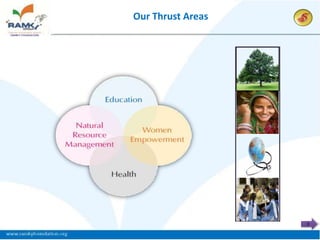
Our Thrust Areas


                   2
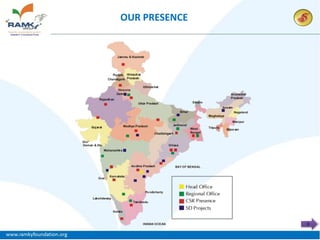
OUR PRESENCE


               3
CSR-Sustainability continuum: our approach


 CSR-Sustainability should be viewed as continuum

    CSR is naïve while sustainability approach is super-ordinate and enlightened.

 The movement from CSR to Sustainability reflects the ability and commitment
    of a business organization to the larger developmental goals.

 CSR and sustainability are being treated as an interdependent system

 CSR-Sustainability continuum also stresses on long-term sustainability of
    business, environment and the distribution of well-being.


                                                                                     4
Our understanding CSR


Businesses’ integration of social and environmental issues into
decisions, goals and operations.

Refer to a mode of business engagement and value creation, allowing
to meet legal, ethical, and societal expectations and acting in a manner
that respects the legitimate goals and interests of all stakeholders.

CSR blends and harmonizes economic operations with a human
community’s social systems and institutions, creating an organic linkage
of business and society.


                                                                           5
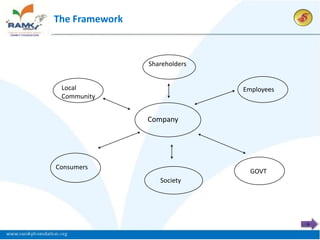
The Framework


                Shareholders


 Local                         Employees
 Community


                Company


Consumers
                                 GOVT
                   Society


                                           6
We mean Sustainability as….


Ability to survive (and thrive) over a given period of time, preferably the long
term.
Sustainability is in not only objective, scientific or neutral concept, but also a
normative or subjective topic, which always contains a set of implicit or explicit
values.
Thus, sustainability as a values-laden umbrella concept about the way in which
the interface between the environment and society
Elkington (1997) “Triple Bottom Line”- referring to three dimensions of
corporate approach to sustainability: people, planet, profit


                                                                                      7
CSR-Sustainability in perspective


Wilber’s – ethics and economics
       business leaders have ethical values that shape the way they do economics
       stakeholders as economic actors (consumers, workers, investors, suppliers)
       have ethical values that help shape their economic behavior
       business institutions and policies impact people differentially
Freeman’s – Integration Thesis
       Business decisions or sentences about business have some ethical
       content, or implicit ethical view
       Ethical decisions or sentences about ethics have some business content or
       implicit view about business
Company Stakeholder Responsibility
       Separation fallacy
       Reductionism


                                                                                    8
CSR-Sustainability Continuum…as we understand

Although Sustainability and CSR have evolved from different
histories, they are aiming towards a common future.

Reification fallacy: CSR as backward integration that enable the
companies to connect with employees and community members around
the work site, thereby implicitly juxtapose community development
from citizenship, and separating CSR activities from Sustainable business
decisions

As global citizens, corporate organizations are seeking solutions
through collaborative dialogue with affected stakeholders, government
representatives and NGOs; and by pledging compliance with global
codes of conduct regarding human rights, environmental
impacts, sustainability, transparency of operations, and financial
integrity.

Thus CSR which was purely voluntary / discretionary in the earlier
times has transformed into a larger / all-encompassing domain of
Sustainability.
                                                                            9
CSR-Sustainability Continuum….our essentials


 Systems approach to CSR : four levels of commitment

     Basic value proposition

     Sustained stakeholder co-operation

     Understanding of social issues – embedding CSR

     Sustainable leadership

 Business cases for CSR

     Competency Driven

     Community driven


                                                        10
Management by Values…what we believe


 The philosophy of governance which is holistic and fosters an integrated
   understanding which does not view one stakeholder as more important than
   others but which understands that satisfaction of every section is a prerequisite
   to achieve sustainable growth.

 Realize society’s expectations with regard to environmental stewardship and
   social responsibility.

 Satisfy the needs of the new breed of shareholders those are only investing in
   companies that meet socially responsible investment criteria.

 Retain the best people and attract potential employees


                                                                                       11
Sustainability Leadership…Our practice


Sustainability Leadership highlights "a Triple Bottom Line” approach
that encompasses profit, people and planet.

It refers to a process of engagement in the challenge of co-creating a
sustainable future; with an integrated focus on the environment,
society, technology, economy and public policy.

SL includes three dimensions of welfare such as economic,
environmental and social - and involves complex synergies and trade-
offs among them.


                                                                          12
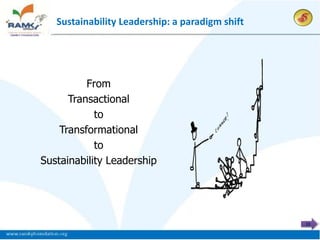
Sustainability Leadership: a paradigm shift


          From
      Transactional
            to
    Transformational
            to
Sustainability Leadership


                                                 13
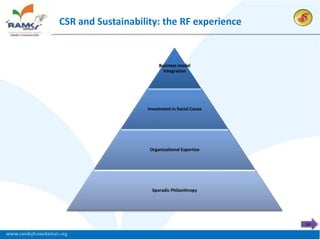
CSR and Sustainability: the RF experience


                        Business model
                          Integration


                   Investment in Social Cause


                    Organizational Expertise


                     Sporadic Philanthropy


                                                14
OUR PROJECTS IN THRUST AREAS


Natural Resource Management
Integrated Watershed Management Project ( sagar, vidisha in Madhya Pradesh)

 Accelerated Development of Minor Irrigation Project ( 8 districts, West Bengal)

AP Community based Tank Management (Krishna district, Andhra Pradesh)

Maathota Project (Kurnool, Andhra Pradesh)

Awareness program on Municipal solid Waste Management (Delhi, Jodhpur)

Farmer’s Clubs (Guntur, Andhra Pradesh)

 Convergence of Agriculture Interventions in Maharastra (Amravati, Maharashtra)

 Wadi project through Organic farming (West Bengal)

Implementation of Participatory Agricultural Development Programme in Maharastra


                                                                                    15
OUR PROJECTS IN THRUST AREAS


 Women Empowerment
 Enhancement of Non-Farms Livelihoods ( Andhra Pradesh)

  Rural Mart (Guntur, Vizianagaram)

 Palavelli program at Ongole, Prakasham district

 Rajeev Vidya Mission – Narasaraopet, Guntur

Education

 Educational Scholarships

 Hostel for orphan, semi orphan and poor adolescent girls - Narasaraopet, Guntur

 Baseline Survey for 10+2 school/ITI in Tarapur – Maharastra, NPCIL

Health

 Targeted intervention project, - A.P , Chattisgarh, UP, Delhi


                                                                                    16
ACTIVITIES IN QUARTER- II
                                     RF Empanelments

     Total No.of activities conducted in the 2nd Quarter – 142
              Tata Institute of Social sciences – National CSR Hub (TISS)
     Total No.of activities conducted in REEL sites - 128
              Andhra Pradesh State AIDS Control Society (APSACS)

     Total No.of activities conducted and Marketing 11
             Employment Generation in RIL sites - Mission as Knowledge Partner (EGMM)

             Chattisgarh conducted in offices -
     Total No.of activitiesState AIDS Control Society3(CGSACS)

              Nuclear Power Corporation of India Limited (NPCIL)

              Accelerated Development of Minor Irrigation Project (ADMIP)

              Andhra Pradesh Community Based Tank Management Project (APCBTMP)

              Convergence of Agriculture Interventions in Maharastra (CAIM)

              National Hydroelectric Development Corporation (NHDC)


                                                                                         17

www.ramkyfoundation.org
ACTIVITIES IN QUARTER- II
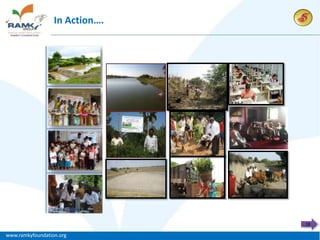
                  In Action….

     Total No.of activities conducted in the 2nd Quarter – 142

     Total No.of activities conducted in REEL sites - 128

     Total No.of activities conducted in RIL sites - 11

     Total No.of activities conducted in offices - 3


                                                                 18

www.ramkyfoundation.org
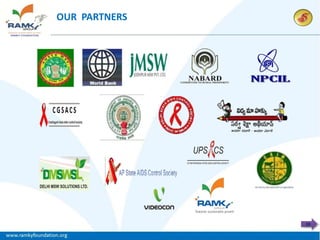
OUR PARTNERS


               10
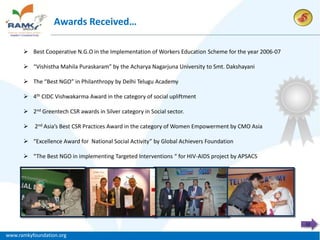
Awards Received… IN QUARTER- II
                           ACTIVITIES

     Total No.of activities conducted in the 2nd Quarter – 142
       Best Cooperative N.G.O in the Implementation of Workers Education Scheme for the year 2006-07

     Total“Vishistha Mahila Puraskaram” by the Acharya Nagarjuna University to Smt. Dakshayani
       No.of activities conducted in REEL sites - 128

      
     TotalThe “Bestactivities conducted Delhi Telugu Academy
           No.of NGO” in Philanthropy by in RIL sites - 11
       4th CIDC Vishwakarma Award in the category of social upliftment
     Total No.of activities conducted in offices - 3
       2nd Greentech CSR awards in Silver category in Social sector.

         2nd Asia’s Best CSR Practices Award in the category of Women Empowerment by CMO Asia

       “Excellence Award for National Social Activity” by Global Achievers Foundation

       “The Best NGO in implementing Targeted Interventions “ for HIV-AIDS project by APSACS


                                                                                                        12

www.ramkyfoundation.org
Few reflections

 Our experience shows that the conceptualization and practice of CSR and
   Sustainability seem to be converging, even though there are points of difference
   between the two constructs.

 So, one should determine whether we need to more accurately distinguish CSR
   and Sustainability or, on the contrary, whether to merge them into one construct
   that will account for the entire social and environmental related issues.

 CSR-Sustainability continuum while combining some elements of CSR and
   sustainability might create a much better definition for firms that are working
   toward becoming sustainable and socially responsible.

 Trust based, co-operative relationships enabled competitive advantage for the RF

 The Co-Creation of Value


                                                                                      1
For more details visit: www.ramkyfoundation.org

Csr sustainability

  • 1.
    Corporate Social Responsibility & Sustainability continuum: the Ramky Foundation’s experience Harish Srivatsava Head-Planning
  • 2.
    ABOUT RAMKY FOUNDATION  Corporate Social Responsibility wing of Ramky Group  Established on 26th July,2006  Working for Employees and Communities Vision: Ramky Foundation envisions to be a Model Organization with focus on equitable, sustainable and accessible development opportunities for the communities we serve. Mission Ramky Foundation will fulfil its vision by working in the areas of Women empowerment, Education, Health, and Natural resource Management through sustainable models. 1
  • 3.
  • 4.
  • 5.
    CSR-Sustainability continuum: ourapproach  CSR-Sustainability should be viewed as continuum  CSR is naïve while sustainability approach is super-ordinate and enlightened.  The movement from CSR to Sustainability reflects the ability and commitment of a business organization to the larger developmental goals.  CSR and sustainability are being treated as an interdependent system  CSR-Sustainability continuum also stresses on long-term sustainability of business, environment and the distribution of well-being. 4
  • 6.
    Our understanding CSR Businesses’integration of social and environmental issues into decisions, goals and operations. Refer to a mode of business engagement and value creation, allowing to meet legal, ethical, and societal expectations and acting in a manner that respects the legitimate goals and interests of all stakeholders. CSR blends and harmonizes economic operations with a human community’s social systems and institutions, creating an organic linkage of business and society. 5
  • 7.
    The Framework Shareholders Local Employees Community Company Consumers GOVT Society 6
  • 8.
    We mean Sustainabilityas…. Ability to survive (and thrive) over a given period of time, preferably the long term. Sustainability is in not only objective, scientific or neutral concept, but also a normative or subjective topic, which always contains a set of implicit or explicit values. Thus, sustainability as a values-laden umbrella concept about the way in which the interface between the environment and society Elkington (1997) “Triple Bottom Line”- referring to three dimensions of corporate approach to sustainability: people, planet, profit 7
  • 9.
    CSR-Sustainability in perspective Wilber’s– ethics and economics business leaders have ethical values that shape the way they do economics stakeholders as economic actors (consumers, workers, investors, suppliers) have ethical values that help shape their economic behavior business institutions and policies impact people differentially Freeman’s – Integration Thesis Business decisions or sentences about business have some ethical content, or implicit ethical view Ethical decisions or sentences about ethics have some business content or implicit view about business Company Stakeholder Responsibility Separation fallacy Reductionism 8
  • 10.
    CSR-Sustainability Continuum…as weunderstand Although Sustainability and CSR have evolved from different histories, they are aiming towards a common future. Reification fallacy: CSR as backward integration that enable the companies to connect with employees and community members around the work site, thereby implicitly juxtapose community development from citizenship, and separating CSR activities from Sustainable business decisions As global citizens, corporate organizations are seeking solutions through collaborative dialogue with affected stakeholders, government representatives and NGOs; and by pledging compliance with global codes of conduct regarding human rights, environmental impacts, sustainability, transparency of operations, and financial integrity. Thus CSR which was purely voluntary / discretionary in the earlier times has transformed into a larger / all-encompassing domain of Sustainability. 9
  • 11.
    CSR-Sustainability Continuum….our essentials Systems approach to CSR : four levels of commitment  Basic value proposition  Sustained stakeholder co-operation  Understanding of social issues – embedding CSR  Sustainable leadership  Business cases for CSR  Competency Driven  Community driven 10
  • 12.
    Management by Values…whatwe believe  The philosophy of governance which is holistic and fosters an integrated understanding which does not view one stakeholder as more important than others but which understands that satisfaction of every section is a prerequisite to achieve sustainable growth.  Realize society’s expectations with regard to environmental stewardship and social responsibility.  Satisfy the needs of the new breed of shareholders those are only investing in companies that meet socially responsible investment criteria.  Retain the best people and attract potential employees 11
  • 13.
    Sustainability Leadership…Our practice SustainabilityLeadership highlights "a Triple Bottom Line” approach that encompasses profit, people and planet. It refers to a process of engagement in the challenge of co-creating a sustainable future; with an integrated focus on the environment, society, technology, economy and public policy. SL includes three dimensions of welfare such as economic, environmental and social - and involves complex synergies and trade- offs among them. 12
  • 14.
    Sustainability Leadership: aparadigm shift From Transactional to Transformational to Sustainability Leadership 13
  • 15.
    CSR and Sustainability:the RF experience Business model Integration Investment in Social Cause Organizational Expertise Sporadic Philanthropy 14
  • 16.
    OUR PROJECTS INTHRUST AREAS Natural Resource Management Integrated Watershed Management Project ( sagar, vidisha in Madhya Pradesh)  Accelerated Development of Minor Irrigation Project ( 8 districts, West Bengal) AP Community based Tank Management (Krishna district, Andhra Pradesh) Maathota Project (Kurnool, Andhra Pradesh) Awareness program on Municipal solid Waste Management (Delhi, Jodhpur) Farmer’s Clubs (Guntur, Andhra Pradesh)  Convergence of Agriculture Interventions in Maharastra (Amravati, Maharashtra)  Wadi project through Organic farming (West Bengal) Implementation of Participatory Agricultural Development Programme in Maharastra 15
  • 17.
    OUR PROJECTS INTHRUST AREAS Women Empowerment Enhancement of Non-Farms Livelihoods ( Andhra Pradesh)  Rural Mart (Guntur, Vizianagaram) Palavelli program at Ongole, Prakasham district Rajeev Vidya Mission – Narasaraopet, Guntur Education  Educational Scholarships  Hostel for orphan, semi orphan and poor adolescent girls - Narasaraopet, Guntur  Baseline Survey for 10+2 school/ITI in Tarapur – Maharastra, NPCIL Health  Targeted intervention project, - A.P , Chattisgarh, UP, Delhi 16
  • 18.
    ACTIVITIES IN QUARTER-II RF Empanelments Total No.of activities conducted in the 2nd Quarter – 142  Tata Institute of Social sciences – National CSR Hub (TISS) Total No.of activities conducted in REEL sites - 128  Andhra Pradesh State AIDS Control Society (APSACS) Total No.of activities conducted and Marketing 11  Employment Generation in RIL sites - Mission as Knowledge Partner (EGMM)  Chattisgarh conducted in offices - Total No.of activitiesState AIDS Control Society3(CGSACS)  Nuclear Power Corporation of India Limited (NPCIL)  Accelerated Development of Minor Irrigation Project (ADMIP)  Andhra Pradesh Community Based Tank Management Project (APCBTMP)  Convergence of Agriculture Interventions in Maharastra (CAIM)  National Hydroelectric Development Corporation (NHDC) 17 www.ramkyfoundation.org
  • 19.
    ACTIVITIES IN QUARTER-II In Action…. Total No.of activities conducted in the 2nd Quarter – 142 Total No.of activities conducted in REEL sites - 128 Total No.of activities conducted in RIL sites - 11 Total No.of activities conducted in offices - 3 18 www.ramkyfoundation.org
  • 20.
  • 21.
    Awards Received… INQUARTER- II ACTIVITIES Total No.of activities conducted in the 2nd Quarter – 142  Best Cooperative N.G.O in the Implementation of Workers Education Scheme for the year 2006-07 Total“Vishistha Mahila Puraskaram” by the Acharya Nagarjuna University to Smt. Dakshayani  No.of activities conducted in REEL sites - 128  TotalThe “Bestactivities conducted Delhi Telugu Academy No.of NGO” in Philanthropy by in RIL sites - 11  4th CIDC Vishwakarma Award in the category of social upliftment Total No.of activities conducted in offices - 3  2nd Greentech CSR awards in Silver category in Social sector.  2nd Asia’s Best CSR Practices Award in the category of Women Empowerment by CMO Asia  “Excellence Award for National Social Activity” by Global Achievers Foundation  “The Best NGO in implementing Targeted Interventions “ for HIV-AIDS project by APSACS 12 www.ramkyfoundation.org
  • 22.
    Few reflections  Ourexperience shows that the conceptualization and practice of CSR and Sustainability seem to be converging, even though there are points of difference between the two constructs.  So, one should determine whether we need to more accurately distinguish CSR and Sustainability or, on the contrary, whether to merge them into one construct that will account for the entire social and environmental related issues.  CSR-Sustainability continuum while combining some elements of CSR and sustainability might create a much better definition for firms that are working toward becoming sustainable and socially responsible.  Trust based, co-operative relationships enabled competitive advantage for the RF  The Co-Creation of Value 1
  • 23.
    For more detailsvisit: www.ramkyfoundation.org