Medicines Transparency Alliance in Ghana Dr Alex Dodoo,  Ph.D., MPSGH, MRPharmS, FPCPharm Co-Chair, MeTA Ghana
What is the  Medicines Transparency Alliance (MeTA)
  Outline Background and Concept Problems of Access To Medicines Why MeTA Purpose and Strategies Motivations for MeTA Stakeholders 09/06/09 MeTA @ Health Summit
What is MeTA MeTA is an international initiative that aims to increase transparency in the  registration ,  procurement ,  distribution  and  sales  of  essential   medicines  in developing countries Born out of lessons  learnt from EITI  ( Extractive Industries Transparency Initiative) The principal international partners are: UK Department for International Development (DFID) The World Health Organization (WHO) The Health Action International (HAI) The World Bank  09/06/09 MeTA @ Health Summit
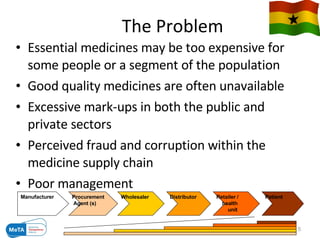
The Problem Essential medicines may be too expensive for some people or a segment of the population Good quality medicines are often unavailable Excessive mark-ups in both the public and private sectors Perceived fraud and corruption within the medicine supply chain Poor management Manufacturer Procurement Agent (s) Wholesaler Distributor Retailer / health unit Patient
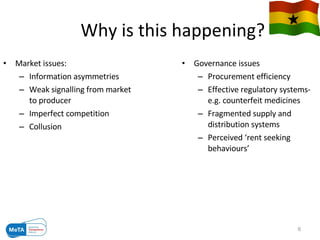
Why is this happening? Market issues: Information asymmetries Weak signalling from market to producer Imperfect competition Collusion Governance issues Procurement efficiency Effective regulatory systems-e.g. counterfeit medicines Fragmented supply and distribution systems Perceived ‘rent seeking behaviours’
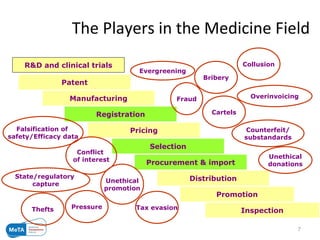
The Players in the Medicine Field Patent R&D and clinical trials Manufacturing Pricing Distribution Registration Selection Procurement & import Promotion Inspection Conflict  of interest Evergreening Counterfeit/ substandards Tax evasion Falsification of  safety/Efficacy data Bribery State/regulatory  capture Overinvoicing Pressure Unethical promotion Thefts Fraud Cartels Collusion Unethical donations
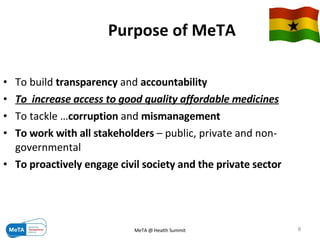
Purpose of MeTA   To build  transparency  and  accountability  To  increase access to good quality affordable medicines To tackle … corruption  and  mismanagement   To work with all stakeholders  – public, private and non-governmental  To proactively engage civil society and the private sector 09/06/09 MeTA @ Health Summit
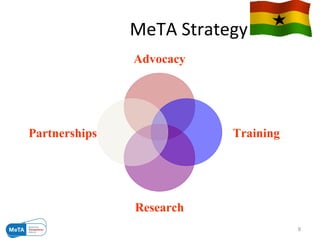
MeTA Strategy Advocacy Training Research Partnerships
Characteristics Of Ghana’s  Pharmaceutical Market 80% of products imported  Few local manufacturers - generics and producing under-capacity Big Pharma involved only in sales No manufacturing or drug development by big Pharma State system for medicine procurement for public sector use National Drug Policy,  Standard Treatment Guidelines and NHIML to guide drug selection, procurement and reimbursements 09/06/09 MeTA @ Health Summit
Key Challenges in enhancing Access1 Benefits of improved procurement are not translating into affordability and availability for patients (e.g. 2004 WHO/HAI Medicines Survey); Slow progress of some key health indicators– i.e. Infant and child mortality, incidence of malaria and maternal health; Low consumer awareness due to very little information on quality, availability and prices of medicines is available in the public domain,  Inconsistency across the public, private and mission sectors in terms of how standards (i.e. quality, availability and pricing) are developed and applied;
Key Challenges in enhancing Access to Medicines 2 Non-adherence to treatment guidelines by prescribers and irrational use of medicines by providers persists despite improved guidance and education; Supply chain performance problems from CMS downstream leading to high stock-out rate; Vulnerability of NHIS to fraud due to inefficient record keeping and analysis Counterfeit and/or substandard products
MeTA Ghana pilot objectives Establishing mechanisms to strengthen the collection, analysis and dissemination of data on medicines along the supply chain; Facilitating peer oversight systems within and across health professions Sustaining regular, open stakeholder dialogue; Developing long-term strategy or ‘master plan’ for MeTA in Ghana.
Strategies 1 Undertake studies to assess the level of transparency and accountability in medicines regulation, procurement, distribution and use. Regular monitoring of medicine prices and availability as well as their rational use using WHO standard indicators. Regular monitoring of medicines quality through sentinel testing using GPHF ‘minilabs’.  Publicize widely data on prices paid at various points along the supply chain, including those agreed at public tender.  Correlate procurement data to stock volumes and the availability of medicines to the consumer.
Strategies 2 Undertake periodic annual studies to understand and/or explain provider and consumer behaviour.  Enhance role of chemical sellers in ensuring medicines availability, affordability and rational use through regulation, training and efficient monitoring. Enhance capacity of CSOs & Media to empower them play more active role in medicines advocacy Facilitate agreement by pharmaceutical companies to publicize their supply prices to match tender data.  Undertake periodic studies on policies concerning  ethical promotion of medicines.
Potential Benefits of MeTA to Ghana Share good practices with other MeTA pilot countries Provide Ghanaian leadership on medicines transparency and accountability across the West Africa region as  model for both effective governance and market efficiency. Provides opportunity for pricing and quality monitoring mechanism to inform the NHIS  Reduce and/or eliminate the risk of counterfeit and substandard medication in the supply chain. Opportunity for enhanced national research capacity. Provides potential mechanism for government commitment to fight inefficiency and corruption in the drug supply landscape.
Risks and assumptions  Mutual suspicions between government and private sector; All stakeholders nervous about change; Where are the enforcement mechanisms across the system? Enforcement of regulations is weak. Civil society fragmentation needs to be addressed; assume that new coalitions can be forged. Need to assume a degree of commitment to transparency by all stakeholders and willingness to be  mutually accountable . Timeliness and sustainability of financing. Need to ensure plans are realistic for pilot phase - not ‘over-ambitious’.
MeTA structures in Ghana MeTA Secretariat Will be hosted by MoH initially Seeking office space MeTA Annual Stakeholder Forum Larger workshop, broader representation; To report on progress, share data. 09/06/09 MeTA
MeTA structures in Ghana MeTA Governing Council: Public sector: Ministry of Health, National Health Insurance Council, Ghana Health Services, Food and Drugs Board, Ministry of Trade, Attorney Generals ’  Department, Ministry of Finance; Professional bodies: Pharmaceutical Society of Ghana, Ghana Medical Association, Nurses and Midwives Council; Civil society: CSOs (health and non-health), media, academic institutions, faith-based service providers. Private sector: Pharmaceutical Manufacturers Association of Ghana, Association of Private Medical and Dental Practitioners International community: World Health Organization, DFID/World Bank/HAI/Other Development Partners Representative. Meets quarterly, with first meeting after national launch. Two co-chairs
Inputs of Governing Council Oversee the activities of the initial phase of MeTA in Ghana Scrutinizing data collected/disclosed on medicine quality, price and availability Discuss what is revealed by data collected Make recommendations and follow up actions based on data assessment Coordinate  data disclosure and other MeTA activities in country Agreeing progress reports and lessons to be shared with other MeTA pilot countries and the international MeTA Forum

CSO & media orientation workshop

  • 1.
    Medicines Transparency Alliancein Ghana Dr Alex Dodoo, Ph.D., MPSGH, MRPharmS, FPCPharm Co-Chair, MeTA Ghana
  • 2.
    What is the Medicines Transparency Alliance (MeTA)
  • 3.
    OutlineBackground and Concept Problems of Access To Medicines Why MeTA Purpose and Strategies Motivations for MeTA Stakeholders 09/06/09 MeTA @ Health Summit
  • 4.
    What is MeTAMeTA is an international initiative that aims to increase transparency in the registration , procurement , distribution and sales of essential medicines in developing countries Born out of lessons learnt from EITI ( Extractive Industries Transparency Initiative) The principal international partners are: UK Department for International Development (DFID) The World Health Organization (WHO) The Health Action International (HAI) The World Bank 09/06/09 MeTA @ Health Summit
  • 5.
    The Problem Essentialmedicines may be too expensive for some people or a segment of the population Good quality medicines are often unavailable Excessive mark-ups in both the public and private sectors Perceived fraud and corruption within the medicine supply chain Poor management Manufacturer Procurement Agent (s) Wholesaler Distributor Retailer / health unit Patient
  • 6.
    Why is thishappening? Market issues: Information asymmetries Weak signalling from market to producer Imperfect competition Collusion Governance issues Procurement efficiency Effective regulatory systems-e.g. counterfeit medicines Fragmented supply and distribution systems Perceived ‘rent seeking behaviours’
  • 7.
    The Players inthe Medicine Field Patent R&D and clinical trials Manufacturing Pricing Distribution Registration Selection Procurement & import Promotion Inspection Conflict of interest Evergreening Counterfeit/ substandards Tax evasion Falsification of safety/Efficacy data Bribery State/regulatory capture Overinvoicing Pressure Unethical promotion Thefts Fraud Cartels Collusion Unethical donations
  • 8.
    Purpose of MeTA To build transparency and accountability To increase access to good quality affordable medicines To tackle … corruption and mismanagement To work with all stakeholders – public, private and non-governmental To proactively engage civil society and the private sector 09/06/09 MeTA @ Health Summit
  • 9.
    MeTA Strategy AdvocacyTraining Research Partnerships
  • 11.
    Characteristics Of Ghana’s Pharmaceutical Market 80% of products imported Few local manufacturers - generics and producing under-capacity Big Pharma involved only in sales No manufacturing or drug development by big Pharma State system for medicine procurement for public sector use National Drug Policy, Standard Treatment Guidelines and NHIML to guide drug selection, procurement and reimbursements 09/06/09 MeTA @ Health Summit
  • 12.
    Key Challenges inenhancing Access1 Benefits of improved procurement are not translating into affordability and availability for patients (e.g. 2004 WHO/HAI Medicines Survey); Slow progress of some key health indicators– i.e. Infant and child mortality, incidence of malaria and maternal health; Low consumer awareness due to very little information on quality, availability and prices of medicines is available in the public domain, Inconsistency across the public, private and mission sectors in terms of how standards (i.e. quality, availability and pricing) are developed and applied;
  • 13.
    Key Challenges inenhancing Access to Medicines 2 Non-adherence to treatment guidelines by prescribers and irrational use of medicines by providers persists despite improved guidance and education; Supply chain performance problems from CMS downstream leading to high stock-out rate; Vulnerability of NHIS to fraud due to inefficient record keeping and analysis Counterfeit and/or substandard products
  • 14.
    MeTA Ghana pilotobjectives Establishing mechanisms to strengthen the collection, analysis and dissemination of data on medicines along the supply chain; Facilitating peer oversight systems within and across health professions Sustaining regular, open stakeholder dialogue; Developing long-term strategy or ‘master plan’ for MeTA in Ghana.
  • 15.
    Strategies 1 Undertakestudies to assess the level of transparency and accountability in medicines regulation, procurement, distribution and use. Regular monitoring of medicine prices and availability as well as their rational use using WHO standard indicators. Regular monitoring of medicines quality through sentinel testing using GPHF ‘minilabs’. Publicize widely data on prices paid at various points along the supply chain, including those agreed at public tender. Correlate procurement data to stock volumes and the availability of medicines to the consumer.
  • 16.
    Strategies 2 Undertakeperiodic annual studies to understand and/or explain provider and consumer behaviour. Enhance role of chemical sellers in ensuring medicines availability, affordability and rational use through regulation, training and efficient monitoring. Enhance capacity of CSOs & Media to empower them play more active role in medicines advocacy Facilitate agreement by pharmaceutical companies to publicize their supply prices to match tender data. Undertake periodic studies on policies concerning ethical promotion of medicines.
  • 17.
    Potential Benefits ofMeTA to Ghana Share good practices with other MeTA pilot countries Provide Ghanaian leadership on medicines transparency and accountability across the West Africa region as model for both effective governance and market efficiency. Provides opportunity for pricing and quality monitoring mechanism to inform the NHIS Reduce and/or eliminate the risk of counterfeit and substandard medication in the supply chain. Opportunity for enhanced national research capacity. Provides potential mechanism for government commitment to fight inefficiency and corruption in the drug supply landscape.
  • 18.
    Risks and assumptions Mutual suspicions between government and private sector; All stakeholders nervous about change; Where are the enforcement mechanisms across the system? Enforcement of regulations is weak. Civil society fragmentation needs to be addressed; assume that new coalitions can be forged. Need to assume a degree of commitment to transparency by all stakeholders and willingness to be mutually accountable . Timeliness and sustainability of financing. Need to ensure plans are realistic for pilot phase - not ‘over-ambitious’.
  • 19.
    MeTA structures inGhana MeTA Secretariat Will be hosted by MoH initially Seeking office space MeTA Annual Stakeholder Forum Larger workshop, broader representation; To report on progress, share data. 09/06/09 MeTA
  • 20.
    MeTA structures inGhana MeTA Governing Council: Public sector: Ministry of Health, National Health Insurance Council, Ghana Health Services, Food and Drugs Board, Ministry of Trade, Attorney Generals ’ Department, Ministry of Finance; Professional bodies: Pharmaceutical Society of Ghana, Ghana Medical Association, Nurses and Midwives Council; Civil society: CSOs (health and non-health), media, academic institutions, faith-based service providers. Private sector: Pharmaceutical Manufacturers Association of Ghana, Association of Private Medical and Dental Practitioners International community: World Health Organization, DFID/World Bank/HAI/Other Development Partners Representative. Meets quarterly, with first meeting after national launch. Two co-chairs
  • 21.
    Inputs of GoverningCouncil Oversee the activities of the initial phase of MeTA in Ghana Scrutinizing data collected/disclosed on medicine quality, price and availability Discuss what is revealed by data collected Make recommendations and follow up actions based on data assessment Coordinate data disclosure and other MeTA activities in country Agreeing progress reports and lessons to be shared with other MeTA pilot countries and the international MeTA Forum