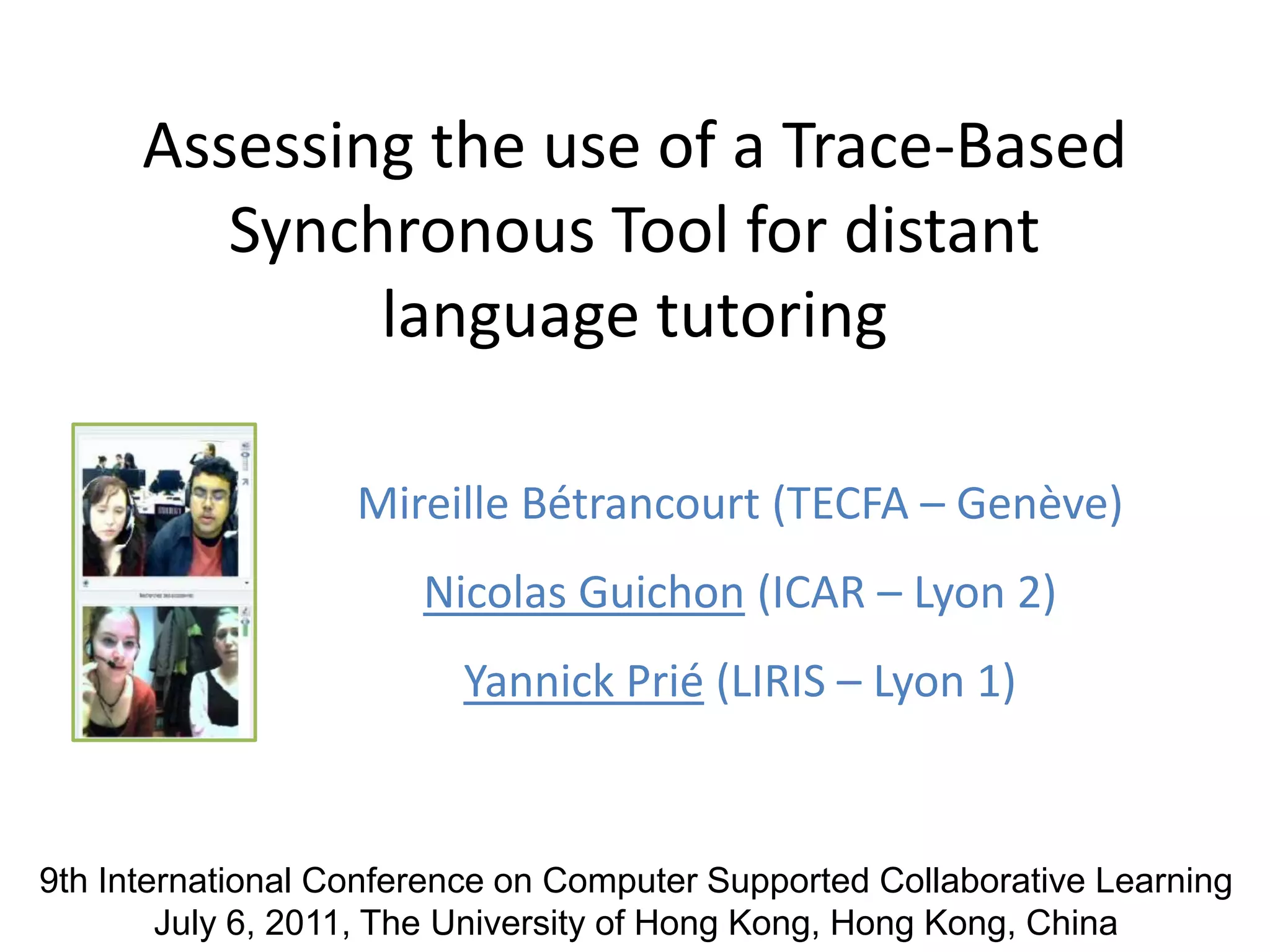
Assessing the use of a Trace-Based Synchronous Tool for distantlanguage tutoringMireille Bétrancourt (TECFA – Genève)Nicolas Guichon (ICAR – Lyon 2)Yannick Prié (LIRIS – Lyon 1)9th International Conference on Computer Supported Collaborative LearningJuly 6, 2011, The University of Hong Kong, Hong Kong, China
IntroductionOngoingresearchmultidisciplinaryprojectDevelopment of a videoconferencingtoolspecificallydesigned for languageteaching.Aims of the presentation:	(1) present the rationale and the design of a synchronous trace-based prototype tool	(2) study the use of marker-based traces by languagetutors
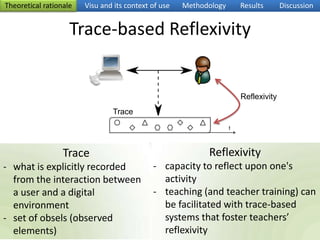
Theoretical rationaleVisu and its context of useMethodologyResultsDiscussionTrace-based ReflexivityReflexivity TracetReflexivity capacity to reflect upon one's activity
teaching (and teacher training) can be facilitated with trace-based systems that foster teachers’ reflexivityTracewhatisexplicitlyrecordedfrom the interaction betweena user and a digital environment
set of obsels (observedelements)Context of the training courseLe français en première ligne: a 45-hour training course to get familiar with synchronous online teaching (cf. Develotte, Guichon, Kern, 2008; Guichon, 2009)Theoretical rationaleVisu and its context of useMethodologyResultsDiscussionhttp://w3.u-grenoble3.fr/fle-1-ligne
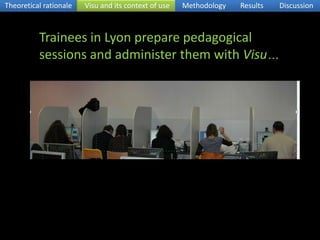
Theoretical rationaleVisu and its context of useMethodologyResultsDiscussionTrainees in Lyon prepare pedagogical sessions and administer them with Visu…
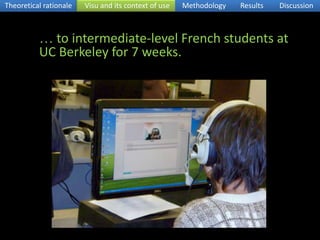
Theoretical rationaleVisu and its context of useMethodologyResultsDiscussion… to intermediate-level French students at UC Berkeley for 7 weeks.
PreparationInteraction (45 min session)Starts with greetings, technical and communicational adjustments and social chitchat. 3 to 5 teaching tasks on a given theme (e.g. The notion of identity)A few minutes at the end for a final reviewRetrospectionDebriefing based on the trace of the activityTheoretical rationaleVisu and its context of useMethodologyResultsDiscussionThree phases
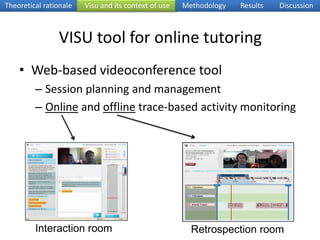
VISU tool for online tutoringWeb-basedvideoconferencetoolSession planning and managementOnline and offline trace-basedactivity monitoringTheoretical rationaleVisu and its context of useMethodologyResultsDiscussionInteraction roomRetrospection room
Traces in VisuTheoretical rationaleVisu and its context of useMethodologyResultsDiscussion123Interaction tracesrecorded automaticallyduring the interaction 1tMarker-based tracesset by the tutor during the interaction in the interaction room2Comment-based tracesset by the tutor after the interaction in the retrospection room3
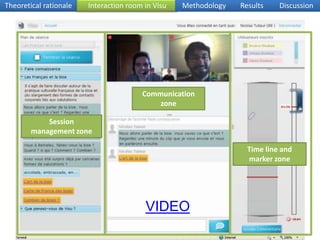
Theoretical rationaleInteraction room in VisuMethodologyResultsDiscussionCommunication zoneSession management zoneTime line and marker zoneVIDEO
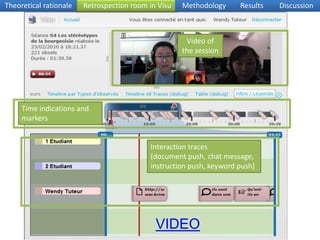
Theoretical rationaleRetrospection room in VisuMethodologyResultsDiscussionVideoof the sessionTime indications and markersInteraction traces (document push, chat message, instruction push, keyword push)VIDEO
Theoretical rationaleVisu and its context of useMethodologyResultsDiscussionA pilot study of marker-based tracesinvestigate the quantitative and qualitative use of markers duringsynchronouslanguageteaching sessions and assess the utility of such a functionality for languagetutoring
Data analysisQuantitative analysis:number of markers and text chat messages over time and across the sample of the 8 tutors.Qualitative analysis:type of markers produced by 2 specifictutors + interviews dataTheoretical rationaleVisu and its context of useMethodologyResultsDiscussion
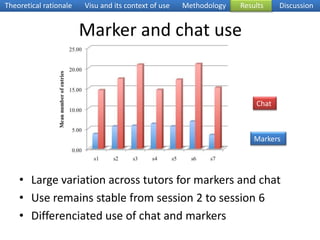
Theoretical rationaleVisu and its context of useMethodologyResultsDiscussionMarker and chat useChatMarkersLarge variation acrosstutors for markers and chatUse remains stable from session 2 to session 6Differenciated use of chat and markers
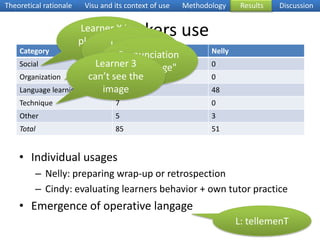
Theoretical rationaleVisu and its context of useMethodologyResultsDiscussionMarkers useLearner X ispleasedwithactivity.Learner 3arrives  latePronunciation of "fromage"Learner 3can’tsee the imageIndividual usagesNelly: preparingwrap-up or retrospectionCindy: evaluatinglearnersbehavior + owntutor practiceEmergence of operative langage L: tellemenT
InterviewsMarkers wereappreciated for taking notes withoutinterrupting the flow of the interactionTaking notes about the learner’s performanceKeepingtrack of events for lateranalysisTheoretical rationaleVisu and its context of useMethodologyResultsDiscussion
Future research questionsHow does the retrospection room improvetrainees’ awareness?Doesit have an impact on theirtutoringskills (especiallyregarding feedback)?Design and implementation of Visu2Theoretical rationaleVisu and its context of useMethodologyResultsDiscussion

Assessing the use of a Trace-Based Synchronous Tool for distant language tutoring

  • 1.
    Assessing the useof a Trace-Based Synchronous Tool for distantlanguage tutoringMireille Bétrancourt (TECFA – Genève)Nicolas Guichon (ICAR – Lyon 2)Yannick Prié (LIRIS – Lyon 1)9th International Conference on Computer Supported Collaborative LearningJuly 6, 2011, The University of Hong Kong, Hong Kong, China
  • 2.
    IntroductionOngoingresearchmultidisciplinaryprojectDevelopment of avideoconferencingtoolspecificallydesigned for languageteaching.Aims of the presentation: (1) present the rationale and the design of a synchronous trace-based prototype tool (2) study the use of marker-based traces by languagetutors
  • 3.
    Theoretical rationaleVisu andits context of useMethodologyResultsDiscussionTrace-based ReflexivityReflexivity TracetReflexivity capacity to reflect upon one's activity
  • 4.
    teaching (and teachertraining) can be facilitated with trace-based systems that foster teachers’ reflexivityTracewhatisexplicitlyrecordedfrom the interaction betweena user and a digital environment
  • 5.
    set of obsels(observedelements)Context of the training courseLe français en première ligne: a 45-hour training course to get familiar with synchronous online teaching (cf. Develotte, Guichon, Kern, 2008; Guichon, 2009)Theoretical rationaleVisu and its context of useMethodologyResultsDiscussionhttp://w3.u-grenoble3.fr/fle-1-ligne
  • 6.
    Theoretical rationaleVisu andits context of useMethodologyResultsDiscussionTrainees in Lyon prepare pedagogical sessions and administer them with Visu…
  • 7.
    Theoretical rationaleVisu andits context of useMethodologyResultsDiscussion… to intermediate-level French students at UC Berkeley for 7 weeks.
  • 8.
    PreparationInteraction (45 minsession)Starts with greetings, technical and communicational adjustments and social chitchat. 3 to 5 teaching tasks on a given theme (e.g. The notion of identity)A few minutes at the end for a final reviewRetrospectionDebriefing based on the trace of the activityTheoretical rationaleVisu and its context of useMethodologyResultsDiscussionThree phases
  • 9.
    VISU tool foronline tutoringWeb-basedvideoconferencetoolSession planning and managementOnline and offline trace-basedactivity monitoringTheoretical rationaleVisu and its context of useMethodologyResultsDiscussionInteraction roomRetrospection room
  • 10.
    Traces in VisuTheoreticalrationaleVisu and its context of useMethodologyResultsDiscussion123Interaction tracesrecorded automaticallyduring the interaction 1tMarker-based tracesset by the tutor during the interaction in the interaction room2Comment-based tracesset by the tutor after the interaction in the retrospection room3
  • 11.
    Theoretical rationaleInteraction roomin VisuMethodologyResultsDiscussionCommunication zoneSession management zoneTime line and marker zoneVIDEO
  • 12.
    Theoretical rationaleRetrospection roomin VisuMethodologyResultsDiscussionVideoof the sessionTime indications and markersInteraction traces (document push, chat message, instruction push, keyword push)VIDEO
  • 13.
    Theoretical rationaleVisu andits context of useMethodologyResultsDiscussionA pilot study of marker-based tracesinvestigate the quantitative and qualitative use of markers duringsynchronouslanguageteaching sessions and assess the utility of such a functionality for languagetutoring
  • 14.
    Data analysisQuantitative analysis:numberof markers and text chat messages over time and across the sample of the 8 tutors.Qualitative analysis:type of markers produced by 2 specifictutors + interviews dataTheoretical rationaleVisu and its context of useMethodologyResultsDiscussion
  • 15.
    Theoretical rationaleVisu andits context of useMethodologyResultsDiscussionMarker and chat useChatMarkersLarge variation acrosstutors for markers and chatUse remains stable from session 2 to session 6Differenciated use of chat and markers
  • 16.
    Theoretical rationaleVisu andits context of useMethodologyResultsDiscussionMarkers useLearner X ispleasedwithactivity.Learner 3arrives latePronunciation of "fromage"Learner 3can’tsee the imageIndividual usagesNelly: preparingwrap-up or retrospectionCindy: evaluatinglearnersbehavior + owntutor practiceEmergence of operative langage L: tellemenT
  • 17.
    InterviewsMarkers wereappreciated fortaking notes withoutinterrupting the flow of the interactionTaking notes about the learner’s performanceKeepingtrack of events for lateranalysisTheoretical rationaleVisu and its context of useMethodologyResultsDiscussion
  • 18.
    Future research questionsHowdoes the retrospection room improvetrainees’ awareness?Doesit have an impact on theirtutoringskills (especiallyregarding feedback)?Design and implementation of Visu2Theoretical rationaleVisu and its context of useMethodologyResultsDiscussion
  • 19.
    Thank you!Website ofthe project:liris.cnrs.fr/ithacaTheseslideswww.slideshare.net/yprie/cscl2011Professional websites:nicolas.guichon.pagesperso-orange.frliris.cnrs.fr/yannick.prieTheoretical rationaleVisu and its context of useMethodologyResultsDiscussion