A First Book of C++A First Book of C++
Chapter 5Chapter 5
RepetitionRepetition
∗ In this chapter, you will learn about:
∗ The while Statement
∗ Interactive while Loops
∗ The for Statement
∗ The do while Statement
∗ Common Programming Errors
∗ Additional Testing Techniques
A First Book of C++ 4th Edition 2
Objectives
∗ A general repetition statement
∗ Format:
while (expression)
statement;
∗ Function:
∗ expression is evaluated the same as an if-else
statement
∗ Statement following expression executed repeatedly as
long as expression has non-zero value (i.e., true)
A First Book of C++ 4th Edition 3
The while Statement
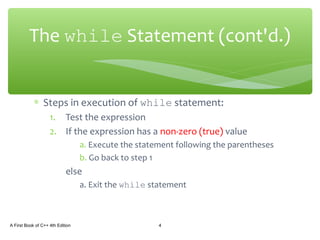
∗ Steps in execution of while statement:
1. Test the expression
2. If the expression has a non-zero (true) value
a. Execute the statement following the parentheses
b. Go back to step 1
else
a. Exit the while statement
A First Book of C++ 4th Edition 4
The while Statement (cont'd.)
A First Book of C++ 4th Edition 5
The while Statement (cont'd.)
A First Book of C++ 4th Edition 6
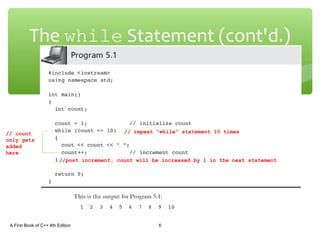
// repeat “while” statement 10 times
//post increment, count will be increased by 1 in the next statement
// count
only gets
added
here
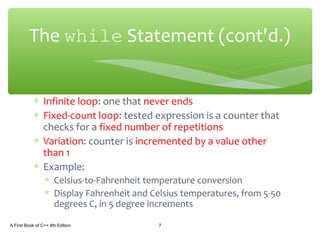
∗ Infinite loop: one that never ends
∗ Fixed-count loop: tested expression is a counter that
checks for a fixed number of repetitions
∗ Variation: counter is incremented by a value other
than 1
∗ Example:
∗ Celsius-to-Fahrenheit temperature conversion
∗ Display Fahrenheit and Celsius temperatures, from 5-50
degrees C, in 5 degree increments
A First Book of C++ 4th Edition 7
The while Statement (cont'd.)
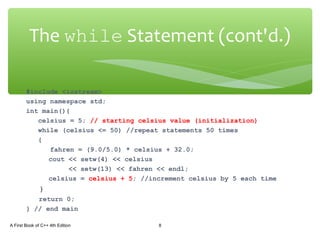
#include <iostream>
using namespace std;
int main(){
celsius = 5; // starting celsius value (initialization)
while (celsius <= 50) //repeat statements 50 times
{
fahren = (9.0/5.0) * celsius + 32.0;
cout << setw(4) << celsius
<< setw(13) << fahren << endl;
celsius = celsius + 5; //increment celsius by 5 each time
}
return 0;
} // end main
A First Book of C++ 4th Edition 8
The while Statement (cont'd.)
∗ Combining interactive data entry with the repetition
of a while statement
∗ Produces very powerful and adaptable programs
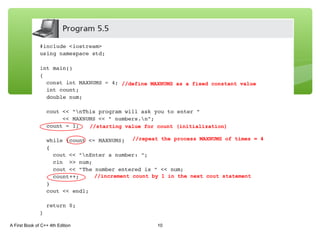
∗ Example (Program 5.5): while statement accepts
and displays four user-entered numbers
∗ Numbers accepted and displayed one at a time
A First Book of C++ 4th Edition 9
Interactive while Loops
A First Book of C++ 4th Edition 10
//starting value for count (initialization)
//increment count by 1 in the next cout statement
//define MAXNUMS as a fixed constant value
//repeat the process MAXNUMS of times = 4
∗ Sample run of Program 5.5:
This program will ask you to enter 4 numbers.
Enter a number: 26.2
The number entered is 26.2
Enter a number: 5
The number entered is 5
Enter a number: 103.456
The number entered is 103.456
Enter a number: 1267.89
The number entered is 1267.89
A First Book of C++ 4th Edition 11
Interactive while Loops
(cont'd.)
1
2
3
4
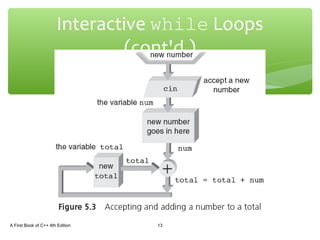
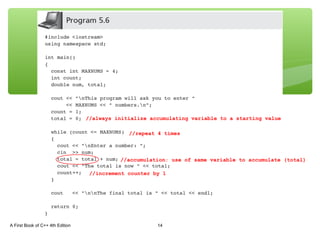
∗ Example (Program 5.6): adding a single number to a
total
∗ A number is entered by the user
∗ Accumulating statement adds the number to total
total = total + num;
∗ A while statement repeats the process
A First Book of C++ 4th Edition 12
Interactive while Loops
(cont'd.)
Interactive while Loops
(cont'd.)
A First Book of C++ 4th Edition 13
A First Book of C++ 4th Edition 14
//always initialize accumulating variable to a starting value
//repeat 4 times
//increment counter by 1
//accumulation: use of same variable to accumulate (total)
∗ Sample run of Program 5.6:
This program will ask you to enter 4 numbers.
Enter a number: 26.2
The total is now 26.2
Enter a number: 5
The total is now 31.2
Enter a number: 103.456
The total is now 134.656
Enter a number: 1267.89
The total is now 1402.546
The final total is 1402.546
A First Book of C++ 4th Edition 15
Interactive while Loops
(cont'd.)
total = 0 + 26.2
total = 26.2 + 5
total = 31.2 + 103.456
total = 134.656 + 1267.89
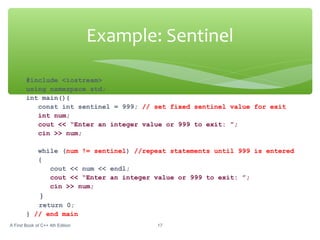
∗ Sentinels
∗ Data values used to signal the start or end of data series
∗ Values must be selected so as not to conflict with
legitimate data values
A First Book of C++ 4th Edition 16
Sentinels
Example: Sentinel
A First Book of C++ 4th Edition 17
#include <iostream>
using namespace std;
int main(){
const int sentinel = 999; // set fixed sentinel value for exit
int num;
cout << “Enter an integer value or 999 to exit: ”;
cin >> num;
while (num != sentinel) //repeat statements until 999 is entered
{
cout << num << endl;
cout << “Enter an integer value or 999 to exit: ”;
cin >> num;
}
return 0;
} // end main
∗ break: forces immediate exit from structures
∗ Use in switch statements:
∗ The desired case has been detected and processed
∗ Use in while, for, and do-while statements:
∗ An unusual condition is detected
∗ Format:
break;
A First Book of C++ 4th Edition 18
break and continue
Statements
∗ continue: causes the next iteration of the loop to
begin immediately
∗ Execution transferred to the top of the loop
∗ Applies only to while, do-while, and for
statements
∗ Format:
continue;
A First Book of C++ 4th Edition 19
break and continue
Statements (cont'd.)
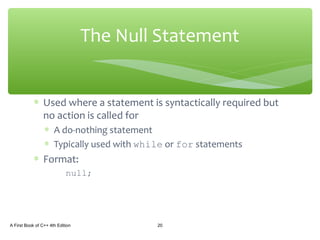
∗ Used where a statement is syntactically required but
no action is called for
∗ A do-nothing statement
∗ Typically used with while or for statements
∗ Format:
null;
A First Book of C++ 4th Edition 20
The Null Statement
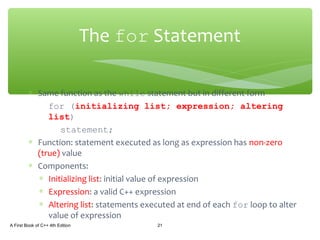
∗ Same function as the while statement but in different form
for (initializing list; expression; altering
list)
statement;
∗ Function: statement executed as long as expression has non-zero
(true) value
∗ Components:
∗ Initializing list: initial value of expression
∗ Expression: a valid C++ expression
∗ Altering list: statements executed at end of each for loop to alter
value of expression
A First Book of C++ 4th Edition 21
The for Statement
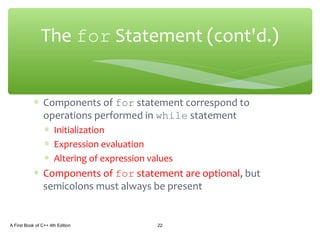
∗ Components of for statement correspond to
operations performed in while statement
∗ Initialization
∗ Expression evaluation
∗ Altering of expression values
∗ Components of for statement are optional, but
semicolons must always be present
A First Book of C++ 4th Edition 22
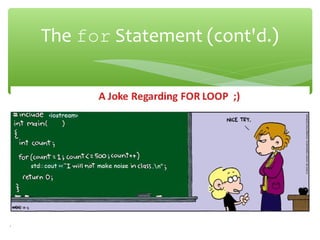
The for Statement (cont'd.)
A First Book of C++ 4th Edition 23
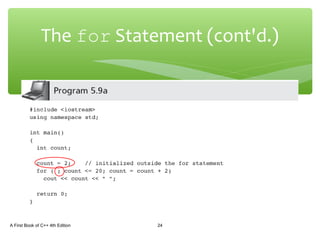
∗ Program 5.9 modified: initializer outside for loop
A First Book of C++ 4th Edition 24
The for Statement (cont'd.)
A First Book of C++ 4th Edition 25
//can use “pow” for this
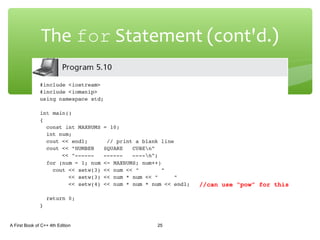
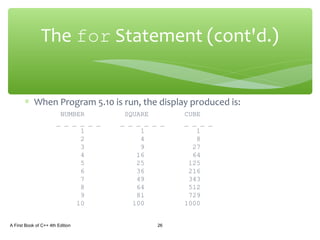
∗ When Program 5.10 is run, the display produced is:
NUMBER SQUARE CUBE
_ _ _ _ _ _ _ _ _ _ _ _ _ _ _ _
1 1 1
2 4 8
3 9 27
4 16 64
5 25 125
6 36 216
7 49 343
8 64 512
9 81 729
10 100 1000
A First Book of C++ 4th Edition 26
The for Statement (cont'd.)
A First Book of C++ 4th Edition 27
∗ Same effect as using cin object within a while loop
∗ Provides interactive user input
A First Book of C++ 4th Edition 28
Interactive for Loops
A First Book of C++ 4th Edition 29
//accumulate total inside a for loop
//calculate average outside a for loop
∗ Program 5.11: for statement creates a loop
∗ Loop executed five times
∗ Actions performed in each loop
∗ User prompted to enter a number
∗ Number added to the total
A First Book of C++ 4th Edition 30
Interactive for Loops (cont'd.)
∗ Initialization variations:
∗ Alternative 1: initialize total outside the loop and count
inside the loop as in Program 5.11
∗ Alternative 2: initialize both total and count inside loop
for (total = 0.0, count = 0; count < MAXCOUNT;
count++)
∗ Alternative 3: initialize and declare both total and count
inside loop
for (double total = 0.0, int count = 0;
count < MAXCOUNT; count++)
A First Book of C++ 4th Edition 31
Interactive for Loops (cont'd.)
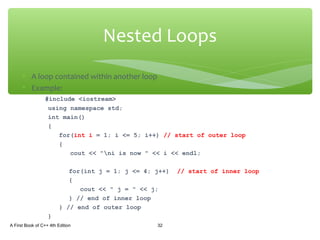
∗ A loop contained within another loop
∗ Example:
#include <iostream>
using namespace std;
int main()
{
for(int i = 1; i <= 5; i++) // start of outer loop
{
cout << "ni is now " << i << endl;
for(int j = 1; j <= 4; j++) // start of inner loop
{
cout << " j = " << j;
} // end of inner loop
} // end of outer loop
}
A First Book of C++ 4th Edition 32
Nested Loops
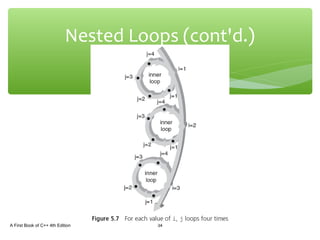
∗ Outer (first) loop:
∗ Controlled by value of i
∗ Inner (second) loop:
∗ Controlled by value of j
∗ Rules:
∗ For each single trip through outer loop, inner loop runs
through its entire sequence
∗ Different variable to control each loop
∗ Inner loop statements contained within outer loop
A First Book of C++ 4th Edition 33
Nested Loops (cont'd.)
A First Book of C++ 4th Edition 34
∗ A repetition statement that evaluates an expression
at the end of the statement
∗ Allows some statements to be executed before an
expression is evaluated
∗ for and while evaluate an expression at the
beginning of the statement
∗ Format:
do
statement;
while (expression); // don’t forget final ;
A First Book of C++ 4th Edition 35
The do-while Statement
A First Book of C++ 4th Edition 36
∗ Provided by do-while statement through filtering of user-
entered input
∗ Example (repeat loop until valid number is entered):
do
{
cout << "nEnter an identification number: ";
cin >> idNum;
if (idNum < 100 || idNum > 1999)
{
cout << "n An invalid number was just entered"
<< "nPlease check the ID number and reenter";
}
else
break; // break if a valid ID number was entered
} while(1); // this expression is always true
A First Book of C++ 4th Edition 37
Validity Checks
∗ “Off by one” errors: loop executes one time too many
or one time too few
∗ Initial and final conditions to control loop must be
carefully constructed
∗ Inadvertent use of assignment operator, =, in place of
the equality operator, ==
∗ This error is not detected by the compiler
A First Book of C++ 4th Edition 38
Common Programming Errors
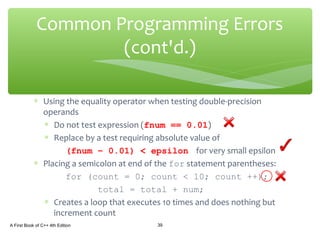
∗ Using the equality operator when testing double-precision
operands
∗ Do not test expression (fnum == 0.01)
∗ Replace by a test requiring absolute value of
(fnum – 0.01) < epsilon for very small epsilon
∗ Placing a semicolon at end of the for statement parentheses:
for (count = 0; count < 10; count ++);
total = total + num;
∗ Creates a loop that executes 10 times and does nothing but
increment count
A First Book of C++ 4th Edition 39
Common Programming Errors
(cont'd.)
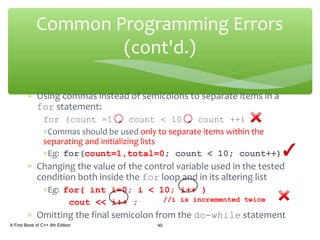
∗ Using commas instead of semicolons to separate items in a
for statement:
for (count =1 , count < 10 , count ++)
∗Commas should be used only to separate items within the
separating and initializing lists
∗Eg: for(count=1,total=0; count < 10; count++)
∗ Changing the value of the control variable used in the tested
condition both inside the for loop and in its altering list
∗Eg: for( int i=0; i < 10; i++ )
cout << i++ ;
∗ Omitting the final semicolon from the do-while statement
A First Book of C++ 4th Edition 40
Common Programming Errors
(cont'd.)
//i is incremented twice
∗ while, for, and do-while statements create loops
∗ These statements evaluate an expression
∗ On the basis of the expression value, either terminate the
loop or continue with it
∗ Each pass through the loop is called a repetition or iteration
∗ while checks expression before any other statement in the
loop
∗ Variables in the tested expression must have values assigned
before while is encountered
A First Book of C++ 4th Edition 41
Summary
∗ The for statement: fixed-count loops
∗ Included in parentheses at top of loop:
∗ Initializing expressions
∗ Tested expression
∗ Expressions that affect the tested expression
∗ Other loop statements can also be included as part of the
altering list
A First Book of C++ 4th Edition 42
Summary (cont'd.)
∗ The do-while statement checks its expression at
the end of the loop
∗ Body of the loop must execute at least once
∗ do-while loop must contain statement(s) that either:
∗ Alter the tested expression’s value or
∗ Force a break from the loop
A First Book of C++ 4th Edition 43
Summary (cont'd.)

Csc1100 lecture05 ch05

  • 1.
    A First Bookof C++A First Book of C++ Chapter 5Chapter 5 RepetitionRepetition
  • 2.
    ∗ In thischapter, you will learn about: ∗ The while Statement ∗ Interactive while Loops ∗ The for Statement ∗ The do while Statement ∗ Common Programming Errors ∗ Additional Testing Techniques A First Book of C++ 4th Edition 2 Objectives
  • 3.
    ∗ A generalrepetition statement ∗ Format: while (expression) statement; ∗ Function: ∗ expression is evaluated the same as an if-else statement ∗ Statement following expression executed repeatedly as long as expression has non-zero value (i.e., true) A First Book of C++ 4th Edition 3 The while Statement
  • 4.
    ∗ Steps inexecution of while statement: 1. Test the expression 2. If the expression has a non-zero (true) value a. Execute the statement following the parentheses b. Go back to step 1 else a. Exit the while statement A First Book of C++ 4th Edition 4 The while Statement (cont'd.)
  • 5.
    A First Bookof C++ 4th Edition 5
  • 6.
    The while Statement(cont'd.) A First Book of C++ 4th Edition 6 // repeat “while” statement 10 times //post increment, count will be increased by 1 in the next statement // count only gets added here
  • 7.
    ∗ Infinite loop:one that never ends ∗ Fixed-count loop: tested expression is a counter that checks for a fixed number of repetitions ∗ Variation: counter is incremented by a value other than 1 ∗ Example: ∗ Celsius-to-Fahrenheit temperature conversion ∗ Display Fahrenheit and Celsius temperatures, from 5-50 degrees C, in 5 degree increments A First Book of C++ 4th Edition 7 The while Statement (cont'd.)
  • 8.
    #include <iostream> using namespacestd; int main(){ celsius = 5; // starting celsius value (initialization) while (celsius <= 50) //repeat statements 50 times { fahren = (9.0/5.0) * celsius + 32.0; cout << setw(4) << celsius << setw(13) << fahren << endl; celsius = celsius + 5; //increment celsius by 5 each time } return 0; } // end main A First Book of C++ 4th Edition 8 The while Statement (cont'd.)
  • 9.
    ∗ Combining interactivedata entry with the repetition of a while statement ∗ Produces very powerful and adaptable programs ∗ Example (Program 5.5): while statement accepts and displays four user-entered numbers ∗ Numbers accepted and displayed one at a time A First Book of C++ 4th Edition 9 Interactive while Loops
  • 10.
    A First Bookof C++ 4th Edition 10 //starting value for count (initialization) //increment count by 1 in the next cout statement //define MAXNUMS as a fixed constant value //repeat the process MAXNUMS of times = 4
  • 11.
    ∗ Sample runof Program 5.5: This program will ask you to enter 4 numbers. Enter a number: 26.2 The number entered is 26.2 Enter a number: 5 The number entered is 5 Enter a number: 103.456 The number entered is 103.456 Enter a number: 1267.89 The number entered is 1267.89 A First Book of C++ 4th Edition 11 Interactive while Loops (cont'd.) 1 2 3 4
  • 12.
    ∗ Example (Program5.6): adding a single number to a total ∗ A number is entered by the user ∗ Accumulating statement adds the number to total total = total + num; ∗ A while statement repeats the process A First Book of C++ 4th Edition 12 Interactive while Loops (cont'd.)
  • 13.
    Interactive while Loops (cont'd.) AFirst Book of C++ 4th Edition 13
  • 14.
    A First Bookof C++ 4th Edition 14 //always initialize accumulating variable to a starting value //repeat 4 times //increment counter by 1 //accumulation: use of same variable to accumulate (total)
  • 15.
    ∗ Sample runof Program 5.6: This program will ask you to enter 4 numbers. Enter a number: 26.2 The total is now 26.2 Enter a number: 5 The total is now 31.2 Enter a number: 103.456 The total is now 134.656 Enter a number: 1267.89 The total is now 1402.546 The final total is 1402.546 A First Book of C++ 4th Edition 15 Interactive while Loops (cont'd.) total = 0 + 26.2 total = 26.2 + 5 total = 31.2 + 103.456 total = 134.656 + 1267.89
  • 16.
    ∗ Sentinels ∗ Datavalues used to signal the start or end of data series ∗ Values must be selected so as not to conflict with legitimate data values A First Book of C++ 4th Edition 16 Sentinels
  • 17.
    Example: Sentinel A FirstBook of C++ 4th Edition 17 #include <iostream> using namespace std; int main(){ const int sentinel = 999; // set fixed sentinel value for exit int num; cout << “Enter an integer value or 999 to exit: ”; cin >> num; while (num != sentinel) //repeat statements until 999 is entered { cout << num << endl; cout << “Enter an integer value or 999 to exit: ”; cin >> num; } return 0; } // end main
  • 18.
    ∗ break: forcesimmediate exit from structures ∗ Use in switch statements: ∗ The desired case has been detected and processed ∗ Use in while, for, and do-while statements: ∗ An unusual condition is detected ∗ Format: break; A First Book of C++ 4th Edition 18 break and continue Statements
  • 19.
    ∗ continue: causesthe next iteration of the loop to begin immediately ∗ Execution transferred to the top of the loop ∗ Applies only to while, do-while, and for statements ∗ Format: continue; A First Book of C++ 4th Edition 19 break and continue Statements (cont'd.)
  • 20.
    ∗ Used wherea statement is syntactically required but no action is called for ∗ A do-nothing statement ∗ Typically used with while or for statements ∗ Format: null; A First Book of C++ 4th Edition 20 The Null Statement
  • 21.
    ∗ Same functionas the while statement but in different form for (initializing list; expression; altering list) statement; ∗ Function: statement executed as long as expression has non-zero (true) value ∗ Components: ∗ Initializing list: initial value of expression ∗ Expression: a valid C++ expression ∗ Altering list: statements executed at end of each for loop to alter value of expression A First Book of C++ 4th Edition 21 The for Statement
  • 22.
    ∗ Components offor statement correspond to operations performed in while statement ∗ Initialization ∗ Expression evaluation ∗ Altering of expression values ∗ Components of for statement are optional, but semicolons must always be present A First Book of C++ 4th Edition 22 The for Statement (cont'd.)
  • 23.
    The for Statement(cont'd.) A First Book of C++ 4th Edition 23
  • 24.
    ∗ Program 5.9modified: initializer outside for loop A First Book of C++ 4th Edition 24 The for Statement (cont'd.)
  • 25.
    The for Statement(cont'd.) A First Book of C++ 4th Edition 25 //can use “pow” for this
  • 26.
    ∗ When Program5.10 is run, the display produced is: NUMBER SQUARE CUBE _ _ _ _ _ _ _ _ _ _ _ _ _ _ _ _ 1 1 1 2 4 8 3 9 27 4 16 64 5 25 125 6 36 216 7 49 343 8 64 512 9 81 729 10 100 1000 A First Book of C++ 4th Edition 26 The for Statement (cont'd.)
  • 27.
    The for Statement(cont'd.) A First Book of C++ 4th Edition 27
  • 28.
    ∗ Same effectas using cin object within a while loop ∗ Provides interactive user input A First Book of C++ 4th Edition 28 Interactive for Loops
  • 29.
    A First Bookof C++ 4th Edition 29 //accumulate total inside a for loop //calculate average outside a for loop
  • 30.
    ∗ Program 5.11:for statement creates a loop ∗ Loop executed five times ∗ Actions performed in each loop ∗ User prompted to enter a number ∗ Number added to the total A First Book of C++ 4th Edition 30 Interactive for Loops (cont'd.)
  • 31.
    ∗ Initialization variations: ∗Alternative 1: initialize total outside the loop and count inside the loop as in Program 5.11 ∗ Alternative 2: initialize both total and count inside loop for (total = 0.0, count = 0; count < MAXCOUNT; count++) ∗ Alternative 3: initialize and declare both total and count inside loop for (double total = 0.0, int count = 0; count < MAXCOUNT; count++) A First Book of C++ 4th Edition 31 Interactive for Loops (cont'd.)
  • 32.
    ∗ A loopcontained within another loop ∗ Example: #include <iostream> using namespace std; int main() { for(int i = 1; i <= 5; i++) // start of outer loop { cout << "ni is now " << i << endl; for(int j = 1; j <= 4; j++) // start of inner loop { cout << " j = " << j; } // end of inner loop } // end of outer loop } A First Book of C++ 4th Edition 32 Nested Loops
  • 33.
    ∗ Outer (first)loop: ∗ Controlled by value of i ∗ Inner (second) loop: ∗ Controlled by value of j ∗ Rules: ∗ For each single trip through outer loop, inner loop runs through its entire sequence ∗ Different variable to control each loop ∗ Inner loop statements contained within outer loop A First Book of C++ 4th Edition 33 Nested Loops (cont'd.)
  • 34.
    Nested Loops (cont'd.) AFirst Book of C++ 4th Edition 34
  • 35.
    ∗ A repetitionstatement that evaluates an expression at the end of the statement ∗ Allows some statements to be executed before an expression is evaluated ∗ for and while evaluate an expression at the beginning of the statement ∗ Format: do statement; while (expression); // don’t forget final ; A First Book of C++ 4th Edition 35 The do-while Statement
  • 36.
    A First Bookof C++ 4th Edition 36
  • 37.
    ∗ Provided bydo-while statement through filtering of user- entered input ∗ Example (repeat loop until valid number is entered): do { cout << "nEnter an identification number: "; cin >> idNum; if (idNum < 100 || idNum > 1999) { cout << "n An invalid number was just entered" << "nPlease check the ID number and reenter"; } else break; // break if a valid ID number was entered } while(1); // this expression is always true A First Book of C++ 4th Edition 37 Validity Checks
  • 38.
    ∗ “Off byone” errors: loop executes one time too many or one time too few ∗ Initial and final conditions to control loop must be carefully constructed ∗ Inadvertent use of assignment operator, =, in place of the equality operator, == ∗ This error is not detected by the compiler A First Book of C++ 4th Edition 38 Common Programming Errors
  • 39.
    ∗ Using theequality operator when testing double-precision operands ∗ Do not test expression (fnum == 0.01) ∗ Replace by a test requiring absolute value of (fnum – 0.01) < epsilon for very small epsilon ∗ Placing a semicolon at end of the for statement parentheses: for (count = 0; count < 10; count ++); total = total + num; ∗ Creates a loop that executes 10 times and does nothing but increment count A First Book of C++ 4th Edition 39 Common Programming Errors (cont'd.)
  • 40.
    ∗ Using commasinstead of semicolons to separate items in a for statement: for (count =1 , count < 10 , count ++) ∗Commas should be used only to separate items within the separating and initializing lists ∗Eg: for(count=1,total=0; count < 10; count++) ∗ Changing the value of the control variable used in the tested condition both inside the for loop and in its altering list ∗Eg: for( int i=0; i < 10; i++ ) cout << i++ ; ∗ Omitting the final semicolon from the do-while statement A First Book of C++ 4th Edition 40 Common Programming Errors (cont'd.) //i is incremented twice
  • 41.
    ∗ while, for,and do-while statements create loops ∗ These statements evaluate an expression ∗ On the basis of the expression value, either terminate the loop or continue with it ∗ Each pass through the loop is called a repetition or iteration ∗ while checks expression before any other statement in the loop ∗ Variables in the tested expression must have values assigned before while is encountered A First Book of C++ 4th Edition 41 Summary
  • 42.
    ∗ The forstatement: fixed-count loops ∗ Included in parentheses at top of loop: ∗ Initializing expressions ∗ Tested expression ∗ Expressions that affect the tested expression ∗ Other loop statements can also be included as part of the altering list A First Book of C++ 4th Edition 42 Summary (cont'd.)
  • 43.
    ∗ The do-whilestatement checks its expression at the end of the loop ∗ Body of the loop must execute at least once ∗ do-while loop must contain statement(s) that either: ∗ Alter the tested expression’s value or ∗ Force a break from the loop A First Book of C++ 4th Edition 43 Summary (cont'd.)