Advanced IS Design
Lecture 2
Information Integration
Bing Liu, UIC 2
Introduction
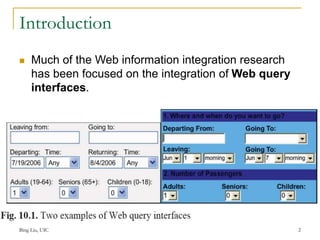
 Much of the Web information integration research
has been focused on the integration of Web query
interfaces.
Bing Liu, UIC 3
Introduction
 In this part, we introduce
 some basic integration techniques, and
 Web query interface integration
Bing Liu, UIC 4
Database integration
 Information integration started with database
integration.
 Fundamental problem: schema matching,
which takes two (or more) database schemas
to produce a mapping between elements (or
attributes) of the two (or more) schemas that
correspond semantically to each other.
 Objective: merge the schemas into a single
global schema.
Bing Liu, UIC 5
Integrating two schemas
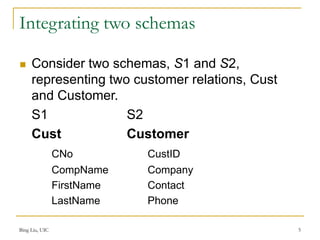
 Consider two schemas, S1 and S2,
representing two customer relations, Cust
and Customer.
S1 S2
Cust Customer
CNo CustID
CompName Company
FirstName Contact
LastName Phone
Bing Liu, UIC 6
Integrating two schemas (contd)
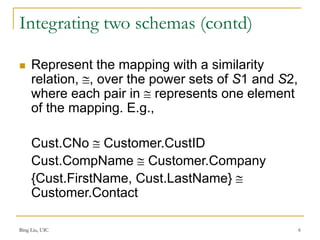
 Represent the mapping with a similarity
relation, , over the power sets of S1 and S2,
where each pair in  represents one element
of the mapping. E.g.,
Cust.CNo  Customer.CustID
Cust.CompName  Customer.Company
{Cust.FirstName, Cust.LastName} 
Customer.Contact
Bing Liu, UIC 7
Different types of matching
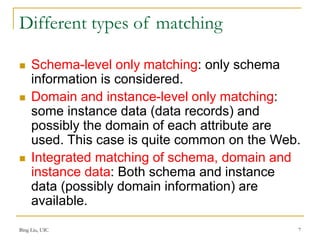
 Schema-level only matching: only schema
information is considered.
 Domain and instance-level only matching:
some instance data (data records) and
possibly the domain of each attribute are
used. This case is quite common on the Web.
 Integrated matching of schema, domain and
instance data: Both schema and instance
data (possibly domain information) are
available.
Bing Liu, UIC 8
Pre-processing for integration
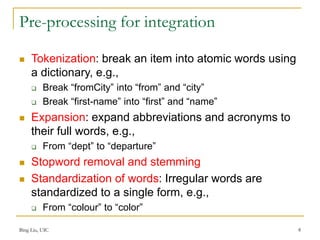
 Tokenization: break an item into atomic words using
a dictionary, e.g.,
 Break “fromCity” into “from” and “city”
 Break “first-name” into “first” and “name”
 Expansion: expand abbreviations and acronyms to
their full words, e.g.,
 From “dept” to “departure”
 Stopword removal and stemming
 Standardization of words: Irregular words are
standardized to a single form, e.g.,
 From “colour” to “color”
Bing Liu, UIC 9
Schema-level matching
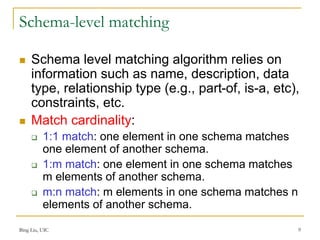
 Schema level matching algorithm relies on
information such as name, description, data
type, relationship type (e.g., part-of, is-a, etc),
constraints, etc.
 Match cardinality:
 1:1 match: one element in one schema matches
one element of another schema.
 1:m match: one element in one schema matches
m elements of another schema.
 m:n match: m elements in one schema matches n
elements of another schema.
Bing Liu, UIC 10
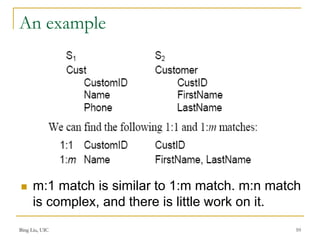
An example
 m:1 match is similar to 1:m match. m:n match
is complex, and there is little work on it.
Bing Liu, UIC 11
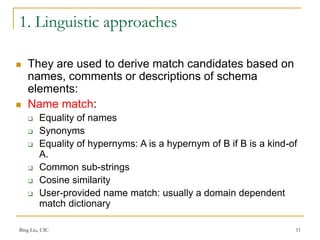
1. Linguistic approaches
 They are used to derive match candidates based on
names, comments or descriptions of schema
elements:
 Name match:
 Equality of names
 Synonyms
 Equality of hypernyms: A is a hypernym of B if B is a kind-of
A.
 Common sub-strings
 Cosine similarity
 User-provided name match: usually a domain dependent
match dictionary
Bing Liu, UIC 12
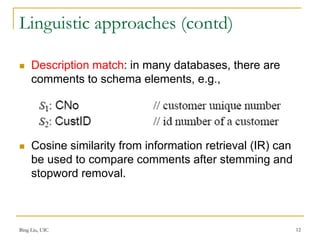
Linguistic approaches (contd)
 Description match: in many databases, there are
comments to schema elements, e.g.,
 Cosine similarity from information retrieval (IR) can
be used to compare comments after stemming and
stopword removal.
Bing Liu, UIC 13
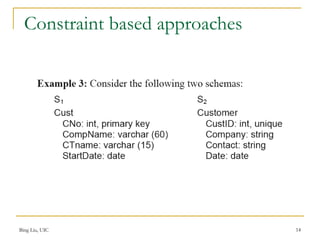
Constraint based approaches
 Constraints such as data types, value ranges,
uniqueness, relationship types, etc.
 An equivalent or compatibility table for data types
and keys can be provided. E.g.,
 string  varchar, and (primiary key)  unique
 For structured schemas, hierarchical relationships
such as
 is-a and part-of
may be utilized to help matching.
 Note: On the Web, the constraint information is often
not available, but some can be inferred based on
the domain and instance data.
Constraint based approaches
Bing Liu, UIC 14
Bing Liu, UIC 15
Domain and instance-level matching
 In many applications, some data instances or
attribute domains may be available.
 Value characteristics are used in matching.
 Two different types of domains
 Simple domain: each value in the domain has only
a single component (the value cannot be
decomposed).
 Composite domain: each value in the domain
contains more than one component.
Bing Liu, UIC 16
Match of simple domains
 A simple domain can be of any type.
 If the data type information is not available (this is
often the case on the Web), the instance values can
often be used to infer types, e.g.,
 Words may be considered as strings
 Phone numbers can have a regular expression pattern.
 Data type patterns (in regular expressions) can be
learnt automatically or defined manually.
 E.g., used to identify such types as integer, real, string,
month, weekday, date, time, zip code, phone numbers, etc.
Bing Liu, UIC 17
Match of simple domains (contd)
 Matching methods:
 Data types are used as constraints.
 For numeric data, value ranges, averages, variances can
be computed and utilized.
 For categorical data: compare domain values.
 For textual data: cosine similarity.
 Schema element names as values: A set of values in a
schema match a set of attribute names of another schema.
E.g.,
 In one schema, the attribute color has the domain {yellow, red,
blue}, but in another schema, it has the element or attribute
names called yellow, red and blue (values are yes and no).
Bing Liu, UIC 18
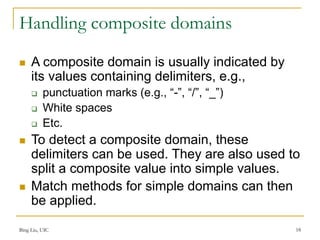
Handling composite domains
 A composite domain is usually indicated by
its values containing delimiters, e.g.,
 punctuation marks (e.g., “-”, “/”, “_”)
 White spaces
 Etc.
 To detect a composite domain, these
delimiters can be used. They are also used to
split a composite value into simple values.
 Match methods for simple domains can then
be applied.
Bing Liu, UIC ACL-07 19
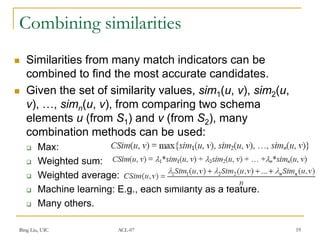
Combining similarities
 Similarities from many match indicators can be
combined to find the most accurate candidates.
 Given the set of similarity values, sim1(u, v), sim2(u,
v), …, simn(u, v), from comparing two schema
elements u (from S1) and v (from S2), many
combination methods can be used:
 Max:
 Weighted sum:
 Weighted average:
 Machine learning: E.g., each similarity as a feature.
 Many others.
Bing Liu, UIC 20
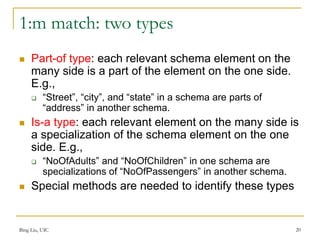
1:m match: two types
 Part-of type: each relevant schema element on the
many side is a part of the element on the one side.
E.g.,
 “Street”, “city”, and “state” in a schema are parts of
“address” in another schema.
 Is-a type: each relevant element on the many side is
a specialization of the schema element on the one
side. E.g.,
 “NoOfAdults” and “NoOfChildren” in one schema are
specializations of “NoOfPassengers” in another schema.
 Special methods are needed to identify these types
Bing Liu, UIC 21
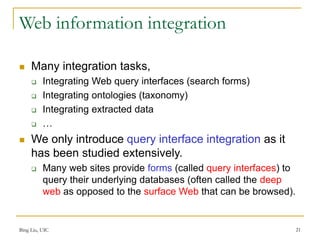
Web information integration
 Many integration tasks,
 Integrating Web query interfaces (search forms)
 Integrating ontologies (taxonomy)
 Integrating extracted data
 …
 We only introduce query interface integration as it
has been studied extensively.
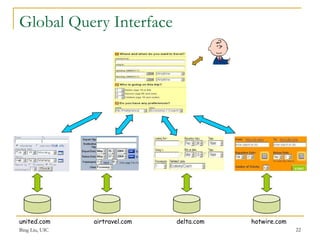
 Many web sites provide forms (called query interfaces) to
query their underlying databases (often called the deep
web as opposed to the surface Web that can be browsed).
Bing Liu, UIC 22
Global Query Interface
united.com airtravel.com delta.com hotwire.com
Bing Liu, UIC 24
Schema model of query interfaces
 In each domain, there is a set of essential concepts C
= {c1, c2, …, cn}, used in query interfaces to enable the
user to restrict the search.
 Each concept is often represented with a single
attribute.
 Each attribute is labeled with a word or phrase, called the
label of the attribute, which is visible to the user.
 Each attribute may also have a set of possible values, its
domain.
Bing Liu, UIC 25
Schema model of query interfaces (contd)
 All the attributes with their labels in a query interface
are called the schema of the query interface.
 Each attribute also has a name in the HTML code.
The name is attached to a TEXTBOX (which takes
the user input). However,
 this name is not visible to the user.
 It is attached to the input value of the attribute and returned
to the server as the attribute of the input value.
 For practical schema integration, we are concerned
with only the label and name of each attribute and
its domain.
Bing Liu, UIC 26
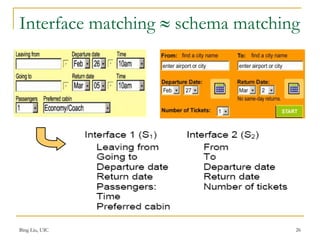
Interface matching  schema matching
Bing Liu, UIC 28
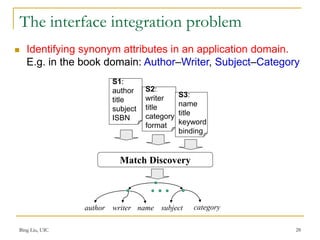
The interface integration problem
 Identifying synonym attributes in an application domain.
E.g. in the book domain: Author–Writer, Subject–Category
Match Discovery
author name subject category
writer
S2:
writer
title
category
format
S3:
name
title
keyword
binding
S1:
author
title
subject
ISBN
Bing Liu, UIC 29
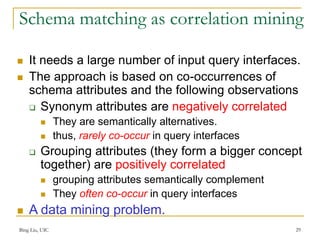
Schema matching as correlation mining
 It needs a large number of input query interfaces.
 The approach is based on co-occurrences of
schema attributes and the following observations
 Synonym attributes are negatively correlated
 They are semantically alternatives.
 thus, rarely co-occur in query interfaces
 Grouping attributes (they form a bigger concept
together) are positively correlated
 grouping attributes semantically complement
 They often co-occur in query interfaces
 A data mining problem.
Schema matching as correlation
mining
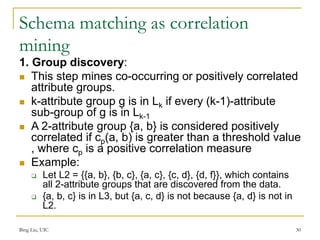
1. Group discovery:
 This step mines co-occurring or positively correlated
attribute groups.
 k-attribute group g is in Lk if every (k-1)-attribute
sub-group of g is in Lk-1
 A 2-attribute group {a, b} is considered positively
correlated if cp(a, b) is greater than a threshold value
, where cp is a positive correlation measure
 Example:
 Let L2 = {{a, b}, {b, c}, {a, c}, {c, d}, {d, f}}, which contains
all 2-attribute groups that are discovered from the data.
 {a, b, c} is in L3, but {a, c, d} is not because {a, d} is not in
L2.
Bing Liu, UIC 30
Schema matching as correlation
mining
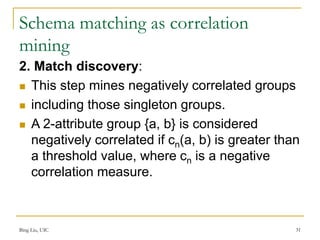
2. Match discovery:
 This step mines negatively correlated groups
 including those singleton groups.
 A 2-attribute group {a, b} is considered
negatively correlated if cn(a, b) is greater than
a threshold value, where cn is a negative
correlation measure.
Bing Liu, UIC 31
Schema matching as correlation
mining
3. Matching selection:
 Choose the most confident and consistent
matches and to remove possibly false ones
 a score function is needed, which is defined
as the maximum negative correlation values
of all 2-attribute groups in the match.
Bing Liu, UIC 32
Bing Liu, UIC 33
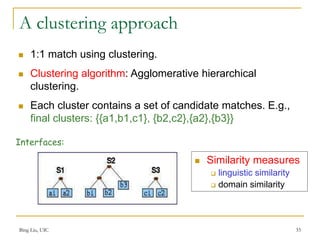
A clustering approach
Interfaces:
 Similarity measures
 linguistic similarity
 domain similarity
 1:1 match using clustering.
 Clustering algorithm: Agglomerative hierarchical
clustering.
 Each cluster contains a set of candidate matches. E.g.,
final clusters: {{a1,b1,c1}, {b2,c2},{a2},{b3}}
A clustering approach
1. Pre-processing the data.
2. Computing all pair-wise attribute similarities of u
( Si) and v ( Sj), i  j. This produces a similarity
matrix.
3. Identify initial 1:m matches. (part of type, is a
type)
4. Cluster schema elements based on the
similarity matrix. This step
discovers 1:1 matches.
5. Generate the final 1:m matches of attributes.
Bing Liu, UIC 34
thank you
40

Lec2_Information Integration.ppt

  • 1.
    Advanced IS Design Lecture2 Information Integration
  • 2.
    Bing Liu, UIC2 Introduction  Much of the Web information integration research has been focused on the integration of Web query interfaces.
  • 3.
    Bing Liu, UIC3 Introduction  In this part, we introduce  some basic integration techniques, and  Web query interface integration
  • 4.
    Bing Liu, UIC4 Database integration  Information integration started with database integration.  Fundamental problem: schema matching, which takes two (or more) database schemas to produce a mapping between elements (or attributes) of the two (or more) schemas that correspond semantically to each other.  Objective: merge the schemas into a single global schema.
  • 5.
    Bing Liu, UIC5 Integrating two schemas  Consider two schemas, S1 and S2, representing two customer relations, Cust and Customer. S1 S2 Cust Customer CNo CustID CompName Company FirstName Contact LastName Phone
  • 6.
    Bing Liu, UIC6 Integrating two schemas (contd)  Represent the mapping with a similarity relation, , over the power sets of S1 and S2, where each pair in  represents one element of the mapping. E.g., Cust.CNo  Customer.CustID Cust.CompName  Customer.Company {Cust.FirstName, Cust.LastName}  Customer.Contact
  • 7.
    Bing Liu, UIC7 Different types of matching  Schema-level only matching: only schema information is considered.  Domain and instance-level only matching: some instance data (data records) and possibly the domain of each attribute are used. This case is quite common on the Web.  Integrated matching of schema, domain and instance data: Both schema and instance data (possibly domain information) are available.
  • 8.
    Bing Liu, UIC8 Pre-processing for integration  Tokenization: break an item into atomic words using a dictionary, e.g.,  Break “fromCity” into “from” and “city”  Break “first-name” into “first” and “name”  Expansion: expand abbreviations and acronyms to their full words, e.g.,  From “dept” to “departure”  Stopword removal and stemming  Standardization of words: Irregular words are standardized to a single form, e.g.,  From “colour” to “color”
  • 9.
    Bing Liu, UIC9 Schema-level matching  Schema level matching algorithm relies on information such as name, description, data type, relationship type (e.g., part-of, is-a, etc), constraints, etc.  Match cardinality:  1:1 match: one element in one schema matches one element of another schema.  1:m match: one element in one schema matches m elements of another schema.  m:n match: m elements in one schema matches n elements of another schema.
  • 10.
    Bing Liu, UIC10 An example  m:1 match is similar to 1:m match. m:n match is complex, and there is little work on it.
  • 11.
    Bing Liu, UIC11 1. Linguistic approaches  They are used to derive match candidates based on names, comments or descriptions of schema elements:  Name match:  Equality of names  Synonyms  Equality of hypernyms: A is a hypernym of B if B is a kind-of A.  Common sub-strings  Cosine similarity  User-provided name match: usually a domain dependent match dictionary
  • 12.
    Bing Liu, UIC12 Linguistic approaches (contd)  Description match: in many databases, there are comments to schema elements, e.g.,  Cosine similarity from information retrieval (IR) can be used to compare comments after stemming and stopword removal.
  • 13.
    Bing Liu, UIC13 Constraint based approaches  Constraints such as data types, value ranges, uniqueness, relationship types, etc.  An equivalent or compatibility table for data types and keys can be provided. E.g.,  string  varchar, and (primiary key)  unique  For structured schemas, hierarchical relationships such as  is-a and part-of may be utilized to help matching.  Note: On the Web, the constraint information is often not available, but some can be inferred based on the domain and instance data.
  • 14.
  • 15.
    Bing Liu, UIC15 Domain and instance-level matching  In many applications, some data instances or attribute domains may be available.  Value characteristics are used in matching.  Two different types of domains  Simple domain: each value in the domain has only a single component (the value cannot be decomposed).  Composite domain: each value in the domain contains more than one component.
  • 16.
    Bing Liu, UIC16 Match of simple domains  A simple domain can be of any type.  If the data type information is not available (this is often the case on the Web), the instance values can often be used to infer types, e.g.,  Words may be considered as strings  Phone numbers can have a regular expression pattern.  Data type patterns (in regular expressions) can be learnt automatically or defined manually.  E.g., used to identify such types as integer, real, string, month, weekday, date, time, zip code, phone numbers, etc.
  • 17.
    Bing Liu, UIC17 Match of simple domains (contd)  Matching methods:  Data types are used as constraints.  For numeric data, value ranges, averages, variances can be computed and utilized.  For categorical data: compare domain values.  For textual data: cosine similarity.  Schema element names as values: A set of values in a schema match a set of attribute names of another schema. E.g.,  In one schema, the attribute color has the domain {yellow, red, blue}, but in another schema, it has the element or attribute names called yellow, red and blue (values are yes and no).
  • 18.
    Bing Liu, UIC18 Handling composite domains  A composite domain is usually indicated by its values containing delimiters, e.g.,  punctuation marks (e.g., “-”, “/”, “_”)  White spaces  Etc.  To detect a composite domain, these delimiters can be used. They are also used to split a composite value into simple values.  Match methods for simple domains can then be applied.
  • 19.
    Bing Liu, UICACL-07 19 Combining similarities  Similarities from many match indicators can be combined to find the most accurate candidates.  Given the set of similarity values, sim1(u, v), sim2(u, v), …, simn(u, v), from comparing two schema elements u (from S1) and v (from S2), many combination methods can be used:  Max:  Weighted sum:  Weighted average:  Machine learning: E.g., each similarity as a feature.  Many others.
  • 20.
    Bing Liu, UIC20 1:m match: two types  Part-of type: each relevant schema element on the many side is a part of the element on the one side. E.g.,  “Street”, “city”, and “state” in a schema are parts of “address” in another schema.  Is-a type: each relevant element on the many side is a specialization of the schema element on the one side. E.g.,  “NoOfAdults” and “NoOfChildren” in one schema are specializations of “NoOfPassengers” in another schema.  Special methods are needed to identify these types
  • 21.
    Bing Liu, UIC21 Web information integration  Many integration tasks,  Integrating Web query interfaces (search forms)  Integrating ontologies (taxonomy)  Integrating extracted data  …  We only introduce query interface integration as it has been studied extensively.  Many web sites provide forms (called query interfaces) to query their underlying databases (often called the deep web as opposed to the surface Web that can be browsed).
  • 22.
    Bing Liu, UIC22 Global Query Interface united.com airtravel.com delta.com hotwire.com
  • 23.
    Bing Liu, UIC24 Schema model of query interfaces  In each domain, there is a set of essential concepts C = {c1, c2, …, cn}, used in query interfaces to enable the user to restrict the search.  Each concept is often represented with a single attribute.  Each attribute is labeled with a word or phrase, called the label of the attribute, which is visible to the user.  Each attribute may also have a set of possible values, its domain.
  • 24.
    Bing Liu, UIC25 Schema model of query interfaces (contd)  All the attributes with their labels in a query interface are called the schema of the query interface.  Each attribute also has a name in the HTML code. The name is attached to a TEXTBOX (which takes the user input). However,  this name is not visible to the user.  It is attached to the input value of the attribute and returned to the server as the attribute of the input value.  For practical schema integration, we are concerned with only the label and name of each attribute and its domain.
  • 25.
    Bing Liu, UIC26 Interface matching  schema matching
  • 26.
    Bing Liu, UIC28 The interface integration problem  Identifying synonym attributes in an application domain. E.g. in the book domain: Author–Writer, Subject–Category Match Discovery author name subject category writer S2: writer title category format S3: name title keyword binding S1: author title subject ISBN
  • 27.
    Bing Liu, UIC29 Schema matching as correlation mining  It needs a large number of input query interfaces.  The approach is based on co-occurrences of schema attributes and the following observations  Synonym attributes are negatively correlated  They are semantically alternatives.  thus, rarely co-occur in query interfaces  Grouping attributes (they form a bigger concept together) are positively correlated  grouping attributes semantically complement  They often co-occur in query interfaces  A data mining problem.
  • 28.
    Schema matching ascorrelation mining 1. Group discovery:  This step mines co-occurring or positively correlated attribute groups.  k-attribute group g is in Lk if every (k-1)-attribute sub-group of g is in Lk-1  A 2-attribute group {a, b} is considered positively correlated if cp(a, b) is greater than a threshold value , where cp is a positive correlation measure  Example:  Let L2 = {{a, b}, {b, c}, {a, c}, {c, d}, {d, f}}, which contains all 2-attribute groups that are discovered from the data.  {a, b, c} is in L3, but {a, c, d} is not because {a, d} is not in L2. Bing Liu, UIC 30
  • 29.
    Schema matching ascorrelation mining 2. Match discovery:  This step mines negatively correlated groups  including those singleton groups.  A 2-attribute group {a, b} is considered negatively correlated if cn(a, b) is greater than a threshold value, where cn is a negative correlation measure. Bing Liu, UIC 31
  • 30.
    Schema matching ascorrelation mining 3. Matching selection:  Choose the most confident and consistent matches and to remove possibly false ones  a score function is needed, which is defined as the maximum negative correlation values of all 2-attribute groups in the match. Bing Liu, UIC 32
  • 31.
    Bing Liu, UIC33 A clustering approach Interfaces:  Similarity measures  linguistic similarity  domain similarity  1:1 match using clustering.  Clustering algorithm: Agglomerative hierarchical clustering.  Each cluster contains a set of candidate matches. E.g., final clusters: {{a1,b1,c1}, {b2,c2},{a2},{b3}}
  • 32.
    A clustering approach 1.Pre-processing the data. 2. Computing all pair-wise attribute similarities of u ( Si) and v ( Sj), i  j. This produces a similarity matrix. 3. Identify initial 1:m matches. (part of type, is a type) 4. Cluster schema elements based on the similarity matrix. This step discovers 1:1 matches. 5. Generate the final 1:m matches of attributes. Bing Liu, UIC 34
  • 33.