CSR
CSR
 Disclosure
Communication
 Exploring European cross-national differences and tendencies


 Partnership with


                            1
A study developed by:   In collaboration with:   In partnership with:


                                    2
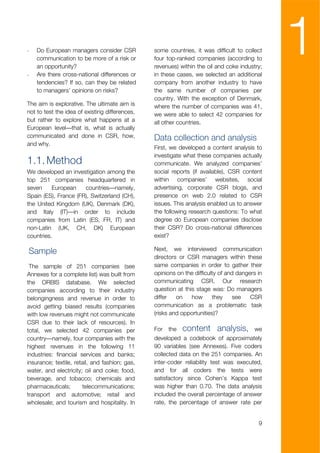
Gonzalez del Valle Brena, Ph.D, Associate
                                professor in advertising and public


Foreword
                                relations.;   Belen Rodriquez Canova,


Foreword
                                research assistant for data collection ;
                                Julia Emilia Sanchez, research assistant
                                for data collection; Mabel Velazquez
 Taking pride in being a good companyassistant for sampling;
                                Merlo, research     without being
jlkdsjflsjfdsjflksjfkdsjfksjf   Ana Toledo, Ph.D, research assistant for
 perceived as having an opportunisticanalysis
                                data
                                        purpose is anything but
klsjdflksdlfjsdlkkkkkkkk
 easy. We analyzed the practice of top European companies
                                              From IULM University there are Emanuele
kkkkkkkkkkkkkkkkkkkk about risks and opportunities
 and asked experts’ opinions Invernizzi, Ph.D, Professor in corporate
 related to communicating CSR. communication and Stefania Romenti,
kkkkkkkkkkkkkkkkkkkk                          Ph.D, Assistant Professor in corporate
kkkkkkkkkkkkkkkkkkkk                          communication
The role of CSR in management is more persistent today than ever before. Although many
kkkkkkkkkkkkkkkkkkkk                          From Judge Business School there is
studies focus on how companies implement socially oriented principles and strategies, little
kkkkkkk from the belief that the EuropeanStelios C. Zyglidopoulos, previous studies
this study starts                             Strategy.
                                               perspective is lacking as
                                                                         Ph.D, Reader in
work has focused on how the company’s social commitment is communicated. Therefore,

have primarily analyzed Fortune 500 companies. What is the degree of social disclosure
among topteam and Institutional partners
(Research European companies? Are there cross-national differences or tendencies? Do


                                                 Titolo 1
of the research
European managers consider CSR communication as more of a risk or an opportunity?
The project was lead by IE School of
To date, the topic of this study has remained a work in progress because debate about
Communication in collaboration with two
what is an appropriate degree of social disclosure is far from being decided. The boundaries
academic partners: IULM (Milan, Italy)
and Judge Business School (U of                  Titolo 2
between engaging in and communicating CSR as well as marketing, corporate image, and
CSR are not yet strictly defined. Nowadays, CSR communication is constantly changing and
Cambridge, Uk).
being redefined. As such, we hope that this study will inspire all those who want to have a
                                                  Titolo 3
better IE School of Communicationpractice related to what is communicated and how. This
From understanding of the current there
work is also meant for all those who are endeavoring to know more about the opinions of
are Laura Illia, Ph.D, Assistant professor in     In rilievo
experts and communication or CSR managers who deal with CSR communication on a
Corporate and Business Communication
daily basis. investigator);
(Principal                         Almudena


Laura Illia, Ph.D.          Stefania Romenti, Ph.D.       Stelios C. Zyglidopoulos, Ph.D.
IE University               IULM                          University of Cambridge


                                                                                            3
Research Team
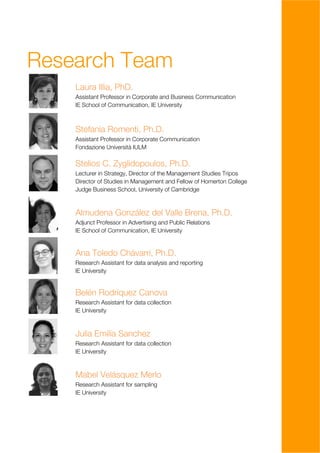
    Laura Illia, PhD.
    Assistant Professor in Corporate and Business Communication
    IE School of Communication, IE University


    Stefania Romenti, Ph.D.
    Assistant Professor in Corporate Communication
    Fondazione Università IULM

    Stelios C. Zyglidopoulos, Ph.D.
    Lecturer in Strategy, Director of the Management Studies Tripos
    Director of Studies in Management and Fellow of Homerton College
    Judge Business School, University of Cambridge


    Almudena González del Valle Brena, Ph.D.
    Adjunct Professor in Advertising and Public Relations
    IE School of Communication, IE University


    Ana Toledo Chávarri, Ph.D.
    Research Assistant for data analysis and reporting
    IE University


    Belén Rodríquez Canova
    Research Assistant for data collection
    IE University


    Julia Emilia Sanchez
    Research Assistant for data collection
    IE University


    Mabel Velásquez Merlo
    Research Assistant for sampling
    IE University


                                                                       4
Content
Executive summary        6

1. Introduction 7
   1.1. Starting point       8
   1.2. Method 9

2. What is communicated 12
   2.1. UK and South Europeans, the high disclosers! 13
   2.2. CSR e-agenda setting: made in ES, IT and UK 20
   2.3. Web 2.0 a South European experimentation 22

3. Opinions of who communicates 26
   3.1. Engaging in or Communicating CSR: That’s the question! 27
   3.2. The marketing risk of communicating CSR 31
   3.3. Attitudes of public opinion and/or mass media 34
   3.4. CSR communication for corporate image during corporate crisis   37
   3.5. CSR advertising: a debated practice 40
   3.6. CSR blogging: a question of character! 42

4. Final Conclusions         44

References        50


Annexes      52

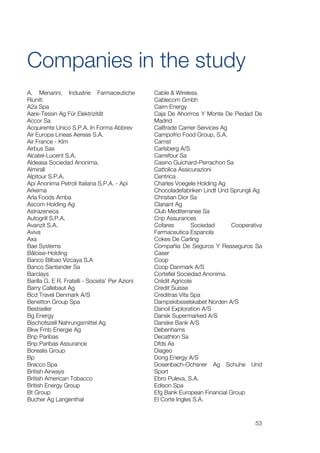
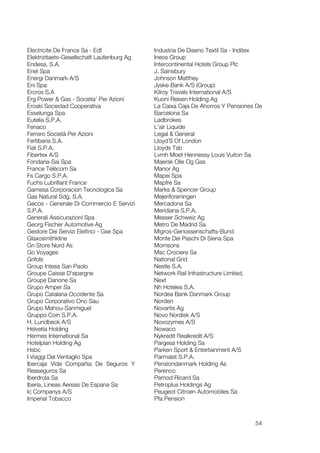
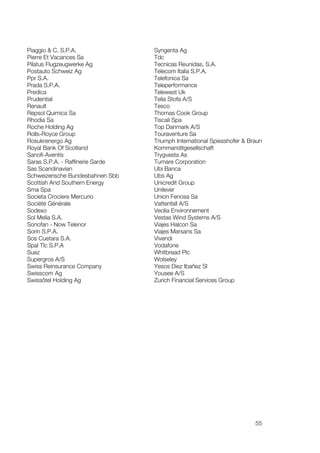
Companies in the study           53

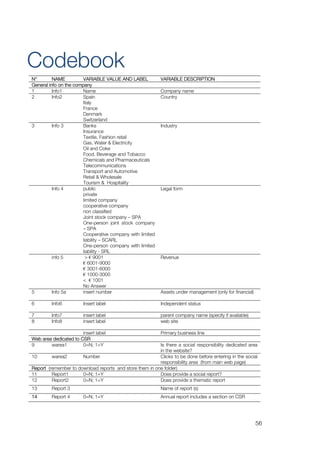
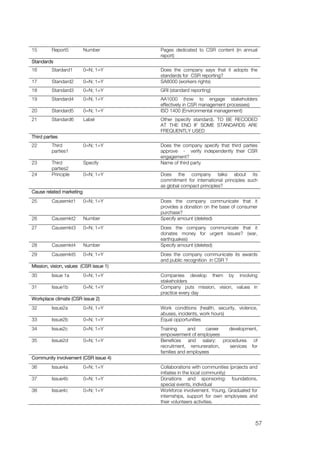
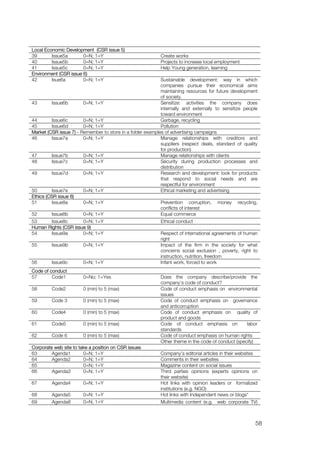
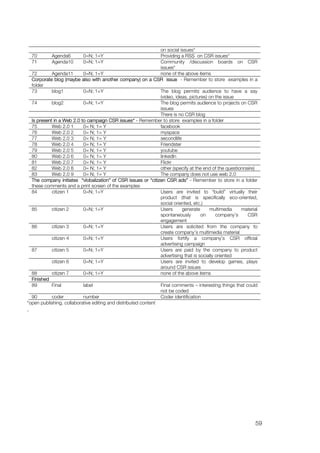
Codebook      56


                                                                             5
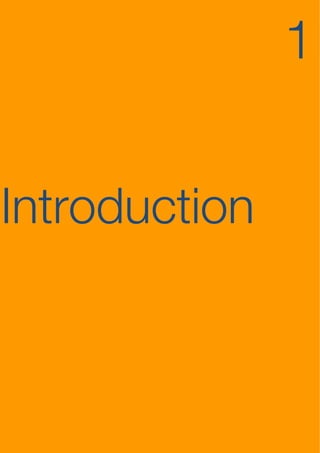
Executive Summary                                  This is true for all aspects we
Project outline
                                                   investigated.
The boost to CSR has been underscored
by the numerous studies on how                 -   Many companies (again, especially from
companies implement socially oriented              the UK, Spain, Italy, and France) tend to
principles and strategies. Management              use their websites to set their agenda
practices with regard to CSR have not yet          on social issues. They care not only
extensively analyzed how companies                 about social reporting or descriptive
communicate their social commitment.               informing about what the company
The state of the research in this area is          does, but also about being gatekeepers
poor and addresses mainly the US reality.          within the debate on social issues in our
In order to understand current practices in        society. As the interviews underscored,
Europe, we investigated the top 251                this behavior is about building a public
companies (in terms of highest revenues)           culture of CSR.
in 11 industries from six European             Manager’s opinions
countries—namely,       Spain,     France,     - Managers do not fear the public opinion
Switzerland,     the   United    Kingdom,        or mass media skepticism that CSR
Denmark, and Italy. We analyzed what is          communication has an opportunistic
communicated using a content analysis of         marketing purpose. Their point of view
companies’ social reports (if available),        is that, in the past, media were attentive
CSR content within companies’ websites,          only to CSR’s worst practices. Today,
social advertising, and presence on web          scandals easily spread, but so do good
2.0 related to CSR issues. We also               practices as CSR communication is
interviewed 69 communication or CSR              starting to become known by media and
managers within these same companies             the general public, who seem to have
about their opinions on risks and                an increasing interest in such issues
opportunities in communicating CSR.              even when they relate to good news.
What is communicated                           - The managers in the current study
- Social reporting is still not an               shared their opinions about how to
  institutionalized practice in Europe as it     avoid risks in communicating CSR.
  is in the US as only one third of              These opinions are summarized in 14
  companies provide social or thematic           guidelines in the study’s conclusion.
  reports to a large audience. Still, the      - The variety and type of managers’
  majority of companies (48%) provide            opinions       indicated    that     CSR
  CSR content in their annual reports.           communication is a practice still be
- The most often communicated social             constantly redefined.
  issues relate to the environment, market     - According to the managers, both
  orientation, and workplace climate             processes—namely, engaging in and
  whereas community involvement, ethics          communicating         CSR—have        their
  and governance, local economic                 complexities and risks. Those who
  development,        and      stakeholders’     consider engaging in CSR to be difficult
  inclusion are less often disclosed.            believe that CSR is about changing the
  Human rights are rarely communicated.          culture of an organization. Meanwhile,
- The European tendency is that UK               communicating CSR is perceived to be
  companies have the highest disclosure,         difficult because of the complexity of
  followed      by    southern     European      fitting       multiple      stakeholders’
  companies (Spain, Italy and France).           expectations while providing a concise
                                                 message that is credible.


                                                                                          6
1


Introduction


               7
1.1. Starting point
The fundamental idea embedded in
corporate social responsibility (CSR) is that
                                                communications overstating companies’
                                                social behaviors.

                                                Previous studies have analyzed the
                                                                                                 1
corporations have an obligation to work         disclosure of US companies (e.g., Guthrie,
for social betterment (Frederick, 1978;         & Parker, 1990), but little efforts have been
Sethi, 1975; Carroll, 1979; Andrews,            made to develop a non-US perspective on
1987) and thus should act responsibly           CSR disclosure. Some studies studied UK,
with stakeholders and ethically toward          Australian or New Zeeland companies
society (Holme and Watts, 2000). A key          (Gray et al 1995, Hackston and Milne
component of engaging in CSR is                 1996, Deegan and Rankin 1999), but
communicating CSR with an appropriate           there is yet still not European perspective
degree of social disclosure (Zéghal and         on CSR communication. This creates an
Ahmed,      1990).    When        companies     interesting opportunity as previous studies
communicate their CSR, they aim to              (e.g., Tixier, 2003; Maignan and Ralston,
provide information about the company’s         2002; Haniffa and Cooke, 2005) agree
special behavior so as to legitimize the        that differences exist between how CSR is
company among its stakeholders (Deegan          communicated by US and European
and Rankin, 1999; Brown and Deegan,             managers. European managers adopt a
1998; Hooghiemstra, 2000).                      “low-risk”      attitude     toward      CSR
                                                communication         compared       to    US
Yet such communication can be anything          managers as they believe that it is too
but easy for two main reasons. First, it is     risky to build a corporate image on CSR
difficult to be informed on CSR as CSR          activities, given that public opinion, media,
actions cannot be readily verified (Carroll,    and consumers see CSR disclosure as
1999; Schoenberger, 2000). It is easy to        having an opportunistic marketing purpose
be informed on a company’s behavior             (Tixier, 2003). A recent study on
through standards or codes of conduct,          sustainability by Havas Media (2009)
but it is quite complicated to be informed      confirms this cross-national component of
about outcomes of very long-term                CSR. Worldwide, 64% of public opinion
projects. Second, it is quite complicated to    and consumers consider that most
take pride in being a good company              companies are socially or environmental
without being seen as having an                 responsible for improving their image. This
opportunistic purpose (Holme and Watts,         opinion is stronger in countries like Spain
2000).       A     company’s      authentic     (72%) and France (70%) than in the US
commitment to CSR can easily be                 (58%). Given these contextual differences,
misunderstood as being a marketing              our aim is to develop a European
attempt. As such, companies ought to            perspective       on     CSR       disclosure.
reflect upon what is the practice               Specifically, we aim to scrutinize the
nowadays. On one side it is important to        following:
know how to reach the right level of
transparency; otherwise, CSR actions            -   What is the degree of social disclosure
might be underestimated. On the other               among top European companies?
side, it is important to counteract
stakeholders’ skepticism toward corporate


                                                                                            8
-


-
    Do European managers consider CSR
    communication to be more of a risk or
    an opportunity?
    Are there cross-national differences or
                                                some countries, it was difficult to collect
                                                four top-ranked companies (according to
                                                revenues) within the oil and coke industry;
                                                in these cases, we selected an additional
                                                                                               1
    tendencies? If so, can they be related      company from another industry to have
    to managers’ opinions on risks?             the same number of companies per
                                                country. With the exception of Denmark,
The aim is explorative. The ultimate aim is     where the number of companies was 41,
not to test the idea of existing differences,   we were able to select 42 companies for
but rather to explore what happens at a         all other countries.
European level—that is, what is actually
communicated and done in CSR, how,              Data collection and analysis
and why.
                                                First, we developed a content analysis to
                                                investigate what these companies actually
1.1. Method                                     communicate. We analyzed companies’
We developed an investigation among the         social reports (if available), CSR content
top 251 companies headquartered in              within companies’ websites, social
seven     European    countries—namely,         advertising, corporate CSR blogs, and
Spain (ES), France (FR), Switzerland (CH),      presence on web 2.0 related to CSR
the United Kingdom (UK), Denmark (DK),          issues. This analysis enabled us to answer
and Italy (IT)—in order to include              the following research questions: To what
companies from Latin (ES, FR, IT) and           degree do European companies disclose
non-Latin (UK, CH, DK) European                 their CSR? Do cross-national differences
countries.                                      exist?

Sample                                          Next, we interviewed communication
                                                directors or CSR managers within these
 The sample of 251 companies (see               same companies in order to gather their
Annexes for a complete list) was built from     opinions on the difficulty of and dangers in
the ORBIS database. We selected                 communicating CSR. Our research
companies according to their industry           question at this stage was: Do managers
belongingness and revenue in order to           differ   on    how      they     see   CSR
avoid getting biased results (companies         communication as a problematic task
with low revenues might not communicate         (risks and opportunities)?
CSR due to their lack of resources). In
total, we selected 42 companies per             For   the   content analysis,           we
country—namely, four companies with the         developed a codebook of approximately
highest revenues in the following 11            90 variables (see Annexes). Five coders
industries: financial services and banks;       collected data on the 251 companies. An
insurance; textile, retail, and fashion; gas,   inter-coder reliability test was executed,
water, and electricity; oil and coke; food,     and for all coders the tests were
beverage, and tobacco; chemicals and            satisfactory since Cohen’s Kappa test
pharmaceuticals;       telecommunications;      was higher than 0.70. The data analysis
transport and automotive; retail and            included the overall percentage of answer
wholesale; and tourism and hospitality. In      rate, the percentage of answer rate per


                                                                                          9
country and industry, and a chi square
analysis to determine how significant
differences per countries are. Elements
we coded in our content analysis are:
                                               -

                                               -
                                                   Corporate magazines on social
                                                   issues;
                                                   Third parties opinions (experts
                                                   opinions on social issues in their
                                                                                          1
                                                   website);
1. Presence and accessibility of CSR           -   Hot links with opinion leaders or
   web site area                                   formalized institutions (e.g. NGO) ;
                                               -   Hot links with Independent news
2. Accessibility of Social or thematic             or blogs;
   report in the corporate website             -   Multimedia content (e.g. web TV
                                                   or videos on long term projects)
                                                   on social issues);
3. Disclosure on 8 CSR issues:                 -   Providing a RSS on social issues
   - Stakeholders’ involvement;                -   Community /discussion boards on
   - Workplace climate,                            CSR issues.
   - Community involvement;
   - Local economic development             7. Corporate blogs and Web 2.0 to
   - Environment,                              communicate social engagement
   - Market orientation,                       (facebook, linkedln, Myspace, you
   - Ethics,                                   tube, secondlife, Friendster,)
   - Human right
                                            8. Initiation of vlobalization or citizen
4. Disclosure    of      Cause   Related       advertising on social products:
   Marketing activities:                       - Users are invited to “build” virtually
       - Donate money on base of                    their product that is eco/social
          consumer purchase;                        oriented;
       - Donate money for urgent               - Users          generate     multimedia
          matters         (e.g.      war,           material       spontaneously    on
          earthquakes)                              company’s CSR engagement ;
       - social and ethical advertising,       - Users are solicited by the
       - Get awards and public                      company to create company’s
          recognition in CSR.                       multimedia CSR material;
                                               - Users fortify a company’s CSR
5. Disclosure of CSR standards and                  official advertising campaign;
   Indexes :AA1000, ISO 140001, ISO            - Users are paid by the company to
   19001, SA8000, Carbon disclosure                 social product advertising
   project, FTSE 4, DJSI, OSHAS 18001,
   EMAS, GRI, ISAE 3000                     Interviews      were conducted online
                                            following a phone call to establish a
6. Use of web to set an e- agenda on
                                            connection with the interviewees. We
   social issues :
                                            developed an interview guideline that
   - Company’s editorial articles in
                                            includes both quantitative and qualitative
      their websites on social issues;
                                            questions. We asked interviewees to
   - Comments in their websites;
                                            indicate their agreement to six statements


                                                                                    10
(using a 5-point Likert scale) and reason
of the agreement/disagreement. A
qualitative “why” answer for each
statement was compulsory. We were
                                              -


                                              -
                                                  Skeptical nature of public opinion or
                                                  mass media

                                                  Risks of     advertising    with   social
                                                                                              1
particularly interested in qualitatively          dimension
analyzing quotations from managers’           -   Risks of using corporate blogs to
opinions                                          communicate CSR
We asked mangers opinions on:

-   Difficulty to do vs     difficulty   to   Five people built the list of contacts within
    communicate CSR                           the 251 companies. In total, we collected
                                              69 interviews.
-   “Marketing” Risk to communicate
    CSR actions                               One coder analyzed the qualitative
                                              statement of managers in order to
-   Boomerang effect of embedding a           develop a cluster pattern of similar
    corporate image around CSR during         reasons regarding their specific opinions
    crisis                                    related to CSR communication.


                                                                                         11
2

What is
communicated


         12
2.1. UK and South Europeans, the high disclosers!
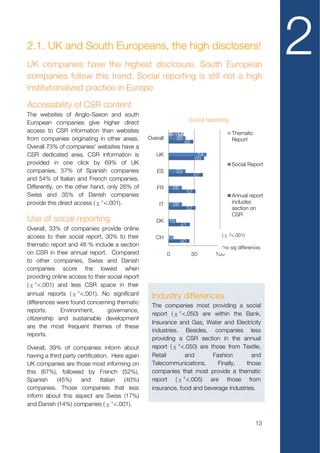
UK companies have the highest disclosure. South European
companies follow this trend. Social reporting is still not a high
                                                                                                            2
institutionalized practice in Europe
Accessibility of CSR content
The websites of Anglo-Saxon and south
European companies give higher direct                                    Social reporting
access to CSR information than websites                                                     Thematic
                                                               30 *
from companies originating in other areas.       Overall         33                         Report
                                                                      48
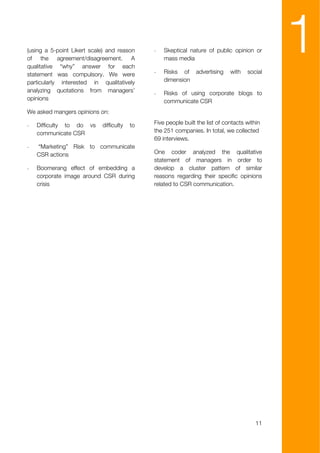
Overall 73% of companies’ websites have a
CSR dedicated area. CSR information is              UK                         74
                                                                              69
provided in one click by 69% of UK                                                          Social Report
companies, 57% of Spanish companies                  ES         33
                                                                              67
and 54% of Italian and French companies.
Differently, on the other hand, only 26% of          FR        26
                                                                         52
Swiss and 35% of Danish companies                                                           Annual report
provide this direct access (χ²<.001).                 IT       26                           includes
                                                                         52                 section on
                                                                                            CSR
Use of social reporting                             DK     15
                                                                    41
Overall, 33% of companies provide online
access to their social report, 30% to their         CH 10                             (χ ²<.001)
                                                                    40
thematic report and 48 % include a section                                            *no sig differences
on CSR in their annual report. Compared                    0               50       100
to other companies, Swiss and Danish
companies score the lowest when
providing online access to their social report
(χ²<.001) and less CSR space in their
annual reports (χ²<.001). No significant
                                                  Industry differences
differences were found concerning thematic
                                                  The companies most providing a social
reports.      Environment,       governance,
                                                  report (χ²<.050) are within the Bank,
citizenship and sustainable development
                                                  Insurance and Gas, Water and Electricity
are the most frequent themes of these
                                                  industries. Besides, companies less
reports.
                                                  providing a CSR section in the annual
Overall, 39% of companies inform about            report (χ²<.050) are those from Textile,
having a third party certification. Here again    Retail       and       Fashion        and
UK companies are those most informing on          Telecommunications.      Finally,   those
this (67%), followed by French (52%),             companies that most provide a thematic
Spanish      (45%)    and       Italian (40%)     report (χ²<.005) are those from
companies. Those companies that less              insurance, food and beverage industries.
inform about this aspect are Swiss (17%)
and Danish (14%) companies (χ²<.001).


                                                                                                       13
Issues being communicated
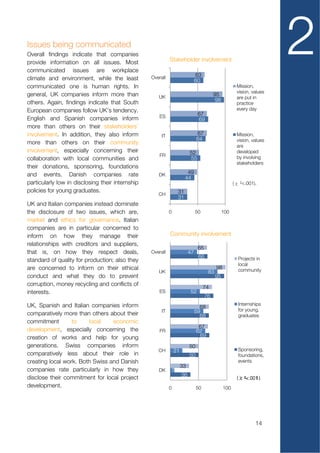
Overall findings indicate that companies
provide information on all issues. Most
communicated issues are workplace
climate and environment, while the least          Overall
                                                            Stakeholder involvement

                                                                               63
                                                                                                                        2
                                                                               60
communicated one is human rights. In                                                                   Mission,
                                                                                                       vision, values
general, UK companies inform more than               UK                                   95
                                                                                                       are put in
others. Again, findings indicate that South                                                98
                                                                                                       practice
European companies follow UK’s tendency.                                                               every day
                                                      ES                        67
English and Spanish companies inform                                            69
more than others on their stakeholders’
involvement. In addition, they also inform             IT                      67                      Mission,
                                                                               64                      vision, values
more than others on their community
                                                                                                       are
involvement, especially concerning their                                  52                           developed
                                                      FR                                               by involving
collaboration with local communities and                                  55
                                                                                                       stakeholders
their donations, sponsoring, foundations
and events. Danish companies rate                    DK                49
                                                                      44
particularly low in disclosing their internship                                                       (χ ²<.001).
policies for young graduates.                                    31
                                                     CH
                                                                 31
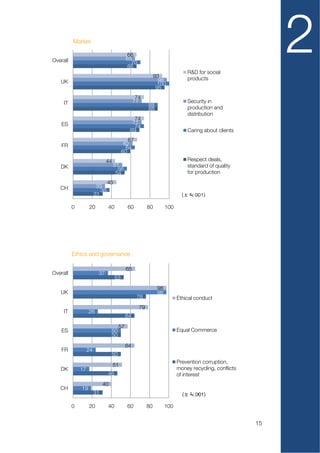
UK and Italian companies instead dominate
the disclosure of two issues, which are,                    0                  50               100
market and ethics for governance. Italian
companies are in particular concerned to
inform on how they manage their                             Community involvement
relationships with creditors and suppliers,
                                                                                65
that is, on how they respect deals,               Overall                 47
                                                                                66                      Projects in
standard of quality for production; also they
                                                                                                        local
are concerned to inform on their ethical                                                   98           community
                                                     UK                               83
conduct and what they do to prevent                                                        95
corruption, money recycling and conflicts of
                                                                                    74
interests.                                            ES                  52
                                                                                     76
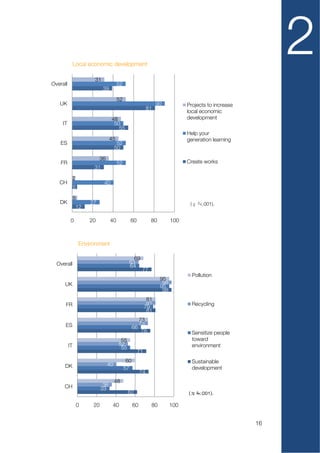
UK, Spanish and Italian companies inform                                                                Internships
                                                                                 68
                                                       IT                      59                       for young,
comparatively more than others about their                                       68                     graduates
commitment        to    local    economic
                                                                                67
development, especially concerning the                FR                       62
creation of works and help for young                                            69
generations. Swiss companies inform                                       50
                                                     CH         21                                      Sponsoring,
comparatively less about their role in                                    50                            foundations,
creating local work. Both Swiss and Danish                                                              events
                                                                     33
companies rate particularly in how they              DK     7
                                                                     36
disclose their commitment for local project
development.                                                0                  50               100


                                                                                                                14
Overall
          Market

                                             66
                                            65
                                              70
                                             66
                                                             93
                                                                             R&D for social
                                                                                                           2
                                                               98            products
   UK                                                          100
                                                              95
                                                  74
     IT                                          71                          Security in
                                                        88                   production and
                                                        88
                                                                             distribution
                                               74
    ES                                        71
                                               74
                                             69                              Caring about clients
                                             67
    FR                                     62
                                            64
                                          60
                               44                                            Respect deals,
   DK                               51                                       standard of quality
                                      56
                                     54                                      for production
                                45
   CH                    33
                           38
                        31

          0        20           40          60          80         100


          Ethics and governance

                                            65
Overall                   37
                                     53
                                                              98
   UK                                                         98
                                                  76                     Ethical conduct
                                                   79
     IT            26
                                            64
                                       57
    ES                            50                                     Equal Commerce
                                  50
                                            64
    FR             24
                                  50
                                                                         Prevention corruption,
                                    51
   DK         17                                                         money recycling, conflicts
                                46                                       of interest
                             40
   CH         19
                        31

          0        20           40          60          80         100


                                                                                                      15
Local economic development
                                                                                                           2
                        31
Overall                                 52
                             39

                                        52
   UK                                                             90           Projects to increase
                                                             81
                                                                               local economic
                                   48                                          development
     IT                             50
                                      55
                                                                               Help your
                                   45                                          generation learning
    ES                                 52
                                      50

                            36
    FR                                  52                                     Create works
                        31

               2
   CH                         40
               5

               5
   DK                  27                                                       (χ ²<.001).
                12

           0           20          40          60             80         100


                   Environment

                                                 69
  Overall                                      63
                                               64
                                                         77
                                                                                 Pollution
                                                                   95
      UK                                                            98
                                                                   95
                                                                    98
                                                          81
      FR                                                  81                     Recycling
                                                         79
                                                          81
                                                        73
      ES                                                73
                                                   66
                                                         76                      Sensitize people
                                         55                                      toward
          IT                            52                                       environment
                                         55
                                                    71
                                              60                                 Sustainable
      DK                         40
                                             57                                  development
                                                        74
                                      48
     CH                       36
                             33
                                              62

                   0    20          40             60         80         100


                                                                                                      16
Overall
          Work place climate

                               50
                                          69
                                         65
                                          69
                                                                                                    2
                                         67
   UK                                                    98
                                                         98
                                                         98
                               50
    FR                                        71
                                               74                   Benefices and salary
                                              71
                                         64                         Training and career
     IT                                    71                       developmen
                                         67
                                          69
                                                                    Equal opportunites
                                    57
    ES                                    69
                                    60                              Work conditions
                                         67
                         39
   DK                              54
                              46
                                    60
              21
   CH                       50
                          45
                         40

          0     20            40         60         80        100


          Human Rights

                          43
Overall                   43
                            49
                                                                     Infant work
                                    57
   UK                               57
                                     62

                                   55
    ES                             55
                                   55                                Social exclusion ,
                                                                     poverty, right to
                               50                                    instruction, nutrition,
    FR                         50
                                        62                           freedom

                        40
   CH                 38                                             Respect of
                     33
                                                                     international
                    32                                               agreement human
   DK          24                                                    right
                              46

               26
     IT         31
                  33

          0     20            40          60        80        100

                                                                                               17
UK and French companies are those that
more disclose on issues related to
environment. Though being comparatively
less disclosing, more than 50% of CH and
DK      companies     inform   on     their
                                                 50% of companies denote a disclosure on
                                                 it). Comparatively speaking, Swiss
                                                 companies rate particularily low in their
                                                 disclosure on benefices and salaries
                                                                                                            2
commitment to sustainable development,           Finally, it is interesting to note that Italian
pollution and environment. This is notable       companies rate particularly low in their
since on other issues this rate is below         communication on human right related
50%.                                             issues, even less than Swiss and Danish
                                                 companies. In general human right is the
Work place climate is another issue on           issue that is less communicated overall: it
which UK, French and Italian companies           is the only issue that rates lower than in
inform comparatevely more than others.           50% for all companies.
As for the topic environment, Danish and
Swiss      companies reveal a higher
disclosure than for other issues (around

 Industry differences
 Not surprisingly the Bank industry reveals to be most disclosing than other industries on
 all issues we analyzed. This tendency is followed by companies in the Gas, Water and
 Electricity industry that are disclosing in many of these issues. Companies that appear to
 be more frequently as having limited communication on many CSR issues belong to
 Tourism, Textile, retail and fashion and oil and coke industries. These results are
 significant from χ²<.050 or χ²<.005.


Cause related marketing
Overall   only    11%       of  companies
communicate to provide a donation on the            DIsclosure on Cause Related marketing
base of consumers purchase, 18% inform
on their social advertising campaign, 27%                11
                                               overall    18                              Donate
inform on the amount of money they                         27                             money on
                                                                    49
donate for urgent matters such as war and                                                 consumer
                                                  UK     14                               purchase
earthquakes, and 49% of companies inform                          38
                                                                              79
on received award for their CSR                                                           Social
engagement.                                       ES          31                          advertising
                                                               38
                                                                          74
UK and Spanish companies have similar             FR         29
                                                             26                           Donate
degree of disclosure on Cause Related                               48
                                                                                          money for
Marketing activities (χ²<.001). Specifically                 17                           urgent
                                                    IT            33
they tend to have the same degree of                                43                    matters
disclosure about their special donations for
                                                  CH 10
                                                     17
urgent issues (e.g. war, earthquakes) and             21                                 (χ ²<.001)
about awards and public recognition
received on CSR.                                  DK 5                                   *no sig
                                                     7 29
                                                                                         differences

Compared to other companies, Spanish                     0               50        100


                                                                                                       18
and French companies inform more on their
social advertising campaigns. Either they
provide the social campaign online, or a
direct link to it.
                                                     Industry differences
                                                     Companies within the food, beverage
                                                     and tobacco industry are those that
                                                     most communicate on their social
                                                                                                                2
Standards and Indexes                                advertising. Banks, telecommunication
The standard that is most communicated is            companies, gas water and electricity
the      ISO      14001        (environmental        companies,        chemicals        and
management), that is communicated by                 pharmaceutical companies follow this
47% of scrutinized companies. ISO 19001              tendency. These results are significant
(quality of management system) is                    from χ²<.050 or χ²<.005.
communicated by 19% of companies;
AA1000 (multi-stakeholder consultation for
accountability, responsibility, sustainability)                                   Standards
is communicated by 17% of it; and OSHAS
18001 (health a security at work) is                                  42
                                                  overall            36                       Global
communicated by 14% of companies. Only                          17                            Compact
                                                                        47
7% of analyzed companies certify that their
reporting follows the GRI standard                                      52
                                                     UK                50
reporting, and only 5 % of them certify to                             48
                                                                       48                     GRI (reporting)
have the ISAE 3000 standard reporting.                                 48
Only 6% inform on their adherence to the             SP                48
                                                                26
Carbon disclosure project. Only 1% on                                             74
EMAS (eco management audit scheme)                                           62               AA1000 (multi-
                                                     FR 5             40
                                                                                              stakeholder
We found significant differences between                                     60               consultation)
how companies inform on their standards                          31
                                                       IT        29
only in AA1000, ISO 14001 and GRI and                           17
                                                                       45                     ISO 14001
their adherence to global compact                                                             (environmental
                                                                24                            management)
principles.   Companies       that    most           CH          26
                                                                0
communicate about having an ISO 14001                            26
are from Spain and France followed by UK                     36
(χ²<.001). On the other hand, standard               DK 5 22
                                                           32
AA1000 is reported instead in particular by
UK companies (χ²<.001), while GRI                           0                50         100
reporting standard is provided especially by
Spanish and UK companies (χ²<.050). In
particular French English and Spanish
companies disclose on their adherence to
global compact principles

 Industry differences
 Companies that are particularly disclosing on following the GRI reporting standard are
 those from Bank and Gas, water and electricity industries (χ²<.050). Companies that
 notably inform on their adherence to ISO 14001 are Banks, Gas, water, electricity and
 Chemicals and Pharmaceuticals companies (χ²<.050). Finally companies informing on
 OSHAS 18001 are those from gas, electricity and Chemicals and Pharmaceuticals
 companies (χ²<.050).                                                                19
2.2. CSR e-agenda setting: made in ES, IT and UK
Companies tend to turn their website into an online newspaper
                                                                                                                2
to inform not only on their CSR commitment, but also on social
issues in general. Spanish, British and Italian companies rate
particularly high in this respect.
Overall findings
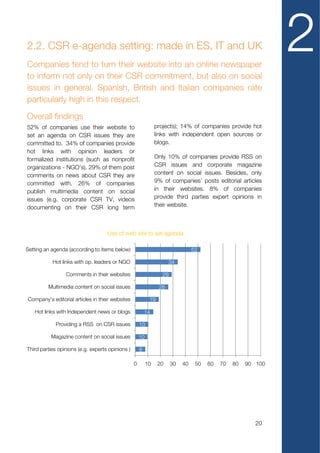
52% of companies use their website to                           projects); 14% of companies provide hot
set an agenda on CSR issues they are                            links with independent open sources or
committed to. 34% of companies provide                          blogs.
hot links with opinion leaders or
formalized institutions (such as nonprofit                      Only 10% of companies provide RSS on
organizations - NGO’s). 29% of them post                        CSR issues and corporate magazine
comments on news about CSR they are                             content on social issues. Besides, only
committed with. 26% of companies                                9% of companies’ posts editorial articles
publish multimedia content on social                            in their websites. 8% of companies
issues (e.g. corporate CSR TV, videos                           provide third parties expert opinions in
documenting on their CSR long term                              their website.


                                    Use of web site to set agenda

Setting an agenda (according to items below)                                      52

           Hot links with op. leaders or NGO                          34

                 Comments in their websites                        29

         Multimedia content on social issues                     26

Company’s editorial articles in their websites              19

   Hot links with Independent news or blogs               14

             Providing a RSS on CSR issues            10

           Magazine content on social issues          10

Third parties opinions (e.g. experts opinions )       8

                                                  0        10    20     30   40    50   60   70   80   90 100


                                                                                                          20
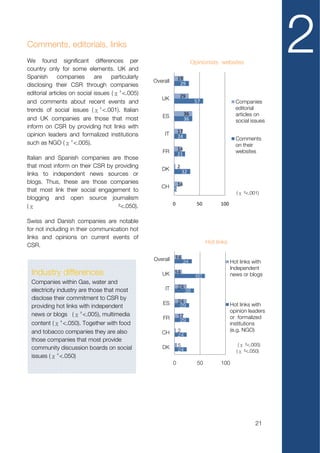
Comments, editorials, links
We found significant differences per
country only for some elements. UK and
Spanish       companies      are    particularly
                                                                           Opinionists websites
                                                                                                                2
                                                   Overall       19
disclosing their CSR through companies                            29
editorial articles on social issues (χ²<.005)                    29
                                                      UK
and comments about recent events and                                        57                  Companies
trends of social issues (χ²<.001). Italian                                                      editorial
                                                       ES             36                        articles on
and UK companies are those that most                                  36                        social issues
inform on CSR by providing hot links with
                                                        IT       17
opinion leaders and formalized institutions                      24                             Comments
such as NGO (χ²<.005).                                                                          on their
                                                       FR        14                             websites
                                                                 21
Italian and Spanish companies are those
that most inform on their CSR by providing                       2
                                                      DK             32
links to independent news sources or
blogs. Thus, these are those companies
                                                      CH 5 14
that most link their social engagement to                                                       (χ ²<.001)
blogging and open source journalism
(χ                                ²<.050).                   0               50         100


Swiss and Danish companies are notable
for not including in their communication hot
links and opinions on current events of
                                                                                  Hot links
CSR.

                                                   Overall   14
                                                                     34                       Hot links with
                                                                                              Independent
 Industry differences                                 UK 14                  60               news or blogs
 Companies within Gas, water and
                                                        IT       24
 electricity industry are those that most                             38
 disclose their commitment to CSR by
                                                       ES        24
 providing hot links with independent                             29                          Hot links with
                                                                                              opinion leaders
 news or blogs (χ²<.005), multimedia                             17                           or formalized
                                                       FR         29
 content (χ²<.050). Together with food                                                        institutions
 and tobacco companies they are also                  CH         2                            (e.g. NGO)
                                                                 24
 those companies that most provide
                                                                 5                               (χ ²<.005)
 community discussion boards on social                DK         24                             (χ ²<.050)
 issues (χ²<.050)
                                                             0               50         100


                                                                                                        21
2.3. Web 2.0: a South European experimentation
CSR communication through web 2.0 is in its early stages.
Spanish, italian and french companies are those that most
                                                                                         2
experiment.
CSR Corporate Blogs
Overall, only the 5% of companies have            companies which experiment this new
corporate blogs on CSR issues. We were            type of CSR communication. Hereafter
able to document examples in particular           are presented some examples.
from Spanish Italian and French

Italian companies
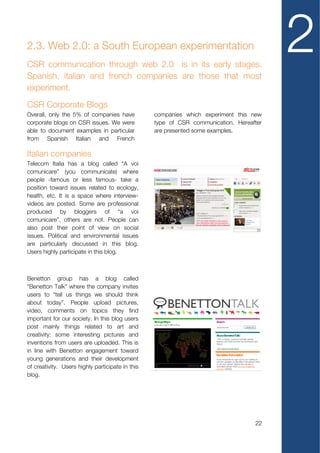
Telecom Italia has a blog called “A voi
comunicare” (you communicate) where
people -famous or less famous- take a
position toward issues related to ecology,
health, etc. It is a space where interview-
videos are posted. Some are professional
produced by bloggers of “a voi
comunicare”, others are not. People can
also post their point of view on social
issues. Political and environmental issues
are particularly discussed in this blog.
Users highly participate in this blog.


Benetton group has a blog called
“Benetton Talk” where the company invites
users to “tell us things we should think
about today”. People upload pictures,
video, comments on topics they find
important for our society. In this blog users
post mainly things related to art and
creativity: some interesting pictures and
inventions from users are uploaded. This is
in line with Benetton engagement toward
young generations and their development
of creativity. Users highly participate in this
blog.


                                                                                   22
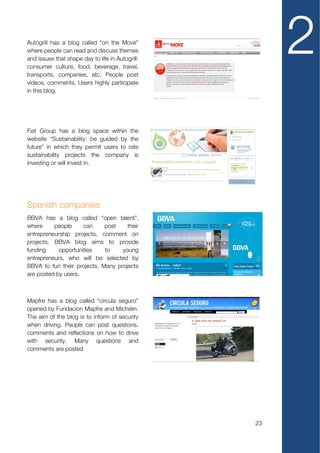
Autogrill has a blog called “on the Move”
where people can read and discuss themes
and issues that shape day to life in Autogrill:
consumer culture, food, beverage, travel,
transports, companies, etc. People post
                                                       2
videos, comments. Users highly participate
in this blog.


Fiat Group has a blog space within the
website “Sustainability: be guided by the
future” in which they permit users to rate
sustainability projects the company is
investing or will invest in.


Spanish companies
BBVA has a blog called “open talent”,
where     people     can     post    their
entrepreneurship projects, comment on
projects. BBVA blog aims to provide
funding     opportunities    to    young
entrepreneurs, who will be selected by
BBVA to fun their projects. Many projects
are posted by users.


Mapfre has a blog called “circula seguro”
opened by Fundacion Mapfre and Michelin.
The aim of the blog is to inform of security
when driving. People can post questions,
comments and reflections on how to drive
with security. Many questions and
comments are posted


                                                  23
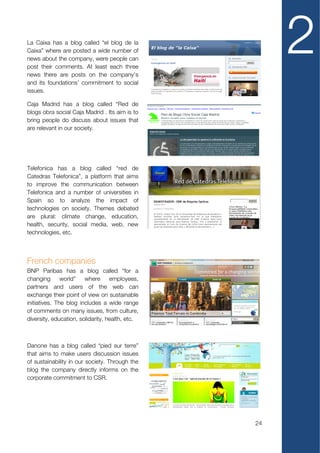
La Caixa has a blog called “el blog de la
Caixa” where are posted a wide number of
news about the company, were people can
post their comments. At least each three
news there are posts on the company’s
                                                      2
and its foundations’ commitment to social
issues.

Caja Madrid has a blog called “Red de
blogs obra social Caja Madrid . Its aim is to
bring people do discuss about issues that
are relevant in our society.


Telefonica has a blog called “red de
Catedras Telefonica”, a platform that aims
to improve the communication between
Telefonica and a number of universities in
Spain so to analyze the impact of
technologies on society. Themes debated
are plural: climate change, education,
health, security, social media, web, new
technologies, etc.


French companies
BNP Paribas has a blog called “for a
changing       world”   where      employees,
partners and users of the web can
exchange their point of view on sustainable
initiatives. The blog includes a wide range
of comments on many issues, from culture,
diversity, education, solidarity, health, etc.


Danone has a blog called “pied sur terre”
that aims to make users discussion issues
of sustainability in our society. Through the
blog the company directly informs on the
corporate commitment to CSR.


                                                 24
Caisse d’Epargne has a blog called
“Bénéfices Futur” where the company
informs users on sustainability projects that
                                                                                                     2
are put forward by the company. Users can
post comments.


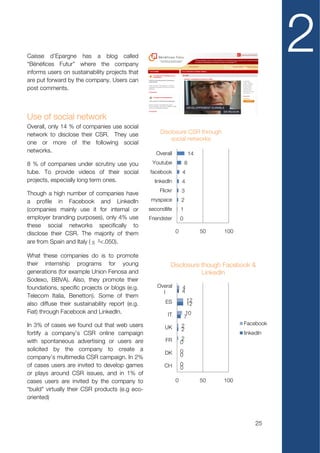
Use of social network
Overall, only 14 % of companies use social
network to disclose their CSR. They use              Disclosure CSR through
                                                         social networks
one or more of the following social
networks.                                           Overall               14
8 % of companies under scrutiny use you           Youtube             8
tube. To provide videos of their social          facebook         4
projects, especially long term ones.               linkedln       4
                                                     Flickr       3
Though a high number of companies have
a profile in Facebook and LinkedIn               myspace          2
(companies mainly use it for internal or         secondlife       1
employer branding purposes), only 4% use         Friendster       0
these social networks specifically to
disclose their CSR. The majority of them                      0                50   100
are from Spain and Italy (χ ²<.050).

What these companies do is to promote
their internship programs for young                       Disclosure though Facebook &
generations (for example Union Fenosa and                            LinkedIn
Sodexo, BBVA). Also, they promote their
foundations, specific projects or blogs (e.g.       Overal        4
                                                      l           4
Telecom Italia, Benetton). Some of them
                                                        ES            12
also diffuse their sustainability report (e.g.                        12
Fiat) through Facebook and LinkedIn.                     IT           10
                                                                      7
In 3% of cases we found out that web users                        2                       Facebook
                                                       UK         2
fortify a company’s CSR online campaign                                                   linkedln
with spontaneous advertising or users are               FR        2
                                                                  0
solicited by the company to create a                              0
                                                       DK         0
company’s multimedia CSR campaign. In 2%
of cases users are invited to develop games            CH         0
                                                                  0
or plays around CSR issues, and in 1% of
cases users are invited by the company to                     0                50   100
“build” virtually their CSR products (e.g eco-
oriented)


                                                                                               25
3
Opinions of
who
communicates

         26
3.1. Engaging in or communicating CSR: That’s
the question!
 Is it more difficult engaging in or communicating CSR? Managers find that both
                                                                                                3
 processes have their complexities and risks. Risks can be avoided easily with a reliable
 communication based on prudence and balance, rigor and transparency and by getting
 to know the media and the audience and stakeholders.

 Communicating is easier than engaging in

 -   “Communicating actions is easy. The true challenge lies in the development of these
     actions” (Spain)
 -   “Well planned CSR activities communicate their meaning by themselves “(Italy)

 Communicating is more difficult than engaging in

 - “Doing CSR is just following our values. Communicating could be a bit tricky - we do
   not want to brag” (Denmark).
 - “We face a problem when communicating CSR: lack of credibility” (Spain).
 - “It is difficult to convey the key messages and data in a concise, simple way” (UK).
 - “There are many different expectations from stakeholders” (Switzerland).
 - “Effective and credible communication covers areas where the company has
   performed badly, or which are far more complex than is publicly understood” (UK).
 - “It is really difficult to communicate CSR engagement, without the action being
   perceived by the public as marketing” (Spain).


Why is engaging in CSR                          changing the culture of an organization,
                                                about finding new ways of working, about
difficult?                                      considering more than the financial
                                                bottom line. All of this is a major challenge
Communicating CRS is seen as an easier
                                                to any organization”.
task than engaging in it by some of the
respondent organizations, who indicated         Thus, CSR is central in companies’
that “what is difficult is implementing         business strategy and implies facing the
responsible policies. Once they are             global industry context as well as its
implemented, communicating them is              fundamental issues. One Danish company
easy” (Italy) and “well planned CSR             understood CSR as “much, much more
activities communicate their meaning by         than communication. Actually, we view it
themselves” (Italy).                            more as an internal change management
                                                tool or even business development, which
Yet implementing CSR is an immense
                                                takes into consideration the conditions
task. It requires the mobilization of “the
                                                that the business is now facing (climate
whole organization” (Spain) and the
                                                change,       outsourcing,    demanding
transformation of the working processes
                                                stakeholders, etc.)”.
in day-to-day activities. As one UK
company stated, doing “CSR is about


                                                                                          27
Changing processes involved in the CSR
requires working with different units and
individuals as it must be implemented and
understood across the company “from
the bottom levels up to the managerial
                                                 (Spain). Communicating CSR provides
                                                 vital implications for firms. Results can be
                                                 important improvements, but a lot of
                                                 possible risks are also possible. As one
                                                 Italian company put it, “knowing how to
                                                                                                3
level” (Italy). Size and location(s) of the      communicate CSR in an effective way
company need to be taken into account.           within the company and with our own
For one Danish company, “implementing            stakeholders is key, not only to CSR
principles and strategies in a large             success but also for the company itself.
organization with more than 22,000               The company may find a competitive
employees in 14 countries is a much              advantage and good relations”.
bigger challenge than communicating
about what we do and why”.                       Firms can encounter difficulties in
                                                 communicating CSR, such as identifying
Some managers pointed out the technical          what it means to engage in CSR. “Often
complexity of implementing CSR. The              an organization is involved in aspects of
processes require a lot of planning,             CSR and for us this is often just running a
commitment, and time. It has “longitudinal       well-managed business. To communicate
and     multidisciplinary   characteristics”     effectively the organization must define
(Spain), and “a serious performance in           what CSR is for itself and communicate
CSR requires a real engagement over              this both internal and externally” (UK). Yet
time” (France). Moreover, CSR involves           some of the respondents identified more
not only intra-organizational elements, but      technical difficulties in communicating in
also external ones. As one Danish                an     effective     and    credible   way.
company stated, “doing CSR properly will         “Communicating CSR is more complex,
often also mean engaging both internal           as it involves far more shades of grey.
and external stakeholders in the process.”       Effective and credible communication
                                                 covers areas where the company has
The following quotation summarizes the           performed badly, or which are far more
opinion of those who find engaging in            complex than is publicly understood. This
CSR more difficult than communicating it:        requires more skill and subtlety than is
“Putting    in    place     the   necessary      needed for simply carrying out social
commitment, framework, processes, and            investment projects or measuring the
KPIs to measure and continuously make            socio-economic status of a local
progress is a difficult task. Once all of this   community, as it is a unique task each
is set, then it becomes easy to                  time” (UK).
communicate            CSR         activities”
(Switzerland).                                   Expected audiences also transform the
                                                 way in which companies manage CSR
Why is communicating CSR                         disclosure. If communication is addressed
                                                 to the general public, the challenge seems
difficult?
                                                 to be finding key and clear messages and
“Communicating CSR is very important             putting them in a “simple way that people
because it's a way of getting optimal            are prepared to read” (UK) because
results in CSR: growth in reputation and         “social and economic tissue, at least in
brand value. Therefore, communication            Italy, still remains immature regarding
costs and interest are not discussed”            these issues” (Italy). In measuring the risk

                                                                                          28
of public perception, one Danish company
focuses “more on educating the industry
and our clients around CSR issues than
communicating about our own initiatives.”
                                                 development, but clearness could also be
                                                 misinterpreted” (Denmark).

                                                 Companies can risk their credibility if the
                                                 messages are not balanced: “we face a
                                                                                                3
However, the audience can also be seen           problem when communicating CSR: a
in a more complex way, as indicated by           lack of credibility. There is still a
several different agents. “There are many        perception that what gets communicated
different expectations from stakeholders.        is smoke and mirrors” (Spain). The main
What is compelling for one audience is           problem stated in this sense is that CSR
insufficient for another. Getting the            can be misunderstood for social
balance between KPIs (and choosing               marketing or interpreted as green
which KPIs) and stories is a perennial           washing: “a company is not always
challenge. The raw material is not difficult     legitimated to communicate its own CSR
to find; describing it in a way that meets       actions. Its stakeholders may become
the expectations of external observers is        suspicious, may accuse the company of
more challenging” (Switzerland). The             green-washing” (France).
different     possible      channels     for
communicating        CSR      also   imply       Understanding         the
challenges. Achieving a wide audience            relationship     between
can be quite competitive as firms contend
with other "interesting news and stories in      engaging      in     and
the public domain” (Denmark).                    communicating CSR
In this sense, the main perceived risk           Taking into consideration all of the
comes from the relationship with media.          previously stated challenges, it can be
“When      communicating        CSR,    the      concluded that the way in which CSR—
company always depends on third                  and       the     relationship     between
parties” (Spain), and these parties do not       communicating and engaging in it—is
always share the same objectives. “Many          understood varies from company to
companies perceive it as a risk to               company and from manager to manager.
communicate about CSR and hesitate to            Therefore, some firms understand CSR as
do so because they know that the media           a      communications-driven       function:
will search for negative stories” (Denmark).     “invariably the communication of the CSR
                                                 approach and achievement will drive the
For one Danish company, “CSR is all              doing of CSR” (UK). Yet others view it as
about walking the talk and talking the           an integrated part of their foundations and
walk. It is what you do that matters. The        values, so they “see no need to
difficult part is giving the receiving end of    communicate it” (Denmark).
your communication the correct picture.
Neither too much nor too little.” As was         In addition, the boundaries between
previously indicated, choosing the KPI to        action and disclosure are not firmly
be transmitted is problematic: “doing CSR        defined. For some of the respondents’
is      just     following     our     values,   managers, the relationship seemed clear:
communicating could be a bit tricky, we          “if   you    act   fundamentally     social
do not want to brag, only being open and         responsible, you can communicate easily,
clear in our reporting, telling about our        transparently, and credibly” (Switzerland);
                                                 “Isn't it obvious? You should only

                                                                                          29
communicate what you are doing”
(Switzerland); and “doing CSR is a natural
part of our morale in Denmark” (Denmark).

Yet the disclosure of CSR is suspicious
                                                esp. support from the top) and across
                                                functions; and implicit in this is the extent
                                                to which it is a priority to the core
                                                business. Communicating CSR also has
                                                its challenges. The question doesn't
                                                                                                3
even within the profession. One manager         specify whether CSR is communicated
stated that, “making statements or              accurately (or indeed whether it's done
communicating is not enough. Very often,        effectively), which is important to establish
unclear or blurred initiatives are hidden       in terms of the ease of communication
behind elegant communication activities”        since the proliferation of CSR related
(Italy). Another believed “that we often find   articles and associated claims of 'green
statements of purposes, which do not            wash' may suggest that in fact it's all too
correspond to actual achievements within        easy to 'communicate CSR'. This also
the company, rather than the contrary”          relates     to     the    knowledge      and
(Italy).                                        understanding of those communicating
One respondent synthesized CSR as               the messages and, linking back to the
such: “The practice of CSR and the ease         ease or difficulty of doing CSR whether
of 'doing CSR' in my understanding varies       there is, in fact, anything to communicate”
from company to company and most                (UK).
likely by sector and country. In a company
scenario, it depends on the support of
those at every level of the business (but


                                                                                          30
3.2. The “marketing” risk of communicating CSR
 We asked managers to tell us if communicating CSR has the risk of being accused of
 doing marketing while communicating CSR. Overall, managers perceive this risk mainly
                                                                                                 3
 when communication does not respond fairly to what is being done.

  It is not risky or it is easy to overcome
 - If real and measurable facts support communication, then the company can easily
       and at any moment demonstrate whatever has been said (Italy).
 - A reliable communication should not mean risks. On the contrary, it should mean an
       opportunity to increase profile (Spain).
 - CSR communication is right and proper because it helps share experiences and
       creates awareness in the public (Italy).

 When it is perceived as risky, what are the risks?
 - For a UK firm, “risk is present for the following reasons:
 - If the communication is not aligned to what the business is actually doing,
   communicating can also attract further scrutiny
 - if the organisation has not addressed the large CR issues relating to its core
   business activities
 - If CR is overly communicated in relation to a specific product or brand where it is not
   appropriate” (UK).

     Overcoming the risk
 -     By being prudent in your own communication you can handle this risk (Denmark).
 -     With robust stakeholder engagement and a sophisticated credibility driven approach
       to CSR communications, risks are managed and mitigated ( UK).


There is no risk or it is easy                    the company’s real commitment in terms
                                                  of resources and organizational structures
to overcome                                       involved” (Italy). “A reliable communication
                                                  should not mean risks. On the contrary, it
Some companies stated that “there are
                                                  should mean an opportunity to increase
no risks involved” in communicating CSR
                                                  the profile, win trust, and motivate and
actions (Spain and Italy). If CRS is “aligned
                                                  drive others to do the same” (Spain).
with the business strategy” (Switzerland)
or if it “is effectively integrated into the      Communicating CSR can also provide the
business model, the debate about image            opportunity for public engagement. “CSR
green washing gets easily overcome”               communication is useful because it
(Spain). Similarly, another respondent            provides the company with the fair image.
added that, “if real and measurable facts         It is also right and proper because it helps
support      communication,       then     the    share experiences and creates awareness
company can easily and at any moment              in the public” (Italy). Indeed, “only when
demonstrate whatever has been said”               the company communicates its own
(Italy). Therefore, communication can be          engagement is it possible to get the other
seen as an opportunity “to demonstrate            actors’ commitment over the targeted


                                                                                           31
objectives and share actual results” (Italy).
Communication CSR “helps to build up
culture over these issues” (Italy).

When it is perceived as risky,
                                                Overcoming the risk
                                                One UK Company explained how to avoid
                                                risk. “Following some very simple rules
                                                should prevent accusations of green
                                                washing. These could be summarized as
                                                                                               3
what are the risks?                             follows:
Nevertheless, some companies consider
                                                - Address your big issues head on; don't
that the risk of being perceived as
                                                  shy away from your material issues
marketing is always present (Denmark),
                                                  because they are difficult.
particularly if communication does not
respond fairly to what is being done.           - Be honest and balanced in your
“Communication must go hand in hand               communications, not just the good
with an effective implementation of               news stories.
everything being stated” (Italy). As one
manager stated, “evidently, if little is done   - Respond to what your stakeholders are
(or barely anything, or even something            asking for; if you communicate what
wrong) a lot of communication becomes             people are interested in, it is more
risky” (Spain).                                   difficult to be accused of green washing
                                                  and PR” (UK).
For one UK firm, “risk is present for the
following reasons:                              Prudence, balance, are focus were
                                                identified as ways of dismantling risks. “By
- If the communication is not aligned to        being prudent in your own communication
  what the business is actually doing,          you can handle this risk” (Denmark). The
  communicating can also attract further        accusation of simply engaging in
  scrutiny                                      marketing “is only likely if the
- if the organization has not addressed         communication is not balanced (e.g., only
  the large CSR issues relating to its core     good news) or focuses on issues that the
  business activities                           reader does not recognize as being
                                                significant to the business” (UK). Some
- If CSR is overly communicated in
                                                managers consider it necessary to
  relation to a specific product or brand
                                                communicate the bad news as well: “The
  where it is not appropriate” (UK).
                                                most important thing is not to make a
The damage to the organization’s                picture perfect!” (Denmark).
reputation, credibility, or coherence could
be bigger if companies are “caught in           Responses differed in regard to reducing
saying but not doing,” which could              appointed risk related to the audience and
damage “the company’s authenticity, and         media. Some respondents pointed out
thereby the consumers’ perception of the        that communicating through media
company as real and trustworthy”                perceived as green washing can only be
(Denmark) or if “there is something dirty in    prevented with “rigor and transparency of
the backstage, and then communication           CSR” (Spain). Others asserted that the
is used to wash away the guilt” (Italy).        media can be useful for CSR disclosure
                                                as “it is better to have one's activities
                                                communicated by a third party to
                                                enhance credibility. External verification
                                                and    demonstration      of    stakeholder

                                                                                         32
engagement can be helpful in allaying
doubts” (Switzerland).

Risk also depends on the stakeholders’
involvement in communication CSR, and
                                              strictly clear. Sometimes this confusion
                                              can be integrated into the organization’s
                                              structure, but “it is crucial that the
                                              responsibility of CSR not be placed in the
                                              marketing department or with non-CSR
                                                                                            3
internal and external audiences need to       professionals” (Denmark). CSR can
be considered separately. “Media are          become “exclusively a marketing plan [if]
more interested in the bad news, rather       the company does not really integrate
than the good news often seen as green        social responsibility within their policies
washing” (Switzerland). In addition, “it is   and processes” (Spain). Even if “CSR is
often challenging to convince internal        not suitable for general marketing
stakeholders of the need for transparency,    purposes, [it] can indirectly benefit that
rather than PR” (UK).                         effort” (Denmark).
Understanding this difference is essential    Communicating CSR can also be
for   managing     risk.    “With   robust    understood as marketing as “some
stakeholder     engagement        and    a    companies      conduct      a     type   of
sophisticated credibility-driven approach     communication that might be qualified as
to CSR communications, risks are              social marketing [whose] objective is to
managed and mitigated. Companies that         get market approval or the media
understand what works with different          approval of a particular group” (Spain).
audiences will be able to craft compelling
communications strategies that provide a      Some managers indicated that they
mixture of hard data, credible visions        “already [see] evidence for the claims of
backed by performance indicators              green washing” (UK), such as when firms
(NGOs), and compelling case studies (civil    use “a form of communication where the
society/ customers)” (UK).                    form wins over content” (France). But they
                                              warned that “CSR actions solely designed
Relationship between                          for marketing purposes get the truth out”
                                              (Italy).
communication and
marketing
In any case, the boundaries between
communicating and marketing are not


                                                                                      33
3.3. Attitudes of public opinion and/or mass media

  We asked manager’s opinions on weather public opinion and/or mass media are
  skeptical toward those companies who inform about their CSR actions. Most of the
                                                                                                    3
  managers do not see this scepticism in media and public opinion at least for that
  companies committed to communicating their actually implemented CSR action. Public
  interest for these actions has been growing lately. Other respondents perceive that more
  transparency is requested due to past scandals.

      The majority of respondents do not see such scepticism
  -     Mass media offer a favourable treatment to companies that inform about their
        policies and activities in the realm of CSR (Spain).
  -     Actually, many actions are well understood (Italy).

  Those who see scepticism state
  - Business credibility is affected by numerous corporate scandals (Spain).
  - They should be. It is a part of having a critical judgement of the information you
     receive (Denmark).

  It depends...
  - On company’s reputation (Italy) and credibility (Denmark; Switzerland).
  - This depends on the industry in which your company is active (Switzerland)


Are public opinion and/or                          These managers further pointed out that
                                                   media are suspicious only of those
mass media skeptical?                              companies that focus on communication
Most manager respondents did not think             rather than the CSR action. As previously
that public opinion and mass media are             indicated, if communication is carried out
skeptical toward those companies who               in a responsible and truthful way, “it may
provide information about their CSR                deliver a high level of trust” (Spain). In the
actions. These managers very positively            same sense, one manager stated that, “if
perceived the relationship with media and          the company develops serious CSR
public opinion. One manager from Italy             planning and reporting, public opinion will
stated that, “I believe that public opinion is     then be interested in understanding and
nevertheless stricken favorably towards            consolidate a reliable relationship with the
those        who      communicate        their     company” (Italy). According to a Swiss
commitment in this subject”; another               company “campaigning is negative, but
manager said, “mass media offer a                  basic communication work, for instance in
favorable treatment to companies that              presentations or in a chapter in a report of
inform [the public] about their policies and       the company, is positive.” So the
activities in the realm of CSR” (Spain).           skepticism “depends really on behavior
                                                   that is not CSR oriented” (Italy).


                                                                                              34
“Actually, many actions are well
understood” (Italy) as “nowadays, there is
fairly widespread knowledge of these
subjects within media and among opinion
leaders" (Italy). The public is also assumed
                                                information on the report, because an
                                                independent party is in charge of
                                                validating all the information” (Spain).

                                                The last possibility is to see media and
                                                                                                  3
to be interested and even “asks for more        public opinion as “indifferent” and “more
information about CSR actions” (Italy).         than skeptical” (Italy). If companies can
Indeed, something has changed in the            profit from some interest, trust can be
past few years regarding media                  built. “When one does have the
perception of and interest in CSR. “There       opportunity to engage and explain one's
has been growing interest in CSR                actions sensibly, rather than in sound
activities and performance over the last        bites, the reaction from both the public
few years, particularly from the media”         and media is usually very positive. If you
(UK). “Media have evolved, they have            have enough of their attention, you can
assimilated CSR concepts. Therefore, it’s       explain convincingly” (Switzerland).
possible to believe that media appreciate
companies supporting transparency”              It depends...
(Spain).                                        Public opinion and/or mass media
                                                depends on the company’s reputation
Yet another group of respondents                (Italy)   and      credibility   (Denmark;
perceived the media as skeptical and            Switzerland), which can be related to the
considered that "suspicion is logical when      company’s previous performance. “There
they perceive an unfair leap between what       is an inherent danger that reports from
is actually performed and what gets             companies that have faced public
communicated; when the focus is just            criticism are faced with skepticism.
advertising, without the balance needed”        However, a good quality report will accept
(Spain). “All our experience shows that         that they have performed badly in the
more transparency is requested by a wide        past, and will explain what the company is
range of stakeholders” (Switzerland). The       doing to improve on this poor
reasons for such suspicion stem from            performance” (UK).
past experiences as “business credibility
is affected by numerous corporate               Different perceptions are also based on
scandals” (Spain). “Probably because in         the sector (Switzerland). Industries’
the early days of CSR some companies            reputation can vary significantly. For
have been less focused on CSR and more          example, “in telecoms there is less
focused on image building” (Denmark).           skepticism about the core nature of the
                                                business than there may be in the
In other words, journalists are supposed        tobacco or airline industries reporting on
to be critical (Denmark). “They should be.      CSR” (UK). As one manager put it, “large
It is a part of having critical judgments of    corporations and the traditional 'sin'
the information you receive” (Denmark).         industries such as tobacco, big business
This can be “both understandable and            and specific sector of industry have
stimulating. Public opinion and media will      reputational issue. This is driven by large
welcome [it] if the form and content of         scandals, the media, and also arts and
communication are good, and if the              culture. I consider this in light of films such
recounted facts are real and verifiable”        as The Whistleblower, Syrianna, Michael
(France). “This gives more credibility to the

                                                                                            35
Clayton, The Constant Gardener, etc."
(UK).

The nature of the products and
production were also indicated as a
                                             In certain circumstances, strategic
                                             planning       can     impeach       CSR
                                             communication, “as was the case during
                                             a gap in reporting when the business was
                                             in transformation” (UK). Possible cultural
                                                                                          3
factor. “Public opinion is swayed by much    differences (Denmark) also need to be
more than CSR communications such as         addressed in communicating CSR as
the nature of the product, history of the    public perception can vary (UK). As one
company, and personal experience of the      manager stated, it “depends on which
company (as a consumer, supplier, or         part of the world you are in. Generally, I
employee)” (UK). A manager from a            think that in Europe the public and the
fashion and apparel company stated that,     media prefer CSR communications to be
“I don't think they are skeptical but they   rather subtle and based on actual results”
are definitely more alert and this is very   (Denmark).
important since CSR work hardly ever
guarantee 100% security in the full chain
of suppliers” (Denmark).


                                                                                    36
3.4. CSR communication for corporate image
during corporate crisis
                                                                                                     3
We asked if embedding a company’s image around CSR engagement is a risk during a
crisis since there can be a boomerang effect. Managers responses highlight that if CSR
is understood as part of the central identity of the company and remains stable also in
the times of crisis, such risk does not exists. CSR can even turn to an opportunity in
hard times. It is then crucial that the CSR principles permeate all parts of the company
and the way it conducts business.

Risks only for those companies that do not embed CSR
- This is only a risk if CSR internally is seen as marketing (Denmark).
- If a company makes its commitment to society over the long term and close to its own
  core business, it is more likely to remain constant to its principles rather than to follow
  trends set by others” (Switzerland).
- CSR “may turn out to be a competitive advantage when an economic crisis occurs”
  (Spain)
There is always a risk. Past events and examples speak for themselves
- This is definitely a risk (Denmark).
- I don't think it's safe to go out on a 'CR ticket'. Good example of this is BP with their
  'Beyond Petroleum' campaign. It can come back to bite (UK).
Corporate image as much more than CSR
- Many factors influence corporate image, not only CSR policies (Italy).
- The company must communicate other aspects too (Italy).


Risks only for those                               is seen as marketing” (Denmark). A third
                                                   respondent concluded that, “if a
companies that do not                              company's CSR activities are truly
embed CSR                                          embedded and informed by the core
Again, for those that disagree, as it was          business, there is no such risk or it can
previously pointed out, the risk of                actively  be     mitigated  by    proper
communicating CSR arises only when                 communication” (Switzerland).
companies act in opposition to their CSR           Stressing the need to understand CSR as
strategy or perceive it as marketing more          a long-term strategy, one respondent
than an integral and transverse part of            stated that, “if a company makes its
their business. In this sense, one Danish          commitment to society over the long term
manager thinks that “a boomerang effect            and close to its own core business, rather
could only happen if you act against the           than investing in shorter-term or
formulated     CSR-policy”       (Denmark).        philanthropic actions that serve a cause
Another executive from the same country            that is not so relevant to the area of
added, “This is only a risk if CSR internally      activity of the company, it is more likely to

                                                                                                37
remain constant to its principles rather
than to follow trends set by others”
(Switzerland). As such, CSR is understood
as part of the central identity of the
company and must remain stable even in
                                                There always is a risk. Past
                                                events and examples speak
                                                for themselves
                                                                                              3
                                                Respondents who agreed that risk always
times of crisis. “It is what you do in a time   exists perceived the same risks as those
of crisis that defines you. If you do not       who did not agree with this idea. “This is
wish to do CSR in a time of crisis, you         definitely a risk. If a company wishes to
should not do it at all” (Denmark). For         brand itself as a responsible business and
some companies, “the CSR engagement             build an image around its CSR
is above the brand. For us, the CSR is our      engagements, it is crucial that the CSR
basic values, and they do not change            principles permeate all parts of the
because of a crisis” (Denmark). Moreover,       company and the way it conducts
“this statement requires that the crisis        business. Possible times of crisis make
implies a reduction of CSR, and this is not     this even more important” (Denmark). The
always true” (Italy). Indeed, CSR can even      difference between those who disagree
be a positive element in hard times. It         and those who agree is that the latter
“may turn out to be a competitive               focus on talking about examples, pointing
advantage when an economic crisis               out that a low profile could be strategic.
occurs” (Spain) as “in crisis times the         For instance, “examples show that
corporate image will always be impacted.        keeping your head down can be (but is
An     effective      approach    to     CSR    not generally) a better strategy than
management should in fact limit the             building a CSR image” (Denmark).
damage” (UK).                                   Moreover, “claiming to act CSR like and
This is true not only because it could be       with ethical standards is of course
good for business. “Especially in times of      dangerous if very bad examples of the
crisis, corporate transparency and social       opposite emerge” (Denmark).
responsibility play a key role” because a       Some companies demonstrate through
company can develop “programs that              examples what could be the positive or
support the economic situation and not          negative consequences of embedding a
just build a corporate image for exclusively    company’s image around its CSR
market reasons” (Spain). “In this period of     engagement. “One particular example
economic crisis, invest heavily in CSR,         which has now occurred several times—
because CSR creates value, guarantees a         although not in my company sector—is
stable return (Italy). Furthermore, “CSR is     the case of a CSR-based or ethical
also about risk/issues management. Any          company selling to a bigger corporate.
company has potential negative issues,          This seems to generate the potential for
but a company that communicates                 negative press and yet those companies
honestly and openly and strives to do its       seem to continue as successful brands
best has a far better chance to control         even when the now parent company is
and navigate through a potential crisis”        not distinctively defined by its CSR” (UK).
(Denmark).                                      Other respondents provided more
                                                concrete cases. “I don't think it's safe to
                                                go out on a 'CR ticket'. A good example
                                                of this is BP with their 'Beyond Petroleum'


                                                                                        38
campaign. It can come back to bite. It's
safer    to    communicate      responsible
business practices alongside other
aspects of the business. Having said that,
M&S seem to have managed their Plan A
                                                based      on     efficiency,    profitability,
                                                transparency and in compliance with the
                                                norms, among many others“(Spain). “It is
                                                rightly depicted only when this particular
                                                corporation knows how to perform its
                                                                                                  3
campaign very well” (UK). In addition, “it is   own trade: products known by their
also risky for Bacardi to hire Michael          quality, correct price, contents…” (Italy).
Schumacher as champions of avoiding             These opinions emerging from interviews
drink/driving. If he is caught, the brand       might not be shared by other
might suffer greatly! Do not be holier than     professionals     who      might    consider
you are!” (Denmark). Another manager            corporate image as perceptions of
added that, “certainly a risk [exists] here,    something more superficial such as
people enjoy finding fault with a company       corporate projections; However, they
that    sells    itself as    ethically   or    enlighten one clear point. Communication
environmentally pure. Examples include          needs to consider that “CSR is a
the accusations of green washing levelled       transverse part of the company and
at BP and the recent problems faced by          therefore must remain transverse in the
Rio Tinto” (UK).                                particular corporate image, not the central
                                                factor”    (Spain).     Furthermore,     “the
Corporate image as much                         company must communicate other
                                                aspects too” (Italy). The place of CSR in a
more than CSR
                                                company’s communication is limited.
One group of respondents stated that
                                                According to one Danish manager, “our
“many factors influence corporate image,
                                                company would never build our image
not     only   CSR     policies”   (Italy).
                                                around our CSR engagement, but we see
Consequently, “CSR is embedded in the
                                                an opportunity in CSR to strengthen and
core management of the company, and
                                                balance the public perception of our
although it may influence on image in a
                                                company” (Denmark).
positive way, it is impossible to build
corporate image on CSR” (Spain). Even if        “CSR engagements should never be the
it would be possible, building corporate        main topic of communication activities,
image around CSR only “could be harmful         but complementary contents. The image
since an univocal relation could be             and, more importantly, the reputation of a
established” (Spain).                           company         mainly    depend       on
                                                communicating the core competences,
What are the factors of corporate image
                                                core efforts, and the stakeholders’
beyond    CSR     according    to   our
                                                benefits” (Switzerland).
respondents? “Corporate image must be


                                                                                            39
3.5. CSR advertising: a debated practice
  We asked about the degree to which advertising with a social dimension can be
  considered as hidden publicity instead than authentic social engagement of the
                                                                                                  3
  company. In this particular point, opinions about the relationship between CSR and
  advertisement are as different as they could be. One respondent answers “CSR
  communication should be looked at as advertising” (Denmark), when other says
  “advertising should be kept away from CSR reporting/communication” (Denmark)” or
  “never use CSR in advertising!” (Denmark).

  CSR communication should be perceived as advertising (Denmark)
  - Do good things and tell about (Switzerland).
  - The public always appreciate advertising with a social dimension (Italy).
  - It is a win-win-situation (Switzerland).
  Should advertising be kept away from CSR communication?
   Never use CSR in advertising!” (Denmark).
  - Using CR for advertising suggests this something from marketing budget not an
    embedded philosophy or corporate standard to which the organisation consistently
    operates (UK).

  It depends...
  - Mainly “on whether the advertising is around core business or not” (UK).
  - This depends entirely on the nature of the advertising and the nature of the product
    (UK).
  - It is necessary, in fact, that employees do not perceive a gap between messages and
    facts (France).

                                                   In one sense, managers think that “the
CSR communication should                           public always appreciate advertising with
                                                   a social dimension, whenever it reflects a
be perceived as advertising
                                                   real purpose to specifically follow the
Companies that think CSR can be part of
                                                   stated objectives” (Italy). “Communicating
the advertising strategy share the principle
                                                   social/ecological efforts complementary to
“do good things and tell about [them]”
                                                   core stakeholders benefits can only result
(Switzerland). One Italian manager asked,
                                                   in a win-win-situation” (Switzerland). In
“why should people misunderstand this
                                                   any case, the respondents also perceived
type of advertising?” (Italy). We can infer
                                                   risk in the same direction indicated in
an answer from one colleague: “It is clear
                                                   previous questions. Advertising with a
to everybody that the company looks to
                                                   social dimension, as CSR communication,
publicize itself. It is legitimate for a
                                                   should only be done “when the company
company to promote its image; the
                                                   is truly committed to the different areas of
essential requirements are very clear to
                                                   CSR; this can be advertised without any
the public, there is no deceit. The
                                                   risk, if it is done with transparency and in
important thing is to make true assertions”
                                                   a rigorous manner” (Spain). “This could
(Italy).
                                                   only happen if corporate social activities

                                                                                            40
were not coherent with its mission, vision,
and strategies” (Italy).


Should advertising be kept
                                               profit, is clearly hypocritical. However, the
                                               same company emphasizing that it is
                                               meeting a social need for energy is much
                                               less risky, as it is far more intellectually
                                               coherent and compelling” (UK).
                                                                                               3
away      from        CSR
communication?                                 “The nature of the advertising and the
                                               nature of the product” also need to be
Some       companies       asserted     that   considered. “If it is designed as pure
“advertising should be kept away from          promotion, it is a risky strategy (buy me,
CSR              reporting/communication”      we're a great company). If however, it is
(Denmark). An even stronger opinion was        offering information or guidance that
“never     use    CSR     in   advertising!”   would        also         benefit      the
(Denmark). “If the idea is to advertise, it    consumer/environment I think this is less
should not be used as propaganda of            risky (buy me, wash at 30 degrees, and
activities or social engagement. It is         help save energy)” (UK).
important to separate these types of
activities and manage them through an          Those who perceived CSR as an internal
adequate channel according to their            issue believe that “the employees are the
nature” (Spain).                               primary concern, internal pressure is
                                               strong” (France) so it is necessary that
Sharing this view, one manager stated          they “do not perceive a gap between
that “using CSR for advertising suggests       messages and facts” (France). “In
this something from a marketing budget         particular,    the   younger   workforce
not an embedded philosophy or corporate        demands more than money from a
standard to which the organization             company (e.g., meaning and purpose)”
consistently operates” (UK). For a Swiss       (Switzerland).
company, “the basic principle is: do not
spend a lot of money (primary costs) to        Some companies believe that there are
communicate CSR actions.”                      still changes to come regarding this issue.
                                               One manager stated that there is a lot to
                                               envisage about the relationship between
It depends...                                  advertising and CSR actions. “I think that
                                               an extremely careful analysis of the
Some of the companies mainly looked at         current corporate internal practices is
“whether the advertising is around core        needed in order to use a social dimension
business or not” (UK). “Every social           as an advertising tool” (Italy). Although
investment must have a reason why [it is]      another manager stated that governments
associated to the company’s core               or agencies will take part in it: “With time,
business and its impact on society must        it will be regulated such as what is
be measured and must generate a ‘win–          beginning to happen with environmental
win’ situation for everyone, company and       issues” (Spain).
society” (Spain). For example, “an oil and
gas major advertising its renewable
business, which accounts for 1% of its


                                                                                         41
3.6. CSR blogging: it is a question of character!

 We asked about the practice of developing CSR corporate blogs as risky or non risky
                                                                                                 3
 places to express a company’s position. This statement, as the previous, provokes
 different reactions among the respondents. On one side, those who agree with the
 statement, think that “it is definitely too risky, because corporate blogs are in general
 considered as a marketing attempt” (Italy), or “I don’t think that blogs are the adequate
 tools for communicating a company’s involvement in social responsibility” (Switzerland).
 On the opposite side, some manager state “I don’t see what exactly may be become
 that risk” (Spain), or “as long as your activities are real and sincere it will be a natural
 thing to discuss it through blogs” (Denmark). Other managers consider that blogs are
 good to be used if the company is ready for them.

 Blogs, no thanks or at least not yet.
 - It is definitely too risky, because corporate blogs are in general considered as a
    marketing attempt (Italy)
 -   Blogs are media that still have to be validated. The web is widely dominated by
     spontaneity and a company is not spontaneous, by definition (Italy).

 Blogs as an opportunity...
 - As long as your activities are real and sincere it will be a natural thing to discuss it
    through blogs (Denmark).
 -   Blogs are real exchange places, and real challenge places between the company
     and its stakeholders (France).

 With some (avoidable) risks.
 - Using corporate blogs is risky because there is no censorship. My experience with
    blogs is that you find many critical voices from participants themselves (Switzerland).
 -   Blogs can be seen as a genuine effort to be more transparent. But they will lose
     credibility if they're seen to just reflect the company line” (UK).
 -   Blog management will require a good communication policy and a quick response to


                                                   company is not spontaneous, by
Blogs, no thanks or at least                       definition” (Italy). A Danish colleague
                                                   added that “studies show that corporate
not yet.
                                                   blogs have very low interest and
An important group of the interviewed              credibility, because they are perceived as
companies do not use blogs to                      hidden marketing instead of a genuine
communicate CRS: “This is not currently a          dialogue      between     the    company
medium of engagement for us” (UK) and              management and the consumer or private
“we do not use a blog (yet) so have no             person” (Denmark). Likewise, blogs are
direct experience” (UK). One Italian               not considered to be a medium useful in
company argued that “blogs are media               all sectors and with all audiences. An oil
that still have to be validated. The web is        and gas company indicated that blogs
widely dominated by spontaneity and a              could be appropriate “for a small, youth-

                                                                                            42
oriented company […] to communicate
CSR issues (cf. Howies). For a large
company, they read like a desperate
attempt to keep up with the times” (UK).
                                              to express the company’s position upon
                                              CSR issues is risky because there is no
                                              censorship. My experience with blogs is
                                              that you find many critical voices from
                                              participants themselves. This is a
                                                                                                3
Blogs as an opportunity...                    disservice     to     companies’       CSR
                                              commitment and activities” (Switzerland).
Some of the respondents indicated that        One manager stated that “corporate blogs
blogs could be interesting spaces that        very often are places where the
could      contribute    to    corporate      management        gets   attacked,      and
communication. They represent “an             therefore, they should not be used by
opportunity to underline how the              managers or by who wants to display
stakeholders are involved in specific         CSR actions, which on the contrary,
issues” (Italy) and “an additional            should be really implemented” (Italy).
communication       channel, with    the
specificity that it allows having direct      This risk is simultaneously a major
knowledge of its readers’ opinions”           strength as the use of blogs can be
(Spain). In this sense, “blogs are real       translated into accountability that “is one
exchange places and real challenge            of the main elements of those companies
places between the company and its            that implement CSR in a serious way”
stakeholders” (France).                       (Italy). As a manager from UK pointed out,
                                              “there are upsides and downsides, [blogs]
Some companies are already using this         can be seen as a genuine effort to be
medium to communicate CSR both within         more transparent. But they will lose
the firms and toward wider audiences.         credibility if they're seen to just reflect the
One Spanish bank has “an internal project     company line” (UK). The risks are then
called blogosphere, and it is an ideal        “dependent on how much the blog is
medium to know one of the most                controlled and the extent to which it's an
important stakeholders: employees. A          interactive forum. If the blog also
company blog where people can share           accommodates responses from readers,
opinions, suggestions, etc.” Two other        then it could be seen as a more genuine
companies reported about how their            or authentic method of engagement than
corporate blog enables people to discuss      one-way advertising” (UK).
issues that are relevant in society (Spain,
France).                                      Blog management is the key to avoiding
                                              risks.    It   “will   require   a   good
With some (avoidable) risk                    communication policy and a quick
Using blogs can also be seen as a risk        response to critical content” (Switzerland)
source. “Blogs, in general, mean a risk,      as “bloggers need to respect a few
because they resemble people’s real           ground rules (honesty) and express their
opinions” (Spain). The main risk perceived    own personal view—e.g., not speak ‘on
is that critics could be included in blogs.   behalf of...’—and then it works”
“Using corporate blogs as places where        (Switzerland). Staying “on the CSR issue”
                                              could also help in this sense (Denmark)


                                                                                          43
4

Final
conclusions


              44
Cross-national tendencies in Europe are a reality, but they
cannot be imputed into managers’ different risk attitudes to
CSR communication. CSR communication emerges as a
                                                                                                  4
practice in constant change and redefinition

UK, ES,                IT and             FR       companies (48%) provide CSR content in
                                                   their annual reports. This result is
companies               disclose          the      representative of the eleven industries we
most                                               scrutinized.
UK companies comparatively revealed the
highest disclosure, followed by southern
                                                   Issues and standards most
European companies (IT, ES, and FR).               communicated among top
UK, Spanish, Italian and French
companies most often provide direct
                                                   European companies
online access to information on CSR or             All companies communicate what they do
sustainability; provide online access to           in    regard     to   workplace    climate,
their social reports; inform about what            community involvement, environment,
they do for workplace climate, local               ethics, human rights, governance,
economic development human rights,                 responsible market orientation, and
governance, community involvement,                 stakeholders’ involvement. Issues that are
environment, ethics, responsible market            most communicated are related to the
orientation, and stakeholders’ inclusion in        environment, market orientation, and
their strategy; inform on cause-related            workplace climate. The issue that is least
marketing activities; and provide access           often addressed is human rights. The
to or inform on their social advertising.          most reported standards are ISO 14001
                                                   (environmental management), ISO 19001
Social reporting still not an                      (quality of management system), AA1000
                                                   (multi-stakeholder     consultation      for
institutionalized practice in                      accountability,              responsibility,
Europe as it is in US                              sustainability), and OSHAS 18001 (health
                                                   and security at work). With regard to
Our study pinpoints that a bit less than           social      issues     and       standards
one third of our sample provides online            communicated, our study confirms
access to their social report or thematic          tendencies identified by previous studies
report. This is a surprisingly low number of       (e.g., Dando and Swift, 2003; Adams and
companies if we consider that we                   Evans, 2004; Esrock and Leichty, 1998;
included in our sample European                    the Havas study, 2009). Environment is
companies with the highest revenues and            among the most communicated issues,
that social reporting is a very common             along with quality management system
practice among Fortune 500 companies               and employees relations.
(e.g., Haniffa and Cooke, 2005). Thus,
comparatively speaking, social reporting is
still not a highly institutionalized practice in
Europe even thought the majority of

                                                                                            45
Information is starting point.
The future is setting an e-
agenda on social issues
 A significant number of companies use
                                                  as “agenda setters,” but also some
                                                  experiment with a form of CSR journalism
                                                  that finds its identity in the open source
                                                  journalism. Open source journalism is a
                                                  kind of semi-participatory journalism that
                                                                                               4
their websites to set an agenda on social         occurs online; people who are not formally
issues. Again this tendency is particularly       part of a newspaper can be considered
present among companies from the UK,              journalists. Can companies, with their
Spain, Italy, and France. This means that         CSR blogs and web agenda-setting
companies use their websites not only to          attitude, represent a new form of online
provide information on what the company           journalism? It is too early to find a
does in CSR, but also as a platform to            definitive answer to this question. Only
provide information, opinions, and                another research design will provide the
comments on social issues in general.             opportunity to find an answer. What is
This finding testifies to companies’ strong       certain is that companies are changing
interest in becoming a point of reference         how they communicate CSR. They care
(i.e., a platform) for those users who want       not only about social reporting or
to know more not only about how the               descriptive information about what the
company is being socially responsible, but        company does, but also about being
also about social issues in general. Some         gatekeepers within the debate on social
of these companies even produce                   issues in our society.
multimedia materials, corporate TV, and
documentaries on social issues.                   Scandals are easily spread,
                                                  but so are good practices.
In addition, a few companies, especially
from Spain, France, and Italy, even               Managers do not fear
decided to develop corporate CSR blogs,           skepticism
where they provide a platform to initiate
an open source discussion of the key              Our results highlight that managers
social issues in our global society. Some         consider CSR disclosure to be more of an
are in line with the company’s                    opportunity than a risk. This kind of
commitment while others are more                  communication can “increase profile”
general, yet they are considered by the           (Spain), “demonstrate the company’s real
company as key for society’s evolution.           commitment” (Italy), or even “strengthen
The company produces interviews and               and balance the public perception of our
initiates discussions in which users can          company” (Denmark). Of course, some
respectively participate and comment.             risks are perceived in communicating
They also allow comments on users’                CSR. As one respondent stated, “there is
posts.                                            no bulletproof formula for doing good
                                                  CSR” (Denmark). The main risk pointed
Previous research clarifies that the use of
                                                  out in almost every question related to
the web for agenda setting purposes is
                                                  losing the company’s credibility and
not new (Esrock and Leichty, 1998; Ku et
                                                  reputation as well as stakeholders’ trust.
al., 2003; Birth, Illia, Lurati, and Zamparini,
                                                  In particular, CSR advertising and
2008). Nevertheless, our findings are new
                                                  blogging are still highly debated tools as
in that they document how companies not
                                                  some managers consider them to be too
only tend to communicate more and more

                                                                                         46
risky given that they are marketing-related
tools. The differences in perceptions of
opportunity and risk can be linked with
different ways of understanding CSR.
CSR       is    still  in   process       of
                                                     as follows: Address your big issues
                                                     head on, don't shy away from your
                                                     material issues because they are
                                                     difficult. Be honest and balanced in
                                                     your communications, not just the
                                                                                                  4
professionalization, and boundaries are              good news stories. Respond to what
not firmly defined, as demonstrated in this          your stakeholders are asking for; if you
report. Consequently, CSR strategies and             communicate what people are
their communication are diverse and                  interested in, it is more difficult to be
change over time. However, a common                  accused of green washing and PR”
view among respondents is that CSR                   (UK). “The most important thing is not
communication has recently become                    to make a picture perfect!” (Denmark).
better known by media and the general                “Being prudent in             your own
public, who seem to have increasing                  communication, you can handle this
interest in such issues. Scandals are                [marketing] risk” (Denmark)
easily spread, but so are good practices.       3.   To avoid stakeholder’s skepticism,
Thus, managers do not fear the public                “the raw material [to communicate
skepticism as in the past, when only bad             CSR ] is not difficult to find; describing
practices were news.                                 it in a way that meets the expectations
                                                     of external observers is more
Avoiding risks in                                    challenging” (Switzerland).
                                                4.   Do not use “a form of communication
communicating CSR
                                                     where the form wins over content”
In their responses, managers pointed out
                                                     (France).
several ways to avoid CSR risks. The
                                                5.   “It is crucial that the responsibility of
most secure approach is engaging in
                                                     CSR is not placed in the marketing
good CSR, which can range from
                                                     department       or     with     non-CSR
effective planning and strategy to
                                                     professionals” (Denmark).
respecting    the   company’s     values,
                                                6.   It is about “building up a culture over
engaging all levels of the firm, and/or
                                                     issues” (Italy). “If the company
considering the global context of the
                                                     develops a serious CSR planning and
industry. We summarize what our
                                                     reporting, public opinion will be then
respondents reported us in the following
                                                     be interested in understanding and
statements, which we provide as
                                                     consolidating a reliable relationship
guidelines:
                                                     with the company” (Italy). Measuring
1. “You should only communicate what                 the risk of public perception means
   you are doing” (Switzerland). “There is           focusing “more on educating the
   no risk when the company’s behavior               industry and our clients around CSR
   is totally coherent” (Italy). It is key to        issues than communicating about our
   “integrate CSR in your processes and              own initiatives” (Denmark).
   policies” (Spain) “Personal experience       7.   To avoid audience skepticism, create
   of the company and its product                    the right conditions: “if you have
   counts beyond communications” (UK).               enough of their attention, you can
2. “Following some very simple rules                 explain convincingly” (Switzerland).
   should prevent accusations of green          8.   Manage       internal    relations    and
   washing. These could be summarized                communication is key. “Mobilize the


                                                                                            47
whole organization” (Spain).“CSR is
    about changing the culture of an
    organization, about finding new ways
    of working, about considering more
    than the financial bottom line” (UK).
                                                  with the times” (UK). This is not the
                                                  rule for everybody; however, it speaks
                                                  about being what you are.
                                              14. If you use blogs, be aware that “there
                                                  is no censorship” (Switzerland). A blog
                                                                                                  4
    “Internal pressure is strong” (France).       has to be real, not built on a story
    In particular, “the younger workforce         because “blogs are real exchange
    demands more than money from a                places” (France).
    company       (e.g.,    meaning    and
    purpose)” (Switzerland).                  Communicating vs engaging
9. Public perception can vary (UK). You
                                              in CSR
    need to address “possible cultural
                                              Managers find that both processes—
    differences”      (Denmark),     which
                                              engaging in and communicating CSR—
    “depends on which part of the world
                                              have their complexities and risks. Those
    you are in” (Denmark).
                                              who consider engaging in CSR to be
10. “CSR engagements should never be
                                              difficult believe that CSR is about
    the main topic of your communication
                                              changing the culture of an organization,
    activities,     but     complementary
                                              finding new ways of working, and
    contents” (Switzerland) as “CSR is a
                                              considering more than the financial
    transverse part of the company and
                                              bottom line. Those who consider CSR
    therefore must remain transverse in
                                              communication to be difficult believe that
    the particular corporate image, not the
                                              the most frequent problems are the lack
    central factor” (Spain). “The company
                                              of     credibility     of      this    type    of
    must communicate other aspects too”
                                              communication,           difficulty    conveying
    (Italy).
                                              concise messages, and difficulty fitting the
11. Before engaging in social advertising,
                                              numerous           different        stakeholders’
    it is necessary to conduct “an
                                              expectations. In addition, to be effective,
    extremely careful analysis of the
                                              CSR communication should provide a
    current corporate internal practices”
                                              realistic picture about the company,
    (Italy). CSR advertising depends on
                                              although this is a difficult role for
    “the nature of the advertising and
                                              communications as one should also
    nature of the product” (UK).
                                              provide information.
12. Look at your industry. “Different
    perceptions are also based on the
    sector” (Switzerland). For a sector
                                              Possible explanation for why
    under criticism, “a good quality report   CH and DK disclose less
    will accept that they [companies in the   Interview results did not reveal any cross-
    industry] have performed badly in the     national    pattern    among      European
    past and will explain what the            managers and their risk perception to
    company is doing to improve on this       CSR communication. Thus, we cannot
    poor performance” (UK).                   confirm previous studies (e.g., Tixier,
13. Do not go against your culture. For       2003; Maignan and Ralston, 2002) in that
    example, blogs could be appropriate       a low degree of social disclosure depends
    “for a small, youth-oriented company      on managers’ low risk attitude toward
    […]. For a large company they read        CSR. Swiss and Danish companies do
    like a desperate attempt to keep up       not disclose less CSR because they fear


                                                                                           48
the media or public’s skepticism more
than managers from Spain, the UK,
France, or Italy, so how can we explain
our results that northern European
companies disclose less than others in
                                             helps gain others’ respect. In the Swiss
                                             and Danish cultures, it is quite the
                                             contrary: Reporting is low, and also status
                                             is not so important that it must be brought
                                             to the forefront because one expects to
                                                                                             4
Europe?                                      be treated independently from it. As such,
                                             one might propose that southern
We can consider these findings in light of   European companies might disclose more
the following statement from a Swiss         CSR than Danish and Swiss companies
manager: “The basic principle is: do not     because in the former their cultures
spend a lot of money (primary costs) to      indicate that it is key to formalize a
communicate        CSR     actions.”  This   company’s activity in formal written
statement     overall     expresses   that   communication that certifies how far the
communicating CSR is just not a priority,    company       is    following   international
which can be interpreted in light of some    guidelines of CSR commitment whereas
studies (see, for example, Hofstede,         in the latter it is not. Our results do not
2001; 2005) that argued that the Spanish,    provide specific evidence to support this
Italian, and French cultures tend to         argument; nevertheless, we consider it to
formalize activities, report on, and show    be an interesting next step to be explored.
off their own status more than Swiss and
Danish cultures. People in southern
European countries believe that status


                                                                                       49
References
Adams, C.A. and Evans, R. (2004),               Frederick, W. C. (1978), “From CSR1 to
  “Accountability,           Completeness,        CSR2: The maturing of business-and-
  Credibility and the Audit Expectations          society thought”, Business and Society,
  Gap”, The Journal of Corporate                  Vol. 33 No. 2, pp. 150-164.
  Citizenship, Vol. 14, pp. 97-115.             Gray, R., Kouhy, R. and Lavers, S. (1995),
Andrews, K. R. (1987), The Concept of             Corporate social and environmental
  Corporate Strategy, McGraw-Hill, New            reporting: a review of the literature and a
  York, NY.                                       longitudinal study of UK disclosure,
Birth G., Illia L., Lurati F., Zamparini A.       Accounting, Auditing & Accountability
  (2008) Communicating CSR: The                   Journal, Vol. 8 No. 2, pp. 47-77.
  practice in the top 300 companies in          Guthrie, J. & Parker, L. 1990, Corporate
  Switzerland. Corporate Communication:         social disclosure practice: A comparative
  An International Journal, vol 13, Issue 2.    international analysis, Advances in Public
Brown, N. and Deegan, C. (1998), “The           Interest Accounting, Vol. 3, pp 159-173.
  public disclosure of environmental            Hackston D. and Milne M.J. (1996) Some
  performance information—A dual test of          Determinants        of       Social     and
  media agenda setting theory and                 Environmental Disclosure in New Zeland
  legitimacy theory”, Accounting and              Companies, Accounting, Auditing and
  Business Research, Vol. 29 No. 1, pp.           Accountability Journal 9:1
  21-41.                                        Haniffa, R. M. and Cooke, T. E. (2005),
Carroll, A. B. (1979), “A Three-                  “The impact of culture and governance
  Dimensional Conceptual Model of                 on corporate social reporting”, Journal
  Corporate Performance”, Academy of              of Accounting and Public Policy, Vol.
  Management Review, Vol. 4 No. 4, pp.            24, pp. 391-430.
  497-505.                                      Hofstede, G. (2005). Cultures and
Carroll, A. B. (1999), “Corporate Social          organizations: software of the mind
  Responsibility. Evolution of a Definitional     (Revised and expanded 2nd ed.). New
  Construct”, Business and Society, Vol.          York: McGraw-Hill.
  38 No. 3, pp. 268-296.                        Hofstede,       G.(     2001).       Culture's
Dando, N. and Swift, T. (2003),                   Consequences:        comparing       values,
  “Transparency and Assurance: Minding            behaviors,         institutions,        and
  the Credibility Gap”, Journal of Business       organizations across nations (2nd ed.).
  Ethics, Vol. 44 No. 2/3, pp. 195-200.           Thousand        Oaks,        CA:      SAGE
Deegan, C. and Rankin, M. (1999), “The            Publications.
  environmental reporting expectations          Holme, L. and Watts, P. (2000), Corporate
  gap: Australian evidence”, The British          social responsibility: Making good
  Accounting Review, Vol. 31 No. 3, pp.           business sense, World Business Council
  313-346.                                        for Business Development, Conches-
Esrock, S. and G. Leichty (1998) Social           Geneva, Switzerland.
  Responsibility and Web Pages: Self            Hooghiemstra, R. , (2000) “Corporate
  Presentation or Agenda Setting?, Public         communication          and       impression
  Relation Review 24(3), 305-319                  management – new perspectives why

                                                                                           50
companies engage in corporate social           the Global Marketplace, Grove Press,
 reporting”, Journal of Business Ethics,        New York, NY.
 27                                           Sethi S.P. (1975) Dimensions of
Ku, G., Kaid, L., and Pfau, M. (2003), “The     Corporate      Social      Responsibility,
 Impact of Web Site Campaigns on                California Management Review, 7(3):58-
 Traditional News Media and Public              64
 Information Processing”, Journalism and      Tixier, M (2003) Soft vs. Hard approach in
 Mass Communication Quarterly, Vol.             communicating on CSR, Thunderbird
 80, pp. 528-547                                International Business Review, Jan/Feb
Maignan, I. and Ralston, D. A. (2002),          2003.
 “Corporate Social Responsibility in          Z´eghal, D. & Ahmed, S.A. (1990).
 Europe and the U.S.: Insights from             Comparison of social responsibility
 Businesses’ Self-presentations”, Journal       information disclosure media used by
 of International Business Studies, Vol.        canadian firms’, Accounting, Auditing
 33 No. 3, pp. 497-514.                         and Accountability Journal, 3(1), 38–53.
Schoenberger, K. (2000), Levi’s Children.
 Coming to Terms with Human Rights in


                                                                                       51
52
Companies in the study
A. Menarini, Industrie Farmaceutiche             Cable & Wireless
Riuniti                                          Cablecom Gmbh
A2a Spa                                          Cairn Energy
Aare-Tessin Ag Für Elektrizität                  Caja De Ahorrros Y Monte De Piedad De
Accor Sa                                         Madrid
Acquirente Unico S.P.A. In Forma Abbrev          Calltrade Carrier Services Ag
Air Europa Lineas Aereas S.A.                    Campofrio Food Group, S.A.
Air France - Klm                                 Camst
Airbus Sas                                       Carlsberg A/S
Alcatel-Lucent S.A.                              Carrefour Sa
Aldeasa Sociedad Anonima.                        Casino Guichard-Perrachon Sa
Almirall                                         Cattolica Assicurazioni
Alpitour S.P.A.                                  Centrica
Api Anonima Petroli Italiana S.P.A. - Api        Charles Voegele Holding Ag
Arkema                                           Chocoladefabriken Lindt Und Sprungli Ag
Arla Foods Amba                                  Christian Dior Sa
Ascom Holding Ag                                 Clariant Ag
Astrazeneca                                      Club Mediterranee Sa
Autogrill S.P.A.                                 Cnp Assurances
Avanzit S.A.                                     Cofares        Sociedad       Cooperativa
Aviva                                            Farmaceutica Espanola
Axa                                              Cokes De Carling
Bae Systems                                      Compañia De Seguros Y Reaseguros Sa
Bâloise-Holding                                  Caser
Banco Bilbao Vizcaya S.A                         Coop
Banco Santander Sa                               Coop Danmark A/S
Barclays                                         Cortefiel Sociedad Anonima.
Barilla G. E R. Fratelli - Societa' Per Azioni   Crédit Agricole
Barry Callebaut Ag                               Credit Suisse
Bcd Travel Denmark A/S                           Creditras Vita Spa
Benetton Group Spa                               Dampskibsselskabet Norden A/S
Bestseller                                       Danoil Exploration A/S
Bg Energy                                        Dansk Supermarked A/S
Bischofszell Nahrungsmittel Ag                   Danske Bank A/S
Bkw Fmb Energie Ag                               Debenhams
Bnp Paribas                                      Decathlon Sa
Bnp Paribas Assurance                            Dfds As
Borealis Group                                   Diageo
Bp                                               Dong Energy A/S
Bracco Spa                                       Dosenbach-Ochsner Ag Schuhe Und
British Airways                                  Sport
British American Tobacco                         Ebro Puleva, S.A.
British Energy Group                             Edison Spa
Bt Group                                         Efg Bank European Financial Group
Bucher Ag Langenthal                             El Corte Ingles S.A.


                                                                                       53
Electricite De France Sa - Edf              Industria De Diseno Textil Sa - Inditex
Elektrizitaets-Gesellschaft Laufenburg Ag   Ineos Group
Endesa, S.A.                                Intercontinental Hotels Group Plc
Enel Spa                                    J. Sainsbury
Energi Danmark A/S                          Johnson Matthey
Eni Spa                                     Jyske Bank A/S (Group)
Ercros S.A                                  Kilroy Travels International A/S
Erg Power & Gas - Societa' Per Azioni       Kuoni Reisen Holding Ag
Eroski Sociedad Cooperativa                 La Caixa Caja De Ahorros Y Pensiones De
Esselunga Spa                               Barcelona Sa
Eutelia S.P.A.                              Ladbrokes
Fenaco                                      L'air Liquide
Ferrero Società Per Azioni                  Legal & General
Fertiberia S.A.                             Lloyd´S Of London
Fiat S.P.A.                                 Lloyds Tsb
Fibertex A/S                                Lvmh Moet Hennessy Louis Vuiton Sa
Fondaria-Sai Spa                            Maersk Olie Og Gas
France Télécom Sa                           Manor Ag
Fs Cargo S.P.A.                             Mapei Spa
Fuchs Lubrifiant France                     Mapfre Sa
Gamesa Corporacion Tecnologica Sa           Marks & Spencer Group
Gas Natural Sdg, S.A.                       Mejeriforeningen
Gecos - Generale Di Commercio E Servizi     Mercadona Sa
S.P.A.                                      Meridiana S.P.A.
Generali Assicurazioni Spa                  Messer Schweiz Ag
Georg Fischer Automotive Ag                 Metro De Madrid Sa
Gestore Dei Servizi Elettrici - Gse Spa     Migros-Genossenschafts-Bund
Glaxosmithkline                             Monte Dei Paschi Di Siena Spa
Gn Store Nord As                            Morrisons
Go Voyages                                  Msc Crociere Sa
Grifols                                     National Grid
Group Intesa San Paolo                      Nestle S.A.
Groupe Caisse D'epargne                     Network Rail Infrastructure Limited.
Groupe Danone Sa                            Next
Grupo Amper Sa                              Nh Hoteles S.A.
Grupo Catalana Occidente Sa                 Nordea Bank Danmark Group
Grupo Corporativo Ono Sau                   Norden
Grupo Mahou-Sanmiguel                       Novartis Ag
Gruppo Coin S.P.A.                          Novo Nordisk A/S
H. Lundbeck A/S                             Novozymes A/S
Helvetia Holding                            Nowaco
Hermes International Sa                     Nykredit Realkredit A/S
Hotelplan Holding Ag                        Pargesa Holding Sa
Hsbc                                        Parken Sport & Entertainment A/S
I Viaggi Del Ventaglio Spa                  Parmalat S.P.A.
Ibercaja Vida Compañia De Seguros Y         Pensiondanmark Holding As
Reaseguros Sa                               Perenco
Iberdrola Sa                                Pernod Ricard Sa
Iberia, Lineas Aereas De Espana Sa          Petroplus Holdings Ag
Ic Companys A/S                             Peugeot Citroen Automobiles Sa
Imperial Tobacco                            Pfa Pension


                                                                                54
Piaggio & C. S.P.A.               Syngenta Ag
Pierre Et Vacances Sa             Tdc
Pilatus Flugzeugwerke Ag          Tecnicas Reunidas, S.A.
Postauto Schweiz Ag               Telecom Italia S.P.A.
Ppr S.A.                          Telefonica Sa
Prada S.P.A.                      Teleperformance
Predica                           Telewest Uk
Prudential                        Telia Stofa A/S
Renault                           Tesco
Repsol Quimica Sa                 Thomas Cook Group
Rhodia Sa                         Tiscali Spa
Roche Holding Ag                  Top Danmark A/S
Rolls-Royce Group                 Touraventure Sa
Rosukrenergo Ag                   Triumph International Spiesshofer & Braun
Royal Bank Of Scotland            Kommanditgesellschaft
Sanofi-Aventis                    Trygvesta As
Saras S.P.A. - Raffinerie Sarde   Tumare Corporation
Sas Scandinavian                  Ubi Banca
Schweizerische Bundesbahnen Sbb   Ubs Ag
Scottish And Southern Energy      Unicredit Group
Sma Spa                           Unilever
Societa Crociere Mercurio         Union Fenosa Sa
Société Générale                  Vattenfall A/S
Sodexo                            Veolia Environnement
Sol Melia S.A.                    Vestas Wind Systems A/S
Sonofan - Now Telenor             Viajes Halcon Sa
Sorin S.P.A.                      Viajes Marsans Sa
Sos Cuetara S.A.                  Vivendi
Spal Tlc S.P.A                    Vodafone
Suez                              Whitbread Plc
Supergros A/S                     Wolseley
Swiss Reinsurance Company         Yesos Diez Ibañez Sl
Swisscom Ag                       Yousee A/S
Swissôtel Holding Ag              Zurich Financial Services Group


                                                                        55
Codebook
N°        NAME          VARIABLE VALUE AND LABEL           VARIABLE DESCRIPTION
General info on the company
1         Info1         Name                               Company name
2         Info2         Spain                              Country
                        Italy
                        France
                        Denmark
                        Switzerland
3         Info 3        Banks                              Industry
                        Insurance
                        Textile, Fashion retail
                        Gas, Water & Electricity
                        Oil and Coke
                        Food, Beverage and Tobacco
                        Chemicals and Pharmaceuticals
                        Telecommunications
                        Transport and Automotive
                        Retail & Wholesale
                        Tourism & Hospitality
          Info 4        public                             Legal form
                        private
                        limited company
                        cooperative company
                        non classified
                        Joint stock company – SPA
                        One-person joint stock company
                        – SPA
                        Cooperative company with limited
                        liability – SCARL
                        One-person company with limited
                        liability - SRL
          info 5          > € 9001                         Revenue
                        € 6001-9000
                        € 3001-6000
                        € 1000-3000
                        < € 1001
                        No Answer
5         Info 5a       insert number                      Assets under management (only for financial)

6        Info6          Insert label                       Independent status

7        Info7          insert label                       parent company name (specify if available)
8        Info8          insert label                       web site

                       insert label                        Primary business line
Web area dedicated to CSR
9       warea1         0=N; 1=Y                          Is there a social responsibility dedicated area
                                                         in the website?
10       warea2       Number                             Clicks to be done before entering in the social
                                                         responsibility area (from main web page)
Report (remember to download reports and store them in one folder)
11       Report1      0=N; 1=Y                           Does provide a social report?
12       Report2      0=N; 1=Y                           Does provide a thematic report
13       Report 3                                          Name of report (s)
14       Report 4       0=N; 1=Y                           Annual report includes a section on CSR


                                                                                                          56
15        Report5         Number        Pages dedicated to CSR content (in annual
                                        report)
Standards
16        Stardard1       0=N; 1=Y      Does the company says that it adopts the
                                        standards for CSR reporting?
17        Standard2       0=N; 1=Y      SA8000 (workers rights)
18        Standard3       0=N; 1=Y      GRI (standard reporting)
19        Standard4       0=N; 1=Y      AA1000 (how to engage stakeholders
                                        effectively in CSR management processes)
20        Standard5       0=N; 1=Y      ISO 1400 (Environmental management)
21        Standard6       Label         Other (specify standard). TO BE RECODED
                                        AT THE END IF SOME STANDARDS ARE
                                        FREQUENTLY USED
Third parties
22        Third           0=N; 1=Y      Does the company specify that third parties
          parties1                      approve - verify independently their CSR
                                        engagement?
23        Third           Specify       Name of third party
          parties2
24        Principle       0=N; 1=Y      Does the company talks about its
                                        commitment for international principles such
                                        as global compact principles?
Cause related marketing
25        Causemkt1       0=N; 1=Y      Does the company communicate that it
                                        provides a donation on the base of consumer
                                        purchase?
26        Causemkt2       Number        Specify amount (deleted)
27        Causemkt3       0=N; 1=Y      Does the company communicate that it
                                        donates money for urgent issues? (war,
                                        earthquakes)
28        Causemkt4       Number        Specify amount (deleted)
29        Causemkt5       0=N; 1=Y      Does the company communicate its awards
                                        and public recognition in CSR ?
Mission, vision, values (CSR issue 1)
30        Issue 1a        0=N; 1=Y      Companies develop them by involving
                                        stakeholders
31        Issue1b         0=N; 1=Y      Company puts mission, vision, values in
                                        practice every day
Workplace climate (CSR issue 2)
32        Issue2a         0=N; 1=Y      Work conditions (health, security, violence,
                                        abuses, incidents, work hours)
33        Issue2b         0=N; 1=Y      Equal opportunities
34        Issue2c         0=N; 1=Y      Training     and     career development,
                                        empowerment of employees
35        Issue2d         0=N; 1=Y      Benefices and salary: procedures of
                                        recruitment, remuneration,  services for
                                        families and employees
Community involvement (CSR issue 4)
36        Issue4a         0=N; 1=Y      Collaborations with communities (projects and
                                        initiates in the local community)
37        Issue4b         0=N; 1=Y      Donations and sponsoring: foundations,
                                        special events, individual
38        Issue4c         0=N; 1=Y      Workforce involvement. Young, Graduated for
                                        internships, support for own employees and
                                        their volunteers activities.


                                                                                    57
Local Economic Development (CSR issue 5)
39       Issue5a       0=N; 1=Y                            Create works
40       Issue5b       0=N; 1=Y                            Projects to increase local employment
41       Issue5c       0=N; 1=Y                            Help Young generation, learning
Environment (CSR issue 6)
42       Isue6a        0=N; 1=Y                             Sustainable development: way in which
                                                            companies pursue their economical aims
                                                            maintaining resources for future development
                                                            of society.
43       Issue6b        0=N; 1=Y                            Sensitize: activities the company does
                                                            internally and externally to sensitize people
                                                            toward environment
44       Issue6c        0=N; 1=Y                            Garbage, recycling
45       Issue6d        0=N; 1=Y                            Pollution
Market (CSR issue 7) - Remember to store in a folder examples of advertising campaigns
46       Issue7a        0=N; 1=Y                            Manage relationships with creditors and
                                                            suppliers (respect deals, standard of quality
                                                            for production)
47       Issue7b        0=N; 1=Y                            Manage relationships with clients
48       Issue7c        0=N; 1=Y                            Security during production processes and
                                                            distribution
49       Issue7d        0=N; 1=Y                            Research and development: look for products
                                                            that respond to social needs and are
                                                            respectful for environment
50       Issue7e        0=N; 1=Y                            Ethical marketing and advertising
Ethics (CSR issue 8)
51       Issue8a        0=N; 1=Y                            Prevention corruption, money recycling,
                                                            conflicts of interest
52       Issue8b        0=N; 1=Y                            Equal commerce
53       Issue8c        0=N; 1=Y                            Ethical conduct
Human Rights (CSR issue 9)
54       Issue9a        0=N; 1=Y                            Respect of international agreements of human
                                                            right
55       Issue9b        0=N; 1=Y                            Impact of the firm in the society for what
                                                            concerns social exclusion , poverty, right to
                                                            instruction, nutrition, freedom
56       Issue9c        0=N; 1=Y                            Infant work, forced to work
Code of conduct
57       Code1          0=No; 1=Yes                        Does the company describe/provide the
                                                           company’s code of conduct?
58       Code2          0 (min) to 5 (max)                 Code of conduct emphasis on environmental
                                                           issues
59       Code 3         0 (min) to 5 (max)                 Code of conduct emphasis on governance
                                                           and anticorruption
60       Code4          0 (min) to 5 (max)                 Code of conduct emphasis on quality of
                                                           product and goods
61       Code5          0 (min) to 5 (max)                 Code of conduct emphasis on             labor
                                                           standards
62       Code 6         0 (min) to 5 (max)                 Code of conduct emphasis on human rights
                                                           Other theme in the code of conduct (specify)
Corporate web site to take a position on CSR issues
63       Agenda1        0=N; 1=Y                           Company’s editorial articles in their websites
64       Agenda2        0=N; 1=Y                           Comments in their websites
65                      0=N; 1=Y                           Magazine content on social issues
66       Agenda3        0=N; 1=Y                           Third parties opinions (experts opinions on
                                                           their website)
67       Agenda4        0=N; 1=Y                           Hot links with opinion leaders or formalized
                                                           institutions (e.g. NGO)
68       Agenda5        0=N; 1=Y                           Hot links with Independent news or blogs*
69       Agenda8        0=N; 1=Y                           Multimedia content (e.g. web corporate TV)


                                                                                                        58
on social issues*
    70     Agenda6         0=N; 1=Y                             Providing a RSS on CSR issues*
    71     Agenda10        0=N; 1=Y                             Community /discussion boards on CSR
                                                                issues*
  72        Agenda11       0=N; 1=Y                             none of the above items
  Corporate blog (maybe also with another company) on a CSR issue - Remember to store examples in a
  folder
  73        blog1          0=N; 1=Y                             The blog permits audience to have a say
                                                                (video, ideas, pictures) on the issue
  74        blog2          0=N; 1=Y                             The blog permits audience to projects on CSR
                                                                issues
                                                                There is no CSR blog
  Is present in a Web 2.0 to campaign CSR issues* - Remember to store examples in a folder
  75        Web 2.0 1      0= N; 1= Y                           facebook
  76        Web 2.0 2      0= N; 1= Y                           myspace
  77        Web 2.0 3      0= N; 1= Y                           secondlife
  78        Web 2.0 4      0= N; 1= Y                           Friendster
  79        Web 2.0 5      0= N; 1= Y                           youtube
  80        Web 2.0 6      0= N; 1= Y                           linkedln
  81        Web 2.0 7      0= N; 1= Y                           Flickr
  82        Web 2.0 8      0= N; 1= Y                           other (specify at the end of the questionnaire)
  83        Web 2.0 9      0= N; 1= Y                           The company does not use web 2.0
  The company initiates “vlobalization” of CSR issues or “citizen CSR ads” - Remember to store in a folder
  these comments and a print screen of the examples
  84        citizen 1      0=N; 1=Y                             Users are invited to “build” virtually their
                                                                product (that is specifically eco-oriented,
                                                                social oriented, etc.)
  85        citizen 2      0=N; 1=Y                             Users      generate      multimedia     material
                                                                spontaneously        on      company’s     CSR
                                                                engagement
  86        citizen 3      0=N; 1=Y                             Users are solicited from the company to
                                                                create company’s multimedia material
            citizen 4      0=N; 1=Y                             Users fortify a company’s CSR official
                                                                advertising campaign
  87        citizen 5      0=N; 1=Y                             Users are paid by the company to product
                                                                advertising that is socially oriented
            citizen 6      0=N; 1=Y                             Users are invited to develop games, plays
                                                                around CSR issues
  88        citizen 7      0=N; 1=Y                             none of the above items
  Finished
  89        Final          label                                Final comments – interesting things that could
                                                                not be coded
  90        coder          number                               Coder identification
*open publishing, collaborative editing and distributed content
.


                                                                                                              59
Contacts
Laura Illia, Ph.D.,
Assistant professor
IE School of Communication
IE University
laura.illia@ie.edu
www.ie.edu


                   IE School of Communication
                   IE School of communication is part of IE University, Its programs, taught in
                   English and Spanish, are intended for creative people with initiative and an
                   international mindset. Following IE’s principles of excellence and innovation,
                   its portfolio offers flexible and multidisciplinary degrees oriented to the labor
                   market.

                   Fondazione Università IULM
                   Fondazione Università IULM is a project for applied research and continuous
                   learning. It aims to use knowledge from many academic disciplines
                   (communication science, marketing, health an society, tourism, language
                   and cultural management) to develop original research and education
                   streams.

                   Judge Business School
                   Judge Business School is part of the Faculty of Business & Management at
                   the University of Cambridge. It is recognized provider of innovative,
                   intellectually challenging management education, encouraging critical
                   reflection and creativity and attracting the most able students to all its
                   courses.

                   Global Alliance
                   The Global Alliance for Public Relations and Communication Management is
                   the umbrella organization linking more than 70 associations representing
                   160,000 public relations professionals around the world. The Global
                   Alliance's mission is to unify the public relations profession, raise
                   professional standards all over the world, share knowledge for the benefit of
                   its members and be the global voice for public relations in the public
                   interest.


 Report Issued: June 2010
 Copyright © 2010 IE School of communication
                                                                                            60

Corporate Social Responsibility (CSR) and Communication

  • 1.
    CSR CSR Disclosure Communication ExploringEuropean cross-national differences and tendencies Partnership with 1
  • 2.
    A study developedby: In collaboration with: In partnership with: 2
  • 3.
    Gonzalez del ValleBrena, Ph.D, Associate professor in advertising and public Foreword relations.; Belen Rodriquez Canova, Foreword research assistant for data collection ; Julia Emilia Sanchez, research assistant for data collection; Mabel Velazquez Taking pride in being a good companyassistant for sampling; Merlo, research without being jlkdsjflsjfdsjflksjfkdsjfksjf Ana Toledo, Ph.D, research assistant for perceived as having an opportunisticanalysis data purpose is anything but klsjdflksdlfjsdlkkkkkkkk easy. We analyzed the practice of top European companies From IULM University there are Emanuele kkkkkkkkkkkkkkkkkkkk about risks and opportunities and asked experts’ opinions Invernizzi, Ph.D, Professor in corporate related to communicating CSR. communication and Stefania Romenti, kkkkkkkkkkkkkkkkkkkk Ph.D, Assistant Professor in corporate kkkkkkkkkkkkkkkkkkkk communication The role of CSR in management is more persistent today than ever before. Although many kkkkkkkkkkkkkkkkkkkk From Judge Business School there is studies focus on how companies implement socially oriented principles and strategies, little kkkkkkk from the belief that the EuropeanStelios C. Zyglidopoulos, previous studies this study starts Strategy. perspective is lacking as Ph.D, Reader in work has focused on how the company’s social commitment is communicated. Therefore, have primarily analyzed Fortune 500 companies. What is the degree of social disclosure among topteam and Institutional partners (Research European companies? Are there cross-national differences or tendencies? Do Titolo 1 of the research European managers consider CSR communication as more of a risk or an opportunity? The project was lead by IE School of To date, the topic of this study has remained a work in progress because debate about Communication in collaboration with two what is an appropriate degree of social disclosure is far from being decided. The boundaries academic partners: IULM (Milan, Italy) and Judge Business School (U of Titolo 2 between engaging in and communicating CSR as well as marketing, corporate image, and CSR are not yet strictly defined. Nowadays, CSR communication is constantly changing and Cambridge, Uk). being redefined. As such, we hope that this study will inspire all those who want to have a Titolo 3 better IE School of Communicationpractice related to what is communicated and how. This From understanding of the current there work is also meant for all those who are endeavoring to know more about the opinions of are Laura Illia, Ph.D, Assistant professor in In rilievo experts and communication or CSR managers who deal with CSR communication on a Corporate and Business Communication daily basis. investigator); (Principal Almudena Laura Illia, Ph.D. Stefania Romenti, Ph.D. Stelios C. Zyglidopoulos, Ph.D. IE University IULM University of Cambridge 3
  • 4.
    Research Team Laura Illia, PhD. Assistant Professor in Corporate and Business Communication IE School of Communication, IE University Stefania Romenti, Ph.D. Assistant Professor in Corporate Communication Fondazione Università IULM Stelios C. Zyglidopoulos, Ph.D. Lecturer in Strategy, Director of the Management Studies Tripos Director of Studies in Management and Fellow of Homerton College Judge Business School, University of Cambridge Almudena González del Valle Brena, Ph.D. Adjunct Professor in Advertising and Public Relations IE School of Communication, IE University Ana Toledo Chávarri, Ph.D. Research Assistant for data analysis and reporting IE University Belén Rodríquez Canova Research Assistant for data collection IE University Julia Emilia Sanchez Research Assistant for data collection IE University Mabel Velásquez Merlo Research Assistant for sampling IE University 4
  • 5.
    Content Executive summary 6 1. Introduction 7 1.1. Starting point 8 1.2. Method 9 2. What is communicated 12 2.1. UK and South Europeans, the high disclosers! 13 2.2. CSR e-agenda setting: made in ES, IT and UK 20 2.3. Web 2.0 a South European experimentation 22 3. Opinions of who communicates 26 3.1. Engaging in or Communicating CSR: That’s the question! 27 3.2. The marketing risk of communicating CSR 31 3.3. Attitudes of public opinion and/or mass media 34 3.4. CSR communication for corporate image during corporate crisis 37 3.5. CSR advertising: a debated practice 40 3.6. CSR blogging: a question of character! 42 4. Final Conclusions 44 References 50 Annexes 52 Companies in the study 53 Codebook 56 5
  • 6.
    Executive Summary This is true for all aspects we Project outline investigated. The boost to CSR has been underscored by the numerous studies on how - Many companies (again, especially from companies implement socially oriented the UK, Spain, Italy, and France) tend to principles and strategies. Management use their websites to set their agenda practices with regard to CSR have not yet on social issues. They care not only extensively analyzed how companies about social reporting or descriptive communicate their social commitment. informing about what the company The state of the research in this area is does, but also about being gatekeepers poor and addresses mainly the US reality. within the debate on social issues in our In order to understand current practices in society. As the interviews underscored, Europe, we investigated the top 251 this behavior is about building a public companies (in terms of highest revenues) culture of CSR. in 11 industries from six European Manager’s opinions countries—namely, Spain, France, - Managers do not fear the public opinion Switzerland, the United Kingdom, or mass media skepticism that CSR Denmark, and Italy. We analyzed what is communication has an opportunistic communicated using a content analysis of marketing purpose. Their point of view companies’ social reports (if available), is that, in the past, media were attentive CSR content within companies’ websites, only to CSR’s worst practices. Today, social advertising, and presence on web scandals easily spread, but so do good 2.0 related to CSR issues. We also practices as CSR communication is interviewed 69 communication or CSR starting to become known by media and managers within these same companies the general public, who seem to have about their opinions on risks and an increasing interest in such issues opportunities in communicating CSR. even when they relate to good news. What is communicated - The managers in the current study - Social reporting is still not an shared their opinions about how to institutionalized practice in Europe as it avoid risks in communicating CSR. is in the US as only one third of These opinions are summarized in 14 companies provide social or thematic guidelines in the study’s conclusion. reports to a large audience. Still, the - The variety and type of managers’ majority of companies (48%) provide opinions indicated that CSR CSR content in their annual reports. communication is a practice still be - The most often communicated social constantly redefined. issues relate to the environment, market - According to the managers, both orientation, and workplace climate processes—namely, engaging in and whereas community involvement, ethics communicating CSR—have their and governance, local economic complexities and risks. Those who development, and stakeholders’ consider engaging in CSR to be difficult inclusion are less often disclosed. believe that CSR is about changing the Human rights are rarely communicated. culture of an organization. Meanwhile, - The European tendency is that UK communicating CSR is perceived to be companies have the highest disclosure, difficult because of the complexity of followed by southern European fitting multiple stakeholders’ companies (Spain, Italy and France). expectations while providing a concise message that is credible. 6
  • 7.
  • 8.
    1.1. Starting point Thefundamental idea embedded in corporate social responsibility (CSR) is that communications overstating companies’ social behaviors. Previous studies have analyzed the 1 corporations have an obligation to work disclosure of US companies (e.g., Guthrie, for social betterment (Frederick, 1978; & Parker, 1990), but little efforts have been Sethi, 1975; Carroll, 1979; Andrews, made to develop a non-US perspective on 1987) and thus should act responsibly CSR disclosure. Some studies studied UK, with stakeholders and ethically toward Australian or New Zeeland companies society (Holme and Watts, 2000). A key (Gray et al 1995, Hackston and Milne component of engaging in CSR is 1996, Deegan and Rankin 1999), but communicating CSR with an appropriate there is yet still not European perspective degree of social disclosure (Zéghal and on CSR communication. This creates an Ahmed, 1990). When companies interesting opportunity as previous studies communicate their CSR, they aim to (e.g., Tixier, 2003; Maignan and Ralston, provide information about the company’s 2002; Haniffa and Cooke, 2005) agree special behavior so as to legitimize the that differences exist between how CSR is company among its stakeholders (Deegan communicated by US and European and Rankin, 1999; Brown and Deegan, managers. European managers adopt a 1998; Hooghiemstra, 2000). “low-risk” attitude toward CSR communication compared to US Yet such communication can be anything managers as they believe that it is too but easy for two main reasons. First, it is risky to build a corporate image on CSR difficult to be informed on CSR as CSR activities, given that public opinion, media, actions cannot be readily verified (Carroll, and consumers see CSR disclosure as 1999; Schoenberger, 2000). It is easy to having an opportunistic marketing purpose be informed on a company’s behavior (Tixier, 2003). A recent study on through standards or codes of conduct, sustainability by Havas Media (2009) but it is quite complicated to be informed confirms this cross-national component of about outcomes of very long-term CSR. Worldwide, 64% of public opinion projects. Second, it is quite complicated to and consumers consider that most take pride in being a good company companies are socially or environmental without being seen as having an responsible for improving their image. This opportunistic purpose (Holme and Watts, opinion is stronger in countries like Spain 2000). A company’s authentic (72%) and France (70%) than in the US commitment to CSR can easily be (58%). Given these contextual differences, misunderstood as being a marketing our aim is to develop a European attempt. As such, companies ought to perspective on CSR disclosure. reflect upon what is the practice Specifically, we aim to scrutinize the nowadays. On one side it is important to following: know how to reach the right level of transparency; otherwise, CSR actions - What is the degree of social disclosure might be underestimated. On the other among top European companies? side, it is important to counteract stakeholders’ skepticism toward corporate 8
  • 9.
    - - Do European managers consider CSR communication to be more of a risk or an opportunity? Are there cross-national differences or some countries, it was difficult to collect four top-ranked companies (according to revenues) within the oil and coke industry; in these cases, we selected an additional 1 tendencies? If so, can they be related company from another industry to have to managers’ opinions on risks? the same number of companies per country. With the exception of Denmark, The aim is explorative. The ultimate aim is where the number of companies was 41, not to test the idea of existing differences, we were able to select 42 companies for but rather to explore what happens at a all other countries. European level—that is, what is actually communicated and done in CSR, how, Data collection and analysis and why. First, we developed a content analysis to investigate what these companies actually 1.1. Method communicate. We analyzed companies’ We developed an investigation among the social reports (if available), CSR content top 251 companies headquartered in within companies’ websites, social seven European countries—namely, advertising, corporate CSR blogs, and Spain (ES), France (FR), Switzerland (CH), presence on web 2.0 related to CSR the United Kingdom (UK), Denmark (DK), issues. This analysis enabled us to answer and Italy (IT)—in order to include the following research questions: To what companies from Latin (ES, FR, IT) and degree do European companies disclose non-Latin (UK, CH, DK) European their CSR? Do cross-national differences countries. exist? Sample Next, we interviewed communication directors or CSR managers within these The sample of 251 companies (see same companies in order to gather their Annexes for a complete list) was built from opinions on the difficulty of and dangers in the ORBIS database. We selected communicating CSR. Our research companies according to their industry question at this stage was: Do managers belongingness and revenue in order to differ on how they see CSR avoid getting biased results (companies communication as a problematic task with low revenues might not communicate (risks and opportunities)? CSR due to their lack of resources). In total, we selected 42 companies per For the content analysis, we country—namely, four companies with the developed a codebook of approximately highest revenues in the following 11 90 variables (see Annexes). Five coders industries: financial services and banks; collected data on the 251 companies. An insurance; textile, retail, and fashion; gas, inter-coder reliability test was executed, water, and electricity; oil and coke; food, and for all coders the tests were beverage, and tobacco; chemicals and satisfactory since Cohen’s Kappa test pharmaceuticals; telecommunications; was higher than 0.70. The data analysis transport and automotive; retail and included the overall percentage of answer wholesale; and tourism and hospitality. In rate, the percentage of answer rate per 9
  • 10.
    country and industry,and a chi square analysis to determine how significant differences per countries are. Elements we coded in our content analysis are: - - Corporate magazines on social issues; Third parties opinions (experts opinions on social issues in their 1 website); 1. Presence and accessibility of CSR - Hot links with opinion leaders or web site area formalized institutions (e.g. NGO) ; - Hot links with Independent news 2. Accessibility of Social or thematic or blogs; report in the corporate website - Multimedia content (e.g. web TV or videos on long term projects) on social issues); 3. Disclosure on 8 CSR issues: - Providing a RSS on social issues - Stakeholders’ involvement; - Community /discussion boards on - Workplace climate, CSR issues. - Community involvement; - Local economic development 7. Corporate blogs and Web 2.0 to - Environment, communicate social engagement - Market orientation, (facebook, linkedln, Myspace, you - Ethics, tube, secondlife, Friendster,) - Human right 8. Initiation of vlobalization or citizen 4. Disclosure of Cause Related advertising on social products: Marketing activities: - Users are invited to “build” virtually - Donate money on base of their product that is eco/social consumer purchase; oriented; - Donate money for urgent - Users generate multimedia matters (e.g. war, material spontaneously on earthquakes) company’s CSR engagement ; - social and ethical advertising, - Users are solicited by the - Get awards and public company to create company’s recognition in CSR. multimedia CSR material; - Users fortify a company’s CSR 5. Disclosure of CSR standards and official advertising campaign; Indexes :AA1000, ISO 140001, ISO - Users are paid by the company to 19001, SA8000, Carbon disclosure social product advertising project, FTSE 4, DJSI, OSHAS 18001, EMAS, GRI, ISAE 3000 Interviews were conducted online following a phone call to establish a 6. Use of web to set an e- agenda on connection with the interviewees. We social issues : developed an interview guideline that - Company’s editorial articles in includes both quantitative and qualitative their websites on social issues; questions. We asked interviewees to - Comments in their websites; indicate their agreement to six statements 10
  • 11.
    (using a 5-pointLikert scale) and reason of the agreement/disagreement. A qualitative “why” answer for each statement was compulsory. We were - - Skeptical nature of public opinion or mass media Risks of advertising with social 1 particularly interested in qualitatively dimension analyzing quotations from managers’ - Risks of using corporate blogs to opinions communicate CSR We asked mangers opinions on: - Difficulty to do vs difficulty to Five people built the list of contacts within communicate CSR the 251 companies. In total, we collected 69 interviews. - “Marketing” Risk to communicate CSR actions One coder analyzed the qualitative statement of managers in order to - Boomerang effect of embedding a develop a cluster pattern of similar corporate image around CSR during reasons regarding their specific opinions crisis related to CSR communication. 11
  • 12.
  • 13.
    2.1. UK andSouth Europeans, the high disclosers! UK companies have the highest disclosure. South European companies follow this trend. Social reporting is still not a high 2 institutionalized practice in Europe Accessibility of CSR content The websites of Anglo-Saxon and south European companies give higher direct Social reporting access to CSR information than websites Thematic 30 * from companies originating in other areas. Overall 33 Report 48 Overall 73% of companies’ websites have a CSR dedicated area. CSR information is UK 74 69 provided in one click by 69% of UK Social Report companies, 57% of Spanish companies ES 33 67 and 54% of Italian and French companies. Differently, on the other hand, only 26% of FR 26 52 Swiss and 35% of Danish companies Annual report provide this direct access (χ²<.001). IT 26 includes 52 section on CSR Use of social reporting DK 15 41 Overall, 33% of companies provide online access to their social report, 30% to their CH 10 (χ ²<.001) 40 thematic report and 48 % include a section *no sig differences on CSR in their annual report. Compared 0 50 100 to other companies, Swiss and Danish companies score the lowest when providing online access to their social report (χ²<.001) and less CSR space in their annual reports (χ²<.001). No significant Industry differences differences were found concerning thematic The companies most providing a social reports. Environment, governance, report (χ²<.050) are within the Bank, citizenship and sustainable development Insurance and Gas, Water and Electricity are the most frequent themes of these industries. Besides, companies less reports. providing a CSR section in the annual Overall, 39% of companies inform about report (χ²<.050) are those from Textile, having a third party certification. Here again Retail and Fashion and UK companies are those most informing on Telecommunications. Finally, those this (67%), followed by French (52%), companies that most provide a thematic Spanish (45%) and Italian (40%) report (χ²<.005) are those from companies. Those companies that less insurance, food and beverage industries. inform about this aspect are Swiss (17%) and Danish (14%) companies (χ²<.001). 13
  • 14.
    Issues being communicated Overallfindings indicate that companies provide information on all issues. Most communicated issues are workplace climate and environment, while the least Overall Stakeholder involvement 63 2 60 communicated one is human rights. In Mission, vision, values general, UK companies inform more than UK 95 are put in others. Again, findings indicate that South 98 practice European companies follow UK’s tendency. every day ES 67 English and Spanish companies inform 69 more than others on their stakeholders’ involvement. In addition, they also inform IT 67 Mission, 64 vision, values more than others on their community are involvement, especially concerning their 52 developed FR by involving collaboration with local communities and 55 stakeholders their donations, sponsoring, foundations and events. Danish companies rate DK 49 44 particularly low in disclosing their internship (χ ²<.001). policies for young graduates. 31 CH 31 UK and Italian companies instead dominate the disclosure of two issues, which are, 0 50 100 market and ethics for governance. Italian companies are in particular concerned to inform on how they manage their Community involvement relationships with creditors and suppliers, 65 that is, on how they respect deals, Overall 47 66 Projects in standard of quality for production; also they local are concerned to inform on their ethical 98 community UK 83 conduct and what they do to prevent 95 corruption, money recycling and conflicts of 74 interests. ES 52 76 UK, Spanish and Italian companies inform Internships 68 IT 59 for young, comparatively more than others about their 68 graduates commitment to local economic 67 development, especially concerning the FR 62 creation of works and help for young 69 generations. Swiss companies inform 50 CH 21 Sponsoring, comparatively less about their role in 50 foundations, creating local work. Both Swiss and Danish events 33 companies rate particularly in how they DK 7 36 disclose their commitment for local project development. 0 50 100 14
  • 15.
    Overall Market 66 65 70 66 93 R&D for social 2 98 products UK 100 95 74 IT 71 Security in 88 production and 88 distribution 74 ES 71 74 69 Caring about clients 67 FR 62 64 60 44 Respect deals, DK 51 standard of quality 56 54 for production 45 CH 33 38 31 0 20 40 60 80 100 Ethics and governance 65 Overall 37 53 98 UK 98 76 Ethical conduct 79 IT 26 64 57 ES 50 Equal Commerce 50 64 FR 24 50 Prevention corruption, 51 DK 17 money recycling, conflicts 46 of interest 40 CH 19 31 0 20 40 60 80 100 15
  • 16.
    Local economic development 2 31 Overall 52 39 52 UK 90 Projects to increase 81 local economic 48 development IT 50 55 Help your 45 generation learning ES 52 50 36 FR 52 Create works 31 2 CH 40 5 5 DK 27 (χ ²<.001). 12 0 20 40 60 80 100 Environment 69 Overall 63 64 77 Pollution 95 UK 98 95 98 81 FR 81 Recycling 79 81 73 ES 73 66 76 Sensitize people 55 toward IT 52 environment 55 71 60 Sustainable DK 40 57 development 74 48 CH 36 33 62 0 20 40 60 80 100 16
  • 17.
    Overall Work place climate 50 69 65 69 2 67 UK 98 98 98 50 FR 71 74 Benefices and salary 71 64 Training and career IT 71 developmen 67 69 Equal opportunites 57 ES 69 60 Work conditions 67 39 DK 54 46 60 21 CH 50 45 40 0 20 40 60 80 100 Human Rights 43 Overall 43 49 Infant work 57 UK 57 62 55 ES 55 55 Social exclusion , poverty, right to 50 instruction, nutrition, FR 50 62 freedom 40 CH 38 Respect of 33 international 32 agreement human DK 24 right 46 26 IT 31 33 0 20 40 60 80 100 17
  • 18.
    UK and Frenchcompanies are those that more disclose on issues related to environment. Though being comparatively less disclosing, more than 50% of CH and DK companies inform on their 50% of companies denote a disclosure on it). Comparatively speaking, Swiss companies rate particularily low in their disclosure on benefices and salaries 2 commitment to sustainable development, Finally, it is interesting to note that Italian pollution and environment. This is notable companies rate particularly low in their since on other issues this rate is below communication on human right related 50%. issues, even less than Swiss and Danish companies. In general human right is the Work place climate is another issue on issue that is less communicated overall: it which UK, French and Italian companies is the only issue that rates lower than in inform comparatevely more than others. 50% for all companies. As for the topic environment, Danish and Swiss companies reveal a higher disclosure than for other issues (around Industry differences Not surprisingly the Bank industry reveals to be most disclosing than other industries on all issues we analyzed. This tendency is followed by companies in the Gas, Water and Electricity industry that are disclosing in many of these issues. Companies that appear to be more frequently as having limited communication on many CSR issues belong to Tourism, Textile, retail and fashion and oil and coke industries. These results are significant from χ²<.050 or χ²<.005. Cause related marketing Overall only 11% of companies communicate to provide a donation on the DIsclosure on Cause Related marketing base of consumers purchase, 18% inform on their social advertising campaign, 27% 11 overall 18 Donate inform on the amount of money they 27 money on 49 donate for urgent matters such as war and consumer UK 14 purchase earthquakes, and 49% of companies inform 38 79 on received award for their CSR Social engagement. ES 31 advertising 38 74 UK and Spanish companies have similar FR 29 26 Donate degree of disclosure on Cause Related 48 money for Marketing activities (χ²<.001). Specifically 17 urgent IT 33 they tend to have the same degree of 43 matters disclosure about their special donations for CH 10 17 urgent issues (e.g. war, earthquakes) and 21 (χ ²<.001) about awards and public recognition received on CSR. DK 5 *no sig 7 29 differences Compared to other companies, Spanish 0 50 100 18
  • 19.
    and French companiesinform more on their social advertising campaigns. Either they provide the social campaign online, or a direct link to it. Industry differences Companies within the food, beverage and tobacco industry are those that most communicate on their social 2 Standards and Indexes advertising. Banks, telecommunication The standard that is most communicated is companies, gas water and electricity the ISO 14001 (environmental companies, chemicals and management), that is communicated by pharmaceutical companies follow this 47% of scrutinized companies. ISO 19001 tendency. These results are significant (quality of management system) is from χ²<.050 or χ²<.005. communicated by 19% of companies; AA1000 (multi-stakeholder consultation for accountability, responsibility, sustainability) Standards is communicated by 17% of it; and OSHAS 18001 (health a security at work) is 42 overall 36 Global communicated by 14% of companies. Only 17 Compact 47 7% of analyzed companies certify that their reporting follows the GRI standard 52 UK 50 reporting, and only 5 % of them certify to 48 48 GRI (reporting) have the ISAE 3000 standard reporting. 48 Only 6% inform on their adherence to the SP 48 26 Carbon disclosure project. Only 1% on 74 EMAS (eco management audit scheme) 62 AA1000 (multi- FR 5 40 stakeholder We found significant differences between 60 consultation) how companies inform on their standards 31 IT 29 only in AA1000, ISO 14001 and GRI and 17 45 ISO 14001 their adherence to global compact (environmental 24 management) principles. Companies that most CH 26 0 communicate about having an ISO 14001 26 are from Spain and France followed by UK 36 (χ²<.001). On the other hand, standard DK 5 22 32 AA1000 is reported instead in particular by UK companies (χ²<.001), while GRI 0 50 100 reporting standard is provided especially by Spanish and UK companies (χ²<.050). In particular French English and Spanish companies disclose on their adherence to global compact principles Industry differences Companies that are particularly disclosing on following the GRI reporting standard are those from Bank and Gas, water and electricity industries (χ²<.050). Companies that notably inform on their adherence to ISO 14001 are Banks, Gas, water, electricity and Chemicals and Pharmaceuticals companies (χ²<.050). Finally companies informing on OSHAS 18001 are those from gas, electricity and Chemicals and Pharmaceuticals companies (χ²<.050). 19
  • 20.
    2.2. CSR e-agendasetting: made in ES, IT and UK Companies tend to turn their website into an online newspaper 2 to inform not only on their CSR commitment, but also on social issues in general. Spanish, British and Italian companies rate particularly high in this respect. Overall findings 52% of companies use their website to projects); 14% of companies provide hot set an agenda on CSR issues they are links with independent open sources or committed to. 34% of companies provide blogs. hot links with opinion leaders or formalized institutions (such as nonprofit Only 10% of companies provide RSS on organizations - NGO’s). 29% of them post CSR issues and corporate magazine comments on news about CSR they are content on social issues. Besides, only committed with. 26% of companies 9% of companies’ posts editorial articles publish multimedia content on social in their websites. 8% of companies issues (e.g. corporate CSR TV, videos provide third parties expert opinions in documenting on their CSR long term their website. Use of web site to set agenda Setting an agenda (according to items below) 52 Hot links with op. leaders or NGO 34 Comments in their websites 29 Multimedia content on social issues 26 Company’s editorial articles in their websites 19 Hot links with Independent news or blogs 14 Providing a RSS on CSR issues 10 Magazine content on social issues 10 Third parties opinions (e.g. experts opinions ) 8 0 10 20 30 40 50 60 70 80 90 100 20
  • 21.
    Comments, editorials, links Wefound significant differences per country only for some elements. UK and Spanish companies are particularly Opinionists websites 2 Overall 19 disclosing their CSR through companies 29 editorial articles on social issues (χ²<.005) 29 UK and comments about recent events and 57 Companies trends of social issues (χ²<.001). Italian editorial ES 36 articles on and UK companies are those that most 36 social issues inform on CSR by providing hot links with IT 17 opinion leaders and formalized institutions 24 Comments such as NGO (χ²<.005). on their FR 14 websites 21 Italian and Spanish companies are those that most inform on their CSR by providing 2 DK 32 links to independent news sources or blogs. Thus, these are those companies CH 5 14 that most link their social engagement to (χ ²<.001) blogging and open source journalism (χ ²<.050). 0 50 100 Swiss and Danish companies are notable for not including in their communication hot links and opinions on current events of Hot links CSR. Overall 14 34 Hot links with Independent Industry differences UK 14 60 news or blogs Companies within Gas, water and IT 24 electricity industry are those that most 38 disclose their commitment to CSR by ES 24 providing hot links with independent 29 Hot links with opinion leaders news or blogs (χ²<.005), multimedia 17 or formalized FR 29 content (χ²<.050). Together with food institutions and tobacco companies they are also CH 2 (e.g. NGO) 24 those companies that most provide 5 (χ ²<.005) community discussion boards on social DK 24 (χ ²<.050) issues (χ²<.050) 0 50 100 21
  • 22.
    2.3. Web 2.0:a South European experimentation CSR communication through web 2.0 is in its early stages. Spanish, italian and french companies are those that most 2 experiment. CSR Corporate Blogs Overall, only the 5% of companies have companies which experiment this new corporate blogs on CSR issues. We were type of CSR communication. Hereafter able to document examples in particular are presented some examples. from Spanish Italian and French Italian companies Telecom Italia has a blog called “A voi comunicare” (you communicate) where people -famous or less famous- take a position toward issues related to ecology, health, etc. It is a space where interview- videos are posted. Some are professional produced by bloggers of “a voi comunicare”, others are not. People can also post their point of view on social issues. Political and environmental issues are particularly discussed in this blog. Users highly participate in this blog. Benetton group has a blog called “Benetton Talk” where the company invites users to “tell us things we should think about today”. People upload pictures, video, comments on topics they find important for our society. In this blog users post mainly things related to art and creativity: some interesting pictures and inventions from users are uploaded. This is in line with Benetton engagement toward young generations and their development of creativity. Users highly participate in this blog. 22
  • 23.
    Autogrill has ablog called “on the Move” where people can read and discuss themes and issues that shape day to life in Autogrill: consumer culture, food, beverage, travel, transports, companies, etc. People post 2 videos, comments. Users highly participate in this blog. Fiat Group has a blog space within the website “Sustainability: be guided by the future” in which they permit users to rate sustainability projects the company is investing or will invest in. Spanish companies BBVA has a blog called “open talent”, where people can post their entrepreneurship projects, comment on projects. BBVA blog aims to provide funding opportunities to young entrepreneurs, who will be selected by BBVA to fun their projects. Many projects are posted by users. Mapfre has a blog called “circula seguro” opened by Fundacion Mapfre and Michelin. The aim of the blog is to inform of security when driving. People can post questions, comments and reflections on how to drive with security. Many questions and comments are posted 23
  • 24.
    La Caixa hasa blog called “el blog de la Caixa” where are posted a wide number of news about the company, were people can post their comments. At least each three news there are posts on the company’s 2 and its foundations’ commitment to social issues. Caja Madrid has a blog called “Red de blogs obra social Caja Madrid . Its aim is to bring people do discuss about issues that are relevant in our society. Telefonica has a blog called “red de Catedras Telefonica”, a platform that aims to improve the communication between Telefonica and a number of universities in Spain so to analyze the impact of technologies on society. Themes debated are plural: climate change, education, health, security, social media, web, new technologies, etc. French companies BNP Paribas has a blog called “for a changing world” where employees, partners and users of the web can exchange their point of view on sustainable initiatives. The blog includes a wide range of comments on many issues, from culture, diversity, education, solidarity, health, etc. Danone has a blog called “pied sur terre” that aims to make users discussion issues of sustainability in our society. Through the blog the company directly informs on the corporate commitment to CSR. 24
  • 25.
    Caisse d’Epargne hasa blog called “Bénéfices Futur” where the company informs users on sustainability projects that 2 are put forward by the company. Users can post comments. Use of social network Overall, only 14 % of companies use social network to disclose their CSR. They use Disclosure CSR through social networks one or more of the following social networks. Overall 14 8 % of companies under scrutiny use you Youtube 8 tube. To provide videos of their social facebook 4 projects, especially long term ones. linkedln 4 Flickr 3 Though a high number of companies have a profile in Facebook and LinkedIn myspace 2 (companies mainly use it for internal or secondlife 1 employer branding purposes), only 4% use Friendster 0 these social networks specifically to disclose their CSR. The majority of them 0 50 100 are from Spain and Italy (χ ²<.050). What these companies do is to promote their internship programs for young Disclosure though Facebook & generations (for example Union Fenosa and LinkedIn Sodexo, BBVA). Also, they promote their foundations, specific projects or blogs (e.g. Overal 4 l 4 Telecom Italia, Benetton). Some of them ES 12 also diffuse their sustainability report (e.g. 12 Fiat) through Facebook and LinkedIn. IT 10 7 In 3% of cases we found out that web users 2 Facebook UK 2 fortify a company’s CSR online campaign linkedln with spontaneous advertising or users are FR 2 0 solicited by the company to create a 0 DK 0 company’s multimedia CSR campaign. In 2% of cases users are invited to develop games CH 0 0 or plays around CSR issues, and in 1% of cases users are invited by the company to 0 50 100 “build” virtually their CSR products (e.g eco- oriented) 25
  • 26.
  • 27.
    3.1. Engaging inor communicating CSR: That’s the question! Is it more difficult engaging in or communicating CSR? Managers find that both 3 processes have their complexities and risks. Risks can be avoided easily with a reliable communication based on prudence and balance, rigor and transparency and by getting to know the media and the audience and stakeholders. Communicating is easier than engaging in - “Communicating actions is easy. The true challenge lies in the development of these actions” (Spain) - “Well planned CSR activities communicate their meaning by themselves “(Italy) Communicating is more difficult than engaging in - “Doing CSR is just following our values. Communicating could be a bit tricky - we do not want to brag” (Denmark). - “We face a problem when communicating CSR: lack of credibility” (Spain). - “It is difficult to convey the key messages and data in a concise, simple way” (UK). - “There are many different expectations from stakeholders” (Switzerland). - “Effective and credible communication covers areas where the company has performed badly, or which are far more complex than is publicly understood” (UK). - “It is really difficult to communicate CSR engagement, without the action being perceived by the public as marketing” (Spain). Why is engaging in CSR changing the culture of an organization, about finding new ways of working, about difficult? considering more than the financial bottom line. All of this is a major challenge Communicating CRS is seen as an easier to any organization”. task than engaging in it by some of the respondent organizations, who indicated Thus, CSR is central in companies’ that “what is difficult is implementing business strategy and implies facing the responsible policies. Once they are global industry context as well as its implemented, communicating them is fundamental issues. One Danish company easy” (Italy) and “well planned CSR understood CSR as “much, much more activities communicate their meaning by than communication. Actually, we view it themselves” (Italy). more as an internal change management tool or even business development, which Yet implementing CSR is an immense takes into consideration the conditions task. It requires the mobilization of “the that the business is now facing (climate whole organization” (Spain) and the change, outsourcing, demanding transformation of the working processes stakeholders, etc.)”. in day-to-day activities. As one UK company stated, doing “CSR is about 27
  • 28.
    Changing processes involvedin the CSR requires working with different units and individuals as it must be implemented and understood across the company “from the bottom levels up to the managerial (Spain). Communicating CSR provides vital implications for firms. Results can be important improvements, but a lot of possible risks are also possible. As one Italian company put it, “knowing how to 3 level” (Italy). Size and location(s) of the communicate CSR in an effective way company need to be taken into account. within the company and with our own For one Danish company, “implementing stakeholders is key, not only to CSR principles and strategies in a large success but also for the company itself. organization with more than 22,000 The company may find a competitive employees in 14 countries is a much advantage and good relations”. bigger challenge than communicating about what we do and why”. Firms can encounter difficulties in communicating CSR, such as identifying Some managers pointed out the technical what it means to engage in CSR. “Often complexity of implementing CSR. The an organization is involved in aspects of processes require a lot of planning, CSR and for us this is often just running a commitment, and time. It has “longitudinal well-managed business. To communicate and multidisciplinary characteristics” effectively the organization must define (Spain), and “a serious performance in what CSR is for itself and communicate CSR requires a real engagement over this both internal and externally” (UK). Yet time” (France). Moreover, CSR involves some of the respondents identified more not only intra-organizational elements, but technical difficulties in communicating in also external ones. As one Danish an effective and credible way. company stated, “doing CSR properly will “Communicating CSR is more complex, often also mean engaging both internal as it involves far more shades of grey. and external stakeholders in the process.” Effective and credible communication covers areas where the company has The following quotation summarizes the performed badly, or which are far more opinion of those who find engaging in complex than is publicly understood. This CSR more difficult than communicating it: requires more skill and subtlety than is “Putting in place the necessary needed for simply carrying out social commitment, framework, processes, and investment projects or measuring the KPIs to measure and continuously make socio-economic status of a local progress is a difficult task. Once all of this community, as it is a unique task each is set, then it becomes easy to time” (UK). communicate CSR activities” (Switzerland). Expected audiences also transform the way in which companies manage CSR Why is communicating CSR disclosure. If communication is addressed to the general public, the challenge seems difficult? to be finding key and clear messages and “Communicating CSR is very important putting them in a “simple way that people because it's a way of getting optimal are prepared to read” (UK) because results in CSR: growth in reputation and “social and economic tissue, at least in brand value. Therefore, communication Italy, still remains immature regarding costs and interest are not discussed” these issues” (Italy). In measuring the risk 28
  • 29.
    of public perception,one Danish company focuses “more on educating the industry and our clients around CSR issues than communicating about our own initiatives.” development, but clearness could also be misinterpreted” (Denmark). Companies can risk their credibility if the messages are not balanced: “we face a 3 However, the audience can also be seen problem when communicating CSR: a in a more complex way, as indicated by lack of credibility. There is still a several different agents. “There are many perception that what gets communicated different expectations from stakeholders. is smoke and mirrors” (Spain). The main What is compelling for one audience is problem stated in this sense is that CSR insufficient for another. Getting the can be misunderstood for social balance between KPIs (and choosing marketing or interpreted as green which KPIs) and stories is a perennial washing: “a company is not always challenge. The raw material is not difficult legitimated to communicate its own CSR to find; describing it in a way that meets actions. Its stakeholders may become the expectations of external observers is suspicious, may accuse the company of more challenging” (Switzerland). The green-washing” (France). different possible channels for communicating CSR also imply Understanding the challenges. Achieving a wide audience relationship between can be quite competitive as firms contend with other "interesting news and stories in engaging in and the public domain” (Denmark). communicating CSR In this sense, the main perceived risk Taking into consideration all of the comes from the relationship with media. previously stated challenges, it can be “When communicating CSR, the concluded that the way in which CSR— company always depends on third and the relationship between parties” (Spain), and these parties do not communicating and engaging in it—is always share the same objectives. “Many understood varies from company to companies perceive it as a risk to company and from manager to manager. communicate about CSR and hesitate to Therefore, some firms understand CSR as do so because they know that the media a communications-driven function: will search for negative stories” (Denmark). “invariably the communication of the CSR approach and achievement will drive the For one Danish company, “CSR is all doing of CSR” (UK). Yet others view it as about walking the talk and talking the an integrated part of their foundations and walk. It is what you do that matters. The values, so they “see no need to difficult part is giving the receiving end of communicate it” (Denmark). your communication the correct picture. Neither too much nor too little.” As was In addition, the boundaries between previously indicated, choosing the KPI to action and disclosure are not firmly be transmitted is problematic: “doing CSR defined. For some of the respondents’ is just following our values, managers, the relationship seemed clear: communicating could be a bit tricky, we “if you act fundamentally social do not want to brag, only being open and responsible, you can communicate easily, clear in our reporting, telling about our transparently, and credibly” (Switzerland); “Isn't it obvious? You should only 29
  • 30.
    communicate what youare doing” (Switzerland); and “doing CSR is a natural part of our morale in Denmark” (Denmark). Yet the disclosure of CSR is suspicious esp. support from the top) and across functions; and implicit in this is the extent to which it is a priority to the core business. Communicating CSR also has its challenges. The question doesn't 3 even within the profession. One manager specify whether CSR is communicated stated that, “making statements or accurately (or indeed whether it's done communicating is not enough. Very often, effectively), which is important to establish unclear or blurred initiatives are hidden in terms of the ease of communication behind elegant communication activities” since the proliferation of CSR related (Italy). Another believed “that we often find articles and associated claims of 'green statements of purposes, which do not wash' may suggest that in fact it's all too correspond to actual achievements within easy to 'communicate CSR'. This also the company, rather than the contrary” relates to the knowledge and (Italy). understanding of those communicating One respondent synthesized CSR as the messages and, linking back to the such: “The practice of CSR and the ease ease or difficulty of doing CSR whether of 'doing CSR' in my understanding varies there is, in fact, anything to communicate” from company to company and most (UK). likely by sector and country. In a company scenario, it depends on the support of those at every level of the business (but 30
  • 31.
    3.2. The “marketing”risk of communicating CSR We asked managers to tell us if communicating CSR has the risk of being accused of doing marketing while communicating CSR. Overall, managers perceive this risk mainly 3 when communication does not respond fairly to what is being done. It is not risky or it is easy to overcome - If real and measurable facts support communication, then the company can easily and at any moment demonstrate whatever has been said (Italy). - A reliable communication should not mean risks. On the contrary, it should mean an opportunity to increase profile (Spain). - CSR communication is right and proper because it helps share experiences and creates awareness in the public (Italy). When it is perceived as risky, what are the risks? - For a UK firm, “risk is present for the following reasons: - If the communication is not aligned to what the business is actually doing, communicating can also attract further scrutiny - if the organisation has not addressed the large CR issues relating to its core business activities - If CR is overly communicated in relation to a specific product or brand where it is not appropriate” (UK). Overcoming the risk - By being prudent in your own communication you can handle this risk (Denmark). - With robust stakeholder engagement and a sophisticated credibility driven approach to CSR communications, risks are managed and mitigated ( UK). There is no risk or it is easy the company’s real commitment in terms of resources and organizational structures to overcome involved” (Italy). “A reliable communication should not mean risks. On the contrary, it Some companies stated that “there are should mean an opportunity to increase no risks involved” in communicating CSR the profile, win trust, and motivate and actions (Spain and Italy). If CRS is “aligned drive others to do the same” (Spain). with the business strategy” (Switzerland) or if it “is effectively integrated into the Communicating CSR can also provide the business model, the debate about image opportunity for public engagement. “CSR green washing gets easily overcome” communication is useful because it (Spain). Similarly, another respondent provides the company with the fair image. added that, “if real and measurable facts It is also right and proper because it helps support communication, then the share experiences and creates awareness company can easily and at any moment in the public” (Italy). Indeed, “only when demonstrate whatever has been said” the company communicates its own (Italy). Therefore, communication can be engagement is it possible to get the other seen as an opportunity “to demonstrate actors’ commitment over the targeted 31
  • 32.
    objectives and shareactual results” (Italy). Communication CSR “helps to build up culture over these issues” (Italy). When it is perceived as risky, Overcoming the risk One UK Company explained how to avoid risk. “Following some very simple rules should prevent accusations of green washing. These could be summarized as 3 what are the risks? follows: Nevertheless, some companies consider - Address your big issues head on; don't that the risk of being perceived as shy away from your material issues marketing is always present (Denmark), because they are difficult. particularly if communication does not respond fairly to what is being done. - Be honest and balanced in your “Communication must go hand in hand communications, not just the good with an effective implementation of news stories. everything being stated” (Italy). As one manager stated, “evidently, if little is done - Respond to what your stakeholders are (or barely anything, or even something asking for; if you communicate what wrong) a lot of communication becomes people are interested in, it is more risky” (Spain). difficult to be accused of green washing and PR” (UK). For one UK firm, “risk is present for the following reasons: Prudence, balance, are focus were identified as ways of dismantling risks. “By - If the communication is not aligned to being prudent in your own communication what the business is actually doing, you can handle this risk” (Denmark). The communicating can also attract further accusation of simply engaging in scrutiny marketing “is only likely if the - if the organization has not addressed communication is not balanced (e.g., only the large CSR issues relating to its core good news) or focuses on issues that the business activities reader does not recognize as being significant to the business” (UK). Some - If CSR is overly communicated in managers consider it necessary to relation to a specific product or brand communicate the bad news as well: “The where it is not appropriate” (UK). most important thing is not to make a The damage to the organization’s picture perfect!” (Denmark). reputation, credibility, or coherence could be bigger if companies are “caught in Responses differed in regard to reducing saying but not doing,” which could appointed risk related to the audience and damage “the company’s authenticity, and media. Some respondents pointed out thereby the consumers’ perception of the that communicating through media company as real and trustworthy” perceived as green washing can only be (Denmark) or if “there is something dirty in prevented with “rigor and transparency of the backstage, and then communication CSR” (Spain). Others asserted that the is used to wash away the guilt” (Italy). media can be useful for CSR disclosure as “it is better to have one's activities communicated by a third party to enhance credibility. External verification and demonstration of stakeholder 32
  • 33.
    engagement can behelpful in allaying doubts” (Switzerland). Risk also depends on the stakeholders’ involvement in communication CSR, and strictly clear. Sometimes this confusion can be integrated into the organization’s structure, but “it is crucial that the responsibility of CSR not be placed in the marketing department or with non-CSR 3 internal and external audiences need to professionals” (Denmark). CSR can be considered separately. “Media are become “exclusively a marketing plan [if] more interested in the bad news, rather the company does not really integrate than the good news often seen as green social responsibility within their policies washing” (Switzerland). In addition, “it is and processes” (Spain). Even if “CSR is often challenging to convince internal not suitable for general marketing stakeholders of the need for transparency, purposes, [it] can indirectly benefit that rather than PR” (UK). effort” (Denmark). Understanding this difference is essential Communicating CSR can also be for managing risk. “With robust understood as marketing as “some stakeholder engagement and a companies conduct a type of sophisticated credibility-driven approach communication that might be qualified as to CSR communications, risks are social marketing [whose] objective is to managed and mitigated. Companies that get market approval or the media understand what works with different approval of a particular group” (Spain). audiences will be able to craft compelling communications strategies that provide a Some managers indicated that they mixture of hard data, credible visions “already [see] evidence for the claims of backed by performance indicators green washing” (UK), such as when firms (NGOs), and compelling case studies (civil use “a form of communication where the society/ customers)” (UK). form wins over content” (France). But they warned that “CSR actions solely designed Relationship between for marketing purposes get the truth out” (Italy). communication and marketing In any case, the boundaries between communicating and marketing are not 33
  • 34.
    3.3. Attitudes ofpublic opinion and/or mass media We asked manager’s opinions on weather public opinion and/or mass media are skeptical toward those companies who inform about their CSR actions. Most of the 3 managers do not see this scepticism in media and public opinion at least for that companies committed to communicating their actually implemented CSR action. Public interest for these actions has been growing lately. Other respondents perceive that more transparency is requested due to past scandals. The majority of respondents do not see such scepticism - Mass media offer a favourable treatment to companies that inform about their policies and activities in the realm of CSR (Spain). - Actually, many actions are well understood (Italy). Those who see scepticism state - Business credibility is affected by numerous corporate scandals (Spain). - They should be. It is a part of having a critical judgement of the information you receive (Denmark). It depends... - On company’s reputation (Italy) and credibility (Denmark; Switzerland). - This depends on the industry in which your company is active (Switzerland) Are public opinion and/or These managers further pointed out that media are suspicious only of those mass media skeptical? companies that focus on communication Most manager respondents did not think rather than the CSR action. As previously that public opinion and mass media are indicated, if communication is carried out skeptical toward those companies who in a responsible and truthful way, “it may provide information about their CSR deliver a high level of trust” (Spain). In the actions. These managers very positively same sense, one manager stated that, “if perceived the relationship with media and the company develops serious CSR public opinion. One manager from Italy planning and reporting, public opinion will stated that, “I believe that public opinion is then be interested in understanding and nevertheless stricken favorably towards consolidate a reliable relationship with the those who communicate their company” (Italy). According to a Swiss commitment in this subject”; another company “campaigning is negative, but manager said, “mass media offer a basic communication work, for instance in favorable treatment to companies that presentations or in a chapter in a report of inform [the public] about their policies and the company, is positive.” So the activities in the realm of CSR” (Spain). skepticism “depends really on behavior that is not CSR oriented” (Italy). 34
  • 35.
    “Actually, many actionsare well understood” (Italy) as “nowadays, there is fairly widespread knowledge of these subjects within media and among opinion leaders" (Italy). The public is also assumed information on the report, because an independent party is in charge of validating all the information” (Spain). The last possibility is to see media and 3 to be interested and even “asks for more public opinion as “indifferent” and “more information about CSR actions” (Italy). than skeptical” (Italy). If companies can Indeed, something has changed in the profit from some interest, trust can be past few years regarding media built. “When one does have the perception of and interest in CSR. “There opportunity to engage and explain one's has been growing interest in CSR actions sensibly, rather than in sound activities and performance over the last bites, the reaction from both the public few years, particularly from the media” and media is usually very positive. If you (UK). “Media have evolved, they have have enough of their attention, you can assimilated CSR concepts. Therefore, it’s explain convincingly” (Switzerland). possible to believe that media appreciate companies supporting transparency” It depends... (Spain). Public opinion and/or mass media depends on the company’s reputation Yet another group of respondents (Italy) and credibility (Denmark; perceived the media as skeptical and Switzerland), which can be related to the considered that "suspicion is logical when company’s previous performance. “There they perceive an unfair leap between what is an inherent danger that reports from is actually performed and what gets companies that have faced public communicated; when the focus is just criticism are faced with skepticism. advertising, without the balance needed” However, a good quality report will accept (Spain). “All our experience shows that that they have performed badly in the more transparency is requested by a wide past, and will explain what the company is range of stakeholders” (Switzerland). The doing to improve on this poor reasons for such suspicion stem from performance” (UK). past experiences as “business credibility is affected by numerous corporate Different perceptions are also based on scandals” (Spain). “Probably because in the sector (Switzerland). Industries’ the early days of CSR some companies reputation can vary significantly. For have been less focused on CSR and more example, “in telecoms there is less focused on image building” (Denmark). skepticism about the core nature of the business than there may be in the In other words, journalists are supposed tobacco or airline industries reporting on to be critical (Denmark). “They should be. CSR” (UK). As one manager put it, “large It is a part of having critical judgments of corporations and the traditional 'sin' the information you receive” (Denmark). industries such as tobacco, big business This can be “both understandable and and specific sector of industry have stimulating. Public opinion and media will reputational issue. This is driven by large welcome [it] if the form and content of scandals, the media, and also arts and communication are good, and if the culture. I consider this in light of films such recounted facts are real and verifiable” as The Whistleblower, Syrianna, Michael (France). “This gives more credibility to the 35
  • 36.
    Clayton, The ConstantGardener, etc." (UK). The nature of the products and production were also indicated as a In certain circumstances, strategic planning can impeach CSR communication, “as was the case during a gap in reporting when the business was in transformation” (UK). Possible cultural 3 factor. “Public opinion is swayed by much differences (Denmark) also need to be more than CSR communications such as addressed in communicating CSR as the nature of the product, history of the public perception can vary (UK). As one company, and personal experience of the manager stated, it “depends on which company (as a consumer, supplier, or part of the world you are in. Generally, I employee)” (UK). A manager from a think that in Europe the public and the fashion and apparel company stated that, media prefer CSR communications to be “I don't think they are skeptical but they rather subtle and based on actual results” are definitely more alert and this is very (Denmark). important since CSR work hardly ever guarantee 100% security in the full chain of suppliers” (Denmark). 36
  • 37.
    3.4. CSR communicationfor corporate image during corporate crisis 3 We asked if embedding a company’s image around CSR engagement is a risk during a crisis since there can be a boomerang effect. Managers responses highlight that if CSR is understood as part of the central identity of the company and remains stable also in the times of crisis, such risk does not exists. CSR can even turn to an opportunity in hard times. It is then crucial that the CSR principles permeate all parts of the company and the way it conducts business. Risks only for those companies that do not embed CSR - This is only a risk if CSR internally is seen as marketing (Denmark). - If a company makes its commitment to society over the long term and close to its own core business, it is more likely to remain constant to its principles rather than to follow trends set by others” (Switzerland). - CSR “may turn out to be a competitive advantage when an economic crisis occurs” (Spain) There is always a risk. Past events and examples speak for themselves - This is definitely a risk (Denmark). - I don't think it's safe to go out on a 'CR ticket'. Good example of this is BP with their 'Beyond Petroleum' campaign. It can come back to bite (UK). Corporate image as much more than CSR - Many factors influence corporate image, not only CSR policies (Italy). - The company must communicate other aspects too (Italy). Risks only for those is seen as marketing” (Denmark). A third respondent concluded that, “if a companies that do not company's CSR activities are truly embed CSR embedded and informed by the core Again, for those that disagree, as it was business, there is no such risk or it can previously pointed out, the risk of actively be mitigated by proper communicating CSR arises only when communication” (Switzerland). companies act in opposition to their CSR Stressing the need to understand CSR as strategy or perceive it as marketing more a long-term strategy, one respondent than an integral and transverse part of stated that, “if a company makes its their business. In this sense, one Danish commitment to society over the long term manager thinks that “a boomerang effect and close to its own core business, rather could only happen if you act against the than investing in shorter-term or formulated CSR-policy” (Denmark). philanthropic actions that serve a cause Another executive from the same country that is not so relevant to the area of added, “This is only a risk if CSR internally activity of the company, it is more likely to 37
  • 38.
    remain constant toits principles rather than to follow trends set by others” (Switzerland). As such, CSR is understood as part of the central identity of the company and must remain stable even in There always is a risk. Past events and examples speak for themselves 3 Respondents who agreed that risk always times of crisis. “It is what you do in a time exists perceived the same risks as those of crisis that defines you. If you do not who did not agree with this idea. “This is wish to do CSR in a time of crisis, you definitely a risk. If a company wishes to should not do it at all” (Denmark). For brand itself as a responsible business and some companies, “the CSR engagement build an image around its CSR is above the brand. For us, the CSR is our engagements, it is crucial that the CSR basic values, and they do not change principles permeate all parts of the because of a crisis” (Denmark). Moreover, company and the way it conducts “this statement requires that the crisis business. Possible times of crisis make implies a reduction of CSR, and this is not this even more important” (Denmark). The always true” (Italy). Indeed, CSR can even difference between those who disagree be a positive element in hard times. It and those who agree is that the latter “may turn out to be a competitive focus on talking about examples, pointing advantage when an economic crisis out that a low profile could be strategic. occurs” (Spain) as “in crisis times the For instance, “examples show that corporate image will always be impacted. keeping your head down can be (but is An effective approach to CSR not generally) a better strategy than management should in fact limit the building a CSR image” (Denmark). damage” (UK). Moreover, “claiming to act CSR like and This is true not only because it could be with ethical standards is of course good for business. “Especially in times of dangerous if very bad examples of the crisis, corporate transparency and social opposite emerge” (Denmark). responsibility play a key role” because a Some companies demonstrate through company can develop “programs that examples what could be the positive or support the economic situation and not negative consequences of embedding a just build a corporate image for exclusively company’s image around its CSR market reasons” (Spain). “In this period of engagement. “One particular example economic crisis, invest heavily in CSR, which has now occurred several times— because CSR creates value, guarantees a although not in my company sector—is stable return (Italy). Furthermore, “CSR is the case of a CSR-based or ethical also about risk/issues management. Any company selling to a bigger corporate. company has potential negative issues, This seems to generate the potential for but a company that communicates negative press and yet those companies honestly and openly and strives to do its seem to continue as successful brands best has a far better chance to control even when the now parent company is and navigate through a potential crisis” not distinctively defined by its CSR” (UK). (Denmark). Other respondents provided more concrete cases. “I don't think it's safe to go out on a 'CR ticket'. A good example of this is BP with their 'Beyond Petroleum' 38
  • 39.
    campaign. It cancome back to bite. It's safer to communicate responsible business practices alongside other aspects of the business. Having said that, M&S seem to have managed their Plan A based on efficiency, profitability, transparency and in compliance with the norms, among many others“(Spain). “It is rightly depicted only when this particular corporation knows how to perform its 3 campaign very well” (UK). In addition, “it is own trade: products known by their also risky for Bacardi to hire Michael quality, correct price, contents…” (Italy). Schumacher as champions of avoiding These opinions emerging from interviews drink/driving. If he is caught, the brand might not be shared by other might suffer greatly! Do not be holier than professionals who might consider you are!” (Denmark). Another manager corporate image as perceptions of added that, “certainly a risk [exists] here, something more superficial such as people enjoy finding fault with a company corporate projections; However, they that sells itself as ethically or enlighten one clear point. Communication environmentally pure. Examples include needs to consider that “CSR is a the accusations of green washing levelled transverse part of the company and at BP and the recent problems faced by therefore must remain transverse in the Rio Tinto” (UK). particular corporate image, not the central factor” (Spain). Furthermore, “the Corporate image as much company must communicate other aspects too” (Italy). The place of CSR in a more than CSR company’s communication is limited. One group of respondents stated that According to one Danish manager, “our “many factors influence corporate image, company would never build our image not only CSR policies” (Italy). around our CSR engagement, but we see Consequently, “CSR is embedded in the an opportunity in CSR to strengthen and core management of the company, and balance the public perception of our although it may influence on image in a company” (Denmark). positive way, it is impossible to build corporate image on CSR” (Spain). Even if “CSR engagements should never be the it would be possible, building corporate main topic of communication activities, image around CSR only “could be harmful but complementary contents. The image since an univocal relation could be and, more importantly, the reputation of a established” (Spain). company mainly depend on communicating the core competences, What are the factors of corporate image core efforts, and the stakeholders’ beyond CSR according to our benefits” (Switzerland). respondents? “Corporate image must be 39
  • 40.
    3.5. CSR advertising:a debated practice We asked about the degree to which advertising with a social dimension can be considered as hidden publicity instead than authentic social engagement of the 3 company. In this particular point, opinions about the relationship between CSR and advertisement are as different as they could be. One respondent answers “CSR communication should be looked at as advertising” (Denmark), when other says “advertising should be kept away from CSR reporting/communication” (Denmark)” or “never use CSR in advertising!” (Denmark). CSR communication should be perceived as advertising (Denmark) - Do good things and tell about (Switzerland). - The public always appreciate advertising with a social dimension (Italy). - It is a win-win-situation (Switzerland). Should advertising be kept away from CSR communication? Never use CSR in advertising!” (Denmark). - Using CR for advertising suggests this something from marketing budget not an embedded philosophy or corporate standard to which the organisation consistently operates (UK). It depends... - Mainly “on whether the advertising is around core business or not” (UK). - This depends entirely on the nature of the advertising and the nature of the product (UK). - It is necessary, in fact, that employees do not perceive a gap between messages and facts (France). In one sense, managers think that “the CSR communication should public always appreciate advertising with a social dimension, whenever it reflects a be perceived as advertising real purpose to specifically follow the Companies that think CSR can be part of stated objectives” (Italy). “Communicating the advertising strategy share the principle social/ecological efforts complementary to “do good things and tell about [them]” core stakeholders benefits can only result (Switzerland). One Italian manager asked, in a win-win-situation” (Switzerland). In “why should people misunderstand this any case, the respondents also perceived type of advertising?” (Italy). We can infer risk in the same direction indicated in an answer from one colleague: “It is clear previous questions. Advertising with a to everybody that the company looks to social dimension, as CSR communication, publicize itself. It is legitimate for a should only be done “when the company company to promote its image; the is truly committed to the different areas of essential requirements are very clear to CSR; this can be advertised without any the public, there is no deceit. The risk, if it is done with transparency and in important thing is to make true assertions” a rigorous manner” (Spain). “This could (Italy). only happen if corporate social activities 40
  • 41.
    were not coherentwith its mission, vision, and strategies” (Italy). Should advertising be kept profit, is clearly hypocritical. However, the same company emphasizing that it is meeting a social need for energy is much less risky, as it is far more intellectually coherent and compelling” (UK). 3 away from CSR communication? “The nature of the advertising and the nature of the product” also need to be Some companies asserted that considered. “If it is designed as pure “advertising should be kept away from promotion, it is a risky strategy (buy me, CSR reporting/communication” we're a great company). If however, it is (Denmark). An even stronger opinion was offering information or guidance that “never use CSR in advertising!” would also benefit the (Denmark). “If the idea is to advertise, it consumer/environment I think this is less should not be used as propaganda of risky (buy me, wash at 30 degrees, and activities or social engagement. It is help save energy)” (UK). important to separate these types of activities and manage them through an Those who perceived CSR as an internal adequate channel according to their issue believe that “the employees are the nature” (Spain). primary concern, internal pressure is strong” (France) so it is necessary that Sharing this view, one manager stated they “do not perceive a gap between that “using CSR for advertising suggests messages and facts” (France). “In this something from a marketing budget particular, the younger workforce not an embedded philosophy or corporate demands more than money from a standard to which the organization company (e.g., meaning and purpose)” consistently operates” (UK). For a Swiss (Switzerland). company, “the basic principle is: do not spend a lot of money (primary costs) to Some companies believe that there are communicate CSR actions.” still changes to come regarding this issue. One manager stated that there is a lot to envisage about the relationship between It depends... advertising and CSR actions. “I think that an extremely careful analysis of the Some of the companies mainly looked at current corporate internal practices is “whether the advertising is around core needed in order to use a social dimension business or not” (UK). “Every social as an advertising tool” (Italy). Although investment must have a reason why [it is] another manager stated that governments associated to the company’s core or agencies will take part in it: “With time, business and its impact on society must it will be regulated such as what is be measured and must generate a ‘win– beginning to happen with environmental win’ situation for everyone, company and issues” (Spain). society” (Spain). For example, “an oil and gas major advertising its renewable business, which accounts for 1% of its 41
  • 42.
    3.6. CSR blogging:it is a question of character! We asked about the practice of developing CSR corporate blogs as risky or non risky 3 places to express a company’s position. This statement, as the previous, provokes different reactions among the respondents. On one side, those who agree with the statement, think that “it is definitely too risky, because corporate blogs are in general considered as a marketing attempt” (Italy), or “I don’t think that blogs are the adequate tools for communicating a company’s involvement in social responsibility” (Switzerland). On the opposite side, some manager state “I don’t see what exactly may be become that risk” (Spain), or “as long as your activities are real and sincere it will be a natural thing to discuss it through blogs” (Denmark). Other managers consider that blogs are good to be used if the company is ready for them. Blogs, no thanks or at least not yet. - It is definitely too risky, because corporate blogs are in general considered as a marketing attempt (Italy) - Blogs are media that still have to be validated. The web is widely dominated by spontaneity and a company is not spontaneous, by definition (Italy). Blogs as an opportunity... - As long as your activities are real and sincere it will be a natural thing to discuss it through blogs (Denmark). - Blogs are real exchange places, and real challenge places between the company and its stakeholders (France). With some (avoidable) risks. - Using corporate blogs is risky because there is no censorship. My experience with blogs is that you find many critical voices from participants themselves (Switzerland). - Blogs can be seen as a genuine effort to be more transparent. But they will lose credibility if they're seen to just reflect the company line” (UK). - Blog management will require a good communication policy and a quick response to company is not spontaneous, by Blogs, no thanks or at least definition” (Italy). A Danish colleague added that “studies show that corporate not yet. blogs have very low interest and An important group of the interviewed credibility, because they are perceived as companies do not use blogs to hidden marketing instead of a genuine communicate CRS: “This is not currently a dialogue between the company medium of engagement for us” (UK) and management and the consumer or private “we do not use a blog (yet) so have no person” (Denmark). Likewise, blogs are direct experience” (UK). One Italian not considered to be a medium useful in company argued that “blogs are media all sectors and with all audiences. An oil that still have to be validated. The web is and gas company indicated that blogs widely dominated by spontaneity and a could be appropriate “for a small, youth- 42
  • 43.
    oriented company […]to communicate CSR issues (cf. Howies). For a large company, they read like a desperate attempt to keep up with the times” (UK). to express the company’s position upon CSR issues is risky because there is no censorship. My experience with blogs is that you find many critical voices from participants themselves. This is a 3 Blogs as an opportunity... disservice to companies’ CSR commitment and activities” (Switzerland). Some of the respondents indicated that One manager stated that “corporate blogs blogs could be interesting spaces that very often are places where the could contribute to corporate management gets attacked, and communication. They represent “an therefore, they should not be used by opportunity to underline how the managers or by who wants to display stakeholders are involved in specific CSR actions, which on the contrary, issues” (Italy) and “an additional should be really implemented” (Italy). communication channel, with the specificity that it allows having direct This risk is simultaneously a major knowledge of its readers’ opinions” strength as the use of blogs can be (Spain). In this sense, “blogs are real translated into accountability that “is one exchange places and real challenge of the main elements of those companies places between the company and its that implement CSR in a serious way” stakeholders” (France). (Italy). As a manager from UK pointed out, “there are upsides and downsides, [blogs] Some companies are already using this can be seen as a genuine effort to be medium to communicate CSR both within more transparent. But they will lose the firms and toward wider audiences. credibility if they're seen to just reflect the One Spanish bank has “an internal project company line” (UK). The risks are then called blogosphere, and it is an ideal “dependent on how much the blog is medium to know one of the most controlled and the extent to which it's an important stakeholders: employees. A interactive forum. If the blog also company blog where people can share accommodates responses from readers, opinions, suggestions, etc.” Two other then it could be seen as a more genuine companies reported about how their or authentic method of engagement than corporate blog enables people to discuss one-way advertising” (UK). issues that are relevant in society (Spain, France). Blog management is the key to avoiding risks. It “will require a good With some (avoidable) risk communication policy and a quick Using blogs can also be seen as a risk response to critical content” (Switzerland) source. “Blogs, in general, mean a risk, as “bloggers need to respect a few because they resemble people’s real ground rules (honesty) and express their opinions” (Spain). The main risk perceived own personal view—e.g., not speak ‘on is that critics could be included in blogs. behalf of...’—and then it works” “Using corporate blogs as places where (Switzerland). Staying “on the CSR issue” could also help in this sense (Denmark) 43
  • 44.
  • 45.
    Cross-national tendencies inEurope are a reality, but they cannot be imputed into managers’ different risk attitudes to CSR communication. CSR communication emerges as a 4 practice in constant change and redefinition UK, ES, IT and FR companies (48%) provide CSR content in their annual reports. This result is companies disclose the representative of the eleven industries we most scrutinized. UK companies comparatively revealed the highest disclosure, followed by southern Issues and standards most European companies (IT, ES, and FR). communicated among top UK, Spanish, Italian and French companies most often provide direct European companies online access to information on CSR or All companies communicate what they do sustainability; provide online access to in regard to workplace climate, their social reports; inform about what community involvement, environment, they do for workplace climate, local ethics, human rights, governance, economic development human rights, responsible market orientation, and governance, community involvement, stakeholders’ involvement. Issues that are environment, ethics, responsible market most communicated are related to the orientation, and stakeholders’ inclusion in environment, market orientation, and their strategy; inform on cause-related workplace climate. The issue that is least marketing activities; and provide access often addressed is human rights. The to or inform on their social advertising. most reported standards are ISO 14001 (environmental management), ISO 19001 Social reporting still not an (quality of management system), AA1000 (multi-stakeholder consultation for institutionalized practice in accountability, responsibility, Europe as it is in US sustainability), and OSHAS 18001 (health and security at work). With regard to Our study pinpoints that a bit less than social issues and standards one third of our sample provides online communicated, our study confirms access to their social report or thematic tendencies identified by previous studies report. This is a surprisingly low number of (e.g., Dando and Swift, 2003; Adams and companies if we consider that we Evans, 2004; Esrock and Leichty, 1998; included in our sample European the Havas study, 2009). Environment is companies with the highest revenues and among the most communicated issues, that social reporting is a very common along with quality management system practice among Fortune 500 companies and employees relations. (e.g., Haniffa and Cooke, 2005). Thus, comparatively speaking, social reporting is still not a highly institutionalized practice in Europe even thought the majority of 45
  • 46.
    Information is startingpoint. The future is setting an e- agenda on social issues A significant number of companies use as “agenda setters,” but also some experiment with a form of CSR journalism that finds its identity in the open source journalism. Open source journalism is a kind of semi-participatory journalism that 4 their websites to set an agenda on social occurs online; people who are not formally issues. Again this tendency is particularly part of a newspaper can be considered present among companies from the UK, journalists. Can companies, with their Spain, Italy, and France. This means that CSR blogs and web agenda-setting companies use their websites not only to attitude, represent a new form of online provide information on what the company journalism? It is too early to find a does in CSR, but also as a platform to definitive answer to this question. Only provide information, opinions, and another research design will provide the comments on social issues in general. opportunity to find an answer. What is This finding testifies to companies’ strong certain is that companies are changing interest in becoming a point of reference how they communicate CSR. They care (i.e., a platform) for those users who want not only about social reporting or to know more not only about how the descriptive information about what the company is being socially responsible, but company does, but also about being also about social issues in general. Some gatekeepers within the debate on social of these companies even produce issues in our society. multimedia materials, corporate TV, and documentaries on social issues. Scandals are easily spread, but so are good practices. In addition, a few companies, especially from Spain, France, and Italy, even Managers do not fear decided to develop corporate CSR blogs, skepticism where they provide a platform to initiate an open source discussion of the key Our results highlight that managers social issues in our global society. Some consider CSR disclosure to be more of an are in line with the company’s opportunity than a risk. This kind of commitment while others are more communication can “increase profile” general, yet they are considered by the (Spain), “demonstrate the company’s real company as key for society’s evolution. commitment” (Italy), or even “strengthen The company produces interviews and and balance the public perception of our initiates discussions in which users can company” (Denmark). Of course, some respectively participate and comment. risks are perceived in communicating They also allow comments on users’ CSR. As one respondent stated, “there is posts. no bulletproof formula for doing good CSR” (Denmark). The main risk pointed Previous research clarifies that the use of out in almost every question related to the web for agenda setting purposes is losing the company’s credibility and not new (Esrock and Leichty, 1998; Ku et reputation as well as stakeholders’ trust. al., 2003; Birth, Illia, Lurati, and Zamparini, In particular, CSR advertising and 2008). Nevertheless, our findings are new blogging are still highly debated tools as in that they document how companies not some managers consider them to be too only tend to communicate more and more 46
  • 47.
    risky given thatthey are marketing-related tools. The differences in perceptions of opportunity and risk can be linked with different ways of understanding CSR. CSR is still in process of as follows: Address your big issues head on, don't shy away from your material issues because they are difficult. Be honest and balanced in your communications, not just the 4 professionalization, and boundaries are good news stories. Respond to what not firmly defined, as demonstrated in this your stakeholders are asking for; if you report. Consequently, CSR strategies and communicate what people are their communication are diverse and interested in, it is more difficult to be change over time. However, a common accused of green washing and PR” view among respondents is that CSR (UK). “The most important thing is not communication has recently become to make a picture perfect!” (Denmark). better known by media and the general “Being prudent in your own public, who seem to have increasing communication, you can handle this interest in such issues. Scandals are [marketing] risk” (Denmark) easily spread, but so are good practices. 3. To avoid stakeholder’s skepticism, Thus, managers do not fear the public “the raw material [to communicate skepticism as in the past, when only bad CSR ] is not difficult to find; describing practices were news. it in a way that meets the expectations of external observers is more Avoiding risks in challenging” (Switzerland). 4. Do not use “a form of communication communicating CSR where the form wins over content” In their responses, managers pointed out (France). several ways to avoid CSR risks. The 5. “It is crucial that the responsibility of most secure approach is engaging in CSR is not placed in the marketing good CSR, which can range from department or with non-CSR effective planning and strategy to professionals” (Denmark). respecting the company’s values, 6. It is about “building up a culture over engaging all levels of the firm, and/or issues” (Italy). “If the company considering the global context of the develops a serious CSR planning and industry. We summarize what our reporting, public opinion will be then respondents reported us in the following be interested in understanding and statements, which we provide as consolidating a reliable relationship guidelines: with the company” (Italy). Measuring 1. “You should only communicate what the risk of public perception means you are doing” (Switzerland). “There is focusing “more on educating the no risk when the company’s behavior industry and our clients around CSR is totally coherent” (Italy). It is key to issues than communicating about our “integrate CSR in your processes and own initiatives” (Denmark). policies” (Spain) “Personal experience 7. To avoid audience skepticism, create of the company and its product the right conditions: “if you have counts beyond communications” (UK). enough of their attention, you can 2. “Following some very simple rules explain convincingly” (Switzerland). should prevent accusations of green 8. Manage internal relations and washing. These could be summarized communication is key. “Mobilize the 47
  • 48.
    whole organization” (Spain).“CSRis about changing the culture of an organization, about finding new ways of working, about considering more than the financial bottom line” (UK). with the times” (UK). This is not the rule for everybody; however, it speaks about being what you are. 14. If you use blogs, be aware that “there is no censorship” (Switzerland). A blog 4 “Internal pressure is strong” (France). has to be real, not built on a story In particular, “the younger workforce because “blogs are real exchange demands more than money from a places” (France). company (e.g., meaning and purpose)” (Switzerland). Communicating vs engaging 9. Public perception can vary (UK). You in CSR need to address “possible cultural Managers find that both processes— differences” (Denmark), which engaging in and communicating CSR— “depends on which part of the world have their complexities and risks. Those you are in” (Denmark). who consider engaging in CSR to be 10. “CSR engagements should never be difficult believe that CSR is about the main topic of your communication changing the culture of an organization, activities, but complementary finding new ways of working, and contents” (Switzerland) as “CSR is a considering more than the financial transverse part of the company and bottom line. Those who consider CSR therefore must remain transverse in communication to be difficult believe that the particular corporate image, not the the most frequent problems are the lack central factor” (Spain). “The company of credibility of this type of must communicate other aspects too” communication, difficulty conveying (Italy). concise messages, and difficulty fitting the 11. Before engaging in social advertising, numerous different stakeholders’ it is necessary to conduct “an expectations. In addition, to be effective, extremely careful analysis of the CSR communication should provide a current corporate internal practices” realistic picture about the company, (Italy). CSR advertising depends on although this is a difficult role for “the nature of the advertising and communications as one should also nature of the product” (UK). provide information. 12. Look at your industry. “Different perceptions are also based on the sector” (Switzerland). For a sector Possible explanation for why under criticism, “a good quality report CH and DK disclose less will accept that they [companies in the Interview results did not reveal any cross- industry] have performed badly in the national pattern among European past and will explain what the managers and their risk perception to company is doing to improve on this CSR communication. Thus, we cannot poor performance” (UK). confirm previous studies (e.g., Tixier, 13. Do not go against your culture. For 2003; Maignan and Ralston, 2002) in that example, blogs could be appropriate a low degree of social disclosure depends “for a small, youth-oriented company on managers’ low risk attitude toward […]. For a large company they read CSR. Swiss and Danish companies do like a desperate attempt to keep up not disclose less CSR because they fear 48
  • 49.
    the media orpublic’s skepticism more than managers from Spain, the UK, France, or Italy, so how can we explain our results that northern European companies disclose less than others in helps gain others’ respect. In the Swiss and Danish cultures, it is quite the contrary: Reporting is low, and also status is not so important that it must be brought to the forefront because one expects to 4 Europe? be treated independently from it. As such, one might propose that southern We can consider these findings in light of European companies might disclose more the following statement from a Swiss CSR than Danish and Swiss companies manager: “The basic principle is: do not because in the former their cultures spend a lot of money (primary costs) to indicate that it is key to formalize a communicate CSR actions.” This company’s activity in formal written statement overall expresses that communication that certifies how far the communicating CSR is just not a priority, company is following international which can be interpreted in light of some guidelines of CSR commitment whereas studies (see, for example, Hofstede, in the latter it is not. Our results do not 2001; 2005) that argued that the Spanish, provide specific evidence to support this Italian, and French cultures tend to argument; nevertheless, we consider it to formalize activities, report on, and show be an interesting next step to be explored. off their own status more than Swiss and Danish cultures. People in southern European countries believe that status 49
  • 50.
    References Adams, C.A. andEvans, R. (2004), Frederick, W. C. (1978), “From CSR1 to “Accountability, Completeness, CSR2: The maturing of business-and- Credibility and the Audit Expectations society thought”, Business and Society, Gap”, The Journal of Corporate Vol. 33 No. 2, pp. 150-164. Citizenship, Vol. 14, pp. 97-115. Gray, R., Kouhy, R. and Lavers, S. (1995), Andrews, K. R. (1987), The Concept of Corporate social and environmental Corporate Strategy, McGraw-Hill, New reporting: a review of the literature and a York, NY. longitudinal study of UK disclosure, Birth G., Illia L., Lurati F., Zamparini A. Accounting, Auditing & Accountability (2008) Communicating CSR: The Journal, Vol. 8 No. 2, pp. 47-77. practice in the top 300 companies in Guthrie, J. & Parker, L. 1990, Corporate Switzerland. Corporate Communication: social disclosure practice: A comparative An International Journal, vol 13, Issue 2. international analysis, Advances in Public Brown, N. and Deegan, C. (1998), “The Interest Accounting, Vol. 3, pp 159-173. public disclosure of environmental Hackston D. and Milne M.J. (1996) Some performance information—A dual test of Determinants of Social and media agenda setting theory and Environmental Disclosure in New Zeland legitimacy theory”, Accounting and Companies, Accounting, Auditing and Business Research, Vol. 29 No. 1, pp. Accountability Journal 9:1 21-41. Haniffa, R. M. and Cooke, T. E. (2005), Carroll, A. B. (1979), “A Three- “The impact of culture and governance Dimensional Conceptual Model of on corporate social reporting”, Journal Corporate Performance”, Academy of of Accounting and Public Policy, Vol. Management Review, Vol. 4 No. 4, pp. 24, pp. 391-430. 497-505. Hofstede, G. (2005). Cultures and Carroll, A. B. (1999), “Corporate Social organizations: software of the mind Responsibility. Evolution of a Definitional (Revised and expanded 2nd ed.). New Construct”, Business and Society, Vol. York: McGraw-Hill. 38 No. 3, pp. 268-296. Hofstede, G.( 2001). Culture's Dando, N. and Swift, T. (2003), Consequences: comparing values, “Transparency and Assurance: Minding behaviors, institutions, and the Credibility Gap”, Journal of Business organizations across nations (2nd ed.). Ethics, Vol. 44 No. 2/3, pp. 195-200. Thousand Oaks, CA: SAGE Deegan, C. and Rankin, M. (1999), “The Publications. environmental reporting expectations Holme, L. and Watts, P. (2000), Corporate gap: Australian evidence”, The British social responsibility: Making good Accounting Review, Vol. 31 No. 3, pp. business sense, World Business Council 313-346. for Business Development, Conches- Esrock, S. and G. Leichty (1998) Social Geneva, Switzerland. Responsibility and Web Pages: Self Hooghiemstra, R. , (2000) “Corporate Presentation or Agenda Setting?, Public communication and impression Relation Review 24(3), 305-319 management – new perspectives why 50
  • 51.
    companies engage incorporate social the Global Marketplace, Grove Press, reporting”, Journal of Business Ethics, New York, NY. 27 Sethi S.P. (1975) Dimensions of Ku, G., Kaid, L., and Pfau, M. (2003), “The Corporate Social Responsibility, Impact of Web Site Campaigns on California Management Review, 7(3):58- Traditional News Media and Public 64 Information Processing”, Journalism and Tixier, M (2003) Soft vs. Hard approach in Mass Communication Quarterly, Vol. communicating on CSR, Thunderbird 80, pp. 528-547 International Business Review, Jan/Feb Maignan, I. and Ralston, D. A. (2002), 2003. “Corporate Social Responsibility in Z´eghal, D. & Ahmed, S.A. (1990). Europe and the U.S.: Insights from Comparison of social responsibility Businesses’ Self-presentations”, Journal information disclosure media used by of International Business Studies, Vol. canadian firms’, Accounting, Auditing 33 No. 3, pp. 497-514. and Accountability Journal, 3(1), 38–53. Schoenberger, K. (2000), Levi’s Children. Coming to Terms with Human Rights in 51
  • 52.
  • 53.
    Companies in thestudy A. Menarini, Industrie Farmaceutiche Cable & Wireless Riuniti Cablecom Gmbh A2a Spa Cairn Energy Aare-Tessin Ag Für Elektrizität Caja De Ahorrros Y Monte De Piedad De Accor Sa Madrid Acquirente Unico S.P.A. In Forma Abbrev Calltrade Carrier Services Ag Air Europa Lineas Aereas S.A. Campofrio Food Group, S.A. Air France - Klm Camst Airbus Sas Carlsberg A/S Alcatel-Lucent S.A. Carrefour Sa Aldeasa Sociedad Anonima. Casino Guichard-Perrachon Sa Almirall Cattolica Assicurazioni Alpitour S.P.A. Centrica Api Anonima Petroli Italiana S.P.A. - Api Charles Voegele Holding Ag Arkema Chocoladefabriken Lindt Und Sprungli Ag Arla Foods Amba Christian Dior Sa Ascom Holding Ag Clariant Ag Astrazeneca Club Mediterranee Sa Autogrill S.P.A. Cnp Assurances Avanzit S.A. Cofares Sociedad Cooperativa Aviva Farmaceutica Espanola Axa Cokes De Carling Bae Systems Compañia De Seguros Y Reaseguros Sa Bâloise-Holding Caser Banco Bilbao Vizcaya S.A Coop Banco Santander Sa Coop Danmark A/S Barclays Cortefiel Sociedad Anonima. Barilla G. E R. Fratelli - Societa' Per Azioni Crédit Agricole Barry Callebaut Ag Credit Suisse Bcd Travel Denmark A/S Creditras Vita Spa Benetton Group Spa Dampskibsselskabet Norden A/S Bestseller Danoil Exploration A/S Bg Energy Dansk Supermarked A/S Bischofszell Nahrungsmittel Ag Danske Bank A/S Bkw Fmb Energie Ag Debenhams Bnp Paribas Decathlon Sa Bnp Paribas Assurance Dfds As Borealis Group Diageo Bp Dong Energy A/S Bracco Spa Dosenbach-Ochsner Ag Schuhe Und British Airways Sport British American Tobacco Ebro Puleva, S.A. British Energy Group Edison Spa Bt Group Efg Bank European Financial Group Bucher Ag Langenthal El Corte Ingles S.A. 53
  • 54.
    Electricite De FranceSa - Edf Industria De Diseno Textil Sa - Inditex Elektrizitaets-Gesellschaft Laufenburg Ag Ineos Group Endesa, S.A. Intercontinental Hotels Group Plc Enel Spa J. Sainsbury Energi Danmark A/S Johnson Matthey Eni Spa Jyske Bank A/S (Group) Ercros S.A Kilroy Travels International A/S Erg Power & Gas - Societa' Per Azioni Kuoni Reisen Holding Ag Eroski Sociedad Cooperativa La Caixa Caja De Ahorros Y Pensiones De Esselunga Spa Barcelona Sa Eutelia S.P.A. Ladbrokes Fenaco L'air Liquide Ferrero Società Per Azioni Legal & General Fertiberia S.A. Lloyd´S Of London Fiat S.P.A. Lloyds Tsb Fibertex A/S Lvmh Moet Hennessy Louis Vuiton Sa Fondaria-Sai Spa Maersk Olie Og Gas France Télécom Sa Manor Ag Fs Cargo S.P.A. Mapei Spa Fuchs Lubrifiant France Mapfre Sa Gamesa Corporacion Tecnologica Sa Marks & Spencer Group Gas Natural Sdg, S.A. Mejeriforeningen Gecos - Generale Di Commercio E Servizi Mercadona Sa S.P.A. Meridiana S.P.A. Generali Assicurazioni Spa Messer Schweiz Ag Georg Fischer Automotive Ag Metro De Madrid Sa Gestore Dei Servizi Elettrici - Gse Spa Migros-Genossenschafts-Bund Glaxosmithkline Monte Dei Paschi Di Siena Spa Gn Store Nord As Morrisons Go Voyages Msc Crociere Sa Grifols National Grid Group Intesa San Paolo Nestle S.A. Groupe Caisse D'epargne Network Rail Infrastructure Limited. Groupe Danone Sa Next Grupo Amper Sa Nh Hoteles S.A. Grupo Catalana Occidente Sa Nordea Bank Danmark Group Grupo Corporativo Ono Sau Norden Grupo Mahou-Sanmiguel Novartis Ag Gruppo Coin S.P.A. Novo Nordisk A/S H. Lundbeck A/S Novozymes A/S Helvetia Holding Nowaco Hermes International Sa Nykredit Realkredit A/S Hotelplan Holding Ag Pargesa Holding Sa Hsbc Parken Sport & Entertainment A/S I Viaggi Del Ventaglio Spa Parmalat S.P.A. Ibercaja Vida Compañia De Seguros Y Pensiondanmark Holding As Reaseguros Sa Perenco Iberdrola Sa Pernod Ricard Sa Iberia, Lineas Aereas De Espana Sa Petroplus Holdings Ag Ic Companys A/S Peugeot Citroen Automobiles Sa Imperial Tobacco Pfa Pension 54
  • 55.
    Piaggio & C.S.P.A. Syngenta Ag Pierre Et Vacances Sa Tdc Pilatus Flugzeugwerke Ag Tecnicas Reunidas, S.A. Postauto Schweiz Ag Telecom Italia S.P.A. Ppr S.A. Telefonica Sa Prada S.P.A. Teleperformance Predica Telewest Uk Prudential Telia Stofa A/S Renault Tesco Repsol Quimica Sa Thomas Cook Group Rhodia Sa Tiscali Spa Roche Holding Ag Top Danmark A/S Rolls-Royce Group Touraventure Sa Rosukrenergo Ag Triumph International Spiesshofer & Braun Royal Bank Of Scotland Kommanditgesellschaft Sanofi-Aventis Trygvesta As Saras S.P.A. - Raffinerie Sarde Tumare Corporation Sas Scandinavian Ubi Banca Schweizerische Bundesbahnen Sbb Ubs Ag Scottish And Southern Energy Unicredit Group Sma Spa Unilever Societa Crociere Mercurio Union Fenosa Sa Société Générale Vattenfall A/S Sodexo Veolia Environnement Sol Melia S.A. Vestas Wind Systems A/S Sonofan - Now Telenor Viajes Halcon Sa Sorin S.P.A. Viajes Marsans Sa Sos Cuetara S.A. Vivendi Spal Tlc S.P.A Vodafone Suez Whitbread Plc Supergros A/S Wolseley Swiss Reinsurance Company Yesos Diez Ibañez Sl Swisscom Ag Yousee A/S Swissôtel Holding Ag Zurich Financial Services Group 55
  • 56.
    Codebook N° NAME VARIABLE VALUE AND LABEL VARIABLE DESCRIPTION General info on the company 1 Info1 Name Company name 2 Info2 Spain Country Italy France Denmark Switzerland 3 Info 3 Banks Industry Insurance Textile, Fashion retail Gas, Water & Electricity Oil and Coke Food, Beverage and Tobacco Chemicals and Pharmaceuticals Telecommunications Transport and Automotive Retail & Wholesale Tourism & Hospitality Info 4 public Legal form private limited company cooperative company non classified Joint stock company – SPA One-person joint stock company – SPA Cooperative company with limited liability – SCARL One-person company with limited liability - SRL info 5 > € 9001 Revenue € 6001-9000 € 3001-6000 € 1000-3000 < € 1001 No Answer 5 Info 5a insert number Assets under management (only for financial) 6 Info6 Insert label Independent status 7 Info7 insert label parent company name (specify if available) 8 Info8 insert label web site insert label Primary business line Web area dedicated to CSR 9 warea1 0=N; 1=Y Is there a social responsibility dedicated area in the website? 10 warea2 Number Clicks to be done before entering in the social responsibility area (from main web page) Report (remember to download reports and store them in one folder) 11 Report1 0=N; 1=Y Does provide a social report? 12 Report2 0=N; 1=Y Does provide a thematic report 13 Report 3 Name of report (s) 14 Report 4 0=N; 1=Y Annual report includes a section on CSR 56
  • 57.
    15 Report5 Number Pages dedicated to CSR content (in annual report) Standards 16 Stardard1 0=N; 1=Y Does the company says that it adopts the standards for CSR reporting? 17 Standard2 0=N; 1=Y SA8000 (workers rights) 18 Standard3 0=N; 1=Y GRI (standard reporting) 19 Standard4 0=N; 1=Y AA1000 (how to engage stakeholders effectively in CSR management processes) 20 Standard5 0=N; 1=Y ISO 1400 (Environmental management) 21 Standard6 Label Other (specify standard). TO BE RECODED AT THE END IF SOME STANDARDS ARE FREQUENTLY USED Third parties 22 Third 0=N; 1=Y Does the company specify that third parties parties1 approve - verify independently their CSR engagement? 23 Third Specify Name of third party parties2 24 Principle 0=N; 1=Y Does the company talks about its commitment for international principles such as global compact principles? Cause related marketing 25 Causemkt1 0=N; 1=Y Does the company communicate that it provides a donation on the base of consumer purchase? 26 Causemkt2 Number Specify amount (deleted) 27 Causemkt3 0=N; 1=Y Does the company communicate that it donates money for urgent issues? (war, earthquakes) 28 Causemkt4 Number Specify amount (deleted) 29 Causemkt5 0=N; 1=Y Does the company communicate its awards and public recognition in CSR ? Mission, vision, values (CSR issue 1) 30 Issue 1a 0=N; 1=Y Companies develop them by involving stakeholders 31 Issue1b 0=N; 1=Y Company puts mission, vision, values in practice every day Workplace climate (CSR issue 2) 32 Issue2a 0=N; 1=Y Work conditions (health, security, violence, abuses, incidents, work hours) 33 Issue2b 0=N; 1=Y Equal opportunities 34 Issue2c 0=N; 1=Y Training and career development, empowerment of employees 35 Issue2d 0=N; 1=Y Benefices and salary: procedures of recruitment, remuneration, services for families and employees Community involvement (CSR issue 4) 36 Issue4a 0=N; 1=Y Collaborations with communities (projects and initiates in the local community) 37 Issue4b 0=N; 1=Y Donations and sponsoring: foundations, special events, individual 38 Issue4c 0=N; 1=Y Workforce involvement. Young, Graduated for internships, support for own employees and their volunteers activities. 57
  • 58.
    Local Economic Development(CSR issue 5) 39 Issue5a 0=N; 1=Y Create works 40 Issue5b 0=N; 1=Y Projects to increase local employment 41 Issue5c 0=N; 1=Y Help Young generation, learning Environment (CSR issue 6) 42 Isue6a 0=N; 1=Y Sustainable development: way in which companies pursue their economical aims maintaining resources for future development of society. 43 Issue6b 0=N; 1=Y Sensitize: activities the company does internally and externally to sensitize people toward environment 44 Issue6c 0=N; 1=Y Garbage, recycling 45 Issue6d 0=N; 1=Y Pollution Market (CSR issue 7) - Remember to store in a folder examples of advertising campaigns 46 Issue7a 0=N; 1=Y Manage relationships with creditors and suppliers (respect deals, standard of quality for production) 47 Issue7b 0=N; 1=Y Manage relationships with clients 48 Issue7c 0=N; 1=Y Security during production processes and distribution 49 Issue7d 0=N; 1=Y Research and development: look for products that respond to social needs and are respectful for environment 50 Issue7e 0=N; 1=Y Ethical marketing and advertising Ethics (CSR issue 8) 51 Issue8a 0=N; 1=Y Prevention corruption, money recycling, conflicts of interest 52 Issue8b 0=N; 1=Y Equal commerce 53 Issue8c 0=N; 1=Y Ethical conduct Human Rights (CSR issue 9) 54 Issue9a 0=N; 1=Y Respect of international agreements of human right 55 Issue9b 0=N; 1=Y Impact of the firm in the society for what concerns social exclusion , poverty, right to instruction, nutrition, freedom 56 Issue9c 0=N; 1=Y Infant work, forced to work Code of conduct 57 Code1 0=No; 1=Yes Does the company describe/provide the company’s code of conduct? 58 Code2 0 (min) to 5 (max) Code of conduct emphasis on environmental issues 59 Code 3 0 (min) to 5 (max) Code of conduct emphasis on governance and anticorruption 60 Code4 0 (min) to 5 (max) Code of conduct emphasis on quality of product and goods 61 Code5 0 (min) to 5 (max) Code of conduct emphasis on labor standards 62 Code 6 0 (min) to 5 (max) Code of conduct emphasis on human rights Other theme in the code of conduct (specify) Corporate web site to take a position on CSR issues 63 Agenda1 0=N; 1=Y Company’s editorial articles in their websites 64 Agenda2 0=N; 1=Y Comments in their websites 65 0=N; 1=Y Magazine content on social issues 66 Agenda3 0=N; 1=Y Third parties opinions (experts opinions on their website) 67 Agenda4 0=N; 1=Y Hot links with opinion leaders or formalized institutions (e.g. NGO) 68 Agenda5 0=N; 1=Y Hot links with Independent news or blogs* 69 Agenda8 0=N; 1=Y Multimedia content (e.g. web corporate TV) 58
  • 59.
    on social issues* 70 Agenda6 0=N; 1=Y Providing a RSS on CSR issues* 71 Agenda10 0=N; 1=Y Community /discussion boards on CSR issues* 72 Agenda11 0=N; 1=Y none of the above items Corporate blog (maybe also with another company) on a CSR issue - Remember to store examples in a folder 73 blog1 0=N; 1=Y The blog permits audience to have a say (video, ideas, pictures) on the issue 74 blog2 0=N; 1=Y The blog permits audience to projects on CSR issues There is no CSR blog Is present in a Web 2.0 to campaign CSR issues* - Remember to store examples in a folder 75 Web 2.0 1 0= N; 1= Y facebook 76 Web 2.0 2 0= N; 1= Y myspace 77 Web 2.0 3 0= N; 1= Y secondlife 78 Web 2.0 4 0= N; 1= Y Friendster 79 Web 2.0 5 0= N; 1= Y youtube 80 Web 2.0 6 0= N; 1= Y linkedln 81 Web 2.0 7 0= N; 1= Y Flickr 82 Web 2.0 8 0= N; 1= Y other (specify at the end of the questionnaire) 83 Web 2.0 9 0= N; 1= Y The company does not use web 2.0 The company initiates “vlobalization” of CSR issues or “citizen CSR ads” - Remember to store in a folder these comments and a print screen of the examples 84 citizen 1 0=N; 1=Y Users are invited to “build” virtually their product (that is specifically eco-oriented, social oriented, etc.) 85 citizen 2 0=N; 1=Y Users generate multimedia material spontaneously on company’s CSR engagement 86 citizen 3 0=N; 1=Y Users are solicited from the company to create company’s multimedia material citizen 4 0=N; 1=Y Users fortify a company’s CSR official advertising campaign 87 citizen 5 0=N; 1=Y Users are paid by the company to product advertising that is socially oriented citizen 6 0=N; 1=Y Users are invited to develop games, plays around CSR issues 88 citizen 7 0=N; 1=Y none of the above items Finished 89 Final label Final comments – interesting things that could not be coded 90 coder number Coder identification *open publishing, collaborative editing and distributed content . 59
  • 60.
    Contacts Laura Illia, Ph.D., Assistantprofessor IE School of Communication IE University laura.illia@ie.edu www.ie.edu IE School of Communication IE School of communication is part of IE University, Its programs, taught in English and Spanish, are intended for creative people with initiative and an international mindset. Following IE’s principles of excellence and innovation, its portfolio offers flexible and multidisciplinary degrees oriented to the labor market. Fondazione Università IULM Fondazione Università IULM is a project for applied research and continuous learning. It aims to use knowledge from many academic disciplines (communication science, marketing, health an society, tourism, language and cultural management) to develop original research and education streams. Judge Business School Judge Business School is part of the Faculty of Business & Management at the University of Cambridge. It is recognized provider of innovative, intellectually challenging management education, encouraging critical reflection and creativity and attracting the most able students to all its courses. Global Alliance The Global Alliance for Public Relations and Communication Management is the umbrella organization linking more than 70 associations representing 160,000 public relations professionals around the world. The Global Alliance's mission is to unify the public relations profession, raise professional standards all over the world, share knowledge for the benefit of its members and be the global voice for public relations in the public interest. Report Issued: June 2010 Copyright © 2010 IE School of communication 60