“Enhancement of Tungsten Carbide tool through
Cryogenic Process”
MKL
• Tungsten has melting point temperature 3420 oC and density 19.3
Mg/m3, which make it suitable for application where high temperature
strength, good thermal conductivity, Hardness and toughness
required
• It is used as heating element, incandescent bulbs filament, electronic
emitter, kinetic energy penetrator, high temperature furnace, X-ray
electrode Fusion reactor and cemented carbide tool.
• Cutting tools are normally made of Tungsten Carbide
Introduction
2
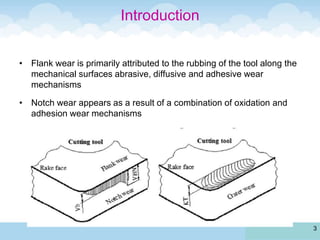
• Flank wear is primarily attributed to the rubbing of the tool along the
mechanical surfaces abrasive, diffusive and adhesive wear
mechanisms
• Notch wear appears as a result of a combination of oxidation and
adhesion wear mechanisms
3
Introduction
Problem Statement
• When Machining Tungsten transform from ductile to brittle under
various temperature condition
• At the higher temperature Oxygen, Carbon and nitrogen present in
form of oxides, carbides and nitrides at the grain boundaries.
• These impurities can alter the physical and mechanical properties of
the tungsten
4
Cryogenic Techniques
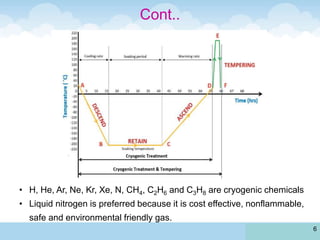
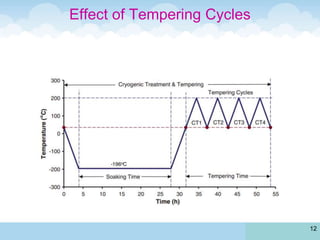
It consist of following steps
• 1st stage Cooling with cryogenic liquid from room temperature till
cryogenic temperature
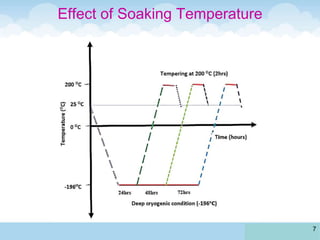
• 2nd stage Soaking for a specific time period, so properties changes
• 3rd stage slow and steady heating till room temperature.
• If there is any stresses remaining after 3rd stage then tempering is
carried out to reduce these stresses
5
6
• H, He, Ar, Ne, Kr, Xe, N, CH4, C2H6 and C3H8 are cryogenic chemicals
• Liquid nitrogen is preferred because it is cost effective, nonflammable,
safe and environmental friendly gas.
Cont..
Effect of Soaking Temperature
7
Scanning Electron Microscopy images
8
SEM images of (a) DCT-00; (b) DCT-24; (c) DCT-48; (d) DCT-72.
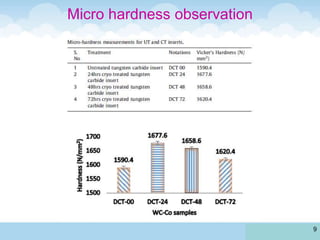
Micro hardness observation
9
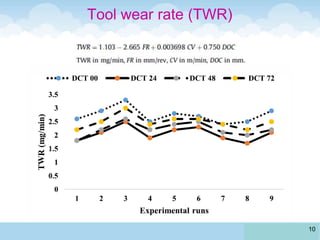
Tool wear rate (TWR)
10
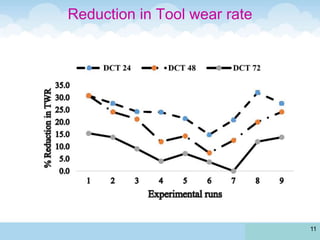
Reduction in Tool wear rate
11
Effect of Tempering Cycles
12
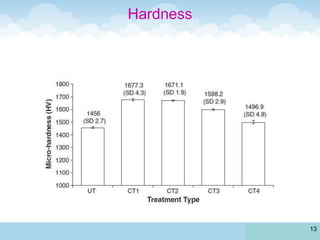
Hardness
13
Conclusion
• Cryogenic treatment improve the surface morphology
• Hardness Improved and Tool wear rate reduced at 24 hour
soaking time.
• micro-hardness decreased with an increase in the number of
tempering cycles after the treatment
• At the low cutting conditions, number of tempering cycles
influenced the performance marginally
14
15
Thanks

Cryogenic technique advance manufacturing.pptx

  • 1.
    “Enhancement of TungstenCarbide tool through Cryogenic Process” MKL
  • 2.
    • Tungsten hasmelting point temperature 3420 oC and density 19.3 Mg/m3, which make it suitable for application where high temperature strength, good thermal conductivity, Hardness and toughness required • It is used as heating element, incandescent bulbs filament, electronic emitter, kinetic energy penetrator, high temperature furnace, X-ray electrode Fusion reactor and cemented carbide tool. • Cutting tools are normally made of Tungsten Carbide Introduction 2
  • 3.
    • Flank wearis primarily attributed to the rubbing of the tool along the mechanical surfaces abrasive, diffusive and adhesive wear mechanisms • Notch wear appears as a result of a combination of oxidation and adhesion wear mechanisms 3 Introduction
  • 4.
    Problem Statement • WhenMachining Tungsten transform from ductile to brittle under various temperature condition • At the higher temperature Oxygen, Carbon and nitrogen present in form of oxides, carbides and nitrides at the grain boundaries. • These impurities can alter the physical and mechanical properties of the tungsten 4
  • 5.
    Cryogenic Techniques It consistof following steps • 1st stage Cooling with cryogenic liquid from room temperature till cryogenic temperature • 2nd stage Soaking for a specific time period, so properties changes • 3rd stage slow and steady heating till room temperature. • If there is any stresses remaining after 3rd stage then tempering is carried out to reduce these stresses 5
  • 6.
    6 • H, He,Ar, Ne, Kr, Xe, N, CH4, C2H6 and C3H8 are cryogenic chemicals • Liquid nitrogen is preferred because it is cost effective, nonflammable, safe and environmental friendly gas. Cont..
  • 7.
    Effect of SoakingTemperature 7
  • 8.
    Scanning Electron Microscopyimages 8 SEM images of (a) DCT-00; (b) DCT-24; (c) DCT-48; (d) DCT-72.
  • 9.
  • 10.
  • 11.
    Reduction in Toolwear rate 11
  • 12.
  • 13.
  • 14.
    Conclusion • Cryogenic treatmentimprove the surface morphology • Hardness Improved and Tool wear rate reduced at 24 hour soaking time. • micro-hardness decreased with an increase in the number of tempering cycles after the treatment • At the low cutting conditions, number of tempering cycles influenced the performance marginally 14
  • 15.