LILAC 2012
Glasgow, Scotland
    April 13,2012
   Mike Crumpton
    ◦ Assistant Dean for Administrative Services
    ◦ The University of North Carolina at Greensboro
    ◦ macrumpt@uncg.edu

   Nora Bird
    ◦   Assistant Professor, School of Education
    ◦   Dept. of Library and Information Studies
    ◦   The University of North Carolina at Greensboro
    ◦   njbird@uncg.edu
   Date back to 1900
   Originally called “Junior Colleges” – first two
    years to prepare students for University
   Now a mix of college preparatory, vocational
    training, and workforce re-training
   Economic focus on Community Colleges

   WILIS study of librarians in North Carolina, USA

   IMLS grant to Northern Illinois Library Consortium

   Nature of Community College Librarianship, unique

    skill set

   Diversity of staff vs. students served
                                       Project website
   Assessment
    ◦ Surveys
    ◦ Focus groups
    ◦ Field literature
   Identification of skill set(s) needed
    ◦ DACUM
    ◦ Detailed assessment
   Course design
    ◦ Temp to perm
    ◦ Professional development
    ◦ LIS course
   Evaluation
   Book to celebrate uniqueness
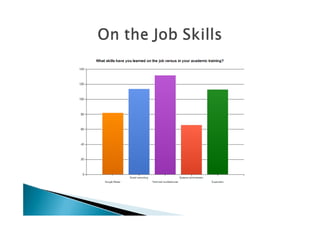
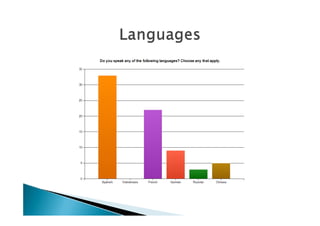
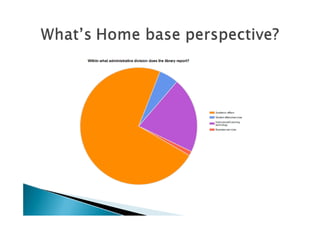
   190 respondents
   NC, SC, VA & some nationally
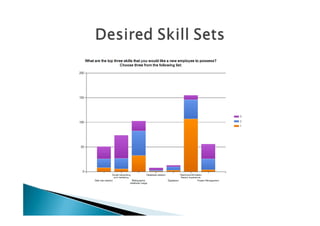
   Looked at gender, degree, coursework, skills
    learned since degree, titles
   Some demographic info
   Over 70% surveyed has middle or early
    college programs
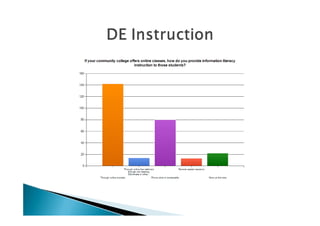
   High percentage of distance education
    support
   Others listed…………….
   Working with diverse clients/patrons
   Workforce and lifelong learning issues
   Dealing with early and middle colleges
   Small staffs and personal skills employed
   Distance education programs
   Management and administrative skills
   Adult learning and andragogy skills
   Resource specialization
   Workplace information literacy and ID
   Academic transfer preparation

   Vocational-technical education

   Developmental education

   Continuing education

   Community service
   According to many definitions, the
    information literate person “must be able to
    recognize when information is needed and
    have the ability to locate, evaluate, and use
    effectively the needed information.”
    (American Library Association, 1989)
   Challenge is: Would you define Workplace
    Information Literacy differently?
   “Information literacy landscapes: Information
    literacy in education, workplace, and everyday
    contexts”
   Her title says it all. Context is essential to the
    process. There is no universal information
    literacy.
   The focus has been on academic information
    literacy.
   Confirmed the impression that
    vocational programs are underserved
   “I don’t know many people who have
    HVAC degrees... If HVAC approached
    me to do an [IL class] I’d have to get
    familiar enough to be able to answer
    subject-specific questions. That’s a
    mammoth job.”
   “ …I think their comfort level with us.
    Yeah, they may know how to do that,
    but the ones [instructors] who come
    back all the time believe that we do a
    better job –they don’t try to do our job
    for us, just like we don’t teach English
    … I think that they see us as
    professionals in the same way that
    they are.”
“We led a session on our staff development day
 where people can choose to take our
 workshop at the library, and the information
 technology people loved it because in NC Live
 there’s a place you can go where you work on
 certain cars. The depth of the knowledge is
 for real people, it’s not just academic. Yeah, I
 think the workplace and the fact that we have
 older students could be developed.”
Re-investment of time into addressing issues
  of equity in information literacy teachings:
 Emphasis on explicit instruction

 Addressing economic, social and political
  factors
 Early student engagement

 New “conceptualizations” of reading

 IL as practice

 Insights from workplace information literacy
printed by

www.postersession.com
   Develop series of continuing education
    modules, based on research via MLIS
   Employ “Teacher-Librarian-Faculty”
    practicum for MLIS students
   Grow continuing education coursework into
    full-course development for MLIS program
   Resource developed for widespread
    distribution and support of curriculum
    content, such as a textbook
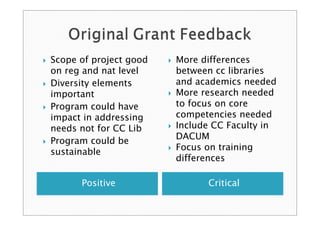
   Scope of project good      More differences
    on reg and nat level        between cc libraries
   Diversity elements          and academics needed
    important                  More research needed
   Program could have          to focus on core
    impact in addressing        competencies needed
    needs not for CC Lib       Include CC Faculty in
                                DACUM
   Program could be
                               Focus on training
    sustainable
                                differences

          Positive                    Critical
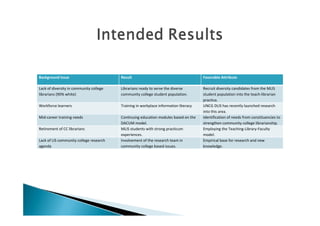
Background Issue                          Result                                       Favorable Attribute

Lack of diversity in community college    Librarians ready to serve the diverse        Recruit diversity candidates from the MLIS 
librarians (90% white)                    community college student population.        student population into the teach‐librarian 
                                                                                       practica.
Workforce learners                        Training in workplace information literacy   UNCG DLIS has recently launched research 
                                                                                       into this area.
Mid‐career training needs                 Continuing education modules based on the    Identification of needs from constituencies to 
                                          DACUM model.                                 strengthen community college librarianship.
Retirement of CC librarians               MLIS students with strong practicum          Employing the Teaching‐Library‐Faculty 
                                          experiences.                                 model. 
Lack of LIS community college research    Involvement of the research team in          Empirical base for research and new 
agenda                                    community college based issues.              knowledge. 
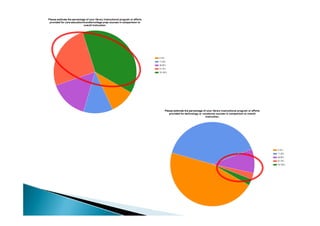
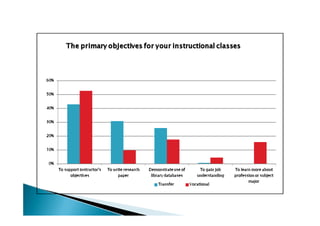
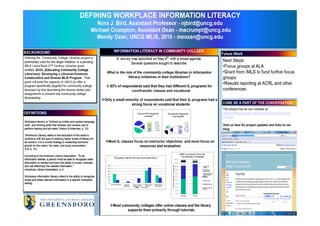
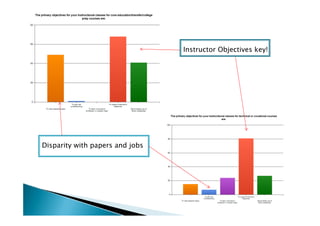
Instructor Objectives key!


Disparity with papers and jobs
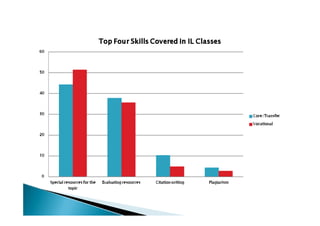
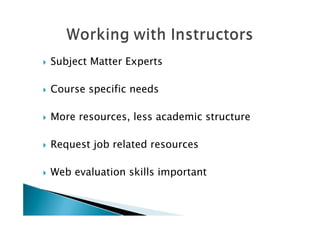
   Subject Matter Experts

   Course specific needs

   More resources, less academic structure

   Request job related resources

   Web evaluation skills important
   Addresses information literacy for continuing
    education curriculum
   Addresses diverse learning objectives and
    needs of CE students
    ◦ Andragogy
    ◦ Culture and language
    ◦ Active environments
   Instructor awareness
    ◦ Of options available
    ◦ Of need for including IL within coursework
   Research study
    ◦   Types of information in the workplace
    ◦   Information tools used in the workplace
    ◦   Activities performed by research and information
    ◦   Research skills needs
    ◦   How do graduating students measure up?

   Results recommend a more varied approach
    to information literacy instruction
   Key role of human relations in the workplace
    to foster information literacy

   Proactive consultation with agencies involved
    in skill development and training

   Provide internally benchmarks, resources and
    space dedicated to fostering IL growth
   SME = primary faculty member
   Behavioral objectives =
    ◦ Demonstrated behaviors
    ◦ Action verbs
    ◦ Expected level of achievement
   Cognitive objectives =
    ◦ General instructional objective
      (learning domain)
    ◦ Specific types of performance
   CLER
    ◦ Configurations
      relationships
    ◦ Linkages
      Org links, i.e. course
    ◦ Environment
      Physical, social and intellectual forces
    ◦ Resources
      Support mechanisms
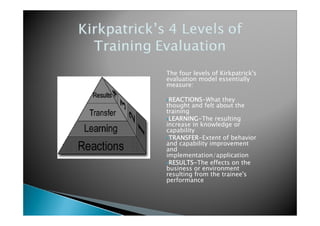
The four levels of Kirkpatrick's
evaluation model essentially
measure:

REACTIONS-What    they
thought and felt about the
training
LEARNING-The resulting
increase in knowledge or
capability
TRANSFER-Extent of behavior
and capability improvement
and
implementation/application
RESULTS-The effects on the
business or environment
resulting from the trainee's
performance
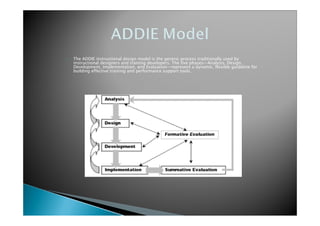
   The ADDIE instructional design model is the generic process traditionally used by
    instructional designers and training developers. The five phases—Analysis, Design,
    Development, Implementation, and Evaluation—represent a dynamic, flexible guideline for
    building effective training and performance support tools.
   Ohio State case study
    ◦ Assess course objectives
    ◦ IL goals and librarian relationships
    ◦ Instructor’s perspective
   Measured
    ◦ Instructor satisfaction with student work
    ◦ Compared library instruction for outcomes
    ◦ Opportunity for supportive instruction
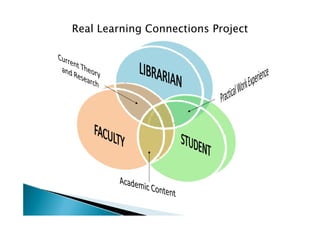
Real Learning Connections Project
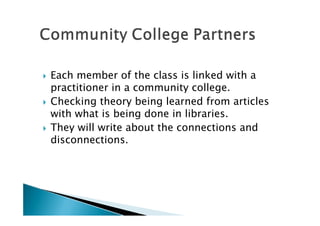
   Each member of the class is linked with a
    practitioner in a community college.
   Checking theory being learned from articles
    with what is being done in libraries.
   They will write about the connections and
    disconnections.
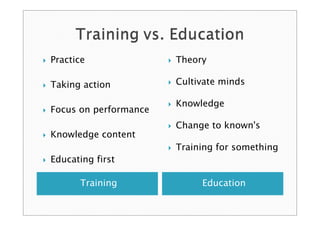
   Practice                  Theory

   Taking action             Cultivate minds

                              Knowledge
   Focus on performance
                              Change to known's
   Knowledge content
                              Training for something
   Educating first

          Training                  Education
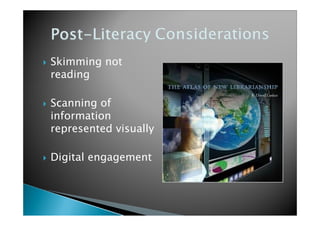
   Skimming not
    reading

   Scanning of
    information
    represented visually

   Digital engagement
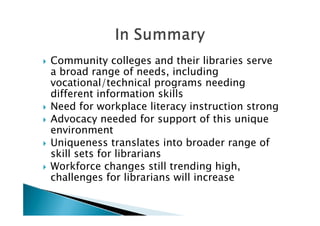
   Community colleges and their libraries serve
    a broad range of needs, including
    vocational/technical programs needing
    different information skills
   Need for workplace literacy instruction strong
   Advocacy needed for support of this unique
    environment
   Uniqueness translates into broader range of
    skill sets for librarians
   Workforce changes still trending high,
    challenges for librarians will increase
   Bird, Nora J., Michael A. Crumpton, Melynda Ozan, and Tim Williams. "Workplace Information Literacy: a
    Neglected Priority." Journal of Business & Finance Librarianship 17.1 (2012): 18-33.
   Dowell, D. (2006). Introduction. In D. Dowell (Ed.) It’s all about student learning: Managing community
    and other college libraries in the 21st century. Westport, CT: Libraries Unlimited.
   Karp, R. (2006). Leadership issues for community college librarians. In D. Dowell (Ed.) It’s all about
    student learning: Managing community and other college libraries in the 21st century. Westport, CT:
    Libraries Unlimited.
   Kirkpatrick, Donald L. Evaluating Training Programs. New York, NY: Berrett-Koehler, 1994.
   Lloyd, A. (2010). Information literacy landscapes: Information literacy in education, workplace, and
    everyday contexts. Oxford, UK: Chandos Publishing.
   Lloyd, A. and Williamson, K. (2008). Towards an understanding of information literacy in context:
    Implications for research. Journal of Librarianship and Information Science, 40(1), 3-12.
   Marshall, J. G., Marshall, V. W., Morgan, J. C., Barreau, D., Moran, B. B., Solomon, P., et al. (2005).
    Workforce issues in library and information science (WILIS). UNC Institute on Aging and UNC School of
    Information and Library Science: Institute of Museum and Library Services.
   O'Hanlon, Nancy. "Information Literacy in the University Curriculum: Challenges for Outcomes
    Assessment." Libraries and the Academy 7.2 (2007): 169-189. Web. 2 Feb. 2012.
   Patterson, David. "Information Literacy and Community Colleges Students: Using New Approaches to
    Literacy Theory to Produce Equity." Library Quarterly 79.3 (2009): 343-361.
   Provasnik, S. and Planty, M. (2008). Community Colleges: Special Supplement to The Condition of
    Education. Statistical Analysis Report. Washington, DC: National Center for Education Statistics.
   Warren, Leslie A. "Information Literacy in Community Colleges." Reference & User Services Quarterly
    45.4 (2006): 297-303.

Crumpton - Teaching workplace information literacy in the community colleges

  • 1.
  • 2.
    Mike Crumpton ◦ Assistant Dean for Administrative Services ◦ The University of North Carolina at Greensboro ◦ macrumpt@uncg.edu  Nora Bird ◦ Assistant Professor, School of Education ◦ Dept. of Library and Information Studies ◦ The University of North Carolina at Greensboro ◦ njbird@uncg.edu
  • 3.
    Date back to 1900  Originally called “Junior Colleges” – first two years to prepare students for University  Now a mix of college preparatory, vocational training, and workforce re-training
  • 4.
    Economic focus on Community Colleges  WILIS study of librarians in North Carolina, USA  IMLS grant to Northern Illinois Library Consortium  Nature of Community College Librarianship, unique skill set  Diversity of staff vs. students served Project website
  • 6.
    Assessment ◦ Surveys ◦ Focus groups ◦ Field literature  Identification of skill set(s) needed ◦ DACUM ◦ Detailed assessment  Course design ◦ Temp to perm ◦ Professional development ◦ LIS course  Evaluation  Book to celebrate uniqueness
  • 7.
    190 respondents  NC, SC, VA & some nationally  Looked at gender, degree, coursework, skills learned since degree, titles  Some demographic info  Over 70% surveyed has middle or early college programs  High percentage of distance education support  Others listed…………….
  • 13.
    Working with diverse clients/patrons  Workforce and lifelong learning issues  Dealing with early and middle colleges  Small staffs and personal skills employed  Distance education programs  Management and administrative skills  Adult learning and andragogy skills  Resource specialization  Workplace information literacy and ID
  • 14.
    Academic transfer preparation  Vocational-technical education  Developmental education  Continuing education  Community service
  • 15.
    According to many definitions, the information literate person “must be able to recognize when information is needed and have the ability to locate, evaluate, and use effectively the needed information.” (American Library Association, 1989)  Challenge is: Would you define Workplace Information Literacy differently?
  • 17.
    “Information literacy landscapes: Information literacy in education, workplace, and everyday contexts”  Her title says it all. Context is essential to the process. There is no universal information literacy.  The focus has been on academic information literacy.
  • 20.
    Confirmed the impression that vocational programs are underserved  “I don’t know many people who have HVAC degrees... If HVAC approached me to do an [IL class] I’d have to get familiar enough to be able to answer subject-specific questions. That’s a mammoth job.”
  • 21.
    “ …I think their comfort level with us. Yeah, they may know how to do that, but the ones [instructors] who come back all the time believe that we do a better job –they don’t try to do our job for us, just like we don’t teach English … I think that they see us as professionals in the same way that they are.”
  • 22.
    “We led asession on our staff development day where people can choose to take our workshop at the library, and the information technology people loved it because in NC Live there’s a place you can go where you work on certain cars. The depth of the knowledge is for real people, it’s not just academic. Yeah, I think the workplace and the fact that we have older students could be developed.”
  • 23.
    Re-investment of timeinto addressing issues of equity in information literacy teachings:  Emphasis on explicit instruction  Addressing economic, social and political factors  Early student engagement  New “conceptualizations” of reading  IL as practice  Insights from workplace information literacy
  • 24.
  • 25.
    Develop series of continuing education modules, based on research via MLIS  Employ “Teacher-Librarian-Faculty” practicum for MLIS students  Grow continuing education coursework into full-course development for MLIS program  Resource developed for widespread distribution and support of curriculum content, such as a textbook
  • 26.
    Scope of project good  More differences on reg and nat level between cc libraries  Diversity elements and academics needed important  More research needed  Program could have to focus on core impact in addressing competencies needed needs not for CC Lib  Include CC Faculty in DACUM  Program could be  Focus on training sustainable differences Positive Critical
  • 27.
    Background Issue Result Favorable Attribute Lack of diversity in community college  Librarians ready to serve the diverse  Recruit diversity candidates from the MLIS  librarians (90% white) community college student population.  student population into the teach‐librarian  practica. Workforce learners Training in workplace information literacy UNCG DLIS has recently launched research  into this area. Mid‐career training needs Continuing education modules based on the  Identification of needs from constituencies to  DACUM model.  strengthen community college librarianship. Retirement of CC librarians MLIS students with strong practicum  Employing the Teaching‐Library‐Faculty  experiences.  model.  Lack of LIS community college research  Involvement of the research team in  Empirical base for research and new  agenda community college based issues. knowledge. 
  • 28.
  • 29.
    Subject Matter Experts  Course specific needs  More resources, less academic structure  Request job related resources  Web evaluation skills important
  • 30.
    Addresses information literacy for continuing education curriculum  Addresses diverse learning objectives and needs of CE students ◦ Andragogy ◦ Culture and language ◦ Active environments  Instructor awareness ◦ Of options available ◦ Of need for including IL within coursework
  • 31.
    Research study ◦ Types of information in the workplace ◦ Information tools used in the workplace ◦ Activities performed by research and information ◦ Research skills needs ◦ How do graduating students measure up?  Results recommend a more varied approach to information literacy instruction
  • 32.
    Key role of human relations in the workplace to foster information literacy  Proactive consultation with agencies involved in skill development and training  Provide internally benchmarks, resources and space dedicated to fostering IL growth
  • 33.
    SME = primary faculty member  Behavioral objectives = ◦ Demonstrated behaviors ◦ Action verbs ◦ Expected level of achievement  Cognitive objectives = ◦ General instructional objective (learning domain) ◦ Specific types of performance
  • 34.
    CLER ◦ Configurations  relationships ◦ Linkages  Org links, i.e. course ◦ Environment  Physical, social and intellectual forces ◦ Resources  Support mechanisms
  • 35.
    The four levelsof Kirkpatrick's evaluation model essentially measure: REACTIONS-What they thought and felt about the training LEARNING-The resulting increase in knowledge or capability TRANSFER-Extent of behavior and capability improvement and implementation/application RESULTS-The effects on the business or environment resulting from the trainee's performance
  • 36.
    The ADDIE instructional design model is the generic process traditionally used by instructional designers and training developers. The five phases—Analysis, Design, Development, Implementation, and Evaluation—represent a dynamic, flexible guideline for building effective training and performance support tools.
  • 37.
    Ohio State case study ◦ Assess course objectives ◦ IL goals and librarian relationships ◦ Instructor’s perspective  Measured ◦ Instructor satisfaction with student work ◦ Compared library instruction for outcomes ◦ Opportunity for supportive instruction
  • 38.
  • 39.
    Each member of the class is linked with a practitioner in a community college.  Checking theory being learned from articles with what is being done in libraries.  They will write about the connections and disconnections.
  • 40.
    Practice  Theory  Taking action  Cultivate minds  Knowledge  Focus on performance  Change to known's  Knowledge content  Training for something  Educating first Training Education
  • 41.
    Skimming not reading  Scanning of information represented visually  Digital engagement
  • 42.
    Community colleges and their libraries serve a broad range of needs, including vocational/technical programs needing different information skills  Need for workplace literacy instruction strong  Advocacy needed for support of this unique environment  Uniqueness translates into broader range of skill sets for librarians  Workforce changes still trending high, challenges for librarians will increase
  • 43.
    Bird, Nora J., Michael A. Crumpton, Melynda Ozan, and Tim Williams. "Workplace Information Literacy: a Neglected Priority." Journal of Business & Finance Librarianship 17.1 (2012): 18-33.  Dowell, D. (2006). Introduction. In D. Dowell (Ed.) It’s all about student learning: Managing community and other college libraries in the 21st century. Westport, CT: Libraries Unlimited.  Karp, R. (2006). Leadership issues for community college librarians. In D. Dowell (Ed.) It’s all about student learning: Managing community and other college libraries in the 21st century. Westport, CT: Libraries Unlimited.  Kirkpatrick, Donald L. Evaluating Training Programs. New York, NY: Berrett-Koehler, 1994.  Lloyd, A. (2010). Information literacy landscapes: Information literacy in education, workplace, and everyday contexts. Oxford, UK: Chandos Publishing.  Lloyd, A. and Williamson, K. (2008). Towards an understanding of information literacy in context: Implications for research. Journal of Librarianship and Information Science, 40(1), 3-12.  Marshall, J. G., Marshall, V. W., Morgan, J. C., Barreau, D., Moran, B. B., Solomon, P., et al. (2005). Workforce issues in library and information science (WILIS). UNC Institute on Aging and UNC School of Information and Library Science: Institute of Museum and Library Services.  O'Hanlon, Nancy. "Information Literacy in the University Curriculum: Challenges for Outcomes Assessment." Libraries and the Academy 7.2 (2007): 169-189. Web. 2 Feb. 2012.  Patterson, David. "Information Literacy and Community Colleges Students: Using New Approaches to Literacy Theory to Produce Equity." Library Quarterly 79.3 (2009): 343-361.  Provasnik, S. and Planty, M. (2008). Community Colleges: Special Supplement to The Condition of Education. Statistical Analysis Report. Washington, DC: National Center for Education Statistics.  Warren, Leslie A. "Information Literacy in Community Colleges." Reference & User Services Quarterly 45.4 (2006): 297-303.