BACKGROUND INFORMATION
                                 CROSS SECTOR PARTNERSHIPS
                            Developed by Origo Social Enterprise Partners


    •   What are cross sector/ multi-stakeholder partnerships?

Stakeholder refers to persons and/or groups of people that affect, or are affected by, an
                                                     1
organization’s decisions, policies, and operations . Consequently, the word stake, in this context,
means an interest- or claim on a business enterprise. Those with a stake in the firm’s actions
include such diverse groups as customers, employees, stockholders, the media, governments,
multilateral organizations, professional and trade associations, social and environmental activists,
and non-governmental organizations.

Business organizations are embedded in networks involving many stakeholders. Each of these
has a relationship with the firm, based on ongoing interactions. Each of them shares, to some
degree, in both the risks and rewards of the firms’ activities. And each has some kind of claim on
the firm’s resources and attention, based on law, moral right or both. The number of stakeholders
and the variety of their interests can be diverse, making a company’s decisions very complex.


Not surprisingly, business and stakeholder interests often coincide. When their interests are
similar, stakeholder and companies may form coalitions, that is, alliances to pursue a common
interest. These strategic alliances or coalitions among companies and their stakeholders are
often referred as partnerships.


Some useful working definitions of cross sector / multi-stakeholder partnerships are:

    •   A partnership is an alliance between organizations from two or more sectors that commit
        themselves to working together to develop and implement a specific project. Such a
        partnership implies that participants are willing to share risks, costs and benefits, review
        the relationship regularly and revise the partnership as necessary.

    •   Alliances between parties drawn for example, from businesses, government and civil
        society, that strategically aggregate the resources and competencies of each to resolve a
        specific problem/challenge.


1
 The term stakeholder was introduced in 1963 but was not used in the management literature until the
publication of R. Freeman’s, Strategic Management: A Stakeholder Approach (Marshfield, MA: Pitman,
1984)


                                                    1
•   Partnerships across different sectors of society imply transcending some of the divides
        between business/NGOs/governments. Interest from many governments and NGOs in
        working with business is quite high so the partnership model has been replacing the
        adversarial model.


    •   Partnering across sectors means that different sectors of society are open to
        communicate and collaborate with each other, fostering and creating more inclusive-
        participatory models for solving problems.

    •   A management tool to deliver business, social and environmental development outcomes
        by optimizing the effectiveness of different partners’ resources core competencies.


Considering the above definitions, multi-stakeholder partnerships are partnerships that could
engage two or more parties from various sectors of society such as: businesses, governments,
multilateral institutions, Non governmental organizations, civil society.


It is important to bear in mind that partnerships are about sharing not shifting risks and they
should aim to find innovative ways to pool resources and talents based on each parties’ core
strengths. They ought to be designed and maintained over time in such a way as to deliver
mutual benefits for all collaborating parties.


Another point to consider is that multi-stakeholder partnerships are not static. Groups that are
highly involved with a company today may be less involved tomorrow. Controversial issues that
that are highly important at one time may be replaced by others; stakeholders that who are most
dependant on an organization at one time may be less so at another. In addition, interests and
priorities in companies can change over time so the nature and objectives of partnerships change
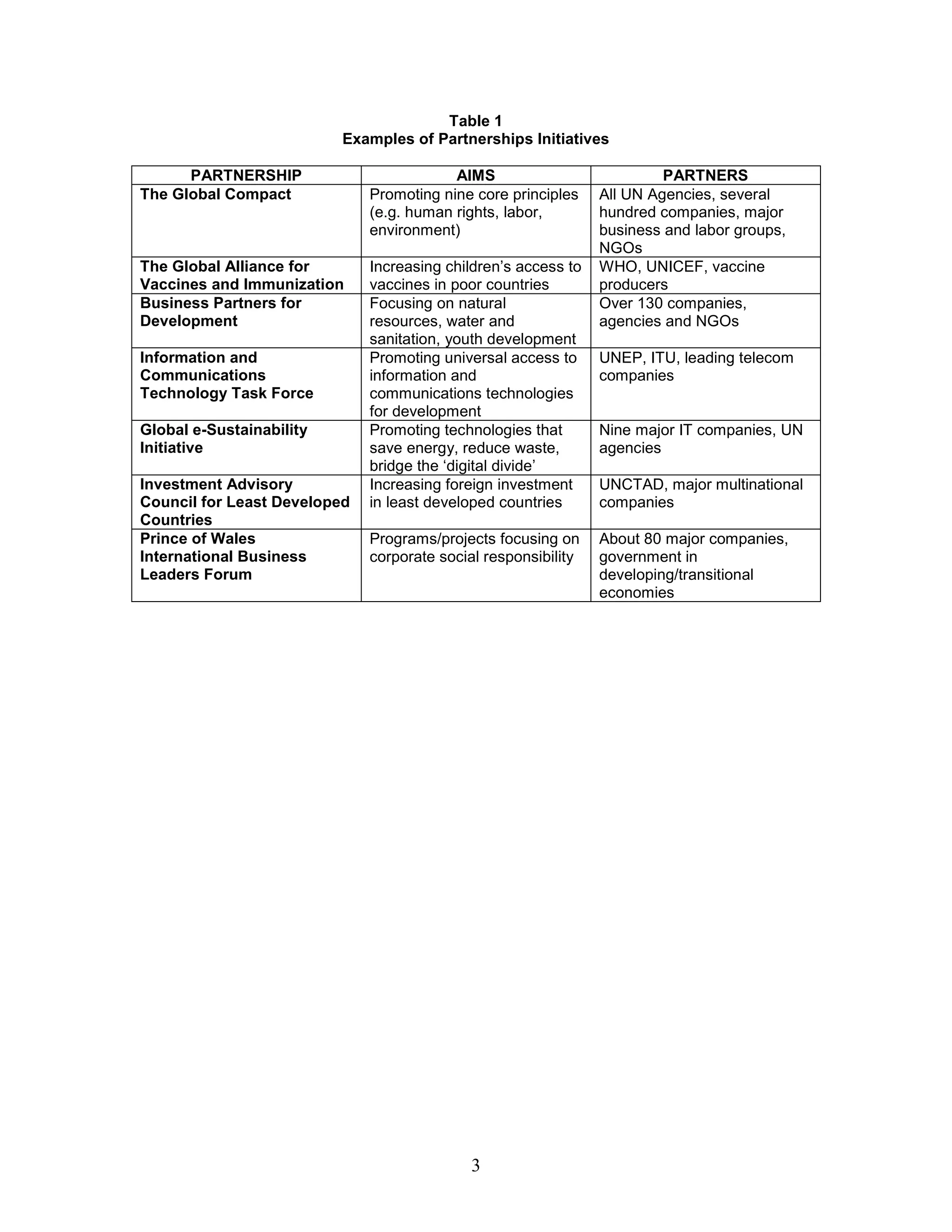
as well. Some examples of partnerships nowadays are presented in Table 1.


                                                  2
Table 1
                          Examples of Partnerships Initiatives

      PARTNERSHIP                         AIMS                           PARTNERS
The Global Compact            Promoting nine core principles    All UN Agencies, several
                              (e.g. human rights, labor,        hundred companies, major
                              environment)                      business and labor groups,
                                                                NGOs
The Global Alliance for       Increasing children’s access to   WHO, UNICEF, vaccine
Vaccines and Immunization     vaccines in poor countries        producers
Business Partners for         Focusing on natural               Over 130 companies,
Development                   resources, water and              agencies and NGOs
                              sanitation, youth development
Information and               Promoting universal access to     UNEP, ITU, leading telecom
Communications                information and                   companies
Technology Task Force         communications technologies
                              for development
Global e-Sustainability       Promoting technologies that       Nine major IT companies, UN
Initiative                    save energy, reduce waste,        agencies
                              bridge the ‘digital divide’
Investment Advisory           Increasing foreign investment     UNCTAD, major multinational
Council for Least Developed   in least developed countries      companies
Countries
Prince of Wales               Programs/projects focusing on     About 80 major companies,
International Business        corporate social responsibility   government in
Leaders Forum                                                   developing/transitional
                                                                economies


                                             3
•    Actors: Their roles and attributes

As explained above, cross sector/ multi-stakeholder partnerships can involve two or more sectors
of society. Nevertheless for the purposes, of this section let’s consider that society has broadly
three sectors: the public sector, business and civil society. Each has different constituents and
some examples are presented in Table 2.


                                           Table 2
                         The Sectors of Society and their Constituents

                     Sector                                    Examples of Constituents
                                                         •   International multilateral agencies
Public                                                   •   National and local government
                                                         •   Public Sector Services
                                                         •   Quasi-autonomous non-governmental
                                                             organizations
                                                         •   Educational/academic institutions *
                                                         •   Multinational companies
Business                                                 •   Business associations
                                                         •   Enterprise development agencies
                                                         •   Social enterprises
                                                         •   Financial institutions
                                                         •   National Companies
                                                         •   Joint stock companies

                                                         •   Campaign groups
Civil Society                                            •   Community-based organizations
                                                         •   Donor agencies
                                                         •   Labor organizations
                                                         •   Non-governmental organizations
                                                         •   Private voluntary organizations
                                                         •   Religious institutions

* May have a place in all three sectors

It is always hard to make generalizations on the roles and characteristics of these sectors of
society, but it is useful to consider that each of these sectors has a relevant and different role to
play in cross sector partnerships. These roles are not stable and more than anything they involve
complex and changing relationships. Each actor brings to the table various goals, interests and
ways of perceiving the world, its problems and feasible solutions.


It is also becoming clear that when these sectors ally to form partnerships each of them brings to
the collaboration effort different but complementary skills, experiences and attributes. Table 3
indicates some of the key roles and attributes of each of these sectors of society.


                                                   4
Table 3
           Key Roles and Attributes of the three Major Sectors in Society
 Sector            Key Roles                   Attributes        Potential resources to
                                                                       be offered
               •   Promotes economic                                     •   Access to
                   development                     •   Rights driven-        information
               •   Encourages social                   provides          •   Skilled staff with a
 Public            improvements                        information,          public interest
               •   Develop and implement               stability and         focus
                   programs and strategies             legitimacy        •   Surplus
                   to raise revenues                                         accommodation
                   through taxes                                             and transport
               •   Creates the framework                                     capacity
                   for economic, political                               •   Authority to
                   and social rights                                         mobilize
               •   Provides regulations and                                  resources from
                   standard-setting                                          other public
                   mechanisms, as well as                                    sources
                   adherence to
                   international obligations
               •   Creates goods and                                     •   Management and
                   services                        •   Profits driven-       technical skills
               •   Creates value by                    is inventive,     •   Equipment
Business           increasing revenues,                high capacity     •   Dissemination and
                   lowering operational                to generate           distribution
                   costs, and improving                human and             capacity
                   productivity                        monetary          •   Contacts and
               •   Maximizes profits for               resources,            spheres of
                   investors                           can operate           influence
               •   Provides employment                 fast and          •   Human and
                   opportunities, innovation           efficiently           monetary
                   and economic growth                                       resources
               •   Helps to build and
                   strengthen new markets,
                   tapping into new
                   revenue streams
               •   Creates opportunities for                             •   On the ground
                   individual and                  •   Values driven-        know-how
                   community growth                    is responsive,    •   Development of
               •   Provides support and                inclusive and         experience and
                   services for those in               imaginative           knowledge
 Civil
                   need or excluded from                                 •   People skills
Society
                   mainstream society                                    •   Imaginative, low-
               •   Protects social values                                    cost responses to
               •   Ensures that the local                                    challenges
                   environment is protected
               •   Ensures that the local
                   area is developed
               •   Monitors business
                   actions and policies to
                   ensure that they
                   conform with legal and
                   ethical standards, and
                   that they protect
                   people’s safety
               •   Contributes to the
                   achievement of
                   prosperity for society


                                               5
Document based on the following bibliography:

Hutchinson, J. (1994) “The Practice of Partnerships in Local Economy Development”, Local
Government Studies 20: 335-44.

Lawrence A.T., Webber J. and Post J.E. (2004), “Business and Society: Stakeholders, Ethics,
Public Policy”, McGraw-Hill Irwin , N.Y.

Macintosh, M. (1992) “Partnership: Issues of Policy and Negotiation”, Local Economy 7.3: 210-
224

Overseas Development Institute (ODI) and Foundation for Development Cooperation (FDC)
(2003), “Multi-Stakeholder Partnerships Issue Paper”, Global Knowledge Secretariat (GKP),
Kuala Lumpur, Malaysia.

Tennyson, R. and Wilde, L. (2000) “The Guiding Hand. Brokering Partnerships for Sustainable
Development”, The Prince of Wales Business Leaders Forum and The United Nations Staff
College, U.S.A.

Stewart, M. and Snape (1996) Keeping out the Momentum: Partnership Working in Bristol and
the West (unpublished study for the Bristol Chamber of Commerce and Initiative; Bristol, UK:
School of Policy Studies, University of Bristol)

Weir A. (2000), “Meeting Social and Environmental Objectives through Partnership. The
Experience of Unilever” in Bendell (ed.), Terms for Endearment. Business, NGOs and
Sustainable Development, Greenleaf Publishing, Sheffied U.K.

World Business Council for Sustainable Development (WBCSD) (2003), Doing Business with the
Poor a Field-Guide, WBCSD, Geneva, Switzerland.


                                               6

Cross sector partnerships

  • 1.
    BACKGROUND INFORMATION CROSS SECTOR PARTNERSHIPS Developed by Origo Social Enterprise Partners • What are cross sector/ multi-stakeholder partnerships? Stakeholder refers to persons and/or groups of people that affect, or are affected by, an 1 organization’s decisions, policies, and operations . Consequently, the word stake, in this context, means an interest- or claim on a business enterprise. Those with a stake in the firm’s actions include such diverse groups as customers, employees, stockholders, the media, governments, multilateral organizations, professional and trade associations, social and environmental activists, and non-governmental organizations. Business organizations are embedded in networks involving many stakeholders. Each of these has a relationship with the firm, based on ongoing interactions. Each of them shares, to some degree, in both the risks and rewards of the firms’ activities. And each has some kind of claim on the firm’s resources and attention, based on law, moral right or both. The number of stakeholders and the variety of their interests can be diverse, making a company’s decisions very complex. Not surprisingly, business and stakeholder interests often coincide. When their interests are similar, stakeholder and companies may form coalitions, that is, alliances to pursue a common interest. These strategic alliances or coalitions among companies and their stakeholders are often referred as partnerships. Some useful working definitions of cross sector / multi-stakeholder partnerships are: • A partnership is an alliance between organizations from two or more sectors that commit themselves to working together to develop and implement a specific project. Such a partnership implies that participants are willing to share risks, costs and benefits, review the relationship regularly and revise the partnership as necessary. • Alliances between parties drawn for example, from businesses, government and civil society, that strategically aggregate the resources and competencies of each to resolve a specific problem/challenge. 1 The term stakeholder was introduced in 1963 but was not used in the management literature until the publication of R. Freeman’s, Strategic Management: A Stakeholder Approach (Marshfield, MA: Pitman, 1984) 1
  • 2.
    Partnerships across different sectors of society imply transcending some of the divides between business/NGOs/governments. Interest from many governments and NGOs in working with business is quite high so the partnership model has been replacing the adversarial model. • Partnering across sectors means that different sectors of society are open to communicate and collaborate with each other, fostering and creating more inclusive- participatory models for solving problems. • A management tool to deliver business, social and environmental development outcomes by optimizing the effectiveness of different partners’ resources core competencies. Considering the above definitions, multi-stakeholder partnerships are partnerships that could engage two or more parties from various sectors of society such as: businesses, governments, multilateral institutions, Non governmental organizations, civil society. It is important to bear in mind that partnerships are about sharing not shifting risks and they should aim to find innovative ways to pool resources and talents based on each parties’ core strengths. They ought to be designed and maintained over time in such a way as to deliver mutual benefits for all collaborating parties. Another point to consider is that multi-stakeholder partnerships are not static. Groups that are highly involved with a company today may be less involved tomorrow. Controversial issues that that are highly important at one time may be replaced by others; stakeholders that who are most dependant on an organization at one time may be less so at another. In addition, interests and priorities in companies can change over time so the nature and objectives of partnerships change as well. Some examples of partnerships nowadays are presented in Table 1. 2
  • 3.
    Table 1 Examples of Partnerships Initiatives PARTNERSHIP AIMS PARTNERS The Global Compact Promoting nine core principles All UN Agencies, several (e.g. human rights, labor, hundred companies, major environment) business and labor groups, NGOs The Global Alliance for Increasing children’s access to WHO, UNICEF, vaccine Vaccines and Immunization vaccines in poor countries producers Business Partners for Focusing on natural Over 130 companies, Development resources, water and agencies and NGOs sanitation, youth development Information and Promoting universal access to UNEP, ITU, leading telecom Communications information and companies Technology Task Force communications technologies for development Global e-Sustainability Promoting technologies that Nine major IT companies, UN Initiative save energy, reduce waste, agencies bridge the ‘digital divide’ Investment Advisory Increasing foreign investment UNCTAD, major multinational Council for Least Developed in least developed countries companies Countries Prince of Wales Programs/projects focusing on About 80 major companies, International Business corporate social responsibility government in Leaders Forum developing/transitional economies 3
  • 4.
    Actors: Their roles and attributes As explained above, cross sector/ multi-stakeholder partnerships can involve two or more sectors of society. Nevertheless for the purposes, of this section let’s consider that society has broadly three sectors: the public sector, business and civil society. Each has different constituents and some examples are presented in Table 2. Table 2 The Sectors of Society and their Constituents Sector Examples of Constituents • International multilateral agencies Public • National and local government • Public Sector Services • Quasi-autonomous non-governmental organizations • Educational/academic institutions * • Multinational companies Business • Business associations • Enterprise development agencies • Social enterprises • Financial institutions • National Companies • Joint stock companies • Campaign groups Civil Society • Community-based organizations • Donor agencies • Labor organizations • Non-governmental organizations • Private voluntary organizations • Religious institutions * May have a place in all three sectors It is always hard to make generalizations on the roles and characteristics of these sectors of society, but it is useful to consider that each of these sectors has a relevant and different role to play in cross sector partnerships. These roles are not stable and more than anything they involve complex and changing relationships. Each actor brings to the table various goals, interests and ways of perceiving the world, its problems and feasible solutions. It is also becoming clear that when these sectors ally to form partnerships each of them brings to the collaboration effort different but complementary skills, experiences and attributes. Table 3 indicates some of the key roles and attributes of each of these sectors of society. 4
  • 5.
    Table 3 Key Roles and Attributes of the three Major Sectors in Society Sector Key Roles Attributes Potential resources to be offered • Promotes economic • Access to development • Rights driven- information • Encourages social provides • Skilled staff with a Public improvements information, public interest • Develop and implement stability and focus programs and strategies legitimacy • Surplus to raise revenues accommodation through taxes and transport • Creates the framework capacity for economic, political • Authority to and social rights mobilize • Provides regulations and resources from standard-setting other public mechanisms, as well as sources adherence to international obligations • Creates goods and • Management and services • Profits driven- technical skills • Creates value by is inventive, • Equipment Business increasing revenues, high capacity • Dissemination and lowering operational to generate distribution costs, and improving human and capacity productivity monetary • Contacts and • Maximizes profits for resources, spheres of investors can operate influence • Provides employment fast and • Human and opportunities, innovation efficiently monetary and economic growth resources • Helps to build and strengthen new markets, tapping into new revenue streams • Creates opportunities for • On the ground individual and • Values driven- know-how community growth is responsive, • Development of • Provides support and inclusive and experience and services for those in imaginative knowledge Civil need or excluded from • People skills Society mainstream society • Imaginative, low- • Protects social values cost responses to • Ensures that the local challenges environment is protected • Ensures that the local area is developed • Monitors business actions and policies to ensure that they conform with legal and ethical standards, and that they protect people’s safety • Contributes to the achievement of prosperity for society 5
  • 6.
    Document based onthe following bibliography: Hutchinson, J. (1994) “The Practice of Partnerships in Local Economy Development”, Local Government Studies 20: 335-44. Lawrence A.T., Webber J. and Post J.E. (2004), “Business and Society: Stakeholders, Ethics, Public Policy”, McGraw-Hill Irwin , N.Y. Macintosh, M. (1992) “Partnership: Issues of Policy and Negotiation”, Local Economy 7.3: 210- 224 Overseas Development Institute (ODI) and Foundation for Development Cooperation (FDC) (2003), “Multi-Stakeholder Partnerships Issue Paper”, Global Knowledge Secretariat (GKP), Kuala Lumpur, Malaysia. Tennyson, R. and Wilde, L. (2000) “The Guiding Hand. Brokering Partnerships for Sustainable Development”, The Prince of Wales Business Leaders Forum and The United Nations Staff College, U.S.A. Stewart, M. and Snape (1996) Keeping out the Momentum: Partnership Working in Bristol and the West (unpublished study for the Bristol Chamber of Commerce and Initiative; Bristol, UK: School of Policy Studies, University of Bristol) Weir A. (2000), “Meeting Social and Environmental Objectives through Partnership. The Experience of Unilever” in Bendell (ed.), Terms for Endearment. Business, NGOs and Sustainable Development, Greenleaf Publishing, Sheffied U.K. World Business Council for Sustainable Development (WBCSD) (2003), Doing Business with the Poor a Field-Guide, WBCSD, Geneva, Switzerland. 6