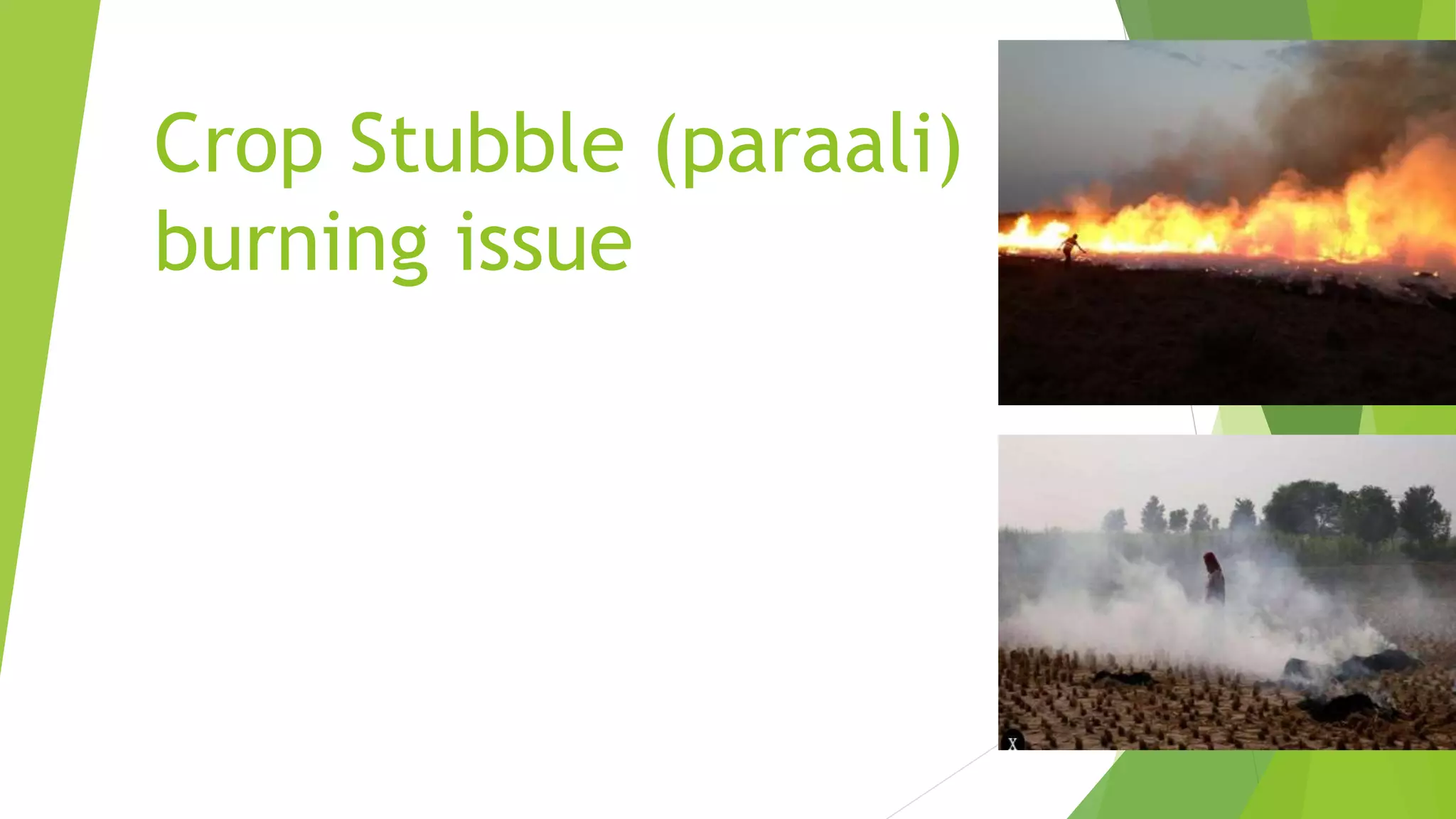
Crop Stubble (paraali)
burning issue
Introduction
 Stubble; usually pronounced as stubbles..
 The stump of grain or other stalks left in ground when
crop is cut.
 paraali; Paddy stubble is locally called ‘paraali’ in
Punjab.
What is stubble (paraali) burning ?
 Stubble (paraali) burning is the act of setting
fire to crop residue to remove them from the
field to sow the next crop.
 In order to plant next winter crop (Rabi
crop), farmers in Haryana and Punjab have to
move in a very short interval and if they are
late, due to short winters these days, they
might face considerable losses. Therefore,
burning is the cheapest and fastest way to
get rid of the stubble.
 If paraali is left in the field, pests like termites
may attack the upcoming crop.
 The precarious economic condition of farmers
doesn’t allow them to use expensive
mechanised methods to remove stubble.
Scale of Burning
 Punjab produces approximately 19-20 million tonnes of paddy straw and
about 20 million tonnes of wheat straw.
 In Haryana, the problem of paddy straw burning also exists, although the
scale is smaller than in Punjab. Paddy straw production is estimated at 2
million tonnes.
 The kharif harvesting season begins in October.
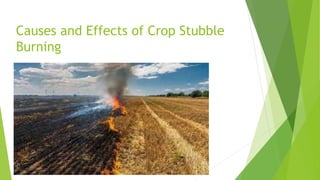
Causes and Effects of Crop Stubble
Burning
Causes of the Stubble Burning
Technology: The problem arises due to the use of mechanized harvesting which leaves
several inches of stubble in the fields.
Earlier, this excess crop was used by farmers for cooking, as hay to keep their animals
warm or even as extra insulation for homes.
But, now the stubble use for such purposes has become outdated.
Adverse Impact of Laws: Implementation of the Punjab Preservation of Subsoil Water
Act (2009) made the time period of stubble burning coincident with the onset of winter
in Northern India.
Late transplanting of paddy during Kharif season to prevent water loss as directed by
PPSW Act (2009) had left farmers with little time between harvesting and preparing the
field for the next crop and hence farmers are resorting to the burning of stubble.
High Silica Content: Rice straw is considered useless as fodder in the case of non-
basmati rice, because of its high silica content.
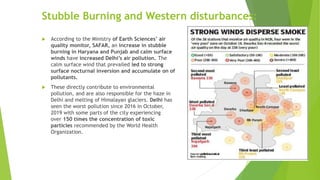
Stubble Burning and Western disturbances:
 According to the Ministry of Earth Sciences’ air
quality monitor, SAFAR, an increase in stubble
burning in Haryana and Punjab and calm surface
winds have increased Delhi’s air pollution. The
calm surface wind that prevailed led to strong
surface nocturnal inversion and accumulate on of
pollutants.
 These directly contribute to environmental
pollution, and are also responsible for the haze in
Delhi and melting of Himalayan glaciers. Delhi has
seen the worst pollution since 2016 in October,
2019 with some parts of the city experiencing
over 150 times the concentration of toxic
particles recommended by the World Health
Organization.
Effects of Stubble Burning
 Pollution: Open stubble burning emits large amounts of toxic
pollutants in the atmosphere which contain harmful gases
like methane (CH4), Carbon Monoxide (CO), Volatile
organic compound (VOC) and carcinogenic polycyclic
aromatic hydrocarbons.
 A study estimates that crop residue burning released 149.24
million tonnes of carbon dioxide (CO2), over 9 million tonnes
of carbon monoxide (CO), 0.25 million tonnes of oxides of
sulphur (SOX), 1.28 million tonnes of particulate matter and
0.07 million tonnes of black carbon.
 After the release in the atmosphere, these pollutants
disperse in the surroundings, may undergo a physical and
chemical transformation and eventually adversely affect
human health by causing a thick blanket of smog.
 Soil Fertility: Burning husk on ground destroys the nutrients
in the soil, making it less fertile.
 Heat Penetration: Heat generated by stubble burning
penetrates into the soil, leading to the loss of moisture and
useful microbes.
 Stubble burning makes both the soil and air
poisonous. Microorganisms present in the upper layer of the
soil as well as its organic quality gets affected. Due to
the loss of ‘friendly’ pests, the wrath of ‘enemy’ pests has
increased and as a result, crops are more prone to disease.
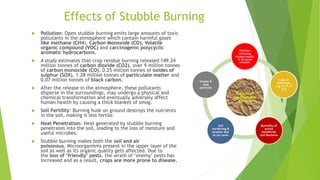
Impacts of
Crop Residue
Burning
Pollution
(Affecting
Human health)
& GH gases
emission
Loss of
Nutrients
e.g. N, P, K
& S
Mortality of
active
beneficial
Soil Bacteria
Soil
hardening &
erosion due
to no cover
Smoke &
soot
particles
9|
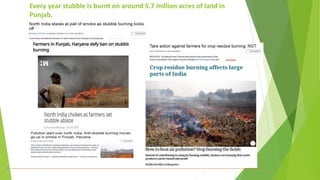
Every year stubble is burnt on around 5.7 million acres of land in
Punjab.
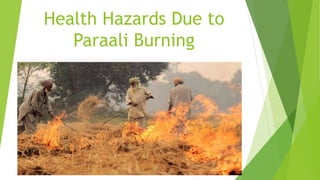
Health Hazards Due to
Paraali Burning
What are the effects of stubble burning?
 Stubble burning emits fine particulate matter, an air pollutant
that is a concern for people's health when levels in the air are
high; the particles can get trapped inside the lungs and
increase the risk of lung cancer by 36%.
 Researchers have shown that the burning of agricultural
biomass residue or stubble burning is a major health
hazard. It doesn't just affects the organic carbon levels of
the soil but also produces an uncontrollable amount
of harmful smoke that causes air pollution.
Harmful Effects
Pollution: Open stubble burning emits large amounts of toxic pollutants in the atmosphere
which contain harmful gases like methane (CH4), Carbon Monoxide (CO), and carcinogenic
polycyclic aromatic hydrocarbons.
“Stubble burning is creating dangerous air pollution, causing adverse health effects in majority
of population.
Causes
 Irritation in eyes was reported by 76.8% people,
 Irritation in nose by 44.8%,
 Irritation in throat by 45.5%.
 Cough or increase in cough was reported by 41.6%
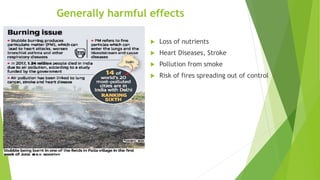
Generally harmful effects
 Loss of nutrients
 Heart Diseases, Stroke
 Pollution from smoke
 Risk of fires spreading out of control
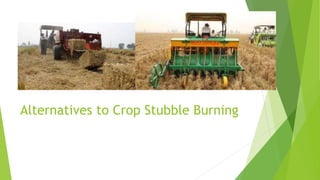
Alternatives to Crop Stubble Burning
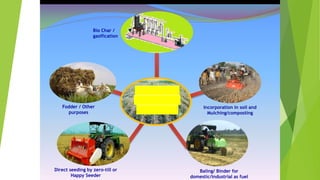
Incorporation in soil and
Mulching/composting
Baling/ Binder for
domestic/industrial as fuel
Direct seeding by zero-till or
Happy Seeder
Fodder / Other
purposes
Bio Char /
gasification
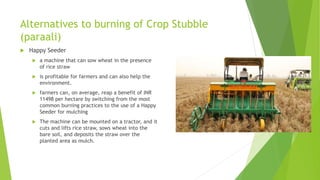
Alternatives to burning of Crop Stubble
(paraali)
 Happy Seeder
 a machine that can sow wheat in the presence
of rice straw
 is profitable for farmers and can also help the
environment.
 farmers can, on average, reap a benefit of INR
11498 per hectare by switching from the most
common burning practices to the use of a Happy
Seeder for mulching
 The machine can be mounted on a tractor, and it
cuts and lifts rice straw, sows wheat into the
bare soil, and deposits the straw over the
planted area as mulch.
 Biogas Plants
 Recent developments in technology have opened the possibility of using paddy
straw and other crop residue other than dung and vegetable waste for biogas
generation in an integrated approach.
 Biogas plant combined with commercial farms and processing units that was set up in
Fazilka, Punjab as a novel initiative towards green energy. It generates around 4000
m3 of biogas from 10 tons of agricultural residue.
 In another biogas enterprise, a 12 MW rice-straw power plant can consume 120,000
tons of stubble collected from nearly 15,000 farmers. These private enterprises
generated around 700,000 jobs for the farming population.
 Power Generation
 The Government of India recently directed the National Thermal Power
Corporation (NTPC) to mix crop residue pellets (nearly 10%) with coal for
power generation. This helped the farmers with a monetary return of
approximately Rs. 5500 (77 USD) per ton of crop residue.
 USA-based New Generation Power International has proposed to set
up 1000 MW biomass energy generating plants in Punjab to address
stubble burning.
 The company plans to set up 200 plants, each having 5 MW capacity,
which will use the stubble as raw material.
 Composting
 The high organic content in crop residue makes it an ideal raw material
for compost similar to animal manure and food waste.
 Composting is the natural process of rotting or decomposition of organic
matter by micro-organisms under controlled conditions
 As a rich source of organic matter, compost plays an important role in
sustaining soil fertility and thereby helping to achieve sustainable
agricultural productivity
 Addition of compost to the soil improves physio-chemical and biological
properties of the soil and can completely replace application of
agricultural chemicals such as fertilizer and pesticides.
 Production of Biochar
 Biochar is a fine-grained carbon rich porous product obtained from the
thermo-chemical conversion called the pyrolysis at low temperatures in
an oxygen free environment
 When amended to soil, highly porous nature of the biochar helps in
improved water retention and increased soil surface area
 biochar is used in various application such as the water treatment,
construction industry, food industry, cosmetic industry, metallurgy,
treatment of waste water and many other chemical applications. In India
currently, the biochar application is limited and mainly seen in in villages
and small towns.
Further Reading
 https://decodingbiosphere.com/2023/04/25/the-causes-and-effects-of-air-
pollution-a-comprehensive-guide/
 https://decodingbiosphere.com/how-air-pollution-affects-human-health-
risks-and-solutions/
 https://decodingbiosphere.com/how-to-protect-yourself-from-air-pollution-
simple-steps-for-a-healthier-life/
 https://decodingbiosphere.com/10-effects-of-air-pollution-on-human-health/
Thank you

Crop stubble burning issue ppt.pptx

  • 1.
  • 2.
    Introduction  Stubble; usuallypronounced as stubbles..  The stump of grain or other stalks left in ground when crop is cut.  paraali; Paddy stubble is locally called ‘paraali’ in Punjab.
  • 3.
    What is stubble(paraali) burning ?  Stubble (paraali) burning is the act of setting fire to crop residue to remove them from the field to sow the next crop.  In order to plant next winter crop (Rabi crop), farmers in Haryana and Punjab have to move in a very short interval and if they are late, due to short winters these days, they might face considerable losses. Therefore, burning is the cheapest and fastest way to get rid of the stubble.  If paraali is left in the field, pests like termites may attack the upcoming crop.  The precarious economic condition of farmers doesn’t allow them to use expensive mechanised methods to remove stubble.
  • 4.
    Scale of Burning Punjab produces approximately 19-20 million tonnes of paddy straw and about 20 million tonnes of wheat straw.  In Haryana, the problem of paddy straw burning also exists, although the scale is smaller than in Punjab. Paddy straw production is estimated at 2 million tonnes.  The kharif harvesting season begins in October.
  • 5.
    Causes and Effectsof Crop Stubble Burning
  • 6.
    Causes of theStubble Burning Technology: The problem arises due to the use of mechanized harvesting which leaves several inches of stubble in the fields. Earlier, this excess crop was used by farmers for cooking, as hay to keep their animals warm or even as extra insulation for homes. But, now the stubble use for such purposes has become outdated. Adverse Impact of Laws: Implementation of the Punjab Preservation of Subsoil Water Act (2009) made the time period of stubble burning coincident with the onset of winter in Northern India. Late transplanting of paddy during Kharif season to prevent water loss as directed by PPSW Act (2009) had left farmers with little time between harvesting and preparing the field for the next crop and hence farmers are resorting to the burning of stubble. High Silica Content: Rice straw is considered useless as fodder in the case of non- basmati rice, because of its high silica content.
  • 7.
    Stubble Burning andWestern disturbances:  According to the Ministry of Earth Sciences’ air quality monitor, SAFAR, an increase in stubble burning in Haryana and Punjab and calm surface winds have increased Delhi’s air pollution. The calm surface wind that prevailed led to strong surface nocturnal inversion and accumulate on of pollutants.  These directly contribute to environmental pollution, and are also responsible for the haze in Delhi and melting of Himalayan glaciers. Delhi has seen the worst pollution since 2016 in October, 2019 with some parts of the city experiencing over 150 times the concentration of toxic particles recommended by the World Health Organization.
  • 8.
    Effects of StubbleBurning  Pollution: Open stubble burning emits large amounts of toxic pollutants in the atmosphere which contain harmful gases like methane (CH4), Carbon Monoxide (CO), Volatile organic compound (VOC) and carcinogenic polycyclic aromatic hydrocarbons.  A study estimates that crop residue burning released 149.24 million tonnes of carbon dioxide (CO2), over 9 million tonnes of carbon monoxide (CO), 0.25 million tonnes of oxides of sulphur (SOX), 1.28 million tonnes of particulate matter and 0.07 million tonnes of black carbon.  After the release in the atmosphere, these pollutants disperse in the surroundings, may undergo a physical and chemical transformation and eventually adversely affect human health by causing a thick blanket of smog.  Soil Fertility: Burning husk on ground destroys the nutrients in the soil, making it less fertile.  Heat Penetration: Heat generated by stubble burning penetrates into the soil, leading to the loss of moisture and useful microbes.  Stubble burning makes both the soil and air poisonous. Microorganisms present in the upper layer of the soil as well as its organic quality gets affected. Due to the loss of ‘friendly’ pests, the wrath of ‘enemy’ pests has increased and as a result, crops are more prone to disease. Impacts of Crop Residue Burning Pollution (Affecting Human health) & GH gases emission Loss of Nutrients e.g. N, P, K & S Mortality of active beneficial Soil Bacteria Soil hardening & erosion due to no cover Smoke & soot particles
  • 9.
    9| Every year stubbleis burnt on around 5.7 million acres of land in Punjab.
  • 10.
    Health Hazards Dueto Paraali Burning
  • 11.
    What are theeffects of stubble burning?  Stubble burning emits fine particulate matter, an air pollutant that is a concern for people's health when levels in the air are high; the particles can get trapped inside the lungs and increase the risk of lung cancer by 36%.  Researchers have shown that the burning of agricultural biomass residue or stubble burning is a major health hazard. It doesn't just affects the organic carbon levels of the soil but also produces an uncontrollable amount of harmful smoke that causes air pollution.
  • 12.
    Harmful Effects Pollution: Openstubble burning emits large amounts of toxic pollutants in the atmosphere which contain harmful gases like methane (CH4), Carbon Monoxide (CO), and carcinogenic polycyclic aromatic hydrocarbons. “Stubble burning is creating dangerous air pollution, causing adverse health effects in majority of population. Causes  Irritation in eyes was reported by 76.8% people,  Irritation in nose by 44.8%,  Irritation in throat by 45.5%.  Cough or increase in cough was reported by 41.6%
  • 13.
    Generally harmful effects Loss of nutrients  Heart Diseases, Stroke  Pollution from smoke  Risk of fires spreading out of control
  • 14.
    Alternatives to CropStubble Burning
  • 15.
    Incorporation in soiland Mulching/composting Baling/ Binder for domestic/industrial as fuel Direct seeding by zero-till or Happy Seeder Fodder / Other purposes Bio Char / gasification
  • 16.
    Alternatives to burningof Crop Stubble (paraali)  Happy Seeder  a machine that can sow wheat in the presence of rice straw  is profitable for farmers and can also help the environment.  farmers can, on average, reap a benefit of INR 11498 per hectare by switching from the most common burning practices to the use of a Happy Seeder for mulching  The machine can be mounted on a tractor, and it cuts and lifts rice straw, sows wheat into the bare soil, and deposits the straw over the planted area as mulch.
  • 17.
     Biogas Plants Recent developments in technology have opened the possibility of using paddy straw and other crop residue other than dung and vegetable waste for biogas generation in an integrated approach.  Biogas plant combined with commercial farms and processing units that was set up in Fazilka, Punjab as a novel initiative towards green energy. It generates around 4000 m3 of biogas from 10 tons of agricultural residue.  In another biogas enterprise, a 12 MW rice-straw power plant can consume 120,000 tons of stubble collected from nearly 15,000 farmers. These private enterprises generated around 700,000 jobs for the farming population.
  • 18.
     Power Generation The Government of India recently directed the National Thermal Power Corporation (NTPC) to mix crop residue pellets (nearly 10%) with coal for power generation. This helped the farmers with a monetary return of approximately Rs. 5500 (77 USD) per ton of crop residue.  USA-based New Generation Power International has proposed to set up 1000 MW biomass energy generating plants in Punjab to address stubble burning.  The company plans to set up 200 plants, each having 5 MW capacity, which will use the stubble as raw material.
  • 19.
     Composting  Thehigh organic content in crop residue makes it an ideal raw material for compost similar to animal manure and food waste.  Composting is the natural process of rotting or decomposition of organic matter by micro-organisms under controlled conditions  As a rich source of organic matter, compost plays an important role in sustaining soil fertility and thereby helping to achieve sustainable agricultural productivity  Addition of compost to the soil improves physio-chemical and biological properties of the soil and can completely replace application of agricultural chemicals such as fertilizer and pesticides.
  • 20.
     Production ofBiochar  Biochar is a fine-grained carbon rich porous product obtained from the thermo-chemical conversion called the pyrolysis at low temperatures in an oxygen free environment  When amended to soil, highly porous nature of the biochar helps in improved water retention and increased soil surface area  biochar is used in various application such as the water treatment, construction industry, food industry, cosmetic industry, metallurgy, treatment of waste water and many other chemical applications. In India currently, the biochar application is limited and mainly seen in in villages and small towns.
  • 21.
    Further Reading  https://decodingbiosphere.com/2023/04/25/the-causes-and-effects-of-air- pollution-a-comprehensive-guide/ https://decodingbiosphere.com/how-air-pollution-affects-human-health- risks-and-solutions/  https://decodingbiosphere.com/how-to-protect-yourself-from-air-pollution- simple-steps-for-a-healthier-life/  https://decodingbiosphere.com/10-effects-of-air-pollution-on-human-health/
  • 22.