CROP PESTS AND
DISEASES
Introduction
 Pests and diseases cause damage to crops; in fields and stores.
 They lower crop growth rates hence reduced yield and quality of crop products.
 They also raise the cost production in the effort to eliminate them thus lowers
farmers’ gross margins or profits.
 To manage crops and diseases effectively and at minimal costs, one must
understand the pests’ life cycles, feeding habits, damages they cause and their
natural enemies. It is also of essence to know causes and effects of diseases.
CROP PESTS AND THEIR CONTROL
 A crop pest is a living organism that destroy crops; directly or indirectly.
 Direct destruction includes physical damage to the plant while indirect
includes introduction of disease-causing organisms (pathogens); viruses,
bacteria or fungi.
 Examples of crop pests include; insects, nematodes, birds, rodents, mites and
large animals such as elephants. Some birds are also pests.
 Domestic animals can become pests if not take good care of.
Negative Effects of Crop Pests
 Unearth planted seeds resulting in low plan population e.g. squirrels.
 Damage crop roots leading to wilting and death of crops e.g. nematodes.
 Destroy leaves thereby reducing photosynthetic area thus lowering crop yields.
 The pests that suck plants’ sap deprive them food leading to retarded growth.
 Lower crop quality and quantity by attacking fruits, berries and/or flowers.
 Attack and destroy embryo of seeds and lowering their germination potential.
 Some pests transmit crop diseases e.g. aphids while other give way to secondary
infections.
 Some e.g. stalk borers consume growing parts causing retarded growth.
CLASSIFICATION OF PESTS
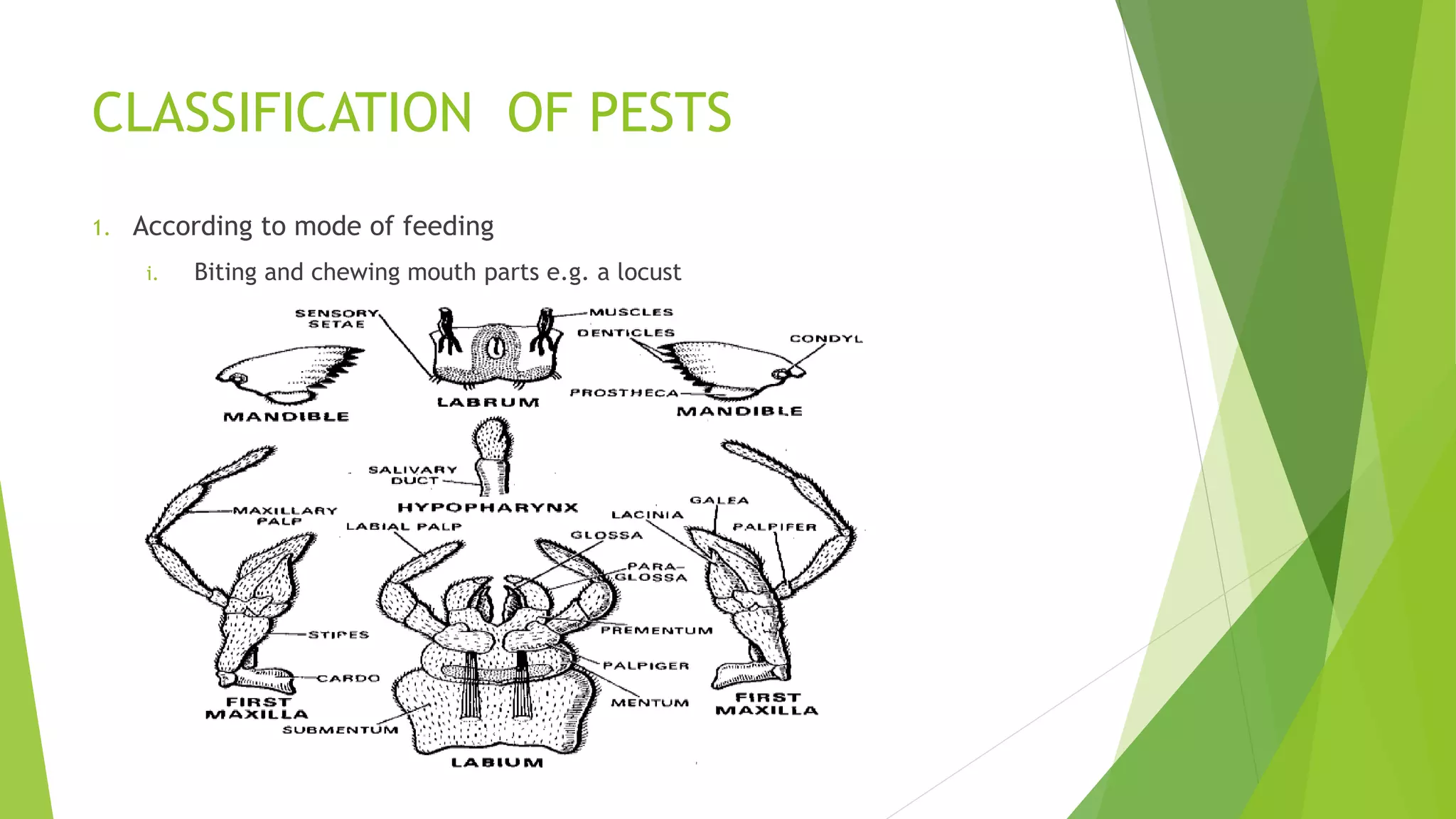
1. According to mode of feeding
i. Biting and chewing mouth parts e.g. a locust
According to the mode of feeding continued
ii. Piercing and sucking mouth parts e.g. an aphid
CLASSIFICATION OF PESTS contd…..
2. According to crops attacked
Some pests are very specific to the crops they attack e.g. coffee pests.
CLASSIFICATION OF PESTS contd…..
3. Stage of development at which pest is harmful/destructive.
4. Stage of growth of the crop attacked.
5. Scientific classification.
6. The level of damage caused.
7. The habitat of the pest/ ecological niche of the pest.
To be continued……….

Crop pests and diseases

  • 1.
  • 2.
    Introduction  Pests anddiseases cause damage to crops; in fields and stores.  They lower crop growth rates hence reduced yield and quality of crop products.  They also raise the cost production in the effort to eliminate them thus lowers farmers’ gross margins or profits.  To manage crops and diseases effectively and at minimal costs, one must understand the pests’ life cycles, feeding habits, damages they cause and their natural enemies. It is also of essence to know causes and effects of diseases.
  • 3.
    CROP PESTS ANDTHEIR CONTROL  A crop pest is a living organism that destroy crops; directly or indirectly.  Direct destruction includes physical damage to the plant while indirect includes introduction of disease-causing organisms (pathogens); viruses, bacteria or fungi.  Examples of crop pests include; insects, nematodes, birds, rodents, mites and large animals such as elephants. Some birds are also pests.  Domestic animals can become pests if not take good care of.
  • 4.
    Negative Effects ofCrop Pests  Unearth planted seeds resulting in low plan population e.g. squirrels.  Damage crop roots leading to wilting and death of crops e.g. nematodes.  Destroy leaves thereby reducing photosynthetic area thus lowering crop yields.  The pests that suck plants’ sap deprive them food leading to retarded growth.  Lower crop quality and quantity by attacking fruits, berries and/or flowers.  Attack and destroy embryo of seeds and lowering their germination potential.  Some pests transmit crop diseases e.g. aphids while other give way to secondary infections.  Some e.g. stalk borers consume growing parts causing retarded growth.
  • 5.
    CLASSIFICATION OF PESTS 1.According to mode of feeding i. Biting and chewing mouth parts e.g. a locust
  • 6.
    According to themode of feeding continued ii. Piercing and sucking mouth parts e.g. an aphid
  • 7.
    CLASSIFICATION OF PESTScontd….. 2. According to crops attacked Some pests are very specific to the crops they attack e.g. coffee pests.
  • 8.
    CLASSIFICATION OF PESTScontd….. 3. Stage of development at which pest is harmful/destructive. 4. Stage of growth of the crop attacked. 5. Scientific classification. 6. The level of damage caused. 7. The habitat of the pest/ ecological niche of the pest. To be continued……….