By Nadia Rowbotham
Biography 1932   Born 25 th  June, Dartford, Kent 1946-51   Attended Gravesend Technical College and School of art 1951-53   National service in the R.A.F 1953-56   Royal College of Art, London – First Class Diploma 1956-57   Leverhulme Research Award  to study popular art.    1960-64   Taught at several Schools of Art including St Martin’s, Harrow and  Walthamstow. 1963   Married Jann Haworth 1964-76   Taught at Royal College of Art , London 1975  Founding member of  The Brotherhood of Ruralists  with Jann  Haworth, Ann and Graham Arnold, David Inshaw, and Annie and  Graham Ovenden. 1994-96   Third associate Artist of the National Gallery, London 2002   Received  Knighthood . Became professor of Drawing at the Royal  Academy Schools.
Blake’s Early Work Blake's early work is dominated by two major subjects: fantastic scenes from the world of the circus and naturalistic paintings with autobiographic elements.  Circus characters and children reading comic books are among the artist's typical motifs.  In style and content both types of pictures paved the way for English Pop Art.
Leverhulme scholarship Thanks to a Leverhulme scholarship, Blake had the opportunity to travel through Europe from 1956 to 1957, where he acquainted himself with the artistic trends of the time.  In 1959, inspired by reproductions by Robert Rauschenberg and Jasper Johns, Blake began to paint collage-like pictures of pop musicians and film stars and to produce assemblages made of recycled material, postcards and other items.
Brotherhood of Ruralists In 1975 Blake was one of the founding members of the 'Brotherhood of Ruralists'.  His imagery changed under the influence of this group of artists and his rural surroundings in Wellow on Avon.  Just like the pre-Raffaelites, they strove for an aesthetic permeation of all parts of life.  Childhood memories, fairy tales and elves, depicted in realistic style using techniques of the old masters, became his favourite subjects.
Collage Blake’s most recent work has taken the form of collage, inspired by his work in 1959 where he  produce assemblages made of recycled material, postcards and other items.  Most of his collages are made up of collected items and images, creating memories of holidays or trips.
Influential Artists   –   Robert Rauschenberg Blake was inspired by reproductions by both  Robert Rauschenberg and Jasper Johns. Robert Rauschenberg was an American artist who came to prominence in the 1950s  . Rauschenberg Blake You can clearly see the influence Rauschenberg had on Blake as he began to paint collage-like pictures of pop musicians and film stars.
Jasper Johns is an American contemporary artist who works primarily in painting and printmaking. You can see very clearly that Johns has influenced Blake’s art work. Influential Artists   -   Jasper Johns Blake Johns
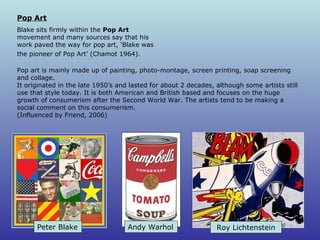
Pop art is mainly made up of painting, photo-montage, screen printing, soap screening and collage. It originated in the late 1950’s and lasted for about 2 decades, although some artists still use that style today. It is both American and British based and focuses on the huge growth of consumerism after the Second World War. The artists tend to be making a social comment on this consumerism.  (Influenced by Friend, 2006) Pop Art Blake sits firmly within the  Pop Art  movement and many sources say that his work paved the way for pop art, ‘Blake was the  pioneer of Pop Art’ (Chamot 1964).   Andy Warhol Peter Blake Roy  Lichtenstein
Abstract Expressionism Began around 1946 Abstract Expressionism was an American post–World War II art movement.   It was an important predecessor is surrealism, with its emphasis on spontaneous, automatic or subconscious creation. The bold colours introduced in this period can be clearly seen in the later pop art movement. Postmodernism Throughout 1970’s Postmodernism was thought to be in contradiction to some aspect of modernism, or to have emerged or developed in its aftermath.  Its traits include collage, simplification, appropriation, depiction of consumer or popular culture and Performance art.  Jackson Pollock Alan Davie Barbara Kruger   Julian Schnabel POP ART Began around 1952
Pop Art in the classroom For pupils to have a solid understanding of Pop Art, they need to see as many examples of it as possible and learn how they came to be created. Many artists use different processes and techniques and it is important to know how they were made and the reasons behind them.  As with any art movement they should be allowed to study closely the work of select artists, creating reproductions where suitable before they can be inspired to create their own piece in the same style. Make It Pop! Activities and Adventures in Pop Art.  By Joyce Raimondo Although this book does not contain any work by Peter Blake, it does provide valuable information about the Pop Art Movement. It also contains the work of Blake’s inspirational artists. Pop art will teach children about the use of colour as the movement is well known for its brash use of bright block colours and contrasts.
Sgt. Pepper Album cover  1967 Initial sketches for the album cover Original Beatles Cover was reworked to pay homage to Liverpool 2003 Beatles Album Cover Both the original collage and the reworked version are ideal to use with children. They can relate to at least some of the people features in the Liverpool collage. The initial sketch shows children how Blake began his thinking for the final piece. KS1 Simplistic version Created through paint Includes all class members (portrait) Collage on display board once portraits are completed Resources – paint, paper, mirrors, display board KS2 Digitally created Members of the school Photo collage using Photoshop Resources – digital cameras, computers with Photoshop
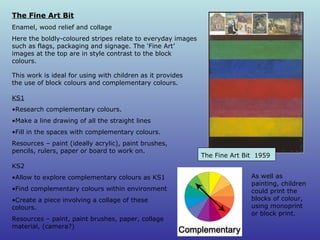
This work is ideal for using with children as it provides the use of block colours and complementary colours.  The Fine Art Bit  1959   The Fine Art Bit Enamel, wood relief and collage Here the boldly-coloured stripes relate to everyday images such as flags, packaging and signage. The ‘Fine Art’ images at the top are in style contrast to the block colours.  KS1 Research complementary colours.  Make a line drawing of all the straight lines Fill in the spaces with complementary colours. Resources – paint (ideally acrylic), paint brushes, pencils, rulers, paper or board to work on.  KS2 Allow to explore complementary colours as KS1 Find complementary colours within environment Create a piece involving a collage of these colours. Resources – paint, paint brushes, paper, collage material, (camera?) As well as painting, children could print the blocks of colour, using monoprint or block print.
Collage in the Classroom Mixing art and imagination! Collage and assemblage art are compositions of various elements (such as paper, wood, fabric, feathers, leaves, and other found objects) fixed with an adhesive glue or paint.  All of Blake’s work has an element of collage. It is important to allow children to explore and understand collage before creating a final piece. Peter Blake: About Collage    By Natalie Rudd There is a child friendly version of this book that is called: Make Your Own Collage with Peter Blake    By Natalie Rudd  The book explains how to create collages and what to consider when making. This is a really useful resource for both children and teachers. Collage teaches children about composition and texture.
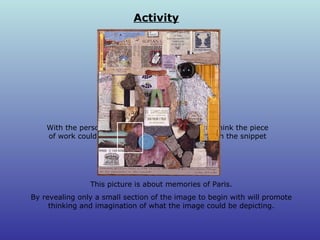
Activity With the person next to you, discuss what you think the piece of work could be about from what you can see in the snippet above. This picture is about memories of Paris. By revealing only a small section of the image to begin with will promote thinking and imagination of what the image could be depicting.
Memories of a Place – Paris Textured collage made up found objects while in a particular place. Blake’s choice of items is critical along with the composition. Memories of a Place – Paris 2005 KS1 Select collage items from a variety provided Concentrate on composition Arrange but don’t stick Photograph Resources – collage items, digital camera KS2 Bring in a selection of small items that remind them of somewhere or something Disregard items that don’t work Concentrate on composition Fix to board once happy Resources – collage items, glue, board There are numerous other ‘Memories of a Place’ collages.
‘ The Museum of the Colour White’ 1995 The Museum of the Colour White Textured collage made up of objects within the colour of white. The objects vary in size, purpose, etc. but have their colour in common. It’s purpose was to explore feelings behind the colour. This piece colour encourage children to identify variations of the same colour, and identify the difference between certain colours, for example – is turquoise blue or green? KS1 Sort objects around the classroom into colour groups Discuss why Create a mind map of how colours make you feel Resources – Hoops, objects, paper and pen/IWB  KS2 Each child chooses a colour of their choice Gather scraps of fabrics in their chosen colour way Create either a cut and stick collage of fabrics or a stitched textile piece depending on ability of children Discuss feelings associated with colour Resources – fabric, scissors and glue, or needle and thread  Jen Mick  Textile Collage - Colour
The Toy Shop 1962 The Toy Shop Mixed media collage of childhood memories. This image was suggested for use in the QCA scheme of work – Unit 5 – Objects and meanings, as an example of ‘symbolic composition’. This piece can therefore teach children about composition, as they can view the detail that is within each window and how it has been arranged. KS2 Children create a composition of objects they have an emotional attachment to Draw or paint these objects within their composition Pictures should take note of the 3D quality on objects Resources – objects, paper, (pencils/paint and paint brushes) KS1 In groups arrange a composition of toys Photograph Piece images together to create a shop window This work could lead on from or up to collections work on toys Resources – toys, digital camera, printer, display board
Art Across the Curriculum Art should be accessible across the curriculum, making its way into almost every subject. This is easy with the skills of drawing and painting, but becomes more difficult when trying to fit an art movement across the curriculum. Peter Blake’s work could fit into the following subjects: DT  – a lot of Blake’s collages are 3D and require some form of construction, this could take place in DT PSHE  – some of Blake’s work links to feelings, this could be discussed. Literacy  – children could write captions to go with the art work of could write a story behind it Maths  – some of his art work contains straight lines, circles, shapes and children could experiment with these ICT  – children could use cameras and computers to create work like Blake’s History  – children could learn about the 60’s (dressing-up role play area would be perfect Geography  – ‘Memories of a Place’ are based on a place so the children could research and learn about, Paris for example.
Bibliography Blake, P. and Rudd, N. (2007)  Make Your Own Collage with Peter Blake.  London: Tate Publishing. Chamot, M. et al. (1965)  The Modern British Paintings, Drawings and Sculpture.  London: Oldbourne Mick, J. (2008)  Jen Mick: Visual and Textile Artist.  Available at:  http://jenmick.com/  (Accessed: 22 April 2009). Raimondo, J. (2006)  Make It Pop! Activities and Adventures in Pop Art.  New York:  Watson-Guptill Publications Inc.  Rudd, N. (2003)  Peter Blake.  London: Tate Publishing. Waddington Galleries (2005)  Peter Blake.  London: Waddington Galleries. Wroe, N. (2006) Peter Blake:  The Bigger Picture.  Available at:  http://www.guardian.co.uk/artanddesign/2006/jan/21/art  (Accessed: 16 January 2009). All images sourced from: Tate Collections (2009) Available at:  http://www.tate.org.uk/collection/  (Accessed: 19 March 2009)

Critical Studies Peter Blake

  • 1.
  • 2.
    Biography 1932 Born 25 th June, Dartford, Kent 1946-51 Attended Gravesend Technical College and School of art 1951-53 National service in the R.A.F 1953-56 Royal College of Art, London – First Class Diploma 1956-57 Leverhulme Research Award to study popular art. 1960-64 Taught at several Schools of Art including St Martin’s, Harrow and Walthamstow. 1963 Married Jann Haworth 1964-76 Taught at Royal College of Art , London 1975 Founding member of The Brotherhood of Ruralists with Jann Haworth, Ann and Graham Arnold, David Inshaw, and Annie and Graham Ovenden. 1994-96 Third associate Artist of the National Gallery, London 2002 Received Knighthood . Became professor of Drawing at the Royal Academy Schools.
  • 3.
    Blake’s Early WorkBlake's early work is dominated by two major subjects: fantastic scenes from the world of the circus and naturalistic paintings with autobiographic elements. Circus characters and children reading comic books are among the artist's typical motifs. In style and content both types of pictures paved the way for English Pop Art.
  • 4.
    Leverhulme scholarship Thanksto a Leverhulme scholarship, Blake had the opportunity to travel through Europe from 1956 to 1957, where he acquainted himself with the artistic trends of the time. In 1959, inspired by reproductions by Robert Rauschenberg and Jasper Johns, Blake began to paint collage-like pictures of pop musicians and film stars and to produce assemblages made of recycled material, postcards and other items.
  • 5.
    Brotherhood of RuralistsIn 1975 Blake was one of the founding members of the 'Brotherhood of Ruralists'. His imagery changed under the influence of this group of artists and his rural surroundings in Wellow on Avon. Just like the pre-Raffaelites, they strove for an aesthetic permeation of all parts of life. Childhood memories, fairy tales and elves, depicted in realistic style using techniques of the old masters, became his favourite subjects.
  • 6.
    Collage Blake’s mostrecent work has taken the form of collage, inspired by his work in 1959 where he produce assemblages made of recycled material, postcards and other items. Most of his collages are made up of collected items and images, creating memories of holidays or trips.
  • 7.
    Influential Artists – Robert Rauschenberg Blake was inspired by reproductions by both Robert Rauschenberg and Jasper Johns. Robert Rauschenberg was an American artist who came to prominence in the 1950s . Rauschenberg Blake You can clearly see the influence Rauschenberg had on Blake as he began to paint collage-like pictures of pop musicians and film stars.
  • 8.
    Jasper Johns isan American contemporary artist who works primarily in painting and printmaking. You can see very clearly that Johns has influenced Blake’s art work. Influential Artists - Jasper Johns Blake Johns
  • 9.
    Pop art ismainly made up of painting, photo-montage, screen printing, soap screening and collage. It originated in the late 1950’s and lasted for about 2 decades, although some artists still use that style today. It is both American and British based and focuses on the huge growth of consumerism after the Second World War. The artists tend to be making a social comment on this consumerism. (Influenced by Friend, 2006) Pop Art Blake sits firmly within the Pop Art movement and many sources say that his work paved the way for pop art, ‘Blake was the pioneer of Pop Art’ (Chamot 1964). Andy Warhol Peter Blake Roy Lichtenstein
  • 10.
    Abstract Expressionism Beganaround 1946 Abstract Expressionism was an American post–World War II art movement. It was an important predecessor is surrealism, with its emphasis on spontaneous, automatic or subconscious creation. The bold colours introduced in this period can be clearly seen in the later pop art movement. Postmodernism Throughout 1970’s Postmodernism was thought to be in contradiction to some aspect of modernism, or to have emerged or developed in its aftermath. Its traits include collage, simplification, appropriation, depiction of consumer or popular culture and Performance art. Jackson Pollock Alan Davie Barbara Kruger Julian Schnabel POP ART Began around 1952
  • 11.
    Pop Art inthe classroom For pupils to have a solid understanding of Pop Art, they need to see as many examples of it as possible and learn how they came to be created. Many artists use different processes and techniques and it is important to know how they were made and the reasons behind them. As with any art movement they should be allowed to study closely the work of select artists, creating reproductions where suitable before they can be inspired to create their own piece in the same style. Make It Pop! Activities and Adventures in Pop Art. By Joyce Raimondo Although this book does not contain any work by Peter Blake, it does provide valuable information about the Pop Art Movement. It also contains the work of Blake’s inspirational artists. Pop art will teach children about the use of colour as the movement is well known for its brash use of bright block colours and contrasts.
  • 12.
    Sgt. Pepper Albumcover 1967 Initial sketches for the album cover Original Beatles Cover was reworked to pay homage to Liverpool 2003 Beatles Album Cover Both the original collage and the reworked version are ideal to use with children. They can relate to at least some of the people features in the Liverpool collage. The initial sketch shows children how Blake began his thinking for the final piece. KS1 Simplistic version Created through paint Includes all class members (portrait) Collage on display board once portraits are completed Resources – paint, paper, mirrors, display board KS2 Digitally created Members of the school Photo collage using Photoshop Resources – digital cameras, computers with Photoshop
  • 13.
    This work isideal for using with children as it provides the use of block colours and complementary colours. The Fine Art Bit  1959 The Fine Art Bit Enamel, wood relief and collage Here the boldly-coloured stripes relate to everyday images such as flags, packaging and signage. The ‘Fine Art’ images at the top are in style contrast to the block colours. KS1 Research complementary colours. Make a line drawing of all the straight lines Fill in the spaces with complementary colours. Resources – paint (ideally acrylic), paint brushes, pencils, rulers, paper or board to work on. KS2 Allow to explore complementary colours as KS1 Find complementary colours within environment Create a piece involving a collage of these colours. Resources – paint, paint brushes, paper, collage material, (camera?) As well as painting, children could print the blocks of colour, using monoprint or block print.
  • 14.
    Collage in theClassroom Mixing art and imagination! Collage and assemblage art are compositions of various elements (such as paper, wood, fabric, feathers, leaves, and other found objects) fixed with an adhesive glue or paint. All of Blake’s work has an element of collage. It is important to allow children to explore and understand collage before creating a final piece. Peter Blake: About Collage By Natalie Rudd There is a child friendly version of this book that is called: Make Your Own Collage with Peter Blake By Natalie Rudd The book explains how to create collages and what to consider when making. This is a really useful resource for both children and teachers. Collage teaches children about composition and texture.
  • 15.
    Activity With theperson next to you, discuss what you think the piece of work could be about from what you can see in the snippet above. This picture is about memories of Paris. By revealing only a small section of the image to begin with will promote thinking and imagination of what the image could be depicting.
  • 16.
    Memories of aPlace – Paris Textured collage made up found objects while in a particular place. Blake’s choice of items is critical along with the composition. Memories of a Place – Paris 2005 KS1 Select collage items from a variety provided Concentrate on composition Arrange but don’t stick Photograph Resources – collage items, digital camera KS2 Bring in a selection of small items that remind them of somewhere or something Disregard items that don’t work Concentrate on composition Fix to board once happy Resources – collage items, glue, board There are numerous other ‘Memories of a Place’ collages.
  • 17.
    ‘ The Museumof the Colour White’ 1995 The Museum of the Colour White Textured collage made up of objects within the colour of white. The objects vary in size, purpose, etc. but have their colour in common. It’s purpose was to explore feelings behind the colour. This piece colour encourage children to identify variations of the same colour, and identify the difference between certain colours, for example – is turquoise blue or green? KS1 Sort objects around the classroom into colour groups Discuss why Create a mind map of how colours make you feel Resources – Hoops, objects, paper and pen/IWB KS2 Each child chooses a colour of their choice Gather scraps of fabrics in their chosen colour way Create either a cut and stick collage of fabrics or a stitched textile piece depending on ability of children Discuss feelings associated with colour Resources – fabric, scissors and glue, or needle and thread Jen Mick Textile Collage - Colour
  • 18.
    The Toy Shop1962 The Toy Shop Mixed media collage of childhood memories. This image was suggested for use in the QCA scheme of work – Unit 5 – Objects and meanings, as an example of ‘symbolic composition’. This piece can therefore teach children about composition, as they can view the detail that is within each window and how it has been arranged. KS2 Children create a composition of objects they have an emotional attachment to Draw or paint these objects within their composition Pictures should take note of the 3D quality on objects Resources – objects, paper, (pencils/paint and paint brushes) KS1 In groups arrange a composition of toys Photograph Piece images together to create a shop window This work could lead on from or up to collections work on toys Resources – toys, digital camera, printer, display board
  • 19.
    Art Across theCurriculum Art should be accessible across the curriculum, making its way into almost every subject. This is easy with the skills of drawing and painting, but becomes more difficult when trying to fit an art movement across the curriculum. Peter Blake’s work could fit into the following subjects: DT – a lot of Blake’s collages are 3D and require some form of construction, this could take place in DT PSHE – some of Blake’s work links to feelings, this could be discussed. Literacy – children could write captions to go with the art work of could write a story behind it Maths – some of his art work contains straight lines, circles, shapes and children could experiment with these ICT – children could use cameras and computers to create work like Blake’s History – children could learn about the 60’s (dressing-up role play area would be perfect Geography – ‘Memories of a Place’ are based on a place so the children could research and learn about, Paris for example.
  • 20.
    Bibliography Blake, P.and Rudd, N. (2007) Make Your Own Collage with Peter Blake. London: Tate Publishing. Chamot, M. et al. (1965) The Modern British Paintings, Drawings and Sculpture. London: Oldbourne Mick, J. (2008) Jen Mick: Visual and Textile Artist. Available at: http://jenmick.com/ (Accessed: 22 April 2009). Raimondo, J. (2006) Make It Pop! Activities and Adventures in Pop Art. New York: Watson-Guptill Publications Inc. Rudd, N. (2003) Peter Blake. London: Tate Publishing. Waddington Galleries (2005) Peter Blake. London: Waddington Galleries. Wroe, N. (2006) Peter Blake: The Bigger Picture. Available at: http://www.guardian.co.uk/artanddesign/2006/jan/21/art (Accessed: 16 January 2009). All images sourced from: Tate Collections (2009) Available at: http://www.tate.org.uk/collection/ (Accessed: 19 March 2009)

Editor's Notes

  • #13 KS1 activity – each child will paint their face (self portrait) could be done in the style of Andy Warhol to tie together 2 styles of Pop art. Faces arranged together on a display board (by the children with adult supervision) to create a class collage. KS2 activity – children to take photos of people within school (teachers, head, dinner ladies, etc). Design on paper first, deciding where people should go. Collage together using Photoshop.
  • #14 Finding colours within environment links to Blake’s flags, packaging and signage. Collage could be photographic or otherwise.