Critical Analysis of
Renewable Energy Sources
Outline
 Forms of renewable sources
 Global renewable energy production
 Solar Energy
 Wind Energy
 Geo Thermal
 Hydro Power
 Biofuels
 Facts
Forms of renewable sources
 Solar Energy
 Wind Energy
 Geo Thermal Energy
 Hydroelectric Energy
 Biomass Technology
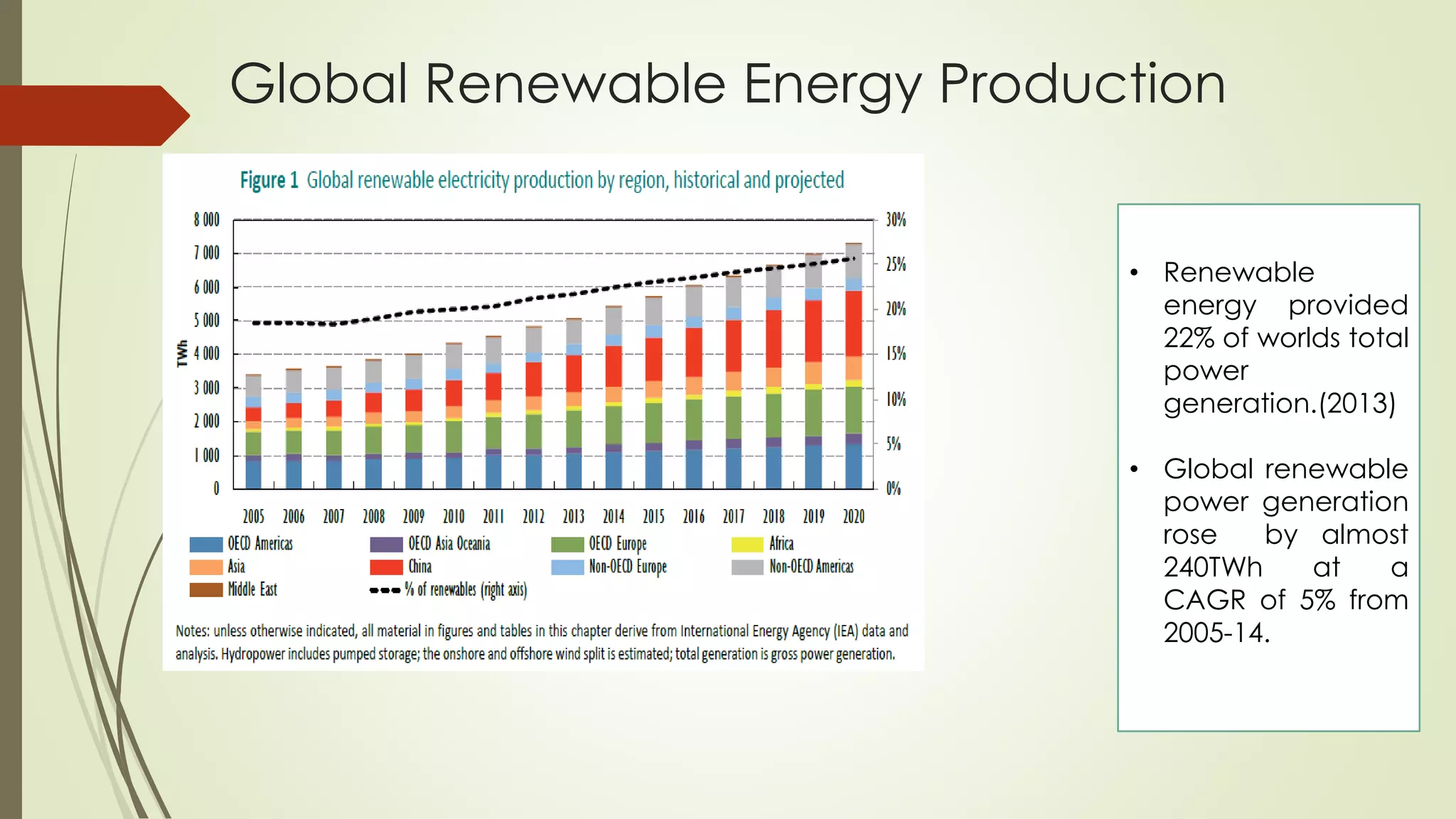
Global Renewable Energy Production
• Renewable
energy provided
22% of worlds total
power
generation.(2013)
• Global renewable
power generation
rose by almost
240TWh at a
CAGR of 5% from
2005-14.
Solar Energy
0
20000
40000
60000
80000
100000
120000
140000
2003 2004 2005 2006 2007 2008 2009 2010 2011 2012 2013
Solar Energy Installed Capacity (in mw)
Germany China Italy
Japan USA Spain
France Australia Belgium
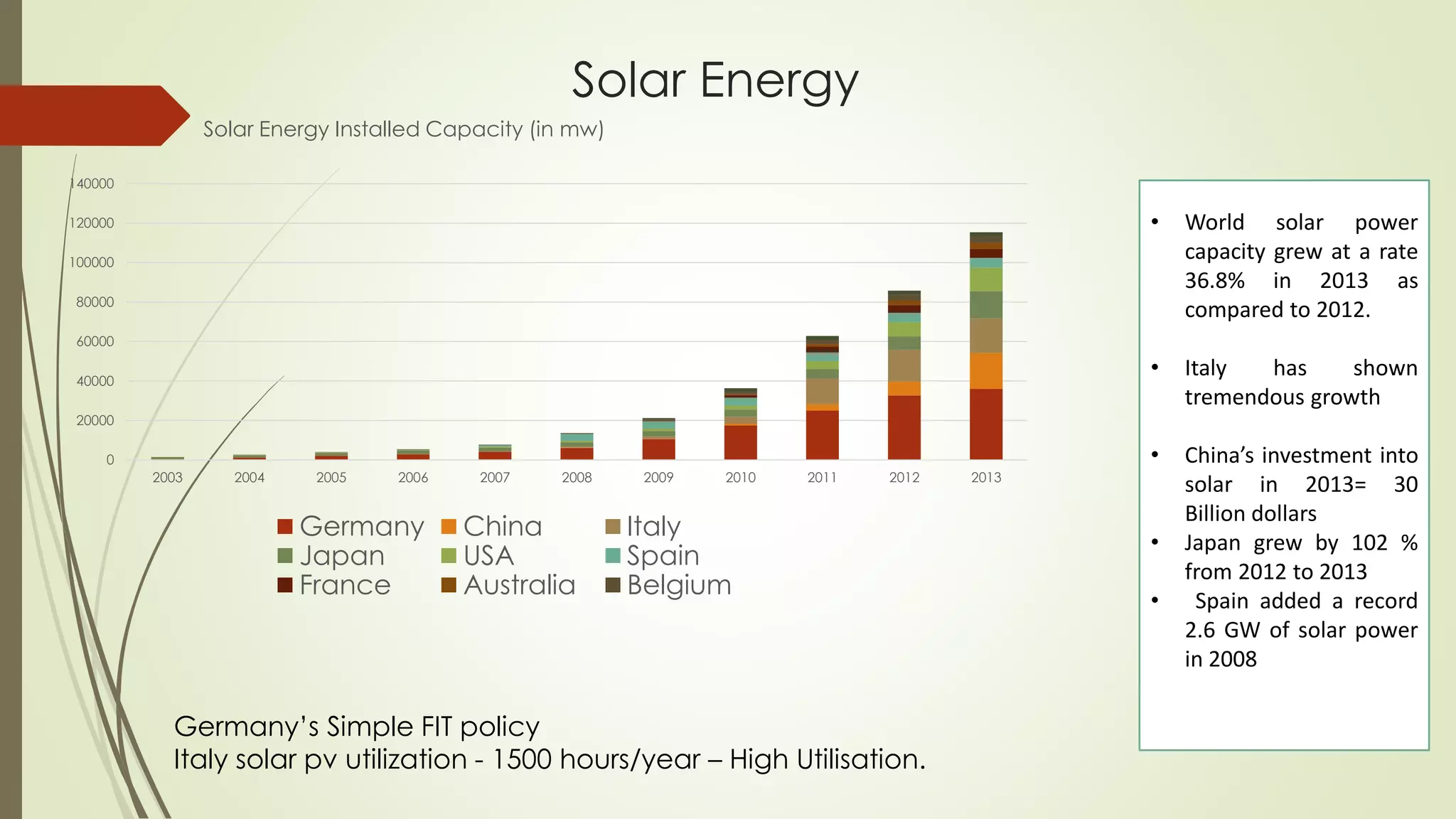
• World solar power
capacity grew at a rate
36.8% in 2013 as
compared to 2012.
• Italy has shown
tremendous growth
• China’s investment into
solar in 2013= 30
Billion dollars
• Japan grew by 102 %
from 2012 to 2013
• Spain added a record
2.6 GW of solar power
in 2008
Germany’s Simple FIT policy
Italy solar pv utilization - 1500 hours/year – High Utilisation.
0
5
10
15
20
25
30
2003 2004 2005 2006 2007 2008 2009 2010 2011 2012 2013
Solar Energy Consumption (in mtoe)
Germany Italy Spain China Japan
USA France Australia Czech Belgium
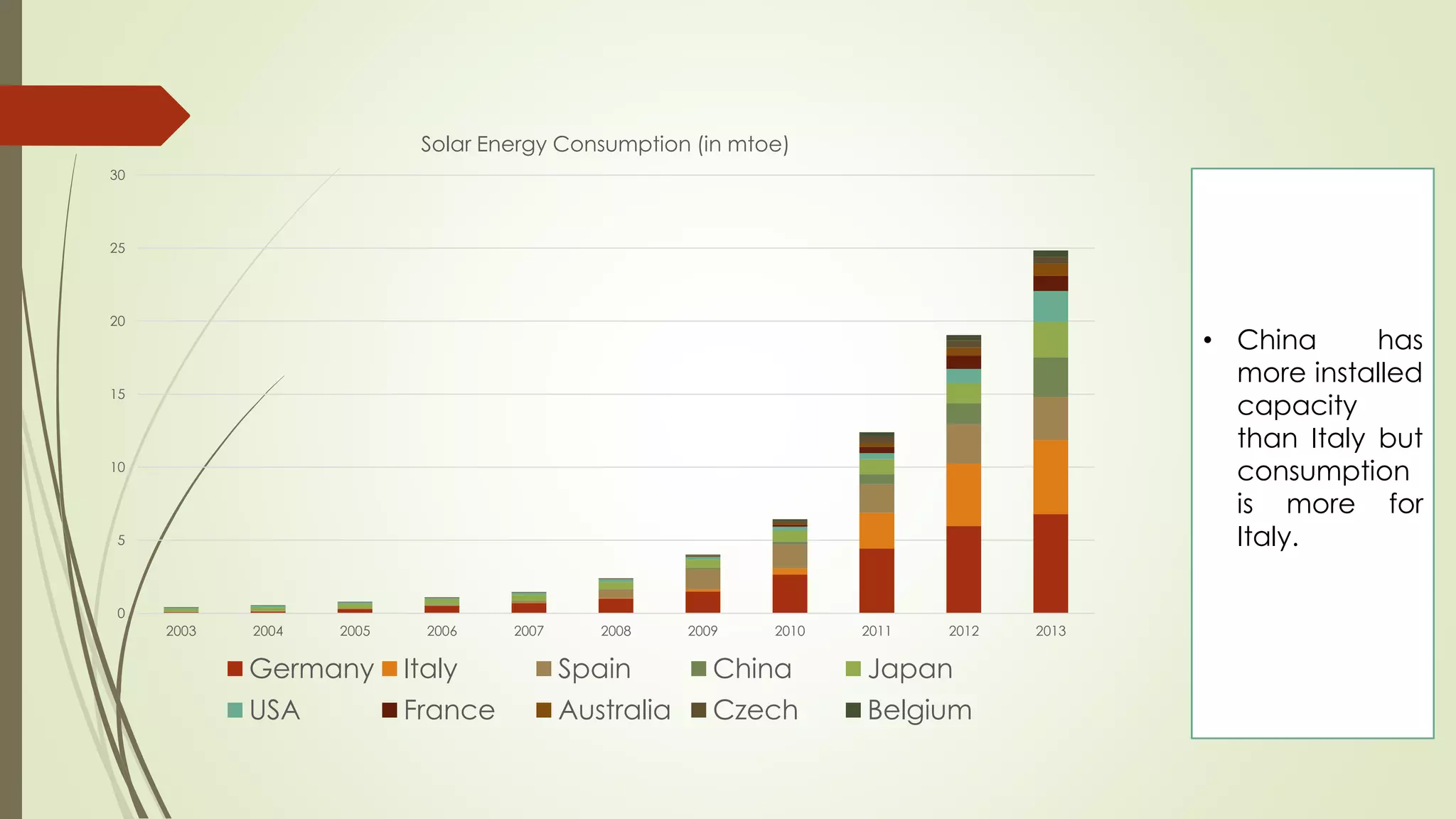
• China has
more installed
capacity
than Italy but
consumption
is more for
Italy.
Wind Energy
0
50000
100000
150000
200000
250000
300000
2003 2004 2005 2006 2007 2008 2009 2010 2011 2012 2013
Wind Energy Production(in mw)
USA China Germany Spain India
Canada Denmark Sweden Brazil france
Italy Protugal Japan Netherlands
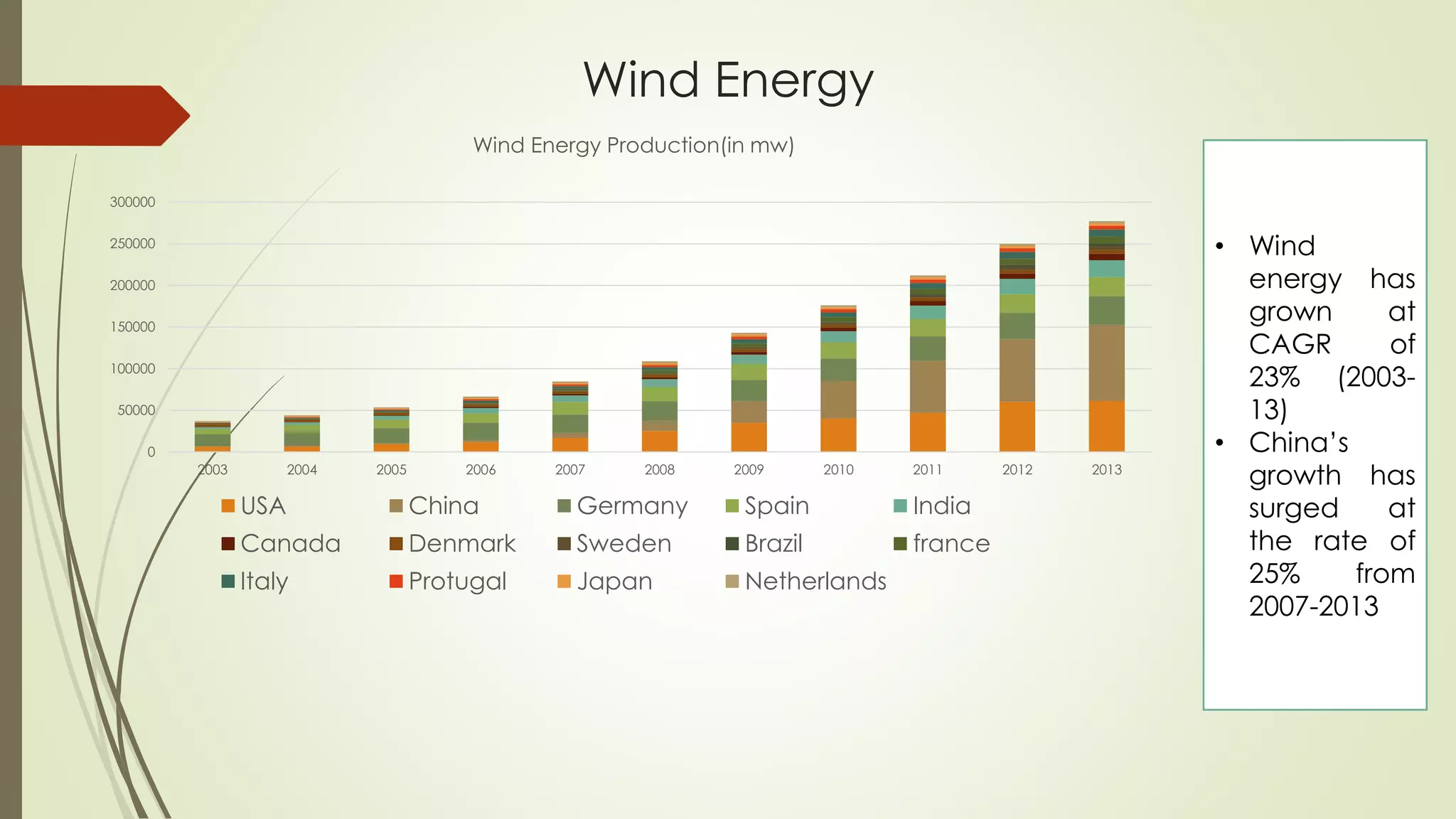
• Wind
energy has
grown at
CAGR of
23% (2003-
13)
• China’s
growth has
surged at
the rate of
25% from
2007-2013
-
20.0
40.0
60.0
80.0
100.0
120.0
140.0
2003 2004 2005 2006 2007 2008 2009 2010 2011 2012 2013
Wind energy consumption
USA China Spain Germany India
france Italy Protugal Canada Denmark
Sweden Brazil Netherlands Japan
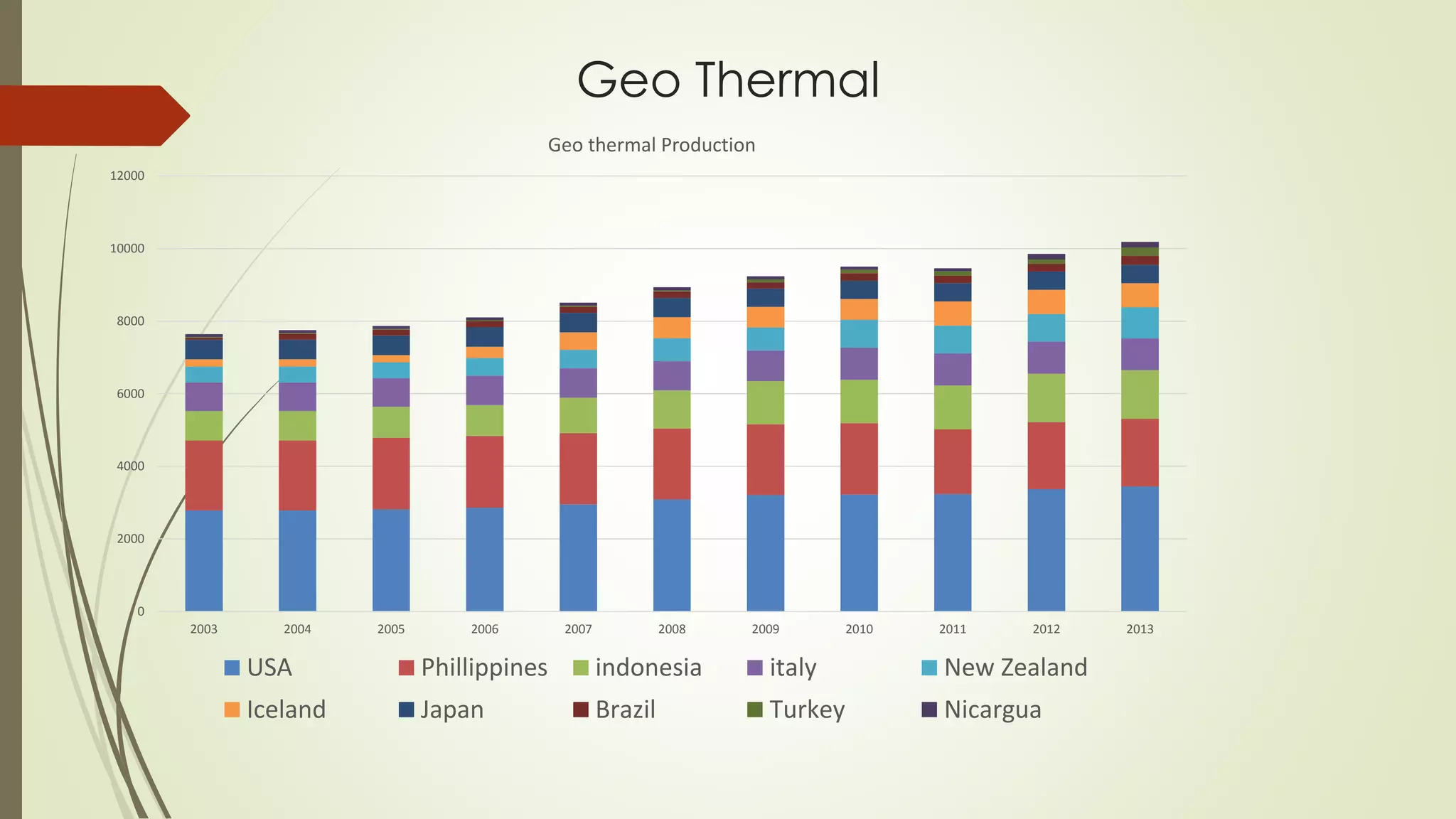
Geo Thermal
0
2000
4000
6000
8000
10000
12000
2003 2004 2005 2006 2007 2008 2009 2010 2011 2012 2013
Geo thermal Production
USA Phillippines indonesia italy New Zealand
Iceland Japan Brazil Turkey Nicargua
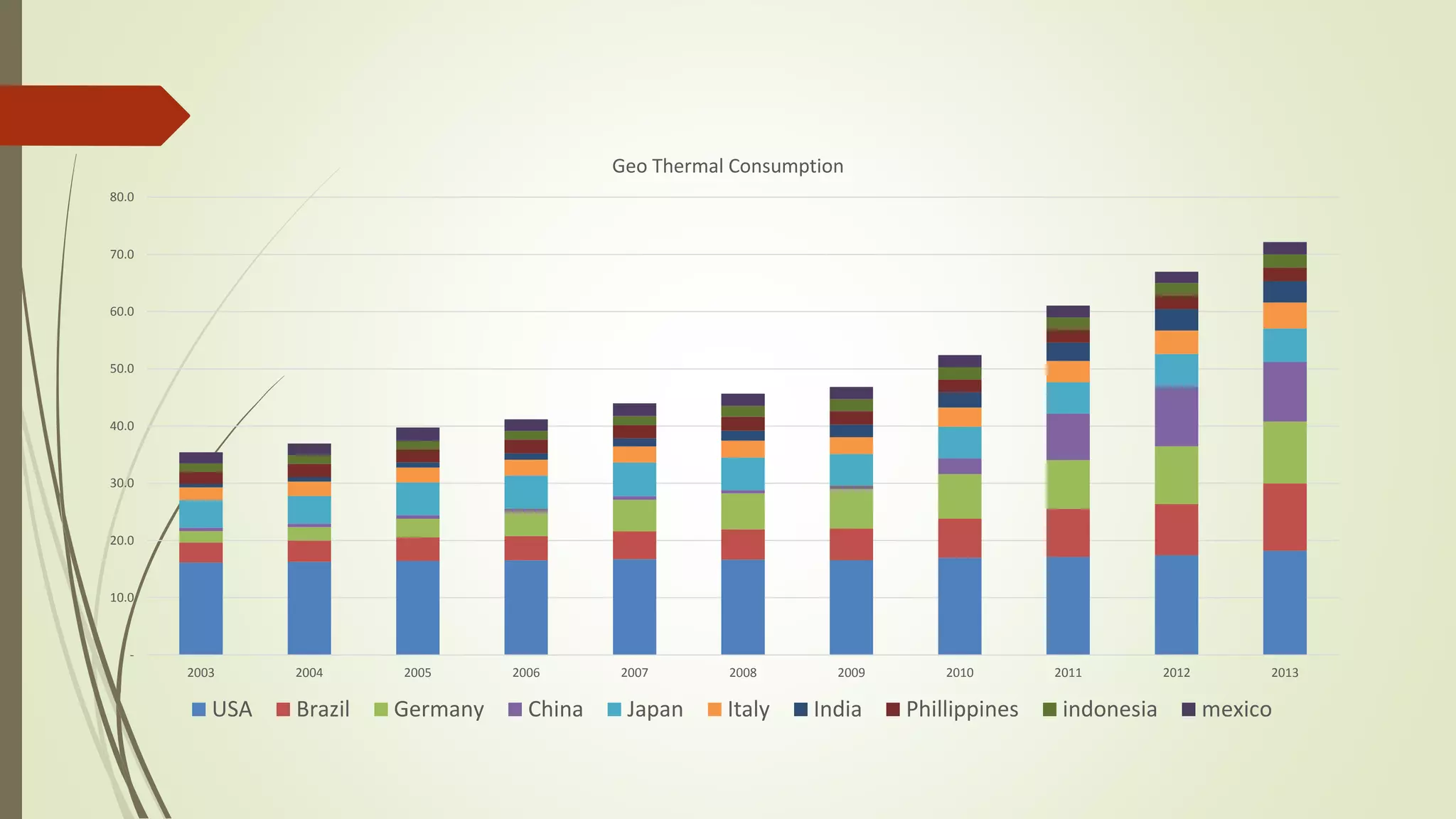
-
10.0
20.0
30.0
40.0
50.0
60.0
70.0
80.0
2003 2004 2005 2006 2007 2008 2009 2010 2011 2012 2013
Geo Thermal Consumption
USA Brazil Germany China Japan Italy India Phillippines indonesia mexico
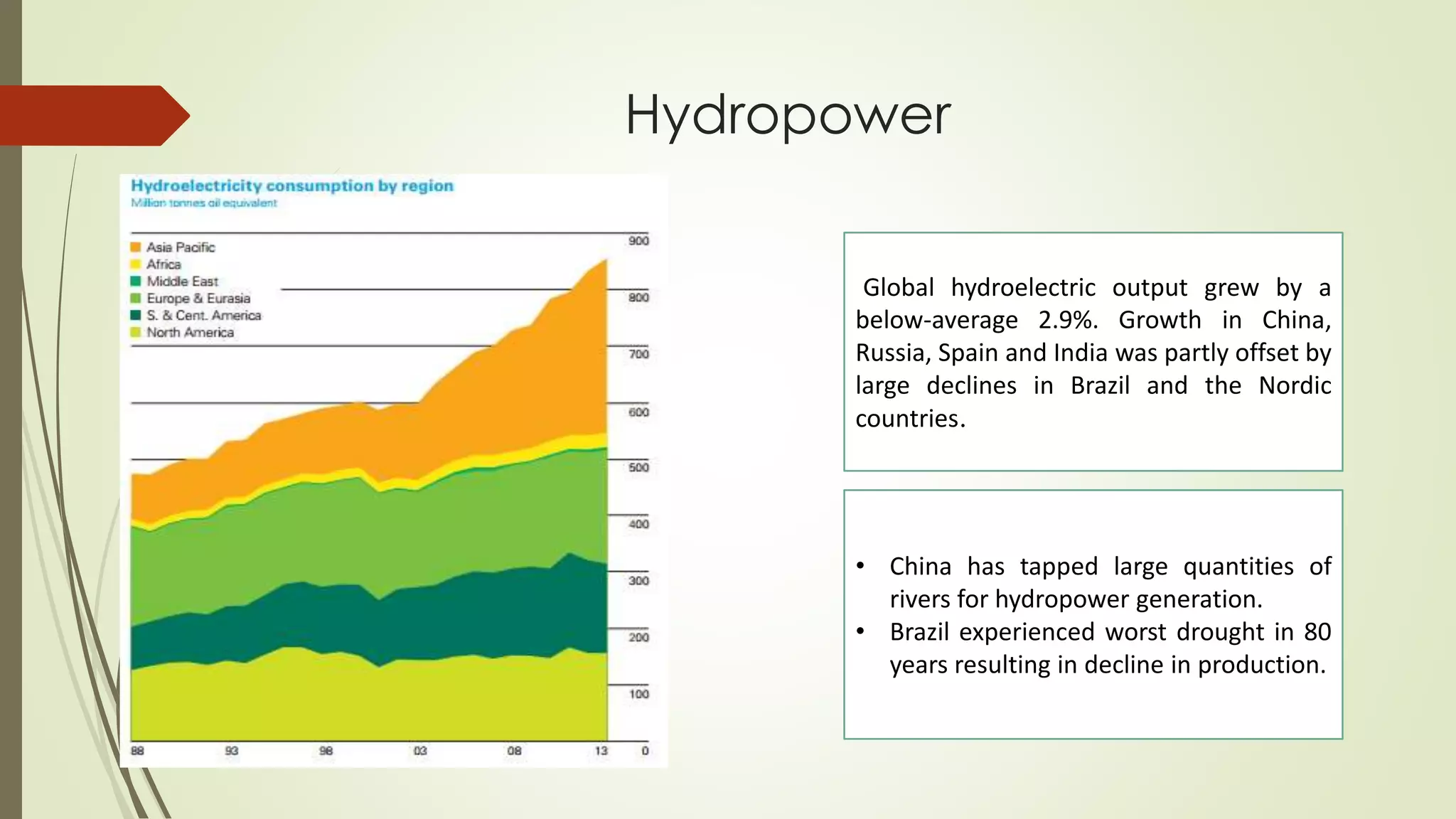
Hydropower
Global hydroelectric output grew by a
below-average 2.9%. Growth in China,
Russia, Spain and India was partly offset by
large declines in Brazil and the Nordic
countries.
• China has tapped large quantities of
rivers for hydropower generation.
• Brazil experienced worst drought in 80
years resulting in decline in production.
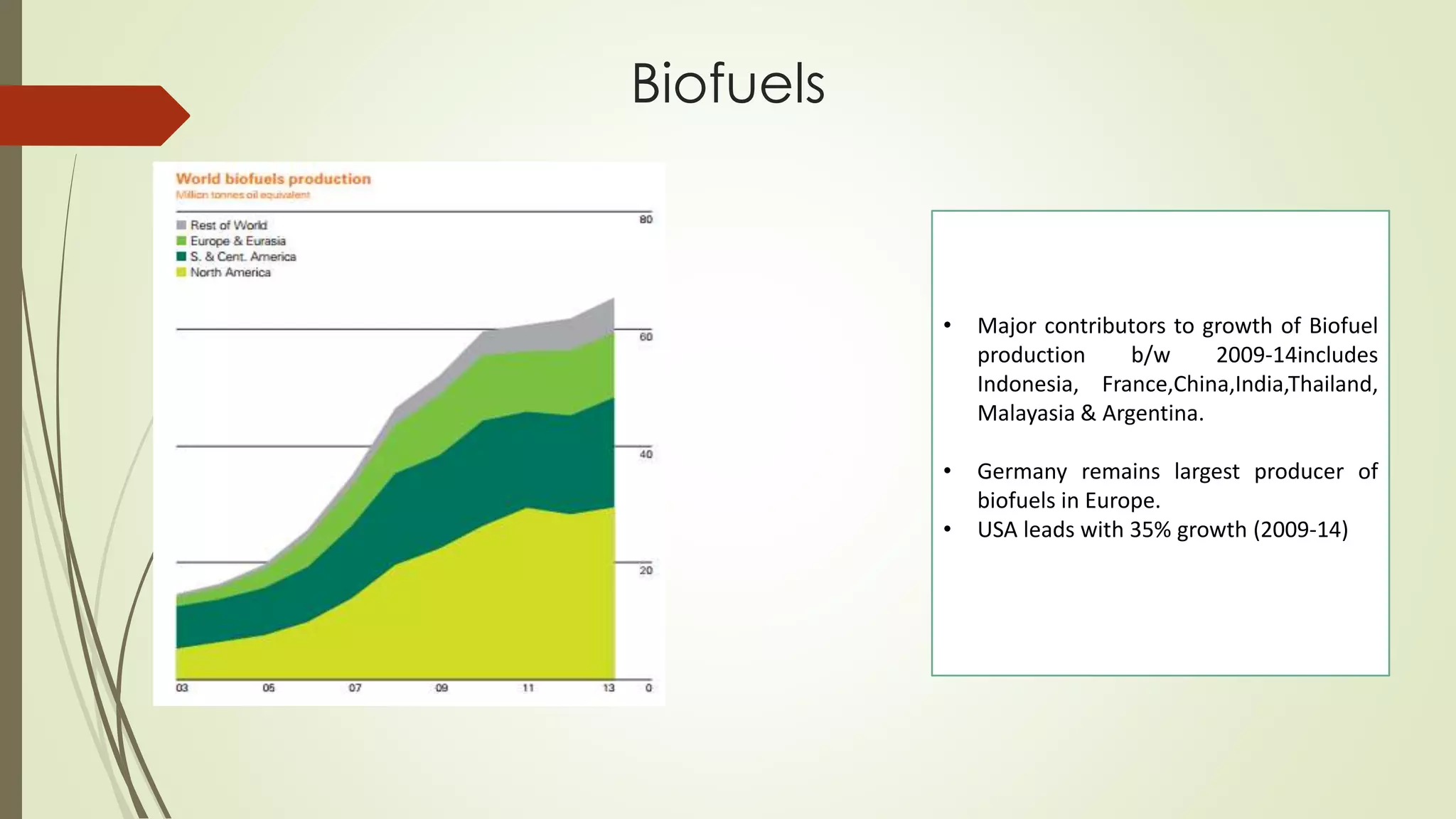
Biofuels
• Major contributors to growth of Biofuel
production b/w 2009-14includes
Indonesia, France,China,India,Thailand,
Malayasia & Argentina.
• Germany remains largest producer of
biofuels in Europe.
• USA leads with 35% growth (2009-14)
Facts & Conclusions
 According to Bloomberg, renewable power generation capacity in 2013 made up 13.7%
of world generation capacity, up from 12.6% in 2012, and accounted for 8.5% of world
generation, up from 7.8% in 2012. Investments in new renewable generation assets made
up more than 40% of worldwide investments in all generation assets in 2013 as in 2012 .
 Nine percent of total final energy consumption is modern renewable energy, and up to
another 9% is traditional biomass (mainly used for heating), of which only part is
sustainable, resulting in a total renewable energy share of 18% in 2010 .
 Renewable energy sources (excluding hydropower)—in power generation as well as
transport—continued to increase in 2013, reaching a record 2.7% of global energy
consumption, up from 0.8% a decade ago. Renewable energy accounted for more than
5% of global electricity production for the first time, and 15% of EU power generation .
 Hydropower makes up the largest share of renewable electricity generation by a wide
margin .
 On 2013, global hydroelectric output grew by a below average 2.9%, and accounted for
6.7% of global energy consumption .
 In the OECD area the bulk of hydropower resources has already been developed. Outside the
OECD area the situation is different. OECD generation is assumed to grow by 0.6% per year
between 2010 and 2040, Chinese and other non-OECD generation by averages of 3.1% and 2.4%
per year, respectively.
 Global investments in wind power declined by 6% in 2012 and by another 1% in 2013. Investments
in solar power dropped by almost 10% in 2012 and plummeted by more than 20% in 2013.
 Globally, wind energy (+20.7%) once again accounted for more than half of renewable power
generation growth and solar power generation grew even more rapidly (+33%), but from a
smaller base .
 Global biofuels production grew by a below-average 6.1%
 In 2013, approximately 6.5 million people were employed in the renewable energy industry
(excluding hydropower except for small hydropower) worldwide.
 In 2013, the solar photovoltaic sector accounted for 2.3 million jobs. Liquid biofuels, modern
biomass and biogas were large employers (1.4 million, 0.8 million and 0.3 million). Wind
employment remained relatively stable at 0.8 million jobs.
 China remains the largest employer in renewable energy sector in 2013
References
1. Statistical Review of World Energy 2014, BP
2. Energy Perspectives 2014, Statoil
3. REmap 2030, IRENA
4. World Energy Investment Outlook, IEA
5. Renewable Energy and Jobs – Annual Review 2014,
IRENA

Critical analysis of renewable energy sources

  • 1.
  • 2.
    Outline  Forms ofrenewable sources  Global renewable energy production  Solar Energy  Wind Energy  Geo Thermal  Hydro Power  Biofuels  Facts
  • 3.
    Forms of renewablesources  Solar Energy  Wind Energy  Geo Thermal Energy  Hydroelectric Energy  Biomass Technology
  • 4.
    Global Renewable EnergyProduction • Renewable energy provided 22% of worlds total power generation.(2013) • Global renewable power generation rose by almost 240TWh at a CAGR of 5% from 2005-14.
  • 5.
    Solar Energy 0 20000 40000 60000 80000 100000 120000 140000 2003 20042005 2006 2007 2008 2009 2010 2011 2012 2013 Solar Energy Installed Capacity (in mw) Germany China Italy Japan USA Spain France Australia Belgium • World solar power capacity grew at a rate 36.8% in 2013 as compared to 2012. • Italy has shown tremendous growth • China’s investment into solar in 2013= 30 Billion dollars • Japan grew by 102 % from 2012 to 2013 • Spain added a record 2.6 GW of solar power in 2008 Germany’s Simple FIT policy Italy solar pv utilization - 1500 hours/year – High Utilisation.
  • 6.
    0 5 10 15 20 25 30 2003 2004 20052006 2007 2008 2009 2010 2011 2012 2013 Solar Energy Consumption (in mtoe) Germany Italy Spain China Japan USA France Australia Czech Belgium • China has more installed capacity than Italy but consumption is more for Italy.
  • 7.
    Wind Energy 0 50000 100000 150000 200000 250000 300000 2003 20042005 2006 2007 2008 2009 2010 2011 2012 2013 Wind Energy Production(in mw) USA China Germany Spain India Canada Denmark Sweden Brazil france Italy Protugal Japan Netherlands • Wind energy has grown at CAGR of 23% (2003- 13) • China’s growth has surged at the rate of 25% from 2007-2013
  • 8.
    - 20.0 40.0 60.0 80.0 100.0 120.0 140.0 2003 2004 20052006 2007 2008 2009 2010 2011 2012 2013 Wind energy consumption USA China Spain Germany India france Italy Protugal Canada Denmark Sweden Brazil Netherlands Japan
  • 9.
    Geo Thermal 0 2000 4000 6000 8000 10000 12000 2003 20042005 2006 2007 2008 2009 2010 2011 2012 2013 Geo thermal Production USA Phillippines indonesia italy New Zealand Iceland Japan Brazil Turkey Nicargua
  • 10.
    - 10.0 20.0 30.0 40.0 50.0 60.0 70.0 80.0 2003 2004 20052006 2007 2008 2009 2010 2011 2012 2013 Geo Thermal Consumption USA Brazil Germany China Japan Italy India Phillippines indonesia mexico
  • 11.
    Hydropower Global hydroelectric outputgrew by a below-average 2.9%. Growth in China, Russia, Spain and India was partly offset by large declines in Brazil and the Nordic countries. • China has tapped large quantities of rivers for hydropower generation. • Brazil experienced worst drought in 80 years resulting in decline in production.
  • 12.
    Biofuels • Major contributorsto growth of Biofuel production b/w 2009-14includes Indonesia, France,China,India,Thailand, Malayasia & Argentina. • Germany remains largest producer of biofuels in Europe. • USA leads with 35% growth (2009-14)
  • 13.
    Facts & Conclusions According to Bloomberg, renewable power generation capacity in 2013 made up 13.7% of world generation capacity, up from 12.6% in 2012, and accounted for 8.5% of world generation, up from 7.8% in 2012. Investments in new renewable generation assets made up more than 40% of worldwide investments in all generation assets in 2013 as in 2012 .  Nine percent of total final energy consumption is modern renewable energy, and up to another 9% is traditional biomass (mainly used for heating), of which only part is sustainable, resulting in a total renewable energy share of 18% in 2010 .  Renewable energy sources (excluding hydropower)—in power generation as well as transport—continued to increase in 2013, reaching a record 2.7% of global energy consumption, up from 0.8% a decade ago. Renewable energy accounted for more than 5% of global electricity production for the first time, and 15% of EU power generation .  Hydropower makes up the largest share of renewable electricity generation by a wide margin .  On 2013, global hydroelectric output grew by a below average 2.9%, and accounted for 6.7% of global energy consumption .
  • 14.
     In theOECD area the bulk of hydropower resources has already been developed. Outside the OECD area the situation is different. OECD generation is assumed to grow by 0.6% per year between 2010 and 2040, Chinese and other non-OECD generation by averages of 3.1% and 2.4% per year, respectively.  Global investments in wind power declined by 6% in 2012 and by another 1% in 2013. Investments in solar power dropped by almost 10% in 2012 and plummeted by more than 20% in 2013.  Globally, wind energy (+20.7%) once again accounted for more than half of renewable power generation growth and solar power generation grew even more rapidly (+33%), but from a smaller base .  Global biofuels production grew by a below-average 6.1%  In 2013, approximately 6.5 million people were employed in the renewable energy industry (excluding hydropower except for small hydropower) worldwide.  In 2013, the solar photovoltaic sector accounted for 2.3 million jobs. Liquid biofuels, modern biomass and biogas were large employers (1.4 million, 0.8 million and 0.3 million). Wind employment remained relatively stable at 0.8 million jobs.  China remains the largest employer in renewable energy sector in 2013
  • 15.
    References 1. Statistical Reviewof World Energy 2014, BP 2. Energy Perspectives 2014, Statoil 3. REmap 2030, IRENA 4. World Energy Investment Outlook, IEA 5. Renewable Energy and Jobs – Annual Review 2014, IRENA