CRITERION B: DESIGN
DATA STRUCTURES
This program involves two main classes: events and tasks. Events are scheduled
components of the agenda. An event includes a title, start time, and an end time. Tasks do not
have any set times, but have a duration and priority, both of which can be updated by the user.
Ultimately, the agenda will display only events; some of the events will be static while other will
be instances of placed tasks. Since Java’s “DateTime” data structures are too complex, simpler
Time and Duration classes will be created and used.
ALGORITHMS
Although the data structures are fairly simple, the algorithms are quite complex. Apart
from the myriad simpler algorithms that convert user input into data structures, the core
algorithm of the program needs to take tasks given duration and priority, and time them into
agenda events. In addition, another algorithm is to change the timing of the tasks when tasks are
progressed or completed. Here is a shortened example:
Task Title Task Duration Task Priority
A 30 minutes (0:30) 1
B 25 minutes (0:25) 2
C 1 hour (1:00) 3
D 5 minutes (0:05) 4
E 2 hours (2:00) 5
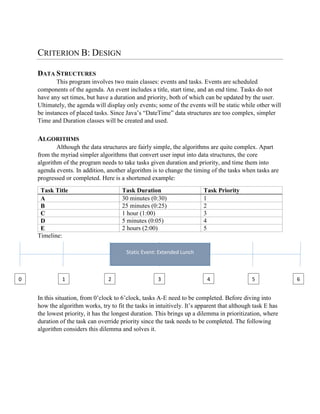
Timeline:
In this situation, from 0’clock to 6’clock, tasks A-E need to be completed. Before diving into
how the algorithm works, try to fit the tasks in intuitively. It’s apparent that although task E has
the lowest priority, it has the longest duration. This brings up a dilemma in prioritization, where
duration of the task can override priority since the task needs to be completed. The following
algorithm considers this dilemma and solves it.
0 1 2 3 4 5 6
Static Event: Extended Lunch
This is the central algorithm of the program, involving other complex processes such as getting
free time, prioritizing tasks, and managing all the events in the agenda.

Crit B Design

  • 1.
    CRITERION B: DESIGN DATASTRUCTURES This program involves two main classes: events and tasks. Events are scheduled components of the agenda. An event includes a title, start time, and an end time. Tasks do not have any set times, but have a duration and priority, both of which can be updated by the user. Ultimately, the agenda will display only events; some of the events will be static while other will be instances of placed tasks. Since Java’s “DateTime” data structures are too complex, simpler Time and Duration classes will be created and used. ALGORITHMS Although the data structures are fairly simple, the algorithms are quite complex. Apart from the myriad simpler algorithms that convert user input into data structures, the core algorithm of the program needs to take tasks given duration and priority, and time them into agenda events. In addition, another algorithm is to change the timing of the tasks when tasks are progressed or completed. Here is a shortened example: Task Title Task Duration Task Priority A 30 minutes (0:30) 1 B 25 minutes (0:25) 2 C 1 hour (1:00) 3 D 5 minutes (0:05) 4 E 2 hours (2:00) 5 Timeline: In this situation, from 0’clock to 6’clock, tasks A-E need to be completed. Before diving into how the algorithm works, try to fit the tasks in intuitively. It’s apparent that although task E has the lowest priority, it has the longest duration. This brings up a dilemma in prioritization, where duration of the task can override priority since the task needs to be completed. The following algorithm considers this dilemma and solves it. 0 1 2 3 4 5 6 Static Event: Extended Lunch
  • 2.
    This is thecentral algorithm of the program, involving other complex processes such as getting free time, prioritizing tasks, and managing all the events in the agenda.