GENERAL SAFETY AND CRIME
PREVENTION INFORMATION
PCpl Jo Erick M Dazo
Station Community Affairs Section
GENERAL SAFETY AND CRIME PREVENTION
INFORMATION
•Crime Prevention Tips
•Emergency Call
•Keeping the family/children and home Safe
•Safety Tips on the Streets/ Commuters/ Travel
WE THE POLICE OFFICERS
• The Philippine National Police is committed to ensuring public
safety and reducing the fear and the incidence of crime in the
community.
• Following slides are crime prevention tips for your home, your
business, yourself and your family. We urge you to familiarize
yourself with the information contained in this section and to
make crime prevention, awareness and education a part of your
everyday life.
CRIME PREVENTION TIPS
Crime Prevention Starts With You And
Your Family
• More often than not, crimes occur because we open ourselves and our
families to criminal opportunities. Talking to strangers, absence of security
procedures for anonymous callers, taking for granted one’s safety outside
the home, etc. make us easy prey to criminals. In the fight against crime,
knowing that the worst can happen makes you less prone to be a victim
and more confident of avoiding disasters.
• Protecting yourself, your family and your home is a matter of
responsibility that cannot be taken on by anyone else. You can make the
difference.
Crime Prevention Tips
• Get to know your neighbors and all those residing in your street. They
will be your partners in watching the activities in your block.
• Organize a Street Watch composed of neighbors as members. Be
concerned and cooperate in watching activities on the block and
reporting unusual or suspicious behavior to the police and the Street
Watch Officer.
• Attend meetings called by your Street Watch Officer. Find out about
the crime situation in your area and what you can do about them.
Share information and experiences with your neighbors
Crime Prevention Tips
• Look after you neighbor's house when he is away and ask him to
look after yours. This includes collecting your mail, newspapers and
other deliveries which would indicate at a glance that no one is
home.
• Get to know your police chief and members of the police station in
your area. Write down the station’s emergency hotline number in a
place you can easily see in case you will need police advise or
assistance. Use your police force – they are ready, willing and able
to keep you, your family and your neighborhood safe and sound.
Crime Prevention Tips
• Exchange names, home and work telephone numbers among
members. Prepare diagram of the block or neighbourhood where
you belong for easy identification of households in case an
emergency or crime incident occurs. The diagram should contain
the house number, telephone numbers and occupants' names. The
emergency and police department telephone numbers should be
included in the diagram.
EMERGENCY CALLS
Emergency Call
An emergency call is defined as a situation where a person’s life or
property is in danger or threatened. In-progress calls are where
crimes are being committed at the time of your report.
Examples of Emergency Calls
• Accidents with injuries
• All fire calls
• Rescue calls
• Ambulance calls
• Persons injured or bleeding
• Stabbings
• Armed robberies
• Rape
Non-Emergency Call
A non-emergency call is a situation where a person’s life and property
is not in immediate danger. Included under this definition are crimes
against property, crimes against persons where the victim is not
injured and offenders are not at or near the scene. However, a police
officer is needed to respond, investigate and take a report
Examples of Emergency Calls
• Smashed doors or windows in unoccupied homes or stores.
• Abandoned car on the street.
• Persons loitering near school.
• Information and rumors of impending crimes.
Emergency Call
• All Calls are treated emergencies and valid until some validation are
conducted regardless of the information received.
• Upon receiving calls / texts / tips and any information always relay
and forward said information to concerned authorities
• Be responsible in using Emergency Hotlines.
Information the emergency operator
will want to know
• A description of the emergency you are reporting. (What did you observe?)
• The address or location of the emergency you are reporting.
• Your name, address and telephone number.
• Number of persons involved.
• Descriptions of the persons involved.
• Direction taken by the escaping suspects.
• Is suspect in a vehicle or on foot?
• Plate number and description of vehicle.
• Other details and circumstances.
KEEPING THE FAMILY SAFE
Keeping the family Safe
• Make sure you and members of your family know the whereabouts
of everyone for the day. Place a “whereabouts” board in the kitchen
or family room where family members can post their schedules or
destinations for the day.
• Instruct all family members and household help not to entertain
strangers at the gate or on the phone. Children should be especially
trained not to converse with strangers on the phone. Transactions, if
any, should be done outside the gate. This will prevent closer
observation of your premises or the household layout.
Keeping the family Safe
• Never give out information on the whereabouts of family members
to just anyone on the phone. Friends or relatives should be politely
asked to call again so they can personally talk to the person they are
looking for. Should the unknown caller insist on asking to speak to
each and every family member, ask for his name and politely say the
message will be relayed and that he should call back again. Call the
police for assistance if you Repeatedly receive anonymous phone
calls.
• Teach your family and household helps to verify the identity of
phone callers before identifying themselves.
Keeping the family Safe
• Instruct family members and your house help that designated family
member must be contacted in an emergency or if there are dubious
characters at your door or on your phone. List the important phone
numbers in the front or back page of your directory for easy access.
• Be aware of phone swindlers who call in and report that one family
member has been in an accident and is asking for the family
member or household help to bring cash or other valuable to a
certain place. Verify with another family member before acting on
this
Keeping the family Safe
• Verify the identity of callers at your gate before opening the door.
Use peepholes provided on gates and doors for this purpose. Should
the stranger be a repairman, electrician or the like, verify his identity
by calling the service office.
• Advise your children to refrain from playing/loitering on streets
outside your residence where they are highly vulnerable to
abduction. Advice your children never to leave home without telling
you of their destination and expected time of arrival.
Keeping the family Safe
• Do a background check of anyone you intend to employ i.e. baby-
sitter, gardener, domestic helper, driver or security guard. It is
possible that the kidnappers would be utilizing such persons to
infiltrate your residence to acquire vital information on household
valuable, routines, layout and patterns.
• Teach your children not to talk to strangers or accept anything from
strangers, especially in school. Should they be approached, tell them
to report the incident to school authorities
KEEPING THE CHILDREN SAFE
Keeping the Children Safe
• Ask your children’s school not to give out any information regarding
your children to anybody. Insist that strict guidelines be followed
regarding persons authorized to pick-up your children. Other than
those duly authorized by you, your children should not be allowed to
leave with any other person without prior authorization from you.
• Teach your children not to talk to strangers or accept anything from
strangers, especially in school. Should they be approached, tell them
to report the incident to school authorities
Keeping the Children Safe
• When outside put a tag / card in pockets of your child/children
containing basic important information. Having your child memorize
basic information will help in the future and contacting you when
they are lost.
• Don’t Keep Secret communicate and bridge the Gap. Kids are often
told to keep something their friend or sibling did secret, but teach
them that should they believe the activity was dangerous, harmful
or really naughty, they should not be afraid to tell you.
Keeping the Children Safe
• No one is allowed to touch your kid’s body. This is a very important
personal safety rule for kids and you should teach about it as soon as your kid
can understand the basics. Teach about good touch and bad touch. Tell your kid
that no one is allowed to touch your kid except mommy, and sometimes papa, if
needed. If anyone else has touched your kid, your kid should immediately shout
for help and alert people around.
SECURING YOUR HOME AND YOUR BELONGINGS
SECURING YOUR HOME AND YOUR
BELONGINGS
There are three things you can do to help reduce burglary:
• Make your home burglar-proof.
• Mark your belongings that burglars are most likely to steal.
• Be alert to report suspicious persons and unusual activities to the
police before a crime may occur.
What can you do?
• Ensure all doors and windows have locks in working condition.
Keep only that is used to enter the house open, all other entry
points to your household should be securely locked to prevent
unnoticed entry into your home.
• Make it a habit to check that all doors and windows are locked at
night before going to sleep. The dark of night is a most ready
camouflage for robbers and other criminals.
What can you do?
• Outside your home: Prune lower tree limbs – don’t provide the
thief with a natural ladder into second floor windows. Keep the
view to your house open – criminals love to hide behind tall fences
or overgrown bushes while breaking into your home.
• Keeps porches, yards, and all entrances to your house and garage
well lighted. Leave lights on inside your house when you go out for
the evening.
What can you do?
• Keep a record of the important information (especially make,
model number, serial number) of all household facilities and
equipment, such as TV, radio, video cassette recorder, refrigerator,
VCR, washing machine. Have an inventory of your jewelry and
other precious items and documents like birth, baptismal and
marriage certificates.
• Store cash and other valuable in the bank. Hiding them inside
locked drawers does not guarantee that they will be safe from the
knowing eyes and practiced moves of robbers
What can you do?
• Bring in all outdoor equipment (bicycles, garden hose, mower,
etc.) at night. Leaving these valuables out in the garden or street is
an open invitation to robbers and thieves.
• If you and your family are going on a vacation, ask a neighbor to
watch your home, or ask a relative to stay in your home while you
are away. An empty house is a prime target for criminal elements.
• Protect your house from prying eyes by using curtains or drapes.
What can you do?
• Provide family members with their own keys to the house. This is
safer than leaving the key in a “secret” place, one that can be
discovered by any person who takes the time to watch your
movements when you leave your home and come back at night.
What can you do? If you are under threat…
• If there are suspicious sounds or shadows in your home, try to
contract the police quietly so as not to let the intruders know that
you are aware of their presence. Most robbers are after the
property inside your home, and are more prone to working swiftly
and quietly to avoid any physical or violent encounters.
What can you do? If you awake to the sound of
an intruder, you have several options
• Lie quietly to avoid attracting attention to yourself, hoping that they will
leave you undisturbed.
• You may choose to open lights and make noise by moving around
thereby warning them that you are awake, and scaring them into leaving
your home. Even if you are alone in the house, you may speak loudly to
an imaginary companion.
• If you see signs of a break-in or suspicious persons inside your home, do
not attempt to go in as the robbers may still be inside. Go to your
nearest neighbor and call the police for immediate assistance.
What can you do? If you awake to the sound of
an intruder, you have several options
• Remain calm and do not panic. Although a robber would prefer to
avoid confrontation, they are easily agitated and more prone to
uncalled for abuse or violence.
• Try to talk it out with the robbers. If you are up to it. This will delay
them, and allow for alternative action on your part, if the situation
allows.
• Note all peculiarities and mannerisms of the robbers, if you come
face-to-face with them. Tattoo marks, physical defects, moles and
speech mannerisms will help in giving the police a more solid
description of the robbers
SAFETY TIPS ON THE STREETS
• Day or night, do not walk in dark streets, alleys and unsafe
shortcuts.
• Stay away from dark isolated places or vacant lots at night. These
areas are hangouts of criminals. Do not take chances.
• Do not walk between parked cars in parking lots. Avoid walking
alone in unlit and uncertain places. At night, wait for buses,
taxicabs or jeepneys in well-lighted areas.
SAFETY TIPS ON THE STREETS
• When going to economically depressed areas (slums/squatter’s
area) communities, do not wear expensive jewelry and carry
substantial cash. If you decide to go to such places, remove your
jewelry; this may save your life or limbs.
• Do not flash a lot of cash around when travelling. Money attracts
the “bad eggs.”
COMMUTER SAFETY
COMMUTER SAFETY
• When in a bus or jeepney, do not extend your hand out the
window; your watch/jewelry could be snatched or your hand
injured by another vehicle.
• When you ride a cab, take the habit of getting the name of the
cab, its plate number, and the cab driver’s name. This will be
handy in case you leave something in the cab or if the driver tries
to hurt or rob you.
COMMUTER SAFETY
• Be careful with what you carry when riding on a crowded bus. If
you are to carry so many things, take a cab home and check the
cab well before alighting.
• If you are to visit someone, call him/her for your expected time of
arrival. This will be helpful in case an accident happens on the way.
It is also advisable to always inform your relatives or neighbors
where you are going and for how long you will be away.
TIPS FOR WOMEN
Tips for Women
• If someone is talking you, seek the help of security guards (when
inside a building) and then call or go to the nearest police
block/station in your area.
• Do not ride a jeepney if there are no female passengers inside, wait
for the next vehicles. It is safer to take a bus if you are commuting
alone at night. Sit near the driver if passengers are predominantly
male.
• Ask somebody to accompany you when traveling, especially if night
will overtake you.
Tips for Women
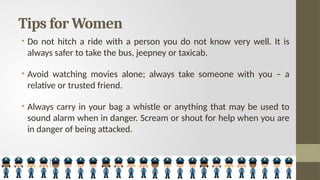
• Do not hitch a ride with a person you do not know very well. It is
always safer to take the bus, jeepney or taxicab.
• Avoid watching movies alone; always take someone with you – a
relative or trusted friend.
• Always carry in your bag a whistle or anything that may be used to
sound alarm when in danger. Scream or shout for help when you are
in danger of being attacked.
COMMON CRIME MODUS
COMMON CRIME MODUS
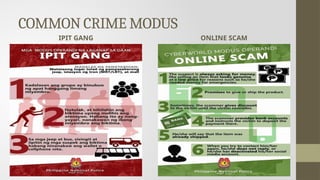
IPIT GANG ONLINE SCAM
COMMON CRIME MODUS
BUKAS KOTSE GANG BEST FRIEND GANG
COMMON CRIME MODUS
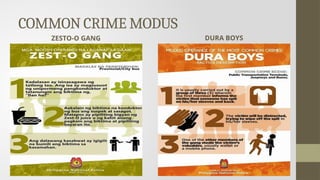
ZESTO-O GANG DURA BOYS
COMMON CRIME MODUS
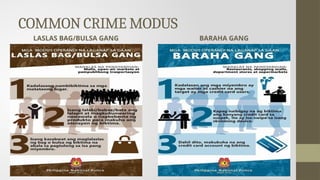
LASLAS BAG/BULSA GANG BARAHA GANG
COMMON CRIME MODUS
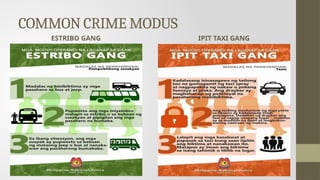
ESTRIBO GANG IPIT TAXI GANG
COMMON CRIME MODUS
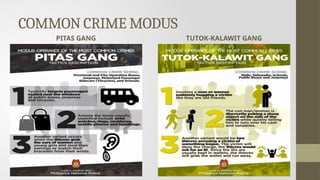
PITAS GANG TUTOK-KALAWIT GANG
COMMON CRIME MODUS
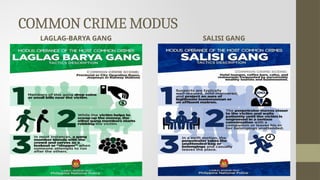
LAGLAG-BARYA GANG SALISI GANG
NORTHERN POLICE DISTRICT
Tel#: 287-3717
Ireport mo kay Tsip
0917-847-5757
E-SUMBONG SMS HOTLINES
SMART: 0919-160-1752
GLOBE: 0917-847-5757
VALENZUELA CITY POLICE STATION
TEL# 8-352-4000
CP# 0906-119-7676
OIC-VCPS# 0998-967-4505
FB PAGE: Valenzuela City Police Station
HUWAG MATAKOT!!
ISUMBONG MO!
END OF PRESENTATION
MARAMING SALAMAT PO

Crime Prevention Lecture for General Attendees

  • 1.
    GENERAL SAFETY ANDCRIME PREVENTION INFORMATION PCpl Jo Erick M Dazo Station Community Affairs Section
  • 2.
    GENERAL SAFETY ANDCRIME PREVENTION INFORMATION •Crime Prevention Tips •Emergency Call •Keeping the family/children and home Safe •Safety Tips on the Streets/ Commuters/ Travel
  • 3.
    WE THE POLICEOFFICERS • The Philippine National Police is committed to ensuring public safety and reducing the fear and the incidence of crime in the community. • Following slides are crime prevention tips for your home, your business, yourself and your family. We urge you to familiarize yourself with the information contained in this section and to make crime prevention, awareness and education a part of your everyday life.
  • 4.
  • 5.
    Crime Prevention StartsWith You And Your Family • More often than not, crimes occur because we open ourselves and our families to criminal opportunities. Talking to strangers, absence of security procedures for anonymous callers, taking for granted one’s safety outside the home, etc. make us easy prey to criminals. In the fight against crime, knowing that the worst can happen makes you less prone to be a victim and more confident of avoiding disasters. • Protecting yourself, your family and your home is a matter of responsibility that cannot be taken on by anyone else. You can make the difference.
  • 6.
    Crime Prevention Tips •Get to know your neighbors and all those residing in your street. They will be your partners in watching the activities in your block. • Organize a Street Watch composed of neighbors as members. Be concerned and cooperate in watching activities on the block and reporting unusual or suspicious behavior to the police and the Street Watch Officer. • Attend meetings called by your Street Watch Officer. Find out about the crime situation in your area and what you can do about them. Share information and experiences with your neighbors
  • 7.
    Crime Prevention Tips •Look after you neighbor's house when he is away and ask him to look after yours. This includes collecting your mail, newspapers and other deliveries which would indicate at a glance that no one is home. • Get to know your police chief and members of the police station in your area. Write down the station’s emergency hotline number in a place you can easily see in case you will need police advise or assistance. Use your police force – they are ready, willing and able to keep you, your family and your neighborhood safe and sound.
  • 8.
    Crime Prevention Tips •Exchange names, home and work telephone numbers among members. Prepare diagram of the block or neighbourhood where you belong for easy identification of households in case an emergency or crime incident occurs. The diagram should contain the house number, telephone numbers and occupants' names. The emergency and police department telephone numbers should be included in the diagram.
  • 9.
  • 10.
    Emergency Call An emergencycall is defined as a situation where a person’s life or property is in danger or threatened. In-progress calls are where crimes are being committed at the time of your report. Examples of Emergency Calls • Accidents with injuries • All fire calls • Rescue calls • Ambulance calls • Persons injured or bleeding • Stabbings • Armed robberies • Rape
  • 11.
    Non-Emergency Call A non-emergencycall is a situation where a person’s life and property is not in immediate danger. Included under this definition are crimes against property, crimes against persons where the victim is not injured and offenders are not at or near the scene. However, a police officer is needed to respond, investigate and take a report Examples of Emergency Calls • Smashed doors or windows in unoccupied homes or stores. • Abandoned car on the street. • Persons loitering near school. • Information and rumors of impending crimes.
  • 12.
    Emergency Call • AllCalls are treated emergencies and valid until some validation are conducted regardless of the information received. • Upon receiving calls / texts / tips and any information always relay and forward said information to concerned authorities • Be responsible in using Emergency Hotlines.
  • 13.
    Information the emergencyoperator will want to know • A description of the emergency you are reporting. (What did you observe?) • The address or location of the emergency you are reporting. • Your name, address and telephone number. • Number of persons involved. • Descriptions of the persons involved. • Direction taken by the escaping suspects. • Is suspect in a vehicle or on foot? • Plate number and description of vehicle. • Other details and circumstances.
  • 14.
  • 15.
    Keeping the familySafe • Make sure you and members of your family know the whereabouts of everyone for the day. Place a “whereabouts” board in the kitchen or family room where family members can post their schedules or destinations for the day. • Instruct all family members and household help not to entertain strangers at the gate or on the phone. Children should be especially trained not to converse with strangers on the phone. Transactions, if any, should be done outside the gate. This will prevent closer observation of your premises or the household layout.
  • 16.
    Keeping the familySafe • Never give out information on the whereabouts of family members to just anyone on the phone. Friends or relatives should be politely asked to call again so they can personally talk to the person they are looking for. Should the unknown caller insist on asking to speak to each and every family member, ask for his name and politely say the message will be relayed and that he should call back again. Call the police for assistance if you Repeatedly receive anonymous phone calls. • Teach your family and household helps to verify the identity of phone callers before identifying themselves.
  • 17.
    Keeping the familySafe • Instruct family members and your house help that designated family member must be contacted in an emergency or if there are dubious characters at your door or on your phone. List the important phone numbers in the front or back page of your directory for easy access. • Be aware of phone swindlers who call in and report that one family member has been in an accident and is asking for the family member or household help to bring cash or other valuable to a certain place. Verify with another family member before acting on this
  • 18.
    Keeping the familySafe • Verify the identity of callers at your gate before opening the door. Use peepholes provided on gates and doors for this purpose. Should the stranger be a repairman, electrician or the like, verify his identity by calling the service office. • Advise your children to refrain from playing/loitering on streets outside your residence where they are highly vulnerable to abduction. Advice your children never to leave home without telling you of their destination and expected time of arrival.
  • 19.
    Keeping the familySafe • Do a background check of anyone you intend to employ i.e. baby- sitter, gardener, domestic helper, driver or security guard. It is possible that the kidnappers would be utilizing such persons to infiltrate your residence to acquire vital information on household valuable, routines, layout and patterns. • Teach your children not to talk to strangers or accept anything from strangers, especially in school. Should they be approached, tell them to report the incident to school authorities
  • 20.
  • 21.
    Keeping the ChildrenSafe • Ask your children’s school not to give out any information regarding your children to anybody. Insist that strict guidelines be followed regarding persons authorized to pick-up your children. Other than those duly authorized by you, your children should not be allowed to leave with any other person without prior authorization from you. • Teach your children not to talk to strangers or accept anything from strangers, especially in school. Should they be approached, tell them to report the incident to school authorities
  • 22.
    Keeping the ChildrenSafe • When outside put a tag / card in pockets of your child/children containing basic important information. Having your child memorize basic information will help in the future and contacting you when they are lost. • Don’t Keep Secret communicate and bridge the Gap. Kids are often told to keep something their friend or sibling did secret, but teach them that should they believe the activity was dangerous, harmful or really naughty, they should not be afraid to tell you.
  • 23.
    Keeping the ChildrenSafe • No one is allowed to touch your kid’s body. This is a very important personal safety rule for kids and you should teach about it as soon as your kid can understand the basics. Teach about good touch and bad touch. Tell your kid that no one is allowed to touch your kid except mommy, and sometimes papa, if needed. If anyone else has touched your kid, your kid should immediately shout for help and alert people around.
  • 24.
    SECURING YOUR HOMEAND YOUR BELONGINGS
  • 25.
    SECURING YOUR HOMEAND YOUR BELONGINGS There are three things you can do to help reduce burglary: • Make your home burglar-proof. • Mark your belongings that burglars are most likely to steal. • Be alert to report suspicious persons and unusual activities to the police before a crime may occur.
  • 26.
    What can youdo? • Ensure all doors and windows have locks in working condition. Keep only that is used to enter the house open, all other entry points to your household should be securely locked to prevent unnoticed entry into your home. • Make it a habit to check that all doors and windows are locked at night before going to sleep. The dark of night is a most ready camouflage for robbers and other criminals.
  • 27.
    What can youdo? • Outside your home: Prune lower tree limbs – don’t provide the thief with a natural ladder into second floor windows. Keep the view to your house open – criminals love to hide behind tall fences or overgrown bushes while breaking into your home. • Keeps porches, yards, and all entrances to your house and garage well lighted. Leave lights on inside your house when you go out for the evening.
  • 28.
    What can youdo? • Keep a record of the important information (especially make, model number, serial number) of all household facilities and equipment, such as TV, radio, video cassette recorder, refrigerator, VCR, washing machine. Have an inventory of your jewelry and other precious items and documents like birth, baptismal and marriage certificates. • Store cash and other valuable in the bank. Hiding them inside locked drawers does not guarantee that they will be safe from the knowing eyes and practiced moves of robbers
  • 29.
    What can youdo? • Bring in all outdoor equipment (bicycles, garden hose, mower, etc.) at night. Leaving these valuables out in the garden or street is an open invitation to robbers and thieves. • If you and your family are going on a vacation, ask a neighbor to watch your home, or ask a relative to stay in your home while you are away. An empty house is a prime target for criminal elements. • Protect your house from prying eyes by using curtains or drapes.
  • 30.
    What can youdo? • Provide family members with their own keys to the house. This is safer than leaving the key in a “secret” place, one that can be discovered by any person who takes the time to watch your movements when you leave your home and come back at night.
  • 31.
    What can youdo? If you are under threat… • If there are suspicious sounds or shadows in your home, try to contract the police quietly so as not to let the intruders know that you are aware of their presence. Most robbers are after the property inside your home, and are more prone to working swiftly and quietly to avoid any physical or violent encounters.
  • 32.
    What can youdo? If you awake to the sound of an intruder, you have several options • Lie quietly to avoid attracting attention to yourself, hoping that they will leave you undisturbed. • You may choose to open lights and make noise by moving around thereby warning them that you are awake, and scaring them into leaving your home. Even if you are alone in the house, you may speak loudly to an imaginary companion. • If you see signs of a break-in or suspicious persons inside your home, do not attempt to go in as the robbers may still be inside. Go to your nearest neighbor and call the police for immediate assistance.
  • 33.
    What can youdo? If you awake to the sound of an intruder, you have several options • Remain calm and do not panic. Although a robber would prefer to avoid confrontation, they are easily agitated and more prone to uncalled for abuse or violence. • Try to talk it out with the robbers. If you are up to it. This will delay them, and allow for alternative action on your part, if the situation allows. • Note all peculiarities and mannerisms of the robbers, if you come face-to-face with them. Tattoo marks, physical defects, moles and speech mannerisms will help in giving the police a more solid description of the robbers
  • 34.
    SAFETY TIPS ONTHE STREETS
  • 35.
    SAFETY TIPS ONTHE STREETS • Day or night, do not walk in dark streets, alleys and unsafe shortcuts. • Stay away from dark isolated places or vacant lots at night. These areas are hangouts of criminals. Do not take chances. • Do not walk between parked cars in parking lots. Avoid walking alone in unlit and uncertain places. At night, wait for buses, taxicabs or jeepneys in well-lighted areas.
  • 36.
    SAFETY TIPS ONTHE STREETS • When going to economically depressed areas (slums/squatter’s area) communities, do not wear expensive jewelry and carry substantial cash. If you decide to go to such places, remove your jewelry; this may save your life or limbs. • Do not flash a lot of cash around when travelling. Money attracts the “bad eggs.”
  • 37.
  • 38.
    COMMUTER SAFETY • Whenin a bus or jeepney, do not extend your hand out the window; your watch/jewelry could be snatched or your hand injured by another vehicle. • When you ride a cab, take the habit of getting the name of the cab, its plate number, and the cab driver’s name. This will be handy in case you leave something in the cab or if the driver tries to hurt or rob you.
  • 39.
    COMMUTER SAFETY • Becareful with what you carry when riding on a crowded bus. If you are to carry so many things, take a cab home and check the cab well before alighting. • If you are to visit someone, call him/her for your expected time of arrival. This will be helpful in case an accident happens on the way. It is also advisable to always inform your relatives or neighbors where you are going and for how long you will be away.
  • 40.
  • 41.
    Tips for Women •If someone is talking you, seek the help of security guards (when inside a building) and then call or go to the nearest police block/station in your area. • Do not ride a jeepney if there are no female passengers inside, wait for the next vehicles. It is safer to take a bus if you are commuting alone at night. Sit near the driver if passengers are predominantly male. • Ask somebody to accompany you when traveling, especially if night will overtake you.
  • 42.
    Tips for Women •Do not hitch a ride with a person you do not know very well. It is always safer to take the bus, jeepney or taxicab. • Avoid watching movies alone; always take someone with you – a relative or trusted friend. • Always carry in your bag a whistle or anything that may be used to sound alarm when in danger. Scream or shout for help when you are in danger of being attacked.
  • 43.
  • 44.
    COMMON CRIME MODUS IPITGANG ONLINE SCAM
  • 45.
    COMMON CRIME MODUS BUKASKOTSE GANG BEST FRIEND GANG
  • 46.
  • 47.
    COMMON CRIME MODUS LASLASBAG/BULSA GANG BARAHA GANG
  • 48.
    COMMON CRIME MODUS ESTRIBOGANG IPIT TAXI GANG
  • 49.
    COMMON CRIME MODUS PITASGANG TUTOK-KALAWIT GANG
  • 50.
  • 51.
    NORTHERN POLICE DISTRICT Tel#:287-3717 Ireport mo kay Tsip 0917-847-5757 E-SUMBONG SMS HOTLINES SMART: 0919-160-1752 GLOBE: 0917-847-5757 VALENZUELA CITY POLICE STATION TEL# 8-352-4000 CP# 0906-119-7676 OIC-VCPS# 0998-967-4505 FB PAGE: Valenzuela City Police Station HUWAG MATAKOT!! ISUMBONG MO!
  • 52.

Editor's Notes

  • #2 To student they can relate it to as Public Community Officers