Personal Safety   Presented by:  Crime Prevention Officer Jim Yester  847-459-2560 [email_address]
What Is Crime Prevention? Crime prevention is defined as the: ANTICIPATION   RECOGNITION  &  APPRAISAL of a crime risk and the initiation of some action to remove or reduce it.
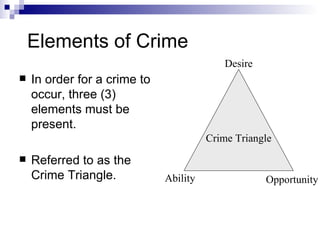
Elements of Crime In order for a crime to occur, three (3) elements must be present. Referred to as the Crime Triangle.  Desire Ability Opportunity Crime Triangle
Basic Personal Safety Rules Stay Alert Stand tall and walk confidently Always trust your instincts Have a plan
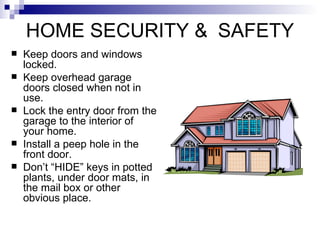
HOME SECURITY &  SAFETY Keep doors and windows locked. Keep overhead garage doors closed when not in use. Lock the entry door from the garage to the interior of your home. Install a peep hole in the front door. Don’t “HIDE” keys in potted plants, under door mats, in the mail box or other obvious place.
Don’t rely on chain lock or a doorknob lock. Install deadbolt locks  and use them . Do not allow strangers into your home. If a stranger makes a suspicious inquiry at your door, do not reveal that you are alone. Call 9-1-1. Teach children not to reveal that they are home alone and never to let a stranger into the house.
Have locks changed when you move into a new home. You don’t know who might have a key.  If you return home and suspect that it has been burglarized or just that something isn’t right, do not enter. CALL  9-1-1
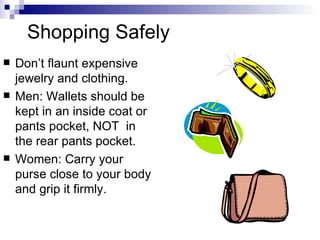
Shopping Safely Don’t flaunt expensive jewelry and clothing. Men: Wallets should be kept in an inside coat or pants pocket, NOT  in the rear pants pocket.  Women: Carry your purse close to your body and grip it firmly.
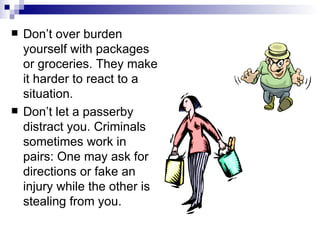
Don’t over burden yourself with packages or groceries. They make it harder to react to a situation. Don’t let a passerby distract you. Criminals sometimes work in pairs: One may ask for directions or fake an injury while the other is stealing from you.
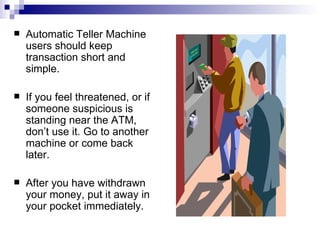
Automatic Teller Machine users should keep transaction short and simple.  If you feel threatened, or if someone suspicious is standing near the ATM, don’t use it. Go to another machine or come back later. After you have withdrawn your money, put it away in your pocket immediately.
Parking Lot Safety Have your keys in your hand as you approach your car. Before you enter your car, check for people in the back seat or on the floor. If you see someone, leave the area and call the police immediately. Avoid leaving the building alone, especially after dark. Scan the parking area, look for feet by parked vehicles. When parking your car, secure all valuables you plan to leave in the car out of sight.  Never   on the seat. Always lock your vehicle.
Safe Driving Always keep your doors locked and windows rolled up. Know where you are going and how to get there. Carry a map with you.  Check gas gauge before you leave. Be alert and careful when using underground or enclosed parking garages. Park in well-lighted areas.
When driving, place purses, cellular phones and other valuables in compartments or underneath your seat.  Never   on the seat. Be alert at intersections, on expressways  “on & off”  ramps, and anytime when traffic is moving slowly. Smash and grab robberies or car-jacking are most likely to occur at these locations.
If you feel you are being followed, drive to the nearest police or fire station, open gas station or business, or a well-lighted residence where you can safely call the police.
Never pick up hitchhikers. Keep your car in good running condition to avoid breakdowns. Taking a trip? Plan your route in advance. If your car breaks down, raise the hood, activate the 4-way flashers, use flares when needed, and place a “Call Police” placard in the window.  Stay in your vehicle with the doors locked and windows rolled up.
If you come across another motorist in trouble, call the police.  Do Not Stop Always carry a flashlight with fresh batteries, a fire extinguisher, first aid kit and a cellular phone.  Fully charge your cellular phone battery prior to leaving on your trip.
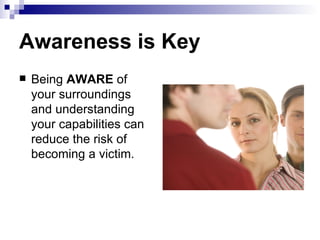
Awareness is Key Being  AWARE  of your surroundings and understanding your capabilities can reduce the risk of becoming a victim.

Personal Safety I

  • 1.
    Personal Safety Presented by: Crime Prevention Officer Jim Yester 847-459-2560 [email_address]
  • 2.
    What Is CrimePrevention? Crime prevention is defined as the: ANTICIPATION RECOGNITION & APPRAISAL of a crime risk and the initiation of some action to remove or reduce it.
  • 3.
    Elements of CrimeIn order for a crime to occur, three (3) elements must be present. Referred to as the Crime Triangle. Desire Ability Opportunity Crime Triangle
  • 4.
    Basic Personal SafetyRules Stay Alert Stand tall and walk confidently Always trust your instincts Have a plan
  • 5.
    HOME SECURITY & SAFETY Keep doors and windows locked. Keep overhead garage doors closed when not in use. Lock the entry door from the garage to the interior of your home. Install a peep hole in the front door. Don’t “HIDE” keys in potted plants, under door mats, in the mail box or other obvious place.
  • 6.
    Don’t rely onchain lock or a doorknob lock. Install deadbolt locks and use them . Do not allow strangers into your home. If a stranger makes a suspicious inquiry at your door, do not reveal that you are alone. Call 9-1-1. Teach children not to reveal that they are home alone and never to let a stranger into the house.
  • 7.
    Have locks changedwhen you move into a new home. You don’t know who might have a key. If you return home and suspect that it has been burglarized or just that something isn’t right, do not enter. CALL 9-1-1
  • 8.
    Shopping Safely Don’tflaunt expensive jewelry and clothing. Men: Wallets should be kept in an inside coat or pants pocket, NOT in the rear pants pocket. Women: Carry your purse close to your body and grip it firmly.
  • 9.
    Don’t over burdenyourself with packages or groceries. They make it harder to react to a situation. Don’t let a passerby distract you. Criminals sometimes work in pairs: One may ask for directions or fake an injury while the other is stealing from you.
  • 10.
    Automatic Teller Machineusers should keep transaction short and simple. If you feel threatened, or if someone suspicious is standing near the ATM, don’t use it. Go to another machine or come back later. After you have withdrawn your money, put it away in your pocket immediately.
  • 11.
    Parking Lot SafetyHave your keys in your hand as you approach your car. Before you enter your car, check for people in the back seat or on the floor. If you see someone, leave the area and call the police immediately. Avoid leaving the building alone, especially after dark. Scan the parking area, look for feet by parked vehicles. When parking your car, secure all valuables you plan to leave in the car out of sight. Never on the seat. Always lock your vehicle.
  • 12.
    Safe Driving Alwayskeep your doors locked and windows rolled up. Know where you are going and how to get there. Carry a map with you. Check gas gauge before you leave. Be alert and careful when using underground or enclosed parking garages. Park in well-lighted areas.
  • 13.
    When driving, placepurses, cellular phones and other valuables in compartments or underneath your seat. Never on the seat. Be alert at intersections, on expressways “on & off” ramps, and anytime when traffic is moving slowly. Smash and grab robberies or car-jacking are most likely to occur at these locations.
  • 14.
    If you feelyou are being followed, drive to the nearest police or fire station, open gas station or business, or a well-lighted residence where you can safely call the police.
  • 15.
    Never pick uphitchhikers. Keep your car in good running condition to avoid breakdowns. Taking a trip? Plan your route in advance. If your car breaks down, raise the hood, activate the 4-way flashers, use flares when needed, and place a “Call Police” placard in the window. Stay in your vehicle with the doors locked and windows rolled up.
  • 16.
    If you comeacross another motorist in trouble, call the police. Do Not Stop Always carry a flashlight with fresh batteries, a fire extinguisher, first aid kit and a cellular phone. Fully charge your cellular phone battery prior to leaving on your trip.
  • 17.
    Awareness is KeyBeing AWARE of your surroundings and understanding your capabilities can reduce the risk of becoming a victim.