Is the paperworth writing?
• What’s in the literature?
• “So What?”
• It’s a lot of work (average 20-30 drafts).
Don’t do it unless its worth it.
4.
What do Ihave to say?
A single question clearly stated with adequate
evidence for the answer.
Try stating the question and its answer in one
simple sentence.
5.
Is it oneor more papers?
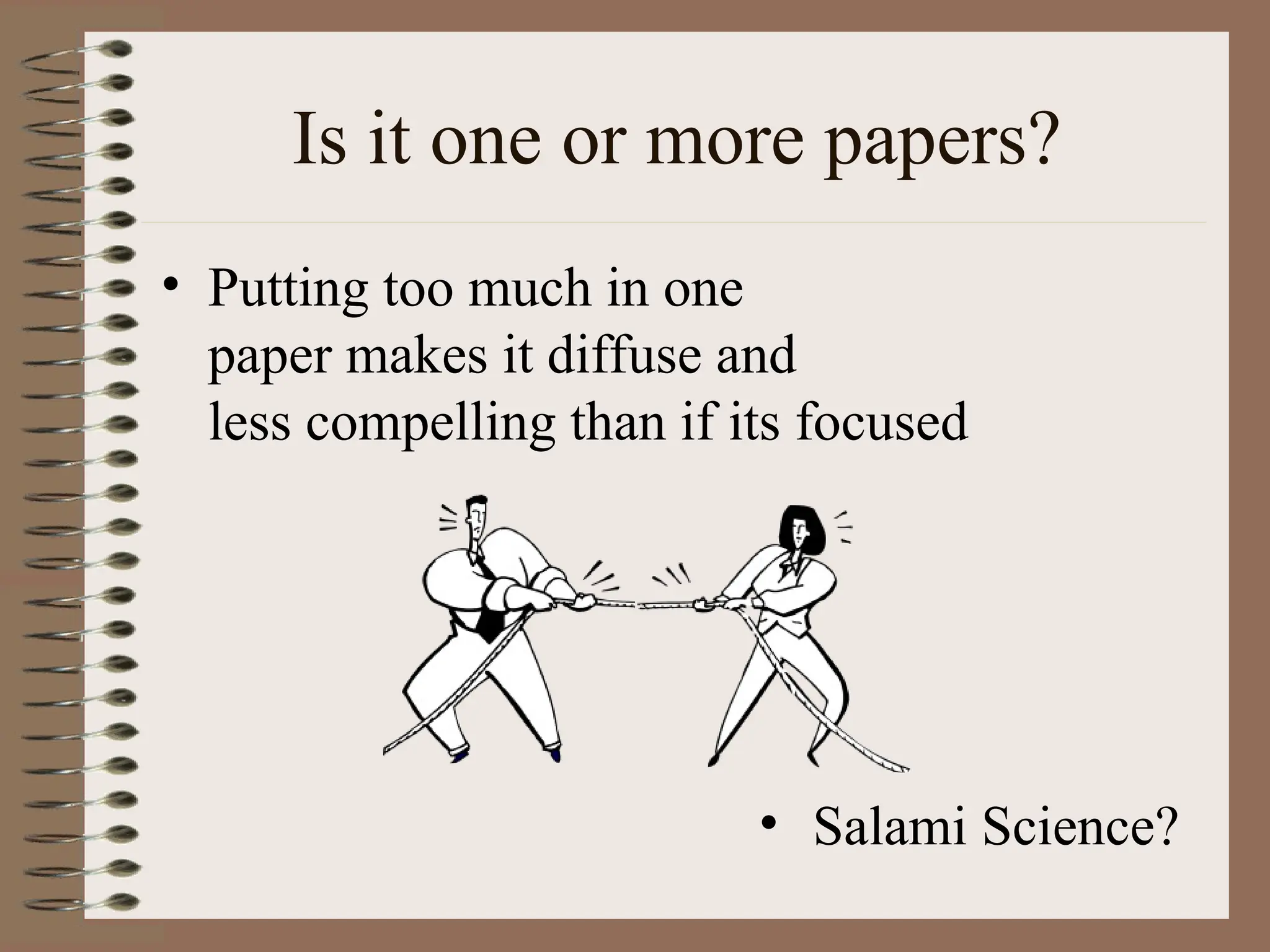
• Putting too much in one
paper makes it diffuse and
less compelling than if its focused
• Salami Science?
6.
OK, So youwant to/need to
write a paper --> next questions
a. What is the right format for the message
(original article/review?)
b. What is the right audience—who cares?
c. What journal should I choose?
7.
Which journal?
• i.Is topic of my paper
within its scope and
format?
• ii. Would it match my
audience?
• iii. Ask mentor or other
senior researchers:
appropriateness
• iv. Impact Factor
• v. Consequences of
wrong decision: time lost;
failure to publish
8.
Calculation for journalimpact
factor*
A= total cites in 2015
B= 2015 cites to articles published in
2013-14 (this is a subset of A)
C= number of articles published in 2013-14
D= B/C = 2015 impact factor
*Weights review articles heavily and is higher in
scientifically better populated fields
9.
To find outa journal’s impact
factor
Search on Impact Factor (current year
- 2 years)
(e.g. for now,
search: impact factor 2015
10.
A scientific articleas a critical
argument
a. Statement of problem; posing a question
b. Presentation of evidence
c. Assessment of the validity of the
evidence in the face of ..
a. strengths/weaknesses
b. other evidence
d. Conclusions
11.
Literature Search First
•What has been done and what can you
say that’s new?
• Be thorough in your search:---a high
sensitivity/low specificity search.
12.
a. Establishes responsibilitiesin paper
writing
b. Avoids hurt feelings
The Title Page: Do it early—
title; authors and their order;
sources of support
13.
The Process ofPaper Writing
• Create an outline first
• Plan on multiple drafts:
– Filename with dates
– One filename written over with new draft
• Tables/figures early: prompt more analysis
• Deadlines for you and coauthors
14.
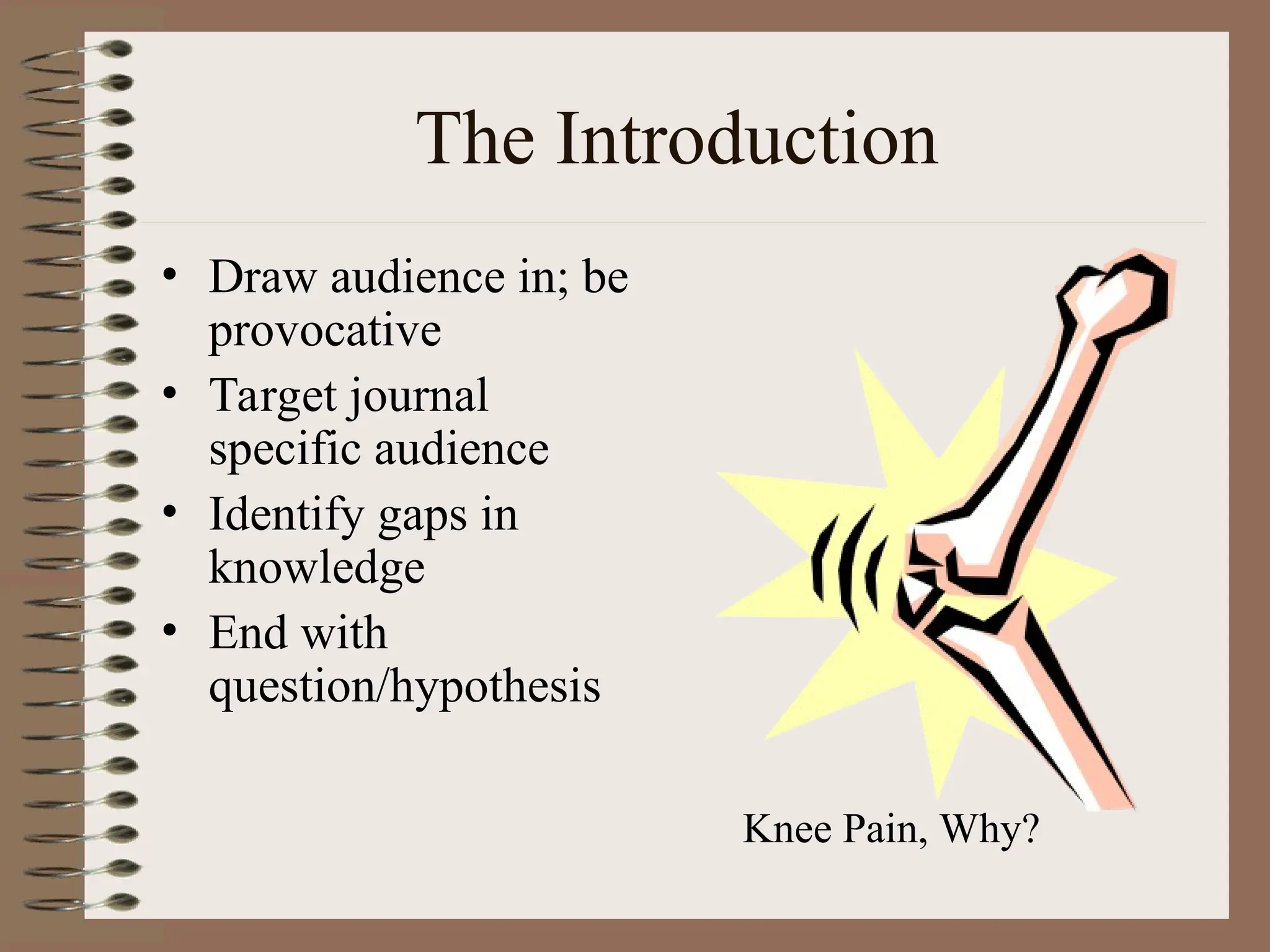
The Introduction
• Drawaudience in; be
provocative
• Target journal
specific audience
• Identify gaps in
knowledge
• End with
question/hypothesis
Knee Pain, Why?
15.
The Methods Section
Should include
subheadings
Write clearly enough
to be understood by
nontechnical reader
and be replicated
Past tense
16.
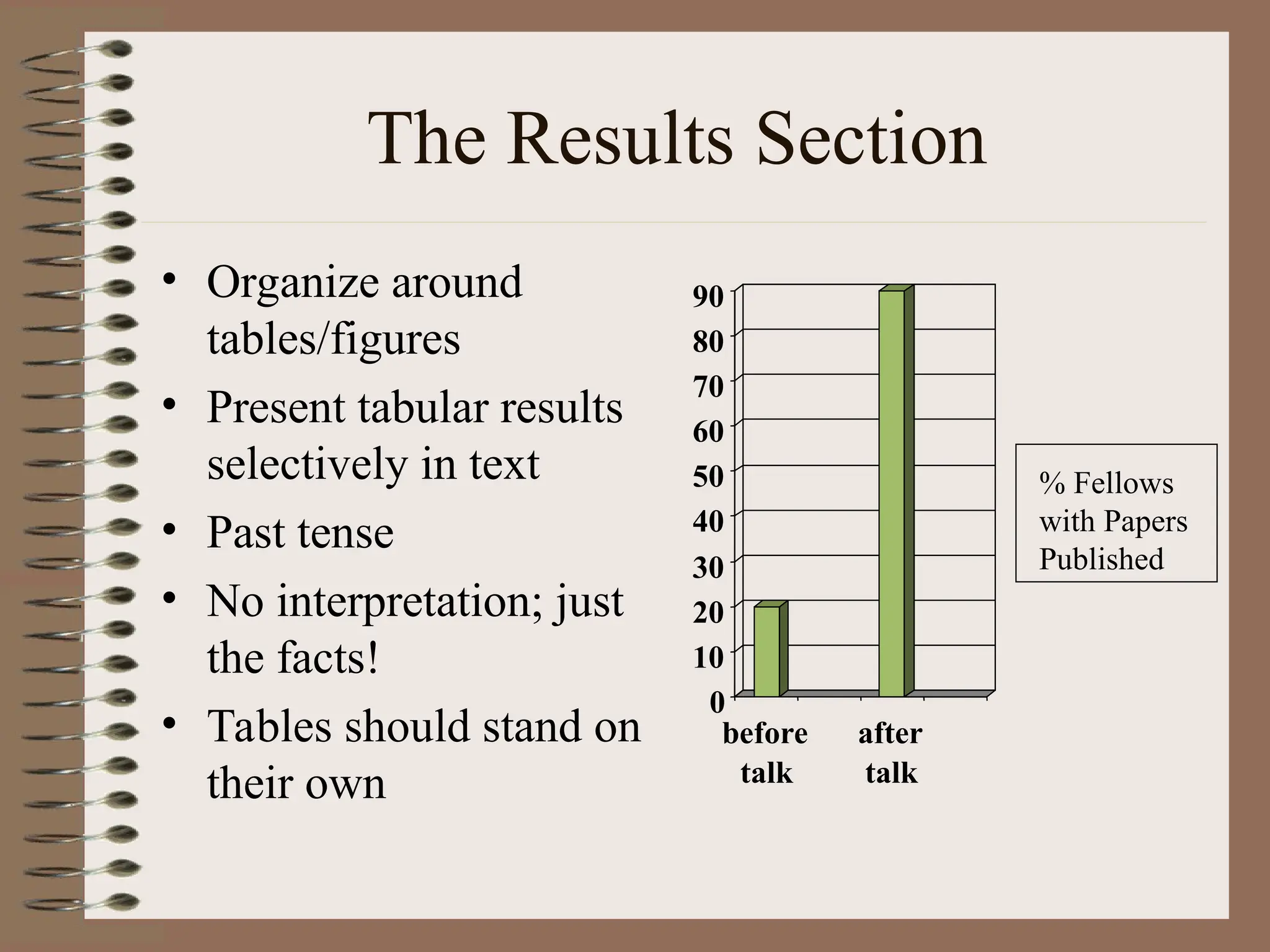
The Results Section
•Organize around
tables/figures
• Present tabular results
selectively in text
• Past tense
• No interpretation; just
the facts!
• Tables should stand on
their own
0
10
20
30
40
50
60
70
80
90
before
talk
after
talk
% Fellows
with Papers
Published
17.
The Discussion Section
•1st
paragraph: answer question/hypothesis
• Remainder:
– Evidence pro and con: literature review
– Strengths/limitations of your study
– Implications of findings (be conservative)
– Other findings of your study
• Last Paragraph: conclusion
18.
Getting Tense!
PAST andPRESENT
• When quoting
previously published
work, refer to it in
present tense (e.g.
penicillin treats strep
throat)
• When describing your
own study, refer to
work in past tense
(e.g. we tested a new
antibiotic for strep
throat)
19.
Pop Quiz: Thegood scientific
paper ...
A. Is focused on a specific question(s).
B. Covers a broad spectrum of disease or
methodologic questions
Less is More.
20.
Pop Quiz: Ina good scientific
paper ...
A: Abstract and tables and figures are
understandable without reading whole
paper.
B. Abstract and tables and figures are
understandable only with reading whole
paper.
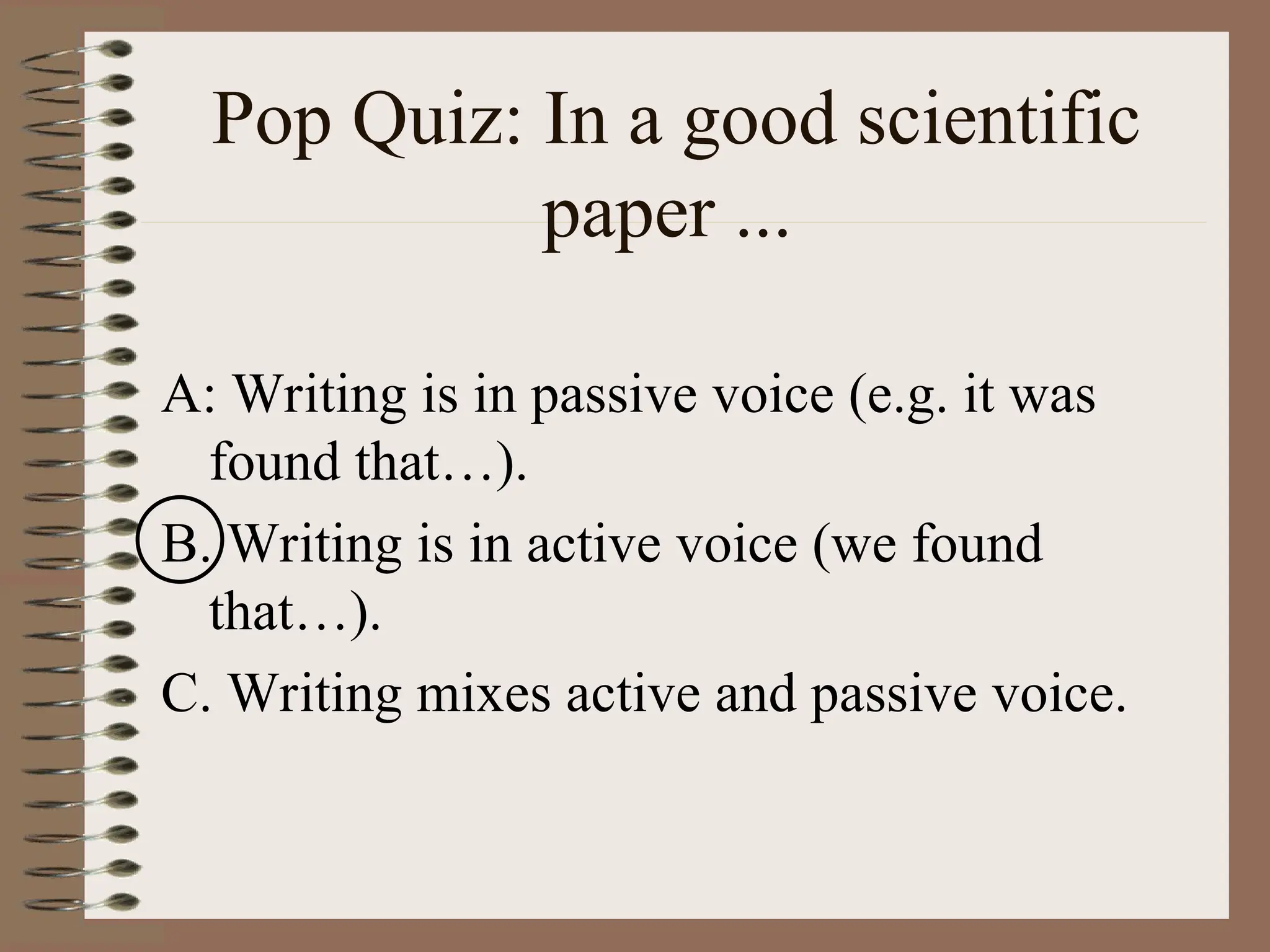
21.
Pop Quiz: Ina good scientific
paper ...
A: Writing is in passive voice (e.g. it was
found that…).
B. Writing is in active voice (we found
that…).
C. Writing mixes active and passive voice.
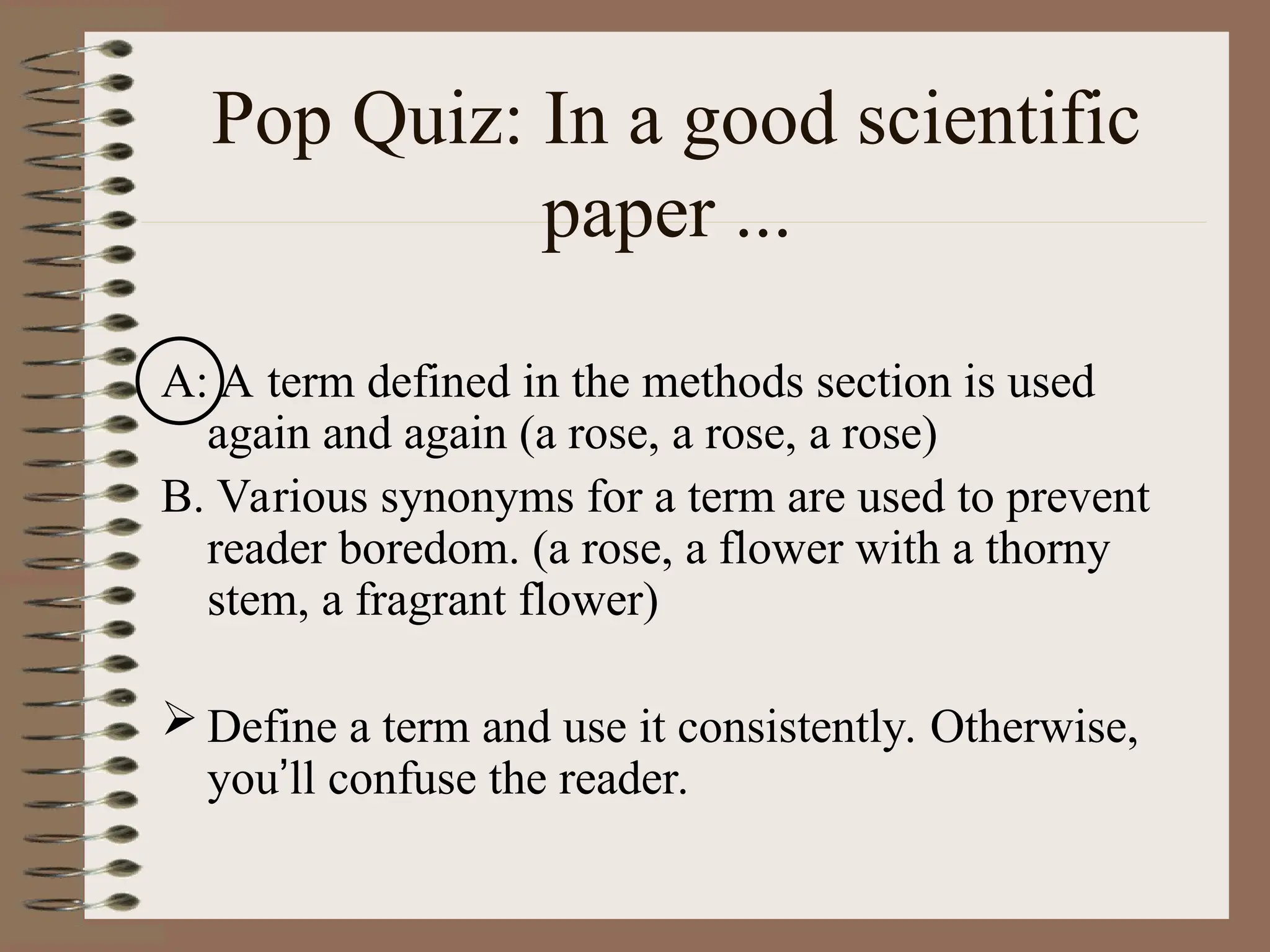
22.
Pop Quiz: Ina good scientific
paper ...
A: A term defined in the methods section is used
again and again (a rose, a rose, a rose)
B. Various synonyms for a term are used to prevent
reader boredom. (a rose, a flower with a thorny
stem, a fragrant flower)
Define a term and use it consistently. Otherwise,
you’ll confuse the reader.
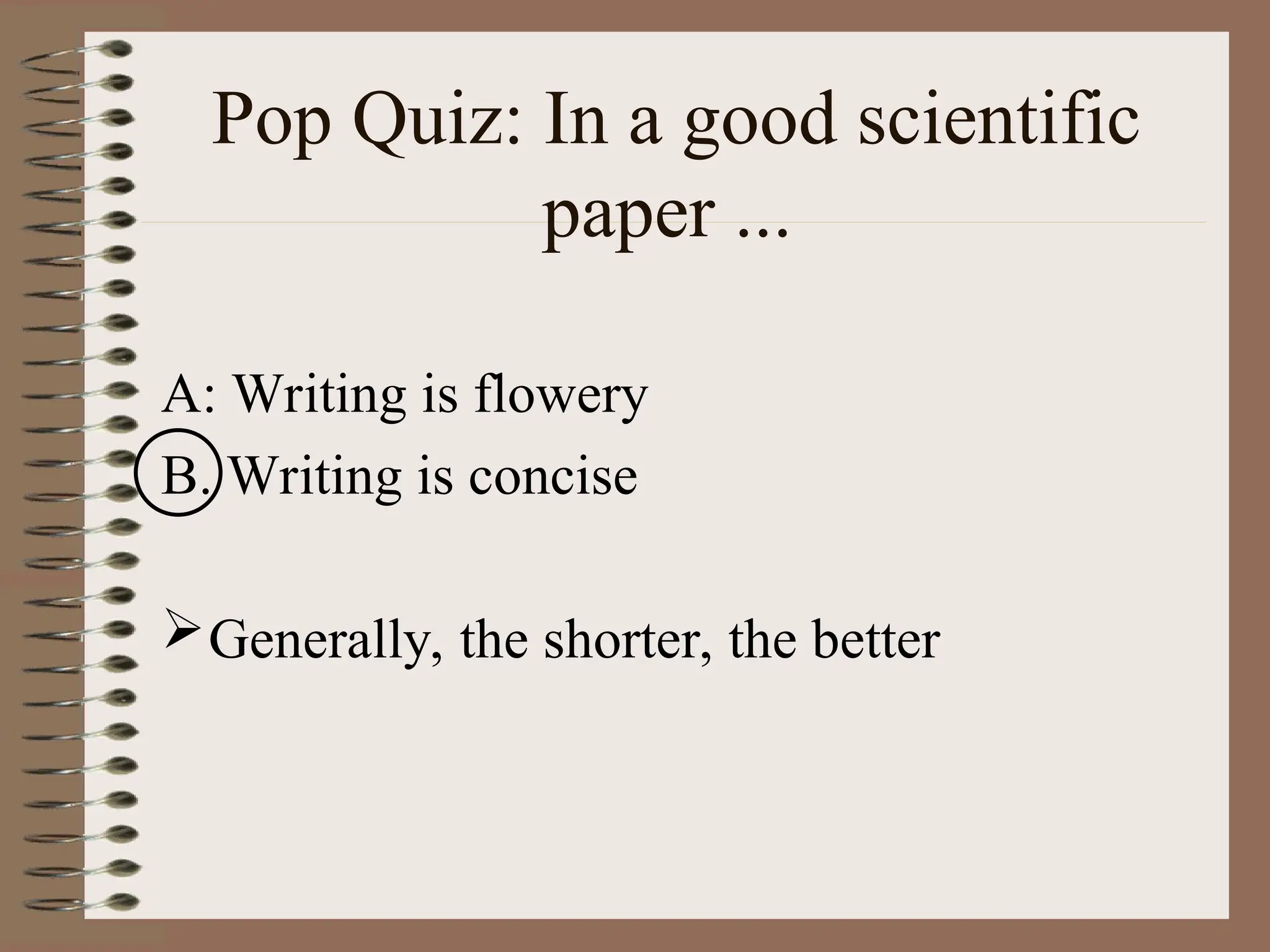
23.
Pop Quiz: Ina good scientific
paper ...
A: Writing is flowery
B. Writing is concise
Generally, the shorter, the better
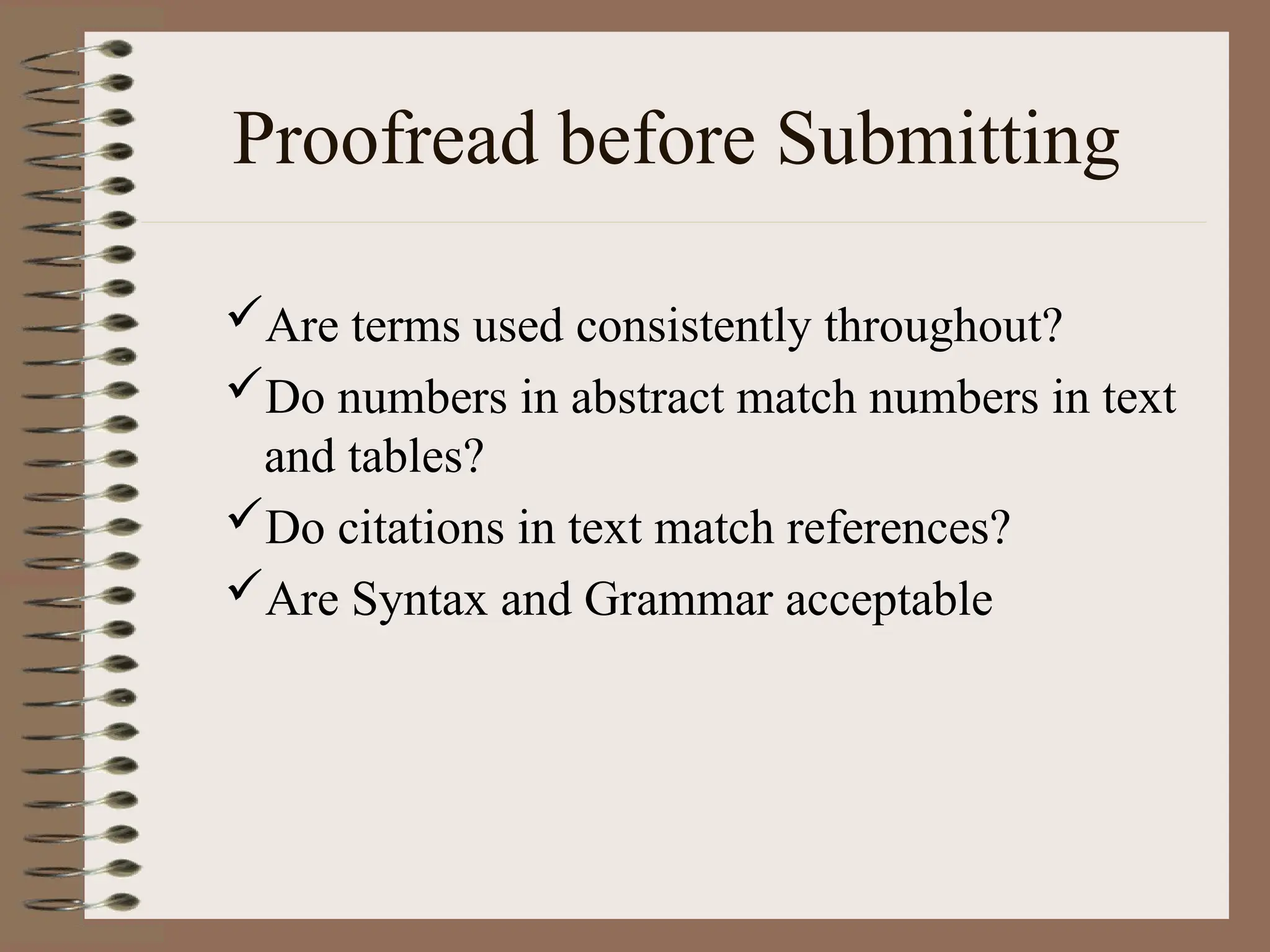
24.
Proofread before Submitting
Areterms used consistently throughout?
Do numbers in abstract match numbers in text
and tables?
Do citations in text match references?
Are Syntax and Grammar acceptable
25.
A brief synopsisof writing an
abstract
• It’s a minipaper:
– Introduction (usually 1-2 sentences)
– Methods (often longest part)
– Results
– Discussion is limited to concluding statement
• Like a paper, requires many drafts, most
oriented to presenting argument concisely
26.
Getting the Reviewsof Your
Paper
• “The reviewer is always right.” (whether
they are or not!)
• Don’t respond quickly. Digest reviews.
.
27.
If your paperwas rejected…
• Was it sent out for
review? If not,
consider changing
type of journal
• If reviews don’t
suggest changes, send
it out quickly to
another journal
• The 3 journal rule.



![[DSC Europe 25] Kaja Kandare - LLM as a judge.pptx](https://cdn.slidesharecdn.com/ss_thumbnails/arxyccaxsdsd1ba99wjw-7-251212104007-2b4e3f64-thumbnail.jpg?width=640&height=640&fit=bounds)

![[DSC Europe 25] Hans Kleinsman - The Compliance Gearbox: How Tax Tech Mediate...](https://cdn.slidesharecdn.com/ss_thumbnails/dxdytie1toel0hr90bjs-2-251212103250-174fdbe7-thumbnail.jpg?width=640&height=640&fit=bounds)


![[DSC Europe 25] Miodrag Pesovic & Vladislav Radonjic - Federated Data Archite...](https://cdn.slidesharecdn.com/ss_thumbnails/gsbe3y5it5uhndi4e08e-1-251212103249-f1008e0c-thumbnail.jpg?width=640&height=640&fit=bounds)

![[DSC Europe 25] Jon Dajci - Bridging TradFi and DeFi: Building the Future of ...](https://cdn.slidesharecdn.com/ss_thumbnails/fqmhfvlbqhkihjvqvhmu-7-251211083849-6af7e325-thumbnail.jpg?width=640&height=640&fit=bounds)
![[DSC Europe 25] Dusan Nesic - Securing Tomorrow’s Infrastructure: Why Cyber-P...](https://cdn.slidesharecdn.com/ss_thumbnails/qikbszfftyowjm2q6duw-1-251211083848-8f2ead6b-thumbnail.jpg?width=640&height=640&fit=bounds)

![[DSC Europe 25] Nikolay Burlutskiy - Best Practices for Building Enterprise M...](https://cdn.slidesharecdn.com/ss_thumbnails/uirvaiuvq8y1w8hzd9tx-7-251212103249-2619edb4-thumbnail.jpg?width=640&height=640&fit=bounds)
![[DSC Europe 25] Vladimir Jelic - The AI-Driven Security Shift From Reactive D...](https://cdn.slidesharecdn.com/ss_thumbnails/6g5gj25mtjwayniqem1t-6-251209104645-7a5a5fc6-thumbnail.jpg?width=640&height=640&fit=bounds)
![[DSC Europe 25] Milan Sekuloski - Data, Defence, and Development: Cybersecuri...](https://cdn.slidesharecdn.com/ss_thumbnails/dfrkwwx4qly6atqpbl4z-4-251209104645-c3d4b0ca-thumbnail.jpg?width=640&height=640&fit=bounds)
![[DSC Europe 25] Branko Urosevic -Rethinking Financial Talent: Integrating Cod...](https://cdn.slidesharecdn.com/ss_thumbnails/8jjrus8ttko6qj64f58f-3-251212103250-642c6374-thumbnail.jpg?width=640&height=640&fit=bounds)
![[DSC Europe 25] Bassam Maharmeh - Artificial Intelligence: Opportunities and ...](https://cdn.slidesharecdn.com/ss_thumbnails/thhfmr2fqpawzj7hsjpg-5-251211083048-2c23204f-thumbnail.jpg?width=640&height=640&fit=bounds)
![[DSC Europe 25] Debmalya Biswas - Agentification: the art of transforming man...](https://cdn.slidesharecdn.com/ss_thumbnails/r5azlggvtqiaiiusrqdr-4-251212103249-5a12c89b-thumbnail.jpg?width=640&height=640&fit=bounds)
