CRESCENT PURE
BRAND POSITIONING
HARVARD BUSINESS SCHOOL CASE
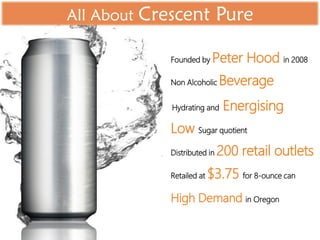
All About Crescent Pure
Founded by Peter Hood in 2008
Non Alcoholic Beverage
Hydrating and Energising
Low Sugar quotient
Distributed in 200 retail outlets
Retailed at $3.75 for 8-ounce can
High Demand in Oregon
Introducing
Portland Drake Beverages (PDB)
 Manufacturer of Organic juices and Sparkling Water
 Earned Revenue of $120.5 million by 2012
 High Consumer demand due to Health values and Pricing
Acquired Crescent Pure in July,2013
Expansion of existing product line
Why this Acquisition??
Competitors planning to launch all natural versions
of their drinks
High demand for low calorie drinks
Key Players of
PDB – Crescent Pure Brand Positioning
 Michael Booth
CEO , Portland Drake Beverages
 Sarah Ryan
Vice President of Marketing, Portland Drake Beverages
 Matt Levor
Director of Market Research, Portland Drake Beverages
Present Situation of PDB
Planned “Soft Launch” of Crescent in three western states by Jan’14
Washington California Oregon
Represents 15%
of
National Functional Beverage Demand
Advertising
Budget
$750,000
Objective of the Case
Ryan to evaluate the
Positioning Opportunities
for Crescent and recommend a
Positioning Strategy
to the executive team
Why this case?
Objective of the Case
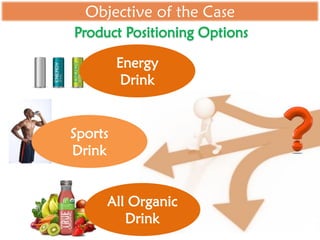
Product Positioning Options
Energy
Drink
Sports
Drink
All Organic
Drink
Objective of the Case
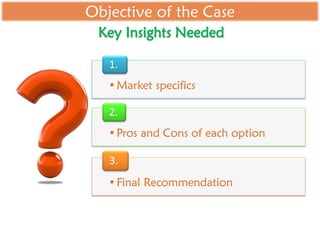
Key Insights Needed
•Market specifics
1.
•Pros and Cons of each option
2.
•Final Recommendation
3.
Hypothesis
Crescent
as an
Energy Drink
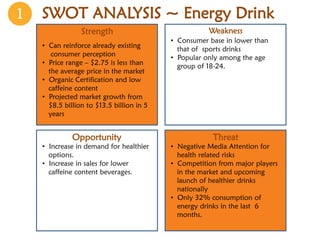
SWOT ANALYSIS ~ Energy Drink
Strength Weakness
ThreatOpportunity
• Can reinforce already existing
consumer perception
• Price range – $2.75 is less than
the average price in the market
• Organic Certification and low
caffeine content
• Projected market growth from
$8.5 billion to $13.5 billion in 5
years
• Increase in demand for healthier
options.
• Increase in sales for lower
caffeine content beverages.
• Consumer base in lower than
that of sports drinks
• Popular only among the age
group of 18-24.
• Negative Media Attention for
health related risks
• Competition from major players
in the market and upcoming
launch of healthier drinks
nationally
• Only 32% consumption of
energy drinks in the last 6
months.
Price Comparison as Energy Drink
Crescent Price Average Market
Price
$2.75 $2.99
Analysis as Energy Drink – Hydration Vs Energy
High Market Share by
competitors yet
Crescent is more
hydrating value
Analysis as Energy Drink – Nutrition Vs Taste
34% market
share
27% market
share
High Competition yet
Nutrition value is
higher
Hypothesis
Crescent
as a
Sports Drink
SWOT ANALYSIS ~ Sports Drink
Strength Weakness
ThreatOpportunity
• Large Consumer base than
energy drinks
• Market expected to grow from
$6.3 billion to $9.58 billion by
2017
• Appealed to a wider age group
mostly youngsters
• Increase in demand for healthier
options.
• Increase in sales for lower
caffeine content beverages.
• Slower growth rate when
compared to Energy Drinks
• Consumer perception that these
are meant for athletes and sports
persons
• Not popular among older age
groups.
• Concerns for child obesity rates
• Competition from major players
in the market and upcoming
launch of healthier drinks
nationally
Price Comparison as Sports Drink
Crescent Price Average Market
Price
$2.75 <$1.00 - $2.00
Analysis as Sports Drink – Hydration Vs Energy
21% market
share
73% market
share
High
Competition
Analysis as Sports Drink – Nutrition Vs Taste
Competitor product’s
taste is on a positive
side
Hypothesis
Crescent
as an
Organic Drink
Hypothesis
Crescent as an Organic Drink
• Broader Approach
• Timing factor
• More Distributors to
evaluate
• Excessive advertising
budget needed
• Increased Demand
for Organic Drinks
• Existing brand
knowledge among
consumers
• Competitive Pricing
Final Recommendation
Energy Drink Sports Drink
Vs
Competitive Price in its market Higher Price in the Market
Consumers in the same
demographic age group
Consumers in the same
demographic age group
Competitors market share
spread almost evenly
2 Competitors dominate the
market share
Consumption rate lower
compared to sports drink
Higher consumption rate
Nutritional Value higher than
its competitor
Nutritional Value similar to its
competitors
Projected demand is higher Projected demand is higher
CRESCENT MIGHT DO WELL IN
THE CONSUMER MARKET AS
AN
ENERGY DRINK
Can PDB fund
Crescent’s national
expansion in 2015??
Break Even Analysis
Whole Sale Price to
Distributor
Distributor Price
25%
Retail Price
40%
$1.24 $ 1.65 $2.75
Break Even Analysis $2.75
Crescent Production – 12,000 cases per month
Cost per case - $29.76 per case
Cost per Can - $ 1.24 per can
Variable Cost - $ 1.02 per can
Profit per can - $ 0.22 per can
No. Of Cans per case - 24
Earnings per case – $5.28 per case
Monthly Profit - $63,360
Yearly Earnings - $ 760,320
Break Even Point - $ 750,000
Yearly Profit - $ 10,320
Advertising
Budget
$750,000
Crescent can break even after first year with
annual profit of $10,320
Created by Aashritha Sripathi, Osmania Univeristy during a
Marketing Internship under
Prof. Sameer Mathur, IIM Lucknow
DISCLAIMER

Crescent pure case study

  • 1.
  • 2.
    All About CrescentPure Founded by Peter Hood in 2008 Non Alcoholic Beverage Hydrating and Energising Low Sugar quotient Distributed in 200 retail outlets Retailed at $3.75 for 8-ounce can High Demand in Oregon
  • 3.
    Introducing Portland Drake Beverages(PDB)  Manufacturer of Organic juices and Sparkling Water  Earned Revenue of $120.5 million by 2012  High Consumer demand due to Health values and Pricing Acquired Crescent Pure in July,2013
  • 4.
    Expansion of existingproduct line Why this Acquisition?? Competitors planning to launch all natural versions of their drinks High demand for low calorie drinks
  • 5.
    Key Players of PDB– Crescent Pure Brand Positioning  Michael Booth CEO , Portland Drake Beverages  Sarah Ryan Vice President of Marketing, Portland Drake Beverages  Matt Levor Director of Market Research, Portland Drake Beverages
  • 6.
    Present Situation ofPDB Planned “Soft Launch” of Crescent in three western states by Jan’14 Washington California Oregon Represents 15% of National Functional Beverage Demand Advertising Budget $750,000
  • 7.
    Objective of theCase Ryan to evaluate the Positioning Opportunities for Crescent and recommend a Positioning Strategy to the executive team Why this case?
  • 8.
    Objective of theCase Product Positioning Options Energy Drink Sports Drink All Organic Drink
  • 9.
    Objective of theCase Key Insights Needed •Market specifics 1. •Pros and Cons of each option 2. •Final Recommendation 3.
  • 10.
  • 11.
    SWOT ANALYSIS ~Energy Drink Strength Weakness ThreatOpportunity • Can reinforce already existing consumer perception • Price range – $2.75 is less than the average price in the market • Organic Certification and low caffeine content • Projected market growth from $8.5 billion to $13.5 billion in 5 years • Increase in demand for healthier options. • Increase in sales for lower caffeine content beverages. • Consumer base in lower than that of sports drinks • Popular only among the age group of 18-24. • Negative Media Attention for health related risks • Competition from major players in the market and upcoming launch of healthier drinks nationally • Only 32% consumption of energy drinks in the last 6 months.
  • 12.
    Price Comparison asEnergy Drink Crescent Price Average Market Price $2.75 $2.99
  • 13.
    Analysis as EnergyDrink – Hydration Vs Energy High Market Share by competitors yet Crescent is more hydrating value
  • 14.
    Analysis as EnergyDrink – Nutrition Vs Taste 34% market share 27% market share High Competition yet Nutrition value is higher
  • 15.
  • 16.
    SWOT ANALYSIS ~Sports Drink Strength Weakness ThreatOpportunity • Large Consumer base than energy drinks • Market expected to grow from $6.3 billion to $9.58 billion by 2017 • Appealed to a wider age group mostly youngsters • Increase in demand for healthier options. • Increase in sales for lower caffeine content beverages. • Slower growth rate when compared to Energy Drinks • Consumer perception that these are meant for athletes and sports persons • Not popular among older age groups. • Concerns for child obesity rates • Competition from major players in the market and upcoming launch of healthier drinks nationally
  • 17.
    Price Comparison asSports Drink Crescent Price Average Market Price $2.75 <$1.00 - $2.00
  • 18.
    Analysis as SportsDrink – Hydration Vs Energy 21% market share 73% market share High Competition
  • 19.
    Analysis as SportsDrink – Nutrition Vs Taste Competitor product’s taste is on a positive side
  • 20.
  • 21.
    Hypothesis Crescent as anOrganic Drink • Broader Approach • Timing factor • More Distributors to evaluate • Excessive advertising budget needed • Increased Demand for Organic Drinks • Existing brand knowledge among consumers • Competitive Pricing
  • 22.
    Final Recommendation Energy DrinkSports Drink Vs Competitive Price in its market Higher Price in the Market Consumers in the same demographic age group Consumers in the same demographic age group Competitors market share spread almost evenly 2 Competitors dominate the market share Consumption rate lower compared to sports drink Higher consumption rate Nutritional Value higher than its competitor Nutritional Value similar to its competitors Projected demand is higher Projected demand is higher
  • 23.
    CRESCENT MIGHT DOWELL IN THE CONSUMER MARKET AS AN ENERGY DRINK
  • 24.
    Can PDB fund Crescent’snational expansion in 2015??
  • 25.
    Break Even Analysis WholeSale Price to Distributor Distributor Price 25% Retail Price 40% $1.24 $ 1.65 $2.75
  • 26.
    Break Even Analysis$2.75 Crescent Production – 12,000 cases per month Cost per case - $29.76 per case Cost per Can - $ 1.24 per can Variable Cost - $ 1.02 per can Profit per can - $ 0.22 per can No. Of Cans per case - 24 Earnings per case – $5.28 per case Monthly Profit - $63,360 Yearly Earnings - $ 760,320 Break Even Point - $ 750,000 Yearly Profit - $ 10,320 Advertising Budget $750,000 Crescent can break even after first year with annual profit of $10,320
  • 28.
    Created by AashrithaSripathi, Osmania Univeristy during a Marketing Internship under Prof. Sameer Mathur, IIM Lucknow DISCLAIMER