Crescent Pure
HBR Case Analysis
Crescent Pure - A background
• Founded by Peter Cooper in 2008
• A non-alcoholic, energy enhancing, hydrating
drink with all organic ingredients : Crescent Pure
• Michael Booth, CEO of Portland Drake Beverages
(PDB), acquired it in July 2013
• PDB is a manufacturer of Organic Juices and
Sparkling Water, set to expand further into the
Organic drinks segment with Crescent Pure.
Why Crescent Pure
• Low calorie beverage – contains about half the
energy to those of other beverages with same
servings
• 70% less sugar than other energy and sports
drinks
• Caffeine as much as a cup of coffee
• All organic and natural stimulants as energy
boosters at a reasonably lower cost
• Product positioning
of Crescent Pure?!
• $750,000 the advertising
budget for the launch
• To “soft launch” the product
in 2014 due to production
capacity constraints
• To be launched nationally by 2015
• Industry specifics related to
each positioning options?
• Potential pros and cons of each option?
Product Positioning Strategy!
Energy Drink Sports DrinkOR
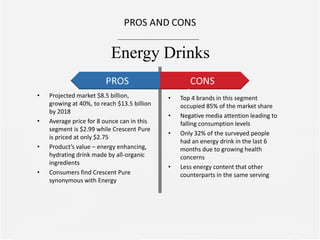
Energy Drinks
• Projected market $8.5 billion,
growing at 40%, to reach $13.5 billion
by 2018
• Average price for 8 ounce can in this
segment is $2.99 while Crescent Pure
is priced at only $2.75
• Product’s value – energy enhancing,
hydrating drink made by all-organic
ingredients
• Consumers find Crescent Pure
synonymous with Energy
• Top 4 brands in this segment
occupied 85% of the market share
• Negative media attention leading to
falling consumption levels
• Only 32% of the surveyed people
had an energy drink in the last 6
months due to growing health
concerns
• Less energy content that other
counterparts in the same serving
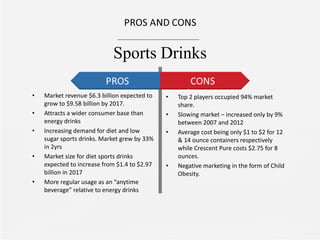
Sports Drinks
• Market revenue $6.3 billion expected to
grow to $9.58 billion by 2017.
• Attracts a wider consumer base than
energy drinks
• Increasing demand for diet and low
sugar sports drinks. Market grew by 33%
in 2yrs
• Market size for diet sports drinks
expected to increase from $1.4 to $2.97
billion in 2017
• More regular usage as an “anytime
beverage” relative to energy drinks
• Top 2 players occupied 94% market
share.
• Slowing market – increased only by 9%
between 2007 and 2012
• Average cost being only $1 to $2 for 12
& 14 ounce containers respectively
while Crescent Pure costs $2.75 for 8
ounces.
• Negative marketing in the form of Child
Obesity.
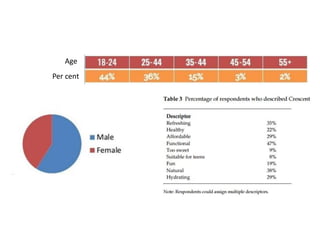
Age
Per cent
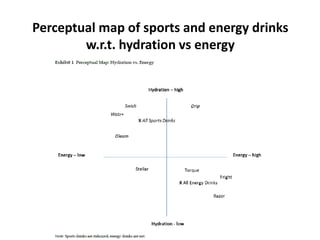
Perceptual map of sports and energy drinks
w.r.t. hydration vs energy
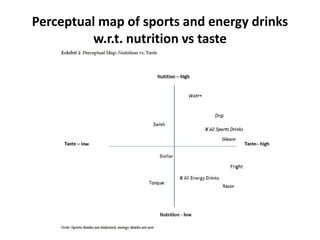
Perceptual map of sports and energy drinks
w.r.t. nutrition vs taste
A third possibility?
Drink
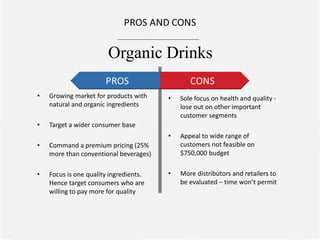
Organic Drinks
• Growing market for products with
natural and organic ingredients
• Target a wider consumer base
• Command a premium pricing (25%
more than conventional beverages)
• Focus is one quality ingredients.
Hence target consumers who are
willing to pay more for quality
• Sole focus on health and quality -
lose out on other important
customer segments
• Appeal to wide range of
customers not feasible on
$750,000 budget
• More distributors and retailers to
be evaluated – time won’t permit
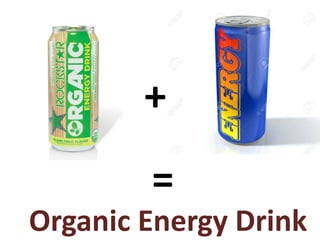
+
=
Organic Energy Drink
Advantages of such a positioning
• Average pricing of energy drinks are
$2.99 per 8 ounce can. Crescent, at
$2.75 is a cheaper and lucrative option
• Energy drink market is booming, growing
at 40% and customers are already
looking for healthier alternatives
• Interest in Crescent’s natural ingredients
reflected focus on health and wellbeing,
thus transcended age groups and
demographic profile.
• Can make inroads into the organic drink
market by brand extension
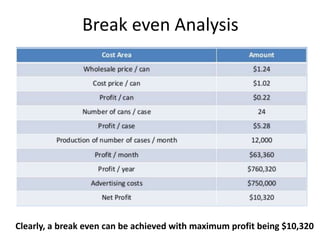
Break even Analysis
Clearly, a break even can be achieved with maximum profit being $10,320
Disclaimer
Created by Sameer Kumar Singh, BITS Pilani, as a
part of marketing internship under Prof.
Sameer Mathur, IIM Lucknow

Crescent Pure - HBR Case Analysis

  • 1.
  • 2.
    Crescent Pure -A background • Founded by Peter Cooper in 2008 • A non-alcoholic, energy enhancing, hydrating drink with all organic ingredients : Crescent Pure • Michael Booth, CEO of Portland Drake Beverages (PDB), acquired it in July 2013 • PDB is a manufacturer of Organic Juices and Sparkling Water, set to expand further into the Organic drinks segment with Crescent Pure.
  • 3.
    Why Crescent Pure •Low calorie beverage – contains about half the energy to those of other beverages with same servings • 70% less sugar than other energy and sports drinks • Caffeine as much as a cup of coffee • All organic and natural stimulants as energy boosters at a reasonably lower cost
  • 4.
    • Product positioning ofCrescent Pure?! • $750,000 the advertising budget for the launch • To “soft launch” the product in 2014 due to production capacity constraints • To be launched nationally by 2015 • Industry specifics related to each positioning options? • Potential pros and cons of each option?
  • 5.
  • 7.
    Energy Drinks • Projectedmarket $8.5 billion, growing at 40%, to reach $13.5 billion by 2018 • Average price for 8 ounce can in this segment is $2.99 while Crescent Pure is priced at only $2.75 • Product’s value – energy enhancing, hydrating drink made by all-organic ingredients • Consumers find Crescent Pure synonymous with Energy • Top 4 brands in this segment occupied 85% of the market share • Negative media attention leading to falling consumption levels • Only 32% of the surveyed people had an energy drink in the last 6 months due to growing health concerns • Less energy content that other counterparts in the same serving
  • 8.
    Sports Drinks • Marketrevenue $6.3 billion expected to grow to $9.58 billion by 2017. • Attracts a wider consumer base than energy drinks • Increasing demand for diet and low sugar sports drinks. Market grew by 33% in 2yrs • Market size for diet sports drinks expected to increase from $1.4 to $2.97 billion in 2017 • More regular usage as an “anytime beverage” relative to energy drinks • Top 2 players occupied 94% market share. • Slowing market – increased only by 9% between 2007 and 2012 • Average cost being only $1 to $2 for 12 & 14 ounce containers respectively while Crescent Pure costs $2.75 for 8 ounces. • Negative marketing in the form of Child Obesity.
  • 10.
  • 11.
    Perceptual map ofsports and energy drinks w.r.t. hydration vs energy
  • 12.
    Perceptual map ofsports and energy drinks w.r.t. nutrition vs taste
  • 13.
  • 14.
  • 15.
    Organic Drinks • Growingmarket for products with natural and organic ingredients • Target a wider consumer base • Command a premium pricing (25% more than conventional beverages) • Focus is one quality ingredients. Hence target consumers who are willing to pay more for quality • Sole focus on health and quality - lose out on other important customer segments • Appeal to wide range of customers not feasible on $750,000 budget • More distributors and retailers to be evaluated – time won’t permit
  • 16.
  • 17.
    Advantages of sucha positioning • Average pricing of energy drinks are $2.99 per 8 ounce can. Crescent, at $2.75 is a cheaper and lucrative option • Energy drink market is booming, growing at 40% and customers are already looking for healthier alternatives • Interest in Crescent’s natural ingredients reflected focus on health and wellbeing, thus transcended age groups and demographic profile. • Can make inroads into the organic drink market by brand extension
  • 19.
    Break even Analysis Clearly,a break even can be achieved with maximum profit being $10,320
  • 20.
    Disclaimer Created by SameerKumar Singh, BITS Pilani, as a part of marketing internship under Prof. Sameer Mathur, IIM Lucknow