CRESCENT PURE
CASE ANALYSIS
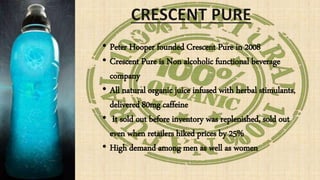
• Peter Hooper founded Crescent Pure in 2008
• Crescent Pure is Non alcoholic functional beverage
company
• All natural organic juice infused with herbal stimulants,
delivered 80mg caffeine
• It sold out before inventory was replenished, sold out
even when retailers hiked prices by 25%
• High demand among men as well as women
Portland
drake
beverages
(pdb)
They are manufacturer of organic juices and sparkling water.
Their revenues hit $120.5 million in 2012.
They are a part of the $131 billion beverage industry.
They wanted to expand into the functional beverage (sports and energy)
sector through acquisition.
Acquired Crescent in July 2013.
Situation
Analysis Large competitors were planning to launch all natural
versions of their beverages.
Due to production capacity restraints and to test the
positioning before nationalizing.
FAST
LAUNCH
SOFT
LAUNCH
The CEO of PDB has asked Sarah Ryan, the vice
president of marketing to form a suitable market
positioning strategy for Crescent within days . She
has to choose between Energy drink, Sports Drink
or a healthy organic drink positioning
OBJECTIVES
Do a comprehensive SWOT analysis.
Identify the target market
Identify the competition
Do market research and surveys
Analyse and interpret the data
Break even analysis
Finalise positioning strategy.
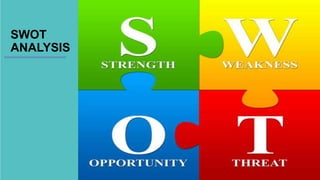
SWOT
ANALYSIS
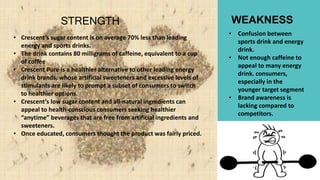
STRENGTH WEAKNESS
• Crescent’s sugar content is on average 70% less than leading
energy and sports drinks.
• The drink contains 80 milligrams of caffeine, equivalent to a cup
of coffee
• Crescent Pure is a healthier alternative to other leading energy
drink brands, whose artificial sweeteners and excessive levels of
stimulants are likely to prompt a subset of consumers to switch
to healthier options.
• Crescent’s low sugar content and all-natural ingredients can
appeal to health-conscious consumers seeking healthier
“anytime” beverages that are free from artificial ingredients and
sweeteners.
• Once educated, consumers thought the product was fairly priced.
• Confusion between
sports drink and energy
drink.
• Not enough caffeine to
appeal to many energy
drink. consumers,
especially in the
younger target segment
• Brand awareness is
lacking compared to
competitors.
OPPORTUNITIES threats
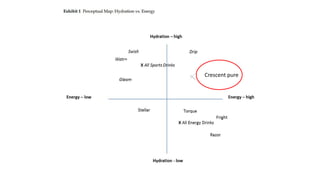
• Low competition in the high hydration
with mid to high energy positioning for
energy drinks
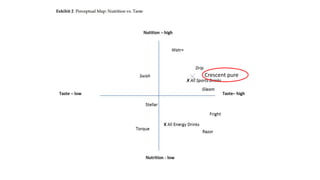
• Low competition in the high nutrition
with high taste positioning for energy
drinks
• In the middle of the “locavore”
movement; The market trend of
organic, all-natural food and beverages
growing rapidly in the United States
• The market for energy drinks expected
to grow to 13.5 billion by 2018
• Both male and female target markets
• Energy drink market captures 34% of
the overall population in the U.S.
• In the energy drink category, Fright, Razor, Torque, and
Stellar accounted for 85% of category revenue
• Gleam and Drip had 73% and 21% market share,
respectively. The remaining 6% of market share ($378
million) was split fairly evenly among roughly 20
producers
• Energy drinks have received negative media
attention.Many are concerned with the health and
safety risks associated with consuming energy drinks
• Younger target segments enjoy drinks containing
unnaturally high energy, more than what Crescent Pure
offers
• Some might question the credibility of the certified
organic label if the drink is priced lower, because most
organic products have a premium price
TARGET MARKET COMPETITION
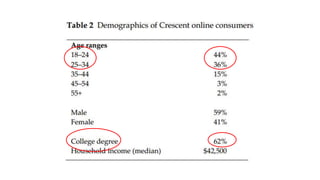
The target market most receptive to the
positioning of an energy drink are those
between the ages of 18-34. The target
market will both males and females that are
health conscious, and active.
While trying to reach their target market,
Portland Drake Beverages should consider
what will be the best way to reach
consumers in the market they are
implementing the soft launch. The company
has limited funds for their advertising
campaign, so their resources must be
allocated wisely.
Though the market is dominated by a
few large competitors, Crescent Pure
has the capability of penetrating the
market with the competitive
advantage of being healthier, more
hydrating, organic, and cheaper than
the competition.
Another competitive disruption
Crescent faces is the consumer
perception that the drink does not
provide enough energy. Crescent will
need to communicate that they
supply the same amount of energy in
a can of their product as a cup of
coffee.
ENERGY DRINK
MARKET
CONSPROS
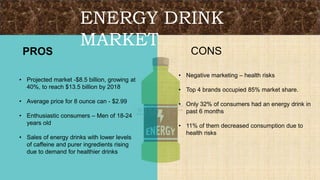
• Projected market -$8.5 billion, growing at
40%, to reach $13.5 billion by 2018
• Average price for 8 ounce can - $2.99
• Enthusiastic consumers – Men of 18-24
years old
• Sales of energy drinks with lower levels
of caffeine and purer ingredients rising
due to demand for healthier drinks
• Negative marketing – health risks
• Top 4 brands occupied 85% market share.
• Only 32% of consumers had an energy drink in
past 6 months
• 11% of them decreased consumption due to
health risks
SPORTS DRINK
MARKETPROS CONS
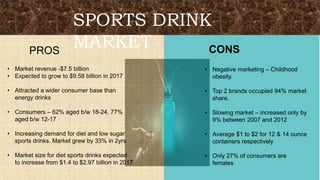
• Market revenue -$7.5 billion
• Expected to grow to $9.58 billion in 2017
• Attracted a wider consumer base than
energy drinks
• Consumers – 62% aged b/w 18-24, 77%
aged b/w 12-17
• Increasing demand for diet and low sugar
sports drinks. Market grew by 33% in 2yrs
• Market size for diet sports drinks expected
to increase from $1.4 to $2.97 billion in 2017
• Negative marketing – Childhood
obesity.
• Top 2 brands occupied 94% market
share.
• Slowing market – increased only by
9% between 2007 and 2012
• Average $1 to $2 for 12 & 14 ounce
containers respectively
• Only 27% of consumers are
females
ORGANIC DRINK
MARKET CONSPROS
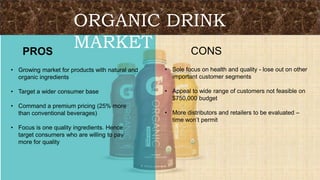
• Growing market for products with natural and
organic ingredients
• Target a wider consumer base
• Command a premium pricing (25% more
than conventional beverages)
• Focus is one quality ingredients. Hence
target consumers who are willing to pay
more for quality
• Sole focus on health and quality - lose out on other
important customer segments
• Appeal to wide range of customers not feasible on
$750,000 budget
• More distributors and retailers to be evaluated –
time won’t permit
12%
6%
5%
22%
9%
7%
9%
4%
11%
52%
34%
16%
11%
28%
8%
22%
11%
6%
49%
27%
0%
10%
20%
30%
40%
50%
60%
Refreshing Healthy Affordable Functional Too Sweet Suitable for teens Fun Natural Hydrating None of these
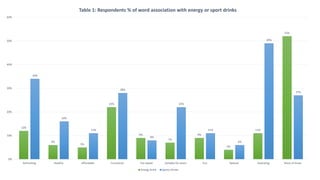
Table 1: Respondents % of word association with energy or sport drinks
Energy Drink Sports Drinks
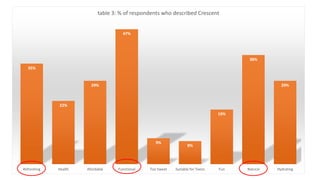
35%
22%
29%
47%
9%
8%
19%
38%
29%
Refreshing Health Afordable Functional Too Sweet Suitable for Teens Fun Natural Hydrating
table 3: % of respondents who described Crescent
Crescent pure
Crescent pure
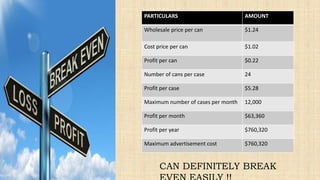
PARTICULARS AMOUNT
Wholesale price per can $1.24
Cost price per can $1.02
Profit per can $0.22
Number of cans per case 24
Profit per case $5.28
Maximum number of cases per month 12,000
Profit per month $63,360
Profit per year $760,320
Maximum advertisement cost $760,320
CAN DEFINITELY BREAK
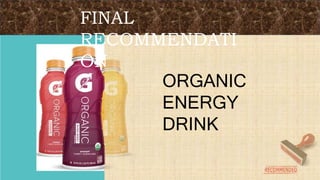
ORGANIC
ENERGY
DRINK
FINAL
RECOMMENDATI
ON
• Consumers viewed “Energy” as Crescent’s most descriptive
character.
• Energy drinks contained artificial sweeteners and excessive
levels of stimulants. Crescent, as an organic energy drink can
be a healthier alternative to these energy drinks
• Energy drink market is booming, growing at 40% and
customers are already looking for healthier alternatives
• Not to forget about braking even and beating the competition.
• Following the “soft” launch of Crescent Pure, assuming the
launch is greatly successful with positive feedback , the brand
will expand.
• If unsuccessful, Crescent Pure will pull back on the organic
positioning and be promoted as an energy drink with less
sugar.
By :
Rachit Garg

Crescent pure

  • 1.
  • 2.
    • Peter Hooperfounded Crescent Pure in 2008 • Crescent Pure is Non alcoholic functional beverage company • All natural organic juice infused with herbal stimulants, delivered 80mg caffeine • It sold out before inventory was replenished, sold out even when retailers hiked prices by 25% • High demand among men as well as women
  • 3.
    Portland drake beverages (pdb) They are manufacturerof organic juices and sparkling water. Their revenues hit $120.5 million in 2012. They are a part of the $131 billion beverage industry. They wanted to expand into the functional beverage (sports and energy) sector through acquisition. Acquired Crescent in July 2013.
  • 4.
    Situation Analysis Large competitorswere planning to launch all natural versions of their beverages. Due to production capacity restraints and to test the positioning before nationalizing. FAST LAUNCH SOFT LAUNCH The CEO of PDB has asked Sarah Ryan, the vice president of marketing to form a suitable market positioning strategy for Crescent within days . She has to choose between Energy drink, Sports Drink or a healthy organic drink positioning
  • 5.
    OBJECTIVES Do a comprehensiveSWOT analysis. Identify the target market Identify the competition Do market research and surveys Analyse and interpret the data Break even analysis Finalise positioning strategy.
  • 6.
  • 7.
    STRENGTH WEAKNESS • Crescent’ssugar content is on average 70% less than leading energy and sports drinks. • The drink contains 80 milligrams of caffeine, equivalent to a cup of coffee • Crescent Pure is a healthier alternative to other leading energy drink brands, whose artificial sweeteners and excessive levels of stimulants are likely to prompt a subset of consumers to switch to healthier options. • Crescent’s low sugar content and all-natural ingredients can appeal to health-conscious consumers seeking healthier “anytime” beverages that are free from artificial ingredients and sweeteners. • Once educated, consumers thought the product was fairly priced. • Confusion between sports drink and energy drink. • Not enough caffeine to appeal to many energy drink. consumers, especially in the younger target segment • Brand awareness is lacking compared to competitors.
  • 8.
    OPPORTUNITIES threats • Lowcompetition in the high hydration with mid to high energy positioning for energy drinks • Low competition in the high nutrition with high taste positioning for energy drinks • In the middle of the “locavore” movement; The market trend of organic, all-natural food and beverages growing rapidly in the United States • The market for energy drinks expected to grow to 13.5 billion by 2018 • Both male and female target markets • Energy drink market captures 34% of the overall population in the U.S. • In the energy drink category, Fright, Razor, Torque, and Stellar accounted for 85% of category revenue • Gleam and Drip had 73% and 21% market share, respectively. The remaining 6% of market share ($378 million) was split fairly evenly among roughly 20 producers • Energy drinks have received negative media attention.Many are concerned with the health and safety risks associated with consuming energy drinks • Younger target segments enjoy drinks containing unnaturally high energy, more than what Crescent Pure offers • Some might question the credibility of the certified organic label if the drink is priced lower, because most organic products have a premium price
  • 9.
    TARGET MARKET COMPETITION Thetarget market most receptive to the positioning of an energy drink are those between the ages of 18-34. The target market will both males and females that are health conscious, and active. While trying to reach their target market, Portland Drake Beverages should consider what will be the best way to reach consumers in the market they are implementing the soft launch. The company has limited funds for their advertising campaign, so their resources must be allocated wisely. Though the market is dominated by a few large competitors, Crescent Pure has the capability of penetrating the market with the competitive advantage of being healthier, more hydrating, organic, and cheaper than the competition. Another competitive disruption Crescent faces is the consumer perception that the drink does not provide enough energy. Crescent will need to communicate that they supply the same amount of energy in a can of their product as a cup of coffee.
  • 10.
    ENERGY DRINK MARKET CONSPROS • Projectedmarket -$8.5 billion, growing at 40%, to reach $13.5 billion by 2018 • Average price for 8 ounce can - $2.99 • Enthusiastic consumers – Men of 18-24 years old • Sales of energy drinks with lower levels of caffeine and purer ingredients rising due to demand for healthier drinks • Negative marketing – health risks • Top 4 brands occupied 85% market share. • Only 32% of consumers had an energy drink in past 6 months • 11% of them decreased consumption due to health risks
  • 11.
    SPORTS DRINK MARKETPROS CONS •Market revenue -$7.5 billion • Expected to grow to $9.58 billion in 2017 • Attracted a wider consumer base than energy drinks • Consumers – 62% aged b/w 18-24, 77% aged b/w 12-17 • Increasing demand for diet and low sugar sports drinks. Market grew by 33% in 2yrs • Market size for diet sports drinks expected to increase from $1.4 to $2.97 billion in 2017 • Negative marketing – Childhood obesity. • Top 2 brands occupied 94% market share. • Slowing market – increased only by 9% between 2007 and 2012 • Average $1 to $2 for 12 & 14 ounce containers respectively • Only 27% of consumers are females
  • 12.
    ORGANIC DRINK MARKET CONSPROS •Growing market for products with natural and organic ingredients • Target a wider consumer base • Command a premium pricing (25% more than conventional beverages) • Focus is one quality ingredients. Hence target consumers who are willing to pay more for quality • Sole focus on health and quality - lose out on other important customer segments • Appeal to wide range of customers not feasible on $750,000 budget • More distributors and retailers to be evaluated – time won’t permit
  • 13.
    12% 6% 5% 22% 9% 7% 9% 4% 11% 52% 34% 16% 11% 28% 8% 22% 11% 6% 49% 27% 0% 10% 20% 30% 40% 50% 60% Refreshing Healthy AffordableFunctional Too Sweet Suitable for teens Fun Natural Hydrating None of these Table 1: Respondents % of word association with energy or sport drinks Energy Drink Sports Drinks
  • 15.
    35% 22% 29% 47% 9% 8% 19% 38% 29% Refreshing Health AfordableFunctional Too Sweet Suitable for Teens Fun Natural Hydrating table 3: % of respondents who described Crescent
  • 16.
  • 17.
  • 18.
    PARTICULARS AMOUNT Wholesale priceper can $1.24 Cost price per can $1.02 Profit per can $0.22 Number of cans per case 24 Profit per case $5.28 Maximum number of cases per month 12,000 Profit per month $63,360 Profit per year $760,320 Maximum advertisement cost $760,320 CAN DEFINITELY BREAK
  • 19.
  • 20.
    • Consumers viewed“Energy” as Crescent’s most descriptive character. • Energy drinks contained artificial sweeteners and excessive levels of stimulants. Crescent, as an organic energy drink can be a healthier alternative to these energy drinks • Energy drink market is booming, growing at 40% and customers are already looking for healthier alternatives • Not to forget about braking even and beating the competition. • Following the “soft” launch of Crescent Pure, assuming the launch is greatly successful with positive feedback , the brand will expand. • If unsuccessful, Crescent Pure will pull back on the organic positioning and be promoted as an energy drink with less sugar.
  • 23.