Conducted by: M’hamed Jamili Supervised by: Prof. Imane Nejjar
June12th, 2017
Creative EFL Teachers and
Students’ Academic
Achievements
A Case Study in Moroccan High Schools
Ecole Normale Supérieure
Université Mohammed V
- Rabat -
III. Results and Discussion
A. The Degree of Creativity of the
Observed Teachers
B. Teachers’ creativity and students’
achievement
C. The Common methods, techniques and
activities used by creative teachers
IV. Conclusion
A. Summary of Findings
B. Conclusions
C. Pedagogical Implications
D. Recommendations
E. Limitations
F. Suggestions for Further Research
Outline
I. Introduction
A. Problem
B. Purpose
C. Research Question(s) and
Hypothesis(es)
D. Rationale
E. Organization of the Study
II. Methodology
A. Data Collection Procedure
B. Data Analysis Procedure
2
I. Introduction
3
Research Problem
 EFL teachers with low level of creativity reduce students’
learning outcomes in Moroccan high schools
4
Research Purpose
 The study attempts to show the extent to which creative EFL
teachers and the instructional methods, techniques and
activities they use impact their students’ learning outcomes.
5
Research Hypothesis
 Teachers’ creativity and the instructional methods, techniques
and activities they use increase their students’ learning
outcomes in the Moroccan high schools.
6
Research Questions
 Do creative EFL teachers impact positively their students’
achievements in the Moroccan high schools?
 What are the techniques, methods and activities deployed by
creative EFL teachers in the Moroccan high schools?
7
Rationale
 The interest on creativity in teaching
 To ascertain whether there are creative teachers in Moroccan
high schools or not.
8
Organization of the study
 Review of the literature related to the topic of the study.
 Methodology (Research design, Sampling, Data collection
instruments, Data analysis tools)
 Data Collection
 Data analysis
 Checking the confirmation of the hypothesis of the research.
9
II. Methodology
Data Collection Procedures
10
Research Design/ Approach
Mixed-method design
(Both qualitative & quantitative approach)
11
Data Collection Instrument /tools
 Observation check-list (26 Items)
 Documents (Students’ grade-reports)
 Questionnaire (Info about the teachers and 5 open-
ended questions)
12
The Population Sampling
Sampling technique:
Convenient Sampling (The available and the appropriate
population for the research)
Population:
Six teachers (over six years of teaching experience)
13
Research Variables
 Independent Variable:
Teacher’s creativity
 Dependent Variable:
Students’ achievements
14
II. Methodology
Data Analysis Procedures
15
Data analysis procedures
DA Tools
 SPSS Statistics
 To compute the general creativity value of each teacher
according to the checklist items
 Microsoft Excel
 To compare the level or degree of creativity of the sampled
teachers
 To compare the level or degree of creativity of each teacher
and their students average grade.
16
Data Analysis Techniques
 Descriptive Analysis:
 To analyze and define the common instructional methods
techniques, and activities deployed by creative EFL teachers in
Moroccan high schools,
17
III. Results & Discussion
18
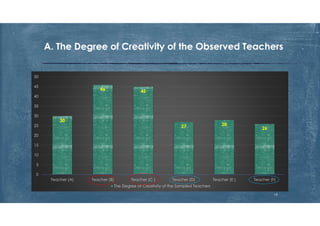
A. The Degree of Creativity of the Observed Teachers
30
46 45
27 28
26
0
5
10
15
20
25
30
35
40
45
50
Teacher (A) Teacher (B) Teacher (C ) Teacher (D) Teacher (E ) Teacher (F)
The Degree of Creativity of the Sampled Teachers
19
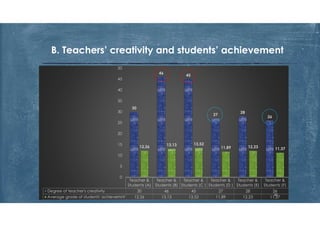
B. Teachers’ creativity and students’ achievement
Teacher &
Students (A)
Teacher &
Students (B)
Teacher &
Students (C )
Teacher &
Students (D )
Teacher &
Students (E)
Teacher &
Students (F)
Degree of teacher's creativity 30 46 45 27 28 26
Average grade of students' achievemnt 12,26 13,13 13,52 11,89 12,23 11,37
30
46
45
27
28
26
12,26 13,13 13,52
11,89 12,23 11,37
0
5
10
15
20
25
30
35
40
45
50
20
C. The Common methods, techniques and activities
used by creative teachers
Focus on T(b) and T(c)
Methods: (Ts’ answers to the open-ended questions)
 Eclectic choice of methods
 Inductive teaching
 Teaching in communicative situations (CA)
21
 Establishing close rapport.
 Providing challenging topics and complex learning situations.
 Using Face-to-face interaction and communication.
 Asking open-ended questions that require high order thinking skills.
 Inviting students to think and express their opinions communicatively,
 Reformulating instructions in different ways.
 Asking open-ended questions.
Techniques: (observation and questionnaire)
22
 Associating the current topics to students’ real-life experiences.
 Using diverse teaching materials that keep students actively involved in the
learning process.
 Using face-to-face interaction and communication as means of developing
students’ proficiency.
 Posing questions that require high order thinking skills.
 Using real life examples to make students understand.
 Enhancing students’ self-confidence.
 Using different cooperative working structures.
23
 Individual activities.
 Collective activities.
 Short dialogues acting.
 Singing 2 minutes’ songs.
 Project-work activities.
 Research-based activities.
 Competency-based activities.
 Grammar/Vocabulary-focused activities.
 Communicative activities.
Activities
24
 Interviewing activities
 Activities that arouse students’ curiosity to learn more about new
things.
 Activities that demands high order thinking skills.
 Writing something on the board and then explaining it.
 Forum discussions
 Skype sessions
25
IV. Conclusion
26
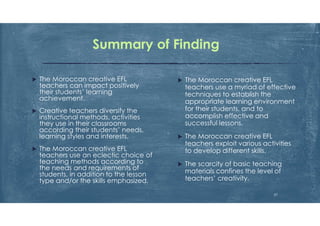
Summary of Finding
 The Moroccan creative EFL
teachers use a myriad of effective
techniques to establish the
appropriate learning environment
for their students, and to
accomplish effective and
successful lessons.
 The Moroccan creative EFL
teachers exploit various activities
to develop different skills.
 The scarcity of basic teaching
materials confines the level of
teachers’ creativity.
 The Moroccan creative EFL
teachers can impact positively
their students’ learning
achievement.
 Creative teachers diversify the
instructional methods, activities
they use in their classrooms
according their students’ needs,
learning styles and interests.
 The Moroccan creative EFL
teachers use an eclectic choice of
teaching methods according to
the needs and requirements of
students, in addition to the lesson
type and/or the skills emphasized.
27
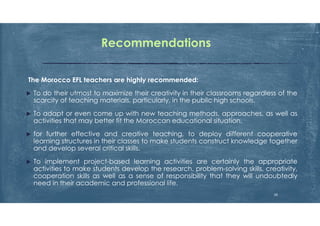
Recommendations
The Morocco EFL teachers are highly recommended:
 To do their utmost to maximize their creativity in their classrooms regardless of the
scarcity of teaching materials, particularly, in the public high schools.
 To adapt or even come up with new teaching methods, approaches, as well as
activities that may better fit the Moroccan educational situation.
 for further effective and creative teaching, to deploy different cooperative
learning structures in their classes to make students construct knowledge together
and develop several critical skills.
 To implement project-based learning activities are certainly the appropriate
activities to make students develop the research, problem-solving skills, creativity,
cooperation skills as well as a sense of responsibility that they will undoubtedly
need in their academic and professional life.
28
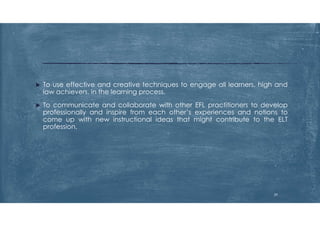
 To use effective and creative techniques to engage all learners, high and
low achievers, in the learning process.
 To communicate and collaborate with other EFL practitioners to develop
professionally and inspire from each other’s experiences and notions to
come up with new instructional ideas that might contribute to the ELT
profession.
29
Pedagogical Implications
 This study can help ELT practitioners in Morocco to identify their
instructional weaknesses and enhance their creativity as well as the
apropos way to choose and deploy the instructional methods,
techniques, and activities for effective and creative teaching.
 The results of this research will be useful to ELT trainers, professors who
want to help trainees or students to achieve an acceptable level of
creativity in their future teaching.
30
Limitations
 With respect to data collection, field hardships have been
encountered due to the inability to find sufficient teachers.
 Get the agreement from the administration of the schools to observe
EFL teachers in their classrooms.
 Some teacher’s unacceptance to provide their students’ grade
reports as an instrument to answer the research questions. This
justifies the small number of teachers used in this research.
31
Suggestions for Further Research
In the light of the previous findings and the research limitations encountered in
this research, it is suggested to the ELT practitioners, trainees and students to
conduct further research on the following areas:
 A large-scale study is suggested to cover different levels (primary, secondary
and higher education) to investigate the impact of creative instructors on
their students’ achievement.
 How can creative teachers trigger their students’ creativity?
 The factors that confine teachers’ creativity into the adaptation of the
teaching materials available for them.
32
Thank you
M’hamed Jamili
mhamedjamili@gmail.com
Phone: +212617400289
33

Creative EFL Teachers & Students' Academic Achievements

  • 1.
    Conducted by: M’hamedJamili Supervised by: Prof. Imane Nejjar June12th, 2017 Creative EFL Teachers and Students’ Academic Achievements A Case Study in Moroccan High Schools Ecole Normale Supérieure Université Mohammed V - Rabat -
  • 2.
    III. Results andDiscussion A. The Degree of Creativity of the Observed Teachers B. Teachers’ creativity and students’ achievement C. The Common methods, techniques and activities used by creative teachers IV. Conclusion A. Summary of Findings B. Conclusions C. Pedagogical Implications D. Recommendations E. Limitations F. Suggestions for Further Research Outline I. Introduction A. Problem B. Purpose C. Research Question(s) and Hypothesis(es) D. Rationale E. Organization of the Study II. Methodology A. Data Collection Procedure B. Data Analysis Procedure 2
  • 3.
  • 4.
    Research Problem  EFLteachers with low level of creativity reduce students’ learning outcomes in Moroccan high schools 4
  • 5.
    Research Purpose  Thestudy attempts to show the extent to which creative EFL teachers and the instructional methods, techniques and activities they use impact their students’ learning outcomes. 5
  • 6.
    Research Hypothesis  Teachers’creativity and the instructional methods, techniques and activities they use increase their students’ learning outcomes in the Moroccan high schools. 6
  • 7.
    Research Questions  Docreative EFL teachers impact positively their students’ achievements in the Moroccan high schools?  What are the techniques, methods and activities deployed by creative EFL teachers in the Moroccan high schools? 7
  • 8.
    Rationale  The intereston creativity in teaching  To ascertain whether there are creative teachers in Moroccan high schools or not. 8
  • 9.
    Organization of thestudy  Review of the literature related to the topic of the study.  Methodology (Research design, Sampling, Data collection instruments, Data analysis tools)  Data Collection  Data analysis  Checking the confirmation of the hypothesis of the research. 9
  • 10.
  • 11.
    Research Design/ Approach Mixed-methoddesign (Both qualitative & quantitative approach) 11
  • 12.
    Data Collection Instrument/tools  Observation check-list (26 Items)  Documents (Students’ grade-reports)  Questionnaire (Info about the teachers and 5 open- ended questions) 12
  • 13.
    The Population Sampling Samplingtechnique: Convenient Sampling (The available and the appropriate population for the research) Population: Six teachers (over six years of teaching experience) 13
  • 14.
    Research Variables  IndependentVariable: Teacher’s creativity  Dependent Variable: Students’ achievements 14
  • 15.
  • 16.
    Data analysis procedures DATools  SPSS Statistics  To compute the general creativity value of each teacher according to the checklist items  Microsoft Excel  To compare the level or degree of creativity of the sampled teachers  To compare the level or degree of creativity of each teacher and their students average grade. 16
  • 17.
    Data Analysis Techniques Descriptive Analysis:  To analyze and define the common instructional methods techniques, and activities deployed by creative EFL teachers in Moroccan high schools, 17
  • 18.
    III. Results &Discussion 18
  • 19.
    A. The Degreeof Creativity of the Observed Teachers 30 46 45 27 28 26 0 5 10 15 20 25 30 35 40 45 50 Teacher (A) Teacher (B) Teacher (C ) Teacher (D) Teacher (E ) Teacher (F) The Degree of Creativity of the Sampled Teachers 19
  • 20.
    B. Teachers’ creativityand students’ achievement Teacher & Students (A) Teacher & Students (B) Teacher & Students (C ) Teacher & Students (D ) Teacher & Students (E) Teacher & Students (F) Degree of teacher's creativity 30 46 45 27 28 26 Average grade of students' achievemnt 12,26 13,13 13,52 11,89 12,23 11,37 30 46 45 27 28 26 12,26 13,13 13,52 11,89 12,23 11,37 0 5 10 15 20 25 30 35 40 45 50 20
  • 21.
    C. The Commonmethods, techniques and activities used by creative teachers Focus on T(b) and T(c) Methods: (Ts’ answers to the open-ended questions)  Eclectic choice of methods  Inductive teaching  Teaching in communicative situations (CA) 21
  • 22.
     Establishing closerapport.  Providing challenging topics and complex learning situations.  Using Face-to-face interaction and communication.  Asking open-ended questions that require high order thinking skills.  Inviting students to think and express their opinions communicatively,  Reformulating instructions in different ways.  Asking open-ended questions. Techniques: (observation and questionnaire) 22
  • 23.
     Associating thecurrent topics to students’ real-life experiences.  Using diverse teaching materials that keep students actively involved in the learning process.  Using face-to-face interaction and communication as means of developing students’ proficiency.  Posing questions that require high order thinking skills.  Using real life examples to make students understand.  Enhancing students’ self-confidence.  Using different cooperative working structures. 23
  • 24.
     Individual activities. Collective activities.  Short dialogues acting.  Singing 2 minutes’ songs.  Project-work activities.  Research-based activities.  Competency-based activities.  Grammar/Vocabulary-focused activities.  Communicative activities. Activities 24
  • 25.
     Interviewing activities Activities that arouse students’ curiosity to learn more about new things.  Activities that demands high order thinking skills.  Writing something on the board and then explaining it.  Forum discussions  Skype sessions 25
  • 26.
  • 27.
    Summary of Finding The Moroccan creative EFL teachers use a myriad of effective techniques to establish the appropriate learning environment for their students, and to accomplish effective and successful lessons.  The Moroccan creative EFL teachers exploit various activities to develop different skills.  The scarcity of basic teaching materials confines the level of teachers’ creativity.  The Moroccan creative EFL teachers can impact positively their students’ learning achievement.  Creative teachers diversify the instructional methods, activities they use in their classrooms according their students’ needs, learning styles and interests.  The Moroccan creative EFL teachers use an eclectic choice of teaching methods according to the needs and requirements of students, in addition to the lesson type and/or the skills emphasized. 27
  • 28.
    Recommendations The Morocco EFLteachers are highly recommended:  To do their utmost to maximize their creativity in their classrooms regardless of the scarcity of teaching materials, particularly, in the public high schools.  To adapt or even come up with new teaching methods, approaches, as well as activities that may better fit the Moroccan educational situation.  for further effective and creative teaching, to deploy different cooperative learning structures in their classes to make students construct knowledge together and develop several critical skills.  To implement project-based learning activities are certainly the appropriate activities to make students develop the research, problem-solving skills, creativity, cooperation skills as well as a sense of responsibility that they will undoubtedly need in their academic and professional life. 28
  • 29.
     To useeffective and creative techniques to engage all learners, high and low achievers, in the learning process.  To communicate and collaborate with other EFL practitioners to develop professionally and inspire from each other’s experiences and notions to come up with new instructional ideas that might contribute to the ELT profession. 29
  • 30.
    Pedagogical Implications  Thisstudy can help ELT practitioners in Morocco to identify their instructional weaknesses and enhance their creativity as well as the apropos way to choose and deploy the instructional methods, techniques, and activities for effective and creative teaching.  The results of this research will be useful to ELT trainers, professors who want to help trainees or students to achieve an acceptable level of creativity in their future teaching. 30
  • 31.
    Limitations  With respectto data collection, field hardships have been encountered due to the inability to find sufficient teachers.  Get the agreement from the administration of the schools to observe EFL teachers in their classrooms.  Some teacher’s unacceptance to provide their students’ grade reports as an instrument to answer the research questions. This justifies the small number of teachers used in this research. 31
  • 32.
    Suggestions for FurtherResearch In the light of the previous findings and the research limitations encountered in this research, it is suggested to the ELT practitioners, trainees and students to conduct further research on the following areas:  A large-scale study is suggested to cover different levels (primary, secondary and higher education) to investigate the impact of creative instructors on their students’ achievement.  How can creative teachers trigger their students’ creativity?  The factors that confine teachers’ creativity into the adaptation of the teaching materials available for them. 32
  • 33.