Robert Wood Johnson Foundation
Local Funding Partnerships
New Grantee Seminar – “Creating your Theory of Change”
RWJF –LFP Deputy Director - Leticia Peguero, MPA
October 13th
2010
1
Introductions
To know how well you’re
doing….you must have some
place you’re trying to get to….
If you don’t know where you’re
going….you’ll end up
somewhere else
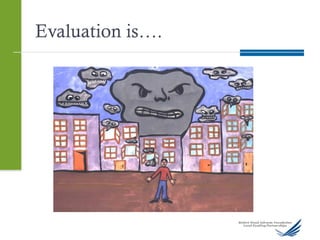
Evaluation is….
Evaluation is….
 Program evaluation is the use of social research
methods to systematically investigate the effectiveness
of social intervention programs. It draws on the
techniques and concepts of social science disciplines
and is intended to be useful for improving programs
and informing social action aimed at ameliorating
social programs (Rossi, Lipsey, and Freeman, 2004)
Evaluation is….
 Program evaluation is the systematic collection
of information about the activities,
characteristics, and outcomes of programs to
make judgments about the program, improve
program effectiveness, and/or inform decisions
about future programming. (Patton, 1997)
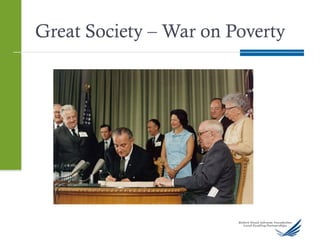
Great Society – War on Poverty
Great Society Programs – War
on Poverty
Era of Accountability….
 What gets measured gets done…
 If you don’t measure – How do you know that it
worked..if it was a success?
 If you can’t see success…you might be
rewarding failure
Era of Accountability….
 If you can’t see success you can’t learn from it
 If you cannot recognize failure, you can’t
correct it.
 If you can demonstrate results you can win
public and funder support….
Politics…
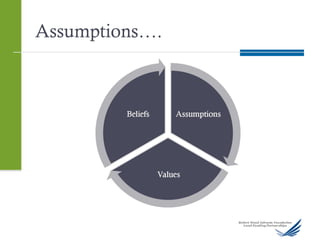
Assumptions….
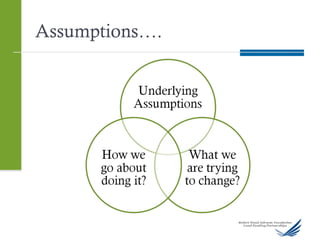
Assumptions….
Assumptions…
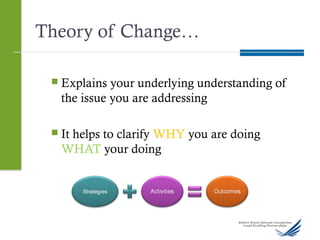
Theory of Change…
 Explains your underlying understanding of
the issue you are addressing
 It helps to clarify WHY you are doing
WHAT your doing
Theory of Change….
Meaningful
Plausible
Doable
Testable
Meaningful…
 Describes the program/project/organization
accurately in ways that the internal staff
acknowledges and of which it feels proud.
 Designed to accomplish something of value
 Has social meaning – recognizable to interested
parties and stakeholders
Plausible…
 If followed, the courses of action
(program services and activities) are likely
to achieve the desired outcome objectives.
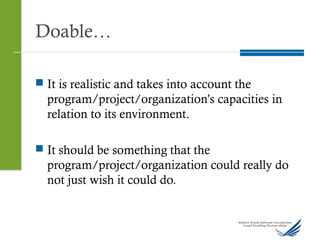
Doable…
 It is realistic and takes into account the
program/project/organization’s capacities in
relation to its environment.
 It should be something that the
program/project/organization could really do
not just wish it could do.
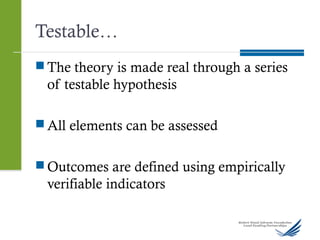
Testable…
 The theory is made real through a series
of testable hypothesis
 All elements can be assessed
 Outcomes are defined using empirically
verifiable indicators
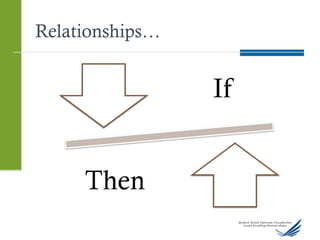
Relationships…
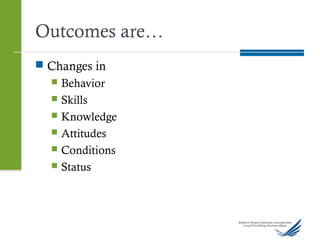
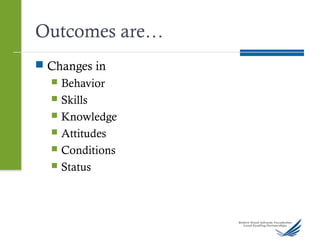
Outcomes are…
 Changes in
 Behavior
 Skills
 Knowledge
 Attitudes
 Conditions
 Status
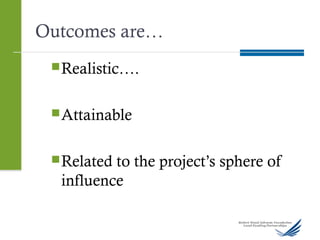
Outcomes are…
Realistic….
Attainable
Related to the project’s sphere of
influence
Outcomes are…
What your program is accountable
for….
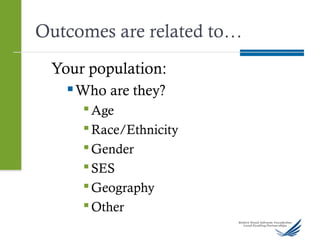
Outcomes are related to…
Your population:
 Who are they?
Age
Race/Ethnicity
Gender
SES
Geography
Other
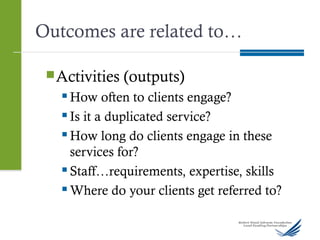
Outcomes are related to…
Activities (outputs)
 How often to clients engage?
 Is it a duplicated service?
 How long do clients engage in these
services for?
 Staff…requirements, expertise, skills
 Where do your clients get referred to?
Outcomes are…
 Changes in
 Behavior
 Skills
 Knowledge
 Attitudes
 Conditions
 Status
Outcomes are…
Realistic….
Attainable
Related to the project’s sphere of
influence
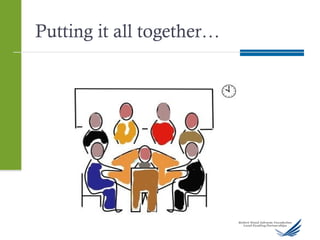
Putting it all together…
Thank you
31

Creating Your Theory of Change