~ rewarding good ~
How to Create Tests
That Fail
by Pete Oliver-Krueger
@petekrueger | @MillionMunkeys
~ rewarding good ~
“Any Test is Better Than No Test”
~ rewarding good ~
“Any Test is Better Than No Test”
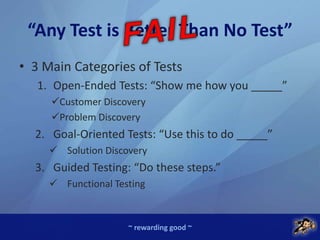
• 3 Main Categories of Tests
1. Open-Ended Tests: “Show me how you _____”
Customer Discovery
Problem Discovery
2. Goal-Oriented Tests: “Use this to do _____”
 Solution Discovery
3. Guided Testing: “Do these steps.”
 Functional Testing
~ rewarding good ~
“Would You Use This?”
~ rewarding good ~
“Would You Use This?”
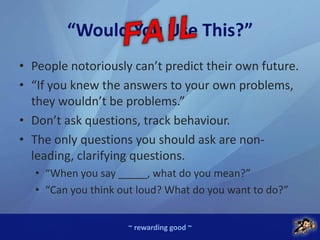
• People notoriously can’t predict their own future.
• “If you knew the answers to your own problems,
they wouldn’t be problems.”
• Don’t ask questions, track behaviour.
• The only questions you should ask are non-
leading, clarifying questions.
• “When you say _____, what do you mean?”
• “Can you think out loud? What do you want to do?”
~ rewarding good ~
“I’ll Get Mom/Spouse/Joe to Test It”
~ rewarding good ~
“I’ll Get Mom/Spouse/Joe to Test It”
• Testing the wrong demographic is worse than not
testing at all ==> False Metrics ==> False Confidence
 Are they the decision makers?
 Is it worth something (of value) to them?
• Don’t know your demographic? ==> First Test!
 Who has the problem you’re solving?
 Who is willing to pay for it?
~ rewarding good ~
“Stay On Topic”
~ rewarding good ~
“Stay On Topic”
• Your gold branches off your initial tunnel.
• Active neurons excite the other neurons that
they connect to the most often.
• If someone goes on a tangent, explore the
connection.
~ rewarding good ~
“No. Wait. Do it This Way.”
~ rewarding good ~
“No. Wait. Do it This Way.”
• The single most-important statement you can say to ensure
the success of your usability tests: "This is a test of US.
This is not a test of YOU. YOU are grading US on how well
WE understand and meet YOUR needs.”
• People love to give advice; People love to judge; People
don't like to be judged.
• If you judge anything they say, they will clam up and filter
everything they say from that point forward.
• This is literally the most important thing to learn to run a
great test: Treat them like royalty, and hang on their every
word with fascination.
~ rewarding good ~
“I Already Ran a Test”
~ rewarding good ~
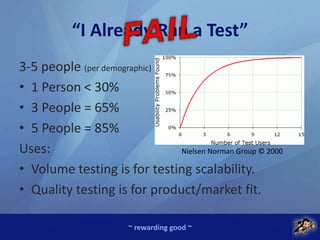
“I Already Ran a Test”
3-5 people (per demographic)
• 1 Person < 30%
• 3 People = 65%
• 5 People = 85%
Uses:
• Volume testing is for testing scalability.
• Quality testing is for product/market fit.
Nielsen Norman Group © 2000
~ rewarding good ~
“I’m Testing My Product”
~ rewarding good ~
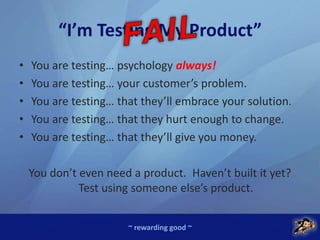
“I’m Testing My Product”
• You are testing… psychology always!
• You are testing… your customer’s problem.
• You are testing… that they’ll embrace your solution.
• You are testing… that they hurt enough to change.
• You are testing… that they’ll give you money.
You don’t even need a product. Haven’t built it yet?
Test using someone else’s product.
~ rewarding good ~
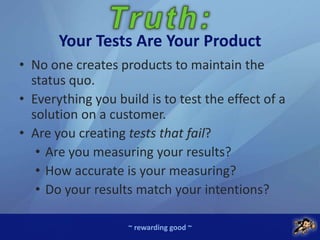
Your Tests Are Your Product
• No one creates products to maintain the
status quo.
• Everything you build is to test the effect of a
solution on a customer.
• Are you creating tests that fail?
• Are you measuring your results?
• How accurate is your measuring?
• Do your results match your intentions?
~ rewarding good ~
Further Information
Want to practice designing metrics?
facebook.com/groups/LeanPolitics
We’re applying Lean Startup & Metrics to
political issues, to help cut through the hype.
For advice, questions, or help in designing good
tests, email me: pete@munkeys.com

Creating Tests That Fail

  • 1.
    ~ rewarding good~ How to Create Tests That Fail by Pete Oliver-Krueger @petekrueger | @MillionMunkeys
  • 2.
    ~ rewarding good~ “Any Test is Better Than No Test”
  • 3.
    ~ rewarding good~ “Any Test is Better Than No Test” • 3 Main Categories of Tests 1. Open-Ended Tests: “Show me how you _____” Customer Discovery Problem Discovery 2. Goal-Oriented Tests: “Use this to do _____”  Solution Discovery 3. Guided Testing: “Do these steps.”  Functional Testing
  • 4.
    ~ rewarding good~ “Would You Use This?”
  • 5.
    ~ rewarding good~ “Would You Use This?” • People notoriously can’t predict their own future. • “If you knew the answers to your own problems, they wouldn’t be problems.” • Don’t ask questions, track behaviour. • The only questions you should ask are non- leading, clarifying questions. • “When you say _____, what do you mean?” • “Can you think out loud? What do you want to do?”
  • 6.
    ~ rewarding good~ “I’ll Get Mom/Spouse/Joe to Test It”
  • 7.
    ~ rewarding good~ “I’ll Get Mom/Spouse/Joe to Test It” • Testing the wrong demographic is worse than not testing at all ==> False Metrics ==> False Confidence  Are they the decision makers?  Is it worth something (of value) to them? • Don’t know your demographic? ==> First Test!  Who has the problem you’re solving?  Who is willing to pay for it?
  • 8.
    ~ rewarding good~ “Stay On Topic”
  • 9.
    ~ rewarding good~ “Stay On Topic” • Your gold branches off your initial tunnel. • Active neurons excite the other neurons that they connect to the most often. • If someone goes on a tangent, explore the connection.
  • 10.
    ~ rewarding good~ “No. Wait. Do it This Way.”
  • 11.
    ~ rewarding good~ “No. Wait. Do it This Way.” • The single most-important statement you can say to ensure the success of your usability tests: "This is a test of US. This is not a test of YOU. YOU are grading US on how well WE understand and meet YOUR needs.” • People love to give advice; People love to judge; People don't like to be judged. • If you judge anything they say, they will clam up and filter everything they say from that point forward. • This is literally the most important thing to learn to run a great test: Treat them like royalty, and hang on their every word with fascination.
  • 12.
    ~ rewarding good~ “I Already Ran a Test”
  • 13.
    ~ rewarding good~ “I Already Ran a Test” 3-5 people (per demographic) • 1 Person < 30% • 3 People = 65% • 5 People = 85% Uses: • Volume testing is for testing scalability. • Quality testing is for product/market fit. Nielsen Norman Group © 2000
  • 14.
    ~ rewarding good~ “I’m Testing My Product”
  • 15.
    ~ rewarding good~ “I’m Testing My Product” • You are testing… psychology always! • You are testing… your customer’s problem. • You are testing… that they’ll embrace your solution. • You are testing… that they hurt enough to change. • You are testing… that they’ll give you money. You don’t even need a product. Haven’t built it yet? Test using someone else’s product.
  • 16.
    ~ rewarding good~ Your Tests Are Your Product • No one creates products to maintain the status quo. • Everything you build is to test the effect of a solution on a customer. • Are you creating tests that fail? • Are you measuring your results? • How accurate is your measuring? • Do your results match your intentions?
  • 17.
    ~ rewarding good~ Further Information Want to practice designing metrics? facebook.com/groups/LeanPolitics We’re applying Lean Startup & Metrics to political issues, to help cut through the hype. For advice, questions, or help in designing good tests, email me: pete@munkeys.com