How to Create Business
Critical Benchmarks and
Reporting to Track Progress
Digital Media Strategy
• Digital Media has a variety of purposes and
can be used to enable all varieties of
companies achieve their goals
• It’s important to have a digital strategy, which
aligns with the overall business strategy and
objectives
- Narrows down digital options to those best
tailored to your specific goals
- Informs KPI measurement strategy
Questions on Strategy
• What are your company’s goals?
• How have you aligned your marketing goals
to meet business objectives?
• How can social media help meet any
marketing goals?
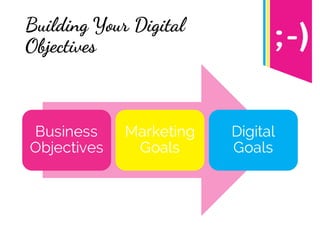
Building Your Digital
Objectives
Business
Objectives
Marketing
Goals
Digital
Goals
Building Your Digital
Objectives
• Let’s put this concept into practice.
• Maybe one of your company’s objectives is to
increase market share by 5%
• Marketing has identified that while most of the
market is saturated, the 18-34 year old audience is
relatively untapped. This could be a key growth area
for the company and has aligned a specific
marketing budget to this audience.
• Now let’s look at how to set digital goals and
benchmarks for this marketing objective
Measurement & KPIs
Creating Meaning out of Metrics
• Digital Marketing is full of metrics and
measurements for almost anything you can think
of
• While measurement is a key strength of the
media, interpreting the metrics in a strategic way
is what creates value
• Interpretations are always changeable and are
hinged on small experiments to create
incremental change:
- Hypothesis Testing
- A/B Testing
Creating Meaning out of Metrics
• The question of what to measure is of both strategic and
practical importance
• What you measure is what you pay attention to and will affect
priorities
- Measurement must, therefore, be linked to strategy
- It must be linked to creating business and customer value
• What KPIs you choose, guides what “levers” need to be pulled
in the background. Measurement guides:
- Your understandingon how other measurements impact your KPIs
- Your understandingof how to optimize campaigns
- Testing priorities based on your understandingof measurement
relationships and your overall objectives
Back to Our Example
• So, we want to increase market share in a
specific age category, how can we measure
progress online?
• Some example metrics can include:
- Increasing visibility for this age group
- Increasing engagement with the group
- Increasing online conversions from the group
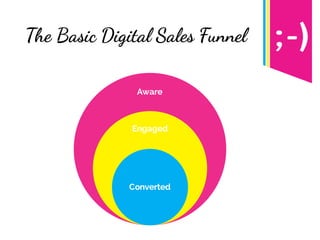
The Basic Digital Sales Funnel
Aware
Engaged
Converted
Picking Your Metrics
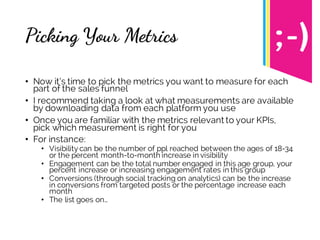
• Now it’s time to pick the metrics you want to measure for each
part of the sales funnel
• I recommend taking a look at what measurements are available
by downloading data from each platform you use
• Once you are familiar with the metrics relevant to your KPIs,
pick which measurement is right for you
• For instance:
• Visibility can be the number of ppl reached between the ages of 18-34
or the percent month-to-month increase in visibility
• Engagement can be the total number engaged in this age group, your
percent increase or increasing engagement rates in this group
• Conversions (through social tracking on analytics) can be the increase
in conversions from targeted posts or the percentage increase each
month
• The list goes on…
Creating Simple Reports
Highlight KPI and
Lever Metrics
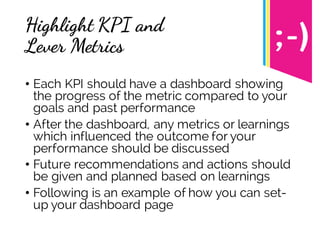
• Each KPI should have a dashboard showing
the progress of the metric compared to your
goals and past performance
• After the dashboard, any metrics or learnings
which influenced the outcome for your
performance should be discussed
• Future recommendations and actions should
be given and planned based on learnings
• Following is an example of how you can set-
up your dashboard page
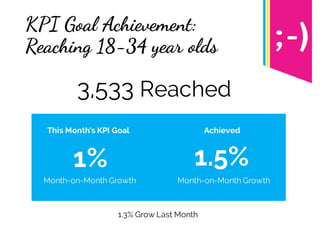
KPI Goal Achievement:
Reaching 18-34 year olds
This Month’s KPI Goal Achieved
1% 1.5%
Month-on-Month Growth Month-on-Month Growth
3,533 Reached
1.3% Grow Last Month
Key Takeaways
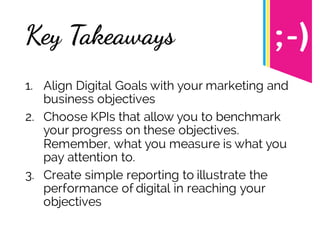
1. Align Digital Goals with your marketing and
business objectives
2. Choose KPIs that allow you to benchmark
your progress on these objectives.
Remember, what you measure is what you
pay attention to.
3. Create simple reporting to illustrate the
performance of digital in reaching your
objectives

Creating Digital Benchmarks and Reporting Progress

  • 1.
    How to CreateBusiness Critical Benchmarks and Reporting to Track Progress
  • 2.
    Digital Media Strategy •Digital Media has a variety of purposes and can be used to enable all varieties of companies achieve their goals • It’s important to have a digital strategy, which aligns with the overall business strategy and objectives - Narrows down digital options to those best tailored to your specific goals - Informs KPI measurement strategy
  • 3.
    Questions on Strategy •What are your company’s goals? • How have you aligned your marketing goals to meet business objectives? • How can social media help meet any marketing goals?
  • 4.
  • 5.
    Building Your Digital Objectives •Let’s put this concept into practice. • Maybe one of your company’s objectives is to increase market share by 5% • Marketing has identified that while most of the market is saturated, the 18-34 year old audience is relatively untapped. This could be a key growth area for the company and has aligned a specific marketing budget to this audience. • Now let’s look at how to set digital goals and benchmarks for this marketing objective
  • 6.
  • 7.
    Creating Meaning outof Metrics • Digital Marketing is full of metrics and measurements for almost anything you can think of • While measurement is a key strength of the media, interpreting the metrics in a strategic way is what creates value • Interpretations are always changeable and are hinged on small experiments to create incremental change: - Hypothesis Testing - A/B Testing
  • 8.
    Creating Meaning outof Metrics • The question of what to measure is of both strategic and practical importance • What you measure is what you pay attention to and will affect priorities - Measurement must, therefore, be linked to strategy - It must be linked to creating business and customer value • What KPIs you choose, guides what “levers” need to be pulled in the background. Measurement guides: - Your understandingon how other measurements impact your KPIs - Your understandingof how to optimize campaigns - Testing priorities based on your understandingof measurement relationships and your overall objectives
  • 9.
    Back to OurExample • So, we want to increase market share in a specific age category, how can we measure progress online? • Some example metrics can include: - Increasing visibility for this age group - Increasing engagement with the group - Increasing online conversions from the group
  • 10.
    The Basic DigitalSales Funnel Aware Engaged Converted
  • 11.
    Picking Your Metrics •Now it’s time to pick the metrics you want to measure for each part of the sales funnel • I recommend taking a look at what measurements are available by downloading data from each platform you use • Once you are familiar with the metrics relevant to your KPIs, pick which measurement is right for you • For instance: • Visibility can be the number of ppl reached between the ages of 18-34 or the percent month-to-month increase in visibility • Engagement can be the total number engaged in this age group, your percent increase or increasing engagement rates in this group • Conversions (through social tracking on analytics) can be the increase in conversions from targeted posts or the percentage increase each month • The list goes on…
  • 12.
  • 13.
    Highlight KPI and LeverMetrics • Each KPI should have a dashboard showing the progress of the metric compared to your goals and past performance • After the dashboard, any metrics or learnings which influenced the outcome for your performance should be discussed • Future recommendations and actions should be given and planned based on learnings • Following is an example of how you can set- up your dashboard page
  • 14.
    KPI Goal Achievement: Reaching18-34 year olds This Month’s KPI Goal Achieved 1% 1.5% Month-on-Month Growth Month-on-Month Growth 3,533 Reached 1.3% Grow Last Month
  • 15.
    Key Takeaways 1. AlignDigital Goals with your marketing and business objectives 2. Choose KPIs that allow you to benchmark your progress on these objectives. Remember, what you measure is what you pay attention to. 3. Create simple reporting to illustrate the performance of digital in reaching your objectives